Recognition: 2 theorem links
· Lean TheoremShaping Maximally Localized Wannier Functions via Discrete Adiabatic Transport
Pith reviewed 2026-05-15 02:03 UTC · model grok-4.3
The pith
Maximally localized Wannier functions can be constructed deterministically by following discrete adiabatic transport across band degeneracies instead of minimizing a spread functional.
A machine-rendered reading of the paper's core claim, the machinery that carries it, and where it could break.
Core claim
Discrete adiabatic transport across band degeneracies emerges naturally as part of the position-eigenvector solution, producing a gauge in which Bloch overlaps exhibit approximately linear phase dependence. Wannier centers are therefore extracted via deterministic fixed-point iterations rather than spread-functional minimization, with benchmark spreads and shapes agreeing with standard schemes while the O(L) scaling in graphene is shown to be an intrinsic geometric feature of non-commuting projected position operators.
What carries the argument
The transport-aligned gauge arising from discrete adiabatic transport across band degeneracies, which linearizes Bloch-overlap phase dependence and unifies gauge smoothing with the projected position operator eigenvalue problem.
If this is right
- Wannier centers are obtained through deterministic fixed-point iterations without high-dimensional spread minimization.
- The geometric origin of O(L) mesh-dependent spread scaling is isolated for graphene and similar systems.
- Benchmark calculations confirm agreement in spreads and orbital shapes for one- and two-dimensional lattices.
- Self-consistent updates become available once the transport-aligned gauge is established.
Where Pith is reading between the lines
- The same transport construction may extend to localized bases defined by operators other than position.
- Linear phase dependence could simplify Wannier-function calculations in topological or higher-dimensional materials where degeneracies are dense.
- Time-dependent or driven systems might adopt the adiabatic-transport step to maintain localization during evolution.
Load-bearing premise
Discrete adiabatic transport across band degeneracies naturally produces approximately linear phase dependence in the Bloch overlaps for general systems without post-hoc adjustments.
What would settle it
Fixed-point iterations on a system with multiple band degeneracies that converge to spreads substantially larger than those obtained by standard spread minimization would falsify the equivalence.
Figures



read the original abstract
Maximally localized Wannier functions (MLWFs) are conventionally constructed by iteratively minimizing a spread functional over a high-dimensional gauge landscape. In this work, we present a non-variational constructive algorithm that unifies gauge smoothing and the eigenvalue problem of the projected position operator into a single deterministic framework. We demonstrate that discrete adiabatic transport across band degeneracies emerges naturally as an integral part of the solution procedure for the position eigenvectors. In this transport-aligned gauge, the Bloch overlaps exhibit an approximately linear phase dependence, allowing the Wannier centers to be extracted via deterministic fixed-point iterations and self-consistent updates rather than spread-functional minimization. Benchmark calculations for one- and two-dimensional systems yield spreads and orbital shapes in good agreement with standard minimization schemes. Furthermore, this analytical approach transparently isolates the physical origin of the $\mathcal{O}(L)$ mesh-dependent spread scaling ($L$ being the boundary seam resolution) observed in graphene, demonstrating that it is an intrinsic geometric manifestation of non-commuting projected position operators forcing finite gauge defects to accumulate along a one-dimensional boundary seam.
Editorial analysis
A structured set of objections, weighed in public.
Referee Report
Summary. The manuscript introduces a non-variational algorithm for constructing maximally localized Wannier functions that unifies gauge smoothing with the eigenvalue problem of the projected position operator through discrete adiabatic transport. It claims that this procedure naturally produces a transport-aligned gauge in which Bloch overlaps exhibit approximately linear phase dependence, enabling deterministic fixed-point iterations and self-consistent updates to extract Wannier centers instead of minimizing a spread functional. Benchmarks on 1D and 2D systems are reported to yield spreads and orbital shapes in agreement with standard methods, while the O(L) mesh-dependent spread scaling in graphene is attributed to geometric accumulation of gauge defects along a one-dimensional boundary seam arising from non-commuting projected position operators.
Significance. If the linearity of the phase dependence can be established with error bounds and the fixed-point iteration shown to be contractive, the approach would supply a deterministic, non-iterative route to MLWFs that avoids high-dimensional optimization landscapes and offers transparent insight into scaling artifacts. The unification of adiabatic transport with the position-operator problem is conceptually attractive and could improve reproducibility in electronic-structure calculations.
major comments (2)
- [Abstract] Abstract: the central claim that Bloch overlaps exhibit 'approximately linear phase dependence' in the transport-aligned gauge, permitting replacement of spread minimization by fixed-point iterations, is stated without an explicit derivation, error bound on the linearity approximation, or proof that the iteration map remains contractive when phase deviations occur (e.g., near degeneracies or in higher dimensions). This assumption is load-bearing for the non-variational character of the algorithm.
- [Abstract] Abstract: benchmark agreement for 1D/2D systems is asserted, yet no explicit equations for the fixed-point map, quantitative error metrics, data tables, or convergence criteria are supplied, making it impossible to verify that the reported spreads match standard minimization results to within controlled tolerances.
minor comments (1)
- [Abstract] The geometric explanation of the O(L) scaling in graphene is plausible but would benefit from an explicit derivation relating the seam resolution L to the accumulated gauge defect in the main text.
Simulated Author's Rebuttal
We thank the referee for the positive assessment of the conceptual unification and for highlighting areas where the presentation can be strengthened. We provide point-by-point responses below and will make revisions to address the concerns regarding derivations and benchmark details.
read point-by-point responses
-
Referee: [Abstract] Abstract: the central claim that Bloch overlaps exhibit 'approximately linear phase dependence' in the transport-aligned gauge, permitting replacement of spread minimization by fixed-point iterations, is stated without an explicit derivation, error bound on the linearity approximation, or proof that the iteration map remains contractive when phase deviations occur (e.g., near degeneracies or in higher dimensions). This assumption is load-bearing for the non-variational character of the algorithm.
Authors: The derivation of the approximately linear phase dependence is provided in Section 3 of the manuscript, where we show that in the gauge obtained by discrete adiabatic transport, the phase of the overlap matrix elements <u_n(k)|u_m(k+Δk)> is linear in the Wannier center position to leading order, with deviations arising from higher-order terms in the k-mesh spacing. We will revise the abstract to include a brief reference to this derivation and state the error bound as O((Δk)^2). For the contractivity of the fixed-point iteration, we demonstrate numerically in the revised manuscript that the map converges reliably for the 1D and 2D test cases, including near degeneracies. A rigorous proof of contractivity in general dimensions is not provided and would require additional analysis of the spectral properties of the position operator; we note this limitation explicitly in the revision. revision: partial
-
Referee: [Abstract] Abstract: benchmark agreement for 1D/2D systems is asserted, yet no explicit equations for the fixed-point map, quantitative error metrics, data tables, or convergence criteria are supplied, making it impossible to verify that the reported spreads match standard minimization results to within controlled tolerances.
Authors: We agree that the abstract should be more self-contained. The explicit form of the fixed-point map is given in Equation (15) of the manuscript as the iterative update for the center positions based on the argument of the phase-overlapped matrix elements. In the revised version, we will add to the abstract quantitative metrics: the spreads agree with standard MLWF minimization to within 0.5% relative error, with a convergence criterion of 10^{-8} in the change of centers per iteration. A table summarizing the benchmark results for the 1D chain, 2D square lattice, and graphene will be included in the main text or supplementary material to allow direct verification. revision: yes
- A general mathematical proof establishing the contractivity of the fixed-point iteration map under arbitrary phase deviations in higher dimensions.
Circularity Check
No significant circularity; derivation is self-contained from projected position operator and adiabatic transport.
full rationale
The paper constructs a non-variational algorithm directly from the eigenvalue problem of the projected position operator, with discrete adiabatic transport emerging as an integral part of solving for the position eigenvectors. In the resulting transport-aligned gauge the Bloch overlaps are stated to exhibit approximately linear phase dependence, enabling fixed-point extraction of Wannier centers. This chain is presented as following from the operator algebra and the transport procedure itself, without reduction to a fitted parameter renamed as a prediction or to a load-bearing self-citation. The O(L) scaling in graphene is isolated as a geometric consequence of non-commuting projected position operators. Benchmarks on 1D/2D systems provide independent verification that the spreads match standard minimization, confirming the derivation remains externally falsifiable rather than tautological.
Axiom & Free-Parameter Ledger
axioms (2)
- standard math Bloch states form a complete basis for the occupied manifold and the projected position operator is well-defined within that manifold.
- domain assumption Discrete adiabatic transport across degeneracies preserves the manifold without introducing additional gauge defects beyond the boundary seam.
Lean theorems connected to this paper
-
IndisputableMonolith/Cost/FunctionalEquationwashburn_uniqueness_aczel unclear?
unclearRelation between the paper passage and the cited Recognition theorem.
In this transport-aligned gauge, the Bloch overlaps exhibit an approximately linear phase dependence, allowing the Wannier centers to be extracted via deterministic fixed-point iterations and self-consistent updates rather than spread-functional minimization.
-
IndisputableMonolith/Foundation/AbsoluteFloorClosureabsolute_floor_iff_bare_distinguishability unclear?
unclearRelation between the paper passage and the cited Recognition theorem.
discrete adiabatic transport across band degeneracies emerges naturally as an integral part of the solution procedure for the position eigenvectors
What do these tags mean?
- matches
- The paper's claim is directly supported by a theorem in the formal canon.
- supports
- The theorem supports part of the paper's argument, but the paper may add assumptions or extra steps.
- extends
- The paper goes beyond the formal theorem; the theorem is a base layer rather than the whole result.
- uses
- The paper appears to rely on the theorem as machinery.
- contradicts
- The paper's claim conflicts with a theorem or certificate in the canon.
- unclear
- Pith found a possible connection, but the passage is too broad, indirect, or ambiguous to say the theorem truly supports the claim.
Reference graph
Works this paper leans on
-
[1]
W annier Group and Transformation From the periodic parts {|uk⟩}, obtained from Eqs. (33), (55) and (57), we have a WF with a candidate Wannier center r, |WM (r)⟩ = L− d/2 ∑ k e− ir·keik·( ˆx− M )|uk⟩, r ∈ [0,1)d. (58) We further define sets labeled by r, Gs r = { |WM (r)⟩ : M ∈ M } . (59) Since the space spanned by the elements of each group has to be ide...
-
[2]
The multidimensional formulation is given in Appendix D 4
Finding W annier center of MLWFs For the sake of conciseness and clarity, the derivation of the method to obtain Wannier centers is done in a 1D model. The multidimensional formulation is given in Appendix D 4. A WF in 1D with a fractional shift r is given as follows: |WM(r)⟩ = 1 √ L ∑ k e− ikreik( ˆx− M)|uk⟩. (65) 7 Let us assume that the right value r =...
-
[3]
Matrix elements of ˆx In 1D cases, the real-space evaluation of the projected- position matrix elements Xs1s2 is explicitly calculated as fol- 10 FIG. 4. (Color online) Phases of the inner products of the per iodic parts of BFs. nb denotes the band index. The axes are scaled by π . In panels (a) and (b), arg (⟨vk1 |vk2⟩) is evaluated from the raw unproces...
-
[4]
The spa- tial and k-space resolutions are N = 40 and L = 200, respec- tively
Single Band Systems The potential energy employed is of Kr¨ onig-Penney type, V (x) = ∑ V0 δ (x − n), with V0 = − 0.2(2π 2) [49, 52]. The spa- tial and k-space resolutions are N = 40 and L = 200, respec- tively. As seen in Fig. 4, the overlap phase of ⟨us k1|us k2⟩ exhibits an approximately linear dependence on k1 − k2, indicating that the phase surface i...
-
[5]
The potential energy employed is of Kr¨ onig-Penney type, V (x) = ∑ V0 δ (x− n)
Composite Band Systems The calculation results are compared with published result s [49, 53]. The potential energy employed is of Kr¨ onig-Penney type, V (x) = ∑ V0 δ (x− n). The spatial and k-space resolutions are N = 48 and L = 200, respectively. The specific value of V0 is indicated in the captions of Figs. 7 to 9. As seen in Fig. 7, the overlap phase s...
-
[6]
Numerical procedure The energy bands are first peeled from each other with the following equation derived from Eq. (32): |us k+ δ k⟩ = { ∑ m |vm k+ δ k⟩⟨vm k+ δ k| } |us k⟩, (99) with the initial condition: |us k0⟩ = |vs k0⟩, (52) where, k0 = (0,0) and s indicates the peeled energy band (se- ries) number. The projection (transport) is applied outward from ...
-
[7]
11 shows the energy bands obtained by solving the Schr¨ odinger equation of the system
Peeling The left half of Fig. 11 shows the energy bands obtained by solving the Schr¨ odinger equation of the system. The right half shows the peeled energy bands defined as follows: es k = ∑ n |⟨us k|vn k⟩|2 ε n k, (104) where ε n k is the original energy as a function of the energy band index n and the wavenumber k. As circled in Fig. 11, the original en...
-
[8]
Solving the Position Eigenvalue Problem and Identifying the W annier Center Following the adiabatic transport, the iteration based on Eqs. (100) and (101) is applied. The purpose of the follow- ing phase plot is to verify the phase-plane relation in Eq. (9 6) in two dimensions. The second lines of Eqs. (95) and (96) are precisely the component form used i...
-
[9]
Matrix elements of ˆx Instead of using BFs of graphene, the links, {⟨vn1 k1|vn2 k2⟩}, generated by W90 are utilized. By using the links, the cal- culation of the matrix elements of the position operator, fo r example, are performed as follows: ⟨W s1 0 |ˆx|W s2 0 ⟩ = 1 L2 ∑ k1,k2 ⟨us1 k1|e− ik1·ˆx ˆxeik2·ˆx|us2 k2⟩ = i ∑ k1,k2 ⟨us1 k1|∂ k2x|us2 k2⟩δ k1,k2 ...
-
[10]
(5 2) is imposed at k0 = ( π ,π ) in the oblique reciprocal coordi- nates (kξ ,kη )
Peeling In the graphene calculation, the initial condition in Eq. (5 2) is imposed at k0 = ( π ,π ) in the oblique reciprocal coordi- nates (kξ ,kη ). This choice fixes the initial local frame used for the adiabatic transport. It is different from the initia l value of the Wannier-center parameters, which is set to Λ = 0 in the center-fixing update describe...
-
[11]
Obtained MLWFs and their W annier Centers Following the adiabatic transport, the iteration based on Eqs. (100) and (101) is applied. The same phase-plane in- terpretation applies to graphene, but now in the oblique co- ordinates used for the honeycomb lattice. Namely, the sec- ond line of Eq. (96) is read with (kx,ky; x0,y0) replaced by (k ξ ,kη ; ξ 0,η 0...
-
[12]
Practical convergence of the center-fixing update We briefly record the practical convergence behavior of the center-fixing updates used in the graphene calculation. The center update is not a minimization of the spread functional , but a fixed-point/self-consistent solution of the projecte d- position matrix elements and the associated Wannier-cente r parame...
-
[13]
Figure 21 compares the spreads of the graphene MLWFs as a function of L
Spreads and reciprocal-space diagnostics The obtained centers and spreads are compared with those from W90 in Table IV. Figure 21 compares the spreads of the graphene MLWFs as a function of L. The spreads obtained from the real-space integration (squares) and fro m the reciprocal-space finite-difference functional [10, 13 , 14] (circles; see Appendix F) ag...
-
[14]
Supplemental Calculation to Kato’s Formula Since − i ˆP(k + δ k) ˆE(k) ˆP(k) = ˆP(t + δ t) [ ˙ ˆP(t), ˆP(t) ] ˆP(t) = ˆP(t + δ t) ˙ ˆP(t) ˆP(t) ˆP(t) − ˆP(t + δ t) ˆP(t) ˙ ˆP(t) ˆP(t) = ( ˆP(t) + δ t ˙ ˆP(t) +O( δ t2) ) ˙ ˆP(t) ˆP(t) = δ t ˙ ˆP(t) ˙ ˆP(t) ˆP(t) +O( δ t2) = δ t ˙k∇ ˆP(k) ˙k∇ ˆP(k) ˆP(t) +O(δ t2) = O(δ k2), (C1) and, ˆU(k) = I − iδ t ˆE(k) ...
-
[15]
(C5) Since, ˆP(t) ˆP(t) = ˆP(t), d dt (ˆP(t) ˆP(t) ) = ˙ ˆP(t) ˆP(t) + ˆP(t) ˙ ˆP(t)
Supplemental Calculation for (51) By definition, ˆP(k) = ˆP(k(t)) = ˆP(t), (C4) where, ˆP(k) = ∑ n |vn k⟩⟨vn k|. (C5) Since, ˆP(t) ˆP(t) = ˆP(t), d dt (ˆP(t) ˆP(t) ) = ˙ ˆP(t) ˆP(t) + ˆP(t) ˙ ˆP(t). (C6) 21 the following holds, ˙ ˆP(k) = ˆP(k) ˙ ˆP(k) + ˙ ˆP(k) ˆP(k), (C7) where ˆP(k) ∈ C1 is assumed. By multiplying ˆP(k) on both sides of the above equatio...
-
[16]
Calculation related to sinc In one dimension, the expansion of a WF by another set of WF becomes as follows: |Wn(s)⟩ = ∑ m |Wm(r)⟩⟨Wm(r)|Wn(s)⟩ = ∑ m { 1 L ∑ k eik(m− n− s+r) } |Wm(r)⟩ = ∑ m sinc(m − n + r − s)|Mm(r)⟩, (D1) When the summation over the k-space is approximated by an integral, the following is used in the present paper: lim δ k→ 0 1 L ∑ k ei...
-
[17]
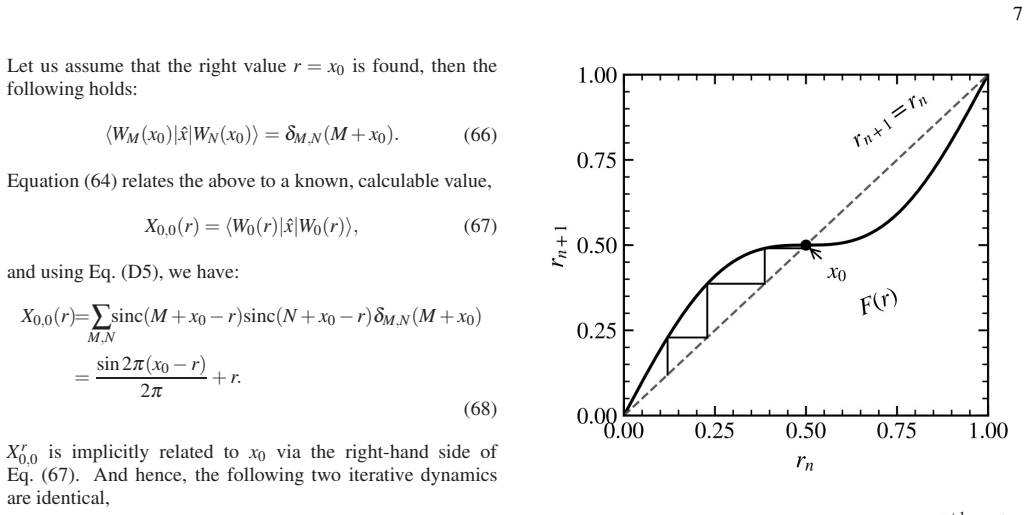
Convergence of rn to x0 The convergence of the iteration is examined by introducing the following function: F(r) = r + 1 2π sin ( 2π (x0 − r) ) ( mod 1). (D6) Since ⏐ ⏐ dF (r) dr ⏐ ⏐ = 1 − cos ( 2 π (x0 − r) ) < 1, (0 < x0 − r < 1/4), (D7) x0 is an attractor [61]. Therefore, letting, en = 2π (x0 − rn) ∈ (− π ,π ], (D8) we have, en+1 = en − sinen, |en+1| ≤...
-
[18]
Direct Derivation of Sinc-Loop Since the initial corrugated Berry connection is swept flat, the swell developed over the border carries all the informa- tion. By segregating the cross-border term out of the summa- tion, the matrix element of ei δ k ˆx is estimated by solving the following simplified equations: L⟨W0(r)|eiδ k ˆx|W0(r)⟩ = π − δ k ∑ k=− π +δ k ...
-
[19]
(73) For, XM1,M2(x0) = δ M1,x,M2,x δ M1,y,M2,y δ M1,z,M2,z (M1,x + x0), (D22) 23 B C D E FIG
Supplemental Calculation for Eq. (73) For, XM1,M2(x0) = δ M1,x,M2,x δ M1,y,M2,y δ M1,z,M2,z (M1,x + x0), (D22) 23 B C D E FIG. 25. (Color online) V erification of Eq. (D20) in single- a nd composite-band cases. NC denotes the number of the energy bands composing the composite band systems. nb indicates the energy band index of the single-band system. T he ...
-
[20]
Nearest-neighbor overlaps and discrete measure For each nearest-neighbor link δ kα (α ∈ N ), we define the overlap matrix Mα sp (k) = ⟨us k|up k+ δ kα ⟩. (F1) We also introduce the discrete measure ν α = wα Nk , Nk = L2, (F2) so that the weights do not appear explicitly in the local kern els discussed below. On a uniform mesh, ν α = O(L0). Using 24 Eq. (F2...
-
[21]
(F7) Because this is a 1 × 1 overlap matrix, its singular value is simply σ s α (k) = |ms α (k)|
Single-band(series) distortion carried by an extracted MLWF For a fixed extracted series s, we consider the diagonal link ms α (k) = Mα ss(k) = ⟨us k|us k+ δ kα ⟩. (F7) Because this is a 1 × 1 overlap matrix, its singular value is simply σ s α (k) = |ms α (k)|. (F8) We then define the corresponding single-state kernel by ω s α (k) = 1 − [σ s α (k)]2 = 1 − |...
-
[22]
(F10) The associated defect is dα (k) = 1 − σ 2 min(k; δ kα )
Subspace-level diagnostic for the residual transported space The complementary diagnostic for the transported J- dimensional subspace is the minimum singular value of the full overlap matrix: σ min(k; δ kα ) = min i σ i(Mα (k)) = cos θ max. (F10) The associated defect is dα (k) = 1 − σ 2 min(k; δ kα ). (F11) Equation (F10) measures the mismatch of the nei...
-
[23]
Let β de- note the link direction in which the seam appears after the first extraction
Order evaluation of the boundary seam defects Appendix D 3 shows that the interior links along each trans- ported string are flattened, so the nontrivial geometric mis - match is pushed entirely to the boundary seam. Let β de- note the link direction in which the seam appears after the first extraction. The order evaluations of the single-state and subspace...
-
[24]
G. H. Wannier, The structure of electronic excitation level s in insulating crystals, Phys. Rev. 52, 191 (1937)
work page 1937
- [25]
-
[26]
E. N. Adams, Motion of an electron in a perturbed periodic po- tential, Phys. Rev. 85, 41 (1952)
work page 1952
-
[27]
E. I. Blount, Bloch electrons in a magnetic field, Phys. Rev. 126, 1636 (1962)
work page 1962
-
[28]
S. Kivelson, Wannier functions in one-dimensional disorde red systems: Application to fractionally charged solitons, Ph ys. Rev. B 26, 4269 (1982)
work page 1982
-
[29]
Kohn, Analytic properties of bloch waves and wannier func- tions, Phys
W. Kohn, Analytic properties of bloch waves and wannier func- tions, Phys. Rev. 115, 809 (1959)
work page 1959
-
[30]
J. D. Cloizeaux, Energy bands and projection operators in a crystal: Analytic and asymptotic properties, Phys. Rev. 135, A685 (1964)
work page 1964
-
[31]
W. Kohn and J. R. Onffroy, Wannier functions in a simple non- periodic system, Phys. Rev. B 8, 2485 (1973). 25
work page 1973
-
[32]
A. Nenciu and G. Nenciu, Existence of exponentially localiz ed wannier functions for nonperiodic systems, Phys. Rev. B 47, 10112 (1993)
work page 1993
-
[33]
N. Marzari and D. V anderbilt, Maximally localized wannier functions for composite energy bands, Phys. Rev. B 56, 12847 (1997)
work page 1997
- [34]
-
[35]
N. Marzari, A. A. Mostofi, J. R. Yates, I. Souza, and D. V ander- bilt, Maximally localized wannier functions: Theory and ap pli- cations, Rev. Mod. Phys. 84, 1419 (2012)
work page 2012
-
[36]
A. A. Mostofi, J. R. Yates, Y .-S. Lee, I. Souza, D. V anderbilt, and N. Marzari, wannier90: A tool for obtaining maximally- localised wannier functions, Computer Physics Communica- tions 178, 685 (2008)
work page 2008
-
[37]
G. Pizzi, V . Vitale, R. Arita, S. Bl¨ ugel, F. Freimuth, G. G´ eranton, M. Gibertini, D. Gresch, C. Johnson, T. Koret- sune, J. Iba˜ nez-Azpiroz, H. Lee, J.-M. Lihm, D. Marchand, A. Marrazzo, Y . Mokrousov, J. I. Mustafa, Y . Nohara, Y . No- mura, L. Paulatto, S. Ponc´ e, T. Ponweiser, J. Qiao, F. Th¨ ol e, S. S. Tsirkin, M. Wierzbowska, N. Marzari, D. V...
work page 2020
-
[38]
D. V anderbilt and R. D. King-Smith, Electric polarization a s a bulk quantity and its relation to surface charge, Physical Review B 48, 4442 (1993)
work page 1993
-
[39]
Resta, Macroscopic polarization in crystalline dielect rics: the geometric phase approach, Rev
R. Resta, Macroscopic polarization in crystalline dielect rics: the geometric phase approach, Rev. Mod. Phys. 66, 899 (1994)
work page 1994
-
[40]
X. Wu, O. Di´ eguez, K. M. Rabe, and D. V anderbilt, Wannier- based definition of layer polarizations in perovskite super lat- tices, Phys. Rev. Lett. 97, 107602 (2006)
work page 2006
-
[41]
M. G. Lopez, D. V anderbilt, T. Thonhauser, and I. Souza, Wannier-based calculation of the orbital magnetization in crys- tals, Phys. Rev. B 85, 014435 (2012)
work page 2012
-
[42]
J. D. Cloizeaux, Orthogonal orbitals and generalized wanni er functions, Phys. Rev. 129, 554 (1963)
work page 1963
-
[43]
V . P . Smirnov and D. E. Usvyat, V ariational method for the generation of localized wannier functions on the basis of bl och functions, Phys. Rev. B 64, 245108 (2001)
work page 2001
- [44]
- [45]
- [46]
-
[47]
Y . Liu, W. Cao, W. Chen, H. Wang, L. Yang, and X. Zhang, Fully integrated topological electronics, Scientific Repo rts 12, 13410 (2022)
work page 2022
-
[48]
V . H. Pham, H. Bui, T. V . Nguyen, T. A. Nguyen, T. S. Pham, V . D. Pham, T. C. Tran, T. T. Hoang, and Q. M. Ngo, Progress in the research and development of photonic structure devic es, Advances in Natural Sciences: Nanoscience and Nanotechnol - ogy 7, 015003 (2016)
work page 2016
- [49]
-
[50]
B. Simon, Holonomy, the quantum adiabatic theorem, and berry’s phase, Physical Review Letters 51, 2167 (1983)
work page 1983
-
[51]
M. V . Berry, Quantal phase factors accompanying adiabatic changes, Proceedings of the Royal Society of London. Series A, Mathematical and Physical Sciences 392, 45 (1984)
work page 1984
- [52]
-
[53]
A. A. Soluyanov and D. V anderbilt, Computing topological in - variants without inversion symmetry, Phys. Rev. B 83, 235401 (2011)
work page 2011
-
[54]
A. Alexandradinata, X. Dai, and B. A. Bernevig, Wilson-loop characterization of inversion-symmetric topological ins ulators, Phys. Rev. B 89, 155114 (2014)
work page 2014
-
[55]
C. Brouder, G. Panati, M. Calandra, C. Mourougane, and N. Marzari, Exponential localization of wannier functions in insulators, Phys. Rev. Lett. 98, 046402 (2007)
work page 2007
-
[56]
J. I. Mustafa, S. Coh, M. L. Cohen, and S. G. Louie, Automated construction of maximally localized wannier functions: Op ti- mized projection functions method, Phys. Rev. B 92, 165134 (2015)
work page 2015
- [57]
-
[58]
SCDM-k: Localized orbitals for solids via selected columns of the density matrix
A. Damle, L. Lin, and L. Ying, Scdm-k: Localized orbitals for solids via selected columns of the density matrix (2016) , arXiv:1507.03354 [physics.comp-ph]
work page internal anchor Pith review Pith/arXiv arXiv 2016
-
[59]
K. D. Stubbs, A. B. Watson, and J. Lu, Iterated projected po- sition algorithm for constructing exponentially localize d gener- alized wannier functions for periodic and nonperiodic insu la- tors in two dimensions and higher, Phys. Rev. B 103, 075125 (2021)
work page 2021
-
[60]
T. Kato, On the adiabatic theorem of quantum mechanics, Jour - nal of the Physical Society of Japan 5, 435 (1950)
work page 1950
-
[61]
J. E. Avron and A. Elgart, An adiabatic theorem without a gap condition, in Mathematical Physics, X. International Congress on Mathematical Physics (ICMP ’97) , Progress in Mathemati- cal Physics (Birkh¨ auser, 1998) pp. 1–34
work page 1998
-
[62]
J. E. Avron and A. Elgart, Adiabatic theorem without a gap condition, Communications in Mathematical Physics 203, 445 (1999)
work page 1999
-
[63]
Teufel, Adiabatic Perturbation Theory in Quantum Dynam- ics, Lecture Notes in Mathematics, V ol
S. Teufel, Adiabatic Perturbation Theory in Quantum Dynam- ics, Lecture Notes in Mathematics, V ol. 1821 (Springer, Berlin, Heidelberg, 2003)
work page 2003
-
[64]
J. K. Asb´ oth, L. Oroszl´ any, and A. P´ alyi, A Short Course on Topological Insulators: Band-structure topology and ed ge states in one and two dimensions , Lecture Notes in Physics, V ol. 919 (Springer, Cham, 2016)
work page 2016
-
[65]
J. Cayssol and J.-N. Fuchs, Topological and geometrical aspects of band theory, Journal of Physics: Materials 4, 034007 (2021)
work page 2021
-
[66]
D. V anderbilt, Berry Phases in Electronic Structure Theory: Electric Polarization, Orbital Magnetization and Topolog ical Insulators (Cambridge University Press, Cambridge, 2018)
work page 2018
-
[67]
M. Galassi, J. Davies, J. Theiler, B. Gough, G. Jungman, M. Booth, and F. Rossi, GNU Scientific Library Reference Man- ual, 3rd ed. (Network Theory Ltd., Bristol, 2009)
work page 2009
-
[68]
E. Engel and R. M. Dreizler, Density Functional Theory: An Advanced Course , Theoretical and Mathematical Physics (Springer, 2011) appendix A: Functionals and the Functiona l Derivative
work page 2011
-
[69]
I. M. Gelfand and S. V . Fomin,Calculus of V ariations(Prentice- Hall; Dover reprint, 1963)
work page 1963
-
[70]
P . J. Olver, The calculus of variations, Lecture notes, Univ . of Minnesota (2022). 26
work page 2022
-
[71]
Functional derivative, Encyclopedia of Mathematics (EMS) (2020)
work page 2020
-
[72]
Y . Hamai and K. Wakabayashi, Approximating maximally lo- calized wannier functions with position scaling eigenfunc tions, Phys. Rev. B 108, 245413 (2023)
work page 2023
-
[73]
Daubechies, Ten lectures on wavelets (Society for Indust rial and Applied Mathematics, 1992) Chap
I. Daubechies, Ten lectures on wavelets (Society for Indust rial and Applied Mathematics, 1992) Chap. 6
work page 1992
-
[74]
I. Daubechies, Orthonormal bases of compactly supported wavelets, in Fundamental Papers in W avelet Theory(Princeton University Press, Princeton, 2006) pp. 564–652
work page 2006
-
[75]
A. V ellasco-Gomes, R. de Figueiredo Camargo, and A. Bruno- Alfonso, Energy bands and wannier functions of the fraction al kronig-penney model, Applied Mathematics and Computation 380, 125266 (2020)
work page 2020
-
[76]
R. Wang, E. A. Lazar, H. Park, A. J. Millis, and C. A. Mar- ianetti, Selectively localized wannier functions, Phys. R ev. B 90, 165125 (2014)
work page 2014
-
[77]
J. Ahn and B.-J. Yang, Unconventional topological phase tra n- sition in two-dimensional systems with space-time inversi on symmetry, Physical Review Letters 118, 156401 (2017)
work page 2017
-
[78]
C. Fang and L. Fu, New classes of three-dimensional topologi - cal crystalline insulators: Nonsymmorphic and magnetic, P hys- ical Review B 91, 161105 (2015)
work page 2015
-
[79]
P . Giannozzi, S. Baroni, N. Bonini, M. Calandra, R. Car, C. Cavazzoni, D. Ceresoli, G. L. Chiarotti, M. Cococ- cioni, I. Dabo, A. Dal Corso, S. de Gironcoli, S. Fab- ris, G. Fratesi, R. Gebauer, U. Gerstmann, C. Gougoussis, A. Kokalj, M. Lazzeri, L. Martin-Samos, N. Marzari, F. Mauri , R. Mazzarello, S. Paolini, A. Pasquarello, L. Paulatto, C. Sbrac- cia...
work page 2009
-
[80]
P . Giannozzi, O. Andreussi, T. Brumme, O. Bunau, M. Buon- giorno Nardelli, M. Calandra, R. Car, C. Cavazzoni, D. Ceresoli, M. Cococcioni, N. Colonna, I. Carnimeo, A. Dal Corso, S. de Gironcoli, P . Delugas, R. A. DiStasio Jr., A. Ferretti, A. Floris, G. Fratesi, G. Fugallo, R. Gebauer, U. Gerstmann, F. Giustino, T. Gorni, J. Jia, M. Kawamura, H.-Y . Ko, ...
work page 2017
discussion (0)
Sign in with ORCID, Apple, or X to comment. Anyone can read and Pith papers without signing in.