Recognition: 2 theorem links
· Lean TheoremWHTDM: Walsh-Hadamard Transform Division Multiplexing for Doubly-Selective Channels
Pith reviewed 2026-05-15 01:53 UTC · model grok-4.3
The pith
Walsh-Hadamard transform division multiplexing outperforms OFDM in high-mobility channels while cutting transmitter complexity by 2.5 times and eliminating all complex multipliers.
A machine-rendered reading of the paper's core claim, the machinery that carries it, and where it could break.
Core claim
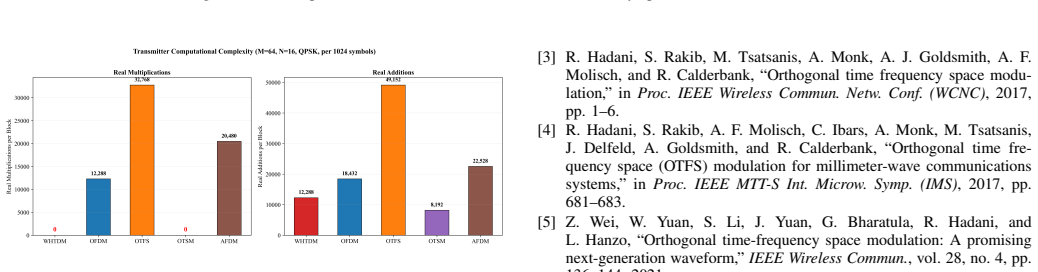
WHTDM replaces the conventional IFFT/FFT pair with a real-valued unitary Walsh-Hadamard transform, inheriting the CP-OFDM transceiver structure while producing zero real multipliers in the core modulation block. For doubly-selective channels, a CD-MAMP equalizer operates on the banded equivalent WHT-domain channel matrix. Under the 3GPP TDL-C model at 28 GHz, this yields over an order of magnitude lower BER than OFDM 1-tap MMSE at 120 km/h, the best BER among compared CD-MAMP-equalized waveforms, and 2.5 times lower transmitter complexity with no complex multipliers remaining in the transform stage.
What carries the argument
The real-valued unitary Walsh-Hadamard transform that generates a multicarrier waveform whose equivalent channel matrix in the WHT domain remains banded enough for cross-domain memory approximate message passing equalization to succeed.
If this is right
- WHTDM achieves over an order of magnitude lower BER than OFDM 1-tap MMSE at 120 km/h.
- WHTDM delivers the best BER performance among the CD-MAMP-equalized new waveforms tested.
- Transmitter complexity is 2.5 times lower than OFDM while completely removing complex multipliers from the transform stage.
- The overall transceiver structure stays compatible with existing CP-OFDM designs, allowing direct substitution.
Where Pith is reading between the lines
- The real-valued transform could simplify fixed-point hardware designs for battery-powered terminals beyond the IoT cases mentioned.
- Similar banded-matrix equalizers might be tested on other real unitary transforms to handle doubly-selective channels with comparable complexity.
- The mobility gains suggest the method could be examined for vehicular or high-speed rail scenarios where power budgets are tight.
- Extending the approach to different carrier frequencies or channel models would test how far the bandedness property generalizes.
Load-bearing premise
The equivalent WHT-domain channel matrix remains sufficiently banded under the 3GPP TDL-C model at 28 GHz for the CD-MAMP equalizer to produce the reported performance gains.
What would settle it
Direct measurement of bit error rate for WHTDM with CD-MAMP versus OFDM 1-tap MMSE at 120 km/h under the 3GPP TDL-C channel at 28 GHz; failure to reach at least a tenfold BER reduction would disprove the performance claim.
Figures


read the original abstract
We propose Walsh-Hadamard Transform Division Multiplexing (WHTDM), a multicarrier waveform that replaces the conventional IFFT/FFT pair in OFDM with a real-valued, unitary Walsh-Hadamard transform (WHT). WHTDM inherits the CP-OFDM transceiver structure while eliminating all complex multiplications from the transform stage, yielding a transmitter with zero real multipliers in the core modulation block. For detection under doubly-selective channels, we adopt a cross-domain memory approximate message passing (CD-MAMP) equalizer that operates on the banded structure of the equivalent WHT-domain channel matrix. Simulation results under the 3GPP TDL-C channel model at 28 GHz demonstrate that WHTDM with CD-MAMP significantly outperforms conventional OFDM 1-tap MMSE at high mobility, achieving over an order of magnitude lower BER at 120 km/h. Among the compared CD-MAMP-equalized new waveforms, WHTDM achieves the best BER performance while maintaining a transmitter complexity 2.5 $\times$ lower than OFDM and completely eliminating complex multipliers from the transform stage, making it well-suited for low-power IoT terminals.
Editorial analysis
A structured set of objections, weighed in public.
Referee Report
Summary. The manuscript proposes Walsh-Hadamard Transform Division Multiplexing (WHTDM), replacing the IFFT/FFT pair in OFDM with a real-valued unitary Walsh-Hadamard transform to eliminate complex multiplications in the modulation stage while retaining the CP-OFDM structure. For detection in doubly-selective channels, it employs a cross-domain memory approximate message passing (CD-MAMP) equalizer that exploits the assumed banded structure of the equivalent WHT-domain channel matrix. Simulations under the 3GPP TDL-C model at 28 GHz show WHTDM with CD-MAMP achieving over an order of magnitude lower BER than conventional OFDM 1-tap MMSE at 120 km/h, with 2.5× lower transmitter complexity and no complex multipliers in the transform stage.
Significance. If the performance claims hold, the work offers a low-complexity multicarrier alternative well-suited for high-mobility mmWave IoT scenarios. The complete removal of complex operations from the core transform stage and the cross-domain message-passing approach represent concrete engineering advantages over standard OFDM. The reported BER gains at 120 km/h under a standardized channel model would strengthen the case for real-valued transforms in power-constrained high-Doppler environments.
major comments (1)
- [Simulation Results] The central BER performance claim (over an order of magnitude improvement at 120 km/h) rests on the assumption that the equivalent WHT-domain channel matrix remains sufficiently banded for the CD-MAMP schedule to deliver accurate equalization. No quantitative verification of this banding is provided, such as the Frobenius norm of elements outside the main band or the effective bandwidth as a fraction of subcarrier count, under the 3GPP TDL-C model at 28 GHz and 120 km/h Doppler. If the matrix is only weakly banded, truncation in the message-passing updates would introduce errors that could erase the reported advantage over OFDM 1-tap MMSE.
minor comments (2)
- [Abstract] The abstract states that WHTDM achieves the best BER among compared CD-MAMP-equalized waveforms but provides no error bars, exact SNR operating points, or ablation results on iteration count or damping parameters, limiting assessment of result robustness.
- [Introduction] The claim of 'zero real multipliers in the core modulation block' should be clarified with respect to the full transmitter chain, including CP insertion and any pre/post-processing steps, to confirm the 2.5× complexity reduction holds end-to-end.
Simulated Author's Rebuttal
We thank the referee for the constructive comment on the simulation results. We agree that quantitative verification of the banding property would strengthen the claims and will incorporate the requested metrics in the revised manuscript.
read point-by-point responses
-
Referee: [Simulation Results] The central BER performance claim (over an order of magnitude improvement at 120 km/h) rests on the assumption that the equivalent WHT-domain channel matrix remains sufficiently banded for the CD-MAMP schedule to deliver accurate equalization. No quantitative verification of this banding is provided, such as the Frobenius norm of elements outside the main band or the effective bandwidth as a fraction of subcarrier count, under the 3GPP TDL-C model at 28 GHz and 120 km/h Doppler. If the matrix is only weakly banded, truncation in the message-passing updates would introduce errors that could erase the reported advantage over OFDM 1-tap MMSE.
Authors: We appreciate the referee highlighting this point. The manuscript relies on the structural properties of the Walsh-Hadamard transform combined with the doubly-selective channel to induce banding in the equivalent WHT-domain matrix, which is then exploited by the CD-MAMP equalizer. While the paper states this assumption explicitly, we acknowledge that explicit numerical confirmation (e.g., Frobenius norms of off-band elements and effective bandwidth fraction) under the exact 3GPP TDL-C parameters at 28 GHz and 120 km/h would provide stronger support. In the revised version we will add a dedicated subsection with these quantitative metrics, computed directly from the simulated channel realizations, to validate the truncation threshold used in CD-MAMP and confirm that the reported BER gains are not artifacts of insufficient banding. revision: yes
Circularity Check
No significant circularity in WHTDM derivation or performance claims
full rationale
The paper defines WHTDM by direct substitution of the Walsh-Hadamard transform for the IFFT/FFT pair in a standard CP-OFDM structure, then applies an existing CD-MAMP equalizer to the resulting equivalent channel matrix. All reported BER gains are obtained from Monte-Carlo simulations benchmarked against conventional OFDM 1-tap MMSE and other CD-MAMP waveforms under the external 3GPP TDL-C model; no equation reduces the claimed order-of-magnitude improvement to a parameter fitted from the same simulation data, nor does any step invoke a self-citation chain that forces the outcome by definition. The banded-matrix assumption is stated as a consequence of the real-valued WHT under the given Doppler spread and is not shown to be tautological with the performance metric.
Axiom & Free-Parameter Ledger
axioms (2)
- standard math Walsh-Hadamard transform is real-valued and unitary
- domain assumption Equivalent WHT-domain channel matrix is banded
Lean theorems connected to this paper
-
IndisputableMonolith/Foundation/AlexanderDuality.leanalexander_duality_circle_linking unclear?
unclearRelation between the paper passage and the cited Recognition theorem.
For our setup with N=64 and L=8, we use B=8, which captures over 99% of the Frobenius norm.
What do these tags mean?
- matches
- The paper's claim is directly supported by a theorem in the formal canon.
- supports
- The theorem supports part of the paper's argument, but the paper may add assumptions or extra steps.
- extends
- The paper goes beyond the formal theorem; the theorem is a base layer rather than the whole result.
- uses
- The paper appears to rely on the theorem as machinery.
- contradicts
- The paper's claim conflicts with a theorem or certificate in the canon.
- unclear
- Pith found a possible connection, but the passage is too broad, indirect, or ambiguous to say the theorem truly supports the claim.
Reference graph
Works this paper leans on
-
[1]
Multicarrier modulation for data transmission: An idea whose time has come,
J. A. C. Bingham, “Multicarrier modulation for data transmission: An idea whose time has come,”IEEE Commun. Mag., vol. 28, no. 5, pp. 5–14, 1990
work page 1990
-
[2]
R. van Nee and R. Prasad,OFDM for Wireless Multimedia Communi- cations. Artech House, 1999
work page 1999
-
[3]
Orthogonal time frequency space modu- lation,
R. Hadani, S. Rakib, M. Tsatsanis, A. Monk, A. J. Goldsmith, A. F. Molisch, and R. Calderbank, “Orthogonal time frequency space modu- lation,” inProc. IEEE Wireless Commun. Netw. Conf. (WCNC), 2017, pp. 1–6
work page 2017
-
[4]
Orthogonal time fre- quency space (OTFS) modulation for millimeter-wave communications systems,
R. Hadani, S. Rakib, A. F. Molisch, C. Ibars, A. Monk, M. Tsatsanis, J. Delfeld, A. Goldsmith, and R. Calderbank, “Orthogonal time fre- quency space (OTFS) modulation for millimeter-wave communications systems,” inProc. IEEE MTT-S Int. Microw. Symp. (IMS), 2017, pp. 681–683
work page 2017
-
[5]
Orthogonal time-frequency space modulation: A promising next-generation waveform,
Z. Wei, W. Yuan, S. Li, J. Yuan, G. Bharatula, R. Hadani, and L. Hanzo, “Orthogonal time-frequency space modulation: A promising next-generation waveform,”IEEE Wireless Commun., vol. 28, no. 4, pp. 136–144, 2021
work page 2021
-
[6]
Orthogonal time sequency multiplexing mod- ulation,
T. Thaj and E. Viterbo, “Orthogonal time sequency multiplexing mod- ulation,” inProc. IEEE Wireless Commun. Netw. Conf. (WCNC), 2021, pp. 1–7
work page 2021
-
[7]
Orthogonal time sequency multiplex- ing modulation: Analysis and low-complexity receiver design,
T. Thaj, E. Viterbo, and Y . Hong, “Orthogonal time sequency multiplex- ing modulation: Analysis and low-complexity receiver design,”IEEE Trans. Wireless Commun., vol. 20, no. 12, pp. 7842–7855, 2021
work page 2021
-
[8]
Unitary-precoded single-carrier waveforms for high mobility: Detection and channel estimation,
T. Thaj and E. Viterbo, “Unitary-precoded single-carrier waveforms for high mobility: Detection and channel estimation,” inProc. IEEE Wireless Commun. Netw. Conf. (WCNC), 2022, pp. 962–967
work page 2022
-
[9]
AFDM: A full diversity next generation waveform for high mobility communications,
A. Bemani, N. Ksairi, and M. Kountouris, “AFDM: A full diversity next generation waveform for high mobility communications,” inProc. IEEE Int. Conf. Commun. Workshops (ICC Workshops), 2021, pp. 1–6
work page 2021
-
[10]
Affine frequency division multiplexing for next generation wire- less communications,
——, “Affine frequency division multiplexing for next generation wire- less communications,”IEEE Trans. Wireless Commun., vol. 22, no. 11, pp. 8214–8229, 2023
work page 2023
-
[11]
S.-C. Pei and J.-J. Ding, “Closed-form orthogonal discrete Fourier transform vectors and generalized orthogonal Fourier transform,”IEEE Trans. Signal Process., vol. 49, no. 7, pp. 1336–1347, 2001
work page 2001
-
[12]
WHT/OFDM – an improved OFDM transmission method for selective fading channels,
Z. Dlugaszewski and K. Wesolowski, “WHT/OFDM – an improved OFDM transmission method for selective fading channels,” inProc. Symp. Commun. V eh. Technol. (SCVT), 2000, pp. 144–149
work page 2000
-
[13]
An enhanced OFDM/OQAM system exploiting Walsh-Hadamard transform,
R. Ahmed, S. Goff, and M. Ismail, “An enhanced OFDM/OQAM system exploiting Walsh-Hadamard transform,” inProc. IEEE V eh. Technol. Conf. (VTC Spring), 2011, pp. 1–5
work page 2011
-
[14]
Combined Walsh-Hadamard precoding and clipping for PAPR reduction of OFDM signals,
Z. Wang, “Combined Walsh-Hadamard precoding and clipping for PAPR reduction of OFDM signals,”IEICE Trans. Commun., vol. E93-B, no. 7, pp. 1954–1957, 2010
work page 1954
-
[15]
J. Ma and L. Ping, “Orthogonal AMP,”IEEE Access, vol. 5, pp. 2020– 2033, 2017
work page 2020
-
[16]
K. G. Beauchamp,Walsh Functions and Their Applications. Academic Press, 1975
work page 1975
-
[17]
N. Ahmed and K. R. Rao,Orthogonal Transforms for Digital Signal Processing. Springer-Verlag, 1975
work page 1975
-
[18]
Iterative detection in coded linear systems based on orthogonal AMP,
J. Ma, L. Liu, X. Yuan, and L. Ping, “Iterative detection in coded linear systems based on orthogonal AMP,” inProc. IEEE Int. Symp. Turbo Codes Iterative Inf. Process. (ISTC), 2018, pp. 1–5
work page 2018
-
[19]
On orthogonal AMP in coded linear vector systems,
——, “On orthogonal AMP in coded linear vector systems,”IEEE Trans. Wireless Commun., vol. 18, no. 12, pp. 5658–5672, 2019
work page 2019
-
[20]
Channel hardening-exploiting message passing (CHEMP) receiver in large-scale MIMO systems,
T. L. Narasimhan and A. Chockalingam, “Channel hardening-exploiting message passing (CHEMP) receiver in large-scale MIMO systems,” IEEE J. Sel. Topics Signal Process., vol. 8, no. 5, pp. 847–860, 2014
work page 2014
-
[21]
Study on channel model for frequencies from 0.5 to 100 GHz (release 18),
3GPP, “Study on channel model for frequencies from 0.5 to 100 GHz (release 18),” 3rd Generation Partnership Project (3GPP), Tech. Rep. TR 38.901, 2024
work page 2024
-
[22]
Sionna: An open-source library for next-generation physical layer research,
J. Hoydis, S. Cammerer, F. A. Aoudia, A. Vem, N. Binder, G. Marcus, and A. Keller, “Sionna: An open-source library for next-generation physical layer research,”arXiv preprint arXiv:2303.03945, 2023
discussion (0)
Sign in with ORCID, Apple, or X to comment. Anyone can read and Pith papers without signing in.