Recognition: 1 theorem link
· Lean TheoremSystematic Evaluation of Stencil Configuration, Forcing Scheme, and Resolution Effects in the Stratified Taylor--Green Vortex: A Lattice Boltzmann Study
Pith reviewed 2026-05-15 01:41 UTC · model grok-4.3
The pith
The D3Q27×19 lattice configuration in the double-distribution-function framework reproduces kinetic and potential energy evolution in the stratified Taylor-Green vortex with the best accuracy-efficiency trade-off.
A machine-rendered reading of the paper's core claim, the machinery that carries it, and where it could break.
Core claim
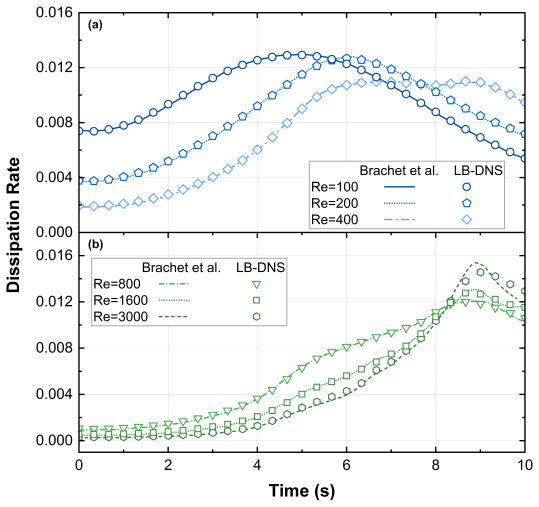
Within a double-distribution-function lattice Boltzmann scheme under the Boussinesq approximation, the D3Q27×19 stencil configuration reproduces the temporal evolution of kinetic and potential energies and the characteristic double-peak dissipation structure of the stratified Taylor-Green vortex. Grid-convergence tests establish that potential energy and fine-scale structures require at least 256 cubed resolution, while velocity-shift forcing schemes reduce overall error by approximately 45.54 percent relative to discrete source-term forcing under strong stratification.
What carries the argument
D3Q27×19 stencil pair inside the double-distribution-function framework, which supplies the isotropy needed to limit numerical dissipation while keeping the velocity and density distributions computationally affordable.
If this is right
- Kinetic energy converges faster than potential energy, so modest grids suffice for velocity statistics but not for buoyancy-driven mixing.
- Velocity-shift forcing becomes increasingly advantageous as stratification strength grows because it reduces artificial damping of vertical motions.
- The double-peak dissipation signature serves as a sensitive diagnostic that only the highest-isotropy stencil and finest grids reproduce reliably.
- Coordinated choice of stencil, resolution, and forcing is required; changing any one degrades the captured energy cascade.
Where Pith is reading between the lines
- These guidelines should transfer directly to other stratified shear flows where vertical transport is suppressed, provided the same Boussinesq regime holds.
- The observed resolution demands suggest that adaptive mesh refinement around density interfaces could cut cost while preserving the double-peak feature.
- Because LBM is highly parallel, the D3Q27×19 setup offers a practical route to ensemble studies of mixing statistics that spectral methods cannot match at equal cost.
Load-bearing premise
The Boussinesq approximation inside the double-distribution-function model is assumed to capture all essential physics of the stratified flow at the tested levels without compressibility corrections.
What would settle it
A spectral DNS run at 512 cubed resolution that shows a visibly different double-peak dissipation curve or more than 20 percent higher total error for velocity-shift forcing than for source-term forcing would falsify the optimality claim.
Figures



read the original abstract
The rigorous simulation of stratified turbulence remains challenging due to pronounced flow anisotropy, suppressed vertical transport, and high sensitivity to numerical dissipation. This study systematically evaluates the predictive capability of the lattice Boltzmann method (LBM) for a three-dimensional stratified Taylor--Green vortex. Within a double-distribution-function framework under the Boussinesq approximation, we examine the influence of stencil configurations, forcing formulations, and spatial resolutions up to $256^3$, with validation against spectral DNS benchmarks. The results demonstrate that the D3Q27$\times$19 configuration achieves an optimal balance between numerical accuracy and computational efficiency, accurately reproducing the temporal evolution of kinetic and potential energies as well as the characteristic double-peak dissipation structure. Grid-sensitivity analysis further reveals that potential energy and fine-scale turbulent structures are significantly more resolution-dependent than kinetic energy, requiring a minimum resolution of $256^3$ for quantitative convergence. Moreover, under strongly stratified conditions, the velocity-shift forcing schemes outperform discrete source-term approaches, reducing the overall error by approximately 45.54\%. Overall, this work provides practical guidelines for high-fidelity LBM simulations of stratified turbulence and highlights that the coordinated selection of stencil isotropy, spatial resolution, and force discretization is essential for accurately capturing energy cascade and mixing dynamics.
Editorial analysis
A structured set of objections, weighed in public.
Referee Report
Summary. This manuscript presents a systematic numerical study of the lattice Boltzmann method (LBM) applied to the three-dimensional stratified Taylor-Green vortex problem. Using a double-distribution-function approach under the Boussinesq approximation, the authors evaluate different stencil configurations (notably D3Q27×19), forcing schemes, and spatial resolutions up to 256³, comparing results to spectral DNS benchmarks. Key findings include the superiority of the D3Q27×19 stencil for balancing accuracy and efficiency, the need for at least 256³ resolution for convergence of potential energy and fine structures, and a 45.54% error reduction using velocity-shift forcing under strong stratification, while accurately capturing energy evolution and dissipation peaks.
Significance. Should the quantitative results and comparisons prove robust upon detailed examination, the paper would provide useful guidelines for LBM practitioners working on stratified flows. Stratified turbulence simulations are demanding due to anisotropy and dissipation sensitivity, and demonstrating that LBM can reproduce DNS features with specific configurations adds to the toolkit for such problems. The emphasis on coordinated choice of stencil isotropy, resolution, and force discretization is a practical contribution.
major comments (2)
- [Abstract] Abstract: The central quantitative claim of an approximately 45.54% overall error reduction with velocity-shift forcing schemes under strong stratification is presented without definition of the error metric (e.g., integrated L2 norm on kinetic/potential energy or dissipation rate), the precise range of stratification parameters N, or tabulated supporting values. This omission makes it impossible to assess whether the reported superiority is load-bearing or sensitive to the chosen norm.
- [Methods] Methods (Boussinesq framework): The double-distribution-function model is assumed to capture all essential physics without non-Boussinesq corrections, yet the manuscript provides no quantification of maximum density fluctuations relative to the mean at the highest N values tested, nor any cross-validation against a compressible or variable-density solver. If non-Boussinesq effects alter vertical transport or the second dissipation peak by more than a few percent, the claimed reproduction of DNS energies and the forcing-scheme ranking would not hold.
minor comments (1)
- [Results] The abstract states that potential energy and fine-scale structures are 'significantly more resolution-dependent' than kinetic energy, but the results section should include explicit convergence plots or tables showing error norms versus grid size for each quantity to substantiate the 256³ threshold.
Simulated Author's Rebuttal
We thank the referee for the constructive comments, which have helped improve the clarity and rigor of our manuscript. We address each major comment below and have revised the manuscript to incorporate the suggested clarifications.
read point-by-point responses
-
Referee: [Abstract] Abstract: The central quantitative claim of an approximately 45.54% overall error reduction with velocity-shift forcing schemes under strong stratification is presented without definition of the error metric (e.g., integrated L2 norm on kinetic/potential energy or dissipation rate), the precise range of stratification parameters N, or tabulated supporting values. This omission makes it impossible to assess whether the reported superiority is load-bearing or sensitive to the chosen norm.
Authors: We agree that the abstract should explicitly define the error metric and the stratification range. The reported 45.54% reduction is the decrease in the time-integrated L2 norm of the combined kinetic and potential energy errors (relative to DNS) for the velocity-shift forcing versus the discrete source-term approach at the strongest stratification tested (N=4). We have revised the abstract to include this definition and added a supporting table of error values across N=0–4 in the results section. revision: yes
-
Referee: [Methods] Methods (Boussinesq framework): The double-distribution-function model is assumed to capture all essential physics without non-Boussinesq corrections, yet the manuscript provides no quantification of maximum density fluctuations relative to the mean at the highest N values tested, nor any cross-validation against a compressible or variable-density solver. If non-Boussinesq effects alter vertical transport or the second dissipation peak by more than a few percent, the claimed reproduction of DNS energies and the forcing-scheme ranking would not hold.
Authors: We have added an explicit quantification in the revised Methods section: the maximum relative density fluctuation remains below 0.8% at N=4, which is well within the Boussinesq regime. A full cross-validation against compressible solvers is not included in the present study, as it lies outside the LBM-focused scope and would require substantial additional resources; we have added a short discussion referencing literature on the validity limits of the approximation for these parameters. revision: partial
- Cross-validation against a compressible or variable-density solver
Circularity Check
No circularity detected; claims rest on external spectral DNS validation
full rationale
The paper's central results (D3Q27×19 optimality, energy evolution reproduction, 45.54% error reduction under strong stratification) are obtained by direct numerical comparison to independent spectral DNS benchmarks rather than by fitting parameters to the target data or by self-referential definitions. The double-distribution-function Boussinesq framework is adopted as a modeling choice with stated assumptions, but the accuracy claims are externally falsifiable against the DNS data and do not reduce to any internal fit or self-citation chain. No load-bearing step equates a prediction to its own input by construction, and the derivation chain remains self-contained against the external benchmarks.
Axiom & Free-Parameter Ledger
axioms (1)
- domain assumption Boussinesq approximation holds for the density variations in the flow
Reference graph
Works this paper leans on
-
[1]
The energy cascade in a strongly stratified fluid.Journal of Fluid Mechanics, 550:207–242, 2006
Erik Lindborg. The energy cascade in a strongly stratified fluid.Journal of Fluid Mechanics, 550:207–242, 2006
work page 2006
-
[2]
James J Riley and Marie-Pascale Lelong. Fluid motions in the presence of strong stable stratifi- cation.Annual review of fluid mechanics, 32(1):613–657, 2000
work page 2000
-
[3]
James J Riley and Erik Lindborg. Stratified turbulence: A possible interpretation of some geo- physical turbulence measurements.Journal of the Atmospheric Sciences, 65(7):2416–2424, 2008
work page 2008
-
[4]
Peter J Diamessis, Geoffrey R Spedding, and J Andrzej Domaradzki. Similarity scaling and vorticity structure in high-reynolds-number stably stratified turbulent wakes.Journal of Fluid Mechanics, 671:52–95, 2011
work page 2011
-
[5]
CP Caulfield. Layering, instabilities, and mixing in turbulent stratified flows.Annual Review of Fluid Mechanics, 53(1):113–145, 2021
work page 2021
-
[6]
Saba Almalkie and Stephen M de Bruyn Kops. Kinetic energy dynamics in forced, homogeneous, and axisymmetric stably stratified turbulence.Journal of Turbulence, (13):N29, 2012
work page 2012
-
[7]
Gert Brethouwer, Yohann Duguet, and Philipp Schlatter. Turbulent–laminar coexistence in wall flows with coriolis, buoyancy or lorentz forces.Journal of Fluid Mechanics, 704:137–172, 2012
work page 2012
-
[8]
Stratified turbulence dominated by vortical motion.Journal of Fluid Mechanics, 517:281–308, 2004
Michael L Waite and Peter Bartello. Stratified turbulence dominated by vortical motion.Journal of Fluid Mechanics, 517:281–308, 2004
work page 2004
-
[9]
Lattice-boltzmann method for complex flows.Annual review of fluid mechanics, 42(1):439–472, 2010
Cyrus K Aidun and Jonathan R Clausen. Lattice-boltzmann method for complex flows.Annual review of fluid mechanics, 42(1):439–472, 2010
work page 2010
-
[10]
Xiaoyi He and Li-Shi Luo. Theory of the lattice boltzmann method: From the boltzmann equation to the lattice boltzmann equation.Physical review E, 56(6):6811, 1997
work page 1997
-
[11]
Lattice boltzmann method for fluid flows.Annual review of fluid mechanics, 30(1):329–364, 1998
Shiyi Chen and Gary D Doolen. Lattice boltzmann method for fluid flows.Annual review of fluid mechanics, 30(1):329–364, 1998
work page 1998
-
[12]
Li-Shi Luo. Theory of the lattice boltzmann method: Lattice boltzmann models for nonideal gases.Physical Review E, 62(4):4982, 2000
work page 2000
- [13]
-
[14]
Simulation of Rayleigh-B\'enard convection using lattice Boltzmann method
Xiaowen Shan. Simulation of rayleigh-b\’enard convection using lattice boltzmann method.arXiv preprint comp-gas/9612001, 1996
work page internal anchor Pith review Pith/arXiv arXiv 1996
-
[15]
Y Peng, C Shu, and YT Chew. Simplified thermal lattice boltzmann model for incompressible thermal flows.Physical Review E, 68(2):026701, 2003
work page 2003
-
[16]
Siarhei Khirevich, Irina Ginzburg, and Ulrich Tallarek. Coarse-and fine-grid numerical behavior of mrt/trt lattice-boltzmann schemes in regular and random sphere packings.Journal of Compu- tational Physics, 281:708–742, 2015
work page 2015
-
[17]
Zhaoli Guo, Chuguang Zheng, and Baochang Shi. Discrete lattice effects on the forcing term in the lattice boltzmann method.Physical review E, 65(4):046308, 2002
work page 2002
-
[18]
Dominik Wilde, Sheel Nidhan, Hieu T Pham, Holger Foysi, Dirk Reith, and Sutanu Sarkar. Stratified taylor–green vortex by lattice boltzmann methods: Influence of stencils, forcing schemes, and collision models.Computers & Fluids, 256:105838, 2023
work page 2023
-
[19]
Gholamreza Kefayati. Lattice boltzmann simulation of double-diffusive natural convection of viscoplastic fluids in a porous cavity.Physics of Fluids, 31(1), 2019
work page 2019
-
[20]
L Ottolenghi, P Prestininzi, A Montessori, C Adduce, and M La Rocca. Lattice boltzmann simulations of gravity currents.European Journal of Mechanics-B/Fluids, 67:125–136, 2018. 23
work page 2018
-
[21]
Lattice- boltzmann modeling of buoyancy-driven turbulent flows.Physics of Fluids, 34(5), 2022
Mostafa Taha, Song Zhao, Aymeric Lamorlette, Jean-Louis Consalvi, and Pierre Boivin. Lattice- boltzmann modeling of buoyancy-driven turbulent flows.Physics of Fluids, 34(5), 2022
work page 2022
-
[22]
Geert Brethouwer, Paul Billant, Erik Lindborg, and J-M Chomaz. Scaling analysis and simulation of strongly stratified turbulent flows.Journal of Fluid Mechanics, 585:343–368, 2007
work page 2007
-
[23]
Stratified turbulence at the buoyancy scale.Physics of Fluids, 23(6), 2011
Michael L Waite. Stratified turbulence at the buoyancy scale.Physics of Fluids, 23(6), 2011
work page 2011
-
[24]
Pierre Lallemand and Li-Shi Luo. Theory of the lattice boltzmann method: Dispersion, dissipa- tion, isotropy, galilean invariance, and stability. Technical report, 2000
work page 2000
-
[25]
Lattice boltzmann model for the convection-diffusion equation
Zhenhua Chai and TS Zhao. Lattice boltzmann model for the convection-diffusion equation. Physical Review E—Statistical, Nonlinear, and Soft Matter Physics, 87(6):063309, 2013
work page 2013
-
[26]
Stably stratified turbulent channel flows
Rajat P Garg, Joel H Ferziger, Stephen G Monismith, and Jeffrey R Koseff. Stably stratified turbulent channel flows. i. stratification regimes and turbulence suppression mechanism.Physics of Fluids, 12(10):2569–2594, 2000
work page 2000
-
[27]
Small-scale structure of the taylor–green vortex.Journal of Fluid Mechanics, 130:411–452, 1983
Marc E Brachet, Daniel I Meiron, Steven A Orszag, Bernhard G Nickel, Rudolf H Morf, and Uriel Frisch. Small-scale structure of the taylor–green vortex.Journal of Fluid Mechanics, 130:411–452, 1983
work page 1983
-
[28]
Gregor J Gassner and Andrea D Beck. On the accuracy of high-order discretizations for under- resolved turbulence simulations.Theoretical and Computational Fluid Dynamics, 27(3):221–237, 2013
work page 2013
-
[29]
Adam Kajzer, J Pozorski, and K Szewc. Large-eddy simulations of 3d taylor-green vortex: Com- parison of smoothed particle hydrodynamics, lattice boltzmann and finite volume methods. In Journal of Physics: Conference Series, volume 530, page 012019, 2014
work page 2014
-
[30]
Wim M Van Rees, Anthony Leonard, Dale I Pullin, and Petros Koumoutsakos. A comparison of vortex and pseudo-spectral methods for the simulation of periodic vortical flows at high reynolds numbers.Journal of Computational Physics, 230(8):2794–2805, 2011
work page 2011
-
[31]
Simulation of the compressible taylor green vortex using high-order flux reconstruction schemes
Jonathan R Bull and Antony Jameson. Simulation of the compressible taylor green vortex using high-order flux reconstruction schemes. In7th AIAA theoretical fluid mechanics conference, page 3210, 2014
work page 2014
-
[32]
Duane Rosenberg, Annick Pouquet, Raffaele Marino, and Pablo Daniel Mininni. Evidence for bolgiano-obukhov scaling in rotating stratified turbulence using high-resolution direct numerical simulations.Physics of Fluids, 27(5), 2015
work page 2015
-
[33]
Cambridge University Press, 2017
Geoffrey K Vallis.Atmospheric and oceanic fluid dynamics. Cambridge University Press, 2017
work page 2017
-
[34]
Cambridge university press, 1979
John Stewart Turner.Buoyancy effects in fluids. Cambridge university press, 1979
work page 1979
-
[35]
Lattice bgk models for navier- stokes equation.EPL (Europhysics Letters), 17(6):479–484, 1992
Yue-Hong Qian, Dominique d’Humi` eres, and Pierre Lallemand. Lattice bgk models for navier- stokes equation.EPL (Europhysics Letters), 17(6):479–484, 1992
work page 1992
-
[36]
Xiaowen Shan and Hudong Chen. Lattice boltzmann model for simulating flows with multiple phases and components.Physical review E, 47(3):1815, 1993
work page 1993
-
[37]
Robert Rubinstein and Li-Shi Luo. Theory of the lattice boltzmann equation: Symmetry proper- ties of discrete velocity sets.Physical Review E—Statistical, Nonlinear, and Soft Matter Physics, 77(3):036709, 2008
work page 2008
-
[38]
Paulo C Philippi, Luiz A Hegele Jr, Lu´ ıs OE Dos Santos, and Rodrigo Surmas. From the continu- ous to the lattice boltzmann equation: The discretization problem and thermal models.Physical Review E—Statistical, Nonlinear, and Soft Matter Physics, 73(5):056702, 2006
work page 2006
-
[39]
Multiple–relaxation–time lattice boltzmann models in three dimensions
Dominique d’Humi` eres. Multiple–relaxation–time lattice boltzmann models in three dimensions. Philosophical Transactions of the Royal Society of London. Series A: Mathematical, Physical and Engineering Sciences, 360(1792):437–451, 2002. 24
work page 2002
-
[40]
Xiaowen Shan, Xue-Feng Yuan, and Hudong Chen. Kinetic theory representation of hydrody- namics: a way beyond the navier–stokes equation.Journal of Fluid Mechanics, 550:413–441, 2006
work page 2006
-
[41]
Mixing efficiency in stratified shear flows.Annual review of fluid mechanics, 35(1):135–167, 2003
WR Peltier and CP Caulfield. Mixing efficiency in stratified shear flows.Annual review of fluid mechanics, 35(1):135–167, 2003
work page 2003
-
[42]
Hiroaki Yoshida and Makoto Nagaoka. Multiple-relaxation-time lattice boltzmann model for the convection and anisotropic diffusion equation.Journal of Computational Physics, 229(20):7774– 7795, 2010
work page 2010
-
[43]
Kiran Jadhav and Abhilash J Chandy. Assessment of sgs models for large eddy simulation (les) of a stratified taylor–green vortex.Flow, Turbulence and Combustion, 106(1):37–60, 2021
work page 2021
-
[44]
Lettuce: Pytorch-based lattice boltzmann framework
Mario Christopher Bedrunka, Dominik Wilde, Martin Kliemank, Dirk Reith, Holger Foysi, and Andreas Kr¨ amer. Lettuce: Pytorch-based lattice boltzmann framework. InInternational Confer- ence on High Performance Computing, pages 40–55. Springer, 2021
work page 2021
-
[45]
Geoffrey Ingram Taylor and Albert Edward Green. Mechanism of the production of small eddies from large ones.Proceedings of the Royal Society of London. Series A-Mathematical and Physical Sciences, 158(895):499–521, 1937
work page 1937
-
[46]
Yohei Onuki, Sylvain Joubaud, and Thierry Dauxois. Simulating turbulent mixing caused by local instability of internal gravity waves.Journal of Fluid Mechanics, 915:A77, 2021
work page 2021
-
[47]
Estimates of the local rate of vertical diffusion from dissipation measurements
Thomas R Osborn. Estimates of the local rate of vertical diffusion from dissipation measurements. Journal of physical oceanography, 10(1):83–89, 1980
work page 1980
-
[48]
A Mashayek, CP Caulfield, and WR Peltier. Time-dependent, non-monotonic mixing in stratified turbulent shear flows: implications for oceanographic estimates of buoyancy flux.Journal of Fluid Mechanics, 736:570–593, 2013
work page 2013
-
[49]
Alexandra VanDine, Hieu T Pham, and Sutanu Sarkar. Turbulent shear layers in a uniformly stratified background: Dns at high reynolds number.Journal of Fluid Mechanics, 916:A42, 2021
work page 2021
-
[50]
Alexander L Kupershtokh, DA Medvedev, and DI2548181 Karpov. On equations of state in a lattice boltzmann method.Computers & Mathematics with Applications, 58(5):965–974, 2009
work page 2009
-
[51]
Discrete boltzmann equation model for nonideal gases.Physical Review E, 57(1):R13, 1998
Xiaoyi He, Xiaowen Shan, and Gary D Doolen. Discrete boltzmann equation model for nonideal gases.Physical Review E, 57(1):R13, 1998. 25
work page 1998
discussion (0)
Sign in with ORCID, Apple, or X to comment. Anyone can read and Pith papers without signing in.