Recognition: 1 theorem link
· Lean TheoremBiquadratic exchange coupling effect on the magnetic properties of (Fe/Ti) multilayers
Pith reviewed 2026-05-15 01:28 UTC · model grok-4.3
The pith
Biquadratic coupling in Fe/Ti multilayers explains observed non-collinear magnetic configurations through a macrospin model.
A machine-rendered reading of the paper's core claim, the machinery that carries it, and where it could break.
Core claim
A macrospin model that incorporates both bilinear and biquadratic interlayer exchange coupling terms reproduces the experimental hysteresis data for Fe/Ti multilayers. The model supports a phase diagram analysis that identifies non-collinear magnetic configurations arising from the biquadratic contribution. Structural characterization confirms rough interfaces, which are linked to the observed magnetic behavior and the importance of the biquadratic term.
What carries the argument
Macrospin model including bilinear antiferromagnetic and biquadratic exchange coupling, used to fit data and generate phase diagrams for non-collinear states.
If this is right
- The biquadratic term leads to non-collinear configurations in the magnetic phase diagram.
- Temperature and layer thickness variations in interlayer coupling are captured by the model.
- Two-step hysteresis loops result from the combined bilinear and biquadratic interactions.
- Rough interfaces enhance the role of biquadratic exchange in the system.
Where Pith is reading between the lines
- This approach could be applied to other metallic multilayers with similar interface roughness to predict magnetic phases.
- Tuning interface quality might allow control over the strength of biquadratic coupling for device applications.
- Dynamic magnetic measurements could further test the model's predictions for spin precession in non-collinear states.
Load-bearing premise
The macrospin approximation is valid for the layers despite their rough interfaces, allowing the biquadratic coupling to be introduced as an independent parameter.
What would settle it
Direct imaging of spin configurations using magnetic force microscopy or neutron reflectometry to verify the presence of non-collinear arrangements predicted by the phase diagram.
Figures



read the original abstract
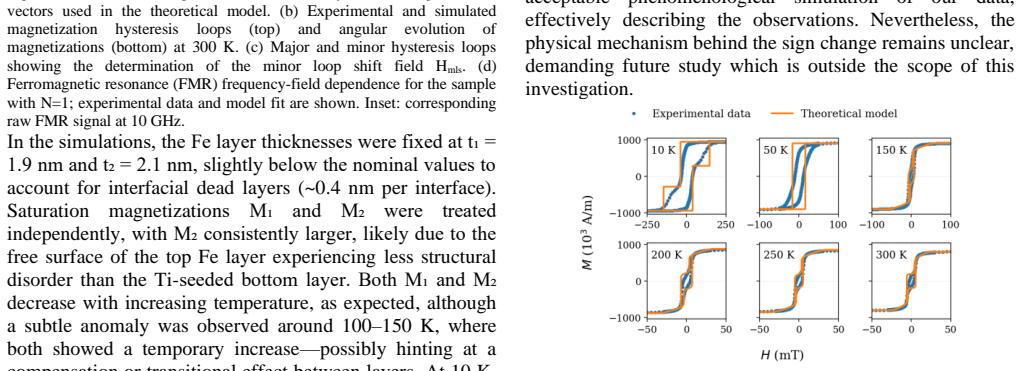
This work explores the static and dynamic magnetic properties of weakly antiferromagnetically coupled Fe/Ti superlattices, emphasizing the link between magnetic behavior and structural characteristics. HRTEM and XRD analyses confirm alternating Fe and Ti layers with rough interfaces, especially in upper layers. Magnetic measurements reveal two-step hysteresis loops and a temperature and thickness-dependent interlayer exchange coupling (IEC). A macrospin model incorporating bilinear and biquadratic coupling reproduces the experimental data and supports a phase diagram analysis identifying non-collinear configurations. The results underscore the impact of structural imperfections and highlight the crucial role of biquadratic exchange in Fe/Ti/Fe multilayers.
Editorial analysis
A structured set of objections, weighed in public.
Referee Report
Summary. The manuscript examines the static and dynamic magnetic properties of weakly antiferromagnetically coupled Fe/Ti superlattices. HRTEM and XRD data establish rough Fe/Ti interfaces. Magnetic measurements show two-step hysteresis loops whose temperature and thickness dependence is attributed to interlayer exchange coupling (IEC). A macrospin model that includes both bilinear (J1) and biquadratic (J2) IEC terms is shown to reproduce the measured loops; the same parameters are then used to generate a phase diagram that identifies regions of non-collinear magnetization.
Significance. If the macrospin description is valid, the work demonstrates that biquadratic coupling can account for the observed two-step loops in Fe/Ti multilayers with rough interfaces and supplies a phase diagram that maps non-collinear states. The explicit connection between structural roughness and magnetic behavior would be useful for the design of exchange-coupled multilayers, provided the biquadratic term can be placed on a firmer microscopic footing.
major comments (2)
- [Model and fitting procedure (implicit in abstract and results)] The biquadratic coupling constant J2 is introduced solely as a free fitting parameter to match the two-step hysteresis loops. No quantitative relation is derived between the measured rms roughness and correlation length (from HRTEM/XRD) and the magnitude of J2, for example via a Slonczewski-type roughness-induced biquadratic exchange mechanism. Consequently the agreement with experiment remains phenomenological and the subsequent phase-diagram prediction of non-collinear states rests on the same fitted value.
- [Results and discussion] The abstract and main text provide no error bars on the fitted J1 and J2 values, no explicit description of the fitting procedure, and no statement of how many independent parameters were adjusted. This absence prevents assessment of the uniqueness of the solution and of the robustness of the non-collinear regions identified in the phase diagram.
minor comments (2)
- [Model section] Notation for the bilinear and biquadratic constants should be defined once at first use and used consistently thereafter; the current text alternates between J1/J2 and descriptive phrases.
- [Figures] Figure captions for the hysteresis loops and phase diagrams should state the temperature, layer thicknesses, and the specific (J1, J2) values employed in each panel.
Simulated Author's Rebuttal
We thank the referee for the constructive comments on our manuscript. We address each major point below, indicating where revisions will be made to strengthen the presentation.
read point-by-point responses
-
Referee: [Model and fitting procedure (implicit in abstract and results)] The biquadratic coupling constant J2 is introduced solely as a free fitting parameter to match the two-step hysteresis loops. No quantitative relation is derived between the measured rms roughness and correlation length (from HRTEM/XRD) and the magnitude of J2, for example via a Slonczewski-type roughness-induced biquadratic exchange mechanism. Consequently the agreement with experiment remains phenomenological and the subsequent phase-diagram prediction of non-collinear states rests on the same fitted value.
Authors: We agree that the value of J2 is obtained phenomenologically by fitting the macrospin model to the measured hysteresis loops. The purpose of the model is to show that a biquadratic term is required to reproduce the two-step loops and to map the resulting non-collinear states; a first-principles or Slonczewski-type calculation that quantitatively links the specific HRTEM/XRD roughness parameters to J2 lies outside the scope of this work. We have added a clarifying sentence in the discussion noting this limitation and identifying it as a topic for future microscopic modeling. revision: partial
-
Referee: [Results and discussion] The abstract and main text provide no error bars on the fitted J1 and J2 values, no explicit description of the fitting procedure, and no statement of how many independent parameters were adjusted. This absence prevents assessment of the uniqueness of the solution and of the robustness of the non-collinear regions identified in the phase diagram.
Authors: We accept this criticism. In the revised manuscript we have inserted a dedicated paragraph in the Methods section that describes the fitting procedure, states that exactly two parameters (J1 and J2) were varied while all other quantities were held fixed at independently measured values, and reports the resulting error bars on J1 and J2 obtained from the covariance matrix of the least-squares fit. These additions allow direct assessment of solution uniqueness and phase-diagram robustness. revision: yes
- Quantitative microscopic derivation of J2 from the measured rms roughness and correlation length
Circularity Check
Biquadratic term fitted to hysteresis loops then used to generate phase diagram of non-collinear states
specific steps
-
fitted input called prediction
[Abstract and modeling section]
"A macrospin model incorporating bilinear and biquadratic coupling reproduces the experimental data and supports a phase diagram analysis identifying non-collinear configurations."
J2 is introduced solely as an adjustable parameter to match the measured hysteresis loops; the phase diagram and non-collinear identification are then generated from those same fitted parameters, rendering the 'support' for non-collinear states a direct output of the fit rather than an independent result.
full rationale
The macrospin model introduces bilinear (J1) and biquadratic (J2) IEC as free parameters to reproduce the observed two-step loops. The phase diagram identifying non-collinear configurations is then constructed directly from the same fitted J1/J2 values. No independent derivation links the measured interface roughness (HRTEM/XRD) to the magnitude of J2, so the claimed support for non-collinear states reduces to a downstream consequence of the fit. This matches the fitted-input-called-prediction pattern with moderate load-bearing circularity.
Axiom & Free-Parameter Ledger
free parameters (2)
- biquadratic coupling strength J2
- bilinear coupling strength J1
axioms (2)
- domain assumption Each Fe layer behaves as a single macrospin with uniform magnetization.
- domain assumption Interface roughness can be absorbed into an effective biquadratic term without explicit micromagnetic simulation.
Reference graph
Works this paper leans on
-
[1]
Interlayer Exchange Coupling in Layered Magnetic Structures,
S. Demokritov, D. Bürgler, P. Grünberg, and M. Johnson, "Interlayer Exchange Coupling in Layered Magnetic Structures," in Interlayer Exchange Coupling, Elsevier, Amsterdam, 2001, pp. 1–85
work page 2001
-
[2]
Structural and transport properties of Fe/Ti multilayers,
B. Rodmacq, P. Bayle-Guillemaud, J. L. Maurice, and M. Viret, "Structural and transport properties of Fe/Ti multilayers," J. Phys.: Condens. Matter, vol. 2, pp. 95–108, 1990
work page 1990
-
[3]
Ferromagnetic resonance studies in Fe/Ti multilayers,
H. Lassri, M. Sajieddine, R. Krishnan, A. Fnidiki, A. Bouabdallah, and M. Zaïdi, "Ferromagnetic resonance studies in Fe/Ti multilayers," J. Magn. Magn. Mater., vol. 272–276, pp. E973–E974, 2004 (Proc. ICM 2003)
work page 2004
-
[4]
Microstructure and magnetic properties of Fe/Ti multilayers,
M. Kopcewicz, B. Szymański, J. Kisielewski, M. Schmidt, and J. Dubowik, "Microstructure and magnetic properties of Fe/Ti multilayers," J. Phys.: Condens. Matter, vol. 9, no. 1, p. 103, 1997
work page 1997
-
[5]
Evolution of the Fe-on-Ti and Ti-on-Fe interfaces under thermal treatment,
J. Balogh, T. Kemeny, L. F. Kiss, I. Vincze, and M. G. Bercoff, "Evolution of the Fe-on-Ti and Ti-on-Fe interfaces under thermal treatment," Thin Solid Films, vol. 721, p. 138551, 2021
work page 2021
-
[6]
Theory of interlayer magnetic coupling,
P. Bruno, "Theory of interlayer magnetic coupling," Phys. Rev. B, vol. 52, no. 1, pp. 411–439, 1995
work page 1995
-
[7]
Correlation of magnetotransport and structure in sputtered Co/Cu multilayers,
A. Paul, L. G. Pereira, M. M. Sant'Anna, et al., "Correlation of magnetotransport and structure in sputtered Co/Cu multilayers," J. Phys.: Condens. Matter, vol. 15, p. 2471, 2003
work page 2003
-
[8]
Giant magnetoresistance in electrodeposited multilayers,
J.-F. Bobo, L. Gabillet, and M. Bibes, "Giant magnetoresistance in electrodeposited multilayers," J. Phys.: Condens. Matter, vol. 16, no. 5, p. S471, 2004
work page 2004
-
[9]
Mixing of acoustic and optical excitations in Ru/Co based multilayers,
P. Ntetsika, A. Kalampounias, I. Panagiotopoulos, et al., "Mixing of acoustic and optical excitations in Ru/Co based multilayers," Mater. Adv., vol. 3, no. 13, pp. 5451–5457, 2022
work page 2022
-
[10]
A. Bonda, Ł. Uba, and S. Uba, "Magnetization dynamics in layered systems with coexisting bilinear and biquadratic interlayer exchange coupling," Phys. Rev. B, vol. 107, p. 144408, 2023
work page 2023
-
[11]
Influence of interface mixed layer on non-collinear exchange coupling in V/Fe multilayers,
A. Ranecka, M. Pugaczowa-Michalska, and L. Smardz, "Influence of interface mixed layer on non-collinear exchange coupling in V/Fe multilayers," Materials, vol. 18, no. 3, p. 697, 2025
work page 2025
-
[12]
Z. Y. Liu and S. Adenwalla, "Oscillatory interlayer exchange coupling and its temperature dependence in [Pt/Co]₃/NiO/[Co/Pt]₃ multilayers with perpendicular anisotropy," Phys. Rev. Lett., vol. 91, p. 037207, 2003
work page 2003
-
[13]
Thermal switching of indirect interlayer exchange in magnetic multilayers,
D. M. Polishchuk, S. I. Khartsev, A. M. Grishin, et al., "Thermal switching of indirect interlayer exchange in magnetic multilayers," Europhys. Lett., vol. 118, no. 3, p. 37006, 2017
work page 2017
-
[14]
A study of interlayer coupling of Fe/Ti multilayers,
M. Lassri, H. Ouahmane, and H. Lassri, "A study of interlayer coupling of Fe/Ti multilayers," J. Optoelectron. Adv. Mater., vol. 15, pp. 1295–1297, 2013
work page 2013
-
[15]
Origin of dead magnetic Fe overlayers on V(110),
J. Izquierdo, A. Vega, L. C. Balbás, et al., "Origin of dead magnetic Fe overlayers on V(110)," Phys. Rev. B, vol. 64, p. 060404(R), 2001
work page 2001
-
[16]
Study of the long-range exchange coupling in Nd-Fe- B/Ti/Fe multilayered structure,
S. Yazdani, J. Phillips, A. Mosey, T. Bsaibes, R. Decca, and R. Cheng, "Study of the long-range exchange coupling in Nd-Fe- B/Ti/Fe multilayered structure," Crystals, vol. 14, no. 2, p. 119, 2024
work page 2024
-
[17]
A facile method for the density determination of ceramic thin films using X-ray reflectivity,
S. A. Veldhuis, K. M. Bansal, R. M. Bowen, et al., "A facile method for the density determination of ceramic thin films using X-ray reflectivity," J. Sol-Gel Sci. Technol., vol. 70, pp. 486–495, 2014
work page 2014
-
[18]
S. Chandran, N. Begam, and J. K. Basu, "Dispersion of polymer grafted nanoparticles in polymer nanocomposite films: Insights from surface X-ray scattering and microscopy," J. Appl. Phys., vol. 116, no. 22, p. 222203, 2014
work page 2014
-
[19]
P. Chongthanaphisut, M. Ishida, M. Kotsugi, et al., "Interlayer exchange coupling in ferromagnetic semiconductor trilayers with out-of-plane magnetic anisotropy," Sci. Rep., vol. 9, p. 41138, 2019
work page 2019
-
[20]
Influence of interface mixed layer on non-collinear exchange coupling in V/Fe multilayers,
A. Ranecka, M. Pugaczowa-Michalska, and L. Smardz, "Influence of interface mixed layer on non-collinear exchange coupling in V/Fe multilayers," Materials, 2025
work page 2025
-
[21]
Effect of the strong coupling on the exchange bias field in IrMn/Py/Ru/Co spin valves,
H. S. Tarazona, W. Alayo, C. V. Landauro, y J. Quispe- Marcatoma, “Effect of the strong coupling on the exchange bias field in IrMn/Py/Ru/Co spin valves,” Journal of Magnetism and Magnetic Materials, vol. 454, pp. 20–26, Jan. 2018
work page 2018
-
[22]
Ferromagnetic resonance absorption in BaFe₁₂O₁₉, a highly anisotropic crystal,
J. Smit and H. G. Beljers, "Ferromagnetic resonance absorption in BaFe₁₂O₁₉, a highly anisotropic crystal," Philips Res. Rep., vol. 10, p. 113, 1955
work page 1955
-
[23]
Theory of biquadratic exchange coupling in magnetic multilayers,
J. C. Slonczewski, "Theory of biquadratic exchange coupling in magnetic multilayers," Phys. Rev. Lett., vol. 67, no. 8, pp. 3172– 3175, 1991
work page 1991
-
[24]
Analytical expressions for the magnetization curves of a magnetic-tunnel-junction-like system,
A. Layadi, “Analytical expressions for the magnetization curves of a magnetic-tunnel-junction-like system,” J. Appl. Phys., vol. 100, no. 8, p. 083904, Oct. 2006, doi: 10.1063/1.2358815
-
[25]
Exchange-bias effect at La₀.₇₅Sr₀.₂₅MnO₃/LaNiO₃ interfaces,
J. C. Rojas Sánchez, L. Steren, J. C. Cezar, et al., "Exchange-bias effect at La₀.₇₅Sr₀.₂₅MnO₃/LaNiO₃ interfaces," Phys. Rev. B, vol. 85, p. 094427, 2012
work page 2012
discussion (0)
Sign in with ORCID, Apple, or X to comment. Anyone can read and Pith papers without signing in.