Recognition: no theorem link
Glue Condensate, Quark Condensate and Dirac Spectral Density
Pith reviewed 2026-05-15 00:57 UTC · model grok-4.3
The pith
The gluon condensate is given by a regularized integral over the Dirac spectral density.
A machine-rendered reading of the paper's core claim, the machinery that carries it, and where it could break.
Core claim
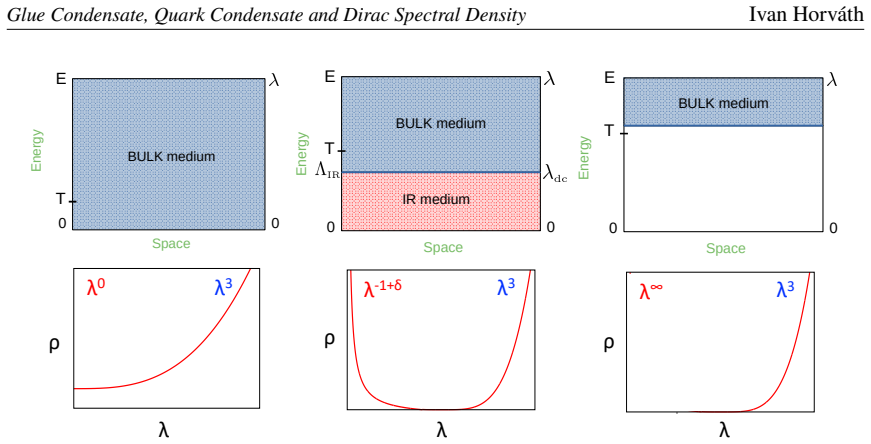
The central claim is that a regularized formula exists for the glue scalar density in terms of the Dirac spectral density, and that this expression reveals the relation between glue and quark scalar densities, its connection to the infrared phase, the distinction between anomalous and spontaneous symmetry breaking, and the interplay of ultraviolet and infrared physics in QCD.
What carries the argument
The regularized formula expressing glue scalar density as an integral involving the Dirac spectral density; it supplies the direct link between gluon condensate and eigenvalue distribution of the Dirac operator.
If this is right
- Glue and quark scalar densities are related through their common dependence on the Dirac spectrum.
- The infrared phase of QCD is encoded in the low-lying part of the same spectral density.
- Anomalous symmetry breaking is distinguished from spontaneous breaking by separate contributions visible in the formula.
- Ultraviolet and infrared physics in QCD are connected by the spectral integral without additional parameters.
Where Pith is reading between the lines
- Lattice practitioners could use the formula to extract the gluon condensate from existing Dirac eigenvalue data without separate glue-operator measurements.
- The spectral relation may constrain models of the QCD vacuum that posit specific infrared behaviors for the eigenvalue density.
- If the regularization holds non-perturbatively, it offers a route to study symmetry-breaking patterns in theories with similar Dirac operators but different gauge groups.
Load-bearing premise
The regularization procedure applied to the glue scalar density expression is valid and does not require further unstated conditions to relate the condensates and symmetry-breaking mechanisms.
What would settle it
A lattice computation that evaluates both sides of the regularized formula on the same gauge configurations and finds a statistically significant mismatch after all known ultraviolet subtractions.
Figures


read the original abstract
I derive the regularized formula for glue scalar density (gluon condensate) in terms of Dirac spectral density [arXiv:2509.03509], and elaborate on its uses and meaning. Particular attention is given to understanding of what this new formula reveals about the relation between glue and quark scalar densities, how it relates to IR phase, how it clarifies the distinction between anomalous and spontaneous ways of breaking symmetries, and what it says about the relation between UV and IR in QCD.
Editorial analysis
A structured set of objections, weighed in public.
Referee Report
Summary. The paper derives a regularized formula for the glue scalar density (gluon condensate) expressed in terms of the Dirac spectral density from the author's prior work (arXiv:2509.03509). It elaborates on the implications of this formula for the relation between glue and quark scalar densities, the infrared phase of QCD, the distinction between anomalous and spontaneous symmetry breaking, and the connection between UV and IR regimes.
Significance. If the derivation holds, the result offers a concrete link between the gluon condensate and the Dirac spectrum that could clarify non-perturbative aspects of the QCD vacuum and symmetry-breaking mechanisms. The approach builds directly on spectral-density techniques and may provide useful relations for lattice studies or effective models, particularly in distinguishing UV and IR contributions.
major comments (1)
- [Derivation of the regularized formula (main section following the abstract)] The regularization procedure for the glue scalar density formula must be shown to be independent of the specific definition of the Dirac spectral density in the referenced prior paper; otherwise the central relation risks being a re-expression rather than a new derivation. Please add an explicit comparison of the regularization steps to standard QCD schemes (e.g., dimensional regularization or lattice cutoffs) and state any additional assumptions.
minor comments (2)
- [Abstract] The abstract would benefit from stating the explicit form of the derived regularized formula (or at least its key structure) rather than only describing its uses.
- [References] Ensure the reference to arXiv:2509.03509 includes the full bibliographic details and is cited consistently throughout the text.
Simulated Author's Rebuttal
We thank the referee for the careful reading of our manuscript and the constructive suggestion. We address the major comment below.
read point-by-point responses
-
Referee: The regularization procedure for the glue scalar density formula must be shown to be independent of the specific definition of the Dirac spectral density in the referenced prior paper; otherwise the central relation risks being a re-expression rather than a new derivation. Please add an explicit comparison of the regularization steps to standard QCD schemes (e.g., dimensional regularization or lattice cutoffs) and state any additional assumptions.
Authors: We agree that an explicit demonstration of independence and a direct comparison to standard schemes will strengthen the presentation. The regularization in the present work is performed by subtracting the perturbative tail of the spectral density in a manner that follows the same logic as the subtraction of the perturbative contribution in the operator product expansion, which is independent of the precise ultraviolet cutoff used to define the spectral density in the prior paper. Nevertheless, to address the concern directly we will add a dedicated paragraph in the main derivation section that (i) recalls the regularization steps from arXiv:2509.03509, (ii) shows that the same subtraction can be obtained by imposing a hard momentum cutoff or by dimensional regularization on the underlying loop integrals, and (iii) lists the minimal assumptions (positivity of the spectral density and the existence of a well-defined perturbative tail). This addition will make clear that the relation constitutes a new derivation rather than a re-expression. revision: yes
Circularity Check
No significant circularity detected
full rationale
The paper derives a regularized formula for glue scalar density in terms of Dirac spectral density, citing prior work for the spectral density input. No equations or derivation steps are exhibited that reduce the claimed output to the inputs by construction, self-definition, or a load-bearing self-citation chain. The additional claims relating the formula to quark condensate, IR phase, and symmetry breaking distinctions introduce independent content beyond the cited input, rendering the derivation self-contained against external benchmarks.
Axiom & Free-Parameter Ledger
Reference graph
Works this paper leans on
-
[1]
A. Alexandru and I. Horváth,Possible New Phase of Thermal QCD,Phys. Rev. D100(2019) 094507 [1906.08047]
-
[2]
Phases of SU(3) Gauge Theories with Fundamental Quarks via Dirac Spectral Density
A. Alexandru and I. Horváth,Phases of SU(3) Gauge Theories with Fundamental Quarks via Dirac Spectral Density,Phys. Rev.D92(2015) 045038 [1502.07732]
work page internal anchor Pith review Pith/arXiv arXiv 2015
-
[3]
Horváth,The Infrared Phase of QCD and Anderson Localization,PoSQCHSC24(2025) 054 [2506.04114]
I. Horváth,The Infrared Phase of QCD and Anderson Localization,PoSQCHSC24(2025) 054 [2506.04114]. [4]𝜒QCD, CLQCDcollaboration,Separation of Infrared and Bulk in Thermal QCD,JHEP 2024(2024) 101 [2305.09459]
-
[4]
Horváth,Gluon condensate via Dirac spectral density: IR phase, scale anomaly, and IR decoupling,Phys
I. Horváth,Gluon condensate via Dirac spectral density: IR phase, scale anomaly, and IR decoupling,Phys. Rev. D112(2025) 094505 [2509.03509]
-
[5]
Nielsen,Gauge invariance and broken conformal symmetry,Nuclear Physics B97(1975) 527
N. Nielsen,Gauge invariance and broken conformal symmetry,Nuclear Physics B97(1975) 527
1975
-
[6]
Collins, A
J.C. Collins, A. Duncan and S.D. Joglekar,Trace and dilatation anomalies in gauge theories, Phys. Rev. D16(1977) 438. 7 Glue Condensate, Quark Condensate and Dirac Spectral DensityIvan Horváth
1977
-
[7]
Nielsen,The energy-momentum tensor in a non-abelian quark gluon theory,Nuclear Physics B120(1977) 212
N.K. Nielsen,The energy-momentum tensor in a non-abelian quark gluon theory,Nuclear Physics B120(1977) 212
1977
-
[8]
I. Horváth,Coherent lattice QCD,PoSLAT2006(2006) 053 [hep-lat/0610121]
work page internal anchor Pith review Pith/arXiv arXiv 2006
-
[9]
A Framework for Systematic Study of QCD Vacuum Structure II: Coherent Lattice QCD
I. Horvath,A Framework for Systematic Study of QCD Vacuum Structure II: Coherent Lattice QCD,hep-lat/0607031
work page internal anchor Pith review Pith/arXiv arXiv
-
[10]
Classical Limits of Scalar and Tensor Gauge Operators Based on the Overlap Dirac Matrix
A. Alexandru, I. Horváth and K.-F. Liu,Classical Limits of Scalar and Tensor Gauge Operators Based on the Overlap Dirac Matrix,Phys.Rev.D78(2008) 085002 [0803.2744]
work page internal anchor Pith review Pith/arXiv arXiv 2008
-
[11]
Banks and A
T. Banks and A. Casher,Chiral Symmetry Breaking in Confining Theories,Nucl.Phys.B169 (1980) 103
1980
-
[12]
Exactly massless quarks on the lattice
H. Neuberger,Exactly massless quarks on the lattice,Phys.Lett.B417(1998) 141 [hep-lat/9707022]
work page internal anchor Pith review Pith/arXiv arXiv 1998
-
[13]
Shifman, A.I
M.A. Shifman, A.I. Vainshtein and V.I. Zakharov,QCD and Resonance Physics. Theoretical Foundations,Nucl. Phys. B147(1979) 385
1979
-
[14]
Alexandru and I
A. Alexandru and I. Horváth,Private notes,Unpublished(2023)
2023
-
[15]
A. Alexandru and I. Horváth,Unusual Features of QCD Low-Energy Modes in the Infrared Phase,Phys. Rev. Lett.127(2021) 052303 [2103.05607]
-
[16]
A. Alexandru and I. Horváth,Anderson metal-to-critical transition in QCD,Phys. Lett. B 833(2022) 137370 [2110.04833]
-
[17]
A. Alexandru, I. Horváth and N. Bhattacharyya,Localized modes in the IR phase of QCD, Phys. Rev. D109(2024) 014501 [2310.03621]
-
[18]
A. Alexandru, C. Bonanno, M. D’Elia and I. Horváth,Dirac spectral density in Nf=2+1 QCD at T=230 MeV,Phys. Rev. D110(2024) 074515 [2404.12298]. 8
discussion (0)
Sign in with ORCID, Apple, or X to comment. Anyone can read and Pith papers without signing in.