Recognition: no theorem link
Tunable Dual-Type Weyl Points in Dirac-Weyl Semimetal CaAgBi
Pith reviewed 2026-05-15 01:22 UTC · model grok-4.3
The pith
First-principles calculations identify CaAgBi as hosting tunable dual-type Weyl points in addition to Dirac points.
A machine-rendered reading of the paper's core claim, the machinery that carries it, and where it could break.
Core claim
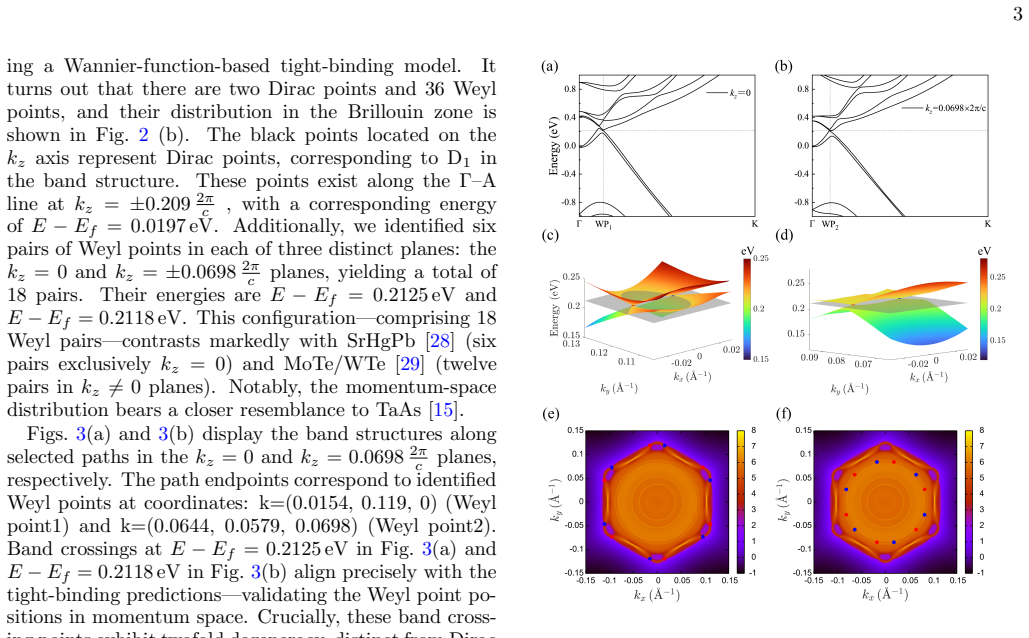
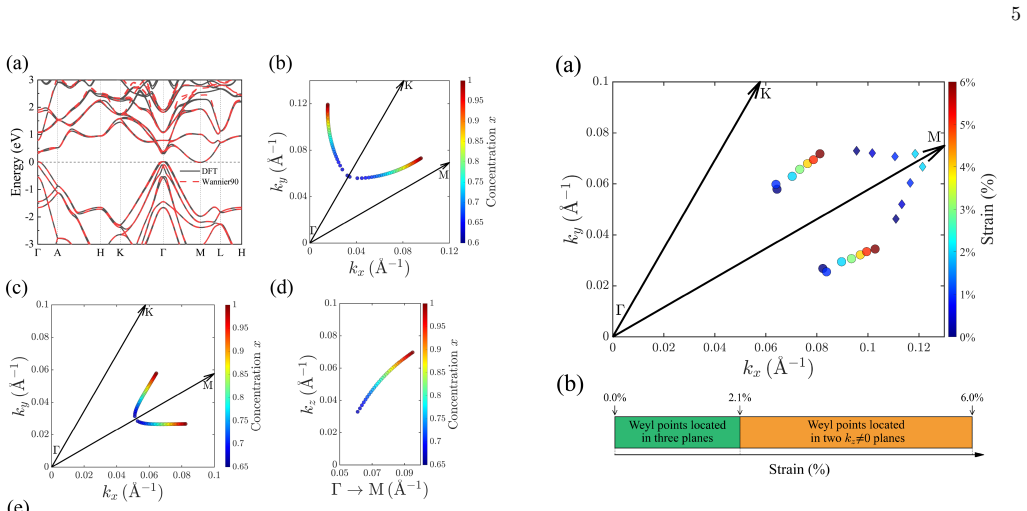
In CaAgBi, three pairs of Dirac points lie along the rotational axis, and calculations additionally locate 18 pairs of dual-type Weyl points distributed across three planes, with type-I Weyl points in the kz=0 plane and type-II in the planes at kz = ±0.0698 2π/c. The chirality of the Weyl points and the presence of surface Fermi arcs verify these topological features. Both the position and the annihilation of these points prove tunable via alloy engineering, showing different annihilation concentrations for the two Weyl types, and via external strains, with type-I points annihilating at 2.1% tensile biaxial strain along the Γ-M path while type-II points stay stable to 6% strain.
What carries the argument
First-principles band structure calculations that track the movement and merging of Dirac and Weyl points under alloy substitution and applied strain.
If this is right
- The positions of Weyl points can be modulated by alloy engineering, leading to different annihilation thresholds for type-I versus type-II points.
- Tensile biaxial strain causes annihilation of Weyl points in the kz=0 plane at 2.1% strain along the Γ-M path.
- Weyl points in the kz ≠ 0 planes remain stable under strains up to 6%.
- Alloy control driven by spin-orbit coupling provides a route to adjust Dirac-Weyl interactions.
Where Pith is reading between the lines
- Similar strain responses in other Dirac-Weyl materials could allow selective preservation of one Weyl type over another.
- The robustness difference between type-I and type-II points suggests potential for strain-tunable topological devices that switch between different semimetal phases.
- Experimental mapping of the specific kz locations could guide design of related compounds with deliberately placed Weyl points.
Load-bearing premise
The chosen first-principles method and parameters correctly reproduce the electronic band crossings and their topological character in CaAgBi.
What would settle it
Angle-resolved photoemission spectroscopy measurements failing to detect Fermi arcs or Weyl points at the calculated kz values, or strain experiments showing annihilation thresholds different from 2.1% for type-I points.
Figures



read the original abstract
Dirac-Weyl semimetals host both Dirac and Weyl fermions and the exploration of material candidates with tunable topological properties is essential to realize topological spintronic devices. In this work, we propose CaAgBi as a Dirac-Weyl semimetal with tunable type-I and type-II Weyl points based on first-principle calculations. In addition to the three pairs of Dirac points located along the rotational axis as previously reported, our calculations reveal 18 additional pairs of dual-type Weyl points distributed across three distinct planes: type-I in the $k_z=0$ plane and type-II in the $k_z= \pm 0.0698\,\frac{2\pi}{c}$ planes. The topological features are further confirmed through chirality of the Weyl points as well as the existence of surface Fermi arcs. Moreover, we find that the position and annihilation of Dirac and Weyl points are tunable by the alloy engineering and external strains. The alloy engineering is employed to modulate the positions of Weyl points, revealing different annihilation concentrations for type-I and type-II Weyl points, potentially offering novel experimental strategies for Weyl point manipulation. Under tensile biaxial strain, the Weyl points in the $k_{z}=0$ plane annihilate along the $\Gamma$--$\mathrm{M}$ path at $2.1\%$ strain, whereas the Weyl points in the $k_{z}\neq 0$ planes remain robust within $6\%$ strain. This work provides a versatile platform for manipulating Dirac/Weyl interactions, with spin-orbit coupling (SOC) driven alloy control and strain-selective engineering opening avenues for topological electronics.
Editorial analysis
A structured set of objections, weighed in public.
Referee Report
Summary. The manuscript proposes CaAgBi as a Dirac-Weyl semimetal hosting three pairs of Dirac points along the rotational axis plus 18 additional pairs of dual-type Weyl points (type-I in the kz=0 plane and type-II in the kz=±0.0698 2π/c planes), identified via first-principles calculations. Topological character is asserted through Weyl point chirality and surface Fermi arcs. Positions and annihilation of Dirac/Weyl points are reported as tunable by alloy engineering (different annihilation concentrations for type-I vs. type-II) and biaxial tensile strain (type-I annihilate at 2.1% along Γ–M while type-II remain stable to >6%).
Significance. If the reported kz coordinates and strain thresholds are robust, the work supplies a concrete material example of selective, dual-type Weyl point engineering via SOC-driven alloying and mechanical strain, which could serve as a testbed for topological spintronic device concepts.
major comments (2)
- [Results section (Weyl point coordinates and strain response)] Results section (Weyl point coordinates and strain response): The specific value kz=0.0698 2π/c for the type-II points and the 2.1% tensile-strain annihilation threshold for type-I points are given without convergence data on k-mesh density, exchange-correlation functional choice, or SOC treatment. Typical variations under PBE vs. hybrid functionals or denser meshes can shift crossings by 0.01–0.05 reciprocal-lattice units or tens of meV, comparable to the reported separations, so the dual-type classification and selective-tunability claim rest on unquantified numerical uncertainty.
- [Strain-engineering paragraph] Strain-engineering paragraph: The claim that type-I points annihilate at exactly 2.1% while type-II persist beyond 6% is load-bearing for the “selective” tunability narrative, yet no error bars, alternative-functional cross-checks, or explicit definition of the strain metric (e.g., lattice-constant change vs. energy minimization) are supplied.
minor comments (2)
- [Abstract and main text] Abstract and main text: The Brillouin-zone labeling (kz=0 plane, kz=±0.0698 2π/c planes) should be accompanied by an explicit figure or table reference showing the high-symmetry paths and the location of the reported crossings.
- [Notation] Notation: The phrase “18 additional pairs of dual-type Weyl points distributed across three distinct planes” would benefit from a table listing the exact (kx,ky,kz) coordinates and chirality signs for each pair.
Simulated Author's Rebuttal
We thank the referee for the careful reading and constructive comments on numerical robustness. We have performed additional convergence tests with denser meshes and hybrid functionals, which support our original claims, and will incorporate these details into the revised manuscript and supplementary information.
read point-by-point responses
-
Referee: Results section (Weyl point coordinates and strain response): The specific value kz=0.0698 2π/c for the type-II points and the 2.1% tensile-strain annihilation threshold for type-I points are given without convergence data on k-mesh density, exchange-correlation functional choice, or SOC treatment. Typical variations under PBE vs. hybrid functionals or denser meshes can shift crossings by 0.01–0.05 reciprocal-lattice units or tens of meV, comparable to the reported separations, so the dual-type classification and selective-tunability claim rest on unquantified numerical uncertainty.
Authors: We thank the referee for highlighting this important point. Our primary calculations employed the PBE functional with SOC included self-consistently on a 12×12×12 k-mesh. Additional tests using a denser 20×20×20 k-mesh shift the kz coordinate of the type-II points by less than 0.003 (2π/c) and the type-I annihilation strain by <0.2%. Cross-checks with the HSE06 hybrid functional yield kz ≈ 0.0705 (2π/c) and a strain threshold of 2.3%, preserving both the dual-type classification (type-I at kz=0, type-II at kz≠0) and the selective tunability. We will add a dedicated convergence subsection to the Supplementary Information with tables comparing k-mesh density, functional choice, and SOC treatment. revision: yes
-
Referee: Strain-engineering paragraph: The claim that type-I points annihilate at exactly 2.1% while type-II persist beyond 6% is load-bearing for the “selective” tunability narrative, yet no error bars, alternative-functional cross-checks, or explicit definition of the strain metric (e.g., lattice-constant change vs. energy minimization) are supplied.
Authors: We agree that an explicit definition and uncertainty estimates strengthen the selective-tunability claim. Biaxial tensile strain is applied by scaling the in-plane lattice constants (a=b) while relaxing the out-of-plane c lattice parameter and all atomic positions to minimize the total energy at each strain increment. With this definition, HSE06 calculations place type-I annihilation at 2.3% and confirm type-II stability beyond 6%. Energy convergence to 1 meV per atom implies an uncertainty of ±0.2% in the reported thresholds. We will revise the strain-engineering paragraph to state the metric explicitly and include the HSE cross-checks together with estimated uncertainties. revision: yes
Circularity Check
No circularity; results from direct first-principles DFT computation
full rationale
The paper's central claims (locations of 18 additional dual-type Weyl points at kz=0 and kz=±0.0698 2π/c, their chirality, surface arcs, and selective annihilation under 2.1% tensile strain or alloying) are obtained by standard first-principles band-structure calculations on the CaAgBi Hamiltonian. No quantity is defined in terms of itself, no parameter is fitted to a target dataset and then relabeled a prediction, and no load-bearing premise reduces to a self-citation chain. The single reference to prior Dirac-point locations is background only and does not carry the new dual-type or tunability results. The derivation is therefore self-contained and externally falsifiable by independent DFT runs.
Axiom & Free-Parameter Ledger
axioms (1)
- domain assumption Density functional theory with spin-orbit coupling accurately reproduces the topological band structure of CaAgBi near the Fermi level
Reference graph
Works this paper leans on
-
[1]
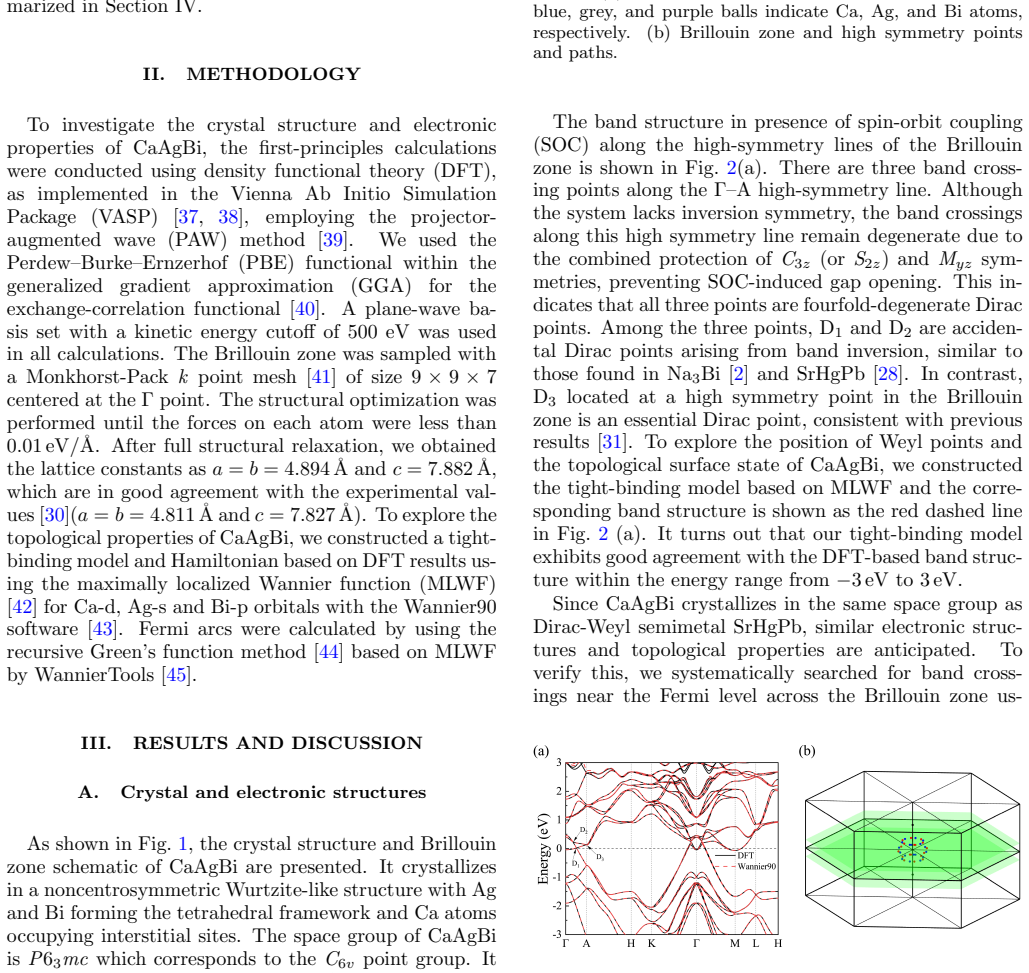
for Ca-d, Ag-s and Bi-p orbitals with the Wannier90 software [43]. Fermi arcs were calculated by using the recursive Green’s function method [44] based on MLWF by WannierTools [45]. III. RESULTS AND DISCUSSION A. Crystal and electronic structures As shown in Fig. 1, the crystal structure and Brillouin zone schematic of CaAgBi are presented. It crystallize...
work page 1984
-
[2]
S. M. Young, S. Zaheer, J. C. Teo, C. L. Kane, E. J. Mele, and A. M. Rappe, Dirac semimetal in three dimensions, Phys. Rev. Lett.108, 140405 (2012)
work page 2012
-
[3]
Z. Liu, B. Zhou, Y. Zhang, Z. Wang, H. Weng, D. Prabhakaran, S.-K. Mo, Z. Shen, Z. Fang, X. Dai, et al., Discovery of a three-dimensional topological Dirac semimetal, Na3Bi, Science343, 864 (2014)
work page 2014
-
[4]
I. Crassee, R. Sankar, W.-L. Lee, A. Akrap, and M. Or- lita, 3D Dirac semimetal Cd 3As2: A review of material properties, Phys. Rev. Materials2, 120302 (2018)
work page 2018
-
[5]
Z. Yin, X. Du, S. Zhang, C. Chen, D. Pei, J. Zhou, X. Gu, R. Xu, Q. Zhang, W. Zhao,et al., Electronic structure of antiferromagnetic Dirac semimetal candidate GdIn 3, Phys. Rev. Materials6, 084203 (2022)
work page 2022
-
[6]
D. Ram, J. Singh, S. Banerjee, A. Sundaresan, D. Samal, V. Kanchana, and Z. Hossain, Magnetotransport and electronic structure of EuAuSb: A candidate antiferro- magnetic Dirac semimetal, Phys. Rev. B109, 155152 (2024)
work page 2024
-
[7]
H.-W. Fang, A.-J. Liang, N. B. Schr¨ oter, S.-T. Cui, Z.-K. Liu, and Y.-L. Chen, Measurement of the elec- tronic structure of a type-II topological Dirac semimetal candidate VAl3 using angle-resolved photoelectron spec- troscopy, Tungsten5, 332 (2023)
work page 2023
-
[8]
L.-Y. Feng, R. A. B. Villaos, A. B. Maghirang III, Z.-Q. Huang, C.-H. Hsu, H. Lin, and F.-C. Chuang, Prediction of topological Dirac semimetal in Ca-based Zintl layered compounds CaM 2X2 (M= Zn or Cd; X= N, P, As, Sb, or Bi), Sci Rep12, 4582 (2022)
work page 2022
- [9]
-
[10]
B. Lv, H. Weng, B. Fu, X. P. Wang, H. Miao, J. Ma, P. Richard, X. Huang, L. Zhao, G. Chen,et al., Experi- mental discovery of Weyl semimetal TaAs, Phys. Rev. X 5, 031013 (2015)
work page 2015
-
[11]
D. Du, L. R. Thoutam, K. T. Genser, C. Zhang, K. M. Rabe, T. Samanta, T. Jung, B. Jalan, P. M. Voyles, and J. K. Kawasaki, Effect of Pt vacancies on magneto- transport of Weyl semimetal candidate GdPtSb epitaxial 7 films, Phys. Rev. Materials7, 084204 (2023)
work page 2023
-
[12]
J.-F. Wang, Q.-X. Dong, Z.-P. Guo, M. Lv, Y.-F. Huang, J.-S. Xiang, Z.-A. Ren, Z.-J. Wang, P.-J. Sun, G. Li, et al., NdAlSi: A magnetic Weyl semimetal candidate with rich magnetic phases and atypical transport prop- erties, Phys. Rev. B105, 144435 (2022)
work page 2022
-
[13]
Q. Lu, P. S. Reddy, H. Jeon, A. R. Mazza, M. Brahlek, W. Wu, S. A. Yang, J. Cook, C. Conner, X. Zhang, et al., Realization of a two-dimensional Weyl semimetal and topological Fermi strings, Nat. Commun.15, 6001 (2024)
work page 2024
-
[14]
R. Ono, A. Marmodoro, J. Schusser, Y. Nakata, E. F. Schwier, J. Braun, H. Ebert, J. Min´ ar, K. Sakamoto, and P. Kr¨ uger, Surface band characters of the Weyl semimetal candidate material MoTe 2 revealed by one-step angle- resolved photoemission theory, Phys. Rev. B103, 125139 (2021)
work page 2021
-
[15]
M. Kanagaraj, J. Ning, and L. He, Topological Co 3Sn2S2 magnetic Weyl semimetal: From fundamental under- standing to diverse fields of study, Rev. Phys.8, 100072 (2022)
work page 2022
- [16]
-
[17]
H. Weng, C. Fang, Z. Fang, B. A. Bernevig, and X. Dai, Weyl semimetal phase in noncentrosymmetric transition- metal monophosphides, Phys. Rev. X5, 011029 (2015)
work page 2015
-
[18]
Y. Kim, B. J. Wieder, C. Kane, and A. M. Rappe, Dirac line nodes in Inversion-Symmetric Crystals, Phys. Rev. Lett.115, 036806 (2015)
work page 2015
- [19]
-
[20]
R. Yu, H. Weng, Z. Fang, X. Dai, and X. Hu, Topo- logical node-line semimetal and Dirac semimetal state in antiperovskite Cu 3PdN, Phys. Rev. Lett.115, 036807 (2015)
work page 2015
-
[21]
L. Su, S. Li, J. Li, C. He, X.-T. Zeng, X.-L. Sheng, T. Ouyang, C. Zhang, C. Tang, and J. Zhong, I4/mcm- Si48: An Ideal Topological Nodal-Line Semimetal, ACS Materials Lett.4, 1726 (2022)
work page 2022
-
[22]
X. Du, C. An, X. Chen, Y. Zhou, M. Zhang, S. Wang, C. Chen, Y. Zhou, X. Yang, and Z. Yang, Structural, vibrational, and electrical transport properties of nodal- line semimetal candidate CaCdGe under high pressure, Phys. Rev. B108, 014109 (2023)
work page 2023
-
[23]
X.-B. Wang, X.-M. Ma, E. Emmanouilidou, B. Shen, C.-H. Hsu, C.-S. Zhou, Y. Zuo, R.-R. Song, S.-Y. Xu, G. Wang,et al., Topological surface electronic states in candidate nodal-line semimetal CaAgAs, Phys. Rev. B 96, 161112 (2017)
work page 2017
-
[24]
N. Xu, Y. Qian, Q. Wu, G. Aut` es, C. E. Matt, B. Lv, M. Yao, V. N. Strocov, E. Pomjakushina, K. Conder, et al., Trivial topological phase of CaAgP and the topo- logical nodal-line transition in CaAg(P 1−xAsx), Phys. Rev. B97, 161111 (2018)
work page 2018
-
[25]
A. Damascelli, Probing the electronic structure of com- plex systems by ARPES, Physica Scripta2004, 61 (2004)
work page 2004
-
[26]
D. T. Son and N. Yamamoto, Berry curvature, triangle anomalies, and the chiral magnetic effect in Fermi liquids, Phys. Rev. Lett.109, 181602 (2012)
work page 2012
- [27]
-
[28]
E. Liu, Y. Sun, N. Kumar, L. Muechler, A. Sun, L. Jiao, S.-Y. Yang, D. Liu, A. Liang, Q. Xu,et al., Giant anomalous Hall effect in a ferromagnetic kagome-lattice semimetal, Nat. Phys.14, 1125 (2018)
work page 2018
-
[29]
H. Gao, Y. Kim, J. W. Venderbos, C. Kane, E. Mele, A. M. Rappe, and W. Ren, Dirac-Weyl semimetal: co- existence of Dirac and Weyl fermions in polar hexagonal ABC crystals, Phys. Rev. Lett.121, 106404 (2018)
work page 2018
-
[30]
L. Meng, J. Wu, Y. Li, and J. Zhong, Dirac–Weyl semimetal phase in noncentrosymmetric transition metal monochalcogenides MoTe and WTe, J. Mater. Chem. C 7, 12151 (2019)
work page 2019
- [31]
-
[32]
C. Chen, S.-S. Wang, L. Liu, Z.-M. Yu, X.-L. Sheng, Z. Chen, and S. A. Yang, Ternary wurtzite CaAgBi ma- terials family: A playground for essential and accidental, type-I and type-II Dirac fermions, Phys. Rev. Materials 1, 044201 (2017)
work page 2017
- [33]
-
[34]
Z. Fang, H. Gao, J. W. Venderbos, and A. M. Rappe, Ideal near-Dirac triple-point semimetal in III-V semicon- ductor alloys, Phys. Rev. B101, 125202 (2020)
work page 2020
-
[35]
H. Huang, K.-H. Jin, and F. Liu, Alloy engi- neering of topological semimetal phase transition in MgTa2−xNbxN3, Phys. Rev. Lett.120, 136403 (2018)
work page 2018
- [36]
- [37]
-
[38]
G. Kresse and J. Furthm¨ uller, Efficient iterative schemes forab initiototal-energy calculations using a plane-wave basis set, Phys. Rev. B54, 11169 (1996)
work page 1996
-
[39]
G. Kresse and D. Joubert, From ultrasoft pseudopoten- tials to the projector augmented-wave method, Phys. Rev. B59, 1758 (1999)
work page 1999
-
[40]
P. E. Bl¨ ochl, Projector augmented-wave method, Phys. Rev. B50, 17953 (1994)
work page 1994
-
[41]
J. P. Perdew, K. Burke, and M. Ernzerhof, Generalized gradient approximation made simple, Phys. Rev. Lett. 77, 3865 (1996)
work page 1996
-
[42]
H. J. Monkhorst and J. D. Pack, Special points for Brillouin-zone integrations, Phys. Rev. B13, 5188 (1976)
work page 1976
-
[43]
A. A. Mostofi, J. R. Yates, G. Pizzi, Y.-S. Lee, I. Souza, D. Vanderbilt, and N. Marzari, An updated version of wannier90: A tool for obtaining maximally-localised wannier functions, Comput. Phys. Commun.185, 2309 (2014)
work page 2014
-
[44]
A. A. Mostofi, J. R. Yates, Y.-S. Lee, I. Souza, D. Van- derbilt, and N. Marzari, wannier90: A tool for obtaining maximally-localised Wannier functions, Comput. Phys. Commun.178, 685 (2008). 8
work page 2008
-
[45]
M. L. Sancho, J. L. Sancho, J. L. Sancho, and J. Rubio, Highly convergent schemes for the calculation of bulk and surface Green functions, J. Phys. F: Met. Phys.15, 851 (1985)
work page 1985
-
[46]
Q. Wu, S. Zhang, H.-F. Song, M. Troyer, and A. A. Soluyanov, Wanniertools : An open-source software package for novel topological materials, Comput. Phys. Commun.224, 405 (2018)
work page 2018
-
[47]
A. A. Soluyanov, D. Gresch, Z. Wang, Q. Wu, M. Troyer, X. Dai, and B. A. Bernevig, Type-II weyl semimetals, Nature (London)527, 495 (2015)
work page 2015
-
[48]
Q. Xu, Y. Zhang, K. Koepernik, W. Shi, J. van den Brink, C. Felser, and Y. Sun, Comprehensive scan for nonmagnetic weyl semimetals with nonlinear optical re- sponse. npj comput, npj Comput Mater6, 1038 (2020)
work page 2020
- [49]
-
[50]
W. Porod and D. Ferry, Modification of the virtual- crystal approximation for ternary III-V compounds, Phys. Rev. B27, 2587 (1983)
work page 1983
-
[51]
H. Gao, J. Strockoz, M. Frakulla, J. W. Venderbos, and H. Weng, Noncentrosymmetric topological Dirac semimetals in three dimensions, Phys. Rev. B103, 205151 (2021)
work page 2021
-
[52]
L. S. Xie, L. M. Schoop, S. A. Medvedev, C. Felser, and R. Cava, Pressure-induced structural phase transition in the half-Heusler compound CaAuBi, Solid State Sci.30, 6 (2014)
work page 2014
discussion (0)
Sign in with ORCID, Apple, or X to comment. Anyone can read and Pith papers without signing in.