Recognition: 2 theorem links
· Lean TheoremKinetic effects on the phase behavior and microstructural transitions of a thermoresponsive polymer solution
Pith reviewed 2026-05-15 01:21 UTC · model grok-4.3
The pith
Pluronic F127 solutions show a multi-step cooling transition through metastable micellar states that fades with repeated cycles.
A machine-rendered reading of the paper's core claim, the machinery that carries it, and where it could break.
Core claim
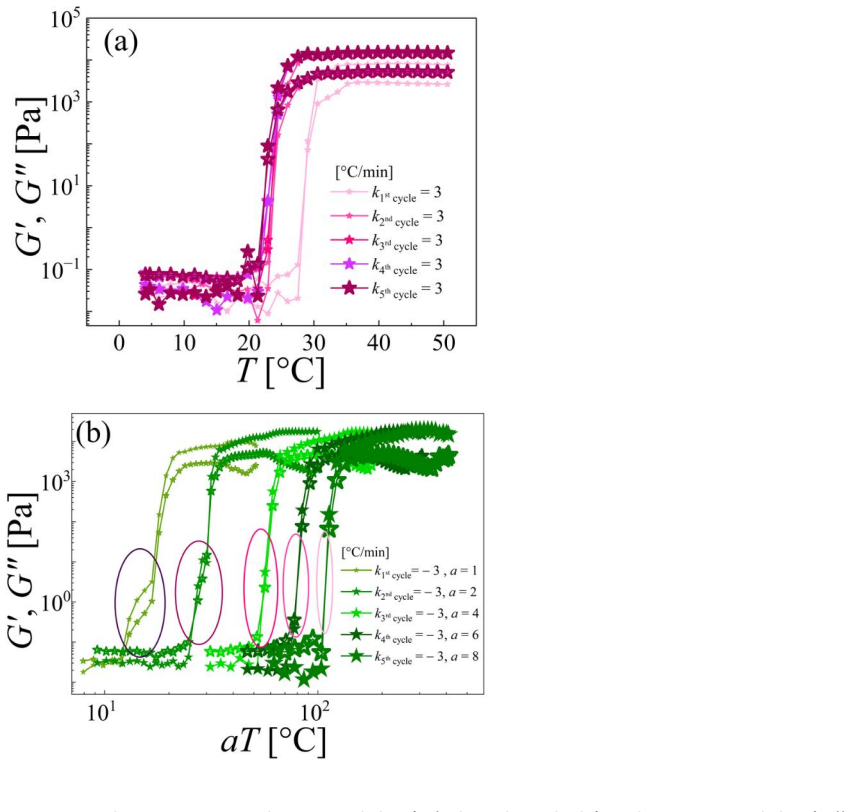
The thermoresponsive behavior of Pluronic F127 is not a simple reversible micellization; cooling instead follows a multi-step pathway through transient metastable states whose signature weakens over successive thermal cycles, and this pathway is captured by a mathematical model of the kinetics while SAXS shows the underlying shift from disordered to ordered microstructures.
What carries the argument
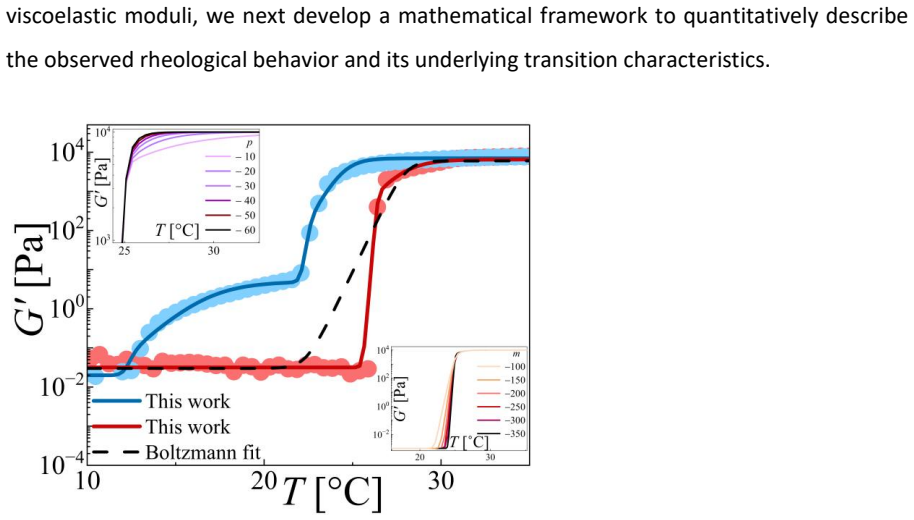
The multi-step transition observed in viscoelastic parameters during cooling, which the model treats as successive kinetic reorganizations of micelles through metastable intermediates.
If this is right
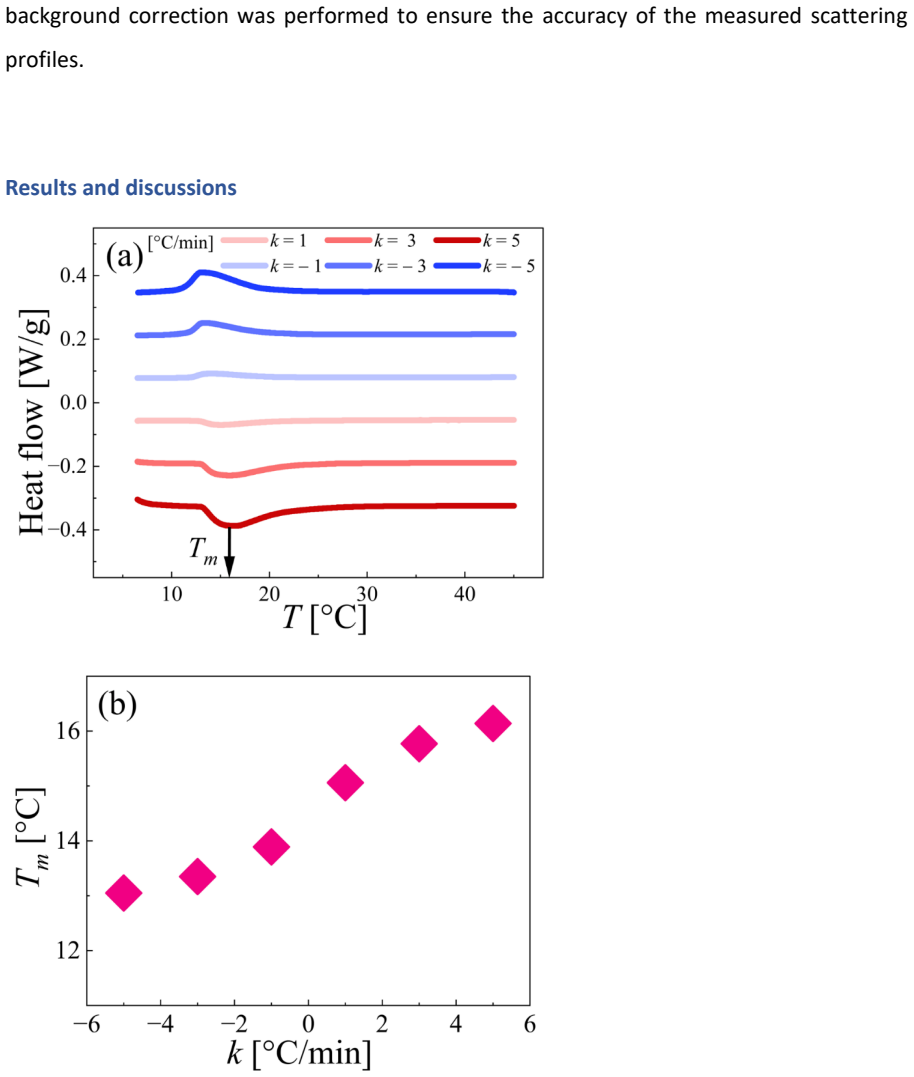
- Micellization temperature and peak intensity shift systematically with the rate of temperature change.
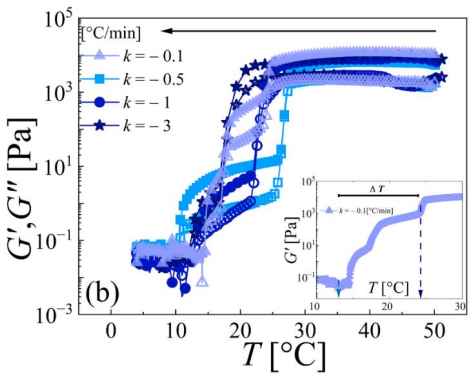
- The multi-step cooling signature is transient and diminishes with each successive heating-cooling cycle.
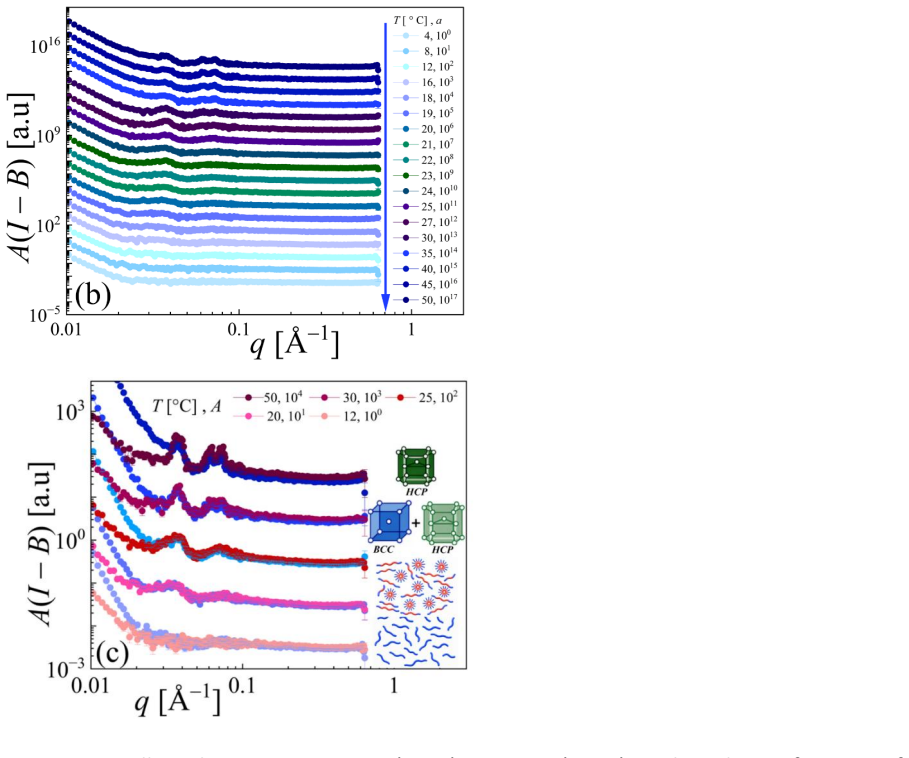
- SAXS peaks track a clear progression from disordered unimers or micelles to a lattice with long-range order as temperature rises.
- Phase boundaries depend on both the direction and history of the thermal path taken.
Where Pith is reading between the lines
- Varying the number of thermal cycles could be used to select different final microstructures in the same material.
- Kinetic models of this form may apply to other block-copolymer solutions where cooling paths deviate from simple reversibility.
- The phase diagram suggests that device or formulation protocols must specify both heating and cooling rates to achieve reproducible states.
Load-bearing premise
The distinct steps seen on cooling come from real kinetic reorganization and metastable states inside the sample rather than from artifacts caused by how fast the temperature is changed or by the sample's prior thermal history.
What would settle it
Performing the same cooling runs at much slower ramp rates or after many additional thermal cycles would eliminate the separate steps if they are intrinsic and transient, while the steps would remain unchanged if they are measurement artifacts.
Figures





read the original abstract
The thermoresponsive behavior of Pluronic F127 solutions is governed by temperature-dependent micellization and complex self-assembly of these micelles. This study investigates the effect of thermal stimuli on the kinetics of phase transition of Pluronic systems during heating and cooling cycles. We employ Differential Scanning Calorimetry measurements to investigate the dependence of the micellization temperature on thermal stimuli, revealing that both the micellization temperature and the peak intensity vary systematically with the applied thermal ramp rate. Furthermore, we employ rheological characterization which reveals a sharp sol to soft-solid transition upon heating. Interestingly, we observe a novel multi-step transition during the cooling phase, indicating a more complex reorganization pathway with intermediate metastable states than typically assumed for reversible micellization. Our findings indicate that the characteristic multi-step cooling transition is transient, gradually weakening with successive thermal cycles. We also present a comprehensive mathematical model which accurately captures the kinetics and multiple step transition in viscoelastic parameters. Significantly, the distinct peaks in Small-Angle X-ray Scattering (SAXS) measurements clearly reveal the evolution from a disordered unimers/micelles state at low temperatures to a highly ordered lattice with long-range spatial correlation at elevated temperatures. We also present a comprehensive phase diagram highlighting the critical role of thermal stimuli and pathways in defining the phase behavior of Pluronic system. This work, therefore, offers essential experimental and theoretical insights into the thermally driven self-assembly, transition kinetics, and microstructural evolution of thermoreversible Pluronic solution.
Editorial analysis
A structured set of objections, weighed in public.
Referee Report
Summary. The manuscript examines kinetic influences of thermal ramp rates on the phase behavior and self-assembly of Pluronic F127 solutions. DSC measurements show systematic variation of micellization temperature and peak intensity with ramp rate. Rheology reveals a sharp sol-to-soft-solid transition on heating and a novel multi-step transition on cooling, interpreted as evidence of metastable intermediate states in a complex reorganization pathway; this multi-step feature weakens over successive thermal cycles. A mathematical model is presented that captures the observed kinetics and viscoelastic multi-step behavior. SAXS data confirm the microstructural evolution from disordered unimers/micelles to an ordered lattice with long-range correlations at high temperature, and a phase diagram is constructed to illustrate the role of thermal pathways.
Significance. If the multi-step cooling transition is shown to reflect intrinsic kinetic metastability rather than experimental artifacts, the work would provide useful experimental and modeling insights into non-equilibrium pathways in thermoresponsive micellar systems, with relevance to controlling microstructure via thermal history in soft-matter applications.
major comments (3)
- [Rheological characterization] Rheological characterization section: The central claim that the multi-step cooling transition indicates metastable intermediate states (rather than ramp-rate or history-dependent artifacts) is load-bearing for both the novelty assertion and the model's validity. The reported weakening over cycles and ramp-rate sensitivity already indicate strong history dependence; without explicit controls that isolate ramp rate from prior cycle number (e.g., fresh-sample slow ramps or long isothermal holds at intermediate temperatures), the steps could arise from heterogeneous packing or stress relaxation instead of true kinetic reorganization.
- [Mathematical model] Mathematical model section: The manuscript states that the model 'accurately captures the kinetics and multiple step transition in viscoelastic parameters,' yet provides no equations, parameter definitions, fitting procedures, or independent validation metrics. This absence prevents assessment of whether the model is predictive or reduces to post-hoc fitting, leaving the kinetic interpretation under-supported.
- [SAXS measurements] SAXS measurements and discussion: SAXS resolves the heating pathway to the ordered lattice but lacks equivalent temporal resolution for the cooling multi-step transition. Consequently, the model's kinetic equations for the cooling pathway remain under-constrained by direct microstructural data.
minor comments (2)
- [Abstract] Abstract: The phrase 'comprehensive mathematical model' is repeated; a single concise statement would improve readability.
- [Phase diagram] Phase diagram: Details on how the boundaries are quantitatively determined from the combined DSC, rheology, and SAXS data are not fully specified, which would aid reproducibility.
Simulated Author's Rebuttal
We thank the referee for the constructive and detailed comments. We address each major point below and will revise the manuscript to incorporate additional experimental controls, model details, and clarifications.
read point-by-point responses
-
Referee: [Rheological characterization] Rheological characterization section: The central claim that the multi-step cooling transition indicates metastable intermediate states (rather than ramp-rate or history-dependent artifacts) is load-bearing for both the novelty assertion and the model's validity. The reported weakening over cycles and ramp-rate sensitivity already indicate strong history dependence; without explicit controls that isolate ramp rate from prior cycle number (e.g., fresh-sample slow ramps or long isothermal holds at intermediate temperatures), the steps could arise from heterogeneous packing or stress relaxation instead of true kinetic reorganization.
Authors: We agree that isolating intrinsic kinetics from history-dependent artifacts requires explicit controls. In the revised manuscript we will add rheological measurements on fresh samples using slow ramp rates and long isothermal holds at the temperatures of the observed steps. These data will show that the multi-step signature persists independently of cycle number, supporting the metastable-state interpretation rather than heterogeneous packing or relaxation effects. revision: yes
-
Referee: [Mathematical model] Mathematical model section: The manuscript states that the model 'accurately captures the kinetics and multiple step transition in viscoelastic parameters,' yet provides no equations, parameter definitions, fitting procedures, or independent validation metrics. This absence prevents assessment of whether the model is predictive or reduces to post-hoc fitting, leaving the kinetic interpretation under-supported.
Authors: We apologize for the omission of technical detail. The model comprises a set of coupled ordinary differential equations governing micelle nucleation, growth, and ordering kinetics, linked to viscoelastic moduli via a Maxwell-type constitutive relation. Parameters were obtained by nonlinear least-squares fitting to the measured G' and G'' traces. In the revision we will present the full equations, all parameter definitions, the fitting protocol, and quantitative validation metrics (including R^{2} and residual analysis) so that the model's predictive capability can be assessed directly. revision: yes
-
Referee: [SAXS measurements] SAXS measurements and discussion: SAXS resolves the heating pathway to the ordered lattice but lacks equivalent temporal resolution for the cooling multi-step transition. Consequently, the model's kinetic equations for the cooling pathway remain under-constrained by direct microstructural data.
Authors: We concur that the present SAXS data set emphasizes the heating branch. The cooling multi-step kinetics are currently constrained by the rheological time series. In the revised manuscript we will add an explicit discussion of this limitation, clarify how the rheological signatures inform the cooling equations, and note that dedicated time-resolved SAXS during cooling would provide stronger microstructural validation. We will also indicate this as a direction for future work. revision: partial
Circularity Check
No significant circularity detected; derivation rests on independent experimental observations.
full rationale
The paper reports DSC, rheology, and SAXS measurements of Pluronic F127 phase behavior under varying thermal ramps and cycles, then introduces a mathematical model stated to capture the observed multi-step cooling kinetics. No equations, parameter-fitting procedures, or self-citations are quoted that reduce any claimed prediction to its own inputs by construction. The multi-step transition is presented as an empirical finding whose transient nature is directly observed across cycles; the model is described only at the level of 'accurately captures' without evidence that its outputs are definitionally equivalent to fitted parameters. The phase diagram and microstructural claims are tied to direct SAXS peaks rather than imported uniqueness theorems or ansatzes. The chain therefore remains self-contained against external benchmarks.
Axiom & Free-Parameter Ledger
Lean theorems connected to this paper
-
IndisputableMonolith/Cost/FunctionalEquation.leanwashburn_uniqueness_aczel unclear?
unclearRelation between the paper passage and the cited Recognition theorem.
We also present a comprehensive mathematical model which accurately captures the kinetics and multiple step transition in viscoelastic parameters... G′ = ∑ ... (Eq. 3)
-
IndisputableMonolith/Foundation/RealityFromDistinction.leanreality_from_one_distinction unclear?
unclearRelation between the paper passage and the cited Recognition theorem.
SAXS... evolution from a disordered unimers/micelles state... to a highly ordered lattice
What do these tags mean?
- matches
- The paper's claim is directly supported by a theorem in the formal canon.
- supports
- The theorem supports part of the paper's argument, but the paper may add assumptions or extra steps.
- extends
- The paper goes beyond the formal theorem; the theorem is a base layer rather than the whole result.
- uses
- The paper appears to rely on the theorem as machinery.
- contradicts
- The paper's claim conflicts with a theorem or certificate in the canon.
- unclear
- Pith found a possible connection, but the passage is too broad, indirect, or ambiguous to say the theorem truly supports the claim.
Reference graph
Works this paper leans on
- [1]
-
[2]
Stimuli -responsive polysaccharide -based smart hydrogels and their emerging applications
Srivastava N, Choudhury AR. Stimuli -responsive polysaccharide -based smart hydrogels and their emerging applications. Industrial & Engineering Chemistry Research. 2022;62(2):841–66
work page 2022
-
[3]
Emerging applications of stimuli-responsive polymer materials
Stuart MAC, Huck WT, Genzer J, Müller M, Ober C, Stamm M, et al. Emerging applications of stimuli-responsive polymer materials. Nature materials. 2010;9(2):101–13. 37
work page 2010
-
[4]
Experimental soft -matter science
Nagel SR. Experimental soft -matter science. Reviews of modern physics. 2017;89(2):025002
work page 2017
-
[5]
Liu F, Urban, M. W. Recent Advances and Challenges in Designing Stimuli -Responsive Polymers. Progress In Polymer Science. 2010;35(1-2):3–23
work page 2010
-
[6]
Fundamentals and effects of biomimicking stimuli - responsive polymers for engineering functions
Korde JM, Kandasubramanian B. Fundamentals and effects of biomimicking stimuli - responsive polymers for engineering functions. Industrial & Engineering Chemistry Research. 2019;58(23):9709–57
work page 2019
-
[7]
Understanding the role of sample preparation parameters on gelation of a colloidal dispersion
Karmakar R, Acharya P, Suman K. Understanding the role of sample preparation parameters on gelation of a colloidal dispersion. Physics of Fluids. 2025;37(12)
work page 2025
-
[8]
Winter H, Mours M. Rheology of Polymers Near Liquid-Solid Transitions Neutron Spin Echo Spectroscopy Viscoelasticity Rheology, volume 134 of Advances in Polymer Science. 1997
work page 1997
-
[9]
Collapse of Gels and the Critical Endpoint
Tanaka T. Collapse of Gels and the Critical Endpoint. Physical Review Letters. 1978;40(12):820–3
work page 1978
-
[10]
Hydrogel -based actuators: possibilities and limitat ions
Ionov L. Hydrogel -based actuators: possibilities and limitat ions. Materials Today. 2014;17(10):494–503
work page 2014
-
[11]
Yao Y, Shao F, Peng X, Wang H, Wang K, Zhu K. Emodin in -situ delivery with Pluronic F-127 hydrogel for myocardial infarction treatment: Enhancing efficacy and reducing hepatotoxicity. Life Sciences. 2024;354:122963
work page 2024
-
[12]
Suman K, Sourav S, Joshi YM. Rheological signatures of gel –glass transition and a revised phase diagram of an aqueous triblock copolymer solution of Pluronic F127. Physics of Fluids. 2021;33(7)
work page 2021
-
[13]
Thermodynamic studies on the gel- sol transition of some pluronic polyols
Vadnere M, Amidon G, Lindenbaum S, Haslam JL. Thermodynamic studies on the gel- sol transition of some pluronic polyols. International journal of pharmaceutics. 1984;22(2 - 3):207–18
work page 1984
-
[14]
Self -assembly in aqueous block copolymer solutions
Malmsten M, Lindman B. Self -assembly in aqueous block copolymer solutions. Macromolecules. 1992;25(20):5440–5
work page 1992
-
[15]
Temperature responsive gels based on Pluronic F127 and poly (vinyl alcohol)
Bercea M, Darie RN, Ni ţă LE, Morariu S. Temperature responsive gels based on Pluronic F127 and poly (vinyl alcohol). Industrial & engineering chemistry research. 2011;50(7):4199–206
work page 2011
-
[16]
Alexandridis P, Hatton TA. Poly (ethylene oxide) poly (pro pylene oxide) poly (ethylene oxide) block copolymer surfactants in aqueous solutions and at interfaces: 38 thermodynamics, structure, dynamics, and modeling. Colloids and Surfaces A: Physicochemical and Engineering Aspects. 1995;96(1-2):1–46
work page 1995
-
[17]
Gelation and long -time relaxation of aqueous solutions of Pluronic F127
Hopkins CC, de Bruyn JR. Gelation and long -time relaxation of aqueous solutions of Pluronic F127. Journal of Rheology. 2019;63(1):191–201
work page 2019
-
[18]
Pluronic® block copolymers as novel polymer therapeutics for drug and gene delivery
Kabanov AV, Batrakova EV, Alakhov VY. Pluronic® block copolymers as novel polymer therapeutics for drug and gene delivery. Journal of controlled release. 2002;82(2-3):189–212
work page 2002
-
[19]
Wanka G, Hoffmann H, Ulbricht W. Phase diagrams and aggregation behavior of poly (oxyethylene)-poly (oxypropylene) -poly (oxyethylene) triblock copolymers in aqueous solutions. Macromolecules. 1994;27(15):4145–59
work page 1994
-
[20]
Russo G, Delpiano GR, Carucci C, Grosso M, Dessì C, Söderman O, et al. Tuning Pluronic F127 phase transitions by adding physiological amounts of salts: A rheology, SAXS, and NMR investigation. European Polymer Journal. 2024;204:112714
work page 2024
-
[21]
Cryo -TEM and SANS microstructural study of pluronic polymer solutions
Mortensen K, Talmon Y. Cryo -TEM and SANS microstructural study of pluronic polymer solutions. Macromolecules. 1995;28(26):8829–34
work page 1995
-
[22]
Branca C, D'Angelo G. Aggregation behavior of pluronic F127 solutions in presence of chitosan/clay nanocomposites examin ed by dynamic light scattering. J Colloid Interface Sci. 2019;542:289–95
work page 2019
-
[23]
Hexagonal close packing of nonionic surfactant micelles in water
Zeng X, Liu Y, Impéror -Clerc M. Hexagonal close packing of nonionic surfactant micelles in water. The Journal of Physical Chemistry B. 2007;111(19):5174–9
work page 2007
-
[24]
Hexagonal close -packed sphere phase of conformationally symmetric block copolymer
Hsu N -W, Nouri B, Chen L -T, Chen H -L. Hexagonal close -packed sphere phase of conformationally symmetric block copolymer. Macromolecules. 2020;53(21):9665–75
work page 2020
-
[25]
Gan Z, Xu Z, Tian K, Zhou D, Li L, Ma Z, et al. Stabilizing hexagonally close-packed phase in single -component b lock copolymers through rational symmetry breaking. Nature Communications. 2024;15(1):6581
work page 2024
-
[26]
Lee Y, Chung HJ, Yeo S, Ahn C -H, Lee H, Messersmith PB, et al. Thermo -sensitive, injectable, and tissue adhesive sol –gel transition hyaluronic acid/pluronic com posite hydrogels prepared from bio-inspired catechol-thiol reaction. Soft Matter. 2010;6(5):977–83
work page 2010
-
[27]
On the rheology of Pluronic F127 aqueous solutions
Jalaal M, Cottrell G, Balmforth N, Stoeber B. On the rheology of Pluronic F127 aqueous solutions. Journal of Rheology. 2017;61(1):139–46
work page 2017
-
[28]
Liu S, Li L. Multiple phase transition and scaling law for poly (ethylene oxide) –poly (propylene oxide)–poly (ethylene oxide) triblock copolymer in aqueous solution. ACS applied materials & interfaces. 2015;7(4):2688–97. 39
work page 2015
-
[29]
Agrawal R, Spicer PT, García-Tuñón E. Connecting bulk rheology, structural transitions and heterogeneous flow in Pluronic F127 micellar cubic liquid crystals using rheo-microscopy. Journal of colloid and interface science. 2025;699:138226
work page 2025
-
[30]
Transition vitreuse dans les polymères amo rphes
Kovacs AJ. Transition vitreuse dans les polymères amo rphes. Etude phénoménologique. Berlin, Heidelberg: Springer Berlin Heidelberg; 1964. 394–507 p
work page 1964
-
[31]
Thermal history asymmetry and dissipation in dense colloidal microgel glasses
Kawale SV, Joshi YM, Bandyopadhyay R. Thermal history asymmetry and dissipation in dense colloidal microgel glasses. Journal of Colloid and Interface Science. 2026:139830
work page 2026
-
[32]
Li X, Park E -k, Hyun K, Oktavia L, Kwak M. Rheological analysis of core -stabilized Pluronic F127 by semi -interpenetrating network (sIPN) in aqueous solution. Journal of Rheology. 2018;62(1):107–20
work page 2018
-
[33]
Pradines B, Djabourov M, Vauthier C, Loiseau PM, Ponchel G, Bouchemal K. Gelation and micellization behaviors of pluronic® F127 hydrogel containing poly (isobutylcyanoacrylate) nanoparticles specifically designed for mucosal application. Colloids and Surfaces B: Biointerfaces. 2015;135:669–76
work page 2015
-
[34]
Mastering rheology: A strategic and practical guide for empowering all users
Suman K. Mastering rheology: A strategic and practical guide for empowering all users. Industrial & Engineering Chemistry Research. 2025;64(42):20091–108
work page 2025
-
[35]
Schmolka IR. Artificial skin I. Preparation and properties of pluronic F‐127 gels for treatment of burns. Journal of biomedical materials research. 1972;6(6):571–82
work page 1972
-
[36]
Shriky B, Kelly A, Isreb M, Babenko M, Mahmoudi N, Rogers S, et al. Pluronic F127 thermosensitive injectable smart hydrogels for controlled drug delivery system development. Journal of Colloid and Interface Science. 2020;565:119–30
work page 2020
-
[37]
Barba AA, d'Amore M, Grassi M, Chirico S, Lamberti G, Titomanlio G. Investigation of Pluronic© F127 –Water solutions phase transitions by DSC and dielectric spectroscopy. Journal of applied polymer science. 2009;114(2):688–95
work page 2009
-
[38]
Nucleation and growth of micellar polycrystals under time -dependent volume fraction conditions
Louhichi A, Tamborini E, Ghofraniha N, Caton F, Roux D, Oberdisse J, et al. Nucleation and growth of micellar polycrystals under time -dependent volume fraction conditions. Physical Review E—Statistical, Nonlinear, and Soft Matter Physics. 2013;87(3):032306
work page 2013
-
[39]
Franco S, Buratti E, Nigro V, Bertoldo M, Ruzicka B, Angelini R. Thermal behaviour of microgels composed of interpenetrating polymer networks of poly (N -isopropylacrylamide) and poly (acrylic acid): A calorimetric study. Polymers. 2021;14(1):115
work page 2021
-
[40]
Fundamentals of Solidification: Trans Tech Publications Limited; 1998
Kurz W, Fisher D. Fundamentals of Solidification: Trans Tech Publications Limited; 1998. 40
work page 1998
-
[41]
Modelling the flow behaviour of very shear -thinning liquids
Roberts G, Barnes H, Carew P. Modelling the flow behaviour of very shear -thinning liquids. Chemical Engineering Science. 2001;56(19):5617–23
work page 2001
-
[42]
Kopač T. Mathematical model for characterization of temperature -responsive polymers: A study on the rheological behavior of gelatin and poly (N -isopropylacrylamide). Polymer Testing. 2024;133:108402
work page 2024
-
[43]
Analysis of linear viscoelasticity of a crosslinking polymer at the gel point
Winter HH, Chambon F. Analysis of linear viscoelasticity of a crosslinking polymer at the gel point. Journal of rheology. 1986;30(2):367–82
work page 1986
-
[44]
Winter HH. Can the gel point of a cross‐linking polymer be detected by the G′ –G ″crossover? Polymer Engineering & Science. 1987;27(22):1698–702
work page 1987
-
[45]
Phenomenological model of viscoelasticity for systems undergoing sol–gel transition
Suman K, Shanbhag S, Joshi YM. Phenomenological model of viscoelasticity for systems undergoing sol–gel transition. Physics of Fluids. 2021;33(3)
work page 2021
-
[46]
Viscoelastic properties of polymers
Ferry JD, Myers HS. Viscoelastic properties of polymers. Journal of The Electrochemical Society. 1961;108(7):142C–3C
work page 1961
-
[47]
Representation of linear viscoelastic behavior by mathematical models
Tschoegl NW. Representation of linear viscoelastic behavior by mathematical models. The Phenomenological Theory of Linear Viscoelastic Behavior: An Introduction: Springer
-
[48]
Linking self -assembly, rheology, and gel transition in attractive colloids
Zaccone A, Winter HH, Siebenbürger M, Ballauff M. Linking self -assembly, rheology, and gel transition in attractive colloids. Journal of Rheology. 2014;58(5):1219–44
work page 2014
-
[49]
Mortensen K, Batsberg W, Hvidt S. Effects of PEO− PPO diblock impurities on the cubic structure of aqueous PEO− PPO− PEO pl uronics micelles: fcc and bcc ordered structures in F127. Macromolecules. 2008;41(5):1720–7
work page 2008
-
[50]
Glatter O, Kratky O. Small angle x-ray scattering. London ;: Academic Press; 1982
work page 1982
discussion (0)
Sign in with ORCID, Apple, or X to comment. Anyone can read and Pith papers without signing in.