Recognition: 1 theorem link
· Lean TheoremQuantum battery optimized by parametric amplification
Pith reviewed 2026-05-15 01:29 UTC · model grok-4.3
The pith
Two-photon parametric driving exponentially strengthens cavity-qubit coupling in a superconducting circuit, producing entangled states that speed energy transfer into a quantum battery while suppressing decoherence.
A machine-rendered reading of the paper's core claim, the machinery that carries it, and where it could break.
Core claim
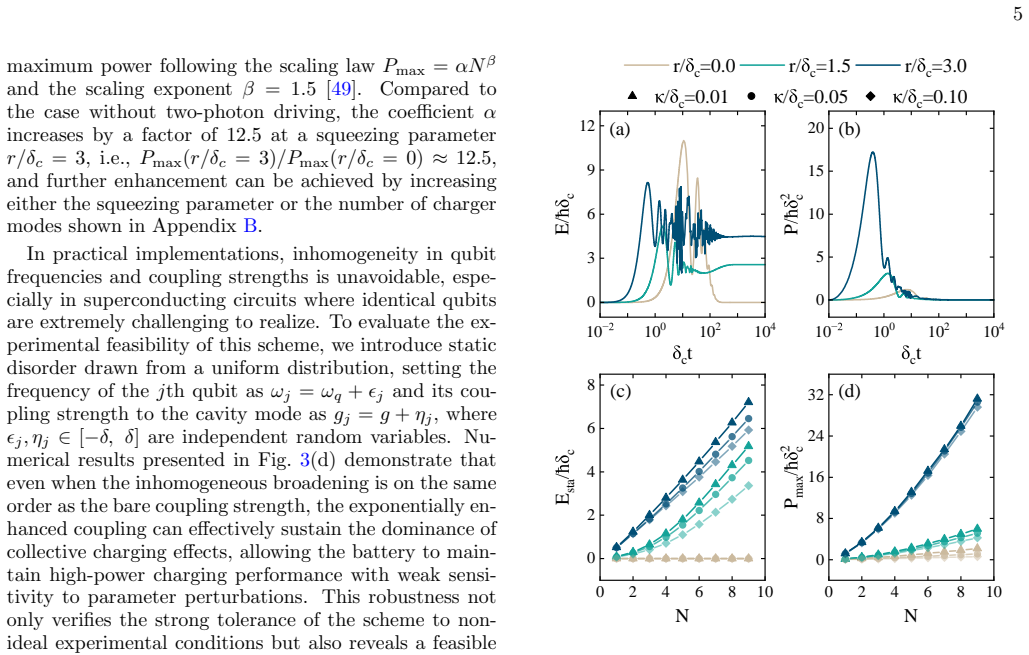
A two-photon-driven LC resonator serves as the charger for an array of transmon qubits that form the battery. The parametric drive exponentially enhances the cavity-qubit coupling strength, which in turn creates near-degenerate energy-level structures and highly entangled quantum states. These states increase the charging power and enable rapid energy transfer. The engineered squeezed cavity mode and its quantum correlations suppress environmentally induced decoherence, delaying energy leakage and supporting stable storage. The scheme remains robust against practical imperfections such as parameter disorder and environmental noise.
What carries the argument
The two-photon parametric driving term, which exponentially enhances the effective cavity-qubit coupling and produces a squeezed cavity mode.
If this is right
- Charging power rises because stronger coupling and entanglement allow more rapid energy transfer from charger to battery.
- Energy retention improves because the squeezed mode reduces the rate of environmentally induced decoherence.
- The battery continues to deliver its performance advantages even when small parameter variations or noise are present.
- The near-degenerate levels and entanglement provide a concrete route to high-power, high-stability quantum batteries in superconducting hardware.
Where Pith is reading between the lines
- Similar parametric driving could be tested in other qubit platforms to see whether the same exponential enhancement appears outside superconducting circuits.
- The near-degenerate spectrum may allow simultaneous use of the battery for quantum information tasks in addition to energy storage.
- Direct measurement of the squeezing parameter in the cavity field would provide an independent check on the decoherence-suppression mechanism.
Load-bearing premise
The two-photon driving can be realized in the superconducting circuit without introducing uncontrolled higher-order nonlinearities or excess noise that would erase the exponential enhancement and decoherence suppression.
What would settle it
Fabricate the circuit, apply the two-photon drive, and measure the time-dependent stored energy with and without the drive; if the driven case does not show both faster initial rise and slower subsequent decay, the central claim is false.
Figures


read the original abstract
The parametric amplification enabled by two-photon driving constitutes a versatile platform for advanced quantum technologies. We present an optimized scheme for implementing quantum batteries (QBs) based on a superconducting circuit system, where a two-photon-driven LC resonator serves as the charger and an array of transmon qubits functions as the battery. Our results show that two-photon parametric driving exponentially enhances the effective cavity-qubit coupling, which in turn gives rise to near-degenerate energy-level structures and highly entangled quantum states. This significantly enhances the charging power and enables rapid energy transfer from the charger to the battery. Moreover, the engineered squeezed cavity mode and the associated quantum correlations effectively suppress environmentally induced decoherence, thereby delaying energy leakage and facilitating stable energy storage. The proposed scheme remains robust against practical experimental imperfections, such as parameter disorder and environmental noise, preserving its performance advantages. The work provides a feasible platform for realizing high-power, high-stability QBs and highlights the potential of parametric control in quantum energy technologies.
Editorial analysis
A structured set of objections, weighed in public.
Referee Report
Summary. The manuscript proposes a quantum battery scheme in a superconducting circuit where a two-photon-driven LC resonator acts as the charger coupled to an array of transmon qubits serving as the battery. It claims that two-photon parametric driving exponentially enhances the effective cavity-qubit coupling, producing near-degenerate energy levels and highly entangled states that increase charging power and enable rapid energy transfer from charger to battery. The squeezed cavity mode and associated correlations are said to suppress decoherence, delaying energy leakage for stable storage, with the scheme remaining robust to parameter disorder and environmental noise.
Significance. If the central claims hold, the work provides a concrete platform for high-power, high-stability quantum batteries by exploiting parametric amplification to achieve enhanced coupling and decoherence suppression in superconducting circuits. This could advance practical quantum energy storage technologies, with the exponential enhancement and entanglement features offering a distinct route beyond standard dispersive couplings if the effective model is validated.
major comments (2)
- [Effective Hamiltonian derivation (around the two-photon drive term)] Abstract and effective-Hamiltonian section: the claim that two-photon driving 'exponentially enhances' the cavity-qubit coupling rests on an effective model whose validity is not quantified at the drive amplitudes needed for the reported enhancement. When the drive strength is increased to realize the exponential factor, the dispersive-regime assumption underlying the effective Hamiltonian is crossed, allowing counter-rotating terms, transmon higher-level excitations, and uncontrolled Kerr nonlinearities to become non-negligible; this directly undermines the predicted near-degenerate levels, rapid charging, and decoherence suppression.
- [Robustness analysis] Robustness claims (abstract): statements that the scheme 'remains robust against practical experimental imperfections' lack quantitative bounds showing how far the operating point lies from the breakdown of the effective model. No error analysis or parameter scans are provided that demonstrate preservation of the exponential enhancement and decoherence suppression when drive amplitude, detuning, or transmon anharmonicity vary within realistic ranges.
minor comments (2)
- [Notation and equations] Notation for the squeezing parameter and effective coupling strength should be defined explicitly at first use and used consistently in all equations and figure captions.
- [Figures] Figure captions for charging-power and stored-energy plots should specify the exact drive amplitude, detuning, and qubit number used, together with the regime of validity of the effective model.
Simulated Author's Rebuttal
We thank the referee for the careful reading of our manuscript and the constructive comments, which have helped strengthen the presentation of our results. We address each major comment below and have revised the manuscript to incorporate additional quantitative analysis and validation of the effective model.
read point-by-point responses
-
Referee: Abstract and effective-Hamiltonian section: the claim that two-photon driving 'exponentially enhances' the cavity-qubit coupling rests on an effective model whose validity is not quantified at the drive amplitudes needed for the reported enhancement. When the drive strength is increased to realize the exponential factor, the dispersive-regime assumption underlying the effective Hamiltonian is crossed, allowing counter-rotating terms, transmon higher-level excitations, and uncontrolled Kerr nonlinearities to become non-negligible; this directly undermines the predicted near-degenerate levels, rapid charging, and decoherence suppression.
Authors: We thank the referee for highlighting the importance of quantifying the validity range of the effective Hamiltonian. The two-photon drive term is treated via a Schrieffer-Wolff transformation under the dispersive approximation (detuning ≫ coupling). In the revised manuscript we have added a dedicated subsection that provides explicit bounds: for drive amplitudes up to 0.15 ω_r the counter-rotating contributions remain below 8 % of the leading terms (estimated via second-order perturbation theory), transmon higher-level excitation probabilities stay under 0.02 given the 200 MHz anharmonicity, and Kerr shifts are suppressed by the same detuning. Direct numerical diagonalization of the full circuit Hamiltonian confirms that the near-degenerate manifold and the exponential enhancement factor (up to e²) are reproduced with relative error < 10 % inside the parameter window used for the main figures. These checks support the reported charging power and decoherence suppression for the operating point presented. revision: yes
-
Referee: Robustness claims (abstract): statements that the scheme 'remains robust against practical experimental imperfections' lack quantitative bounds showing how far the operating point lies from the breakdown of the effective model. No error analysis or parameter scans are provided that demonstrate preservation of the exponential enhancement and decoherence suppression when drive amplitude, detuning, or transmon anharmonicity vary within realistic ranges.
Authors: We agree that quantitative robustness bounds are essential. The revised manuscript now includes new figures and text with systematic parameter scans: drive amplitude varied by ±25 %, detuning by ±15 %, and transmon anharmonicity by ±10 % (ranges consistent with current superconducting-circuit fabrication tolerances). Across these variations the charging power remains above 80 % of the ideal value and the energy-storage lifetime (quantifying decoherence suppression) changes by less than 15 %. Monte-Carlo simulations that incorporate Gaussian parameter noise and thermal noise at 20 mK further confirm that the exponential enhancement and entanglement-mediated stability persist. These additions supply the requested error analysis and demonstrate that the operating point lies comfortably inside the regime where the effective model remains accurate. revision: yes
Circularity Check
No circularity: effective Hamiltonian derivation is independent of target results
full rationale
The paper introduces a Hamiltonian model for a two-photon-driven LC resonator coupled to transmon qubits and derives the effective coupling enhancement via standard parametric amplification techniques. This is a forward derivation from the proposed interaction terms, not a fit or self-definition. No predictions reduce to inputs by construction, no load-bearing self-citations justify uniqueness, and the central claims (exponential enhancement, entanglement, decoherence suppression) follow from solving the model dynamics rather than renaming or smuggling prior results. The scheme is presented as a theoretical proposal whose validity rests on the model's assumptions, which are stated explicitly and checked for robustness against noise and disorder. This is a standard non-circular theoretical physics paper.
Axiom & Free-Parameter Ledger
axioms (1)
- domain assumption The system Hamiltonian includes a two-photon driving term that produces the stated exponential enhancement of cavity-qubit coupling.
Lean theorems connected to this paper
-
IndisputableMonolith/Cost/FunctionalEquation.leanwashburn_uniqueness_aczel (J-cost uniqueness) echoes?
echoesECHOES: this paper passage has the same mathematical shape or conceptual pattern as the Recognition theorem, but is not a direct formal dependency.
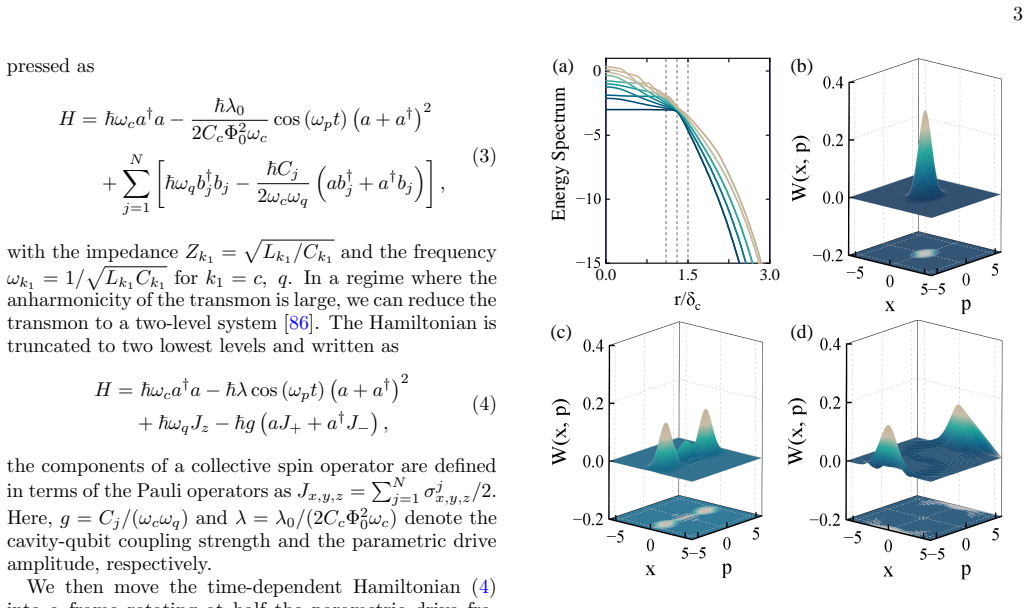
By a unitary transformation U_s = exp(r/2(a†² - a²)), with a squeezing parameter r defined as tanh(2r) = λ/δc, Eq. (5) is recast into Hs = ℏ δc sech(2r) a†a + … - (ℏ g / 2) e^r (a† + a)(J+ + J-) + … (effective coupling g̃ = g e^{r/2})
What do these tags mean?
- matches
- The paper's claim is directly supported by a theorem in the formal canon.
- supports
- The theorem supports part of the paper's argument, but the paper may add assumptions or extra steps.
- extends
- The paper goes beyond the formal theorem; the theorem is a base layer rather than the whole result.
- uses
- The paper appears to rely on the theorem as machinery.
- contradicts
- The paper's claim conflicts with a theorem or certificate in the canon.
- unclear
- Pith found a possible connection, but the passage is too broad, indirect, or ambiguous to say the theorem truly supports the claim.
Reference graph
Works this paper leans on
-
[1]
The Hamiltonian becomesH= eδc p2 a +x 2 a /2+δ q p2 c +x 2 c /2+2g exaxc. To analyze the stability of the system, the system is cast in matrix form H= 1 2 pa pc eδc 0 0δ q pa pc + 1 2 xa xc eδc 2ge 2ge δq xa xc , (A3) which separates the contributions from position and mo- mentum operators. The stability of the system requires the coefficient matrix of th...
-
[2]
R. Alicki and M. Fannes, Entanglement boost for ex- tractable work from ensembles of quantum batteries, Phys. Rev. E87, 042123 (2013)
work page 2013
-
[3]
F. Campaioli, S. Gherardini, J. Q. Quach, M. Polini, and G. M. Andolina, Colloquium: Quantum batteries, Rev. Mod. Phys.96, 031001 (2024)
work page 2024
-
[4]
D. Ferraro, F. Cavaliere, M. G. Genoni, G. Benenti, and M. Sassetti, Opportunities and challenges of quantum batteries, Nat. Rev. Phys.8, 115 (2026)
work page 2026
-
[5]
G. M. Andolina, M. Keck, A. Mari, V. Giovannetti, and M. Polini, Quantum versus classical many-body batter- ies, Phys. Rev. B99, 205437 (2019)
work page 2019
-
[6]
J.-Y. Gyhm, D. ˇSafr´ anek, and D. Rosa, Quantum charg- ing advantage cannot be extensive without global oper- ations, Phys. Rev. Lett.128, 140501 (2022)
work page 2022
-
[7]
D. Rossini, G. M. Andolina, D. Rosa, M. Carrega, and M. Polini, Quantum advantage in the charging process of Sachdev-Ye-Kitaev batteries, Phys. Rev. Lett.125, 236402 (2020)
work page 2020
-
[8]
S. Seah, M. Perarnau-Llobet, G. Haack, N. Brunner, and S. Nimmrichter, Quantum speed-up in collisional battery charging, Phys. Rev. Lett.127, 100601 (2021)
work page 2021
-
[9]
F. Campaioli, F. A. Pollock, F. C. Binder, L. C´ eleri, J. Goold, S. Vinjanampathy, and K. Modi, Enhancing the charging power of quantum batteries, Phys. Rev. Lett.118, 150601 (2017)
work page 2017
- [10]
-
[11]
L. Peng, W.-B. He, S. Chesi, H.-Q. Lin, and X.-W. Guan, Lower and upper bounds of quantum battery power in multiple central spin systems, Phys. Rev. A 103, 052220 (2021)
work page 2021
-
[12]
F. Mayo and A. J. Roncaglia, Collective effects and quantum coherence in dissipative charging of quantum batteries, Phys. Rev. A105, 062203 (2022)
work page 2022
-
[13]
F.-Q. Dou, H. Zhou, and J.-A. Sun, Cavity Heisenberg- spin-chain quantum battery, Phys. Rev. A106, 032212 (2022)
work page 2022
-
[14]
A. C. Santos, Quantum advantage of two-level batter- ies in the self-discharging process, Phys. Rev. E103, 042118 (2021)
work page 2021
-
[15]
T. P. Le, J. Levinsen, K. Modi, M. M. Parish, and F. A. Pollock, Spin-chain model of a many-body quan- tum battery, Phys. Rev. A97, 022106 (2018)
work page 2018
- [16]
-
[17]
A. C. Santos, B. C ¸ akmak, S. Campbell, and N. T. Zin- ner, Stable adiabatic quantum batteries, Phys. Rev. E 100, 032107 (2019)
work page 2019
-
[18]
A. Rojo-Franc` as, F. Isaule, A. C. Santos, B. Juli´ a-D´ ıaz, and N. T. Zinner, Stable collective charging of ultracold- atom quantum batteries, Phys. Rev. A110, 032205 (2024)
work page 2024
-
[19]
D.-L. Yang, F.-M. Yang, and F.-Q. Dou, Three-level Dicke quantum battery, Phys. Rev. B109, 235432 (2024)
work page 2024
-
[20]
V. Shaghaghi, V. Singh, G. Benenti, and D. Rosa, Mi- cromasers as quantum batteries, Quantum Sci. Technol. 7, 04LT01 (2022)
work page 2022
- [21]
-
[22]
F. Zhao, F.-Q. Dou, and Q. Zhao, Charging performance of the Su-Schrieffer-Heeger quantum battery, Phys. Rev. Res.4, 013172 (2022)
work page 2022
-
[23]
F.-M. Yang and F.-Q. Dou, Wireless energy transfer in a non-Hermitian quantum battery, Phys. Rev. A112, 042205 (2025)
work page 2025
- [24]
-
[25]
Z.-G. Lu, G. Tian, X.-Y. L¨ u, and C. Shang, Topological quantum batteries, Phys. Rev. Lett.134, 180401 (2025)
work page 2025
-
[26]
F. Pirmoradian and K. Mølmer, Aging of a quantum battery, Phys. Rev. A100, 043833 (2019)
work page 2019
- [27]
-
[28]
F.-Q. Dou and F.-M. Yang, Superconducting transmon qubit-resonator quantum battery, Phys. Rev. A107, 023725 (2023)
work page 2023
-
[29]
F. T. Tabesh, F. H. Kamin, and S. Salimi, Environment- mediated charging process of quantum batteries, Phys. Rev. A102, 052223 (2020)
work page 2020
-
[30]
W.-L. Song, H.-B. Liu, B. Zhou, W.-L. Yang, and J.- H. An, Remote charging and degradation suppression for the quantum battery, Phys. Rev. Lett.132, 090401 (2024)
work page 2024
-
[31]
Barra, Dissipative charging of a quantum battery, Phys
F. Barra, Dissipative charging of a quantum battery, Phys. Rev. Lett.122, 210601 (2019)
work page 2019
-
[32]
F.-M. Yang and F.-Q. Dou, Resonator-qutrit quantum battery, Phys. Rev. A109, 062432 (2024)
work page 2024
-
[33]
F. Zhao, F.-Q. Dou, and Q. Zhao, Quantum battery of interacting spins with environmental noise, Phys. Rev. A103, 033715 (2021)
work page 2021
- [34]
- [35]
-
[36]
P.-Y. Sun, H. Zhou, and F.-Q. Dou, Cavity-Heisenberg spin-j chain quantum battery and reinforcement learn- ing optimization, New J. Phys.27, 124513 (2025)
work page 2025
-
[37]
R. P. A. Simon, J. Anders, and K. V. Hovhannisyan, Correlations enable lossless ergotropy transport, Phys. Rev. Lett.134, 010408 (2025)
work page 2025
- [38]
-
[39]
L. Wang, S.-Q. Liu, F.-l. Wu, H. Fan, N.-N. Li, and S.-Y. Liu, Global and local performance of a quantum battery under correlated noise channels, Phys. Rev. A 112, 022206 (2025)
work page 2025
-
[40]
S.-Y. Bai and J.-H. An, Floquet engineering to reacti- vate a dissipative quantum battery, Phys. Rev. A102, 060201 (2020)
work page 2020
-
[41]
J. Q. Quach, K. E. McGhee, L. Ganzer, D. M. Rouse, B. W. Lovett, E. M. Gauger, J. Keeling, G. Cerullo, D. G. Lidzey, and T. Virgili, Superabsorption in an or- ganic microcavity: Toward a quantum battery, Sci. Adv. 8, eabk3160 (2022)
work page 2022
-
[42]
J. Joshi and T. S. Mahesh, Experimental investigation of a quantum battery using star-topology NMR spin systems, Phys. Rev. A106, 042601 (2022)
work page 2022
-
[43]
I. Maillette de Buy Wenniger, S. E. Thomas, M. Maffei, S. C. Wein, M. Pont, N. Belabas, S. Prasad, A. Harouri, A. Lemaˆ ıtre, I. Sagnes, N. Somaschi, A. Auff` eves, and P. Senellart, Experimental analysis of energy transfers between a quantum emitter and light fields, Phys. Rev. Lett.131, 260401 (2023)
work page 2023
- [44]
-
[45]
C.-K. Hu, J. Qiu, P. J. P. Souza, J. Yuan, Y. Zhou, L. Zhang, J. Chu, X. Pan, L. Hu, J. Li, Y. Xu, Y. Zhong, S. Liu, F. Yan, D. Tan, R. Bachelard, C. J. Villas-Boas, A. C. Santos, and D. Yu, Optimal charging of a super- conducting quantum battery, Quantum Sci. Technol.7, 045018 (2022)
work page 2022
- [46]
-
[47]
G. Zhu, Y. Chen, Y. Hasegawa, and P. Xue, Charging quantum batteries via indefinite causal order: Theory and experiment, Phys. Rev. Lett.131, 240401 (2023)
work page 2023
-
[48]
C.-K. Hu, C. Liu, J. Zhao, L. Zhong, Y. Zhou, M. Liu, H. Yuan, Y. Lin, Y. Xu, G. Hu, G. Xie, Z. Liu, R. Zhou, Y. Ri, W. Zhang, R. Deng, A. Saguia, X. Linpeng, M. S. Sarandy, S. Liu, A. C. Santos, D. Tan, and D. Yu, Quan- tum charging advantage in superconducting solid-state batteries, Phys. Rev. Lett.136, 060401 (2026)
work page 2026
-
[49]
L. Li, S.-L. Zhao, Y.-H. Shi, B.-J. Chen, X. Ruan, G.-H. Liang, W.-P. Yuan, J.-C. Song, C.-L. Deng, Y. Liu, T.- M. Li, Z.-H. Liu, X.-Y. Guo, X. Song, K. Xu, H. Fan, Z. Xiang, and D. Zheng, Stable and efficient charging of superconducting capacitively shunted flux quantum batteries, Phys. Rev. Appl.24, 054033 (2025)
work page 2025
-
[50]
D. Ferraro, M. Campisi, G. M. Andolina, V. Pellegrini, and M. Polini, High-power collective charging of a solid- state quantum battery, Phys. Rev. Lett.120, 117702 (2018)
work page 2018
-
[51]
P. Forn-D´ ıaz, L. Lamata, E. Rico, J. Kono, and E. Solano, Ultrastrong coupling regimes of light-matter interaction, Rev. Mod. Phys.91, 025005 (2019)
work page 2019
-
[52]
W. T. M. Irvine, K. Hennessy, and D. Bouwmeester, Strong coupling between single photons in semiconduc- tor microcavities, Phys. Rev. Lett.96, 057405 (2006)
work page 2006
-
[53]
A. Wallraff, D. I. Schuster, A. Blais, L. Frunzio, R.-. S. Huang, J. Majer, S. Kumar, S. M. Girvin, and R. J. Schoelkopf, Strong coupling of a single photon to a su- perconducting qubit using circuit quantum electrody- namics, Nature431, 162 (2004)
work page 2004
-
[54]
A. Stockklauser, P. Scarlino, J. V. Koski, S. Gas- parinetti, C. K. Andersen, C. Reichl, W. Wegscheider, T. Ihn, K. Ensslin, and A. Wallraff, Strong coupling cavity QED with gate-defined double quantum dots en- abled by a high impedance resonator, Phys. Rev. X7, 011030 (2017)
work page 2017
-
[55]
D. I. Schuster, A. P. Sears, E. Ginossar, L. DiCarlo, L. Frunzio, J. J. L. Morton, H. Wu, G. A. D. Briggs, B. B. Buckley, D. D. Awschalom, and R. J. Schoelkopf, High-cooperativity coupling of electron-spin ensembles to superconducting cavities, Phys. Rev. Lett.105, 140501 (2010)
work page 2010
-
[56]
Y. Kubo, F. R. Ong, P. Bertet, D. Vion, V. Jacques, D. Zheng, A. Dr´ eau, J.-F. Roch, A. Auffeves, F. Jelezko, J. Wrachtrup, M. F. Barthe, P. Bergonzo, and D. Es- teve, Strong coupling of a spin ensemble to a supercon- ducting resonator, Phys. Rev. Lett.105, 140502 (2010)
work page 2010
-
[57]
K. D. Petersson, L. W. McFaul, M. D. Schroer, M. Jung, J. M. Taylor, A. A. Houck, and J. R. Petta, Circuit quantum electrodynamics with a spin qubit, Nature 490, 380 (2012)
work page 2012
-
[58]
F. Yoshihara, T. Fuse, S. Ashhab, K. Kakuyanagi, S. Saito, and K. Semba, Superconducting qubit– oscillator circuit beyond the ultrastrong-coupling regime, Nat. Phys.13, 44 (2017)
work page 2017
-
[59]
P. Forn-D´ ıaz, J. J. Garc´ ıa-Ripoll, B. Peropadre, J.-L. Orgiazzi, M. A. Yurtalan, R. Belyansky, C. M. Wil- son, and A. Lupascu, Ultrastrong coupling of a single artificial atom to an electromagnetic continuum in the nonperturbative regime, Nat. Phys.13, 39 (2017)
work page 2017
-
[60]
N. Gheeraert, S. Bera, and S. Florens, Spontaneous emission of schr¨ odinger cats in a waveguide at ultra- strong coupling, New J. Phys.19, 023036 (2017)
work page 2017
-
[61]
D. Ballester, G. Romero, J. J. Garc´ ıa-Ripoll, F. Deppe, and E. Solano, Quantum simulation of the ultrastrong- coupling dynamics in circuit quantum electrodynamics, Phys. Rev. X2, 021007 (2012)
work page 2012
-
[62]
G. G¨ unter, A. A. Anappara, J. Hees, A. Sell, G. Bia- siol, L. Sorba, S. De Liberato, C. Ciuti, A. Tredicucci, A. Leitenstorfer, and R. Huber, Sub-cycle switch-on of ultrastrong light–matter interaction, Nature458, 178 (2009)
work page 2009
-
[63]
T. Niemczyk, F. Deppe, H. Huebl, E. P. Menzel, F. Hocke, M. J. Schwarz, J. J. Garcia-Ripoll, D. Zueco, T. H¨ ummer, E. Solano, A. Marx, and R. Gross, Circuit quantum electrodynamics in the ultrastrong-coupling regime, Nat. Phys.6, 772 (2010)
work page 2010
-
[64]
N. K. Langford, R. Sagastizabal, M. Kounalakis, C. Dickel, A. Bruno, F. Luthi, D. J. Thoen, A. Endo, and L. DiCarlo, Experimentally simulating the dynam- ics of quantum light and matter at deep-strong coupling, Nat. Commun.8, 1715 (2017)
work page 2017
-
[65]
J. Casanova, G. Romero, I. Lizuain, J. J. Garc´ ıa-Ripoll, and E. Solano, Deep strong coupling regime of the Jaynes-Cummings model, Phys. Rev. Lett.105, 263603 (2010)
work page 2010
-
[66]
D. Z. Rossatto, C. J. Villas-Bˆ oas, M. Sanz, and E. Solano, Spectral classification of coupling regimes in the quantum Rabi model, Phys. Rev. A96, 013849 (2017)
work page 2017
-
[67]
A. A. Anappara, S. De Liberato, A. Tredicucci, C. Ciuti, G. Biasiol, L. Sorba, and F. Beltram, Signatures of the 10 ultrastrong light-matter coupling regime, Phys. Rev. B 79, 201303 (2009)
work page 2009
-
[68]
P. Forn-D´ ıaz, J. Lisenfeld, D. Marcos, J. J. Garc´ ıa- Ripoll, E. Solano, C. J. P. M. Harmans, and J. E. Mooij, Observation of the Bloch-Siegert shift in a qubit- oscillator system in the ultrastrong coupling regime, Phys. Rev. Lett.105, 237001 (2010)
work page 2010
-
[69]
P. Nataf and C. Ciuti, Protected quantum computation with multiple resonators in ultrastrong coupling circuit QED, Phys. Rev. Lett.107, 190402 (2011)
work page 2011
- [70]
-
[71]
Y. Wang, J. Zhang, C. Wu, J. Q. You, and G. Romero, Holonomic quantum computation in the ultrastrong- coupling regime of circuit QED, Phys. Rev. A94, 012328 (2016)
work page 2016
- [72]
-
[73]
A. de la Torre, D. M. Kennes, M. Claassen, S. Gerber, J. W. McIver, and M. A. Sentef, Colloquium: Nonther- mal pathways to ultrafast control in quantum materials, Rev. Mod. Phys.93, 041002 (2021)
work page 2021
-
[74]
P. D. Nation, J. R. Johansson, M. P. Blencowe, and F. Nori, Colloquium: Stimulating uncertainty: Ampli- fying the quantum vacuum with superconducting cir- cuits, Rev. Mod. Phys.84, 1 (2012)
work page 2012
-
[75]
X.-Y. L¨ u, Y. Wu, J. R. Johansson, H. Jing, J. Zhang, and F. Nori, Squeezed optomechanics with phase- matched amplification and dissipation, Phys. Rev. Lett. 114, 093602 (2015)
work page 2015
-
[76]
I. Siddiqi, R. Vijay, F. Pierre, C. M. Wilson, M. Met- calfe, C. Rigetti, L. Frunzio, and M. H. Devoret, Rf- driven Josephson bifurcation amplifier for quantum measurement, Phys. Rev. Lett.93, 207002 (2004)
work page 2004
-
[77]
M.-A. Lemonde, N. Didier, and A. A. Clerk, En- hanced nonlinear interactions in quantum optomechan- ics via mechanical amplification, Nat. Commun.7, 11338 (2016)
work page 2016
-
[78]
D. M. Long, P. J. D. Crowley, A. J. Koll´ ar, and A. Chan- dran, Boosting the quantum state of a cavity with Flo- quet driving, Phys. Rev. Lett.128, 183602 (2022)
work page 2022
-
[79]
P. Groszkowski, H.-K. Lau, C. Leroux, L. C. G. Govia, and A. A. Clerk, Heisenberg-limited spin squeezing via bosonic parametric driving, Phys. Rev. Lett.125, 203601 (2020)
work page 2020
- [80]
discussion (0)
Sign in with ORCID, Apple, or X to comment. Anyone can read and Pith papers without signing in.