Recognition: no theorem link
Fraxonium: Fractional fluxon states for qudit encoding
Pith reviewed 2026-05-15 01:24 UTC · model grok-4.3
The pith
A superconducting circuit generalizes the fluxonium using fractional fluxon states for protected qudit encoding.
A machine-rendered reading of the paper's core claim, the machinery that carries it, and where it could break.
Core claim
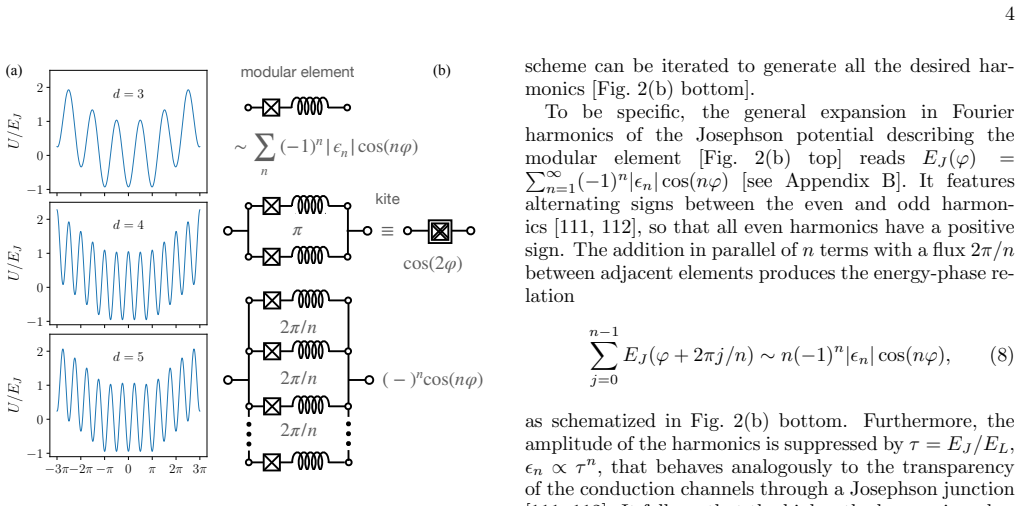
The system represents a generalization of the fluxonium and the low-energy states are constituted by fractional fluxon states, that we call fraxons, localized in the minima of a suitably designed Josephson potential. The latter is tailored through a Fourier engineering approach, that employs multi-harmonic Josephson building block elements composed by a Josephson junction and an inductance connected in series.
What carries the argument
Fourier engineering of the Josephson potential using multi-harmonic building blocks, each a Josephson junction in series with an inductance, to create multiple minima that localize the fractional fluxon states.
If this is right
- The spectrum of d=4 and d=5 systems exhibits d well-separated low-lying states.
- The qutrit case yields dipole matrix elements suitable for coupling to external radiation.
- A non-Abelian STIRAP protocol implements single-qutrit gates adapted to the fraxon states.
- The platform supplies inherent leakage protection for qudit encoding in superconducting circuits.
Where Pith is reading between the lines
- The same engineering method could be extended to other values of d by adjusting the number of harmonics in the potential.
- Integration with existing fluxonium fabrication techniques might allow direct experimental tests of the fraxon localization.
- Qudit gates based on this separation could reduce the overhead of decomposing higher-dimensional operations into qubits.
Load-bearing premise
A suitably designed Josephson potential can be realized through Fourier engineering with multi-harmonic elements such that d low-lying fractional fluxon states remain well separated from the rest of the spectrum.
What would settle it
Fabricate the proposed circuit and measure its energy spectrum to verify whether precisely d states sit isolated at low energy with the expected localization and spacing properties.
Figures



read the original abstract
We propose a superconducting circuit hosting $d$ low-lying states, well separated from the rest of the spectrum, that naturally realizes a qudit system protected from leakage errors. The system represents a generalization of the fluxonium and the low-energy states are constituted by fractional fluxon states, that we call {\it fraxons}, localized in the minima of a suitably designed Josephson potential. The latter is tailored through a Fourier engineering approach, that employs multi-harmonic Josephson building block elements composed by a Josephson junction and an inductance connected in series. We present the spectrum of a $d=4$ and a $d=5$ qudit system and study in detail the qutrit case. We analyze the dipole matrix elements for coupling to radiation and propose a non-Abelian, stimulated Raman adiabatic passage (STIRAP) protocol for single-qutrit gates, that is particularly suited for the present system. The proposed platform opens novel perspectives in circuit engineering and quantum computing beyond the qubit paradigm.
Editorial analysis
A structured set of objections, weighed in public.
Referee Report
Summary. The paper proposes a superconducting circuit, the fraxonium, that generalizes the fluxonium to realize a qudit with d low-lying fractional fluxon states (fraxons) localized in the minima of a Josephson potential. The potential is engineered via Fourier synthesis using multi-harmonic building blocks consisting of a Josephson junction in series with an inductance. Spectra are presented for d=4 and d=5 qudits, with detailed analysis of the qutrit (d=3) case including dipole matrix elements; a non-Abelian STIRAP protocol is proposed for single-qutrit gates. The central claim is that this architecture provides leakage-protected qudit encoding.
Significance. If the engineered potential can be realized with sufficient isolation of the d fraxon states, the platform would offer a hardware-efficient route to qudits in superconducting circuits with built-in protection against leakage errors, extending circuit QED beyond the qubit paradigm and enabling new gate protocols such as the proposed STIRAP scheme.
major comments (2)
- [Abstract and the section describing the Fourier engineering of the Josephson potential] The Fourier engineering approach using JJ+L series elements yields effective potentials whose Fourier coefficients are fixed by the single ratio E_J/E_L per element and are therefore not independently tunable. The spectra presented for d=4 and d=5 (and the detailed qutrit analysis) appear to assume an ideal target potential with d equal-depth minima; it is not shown that the physically attainable coefficients can simultaneously produce the required d minima while suppressing higher harmonics enough to maintain energetic isolation of the fraxon states from the rest of the spectrum. This directly affects the leakage-protection claim.
- [The qutrit case and the STIRAP protocol section] No quantitative error analysis or parameter-sensitivity study is supplied for how deviations in the realized E_J/E_L ratios affect the level spacing or the dipole matrix elements used in the STIRAP protocol. Because the isolation of the d low-lying states is load-bearing for the qudit encoding, such an analysis is required to substantiate the proposal.
minor comments (1)
- [Abstract] The abstract states that spectra for d=4 and d=5 are presented, but the main text should explicitly state whether these are obtained from the constrained multi-harmonic potentials or from an idealized target potential.
Simulated Author's Rebuttal
We thank the referee for the careful reading and constructive comments on our manuscript. We address each major point below and will incorporate revisions to strengthen the presentation of the fraxonium architecture.
read point-by-point responses
-
Referee: [Abstract and the section describing the Fourier engineering of the Josephson potential] The Fourier engineering approach using JJ+L series elements yields effective potentials whose Fourier coefficients are fixed by the single ratio E_J/E_L per element and are therefore not independently tunable. The spectra presented for d=4 and d=5 (and the detailed qutrit analysis) appear to assume an ideal target potential with d equal-depth minima; it is not shown that the physically attainable coefficients can simultaneously produce the required d minima while suppressing higher harmonics enough to maintain energetic isolation of the fraxon states from the rest of the spectrum. This directly affects the leakage-protection claim.
Authors: We agree that the Fourier coefficients are constrained by the E_J/E_L ratio of each JJ+L element and are not independently tunable. The spectra in the manuscript were generated with specific E_J/E_L choices selected to approximate the target potential with d equal-depth minima. To address the concern directly, we will add an explicit section deriving the attainable Fourier coefficients for these ratios and showing that d minima of equal depth can be realized while higher harmonics remain sufficiently suppressed to preserve energetic isolation of the fraxon states. This will substantiate the leakage-protection claim under the physical constraints of the building blocks. revision: yes
-
Referee: [The qutrit case and the STIRAP protocol section] No quantitative error analysis or parameter-sensitivity study is supplied for how deviations in the realized E_J/E_L ratios affect the level spacing or the dipole matrix elements used in the STIRAP protocol. Because the isolation of the d low-lying states is load-bearing for the qudit encoding, such an analysis is required to substantiate the proposal.
Authors: We acknowledge that a quantitative sensitivity analysis is necessary to support the robustness of the encoding and the STIRAP protocol. The original manuscript presented the ideal-case spectra and matrix elements to establish the principle. In the revision we will include a dedicated parameter-sensitivity study that quantifies how small deviations in the E_J/E_L ratios shift the level spacings and alter the dipole matrix elements relevant to STIRAP. This will provide concrete bounds on fabrication tolerances and strengthen the feasibility claim for the proposed gates. revision: yes
Circularity Check
No circularity: design proposal with independent numerical spectra and protocol analysis
full rationale
The manuscript proposes a circuit architecture for d-level qudits based on fractional fluxon states localized in a Fourier-synthesized Josephson potential. Spectra for d=4 and d=5 (and detailed qutrit analysis) are obtained by direct diagonalization of the proposed Hamiltonian; the STIRAP gate protocol is derived from the computed dipole matrix elements. No load-bearing step equates a prediction to a fitted input, renames a known result, or reduces via self-citation to an unverified ansatz. The realizability assumption (multi-harmonic elements producing the target potential) is stated explicitly and left as an engineering claim rather than derived from the paper's own equations. The derivation chain is therefore self-contained and does not collapse to its inputs by construction.
Axiom & Free-Parameter Ledger
axioms (1)
- domain assumption Multi-harmonic Josephson building blocks composed of a junction and series inductance can be used to tailor an arbitrary potential shape
invented entities (1)
-
fraxons
no independent evidence
Reference graph
Works this paper leans on
-
[1]
All the branches are connected in parallel, with a fluxπ/2 between the four equal modular elements
and four, nominally equal, modular elements–each composed by a Josephson junction and an inductance connected in series. All the branches are connected in parallel, with a fluxπ/2 between the four equal modular elements. The latter effectively yield aπ/2-periodic Josephson junction with energyE J. (b) Spectrum (left panel) and potential and few eigenfunct...
-
[2]
Adiabatic tripod scheme Within the Rotating Wave Approximation (RWA), the low-energy Hamiltonian in presence of driving has the 9 Ω! Ω" Ω3Ω#=Ω Ω3 |2⟩|1⟩|0⟩ |𝑢⟩ Ω!Ω#Ω"(a) (b) ρuu ρ00 ρ11 ρ22 0.0 0.2 0.4 0.6 0.8 1.0 0.0 0.2 0.4 0.6 0.8 1.0 (c) 0.0 0.2 0.4 0.6 0.8 1.0 0.0 0.5 1.0 1.5 t/T Ωi/Ω1 (d) Ω0 Ω2 FIG. 8. Possible manipulation scheme inspired by the no...
work page 2023
-
[3]
Tight-binding model Following [107], we can model the dynamics between the fluxon states localized in the minima of the effective transmon potential through a tight-binding approach. The fluxon states are non-orthogonal, and a correct diag- onalization needs to take the overlap matrix into account, such that eigenvalues and eigenstates can be obtained by ...
-
[4]
cos[φx −π(m−n)/2] −E J Dmn( √ 2σ) cos[2φx −π(m−n)/2],(D4) In the working regimeE J ≫E C, EL, the level spacing provided by √8ECEL is small compared toE J and a large number of Fock states is needed to describe well the qutrit low-energy spectrum. In Fig. 6 we employ about 100 Fock states. In Fig. 6 we plot the dipole matrix elements of the flux and the ch...
-
[5]
P. W. Shor, Scheme for reducing decoherence in quan- tum computer memory, Phys. Rev. A52, R2493 (1995)
work page 1995
-
[6]
Gottesman,Stabilizer codes and quantum error cor- 13 rection, Ph.D
D. Gottesman,Stabilizer codes and quantum error cor- 13 rection, Ph.D. thesis, California Institute of Technology (1997)
work page 1997
-
[7]
An Introduction to Quantum Error Correction and Fault-Tolerant Quantum Computation
D. Gottesman, An Introduction to Quantum Er- ror Correction and Fault-Tolerant Quantum Com- putation, arXiv e-prints , arXiv:0904.2557 (2009), arXiv:0904.2557 [quant-ph]
work page internal anchor Pith review Pith/arXiv arXiv 2009
-
[8]
Kitaev, Fault-tolerant quantum computation by anyons, Annals of Physics303, 2 (2003)
A. Kitaev, Fault-tolerant quantum computation by anyons, Annals of Physics303, 2 (2003)
work page 2003
-
[9]
A. Stern and N. H. Lindner, Topological quantum com- putation—from basic concepts to first experiments, Sci- ence339, 1179 (2013)
work page 2013
-
[10]
A. G. Fowler, M. Mariantoni, J. M. Martinis, and A. N. Cleland, Surface codes: Towards practical large-scale quantum computation, Phys. Rev. A86, 032324 (2012)
work page 2012
-
[11]
Google Quantum AI, Suppressing quantum errors by scaling a surface code logical qubit, Nature614, 676 (2023)
work page 2023
- [12]
-
[13]
Y. Wang, Z. Hu, B. C. Sanders, and S. Kais, Qudits and high-dimensional quantum computing, Frontiers in Physics8, 589504 (2020)
work page 2020
-
[14]
E. T. Campbell, H. Anwar, and D. E. Browne, Magic- state distillation in all prime dimensions using quantum Reed-Muller codes, Phys. Rev. X2, 041021 (2012)
work page 2012
-
[15]
E. T. Campbell, Enhanced fault-tolerant quantum com- puting ind-level systems, Phys. Rev. Lett.113, 230501 (2014)
work page 2014
-
[16]
E. Kapit, Hardware-efficient and fully autonomous quantum error correction in superconducting circuits, Phys. Rev. Lett.116, 150501 (2016)
work page 2016
-
[18]
A. Fedorov, L. Steffen, M. Baur, M. P. da Silva, and A. Wallraff, Implementation of a toffoli gate with su- perconducting circuits, Nature481, 170 (2012)
work page 2012
-
[19]
T. C. Ralph, K. J. Resch, and A. Gilchrist, Efficient tof- foli gates using qudits, Phys. Rev. A75, 022313 (2007)
work page 2007
-
[20]
D. Gottesman, Fault-tolerant quantum computation with higher-dimensional systems, inQuantum Comput- ing and Quantum Communications, edited by C. P. Williams (Springer Berlin Heidelberg, Berlin, Heidel- berg, 1999) pp. 302–313
work page 1999
-
[21]
S. Muralidharan, C.-L. Zou, L. Li, J. Wen, and L. Jiang, Overcoming erasure errors with multilevel systems, New Journal of Physics19, 013026 (2017)
work page 2017
- [22]
-
[23]
R. Majumdar, S. Basu, S. Ghosh, and S. Sur-Kolay, Quantum error-correcting code for ternary logic, Phys. Rev. A97, 052302 (2018)
work page 2018
-
[24]
D. J. Spencer, A. Tanggara, T. Haug, D. Khu, and K. Bharti, Qudit low-density parity-check codes, Quan- tum10, 2023 (2026)
work page 2023
-
[25]
S. S. Bullock, D. P. O’Leary, and G. K. Brennen, Asymptotically optimal quantum circuits ford-level sys- tems, Phys. Rev. Lett.94, 230502 (2005)
work page 2005
-
[26]
A. Bocharov, M. Roetteler, and K. M. Svore, Factor- ing with qutrits: Shor’s algorithm on ternary and meta- plectic quantum architectures, Phys. Rev. A96, 012306 (2017)
work page 2017
-
[27]
P. Gokhale, J. M. Baker, C. Duckering, N. C. Brown, K. R. Brown, and F. T. Chong, Asymptotic improve- ments to quantum circuits via qutrits, inProceedings of the 46th International Symposium on Computer Archi- tecture, ISCA ’19 (Association for Computing Machin- ery, New York, NY, USA, 2019) p. 554–566
work page 2019
-
[28]
A. Pavlidis and E. Floratos, Quantum-fourier- transform-based quantum arithmetic with qudits, Phys. Rev. A103, 032417 (2021)
work page 2021
-
[29]
H. Bechmann-Pasquinucci and A. Peres, Quantum cryp- tography with 3-state systems, Phys. Rev. Lett.85, 3313 (2000)
work page 2000
-
[30]
D. Bruß and C. Macchiavello, Optimal eavesdropping in cryptography with three-dimensional quantum states, Phys. Rev. Lett.88, 127901 (2002)
work page 2002
-
[31]
D. Kaszlikowski, D. K. L. Oi, M. Christandl, K. Chang, A. Ekert, L. C. Kwek, and C. H. Oh, Quantum cryp- tography based on qutrit bell inequalities, Phys. Rev. A 67, 012310 (2003)
work page 2003
-
[32]
S. Gr¨ oblacher, T. Jennewein, A. Vaziri, G. Weihs, and A. Zeilinger, Experimental quantum cryptography with qutrits, New Journal of Physics8, 75 (2006)
work page 2006
- [33]
-
[34]
H. Hajji and M. El Baz, Mutually unbiased bases in 3 and 4 dimensions semi-quantum key distribution proto- col, Physics Letters A426, 127884 (2022)
work page 2022
- [35]
-
[36]
B. P. Lanyon, T. J. Weinhold, N. K. Langford, J. L. O’Brien, K. J. Resch, A. Gilchrist, and A. G. White, Manipulating biphotonic qutrits, Phys. Rev. Lett.100, 060504 (2008)
work page 2008
- [37]
- [38]
-
[39]
X.-M. Hu, C. Zhang, B.-H. Liu, Y. Cai, X.-J. Ye, Y. Guo, W.-B. Xing, C.-X. Huang, Y.-F. Huang, C.- F. Li, and G.-C. Guo, Experimental high-dimensional quantum teleportation, Phys. Rev. Lett.125, 230501 (2020)
work page 2020
-
[40]
Y. Chi, J. Huang, Z. Zhang, J. Mao, Z. Zhou, X. Chen, C. Zhai, J. Bao, T. Dai, H. Yuan, M. Zhang, D. Dai, B. Tang, Y. Yang, Z. Li, Y. Ding, L. K. Oxenløwe, M. G. Thompson, J. L. O’Brien, Y. Li, Q. Gong, and J. Wang, A programmable qudit-based quantum processor, Na- ture Communications13, 1166 (2022)
work page 2022
- [41]
-
[42]
M. Ringbauer, M. Meth, L. Postler, R. Stricker, R. Blatt, P. Schindler, and T. Monz, A universal qudit quantum processor with trapped ions, Nature Physics 18, 1053 (2022)
work page 2022
-
[43]
P. Hrmo, B. Wilhelm, L. Gerster, M. W. van Mourik, M. Huber, R. Blatt, P. Schindler, T. Monz, and M. Ringbauer, Native qudit entanglement in a trapped ion quantum processor, Nature Communications14, 2242 (2023)
work page 2023
-
[44]
M. Iqbal, A. Lyons, C. F. B. Lo, N. Tantivasadakarn, J. Dreiling, C. Foltz, T. M. Gatterman, D. Gresh, N. Hewitt, C. A. Holliman, J. Johansen, B. Neyen- huis, Y. Matsuoka, M. Mills, S. A. Moses, P. Siegfried, A. Vishwanath, R. Verresen, and H. Dreyer, Qutrit toric code and parafermions in trapped ions, Nature Commu- nications16, 6301 (2025)
work page 2025
- [45]
-
[46]
B. L. Brock, S. Singh, A. Eickbusch, V. V. Sivak, A. Z. Ding, L. Frunzio, S. M. Girvin, and M. H. Devoret, Quantum error correction of qudits beyond break-even, Nature641, 612 (2025)
work page 2025
-
[47]
D. Gottesman, A. Kitaev, and J. Preskill, Encoding a qubit in an oscillator, Phys. Rev. A64, 012310 (2001)
work page 2001
-
[48]
V. V. Sivak, A. Eickbusch, B. Royer, S. Singh, I. Tsiout- sios, S. Ganjam, A. Miano, B. L. Brock, A. Z. Ding, L. Frunzio, S. M. Girvin, R. J. Schoelkopf, and M. H. Devoret, Real-time quantum error correction beyond break-even, Nature616, 50 (2023)
work page 2023
-
[49]
P. Campagne-Ibarcq, A. Eickbusch, S. Touzard, E. Zalys-Geller, N. E. Frattini, V. V. Sivak, P. Rein- hold, S. Puri, S. Shankar, R. J. Schoelkopf, L. Frunzio, M. Mirrahimi, and M. H. Devoret, Quantum error cor- rection of a qubit encoded in grid states of an oscillator, Nature584, 368 (2020)
work page 2020
- [50]
-
[51]
A. L. Grimsmo and S. Puri, Quantum error correction with the gottesman-kitaev-preskill code, PRX Quantum 2, 020101 (2021)
work page 2021
- [52]
-
[53]
M. Mirrahimi, Z. Leghtas, V. V. Albert, S. Touzard, R. J. Schoelkopf, L. Jiang, and M. H. Devoret, Dynam- ically protected cat-qubits: a new paradigm for univer- sal quantum computation, New Journal of Physics16, 045014 (2014)
work page 2014
-
[54]
R. Lescanne, M. Villiers, T. Peronnin, A. Sarlette, M. Delbecq, B. Huard, T. Kontos, M. Mirrahimi, and Z. Leghtas, Exponential suppression of bit-flips in a qubit encoded in an oscillator, Nature Physics16, 509 (2020)
work page 2020
-
[55]
J. Guillaud and M. Mirrahimi, Repetition cat qubits for fault-tolerant quantum computation, Physical Review X 9, 041053 (2019)
work page 2019
-
[56]
C. Chamberland, K. Noh, P. Arrangoiz-Arriola, E. T. Campbell, C. T. Hann, J. Iverson, H. Putterman, T. C. Bohdanowicz, S. T. Flammia, A. Keller,et al., Building a fault-tolerant quantum computer using concatenated cat codes, PRX Quantum3, 010329 (2022)
work page 2022
-
[57]
A. L. Grimsmo and A. Frisk Kockum, Quantum infor- mation processing with bosonic qubits in circuit QED, Quantum Sci. Technol.6, 043001 (2021)
work page 2021
-
[58]
Y. Shalibo, R. Resh, O. Fogel, D. Shwa, R. Bialczak, J. M. Martinis, and N. Katz, Direct wigner tomography of a superconducting anharmonic oscillator, Phys. Rev. Lett.110, 100404 (2013)
work page 2013
-
[59]
M. J. Peterer, S. J. Bader, X. Jin, F. Yan, A. Ka- mal, T. J. Gudmundsen, P. J. Leek, T. P. Orlando, W. D. Oliver, and S. Gustavsson, Coherence and decay of higher energy levels of a superconducting transmon qubit, Phys. Rev. Lett.114, 010501 (2015)
work page 2015
-
[60]
R. K. Naik, N. Leung, S. Chakram, P. Groszkowski, Y. Lu, N. Earnest, D. C. McKay, J. Koch, and D. I. Schuster, Random access quantum information proces- sors using multimode circuit quantum electrodynamics, Nature Communications8, 1904 (2017)
work page 1904
-
[61]
S. Cao, M. Bakr, G. Campanaro, S. D. Fasciati, J. Wills, D. Lall, B. Shteynas, V. Chidambaram, I. Rungger, and P. Leek, Emulating two qubits with a four-level trans- mon qudit for variational quantum algorithms, Quan- tum Science and Technology9, 035003 (2024)
work page 2024
-
[62]
M. A. Yurtalan, J. Shi, M. Kononenko, A. Lupascu, and S. Ashhab, Implementation of a walsh-hadamard gate in a superconducting qutrit, Phys. Rev. Lett.125, 180504 (2020)
work page 2020
- [63]
-
[64]
M. Kononenko, M. A. Yurtalan, S. Ren, J. Shi, S. Ash- hab, and A. Lupascu, Characterization of control in a superconducting qutrit using randomized benchmark- ing, Phys. Rev. Res.3, L042007 (2021)
work page 2021
-
[65]
M. S. Blok, V. V. Ramasesh, T. Schuster, K. O’Brien, J. M. Kreikebaum, D. Dahlen, A. Morvan, B. Yoshida, N. Y. Yao, and I. Siddiqi, Quantum information scram- bling on a superconducting qutrit processor, Phys. Rev. X11, 021010 (2021)
work page 2021
-
[66]
N. Goss, A. Morvan, B. Marinelli, B. K. Mitchell, L. B. Nguyen, R. K. Naik, L. Chen, C. J¨ unger, J. M. Kreike- baum, D. I. Santiago, J. J. Wallman, and I. Siddiqi, High-fidelity qutrit entangling gates for superconduct- ing circuits, Nature Communications13, 7481 (2022)
work page 2022
-
[67]
T. Roy, Z. Li, E. Kapit, and D. Schuster, Two-qutrit quantum algorithms on a programmable superconduct- ing processor, Phys. Rev. Appl.19, 064024 (2023)
work page 2023
-
[68]
N. Goss, S. Ferracin, A. Hashim, A. Carignan-Dugas, J. M. Kreikebaum, R. K. Naik, D. I. Santiago, and I. Siddiqi, Extending the computational reach of a su- perconducting qutrit processor, npj Quantum Informa- tion10, 101 (2024)
work page 2024
-
[69]
K. Zhou, J.-W. Xu, Q.-P. Su, Y. Zhang, X.-M. Yu, Z. Ma, H.-Y. Zhang, H.-Y. Shi, W. Zheng, S. Pan, Y. Kang, Z. Huang, C.-P. Yang, S.-X. Li, and Y. Yu, Demonstration of discrete-time quantum walks and ob- servation of topological edge states in a superconducting qutrit chain, Phys. Rev. Lett.135, 250601 (2025)
work page 2025
-
[70]
V. Tripathi, N. Goss, A. Vezvaee, L. B. Nguyen, I. Sid- diqi, and D. A. Lidar, Qudit dynamical decoupling on a superconducting quantum processor, Phys. Rev. Lett. 15 134, 050601 (2025)
work page 2025
-
[71]
V. E. Manucharyan, J. Koch, L. I. Glazman, and M. H. Devoret, Fluxonium: Single Cooper-pair circuit free of charge offsets, Science326, 113 (2009)
work page 2009
-
[72]
L. B. Nguyen, G. Koolstra, Y. Kim, A. Morvan, T. Chis- tolini, S. Singh, K. N. Nesterov, C. J¨ unger, L. Chen, Z. Pedramrazi, B. K. Mitchell, J. M. Kreikebaum, S. Puri, D. I. Santiago, and I. Siddiqi, Blueprint for a high-performance fluxonium quantum processor, PRX Quantum3, 037001 (2022)
work page 2022
-
[73]
M. McEwen, D. Kafri, Z. Chen, J. Atalaya, K. J. Satzinger, C. Quintana, P. V. Klimov, D. Sank, C. Gid- ney, A. G. Fowler, F. Arute, K. Arya, B. Buck- ley, B. Burkett, N. Bushnell, B. Chiaro, R. Collins, S. Demura, A. Dunsworth, C. Erickson, B. Foxen, M. Giustina, T. Huang, S. Hong, E. Jeffrey, S. Kim, K. Kechedzhi, F. Kostritsa, P. Laptev, A. Megrant, X. ...
work page 2021
-
[74]
M. D. Reed, B. R. Johnson, A. A. Houck, L. Di- Carlo, J. M. Chow, D. I. Schuster, L. Frunzio, and R. J. Schoelkopf, Fast reset and suppressing sponta- neous emission of a superconducting qubit, Applied Physics Letters96, 203110 (2010)
work page 2010
-
[75]
K. Geerlings, Z. Leghtas, I. M. Pop, S. Shankar, L. Frun- zio, R. J. Schoelkopf, M. Mirrahimi, and M. H. Devoret, Demonstrating a driven reset protocol for a supercon- ducting qubit, Phys. Rev. Lett.110, 120501 (2013)
work page 2013
-
[76]
M. Suchara, A. W. Cross, and J. M. Gambetta, Leakage suppression in the toric code, Quantum Info. Comput. 15, 997–1016 (2015)
work page 2015
-
[77]
P. Magnard, P. Kurpiers, B. Royer, T. Walter, J.-C. Besse, S. Gasparinetti, M. Pechal, J. Heinsoo, S. Storz, A. Blais, and A. Wallraff, Fast and unconditional all- microwave reset of a superconducting qubit, Phys. Rev. Lett.121, 060502 (2018)
work page 2018
-
[78]
C. C. Bultink, T. E. O’Brien, R. Vollmer, N. Muthusub- ramanian, M. W. Beekman, M. A. Rol, X. Fu, B. Tarasinski, V. Ostroukh, B. Varbanov, A. Bruno, and L. DiCarlo, Protecting quantum entanglement from leakage and qubit errors via repetitive parity measure- ments, Science Advances6, eaay3050 (2020)
work page 2020
-
[79]
B. M. Varbanov, F. Battistel, B. M. Tarasinski, V. P. Ostroukh, T. E. O’Brien, L. DiCarlo, and B. M. Terhal, Leakage detection for a transmon-based surface code, npj Quantum Information6, 102 (2020)
work page 2020
-
[80]
P. Duan, Z.-F. Chen, Q. Zhou, W.-C. Kong, H.-F. Zhang, and G.-P. Guo, Mitigating crosstalk-induced qubit readout error with shallow-neural-network dis- crimination, Phys. Rev. Appl.16, 024063 (2021)
work page 2021
-
[81]
Q. Ficheux, L. B. Nguyen, A. Somoroff, H. Xiong, K. N. Nesterov, M. G. Vavilov, and V. E. Manucharyan, Fast logic with slow qubits: Microwave-activated controlled- z gate on low-frequency fluxoniums, Phys. Rev. X11, 021026 (2021)
work page 2021
discussion (0)
Sign in with ORCID, Apple, or X to comment. Anyone can read and Pith papers without signing in.