Perfect transmission and parallel composition for quantum walks on graphs with two leads
Pith reviewed 2026-06-30 20:41 UTC · model grok-4.3
The pith
For real-weighted two-terminal graphs, perfect transmission at fixed momentum occurs when μ₁ equals μ₂ and the point lies on a hyperbola fixing the transmission phase.
A machine-rendered reading of the paper's core claim, the machinery that carries it, and where it could break.
Core claim
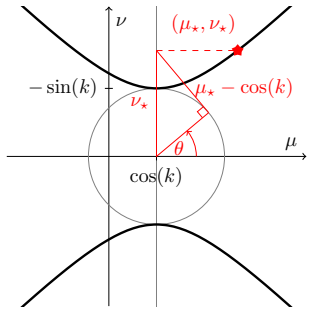
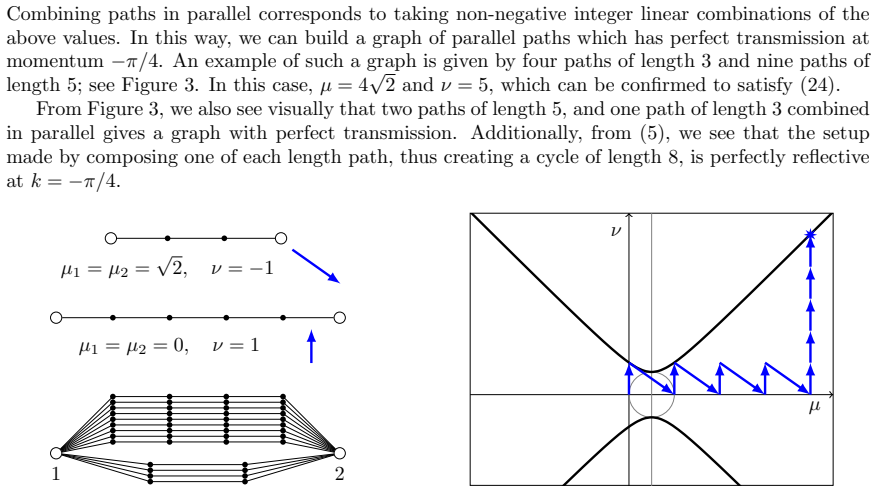
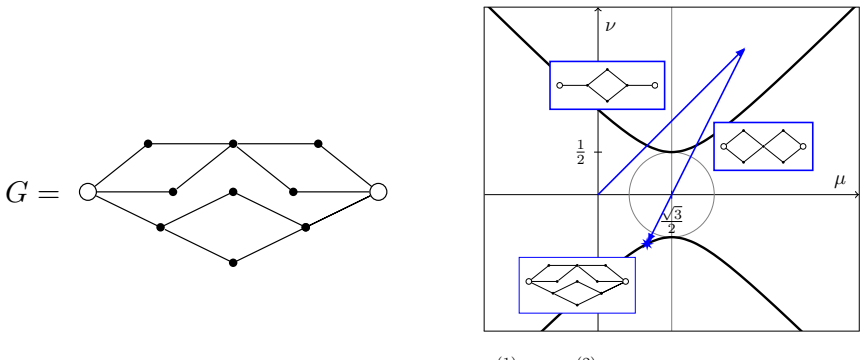
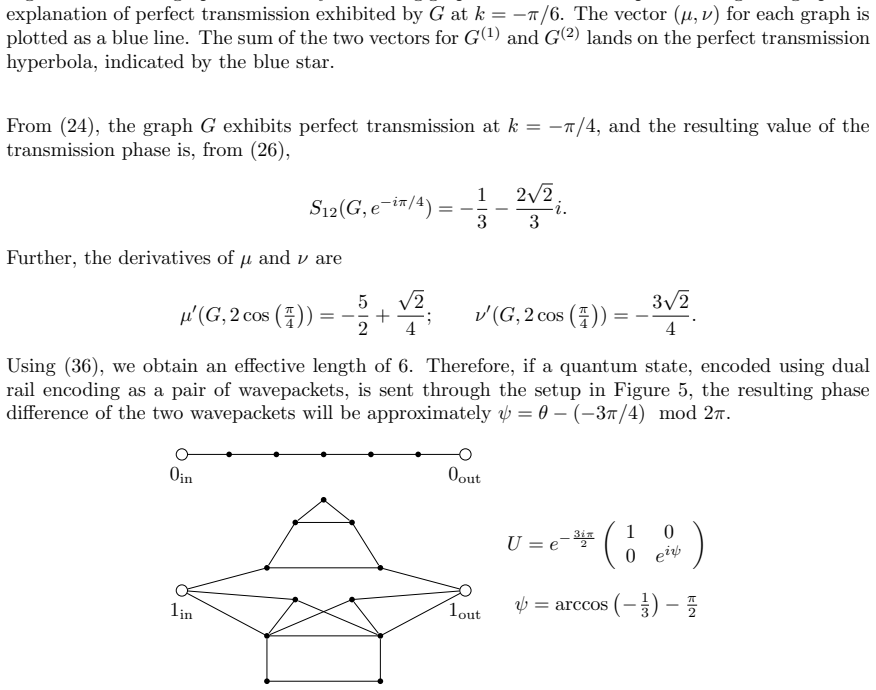
We study scattering for continuous-time quantum walks on finite graphs with two attached leads. We derive explicit formulae for the two-terminal scattering matrix in terms of characteristic polynomials of the finite graph and its vertex-deleted subgraphs. For real-weighted two-terminal graphs, we then introduce three real quantities, μ₁, μ₂, and ν, which are each additive under parallel composition of graphs. In these variables, perfect transmission at fixed momentum is characterized by the condition μ₁=μ₂ together with a hyperbola in the corresponding (μ,ν)-plane, whose points determine the transmission phase. This turns the search for graphs with prescribed transmission properties into a g
What carries the argument
The three real quantities μ₁, μ₂, and ν that are additive under parallel composition of two-terminal graphs, together with the hyperbola condition in the (μ, ν)-plane for perfect transmission.
If this is right
- Parallel composition of graphs corresponds to vector addition of their (μ, ν) contributions.
- Any point on the hyperbola satisfying μ₁ = μ₂ produces perfect transmission with a transmission phase fixed by that point.
- Graphs with prescribed transmission can be assembled by summing vectors from a library of smaller building blocks.
- The explicit polynomial formulae allow direct algebraic computation of μ₁, μ₂, and ν without solving the scattering problem anew for each composite graph.
Where Pith is reading between the lines
- The vector-addition structure may let one enumerate all graphs with perfect transmission by searching over finite sums of small components rather than enumerating large graphs directly.
- If similar additive invariants exist for other scattering properties, the same geometric method could apply to designing graphs with fixed reflection or phase shifts.
- The approach suggests a semigroup structure on the set of transmission properties under parallel composition.
Load-bearing premise
The scattering matrix admits explicit expressions in terms of characteristic polynomials for continuous-time quantum walks on graphs with two leads, which permits the definition of the additive quantities.
What would settle it
Direct numerical solution of the time-dependent Schrödinger equation on a small two-lead graph whose scattering matrix does not match the characteristic-polynomial formula, or explicit addition of two graphs showing that the computed μ₁ and μ₂ values fail to add.
Figures

read the original abstract
We study scattering for continuous-time quantum walks on finite graphs with two attached leads. We derive explicit formulae for the two-terminal scattering matrix in terms of characteristic polynomials of the finite graph and its vertex-deleted subgraphs. For real-weighted two-terminal graphs, we then introduce three real quantities, $\mu_1$, $\mu_2$, and $\nu$, which are each additive under parallel composition of graphs. In these variables, perfect transmission at fixed momentum is characterized by the condition $\mu_1=\mu_2$ together with a hyperbola in the corresponding $(\mu,\nu)$-plane, whose points determine the transmission phase. This turns the search for graphs with prescribed transmission properties into a geometric vector-sum problem for smaller building blocks.
Editorial analysis
A structured set of objections, weighed in public.
Referee Report
Summary. The manuscript derives explicit formulae for the two-terminal scattering matrix of continuous-time quantum walks on finite graphs with two attached leads, expressed in terms of characteristic polynomials of the graph and its vertex-deleted subgraphs. For real-weighted two-terminal graphs it introduces three real additive quantities μ₁, μ₂, and ν under parallel composition; perfect transmission at fixed momentum is then characterized by the condition μ₁ = μ₂ together with a hyperbola in the (μ, ν)-plane whose points fix the transmission phase, thereby recasting the design problem as a geometric vector-sum task on smaller building blocks.
Significance. If the algebraic derivations hold, the work supplies a concrete geometric tool for constructing graphs with prescribed perfect-transmission properties at fixed momentum. The explicit polynomial formulae and the demonstrated additivity of μ₁, μ₂, ν constitute genuine strengths that enable modular composition; the vector-sum interpretation is a clear conceptual advance for quantum-transport studies on graphs.
major comments (1)
- [§3] §3 (scattering-matrix derivation): the explicit formulae relating the S-matrix entries to the characteristic polynomials P_G(λ), P_{G\v}(λ) etc. are central to all subsequent claims; the manuscript should supply a self-contained verification (e.g., direct substitution into the resolvent or boundary-matching equations) that these expressions are free of hidden assumptions on the lead coupling or the momentum value.
minor comments (2)
- [§4] The definition of the three additive quantities μ₁, μ₂, ν (around Eq. (12)–(14)) would benefit from an immediate statement of their explicit polynomial expressions before the additivity proof is invoked.
- [Fig. 2] Figure 2 (parallel-composition diagram) uses the same symbol for the composite graph and its factors; relabeling the factors as G and H would remove ambiguity.
Simulated Author's Rebuttal
We thank the referee for the positive assessment and constructive comment. We address the major comment below.
read point-by-point responses
-
Referee: [§3] §3 (scattering-matrix derivation): the explicit formulae relating the S-matrix entries to the characteristic polynomials P_G(λ), P_{G\v}(λ) etc. are central to all subsequent claims; the manuscript should supply a self-contained verification (e.g., direct substitution into the resolvent or boundary-matching equations) that these expressions are free of hidden assumptions on the lead coupling or the momentum value.
Authors: We agree that an explicit verification would make the central formulae more robust. In the revised manuscript we will insert a short direct verification in §3: we substitute the proposed expressions for the S-matrix entries (in terms of P_G(λ), P_{G\v}(λ), etc.) into the resolvent boundary-matching equations for the two leads and confirm that they hold identically for arbitrary positive lead-coupling strengths and for any real momentum k (subject only to the standing assumptions of the continuous-time quantum-walk model). This addition removes any possible ambiguity without altering the subsequent results. revision: yes
Circularity Check
No significant circularity
full rationale
The derivation begins with explicit scattering-matrix formulae expressed via characteristic polynomials of the graph and subgraphs, which are presented as derived results rather than assumed. The quantities μ1, μ2, and ν are then introduced as functions of these polynomials and shown to be additive under parallel composition through algebraic properties. Perfect transmission is characterized by μ1=μ2 plus a hyperbola condition in the (μ,ν) plane, which follows directly from the scattering matrix without reducing to a self-definition, fitted parameter renamed as prediction, or load-bearing self-citation. The geometric vector-sum interpretation is a consequence of the prior algebraic steps, not an input smuggled in by construction.
Axiom & Free-Parameter Ledger
Reference graph
Works this paper leans on
-
[1]
Universal Computation by Quantum Walk,
A. M. Childs, “Universal Computation by Quantum Walk,”Phys. Rev. Lett., vol. 102, no. 18, p. 180 501, May 2009.doi:10.1103/PhysRevLett.102.180501 17
-
[2]
Universal computation by multi-particle quantum walk
A. M. Childs, D. Gosset, and Z. Webb, “Universal computation by multi-particle quantum walk,”Science, vol. 339, no. 6121, pp. 791–794, Feb. 2013.doi:10.1126/science.1229957 arXiv:1205.3782 [quant-ph]
work page internal anchor Pith review Pith/arXiv arXiv doi:10.1126/science.1229957 2013
-
[3]
Waddington landscape for prototype learning in generalized Hopfield networks
M. Ezawa, “Electric circuits for universal quantum gates and quantum Fourier transforma- tion,”Phys. Rev. Res., vol. 2, no. 2, p. 023 278, Jun. 2020.doi:10.1103/PhysRevResearch. 2.023278
-
[4]
Electric Circuit Induced by Quantum Walk,
Y. Higuchi, M. Sabri, and E. Segawa, “Electric Circuit Induced by Quantum Walk,”J Stat Phys, vol. 181, no. 2, pp. 603–617, Oct. 2020.doi:10.1007/s10955-020-02591-3
-
[5]
Momentum Switches,
A. M. Childs, D. Gosset, D. Nagaj, M. Raha, and Z. Webb, “Momentum Switches,”Quantum Information and Computation, vol. 15, no. 7&8, pp. 0601–0621, 2015
2015
-
[6]
Irrational Quantum Walks,
G. Coutinho, P. F. Baptista, C. Godsil, T. J. Spier, and R. Werner, “Irrational Quantum Walks,”SIAM J. Appl. Algebra Geometry, vol. 7, no. 3, pp. 567–584, Sep. 2023.doi:10 . 1137/22M1521262
2023
-
[7]
Quantum walks do not like bridges,
G. Coutinho, C. Godsil, E. Juliano, and C. M. van Bommel, “Quantum walks do not like bridges,”Linear Algebra and its Applications, vol. 652, pp. 155–172, Nov. 2022.doi:10 . 1016/j.laa.2022.07.009
2022
-
[8]
A simple method for finding the scattering coefficients of quantum graphs,
S. S. Cottrell, “A simple method for finding the scattering coefficients of quantum graphs,” vol. 56, no. 9, pp. 092 203–092 203, Sep. 2015.doi:10.1063/1.4931082
-
[9]
Levinson's theorem for graphs II
A. M. Childs and D. Gosset, “Levinson’s theorem for graphs II,”Journal of Mathematical Physics, vol. 53, no. 10, p. 102 207, Oct. 2012.doi:10.1063/1.4757665arXiv:1203.6557 [math-ph, physics:quant-ph]
work page internal anchor Pith review Pith/arXiv arXiv doi:10.1063/1.4757665arxiv:1203.6557 2012
-
[10]
C. D. Godsil,Algebraic Combinatorics. Chapman\& Hall, 1993
1993
-
[11]
Tools from linear algebra,
C. Godsil, “Tools from linear algebra,”Handbook of Combinatorics, vol. 2, Jan. 1989
1989
-
[12]
All the king’s horses,
W. T. Tutte, “All the king’s horses,” inGraph Theory and Related Topics, University of Waterloo, Ontario: Academic Press, Inc, pp. 15–33
-
[13]
Computing the Characteristic polynomial of a graph,
A. J. Schwenk, “Computing the Characteristic polynomial of a graph,” inGraphs and Com- binatorics, R. A. Bari and F. Harary, Eds., Berlin, Heidelberg: Springer, 1974, pp. 153–172. doi:10.1007/BFb0066438
-
[14]
Removal-cospectral sets of vertices in a graph,
A. J. Schwenk, “Removal-cospectral sets of vertices in a graph,” inProc. Tenth Southeastern Conference on Combinatorics, Graph Theory and Computing, 1979, pp. 849–860
1979
-
[15]
D. M. Pozar,Microwave Engineering, 4th ed. John Wiley & Sons, 2012
2012
-
[16]
Efficient Computation of the Characteristic Polynomial of a Tree and Related Tasks,
M. F¨ urer, “Efficient Computation of the Characteristic Polynomial of a Tree and Related Tasks,”Algorithmica, vol. 68, no. 3, pp. 626–642, Mar. 2014.doi:10.1007/s00453- 012- 9688-5
-
[17]
Information storage in neural networks with low levels of activity
T. Kitagawa, M. S. Rudner, E. Berg, and E. Demler, “Exploring topological phases with quantum walks,”Phys. Rev. A, vol. 82, no. 3, p. 033 429, Sep. 2010.doi:10.1103/PhysRevA. 82.033429
-
[18]
Bulk-boundary correspondence for chiral symmetric quantum walks,
J. K. Asb´ oth and H. Obuse, “Bulk-boundary correspondence for chiral symmetric quantum walks,”Phys. Rev. B, vol. 88, no. 12, p. 121 406, Sep. 2013.doi:10.1103/PhysRevB.88.121406
-
[19]
Scattering theory of topological insulators and superconductors,
I. C. Fulga, F. Hassler, and A. R. Akhmerov, “Scattering theory of topological insulators and superconductors,”Phys. Rev. B, vol. 85, no. 16, p. 165 409, Apr. 2012.doi:10.1103/ PhysRevB.85.165409 18
2012
-
[20]
Scattering theory of topological phases in discrete-time quantum walks,
B. Tarasinski, J. K. Asb´ oth, and J. P. Dahlhaus, “Scattering theory of topological phases in discrete-time quantum walks,”Phys. Rev. A, vol. 89, no. 4, p. 042 327, Apr. 2014.doi: 10.1103/PhysRevA.89.042327
-
[21]
Beziehungen zwischen den in einem Graphen enthaltenen Kreisen und seinem charakteristischen Polynom,
H. Sachs, “Beziehungen zwischen den in einem Graphen enthaltenen Kreisen und seinem charakteristischen Polynom,”Publicationes Mathematicae Debrecen, vol. 11, no. 1-4, pp. 119– 134, 1964
1964
-
[22]
The Determinant of the Adjacency Matrix of a Graph,
F. Harary, “The Determinant of the Adjacency Matrix of a Graph,”SIAM Rev., vol. 4, no. 3, pp. 202–210, Jul. 1962.doi:10.1137/1004057 19 A Schwenk formula for weighted graphs Here we give a proof of the Schwenk recursion formula for the characteristic polynomial of a weighted graph with Hermitian weights. We give the proof in exactly the same way as the or...
discussion (0)
Sign in with ORCID, Apple, or X to comment. Anyone can read and Pith papers without signing in.