N-Graphdiyne as a Tunable Platform for Stabilizing Light Metals toward High-Capacity Reversible Hydrogen Storage
Pith reviewed 2026-06-30 20:40 UTC · model grok-4.3
The pith
N-GDY anchors light metals at N-sites to reach 13 wt% reversible hydrogen storage.
A machine-rendered reading of the paper's core claim, the machinery that carries it, and where it could break.
Core claim
N-sites of N-GDY bind up to five Li, Na, K, and Ca atoms per primitive cell with binding energies of -2.27, -1.57, -1.80, and -2.13 eV respectively, exceeding their respective bulk cohesive energies. AIMD simulations at 400 K confirm the structural robustness of the decorated frameworks and the absence of metal aggregation. The polarized metal centres activate reversible H2 adsorption through electrostatic and dispersion interactions, with average adsorption energies falling within the optimal window of -0.15 to -0.35 eV per H2. Sequential adsorption analysis reveals uptake of up to 25 H2 molecules per primitive cell, achieving intrinsic gravimetric capacities of 13.08, 10.82, 9.23, and 9.15
What carries the argument
Nitrogen atoms within the graphdiyne lattice that serve as selective anchoring points for dispersed light-metal atoms whose polarization then drives reversible molecular H2 physisorption.
Load-bearing premise
The DFT binding energies and AIMD runs at 400 K are assumed accurate enough to guarantee that real metal atoms remain dispersed and that H2 uptake occurs reversibly without clustering or framework collapse.
What would settle it
Experimental decoration of synthesized N-GDY with Li or Ca followed by H2 adsorption measurements that show either visible metal clustering or gravimetric uptake below 6 wt% at 300 K and 1 bar would falsify the central performance claim.
Figures
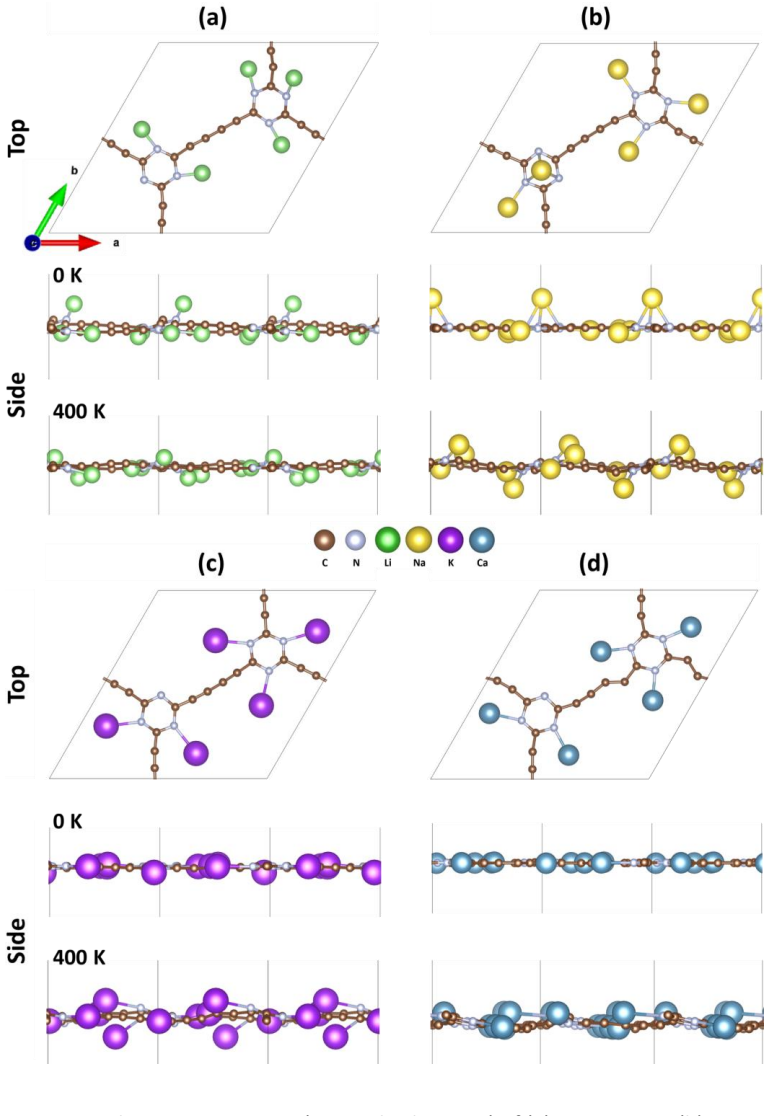
read the original abstract
Hydrogen (H2) is a promising carbon-neutral energy carrier. However, its deployment is limited by the lack of lightweight, reversible storage media that operate under practical conditions. Here, we establish nitrogen-doped graphdiyne (N-GDY) as a programmable two-dimensional platform for stabilizing dispersed light-metal dopants and enabling high-capacity physisorption of molecular H2. The computational package involves density functional theory (DFT) combined with ab initio molecular dynamics (AIMD) and Langmuir-based statistical thermodynamic modeling. The results revealed that N-sites of N-GDY bind up to five Li, Na, K, and Ca atoms per primitive cell with binding energies of -2.27, -1.57, -1.80, and -2.13 eV, respectively, exceeding their respective bulk cohesive energies. AIMD simulations at 400 K further confirm the structural robustness of the decorated frameworks and the absence of metal aggregation. The polarised metal centres activate reversible H2 adsorption through electrostatic and dispersion interactions, with average adsorption energies falling within the optimal window (-0.15 to -0.35 eV per H2). Sequential adsorption analysis reveals uptake of up to 25 H2 molecules per primitive cell, achieving intrinsic gravimetric capacities of 13.08, 10.82, 9.23, and 9.15 wt% for Li-, Na-, K-, and Ca-functionalized systems, respectively. Thermodynamic analysis indicates favorable adsorption-desorption behavior under near-ambient conditions, with Li- and Ca-functionalized systems exceeding the 6.5 wt% U.S. Department of Energy's ultimate system-level target when considering intrinsic material capacity. These results identify N-GDY as a chemically tunable scaffold for dispersing lightweight metals and provide a mechanistic design strategy for achieving high-capacity, reversible hydrogen storage in porous two-dimensional materials.
Editorial analysis
A structured set of objections, weighed in public.
Referee Report
Summary. The paper claims that N-graphdiyne (N-GDY) serves as a tunable 2D platform where N-sites bind up to five Li, Na, K, or Ca atoms per primitive cell, with binding energies of -2.27, -1.57, -1.80, and -2.13 eV respectively that exceed bulk cohesive energies. AIMD at 400 K confirms structural robustness without metal aggregation. The polarized metal centers enable reversible H2 physisorption (up to 25 molecules per cell) with average energies in the -0.15 to -0.35 eV window, yielding gravimetric capacities of 13.08, 10.82, 9.23, and 9.15 wt% and favorable near-ambient thermodynamics via Langmuir modeling, with Li- and Ca-systems exceeding the DOE 6.5 wt% target.
Significance. If the binding-energy comparisons hold after all corrections, the work identifies N-GDY as a chemically programmable scaffold for dispersed light-metal hydrogen-storage materials with high intrinsic capacities. The manuscript credits the use of AIMD to probe dynamical stability and Langmuir-based statistical thermodynamics to connect computed energies to operating conditions, providing a mechanistic design route for 2D porous storage media.
major comments (2)
- [Abstract] Abstract: The binding energies (-2.27 eV for Li, -1.57 eV for Na, -1.80 eV for K, -2.13 eV for Ca) are stated to exceed bulk cohesive energies, but the abstract supplies neither the cohesive-energy reference values nor the exchange-correlation functional and dispersion correction. This comparison is load-bearing for the five-atom-per-cell configuration and the downstream 9–13 wt% capacities; systematic DFT errors in metal–N versus metal–metal energetics could reverse the inequality.
- [Abstract] Abstract: AIMD trajectories at 400 K are invoked to demonstrate absence of metal aggregation, yet the simulation length is unspecified. Short runs are insufficient to rule out aggregation on experimental timescales, which directly supports the claim of stable dispersed metals required for the reported H2 uptake.
minor comments (2)
- Abstract: Gravimetric capacities are quoted to two decimal places without estimated uncertainties arising from the underlying DFT energies or convergence parameters.
- Abstract: The Langmuir modeling is mentioned but the mapping from sequential adsorption energies to the thermodynamic isotherms is not outlined.
Simulated Author's Rebuttal
We thank the referee for the careful reading of our manuscript and the constructive comments. We address each major comment point by point below.
read point-by-point responses
-
Referee: [Abstract] Abstract: The binding energies (-2.27 eV for Li, -1.57 eV for Na, -1.80 eV for K, -2.13 eV for Ca) are stated to exceed bulk cohesive energies, but the abstract supplies neither the cohesive-energy reference values nor the exchange-correlation functional and dispersion correction. This comparison is load-bearing for the five-atom-per-cell configuration and the downstream 9–13 wt% capacities; systematic DFT errors in metal–N versus metal–metal energetics could reverse the inequality.
Authors: We agree that the abstract should explicitly state the reference values and methodological details to strengthen the presentation. All binding energies and cohesive energies were obtained with the PBE functional including Grimme D3 dispersion correction, ensuring consistent comparison. The bulk cohesive energies at this level are -1.63 eV (Li), -1.13 eV (Na), -0.93 eV (K) and -1.84 eV (Ca); these are reported in Section 3.1 and the SI. We will revise the abstract to include the functional, dispersion correction and the cohesive-energy values. revision: yes
-
Referee: [Abstract] Abstract: AIMD trajectories at 400 K are invoked to demonstrate absence of metal aggregation, yet the simulation length is unspecified. Short runs are insufficient to rule out aggregation on experimental timescales, which directly supports the claim of stable dispersed metals required for the reported H2 uptake.
Authors: The AIMD runs were performed for 15 ps (1 fs timestep) at 400 K in the NVT ensemble; no metal aggregation occurred in any trajectory. We acknowledge that longer runs would provide further reassurance, but the observed stability, when combined with binding energies exceeding the cohesive energies, supports the dispersed-metal claim. We will update the abstract and methods section to specify the simulation length and ensemble details. revision: yes
Circularity Check
No circularity: results are direct DFT outputs and statistical thermodynamics without self-referential reductions.
full rationale
The paper computes binding energies via DFT, compares them to external bulk cohesive energies, runs AIMD for stability, and derives capacities from sequential adsorption counts plus Langmuir modeling on the computed energies. No equations define a quantity in terms of itself, no fitted parameters from one data subset are renamed as predictions for closely related quantities, and no load-bearing steps rely on self-citations or imported uniqueness theorems. The chain is self-contained against external benchmarks.
Axiom & Free-Parameter Ledger
axioms (2)
- domain assumption Standard DFT functionals with dispersion corrections yield binding energies accurate enough for ranking metal dispersion and H2 adsorption strengths in carbon-based systems
- domain assumption AIMD simulations of a few hundred femtoseconds at 400 K suffice to establish long-term resistance to metal aggregation
Reference graph
Works this paper leans on
-
[1]
Solar and wind energy: Challenges and solutions in desert regions,
A. Al -Dousari et al. , "Solar and wind energy: Challenges and solutions in desert regions," Energy, vol. 176, pp. 184 -194, 2019, doi: https://doi.org/10.1016/j.energy.2019.03.180
-
[2]
A comprehensive review on the role of hydrogen in renewable energy systems,
R. Bhandari and N. Adhikari, "A comprehensive review on the role of hydrogen in renewable energy systems," Int J Hydrogen Energ, vol. 82, pp. 923 -951, 2024, doi: https://doi.org/10.1016/j.ijhydene.2024.08.004
-
[3]
A Historical Analysis of Hydrogen Economy Research, Development, and Expectations, 1972 to 2020,
J. Yap and B. McLellan, "A Historical Analysis of Hydrogen Economy Research, Development, and Expectations, 1972 to 2020," Environments, vol. 10, no. 1, p. 11doi: 10.3390/environments10010011
-
[4]
Review of Hydrogen Storage Technologies and the Crucial Role of Environmentally Friendly Carriers,
W. Fang et al. , "Review of Hydrogen Storage Technologies and the Crucial Role of Environmentally Friendly Carriers," Energ Fuel, vol. 38, no. 15, pp. 13539-13564, 2024, doi: https://doi.org/10.1021/acs.energyfuels.4c01781
-
[5]
Hydrogen in transport: a review of opportunities, challenges, and sustainability concerns,
M. A. Alreshidi et al., "Hydrogen in transport: a review of opportunities, challenges, and sustainability concerns," RSC Advances, 10.1039/D5RA02918J vol. 15, no. 29, pp. 23874-23909, 2025, doi: 10.1039/D5RA02918J
-
[6]
A recent overview of proton exchange membrane fuel cells: Fundamentals, applications, and advances,
N. A. A. Qasem, "A recent overview of proton exchange membrane fuel cells: Fundamentals, applications, and advances," Applied Thermal Engineering, vol. 252, p. 123746, 2024, doi: 10.1016/j.applthermaleng.2024.123746
-
[7]
Electric Field Effect in Atomically Thin Carbon Films,
K. S. Novoselov et al., "Electric Field Effect in Atomically Thin Carbon Films," Science, vol. 306, no. 5696, pp. 666-669, 2004, doi: 10.1126/science.1102896
work page internal anchor Pith review doi:10.1126/science.1102896 2004
-
[8]
A. K. Geim and K. S. Novoselov, "The rise of graphene," Nature Materials, vol. 6, no. 3, pp. 183-191, 2007, doi: 10.1038/nmat1849. Page 31 of 41
-
[9]
Adsorption of CO2 on Fe-doped graphene nano-ribbons: Investigation of transport properties,
W. Othman, M. Fahed, S. Hatim, A. Sherazi, G. Berdiyorov, and N. Tit, "Adsorption of CO2 on Fe-doped graphene nano-ribbons: Investigation of transport properties," 2017, vol. 869, 1 ed., doi: 10.1088/1742-6596/869/1/012041
-
[10]
W. Alfalasi, W. Othman, T. Hussain, and N. Tit, "Multifunctionality of vacancy-induced boron nitride monolayers for metal -ion battery and hydrogen -storage applications," Applied Surface Science, vol. 685, p. 162025, 2025, doi: https://doi.org/10.1016/j.apsusc.2024.162025
-
[11]
Selective adsorption of H 2 on N-doped ZnO nano -ribbons: First- principle analysis,
W. Othman et al., "Selective adsorption of H 2 on N-doped ZnO nano -ribbons: First- principle analysis," 2018, vol. 2018-Janua, doi: 10.1109/ICREGA.2018.8337638
-
[12]
N. Tit, W. Othman, A. Shaheen, and M. Ali, "High selectivity of N -doped ZnO nano - ribbons in detecting H -2, O -2 and CO2 molecules: Effect of negative -differential resistance on gas-sensing," (in English), Sensor Actuat B-Chem, vol. 270, pp. 167-178, Oct 1 2018, doi: 10.1016/j.snb.2018.04.175
-
[13]
Origins of Negative Differential Resistance in N-doped ZnO Nano-ribbons: Ab-initio Investigation,
A. Shaheen, M. Ali, W. Othman, and N. Tit, "Origins of Negative Differential Resistance in N-doped ZnO Nano-ribbons: Ab-initio Investigation," Scientific Reports, vol. 9, no. 1, 2019, doi: 10.1038/s41598-019-46335-0
-
[14]
A. Shaheen, W. Othman, M. Ali, and N. Tit, "Catalyst-induced gas-sensing selectivity in ZnO nanoribbons: Ab -initio investigation at room temperature," (in English), Applied Surface Science, vol. 505, Mar 1 2020, doi: 10.1016/j.apsusc.2019.144602
-
[15]
Light -Metal Functionalized Boron Monoxide Monolayers as Efficient Hydrogen Storage Material: Insights from DFT Simulations,
W. Othman, W. Alfalasi, T. Hosain, and N. Tit, "Light -Metal Functionalized Boron Monoxide Monolayers as Efficient Hydrogen Storage Material: Insights from DFT Simulations," J Energy Storage, vol. Under Review, 2024. Page 32 of 41
2024
-
[16]
Suitable materials for efficient detection of colorectal cancer biomarkers: acumen from DFT,
I. Alghoul, W. Othman, I. Abdi, T. Hussain, and N. Tit, "Suitable materials for efficient detection of colorectal cancer biomarkers: acumen from DFT," Results in Physics, vol. 78, p. 108493, 2025, doi: https://doi.org/10.1016/j.rinp.2025.108493
-
[17]
W. Othman, I. A. Ghoul, N. Tit, K. F. Aguey -Zinsou, and T. Hussain, "Computational Characterization of Advanced Hydrogen Storage Architecture Using Transition-Metal- Functionalized C3N5 Monolayers," Acs Appl Energ Mater, vol. 8, no. 15, pp. 11614 - 11624, 2025, doi: 10.1021/acsaem.5c01746
-
[18]
B. Mortazavi, F. Karlický, X. Zhuang, and M. Shahrokhi, "First-principles investigation of novel stable, strong, and highly attractive semiconducting nanoporous C3N and CN monolayers," Results in Chemistry, vol. 21, p. 103088, 2026, doi: https://doi.org/10.1016/j.rechem.2026.103088
-
[19]
X. Cai et al., "A novel 2D porous C3N2 framework as a promising anode material with ultra-high specific capacity for lithium -ion batteries," J Mater Chem A, 10.1039/D1TA10877H vol. 10, no. 12, pp. 6551 -6559, 2022, doi: 10.1039/D1TA10877H
-
[20]
2D graphdiyne: an emerging carbon material,
Y . Fang, Y . Liu, L. Qi, Y . Xue, and Y . Li, "2D graphdiyne: an emerging carbon material," Chem Soc Rev, 10.1039/D1CS00592H vol. 51, no. 7, pp. 2681 -2709, 2022, doi: 10.1039/D1CS00592H
-
[21]
Nitrogen-doped graphdiyne as a metal-free catalyst for high-performance oxygen reduction reactions,
R. Liu et al., "Nitrogen-doped graphdiyne as a metal-free catalyst for high-performance oxygen reduction reactions," Nanoscale, 10.1039/C4NR03185G vol. 6, no. 19, pp. 11336-11343, 2014, doi: 10.1039/C4NR03185G
-
[22]
Q. Lv et al. , "Nitrogen -Doped Porous Graphdiyne: A Highly Efficient Metal -Free Electrocatalyst for Oxygen Reduction Reaction," ACS Applied Materials & Interfaces, vol. 9, no. 35, pp. 29744-29752, 2017, doi: 10.1021/acsami.7b08115. Page 33 of 41
-
[23]
Interfacial Synthesis of Conjugated Two -Dimensional N -Graphdiyne,
X. Kan et al. , "Interfacial Synthesis of Conjugated Two -Dimensional N -Graphdiyne," ACS Applied Materials & Interfaces, vol. 10, no. 1, pp. 53 -58, 2018, doi: 10.1021/acsami.7b17326
-
[24]
M. Makaremi, B. Mortazavi, T. Rabczuk, G. A. Ozin, and C. V. Singh, "Theoretical Investigation: 2D N -Graphdiyne Nanosheets as Promising Anode Materials for Li/Na Rechargeable Storage Devices," ACS Applied Nano Materials, vol. 2, no. 1, pp. 127-135, 2019, doi: 10.1021/acsanm.8b01751
-
[25]
https://www.energy.gov/eere/fuelcells/doe-technical-targets-hydrogen- storage-systems-material-handling-equipment
DOE. https://www.energy.gov/eere/fuelcells/doe-technical-targets-hydrogen- storage-systems-material-handling-equipment
-
[26]
Simulations of materials using VASP; Density -functional theory and beyond,
J. Hafner, "Simulations of materials using VASP; Density -functional theory and beyond," (in English), J Comput Chem, vol. 29, no. 13, pp. 2044 -2078, Oct 2008, doi: 10.1002/jcc.21057
-
[27]
G. Kresse and J. Furthmüller, "Efficient iterative schemes for ab initio total -energy calculations using a plane-wave basis set," Phys Rev B, vol. 54, no. 16, pp. 11169-11186, 1996, doi: 10.1103/PhysRevB.54.11169
-
[28]
Generalized Gradient Approximation Made Simple,
J. P . Perdew, K. Burke, and M. Ernzerhof, "Generalized Gradient Approximation Made Simple," Phys Rev Lett, vol. 77, no. 18, pp. 3865 -3868, 1996, doi: 10.1103/PhysRevLett.77.3865
-
[29]
Assessment of the Perdew -Burke-Ernzerhof exchange-correlation functional,
M. Ernzerhof and G. E. Scuseria, "Assessment of the Perdew -Burke-Ernzerhof exchange-correlation functional," (in English), J Chem Phys, vol. 110, no. 11, pp. 5029- 5036, Mar 15 1999, doi: Doi 10.1063/1.478401
-
[30]
S. Grimme, J. Antony, S. Ehrlich, and H. Krieg, "A consistent and accurate ab initio parametrization of density functional dispersion correction (DFT -D) for the 94 Page 34 of 41 elements H -Pu," (in English), J Chem Phys, vol. 132, no. 15, Apr 21 2010, doi: 10.1063/1.3382344
-
[31]
Special points for Brillouin -zone integrations,
H. J. Monkhorst and J. D. Pack, "Special points for Brillouin -zone integrations," Phys Rev B, vol. 13, no. 12, pp. 5188-5192, 1976, doi: 10.1103/PhysRevB.13.5188
-
[32]
A fast and robust algorithm for Bader decomposition of charge density,
G. Henkelman, A. Arnaldsson, and H. Jónsson, "A fast and robust algorithm for Bader decomposition of charge density," (in English), Comp Mater Sci, vol. 36, no. 3, pp. 354- 360, Jun 2006, doi: 10.1016/j.commatsci.2005.04.010
-
[33]
H. Bae et al. , "High -throughput screening of metal -porphyrin-like graphenes for selective capture of carbon dioxide," (in English), Scientific Reports, vol. 6, Feb 23 2016, doi: 10.1038/srep21788
-
[34]
Fe -Porphyrin-like Nanostructures for Selective Ammonia Capture under Humid Conditions,
H. Yang, H. Bae, M. Park, S. Lee, K. C. Kim, and H. Lee, "Fe -Porphyrin-like Nanostructures for Selective Ammonia Capture under Humid Conditions," (in English), J Phys Chem C, vol. 122, no. 4, pp. 2046 -2052, Feb 1 2018, doi: 10.1021/acs.jpcc.7b11991
-
[35]
Ultra -high capacity hydrogen storage in a Li decorated two-dimensional C2N layer,
A. Hashmi, M. U. Farooq, I. Khan, J. Son, and J. Hong, "Ultra -high capacity hydrogen storage in a Li decorated two-dimensional C2N layer," (in English), J Mater Chem A, vol. 5, no. 6, pp. 2821-2828, Feb 14 2017, doi: 10.1039/c6ta08924k
-
[36]
B. Mortazavi, M. Makaremi, M. Shahrokhi, Z. Fan, and T. Rabczuk, "N-graphdiyne two- dimensional nanomaterials: Semiconductors with low thermal conductivity and high stretchability," Carbon, vol. 137, pp. 57 -67, 2018, doi: https://doi.org/10.1016/j.carbon.2018.04.090
-
[37]
Combinatorial Search for Optimal Hydrogen -Storage Nanomaterials Based on Polymers,
H. Lee, W. I. Choi, and J. Ihm, "Combinatorial Search for Optimal Hydrogen -Storage Nanomaterials Based on Polymers," Physical Review Letters, vol. 97, no. 5, p. 056104, 08/04/ 2006, doi: 10.1103/PhysRevLett.97.056104. Page 35 of 41
-
[38]
S. P . Kaur, T. Hussain, T. Kaewmaraya, and T. J. D. Kumar, "Reversible hydrogen storage tendency of light -metal (Li/Na/K) decorated carbon nitride (C 9N4) monolayer," (in English), Int J Hydrogen Energ, vol. 48, no. 67, pp. 26301 -26313, Aug 5 2023, doi: 10.1016/j.ijhydene.2023.03.141
-
[39]
A. Vaidyanathan, P . Mane, V. Wagh, and B. Chakraborty, "Vanadium -decorated 2D polyaramid material for high -capacity hydrogen storage: Insights from DFT simulations," (in English), J Energy Storage, vol. 78, Feb 1 2024, doi: 10.1016/j.est.2023.109899
-
[40]
Superior hydrogen storage capacity of Vanadium decorated biphenylene (Bi+V): A DFT study,
P . Mane, S. P . Kaur, M. Singh, A. Kundu, and B. Chakraborty, "Superior hydrogen storage capacity of Vanadium decorated biphenylene (Bi+V): A DFT study," (in English), Int J Hydrogen Energ, vol. 48, no. 72, pp. 28076 -28090, Aug 22 2023, doi: 10.1016/j.ijhydene.2023.04.033
-
[41]
Y . L. Liu, L. Ren, Y . He, and H. P . Cheng, "Titanium-decorated graphene for high-capacity hydrogen storage studied by density functional simulations," (in English), J Phys - Condens Mat, vol. 22, no. 44, Nov 10 2010, doi: 10.1088/0953-8984/22/44/445301
-
[42]
B. Chakraborty, P . Ray, N. Garg, and S. Banerjee, "High capacity reversible hydrogen storage in titanium doped 2D carbon allotrope Ψ-graphene: Density Functional Theory investigations," (in English), Int J Hydrogen Energ, vol. 46, no. 5, pp. 4154-4167, Jan 19 2021, doi: 10.1016/j.ijhydene.2020.10.161
-
[43]
Empowering hydrogen storage properties of haeckelite monolayers via metal atom functionalization,
Z. Y . Liu, T. Hussain, A. Karton, and S. Er, "Empowering hydrogen storage properties of haeckelite monolayers via metal atom functionalization," (in English), Applied Surface Science, vol. 556, Aug 1 2021, doi: 10.1016/j.apsusc.2021.149709
-
[44]
V. Mahamiya, A. Shukla, N. Garg, and B. Chakraborty, "High -capacity reversible hydrogen storage in scandium decorated holey graphyne: Theoretical perspectives," Page 36 of 41 (in English), Int J Hydrogen Energ, vol. 47, no. 12, pp. 7870 -7883, Feb 8 2022, doi: 10.1016/j.ijhydene.2021.12.112
-
[45]
B. J. Cid et al., "Enhanced reversible hydrogen storage performance of light metal - decorated boron-doped siligene: A DFT study," (in English), Int J Hydrogen Energ, vol. 47, no. 97, pp. 41310-41319, Dec 15 2022, doi: 10.1016/j.ijhydene.2022.03.153
-
[46]
Hydrogen storage on metal decorated pristine siligene and metal decorated boron -doped siligene,
B. J. Cid, A. N. Sosa, A. Miranda, L. A. Pérez, F. Salazar, and M. Cruz-Irisson, "Hydrogen storage on metal decorated pristine siligene and metal decorated boron -doped siligene," (in English), Mater Lett, vol. 293, Jun 15 2021, doi: 10.1016/j.matlet.2021.129743
-
[47]
First -principles investigation on hydrogen storage performance of Li, Na and K decorated borophene,
L. F. Z. Wang, X. F. Chen, H. Y . Du, Y . Q. Yuan, H. Qu, and M. Zou, "First -principles investigation on hydrogen storage performance of Li, Na and K decorated borophene," (in English), Applied Surface Science, vol. 427, pp. 1030 -1037, Jan 1 2018, doi: 10.1016/j.apsusc.2017.08.126
-
[48]
A comparative study of the reversible hydrogen storage behavior in several metal decorated graphyne,
Y . H. Guo et al., "A comparative study of the reversible hydrogen storage behavior in several metal decorated graphyne," (in English), Int J Hydrogen Energ, vol. 38, no. 10, pp. 3987-3993, Apr 1 2013, doi: 10.1016/j.ijhydene.2013.01.064
-
[49]
Ultrahigh hydrogen storage capacity of holey graphyne,
Y . Gao, H. N. Zhang, H. Z. Pan, Q. F. Li, and J. J. Zhao, "Ultrahigh hydrogen storage capacity of holey graphyne," (in English), Nanotechnology, vol. 32, no. 21, May 21 2021, doi: 10.1088/1361-6528/abe48d
-
[50]
P . Panigrahi et al., "Selective decoration of nitrogenated holey graphene (C 2N) with titanium clusters for enhanced hydrogen storage application," (in English), Int J Hydrogen Energ, vol. 46, no. 10, pp. 7371 -7380, Feb 8 2021, doi: 10.1016/j.ijhydene.2020.11.222. Page 37 of 41
-
[51]
P . Mane, S. P . Kaur, and B. Chakraborty, "Enhanced reversible hydrogen storage efficiency of zirconium-decorated biphenylene monolayer: A computational study," (in English), Energy Storage, vol. 4, no. 6, Dec 2022, doi: 10.1002/est2.377
-
[52]
Hydrogen storage in doped biphenylene based sheets,
P . A. Denis and F. Iribarne, "Hydrogen storage in doped biphenylene based sheets," (in English), Comput Theor Chem, vol. 1062, pp. 30 -35, Jun 15 2015, doi: 10.1016/j.comptc.2015.03.012
-
[53]
Ultrahigh reversible hydrogen storage in K and Ca decorated 4 -6-8 biphenylene sheet,
V. Mahamiya, A. Shukla, and B. Chakraborty, "Ultrahigh reversible hydrogen storage in K and Ca decorated 4 -6-8 biphenylene sheet," (in English), Int J Hydrogen Energ, vol. 47, no. 99, pp. 41833-41847, Dec 25 2022, doi: 10.1016/j.ijhydene.2022.01.216
-
[54]
Hydrogen storage properties of Li-decorated B2S monolayers: A DFT study,
Z. Y . Liu, S. Liu, and S. Er, "Hydrogen storage properties of Li-decorated B2S monolayers: A DFT study," (in English), Int J Hydrogen Energ, vol. 44, no. 31, pp. 16803-16810, Jun 21 2019, doi: 10.1016/j.ijhydene.2019.04.234
-
[55]
Yttrium-decorated C48B12 as hydrogen storage media: A DFT study,
T. W. Wang and Z. Y . Tian, "Yttrium-decorated C48B12 as hydrogen storage media: A DFT study," (in English), Int J Hydrogen Energ, vol. 45, no. 46, pp. 24895 -24901, Sep 21 2020, doi: 10.1016/j.ijhydene.2020.02.025
-
[56]
Ab initio and periodic DFT investigation of hydrogen storage on light metal -decorated MOF-5,
M. Dixit, T. A. Maark, and S. Pal, "Ab initio and periodic DFT investigation of hydrogen storage on light metal -decorated MOF-5," (in English), Int J Hydrogen Energ, vol. 36, no. 17, pp. 10816-10827, Aug 2011, doi: 10.1016/j.ijhydene.2011.05.165
-
[57]
A. Kundu and B. Chakraborty, "Yttrium doped covalent triazine frameworks as promising reversible hydrogen storage material: DFT investigations," (in English), Int J Hydrogen Energ, vol. 47, no. 71, pp. 30567 -30579, Aug 19 2022, doi: 10.1016/j.ijhydene.2022.06.315
-
[58]
Hydrogen storage in scandium decorated triazine based g -C3N4: Insights from DFT simulations,
B. Chakraborty, P . Mane, and A. Vaidyanathan, "Hydrogen storage in scandium decorated triazine based g -C3N4: Insights from DFT simulations," (in English), Int J Page 38 of 41 Hydrogen Energ, vol. 47, no. 99, pp. 41878 -41890, Dec 25 2022, doi: 10.1016/j.ijhydene.2022.02.185
-
[59]
Hydrogen storage capacity on Ti -decorated porous graphene: First- principles investigation,
L. H. Yuan et al., "Hydrogen storage capacity on Ti -decorated porous graphene: First- principles investigation," (in English), Applied Surface Science, vol. 434, pp. 843 -849, Mar 15 2018, doi: 10.1016/j.apsusc.2017.10.231
-
[60]
P . Mane, A. Vaidyanathan, and B. Chakraborty, "Graphitic carbon nitride (g -C3N4) decorated with Yttrium as potential hydrogen storage material: Acumen from quantum simulations," (in English), Int J Hydrogen Energ, vol. 47, no. 99, pp. 41898 - 41910, Dec 25 2022, doi: 10.1016/j.ijhydene.2022.04.184
-
[61]
S. Dong et al. , "Construction of transition metal -decorated boron doped twin - graphene for hydrogen storage: A theoretical prediction," (in English), Fuel, vol. 304, Nov 15 2021, doi: 10.1016/j.fuel.2021.121351
-
[62]
Strain -induced switch for hydrogen storage in cobalt -decorated nitrogen-doped graphene,
X. Y . Liang, S. P . Ng, N. Ding, and C. M. L. Wu, "Strain -induced switch for hydrogen storage in cobalt -decorated nitrogen-doped graphene," (in English), Applied Surface Science, vol. 473, pp. 174-181, Apr 15 2019, doi: 10.1016/j.apsusc.2018.12.132
-
[63]
First-principles study of V-decorated porous graphene for hydrogen storage,
L. H. Yuan et al., "First-principles study of V-decorated porous graphene for hydrogen storage," (in English), Chem Phys Lett, vol. 726, pp. 57 -61, Jul 2019, doi: 10.1016/j.cplett.2019.04.026
-
[64]
Titanium-embedded graphene as high-capacity hydrogen-storage media,
S. B. Chu, L. B. Hu, X. R. Hu, M. K. Yang, and J. B. Deng, "Titanium-embedded graphene as high-capacity hydrogen-storage media," (in English), Int J Hydrogen Energ, vol. 36, no. 19, pp. 12324-12328, Sep 2011, doi: 10.1016/j.ijhydene.2011.07.015
-
[65]
Light metal functionalized two-dimensional siligene for high capacity hydrogen storage: DFT study,
A. N. Sosa et al., "Light metal functionalized two-dimensional siligene for high capacity hydrogen storage: DFT study," (in English), Int J Hydrogen Energ, vol. 46, no. 57, pp. 29348-29360, Aug 18 2021, doi: 10.1016/j.ijhydene.2020.10.175. Page 39 of 41
-
[66]
D. Q. Lin et al. , "Potassium -doped PC 71BM for hydrogen storage: Photoelectron spectroscopy and first-principles studies," (in English), Int J Hydrogen Energ, vol. 46, no. 24, pp. 13061-13069, Apr 6 2021, doi: 10.1016/j.ijhydene.2021.01.061
-
[67]
Effect of boron substitution on hydrogen storage in Ca/DCV graphene: A first-principle study,
E. Eroglu, S. Aydin, and M. Simsek, "Effect of boron substitution on hydrogen storage in Ca/DCV graphene: A first-principle study," (in English), Int J Hydrogen Energ, vol. 44, no. 50, pp. 27511-27528, Oct 18 2019, doi: 10.1016/j.ijhydene.2019.08.186
-
[68]
A DFT study of the enhanced hydrogen storage performance of the Li-decorated graphene nanoribbons,
N. Zheng, S. L. Yang, H. X. Xu, Z. G. Lan, Z. Wang, and H. S. Gu, "A DFT study of the enhanced hydrogen storage performance of the Li-decorated graphene nanoribbons," (in English), Vacuum, vol. 171, Jan 2020, doi: 10.1016/j.vacuum.2019.109011
-
[69]
A first-principles study of Li and Na co-decorated T4,4,4-graphyne for hydrogen storage,
Q. Wu, M. M. Shi, X. Huang, Z. S. Meng, Y . H. Wang, and Z. H. Yang, "A first-principles study of Li and Na co-decorated T4,4,4-graphyne for hydrogen storage," (in English), Int J Hydrogen Energ, vol. 46, no. 11, pp. 8104 -8112, Feb 11 2021, doi: 10.1016/j.ijhydene.2020.12.016
-
[70]
A DFT investigation: High-capacity hydrogen storage in metal-decorated doped germanene,
A. N. Sosa, B. J. Cid, Á. Miranda, L. A. Pérez, G. H. Cocoletzi, and M. Cruz-Irisson, "A DFT investigation: High-capacity hydrogen storage in metal-decorated doped germanene," J Energy Storage, vol. 73, p. 108913, 2023/12/10/ 2023, doi: 10.1016/j.est.2023.108913
-
[71]
High -capacity hydrogen storage in lithium decorated penta-BN2: A first-principles study,
Q. Yin, G. Bi, R. Wang, Z. Zhao, and K. Ma, "High -capacity hydrogen storage in lithium decorated penta-BN2: A first-principles study," Journal of Power Sources, vol. 591, p. 233814, 2024/01/30/ 2024, doi: 10.1016/j.jpowsour.2023.233814
-
[72]
An investigation of Li -decorated N -doped penta -graphene for hydrogen storage,
J. B. Hao et al. , "An investigation of Li -decorated N -doped penta -graphene for hydrogen storage," (in English), Int J Hydrogen Energ, vol. 46, no. 50, pp. 25533-25542, Jul 21 2021, doi: 10.1016/j.ijhydene.2021.05.089. Page 40 of 41
-
[73]
High -capacity hydrogen storage in Li -decorated defective penta -BN2: A DFT -D2 study,
Q. Q. Yin, G. X. Bi, R. K. Wang, Z. H. Zhao, and K. Ma, "High -capacity hydrogen storage in Li -decorated defective penta -BN2: A DFT -D2 study," (in English), Int J Hydrogen Energ, vol. 48, no. 67, pp. 26288 -26300, Aug 5 2023, doi: 10.1016/j.ijhydene.2023.03.309
-
[74]
Potential reversible and high-capacity hydrogen storage medium: Li -decorated B3S monolayers,
Y . L. Yong, S. Hu, Z. J. Zhao, R. L. Gao, H. L. Cui, and Z. L. Lv, "Potential reversible and high-capacity hydrogen storage medium: Li -decorated B3S monolayers," (in English), Mater Today Commun, vol. 29, Dec 2021, doi: 10.1016/j.mtcomm.2021.102938
-
[75]
Y . F. Zhang, P . P . Liu, and X. L. Zhu, "Li decorated penta -silicene as a high capacity hydrogen storage material: A density functional theory study," (in English), Int J Hydrogen Energ, vol. 46, no. 5, pp. 4188 -4200, Jan 19 2021, doi: 10.1016/j.ijhydene.2020.10.193
-
[76]
L. Bi et al., "Density functional theory study on hydrogen storage capacity of metal - embedded penta-octa-graphene," (in English), Int J Hydrogen Energ, vol. 47, no. 76, pp. 32552-32564, Sep 5 2022, doi: 10.1016/j.ijhydene.2022.07.134
-
[77]
Potassium decorated γ-graphyne as hydrogen storage medium: Structural and electronic properties,
M. Shams and A. Reisi-Vanani, "Potassium decorated γ-graphyne as hydrogen storage medium: Structural and electronic properties," (in English), Int J Hydrogen Energ, vol. 44, no. 10, pp. 4907-4918, Feb 22 2019, doi: 10.1016/j.ijhydene.2019.01.010
-
[78]
Tin carbide monolayers decorated with alkali metal atoms for hydrogen storage,
A. L. Marcos -Viquez, A. Miranda, M. Cruz -Irisson, and L. A. Pérez, "Tin carbide monolayers decorated with alkali metal atoms for hydrogen storage," (in English), Int J Hydrogen Energ, vol. 47, no. 97, pp. 41329 -41335, Dec 15 2022, doi: 10.1016/j.ijhydene.2021.12.204
-
[79]
Hydrogen storage in Li, Na and Ca decorated and defective borophene: a first principles study,
S. Haldar, S. Mukherjee, and C. V. Singh, "Hydrogen storage in Li, Na and Ca decorated and defective borophene: a first principles study," (in English), Rsc Advances, vol. 8, no. 37, pp. 20748-20757, 2018, doi: 10.1039/c7ra12512g. Page 41 of 41
-
[80]
Hydrogen storage characteristics of Li and Na decorated 2D boron phosphide,
N. Khossossi et al., "Hydrogen storage characteristics of Li and Na decorated 2D boron phosphide," (in English), Sustain Energ Fuels, vol. 4, no. 9, pp. 4538-4546, Sep 1 2020, doi: 10.1039/d0se00709a
discussion (0)
Sign in with ORCID, Apple, or X to comment. Anyone can read and Pith papers without signing in.