Black holes and neutron stars in massive Hellings-Nordtvedt theory
Pith reviewed 2026-06-30 20:38 UTC · model grok-4.3
The pith
The A²R sector of massive Hellings-Nordtvedt theory permits asymptotically flat Schwarzschild black holes with a nontrivial radial vector field and produces neutron stars with significant deviations from general relativity.
A machine-rendered reading of the paper's core claim, the machinery that carries it, and where it could break.
Core claim
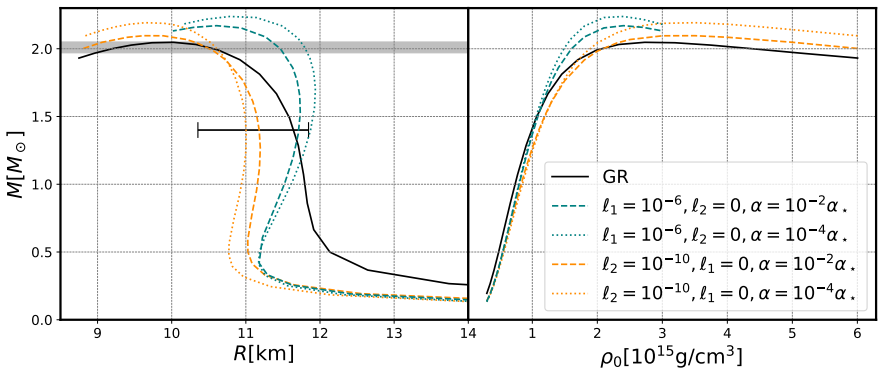
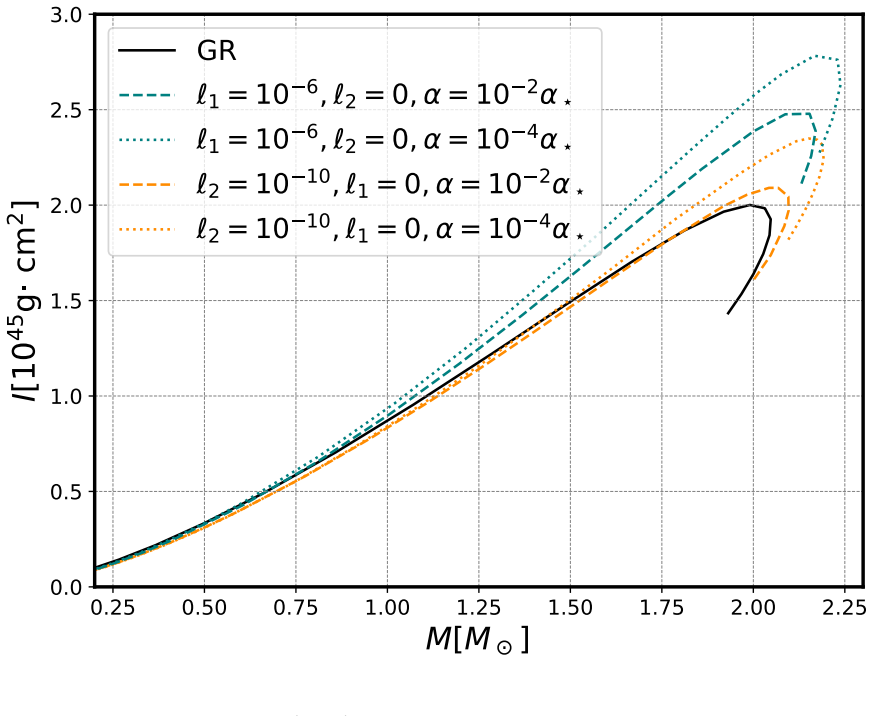
By examining the field equations near spatial infinity, the authors demonstrate that the nonzero vector vacuum condition is compatible only with single-coupling sectors. The A²R sector admits an asymptotically flat Schwarzschild metric with a nontrivial radial vector field. Neutron-star configurations in this sector show appreciable departures in masses, radii, and moments of inertia from general relativity, yet the weak-field deviation is small enough to satisfy existing constraints.
What carries the argument
The A²R coupling term, which permits a radial vector field on an asymptotically flat Schwarzschild background while remaining compatible with the nonzero vacuum boundary condition at infinity.
If this is right
- The A²R sector satisfies Solar-System constraints for sufficiently small vector amplitudes.
- Neutron-star models yield distinct global properties (mass, radius, moment of inertia) from both general relativity and the A^μA^νR_μν sector.
- Black-hole exteriors remain exactly Schwarzschild while carrying a nontrivial radial vector field.
- The A^μA^νR_μν sector is the only other single-coupling option and recovers the previously known monopole asymptotics.
Where Pith is reading between the lines
- Strong-field observations of neutron stars could reveal deviations hidden by weak-field tests.
- The radial vector field may affect accretion flows or binary dynamics around compact objects.
- The framework supplies a controlled setting for exploring vector-tensor effects that remain compatible with asymptotic flatness.
Load-bearing premise
The vector potential must have a zero-energy minimum at nonzero A², and this value must be imposed as a boundary condition at spatial infinity without the field equations forcing generic mixed couplings.
What would settle it
A precise neutron-star moment-of-inertia measurement that matches general relativity to within the predicted offset of the A²R sector, or a demonstration that the asymptotic vector vacuum cannot be maintained consistently with the field equations.
Figures

read the original abstract
Hellings-Nordtvedt theory is a vector-tensor theory in which a vector field $A_\mu$ is nonminimally coupled to curvature through two independent interactions $A^2{\cal R}$ and $A^\mu A^\nu{\cal R}_{\mu\nu}$. When supplemented by a potential whose zero-energy minimum occurs at nonzero $A^2$, the restricted $A^\mu A^\nu{\cal R}_{\mu\nu}$ sector is known to admit black-hole and neutron-star solutions with a monopole-like asymptotic vacuum structure. We examine whether this structure is a generic consequence of the nonzero vector vacuum or instead relies on the special Ricci-tensor coupling. By analyzing the field equations near spatial infinity, we show that the asymptotic vacuum condition is incompatible with generic nonzero values of both couplings and instead selects two allowed single-coupling sectors. The $A^\mu A^\nu{\cal R}_{\mu\nu}$ sector reproduces the known monopole-like asymptotics, whereas the $A^2{\cal R}$ sector admits an asymptotically flat Schwarzschild metric with a nontrivial radial vector field. We further compute the Noether mass in the $A^2{\cal R}$ sector, derive the corresponding Solar-System constraints, and construct neutron-star configurations. Although the weak-field deviation is constrained to be small, neutron stars can still show appreciable departures from both general relativity and the Ricci-tensor-coupling sector in their masses, radii, and moments of inertia. Our results identify that the $A^2{\cal R}$ sector of massive Hellings-Nordtvedt theory as a viable and useful framework for studying strong-field compact objects with a nonzero vector vacuum while remaining compatible with weak-field tests.
Editorial analysis
A structured set of objections, weighed in public.
Referee Report
Summary. The manuscript analyzes massive Hellings-Nordtvedt vector-tensor gravity with a potential whose minimum lies at nonzero A². Field-equation expansion at spatial infinity shows that the nonzero-vector-vacuum boundary condition is incompatible with generic nonzero values of both A²R and A^μA^νR_μν couplings, selecting instead the two single-coupling sectors. The A²R sector is shown to admit an asymptotically flat Schwarzschild black-hole solution accompanied by a nontrivial radial vector field; the corresponding Noether mass is computed, Solar-System constraints are derived, and neutron-star sequences are constructed that display appreciable deviations from GR (and from the Ricci-tensor sector) in mass, radius and moment of inertia while remaining compatible with weak-field bounds.
Significance. If the asymptotic analysis is correct, the work isolates a previously unexamined single-coupling sector that furnishes a concrete, observationally viable framework for strong-field compact objects carrying a nonzero vector vacuum. Explicit construction of neutron-star solutions together with the Noether-mass and PPN-parameter calculations supplies falsifiable predictions that can be confronted with both electromagnetic and gravitational-wave data.
major comments (2)
- [§3, Eqs. (18)–(22)] §3 (asymptotic analysis, around Eqs. (18)–(22)): The assertion that the A²R sector admits an asymptotically flat Schwarzschild metric with A_μ = (0, A_r(r), 0, 0) and A² → v² ≠ 0 at infinity requires a precise statement of the adopted definition of asymptotic flatness for the vector field. In Cartesian coordinates the components A_i ∼ (x^i/r) v retain leading-order angular dependence; it is not shown that the resulting A²R contribution to the stress-energy tensor (or to the field equations) falls off sufficiently rapidly to preserve the standard asymptotic-flatness conditions used for the metric sector.
- [§4.2] §4.2 (neutron-star sequences): The reported deviations in mass, radius and moment of inertia relative to GR are stated to be appreciable, yet the text does not quantify the fractional change in the moment of inertia at fixed gravitational mass for the maximum-mass configurations; without this datum it is difficult to assess whether the claimed strong-field signatures remain distinguishable once the Solar-System bound on the weak-field parameter is imposed.
minor comments (2)
- Notation: the symbol v² for the potential minimum is introduced without an explicit equation number; a cross-reference would aid readability.
- Figure 3 caption: the label “A²R sector” is used interchangeably with “vector-vacuum sector”; a single consistent label would prevent confusion with the Ricci-tensor sector.
Simulated Author's Rebuttal
We thank the referee for the careful reading, positive assessment of significance, and constructive comments. We address each major comment below and will incorporate the requested clarifications and quantifications in the revised manuscript.
read point-by-point responses
-
Referee: [§3, Eqs. (18)–(22)] §3 (asymptotic analysis, around Eqs. (18)–(22)): The assertion that the A²R sector admits an asymptotically flat Schwarzschild metric with A_μ = (0, A_r(r), 0, 0) and A² → v² ≠ 0 at infinity requires a precise statement of the adopted definition of asymptotic flatness for the vector field. In Cartesian coordinates the components A_i ∼ (x^i/r) v retain leading-order angular dependence; it is not shown that the resulting A²R contribution to the stress-energy tensor (or to the field equations) falls off sufficiently rapidly to preserve the standard asymptotic-flatness conditions used for the metric sector.
Authors: We agree that an explicit definition and fall-off verification for the vector sector is required. In the A²R sector the vector is purely radial in spherical coordinates with A_r(r) → v (constant) at infinity; the corresponding Cartesian components A_i ∼ v (x^i/r) produce an A² that approaches the constant v² with no residual angular dependence. Because the A²R term multiplies the curvature scalars, which decay as O(1/r³) or faster for the Schwarzschild background, the contribution to the vector field equations falls off at least as O(1/r³) and is compatible with the standard asymptotic-flatness conditions (metric deviations O(1/r), curvature O(1/r³)). We will add a dedicated paragraph in §3 stating the adopted definition for both metric and vector and verifying the decay rates of all source terms. revision: yes
-
Referee: [§4.2] §4.2 (neutron-star sequences): The reported deviations in mass, radius and moment of inertia relative to GR are stated to be appreciable, yet the text does not quantify the fractional change in the moment of inertia at fixed gravitational mass for the maximum-mass configurations; without this datum it is difficult to assess whether the claimed strong-field signatures remain distinguishable once the Solar-System bound on the weak-field parameter is imposed.
Authors: We accept the referee’s point. In the revised §4.2 we will add explicit values (or a short table) of the fractional deviation ΔI/I_GR evaluated at fixed gravitational mass for the maximum-mass configurations, both for the unconstrained coupling and after imposing the Solar-System bound on the weak-field parameter. This will allow direct assessment of the distinguishability of the strong-field signatures. revision: yes
Circularity Check
Derivation chain is self-contained; no reductions by construction
full rationale
The paper selects allowed sectors by expanding the field equations at large radius under the imposed nonzero-A² vacuum boundary condition at infinity, then solves the resulting system for the A²R sector to obtain the Schwarzschild metric plus radial vector field. Neutron-star models, Noether mass, and Solar-System bounds are obtained by direct numerical integration of the modified equations in that sector. No prediction is statistically forced by a fit, no ansatz is smuggled via self-citation, and the single reference to the 'known' monopole structure in the orthogonal sector is background only and not load-bearing for the A²R results.
Axiom & Free-Parameter Ledger
free parameters (1)
- vector vacuum expectation value
axioms (2)
- domain assumption Asymptotic vacuum condition with nonzero A²
- standard math Standard asymptotic flatness for the metric
invented entities (1)
-
vector field A_μ with potential
no independent evidence
Reference graph
Works this paper leans on
-
[1]
− b2VX(X0) 18ℓ1 , f0 = 1, w 2 = 8πw0(ρ0 +P(ρ 0)) 5(1 +ℓ 1ϕ2
-
[2]
in” and “ext
, X 0 =b 2ϕ2 0 .(34) It is worth emphasizing that the difference between the two single-coupling sectors already appears at the level of the central boundary conditions. In theA µAνRµν coupling sector, the solid-angle deficit is not merely an asymptotic property; it is also reflected in the near- center expansion of neutron-star solutions, for which the l...
2000
-
[3]
The Confrontation between General Relativity and Experiment
C. M. Will, “The Confrontation between General Relativity and Experiment,” Living Rev. Rel.17, 4 (2014) [arXiv:1403.7377 [gr-qc]]. 23
work page internal anchor Pith review Pith/arXiv arXiv 2014
-
[4]
Testing General Relativity with Present and Future Astrophysical Observations
E. Berti, E. Barausse, V. Cardoso, L. Gualtieri, P. Pani, U. Sperhake, L. C. Stein, N. Wex, K. Yagi and T. Baker,et al.“Testing General Relativity with Present and Future Astrophysical Observations,” Class. Quant. Grav.32, 243001 (2015) [arXiv:1501.07274 [gr-qc]]
work page internal anchor Pith review Pith/arXiv arXiv 2015
-
[5]
A. Belenchia, M. Letizia, S. Liberati and E. D. Casola, “Higher-order theories of gravity: diagnosis, extraction and reformulation via non-metric extra degrees of freedom—a review,” Rept. Prog. Phys.81, no.3, 036001 (2018) [arXiv:1612.07749 [gr-qc]]
work page internal anchor Pith review Pith/arXiv arXiv 2018
-
[6]
Modified theories of gravity: Why, how and what?,
S. Shankaranarayanan and J. P. Johnson, “Modified theories of gravity: Why, how and what?,” Gen. Rel. Grav.54, no.5, 44 (2022) [arXiv:2204.06533 [gr-qc]]
-
[7]
A systematic approach to generalisations of General Relativity and their cosmological implications
L. Heisenberg, “A systematic approach to generalisations of General Relativity and their cosmological implications,” Phys. Rept.796, 1-113 (2019) [arXiv:1807.01725 [gr-qc]]
work page internal anchor Pith review Pith/arXiv arXiv 2019
-
[8]
Stellar structure models in modified theories of gravity: Lessons and challenges,
G. J. Olmo, D. Rubiera-Garcia and A. Wojnar, “Stellar structure models in modified theories of gravity: Lessons and challenges,” Phys. Rept.876, 1-75 (2020) [arXiv:1912.05202 [gr-qc]]
-
[9]
D. D. Doneva, F. M. Ramazano˘ glu, H. O. Silva, T. P. Sotiriou and S. S. Yazadjiev, “Sponta- neous scalarization,” Rev. Mod. Phys.96, no.1, 015004 (2024) [arXiv:2211.01766 [gr-qc]]
-
[10]
Vector-Metric Theory of Gravity,
R. W. Hellings and K. Nordtvedt, “Vector-Metric Theory of Gravity,” Phys. Rev. D7, 3593- 3602 (1973)
1973
-
[11]
Static spherical vacuum solutions in the bumblebee gravity model,
R. Xu, D. Liang and L. Shao, “Static spherical vacuum solutions in the bumblebee gravity model,” Phys. Rev. D107, no.2, 024011 (2023) [arXiv:2209.02209 [gr-qc]]
-
[12]
Extended thermodynamics of the bumblebee black holes,
Z. F. Mai, R. Xu, D. Liang and L. Shao, “Extended thermodynamics of the bumblebee black holes,” Phys. Rev. D108, no.2, 024004 (2023) [arXiv:2304.08030 [gr-qc]]
-
[13]
Probing vector hair of black holes with extreme- mass-ratio inspirals,
D. Liang, R. Xu, Z. F. Mai and L. Shao, “Probing vector hair of black holes with extreme- mass-ratio inspirals,” Phys. Rev. D107, no.4, 044053 (2023) [arXiv:2212.09346 [gr-qc]]
-
[14]
Bumblebee Black Holes in Light of Event Horizon Telescope Observations,
R. Xu, D. Liang and L. Shao, “Bumblebee Black Holes in Light of Event Horizon Telescope Observations,” Astrophys. J.945, no.2, 148 (2023) [arXiv:2302.05671 [gr-qc]]
-
[15]
Dynamic instability analysis for bumblebee black holes: The odd parity,
Z. F. Mai, R. Xu, D. Liang and L. Shao, “Dynamic instability analysis for bumblebee black holes: The odd parity,” Phys. Rev. D109, no.8, 084076 (2024) [arXiv:2401.07757 [gr-qc]]
-
[16]
The stealth Kerr solution in the bumblebee gravity,
R. Xu, Z. F. Mai and D. Liang, “The stealth Kerr solution in the bumblebee gravity,” Phys. Lett. B875, 140364 (2026) [arXiv:2601.18809 [gr-qc]]
-
[17]
L. Annulli, V. Cardoso and L. Gualtieri, “Electromagnetism and hidden vector fields in modi- fied gravity theories: spontaneous and induced vectorization,” Phys. Rev. D99, no.4, 044038 (2019) [arXiv:1901.02461 [gr-qc]]. 24
work page internal anchor Pith review Pith/arXiv arXiv 2019
-
[18]
Neutron stars in the bumblebee theory of gravity,
P. Ji, Z. Li, L. Yang, R. Xu, Z. Hu and L. Shao, “Neutron stars in the bumblebee theory of gravity,” Phys. Rev. D110, no.10, 104057 (2024) [arXiv:2409.04805 [gr-qc]]
-
[19]
Probing the vector charge of Sagittarius A* with pulsar timing,
Z. Hu, L. Shao, R. Xu, D. Liang and Z. F. Mai, “Probing the vector charge of Sagittarius A* with pulsar timing,” JCAP04, 087 (2024) [arXiv:2312.02486 [astro-ph.HE]]
-
[20]
Ghost of vector fields in compact stars,
H. O. Silva, A. Coates, F. M. Ramazano˘ glu and T. P. Sotiriou, “Ghost of vector fields in compact stars,” Phys. Rev. D105, no.2, 024046 (2022) [arXiv:2110.04594 [gr-qc]]
-
[21]
Instability of vectorized stars,
E. S. Demirbo˘ ga, A. Coates and F. M. Ramazano˘ glu, “Instability of vectorized stars,” Phys. Rev. D105, no.2, 024057 (2022) [arXiv:2112.04269 [gr-qc]]
-
[22]
Generalization of the Proca Action,
L. Heisenberg, “Generalization of the Proca Action,” JCAP05, 015 (2014) [arXiv:1402.7026 [hep-th]]
-
[23]
Cosmic Acceleration from Abelian Symmetry Breaking
G. Tasinato, “Cosmic Acceleration from Abelian Symmetry Breaking,” JHEP04, 067 (2014) [arXiv:1402.6450 [hep-th]]
work page internal anchor Pith review Pith/arXiv arXiv 2014
-
[24]
Einstein-Vector Gravity, Emerging Gauge Symmetry and de Sitter Bounce
W. J. Geng and H. Lu, “Einstein-Vector Gravity, Emerging Gauge Symmetry and de Sitter Bounce,” Phys. Rev. D93, no.4, 044035 (2016) [arXiv:1511.03681 [hep-th]]
work page internal anchor Pith review Pith/arXiv arXiv 2016
-
[25]
Cosmology in generalized Proca theories
A. De Felice, L. Heisenberg, R. Kase, S. Mukohyama, S. Tsujikawa and Y. l. Zhang, “Cos- mology in generalized Proca theories,” JCAP06, 048 (2016) [arXiv:1603.05806 [gr-qc]]
work page internal anchor Pith review Pith/arXiv arXiv 2016
-
[26]
On the 4D generalized Proca action for an Abelian vector field
E. Allys, J. P. Beltran Almeida, P. Peter and Y. Rodr´ ıguez, “On the 4D generalized Proca action for an Abelian vector field,” JCAP09, 026 (2016) [arXiv:1605.08355 [hep-th]]
work page internal anchor Pith review Pith/arXiv arXiv 2016
-
[27]
Extended vector-tensor theories
R. Kimura, A. Naruko and D. Yoshida, “Extended vector-tensor theories,” JCAP01, 002 (2017) [arXiv:1608.07066 [gr-qc]]
work page internal anchor Pith review Pith/arXiv arXiv 2017
-
[28]
Gravitational radiation from compact binary systems in the massive Brans-Dicke theory of gravity
J. Alsing, E. Berti, C. M. Will and H. Zaglauer, “Gravitational radiation from compact binary systems in the massive Brans-Dicke theory of gravity,” Phys. Rev. D85, 064041 (2012) [arXiv:1112.4903 [gr-qc]]
work page internal anchor Pith review Pith/arXiv arXiv 2012
-
[29]
Gravity, Lorentz Violation, and the Standard Model
V. A. Kostelecky, “Gravity, Lorentz violation, and the standard model,” Phys. Rev. D69, 105009 (2004) [arXiv:hep-th/0312310 [hep-th]]
work page internal anchor Pith review Pith/arXiv arXiv 2004
-
[30]
An exact Schwarzschild-like solution in a bumblebee gravity model
R. Casana, A. Cavalcante, F. P. Poulis and E. B. Santos, “Exact Schwarzschild-like solution in a bumblebee gravity model,” Phys. Rev. D97, no.10, 104001 (2018) [arXiv:1711.02273 [gr-qc]]
work page internal anchor Pith review Pith/arXiv arXiv 2018
-
[31]
Self-consistent neutron stars in a class of massive vector-tensor gravity,
Z. Luo, S. Li and H. Yu, “Self-consistent neutron stars in a class of massive vector-tensor gravity,” Phys. Rev. D113, no.6, 064041 (2026) [arXiv:2601.07196 [gr-qc]]
-
[32]
Gravitational Field of a Global Monopole,
M. Barriola and A. Vilenkin, “Gravitational Field of a Global Monopole,” Phys. Rev. Lett. 25 63, 341 (1989)
1989
-
[33]
Black Holes and Abelian Symmetry Breaking
J. Chagoya, G. Niz and G. Tasinato, “Black Holes and Abelian Symmetry Breaking,” Class. Quant. Grav.33, no.17, 175007 (2016) [arXiv:1602.08697 [hep-th]]
work page internal anchor Pith review Pith/arXiv arXiv 2016
-
[34]
Solutions in the generalized Proca theory with the nonminimal coupling to the Einstein tensor
M. Minamitsuji, “Solutions in the generalized Proca theory with the nonminimal coupling to the Einstein tensor,” Phys. Rev. D94, no.8, 084039 (2016) [arXiv:1607.06278 [gr-qc]]
work page internal anchor Pith review Pith/arXiv arXiv 2016
-
[35]
Stealth configurations in vector-tensor theories of gravity
J. Chagoya and G. Tasinato, “Stealth configurations in vector-tensor theories of gravity,” JCAP01, 046 (2018) [arXiv:1707.07951 [hep-th]]
work page internal anchor Pith review Pith/arXiv arXiv 2018
-
[36]
Thermodynamics of stealth black holes,
A. Bakopoulos, T. Karakasis and E. Papantonopoulos, “Thermodynamics of stealth black holes,” Phys. Rev. D111, no.2, 024065 (2025) [arXiv:2410.14451 [hep-th]]
-
[37]
Dressing a black hole with a time-dependent Galileon
E. Babichev and C. Charmousis, “Dressing a black hole with a time-dependent Galileon,” JHEP08, 106 (2014) [arXiv:1312.3204 [gr-qc]]
work page internal anchor Pith review Pith/arXiv arXiv 2014
-
[38]
Black hole thermodynamics in Horndeski theories,
M. Minamitsuji and K. i. Maeda, “Black hole thermodynamics in Horndeski theories,” Phys. Rev. D108, no.8, 084061 (2023) [arXiv:2308.01082 [gr-qc]]
-
[39]
Revisiting black holes and their thermodynamics in Einstein-Kalb-Ramond gravity
Z. X. Yu, H. D. Lyu, M. Huhe and S. Li, “Revisiting black holes and their thermodynamics in Einstein-Kalb-Ramond gravity,” [arXiv:2511.19926 [gr-qc]]
work page internal anchor Pith review Pith/arXiv arXiv
-
[40]
Black Holes in Higher-Derivative Gravity
H. Lu, A. Perkins, C. N. Pope and K. S. Stelle, “Black Holes in Higher-Derivative Gravity,” Phys. Rev. Lett.114, no.17, 171601 (2015) [arXiv:1502.01028 [hep-th]]
work page internal anchor Pith review Pith/arXiv arXiv 2015
-
[41]
Black hole scalarization in Gauss-Bonnet extended Starobinsky gravity,
H. S. Liu, H. Lu, Z. Y. Tang and B. Wang, “Black hole scalarization in Gauss-Bonnet extended Starobinsky gravity,” Phys. Rev. D103, no.8, 084043 (2021) [arXiv:2004.14395 [gr-qc]]
-
[42]
Quasi-Topological Ricci Polynomial Gravities
Y. Z. Li, H. S. Liu and H. Lu, “Quasi-Topological Ricci Polynomial Gravities,” JHEP02, 166 (2018) [arXiv:1708.07198 [hep-th]]
work page internal anchor Pith review Pith/arXiv arXiv 2018
-
[43]
Neutron stars more compact than black holes as a probe of strong-field gravity
S. Li, H. L¨ u, Y. Gao, R. Xu, L. Shao and H. Yu, “Can a star be smaller than a black hole of the same mass?,” [arXiv:2312.01406 [gr-qc]]
work page internal anchor Pith review Pith/arXiv arXiv
-
[44]
Black Hole Entropy is Noether Charge
R. M. Wald, “Black hole entropy is the Noether charge,” Phys. Rev. D48, no.8, R3427-R3431 (1993) [arXiv:gr-qc/9307038 [gr-qc]]
work page internal anchor Pith review Pith/arXiv arXiv 1993
-
[45]
Some Properties of Noether Charge and a Proposal for Dynamical Black Hole Entropy
V. Iyer and R. M. Wald, “Some properties of Noether charge and a proposal for dynamical black hole entropy,” Phys. Rev. D50, 846-864 (1994) [arXiv:gr-qc/9403028 [gr-qc]]
work page internal anchor Pith review Pith/arXiv arXiv 1994
-
[46]
Black holes in vector-tensor theories and their thermodynamics
Z. Y. Fan, “Black holes in vector-tensor theories and their thermodynamics,” Eur. Phys. J. C 78, no.1, 65 (2018) [arXiv:1709.04392 [hep-th]]
work page internal anchor Pith review Pith/arXiv arXiv 2018
-
[47]
First law of black hole mechanics in Einstein-Maxwell and Einstein-Yang-Mills theories
S. Gao, “The First law of black hole mechanics in Einstein-Maxwell and Einstein-Yang-Mills theories,” Phys. Rev. D68, 044016 (2003) [arXiv:gr-qc/0304094 [gr-qc]]. 26
work page internal anchor Pith review Pith/arXiv arXiv 2003
-
[48]
Dyonic (A)dS Black Holes in Einstein-Born-Infeld Theory in Diverse Dimensions
S. Li, H. Lu and H. Wei, “Dyonic (A)dS Black Holes in Einstein-Born-Infeld Theory in Diverse Dimensions,” JHEP07, 004 (2016) [arXiv:1606.02733 [hep-th]]
work page internal anchor Pith review Pith/arXiv arXiv 2016
-
[49]
S. Q. Wu and S. Li, “Thermodynamics of Static Dyonic AdS Black Holes in theω- Deformed Kaluza-Klein Gauged Supergravity Theory,” Phys. Lett. B746, 276-280 (2015) [arXiv:1505.00117 [hep-th]]
work page internal anchor Pith review Pith/arXiv arXiv 2015
-
[50]
Notes on thermodynamics of Schwarzschild-like bumblebee black hole,
Y. S. An, “Notes on thermodynamics of Schwarzschild-like bumblebee black hole,” Phys. Dark Univ.45, 101520 (2024) [arXiv:2401.15430 [gr-qc]]
-
[51]
Taub-NUT-like black holes in Einstein-bumblebee gravity,
Y. Q. Chen and H. S. Liu, “Taub-NUT-like black holes in Einstein-bumblebee gravity,” Phys. Rev. D112, no.8, 084040 (2025) [arXiv:2505.23104 [gr-qc]]
-
[52]
Dyonic RN-like and Taub-NUT-like black holes in Einstein- bumblebee gravity,
S. Li, L. Liang and L. Ma, “Dyonic RN-like and Taub-NUT-like black holes in Einstein- bumblebee gravity,” [arXiv:2510.04405 [gr-qc]]
-
[53]
Static and spherically symmetric black holes in gravity with a background Kalb-Ramond field,
K. Yang, Y. Z. Chen, Z. Q. Duan and J. Y. Zhao, “Static and spherically symmetric black holes in gravity with a background Kalb-Ramond field,” Phys. Rev. D108, no.12, 124004 (2023) [arXiv:2308.06613 [gr-qc]]
-
[54]
Improved determination ofγby VLBI,
S. B. Lambert and C. Le Poncin-Lafitte, “Improved determination ofγby VLBI,” Astron. Astrophys.529, A70 (2011)
2011
-
[55]
A test of general relativity using radio links with the Cassini spacecraft,
B. Bertotti, L. Iess and P. Tortora, “A test of general relativity using radio links with the Cassini spacecraft,” Nature425, 374-376 (2003)
2003
-
[56]
Self-consistency of compact objects in Lorentz-violating gravity theories,
L. A. Lessa, R. B. Magalh˜ aes and M. M. Ferreira, Junior, “Self-consistency of compact objects in Lorentz-violating gravity theories,” Phys. Rev. D112, no.6, 064031 (2025) [arXiv:2505.01374 [gr-qc]]
-
[57]
A unified equation of state of dense matter and neutron star structure
F. Douchin and P. Haensel, “A unified equation of state of dense matter and neutron star structure,” Astron. Astrophys.380, 151 (2001) [arXiv:astro-ph/0111092 [astro-ph]]
work page internal anchor Pith review Pith/arXiv arXiv 2001
-
[58]
Analytical representations of unified equations of state of neutron-star matter
P. Haensel and A. Y. Potekhin, “Analytical representations of unified equations of state of neutron-star matter,” Astron. Astrophys.428, 191-197 (2004) [arXiv:astro-ph/0408324 [astro- ph]]
work page internal anchor Pith review Pith/arXiv arXiv 2004
-
[59]
Neutron stars in Gauss-Bonnet extended Starobinsky gravity,
Z. Liu, Z. Li, L. Liang, S. Li and H. Yu, “Neutron stars in Gauss-Bonnet extended Starobinsky gravity,” Phys. Rev. D110, no.12, 124052 (2024) [arXiv:2410.14108 [gr-qc]]
-
[60]
Radial oscillations of neutron stars in Starobin- sky gravity and its Gauss-Bonnet extension,
Z. Li, Z. X. Yu, Z. Luo, S. Li and H. Yu, “Radial oscillations of neutron stars in Starobin- sky gravity and its Gauss-Bonnet extension,” Phys. Rev. D112, no.4, 044019 (2025) [arXiv:2507.18916 [gr-qc]]. 27
-
[61]
A Massive Pulsar in a Compact Relativistic Binary
J. Antoniadis, P. C. C. Freire, N. Wex, T. M. Tauris, R. S. Lynch, M. H. van Kerkwijk, M. Kramer, C. Bassa, V. S. Dhillon and T. Driebe,et al.“A Massive Pulsar in a Compact Relativistic Binary,” Science340, 6131 (2013) [arXiv:1304.6875 [astro-ph.HE]]
work page internal anchor Pith review Pith/arXiv arXiv 2013
-
[62]
Stringent constraints on neutron-star radii from multimessenger observations and nuclear theory,
C. D. Capano, I. Tews, S. M. Brown, B. Margalit, S. De, S. Kumar, D. A. Brown, B. Krishnan and S. Reddy, “Stringent constraints on neutron-star radii from multimessenger observations and nuclear theory,” Nature Astron.4, no.6, 625-632 (2020) [arXiv:1908.10352 [astro-ph.HE]]
-
[63]
Slowly rotating neutron stars in scalar-tensor theories with a massive scalar field
S. S. Yazadjiev, D. D. Doneva and D. Popchev, “Slowly rotating neutron stars in scalar-tensor theories with a massive scalar field,” Phys. Rev. D93, no.8, 084038 (2016) [arXiv:1602.04766 [gr-qc]]
work page internal anchor Pith review Pith/arXiv arXiv 2016
-
[64]
K. V. Staykov, D. Popchev, D. D. Doneva and S. S. Yazadjiev, “Static and slowly rotating neutron stars in scalar–tensor theory with self-interacting massive scalar field,” Eur. Phys. J. C78, no.7, 586 (2018) [arXiv:1805.07818 [gr-qc]]
work page internal anchor Pith review Pith/arXiv arXiv 2018
-
[65]
Slowly rotating neutron and strange stars in $R^2$ gravity
K. V. Staykov, D. D. Doneva, S. S. Yazadjiev and K. D. Kokkotas, “Slowly rotating neutron and strange stars inR 2 gravity,” JCAP10, 006 (2014) [arXiv:1407.2180 [gr-qc]]
work page internal anchor Pith review Pith/arXiv arXiv 2014
-
[66]
Non-perturbative and self-consistent models of neutron stars in R-squared gravity
S. S. Yazadjiev, D. D. Doneva, K. D. Kokkotas and K. V. Staykov, “Non-perturbative and self-consistent models of neutron stars in R-squared gravity,” JCAP06, 003 (2014) [arXiv:1402.4469 [gr-qc]]
work page internal anchor Pith review Pith/arXiv arXiv 2014
-
[67]
K. Yagi and N. Yunes, “I-Love-Q,” Science341, 365-368 (2013) [arXiv:1302.4499 [gr-qc]]
work page internal anchor Pith review Pith/arXiv arXiv 2013
-
[68]
K. Yagi and N. Yunes, “I-Love-Q Relations in Neutron Stars and their Applications to As- trophysics, Gravitational Waves and Fundamental Physics,” Phys. Rev. D88, no.2, 023009 (2013) [arXiv:1303.1528 [gr-qc]]
work page internal anchor Pith review Pith/arXiv arXiv 2013
-
[69]
Fixing the dynam- ical evolution of self-interacting vector fields,
M. E. Rubio, G. Lara, M. Bezares, M. Crisostomi and E. Barausse, “Fixing the dynam- ical evolution of self-interacting vector fields,” Phys. Rev. D110, no.6, 063015 (2024) [arXiv:2407.08774 [gr-qc]]
-
[70]
Intrinsic Pathology of Self-Interacting Vector Fields,
A. Coates and F. M. Ramazano˘ glu, “Intrinsic Pathology of Self-Interacting Vector Fields,” Phys. Rev. Lett.129, no.15, 151103 (2022) [arXiv:2205.07784 [gr-qc]]
-
[71]
The well-posedness of the Cauchy problem for self-interacting vector fields,
E. Barausse, M. Bezares, M. Crisostomi and G. Lara, “The well-posedness of the Cauchy problem for self-interacting vector fields,” JCAP11, 050 (2022) [arXiv:2207.00443 [gr-qc]]
-
[72]
Coordinate Singularities of Self-Interacting Vector Field Theories,
A. Coates and F. M. Ramazano˘ glu, “Coordinate Singularities of Self-Interacting Vector Field Theories,” Phys. Rev. Lett.130, no.2, 021401 (2023) [arXiv:2211.08027 [gr-qc]]
-
[73]
Pervasiveness of the breakdown of self-interacting vector 28 field theories,
A. Coates and F. M. Ramazano˘ glu, “Pervasiveness of the breakdown of self-interacting vector 28 field theories,” Phys. Rev. D107, no.10, 104036 (2023) [arXiv:2301.02263 [gr-qc]]
-
[74]
Loss of hyperbolicity and tachyons in generalized Proca theories,
K. ˙I. ¨Unl¨ ut¨ urk, A. Coates and F. M. Ramazano˘ glu, “Loss of hyperbolicity and tachyons in generalized Proca theories,” Phys. Rev. D108, no.4, 044022 (2023) [arXiv:2306.03554 [gr-qc]]
-
[75]
Treatments and placebos for the pathologies of effective field theories,
A. Coates and F. M. Ramazano˘ glu, “Treatments and placebos for the pathologies of effective field theories,” Phys. Rev. D108, no.10, L101501 (2023) [arXiv:2307.07743 [gr-qc]]
-
[76]
Aspects of time evolution in p-form field theories,
K. ˙I. ¨Unl¨ ut¨ urk and F. M. Ramazano˘ glu, “Aspects of time evolution in p-form field theories,” Phys. Rev. D110, no.8, 084036 (2024) [arXiv:2406.15321 [gr-qc]]. 29
discussion (0)
Sign in with ORCID, Apple, or X to comment. Anyone can read and Pith papers without signing in.