Joint Phase Noise and Channel Estimation for OTFS
Pith reviewed 2026-06-30 20:27 UTC · model grok-4.3
The pith
A Wiener filter jointly estimates phase noise and the Doppler channel in OTFS, delivering up to 8 dB BER gains over prior methods.
A machine-rendered reading of the paper's core claim, the machinery that carries it, and where it could break.
Core claim
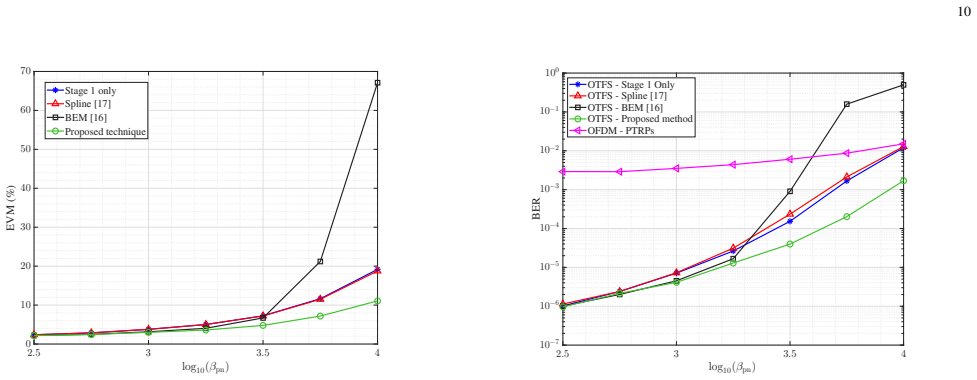
The paper claims that phase noise imposes inter-Doppler interference in the delay-Doppler domain that exceeds the scope of common-phase-error compensation, that existing OTFS phase-noise methods fail when the channel is unknown and multi-tap, and that a Wiener filter exploiting the statistical properties of both phase noise and the Doppler spread channel enables effective joint estimation and compensation, producing up to 8 dB BER improvement.
What carries the argument
Wiener filtering approach for joint phase noise and channel estimation that exploits the statistical nature of both the phase noise and the Doppler spread channel.
If this is right
- Phase noise creates inter-Doppler interference that requires joint compensation with the channel rather than common-phase-error correction alone.
- The proposed method achieves up to 8 dB better bit error rate performance than existing techniques that assume a known single-tap channel.
- SINR expressions quantify the distinct interference levels produced by free-running oscillators, continuous-time PLLs, and discrete-time PLLs.
- OTFS systems need dedicated estimation and compensation because they are sensitive to phase noise in the delay-Doppler domain.
Where Pith is reading between the lines
- The same statistical Wiener approach could be tested on other delay-Doppler or affine-frequency waveforms that face similar oscillator impairments.
- Real deployments would likely need an outer loop to track slowly changing noise statistics when the a-priori assumption no longer holds exactly.
- The derived interference analysis suggests that ignoring Doppler spread when correcting phase noise will produce error floors in high-mobility scenarios.
Load-bearing premise
The statistical properties of both the phase noise and the Doppler spread channel are known in advance so that Wiener filtering can be applied.
What would settle it
A real OTFS link measurement where phase noise or channel statistics deviate from the assumed models and the observed BER gain falls well below 8 dB.
Figures


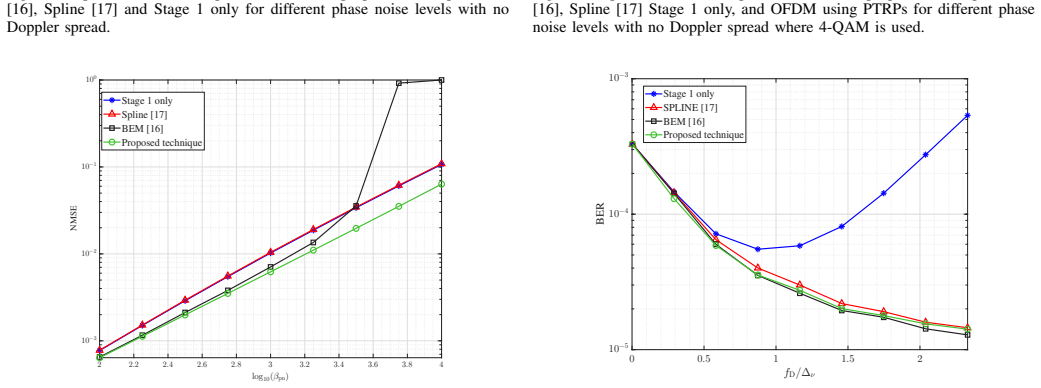


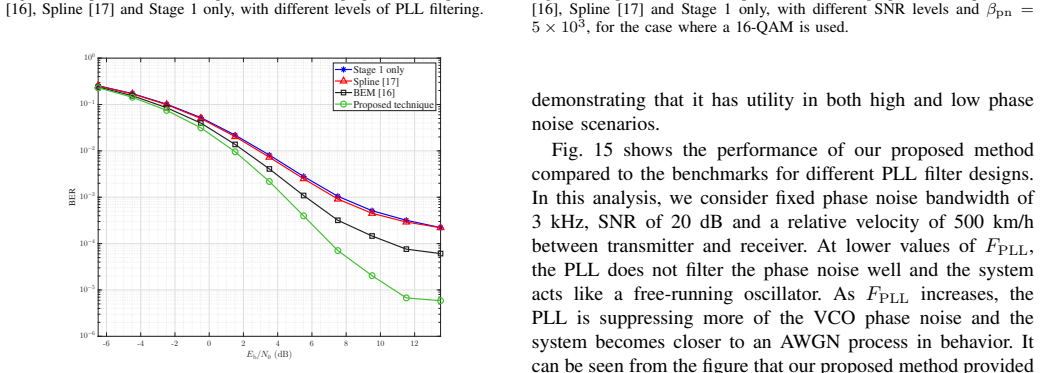
read the original abstract
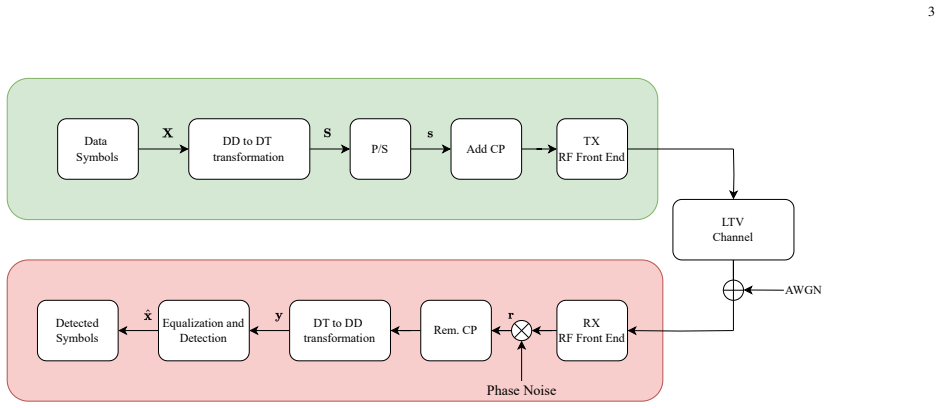
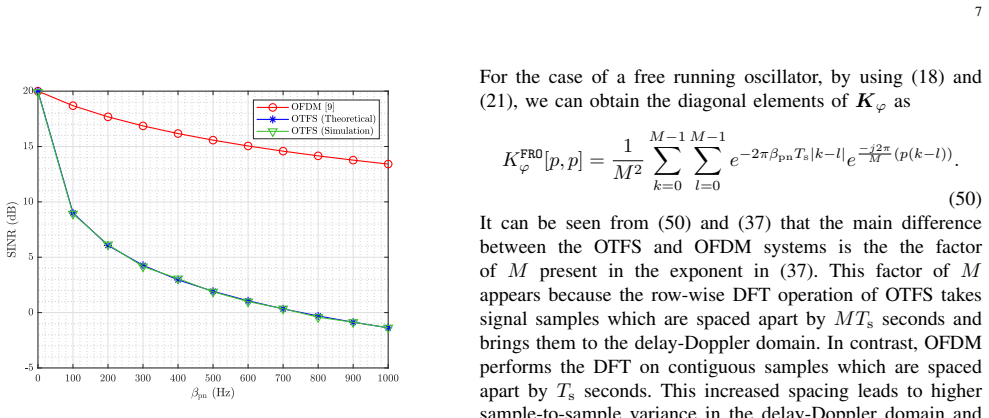
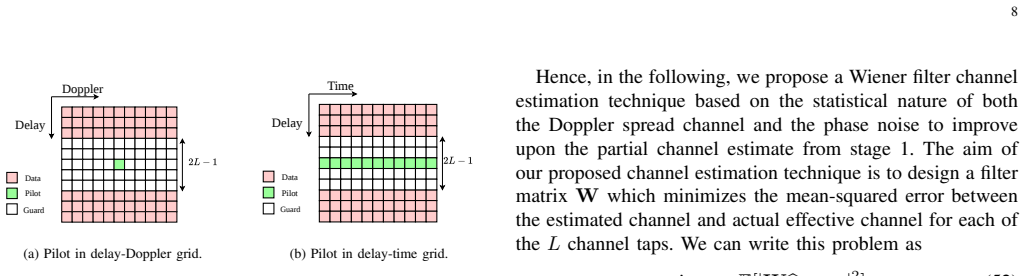
This paper investigates the effect of oscillator phase noise in orthogonal time frequency space (OTFS) systems. The paper provides in-depth analysis of the interference due to phase noise in the delay-Doppler domain and derives expressions for SINR for three different oscillator types, namely free-running oscillators, continuous-time phase locked loops (PLLs) and discrete-time PLLs. The analysis demonstrates the OTFS is sensitive to phase noise and requires appropriate estimation and compensation. In particular, the analysis shows phase noise imposed inter-Doppler-interference (IDI) is severe and that existing phase noise estimation techniques which only consider the common-phase-error (CPE) can not compensate this IDI effectively. Additionally, the existing methods in the OTFS literature on phase noise assume the channel to be a known single tap channel. Hence, in this paper, we propose a method for joint channel and phase noise estimation using a Wiener filtering approach. Our proposed method exploits the statistical nature of both the phase noise and the Doppler spread channel. Our numerical results demonstrate the superior performance of our proposed technique, with gains of up to 8~dB in terms of bit error rate (BER) over existing methods in the literature.
Editorial analysis
A structured set of objections, weighed in public.
Referee Report
Summary. The paper analyzes phase noise effects in OTFS modulation, deriving SINR expressions for free-running oscillators, continuous-time PLLs and discrete-time PLLs that highlight severe inter-Doppler interference (IDI) not captured by common-phase-error compensation alone. It proposes a joint channel and phase-noise estimator based on Wiener filtering that exploits a priori second-order statistics of both the phase-noise process and the Doppler-spread channel, and reports up to 8 dB BER gains over existing methods.
Significance. The IDI analysis supplies a concrete motivation for joint estimation in OTFS. If the reported gains survive statistic mismatch, the Wiener-filter approach would constitute a practical advance for high-mobility OTFS links; the manuscript does not yet demonstrate this robustness.
major comments (2)
- [§III] §III (Wiener-filter derivation): the estimator coefficients are obtained from the known covariance matrices of the phase-noise process and the Doppler channel; the 8 dB BER gain in the numerical results is generated under exact model match. No experiment perturbs these statistics or replaces them with estimated values, so it is unclear whether the claimed superiority holds when the a-priori statistics assumption is violated.
- [Simulation section] Simulation section (results supporting the 8 dB claim): the abstract and text state that the Wiener filter yields the reported gains, yet no description is given of how the filter coefficients are computed when the underlying covariances are only approximately known, nor are any mismatch curves supplied; this directly affects the load-bearing performance claim.
minor comments (2)
- The abstract refers to derived SINR expressions; the main text should display the explicit closed-form expressions (with all assumptions stated) so readers can verify the IDI analysis without reconstructing them.
- Notation for the Wiener-filter input vector and the covariance matrices should be introduced once with consistent symbols across the derivation and the simulation parameter table.
Simulated Author's Rebuttal
We thank the referee for the constructive comments highlighting the need to assess robustness of the Wiener-filter estimator under covariance mismatch. We address each major comment below and will incorporate additional analysis in the revision.
read point-by-point responses
-
Referee: [§III] §III (Wiener-filter derivation): the estimator coefficients are obtained from the known covariance matrices of the phase-noise process and the Doppler channel; the 8 dB BER gain in the numerical results is generated under exact model match. No experiment perturbs these statistics or replaces them with estimated values, so it is unclear whether the claimed superiority holds when the a-priori statistics assumption is violated.
Authors: The Wiener-filter derivation in §III is obtained under the standard assumption of known second-order statistics for both the phase-noise process and the Doppler channel; this yields the closed-form coefficients used in the reported simulations. The 8 dB gain therefore demonstrates the benefit of joint estimation when these statistics are available (e.g., from oscillator datasheets or long-term measurements). We agree that mismatch robustness is a practical concern and will add, in the revised manuscript, a new set of curves that perturb the covariance matrices by 10–20 % and replace them with sample estimates from finite observation windows. revision: yes
-
Referee: [Simulation section] Simulation section (results supporting the 8 dB claim): the abstract and text state that the Wiener filter yields the reported gains, yet no description is given of how the filter coefficients are computed when the underlying covariances are only approximately known, nor are any mismatch curves supplied; this directly affects the load-bearing performance claim.
Authors: We will revise the simulation section to (i) describe the practical computation of the filter coefficients via sample covariance estimation when only approximate statistics are available and (ii) include the mismatch performance curves referenced above. These additions will clarify the scope of the 8 dB claim while preserving the existing matched-statistic results. revision: yes
Circularity Check
No circularity; derivation self-contained via stated model assumptions
full rationale
The paper analyzes phase noise interference in OTFS, derives SINR expressions for different oscillators, and proposes a Wiener-filter joint estimator that explicitly requires known second-order statistics of phase noise and Doppler channel (as stated in abstract and §III). Numerical BER gains are obtained from simulations under exact model match. No equation reduces to a self-definition, no fitted parameter is renamed as a prediction, and no load-bearing self-citation or uniqueness theorem is invoked. The approach is standard and externally falsifiable via mismatch tests (none shown, but that is a limitation of evidence, not circularity).
Axiom & Free-Parameter Ledger
axioms (1)
- domain assumption Statistical properties of phase noise (for free-running, continuous-time PLL, and discrete-time PLL oscillators) and of the Doppler-spread channel are known and can be used directly in a Wiener filter.
Reference graph
Works this paper leans on
-
[1]
Orthogonal time frequency space modu- lation,
R. Hadani, S. Rakib, M. Tsatsanis, A. Monk, A. J. Goldsmith, A. F. Molisch, and R. Calderbank, “Orthogonal time frequency space modu- lation,” inIEEE Wireless Commun. Netw. Conf., 2017, pp. 1–6
2017
-
[2]
Orthogonal time-frequency space modulation: A promising next-generation waveform,
Z. Wei, W. Yuan, S. Li, J. Yuan, G. Bharatula, R. Hadani, and L. Hanzo, “Orthogonal time-frequency space modulation: A promising next-generation waveform,”IEEE Wireless Communications, vol. 28, no. 4, pp. 136–144, 2021
2021
-
[3]
Low complexity modem structure for OFDM-based orthog- onal time frequency space modulation,
A. Farhang, A. RezazadehReyhani, L. E. Doyle, and B. Farhang- Boroujeny, “Low complexity modem structure for OFDM-based orthog- onal time frequency space modulation,”IEEE Wireless Commun. Lett., vol. 7, no. 3, pp. 344–347, 2018
2018
-
[4]
Rf impairments in wireless transceivers: Phase noise, CFO, and IQ imbalance – a survey,
A. Mohammadian and C. Tellambura, “Rf impairments in wireless transceivers: Phase noise, CFO, and IQ imbalance – a survey,”IEEE Access, vol. 9, pp. 111 718–111 791, 2021
2021
-
[5]
OTFS modulation and influence of wideband RF impairments measured on a 60 GHz testbed,
R. Marsalek, J. Blumenstein, D. Sch ¨utzenh¨ofer, and M. Pospisil, “OTFS modulation and influence of wideband RF impairments measured on a 60 GHz testbed,” inIEEE International Workshop on Signal Processing Advances in Wireless Communications, 2020, pp. 1–5
2020
-
[6]
6G wireless systems: Vision, requirements, challenges, insights, and opportunities,
H. Tataria, M. Shafi, A. F. Molisch, M. Dohler, H. Sj ¨oland, and F. Tufvesson, “6G wireless systems: Vision, requirements, challenges, insights, and opportunities,”Proceedings of the IEEE, vol. 109, no. 7, pp. 1166–1199, 2021
2021
-
[7]
A general theory of phase noise in electrical oscillators,
A. Hajimiri and T. Lee, “A general theory of phase noise in electrical oscillators,”IEEE Journal of Solid-State Circuits, vol. 33, no. 2, pp. 179–194, 1998
1998
-
[8]
Chapter 1 - Fundamentals of Time-Varying Communication Channels,
G. Matz and F. Hlawatsch, “Chapter 1 - Fundamentals of Time-Varying Communication Channels,” inWireless Communications Over Rapidly Time-Varying Channels, F. Hlawatsch and G. Matz, Eds. Oxford: Academic Press, 2011, pp. 1–63
2011
-
[9]
Effects of phase noise on OFDM systems with and without PLL: Characterization and compensation,
D. Petrovic, W. Rave, and G. Fettweis, “Effects of phase noise on OFDM systems with and without PLL: Characterization and compensation,” IEEE Transactions on Communications, vol. 55, no. 8, pp. 1607–1616, 2007
2007
-
[10]
Understanding the effects of phase noise in orthog- onal frequency division multiplexing (OFDM),
A. Garcia Armada, “Understanding the effects of phase noise in orthog- onal frequency division multiplexing (OFDM),”IEEE Transactions on Broadcasting, vol. 47, no. 2, pp. 153–159, 2001
2001
-
[11]
Phase-noise compensation for OFDM systems exploiting coherence bandwidth: Modeling, algorithms, and analysis,
M. Chung, L. Liu, and O. Edfors, “Phase-noise compensation for OFDM systems exploiting coherence bandwidth: Modeling, algorithms, and analysis,”IEEE Transactions on Wireless Communications, vol. 21, no. 5, pp. 3040–3056, 2022
2022
-
[12]
OTFS modulation with phase noise in mmWave communications,
G. D. Surabhi, M. K. Ramachandran, and A. Chockalingam, “OTFS modulation with phase noise in mmWave communications,” inIEEE Vehicular Technology Conference, 2019, pp. 1–5
2019
-
[13]
OTFS waveform with phase noise in sub-THz,
Y . Bello, S. Barnola, D. Demmer, and J.-B. Dor´e, “OTFS waveform with phase noise in sub-THz,” inIEEE Vehicular Technology Conference, 2022, pp. 1–5
2022
-
[14]
Time-frequency domain PTRS aided OTFS phase noise compensation,
Y . Liang, X. Li, and P. Fan, “Time-frequency domain PTRS aided OTFS phase noise compensation,”IEEE Communications Letters, pp. 1–1, 2025
2025
-
[15]
Embedded pilot-aided channel estimation for OTFS in delay–doppler channels,
P. Raviteja, K. T. Phan, and Y . Hong, “Embedded pilot-aided channel estimation for OTFS in delay–doppler channels,”IEEE Transactions on Vehicular Technology, vol. 68, no. 5, pp. 4906–4917, 2019
2019
-
[16]
A practical pilot for channel estimation of OTFS,
S. P. S. and A. Farhang, “A practical pilot for channel estimation of OTFS,” inICC 2023 - IEEE International Conference on Communica- tions, 2023, pp. 1319–1325
2023
-
[17]
Orthogonal time sequency multiplex- ing modulation: Analysis and low-complexity receiver design,
T. Thaj, E. Viterbo, and Y . Hong, “Orthogonal time sequency multiplex- ing modulation: Analysis and low-complexity receiver design,”IEEE Transactions on Wireless Communications, vol. 20, no. 12, pp. 7842– 7855, 2021
2021
-
[18]
Wiener interpolation filter for phase noise estimation in sub-THz transmission,
Y . Bello, J.-B. Dor ´e, and D. Demmer, “Wiener interpolation filter for phase noise estimation in sub-THz transmission,” inIEEE Vehicular Technology Conference, 2023, pp. 1–5
2023
-
[19]
Practical pulse- shaping waveforms for reduced-cyclic-prefix OTFS,
P. Raviteja, Y . Hong, E. Viterbo, and E. Biglieri, “Practical pulse- shaping waveforms for reduced-cyclic-prefix OTFS,”IEEE Transactions on Vehicular Technology, vol. 68, no. 1, pp. 957–961, 2019
2019
-
[20]
A spectral model for RF oscillators with power-law phase noise,
A. Chorti and M. Brookes, “A spectral model for RF oscillators with power-law phase noise,”IEEE Transactions on Circuits and Systems I: Regular Papers, vol. 53, no. 9, pp. 1989–1999, 2006
1989
-
[21]
Computing timing jitter from phase noise spectra for oscillators and phase-locked loops with white and1/fnoise,
A. Demir, “Computing timing jitter from phase noise spectra for oscillators and phase-locked loops with white and1/fnoise,”IEEE Transactions on Circuits and Systems I: Regular Papers, vol. 53, no. 9, pp. 1869–1884, 2006
2006
-
[22]
Modeling Stationary Data by a Class of Generalized Ornstein-Uhlenbeck Processes: The Gaussian Case,
A. Arratia, A. Caba ˜na, and E. M. Caba ˜na, “Modeling Stationary Data by a Class of Generalized Ornstein-Uhlenbeck Processes: The Gaussian Case,” inAdvances in Intelligent Data Analysis XIII. Springer International Publishing, 2014, pp. 13–24
2014
-
[23]
Haykin,Adaptive filter theory (3rd ed.)
S. Haykin,Adaptive filter theory (3rd ed.). USA: Prentice-Hall, Inc., 1996
1996
-
[24]
Second-order statistical properties of the WSS Jakes’ fading channel simulator,
C. Xiao, Y . Zheng, and N. Beaulieu, “Second-order statistical properties of the WSS Jakes’ fading channel simulator,”Communications, IEEE Transactions on, vol. 50, pp. 888 – 891, 07 2002
2002
-
[25]
C. Collmann, B. Banerjee, A. Nimr, and G. Fettweis, “A practical analysis: Understanding phase noise modelling in time and frequency domain for phase-locked loops,” 2025. [Online]. Available: https://arxiv.org/abs/2507.12146 [26]3GPP TS 38.901, 3rd Generation Partnership Project (3GPP), June 2018, v15.0.0
-
[26]
Low-complexity linear equal- ization for OTFS modulation,
G. D. Surabhi and A. Chockalingam, “Low-complexity linear equal- ization for OTFS modulation,”IEEE Communications Letters, vol. 24, no. 2, pp. 330–334, 2020
2020
-
[27]
Low-complexity symbol detection and interference cancellation for OTFS system,
H. Qu, G. Liu, L. Zhang, S. Wen, and M. A. Imran, “Low-complexity symbol detection and interference cancellation for OTFS system,”IEEE Transactions on Communications, vol. 69, no. 3, pp. 1524–1537, 2021
2021
-
[28]
Comparison of OTFS diversity performance over slow and fast fading channels,
H. Zhang, X. Huang, and J. A. Zhang, “Comparison of OTFS diversity performance over slow and fast fading channels,” in2019 IEEE/CIC International Conference on Communications in China (ICCC), 2019, pp. 828–833
2019
-
[29]
Channel estimation and turbo equalization for coded OTFS and OFDM: A comparison,
X. Huang, A. Farhang, and R.-R. Chen, “Channel estimation and turbo equalization for coded OTFS and OFDM: A comparison,”IEEE Wireless Communications Letters, vol. 12, no. 9, pp. 1613–1617, 2023
2023
discussion (0)
Sign in with ORCID, Apple, or X to comment. Anyone can read and Pith papers without signing in.