NA61/SHINE results on search for critical point
Pith reviewed 2026-06-30 19:33 UTC · model grok-4.3
The pith
NA61/SHINE nucleus-nucleus collision data at 5-17 GeV show no clear indication of the QCD critical point.
A machine-rendered reading of the paper's core claim, the machinery that carries it, and where it could break.
Core claim
In the reviewed data sets from nucleus-nucleus collisions at √s_NN = 5-17 GeV, studies of net-electric charge fluctuations, π-π femtoscopy, and intermittency of protons and negatively charged hadrons yield no clear indication of the QCD critical point. The work additionally presents novel methods for handling bin-by-bin correlations in intermittency analysis together with improved treatment of systematics and uncertainties.
What carries the argument
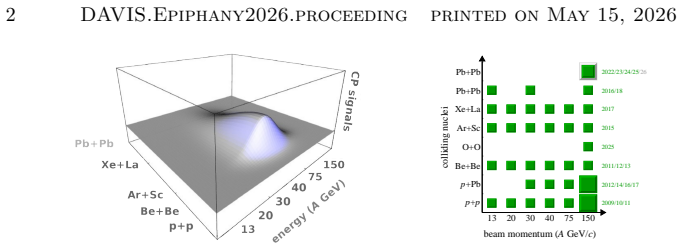
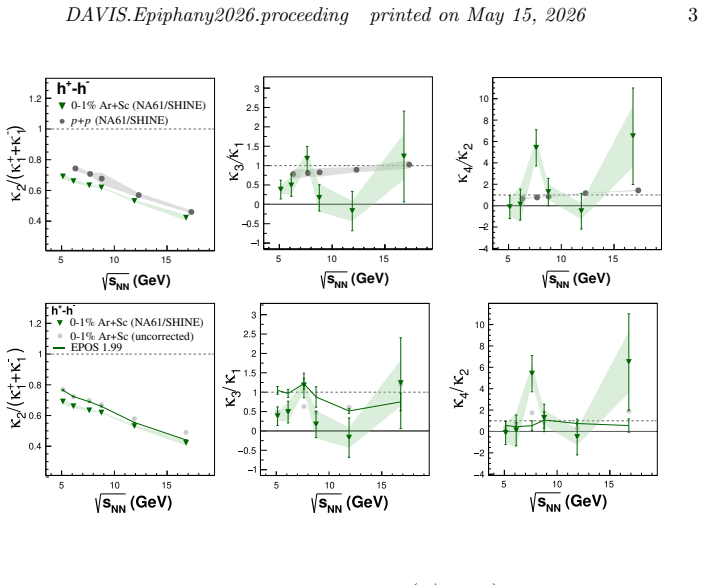
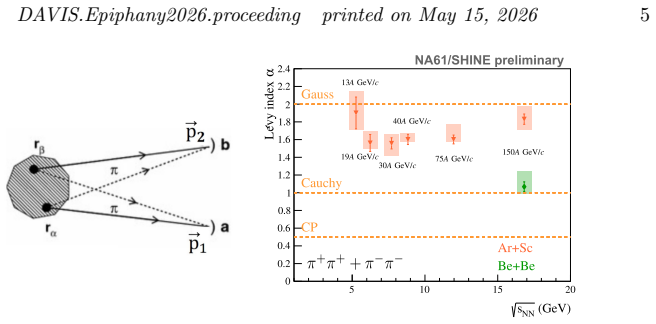
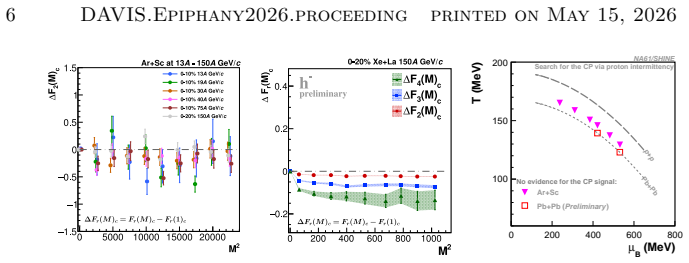
Multiple observables—net-electric charge fluctuations, femtoscopic π-π correlations, and intermittency indices—applied across the 5-17 GeV collision energy range to test for critical-point signatures.
If this is right
- The lack of signals in the scanned energy window places the critical point, if it exists, outside the probed interval or outside the reach of these particular observables.
- New intermittency analysis methods reduce the impact of bin-by-bin correlations and provide tighter control of uncertainties for future measurements.
- The combined results from charge fluctuations, femtoscopy, and intermittency supply a consistent null result across independent probes in the same data sets.
Where Pith is reading between the lines
- Absence of signals may motivate extending the energy scan to higher or lower values in subsequent runs.
- The refined intermittency techniques could be tested on existing or new data from other heavy-ion experiments to check consistency.
- If future runs with larger statistics still show no signals, alternative signatures or theoretical adjustments to the expected critical behavior may need consideration.
Load-bearing premise
The chosen observables and the 5-17 GeV energy range are assumed sensitive enough that a critical point, if present, would have produced detectable signals.
What would settle it
A statistically significant peak or divergence appearing in net-charge fluctuations, a femtoscopic radius, or an intermittency index at one of the scanned energies would indicate the critical point.
Figures
read the original abstract
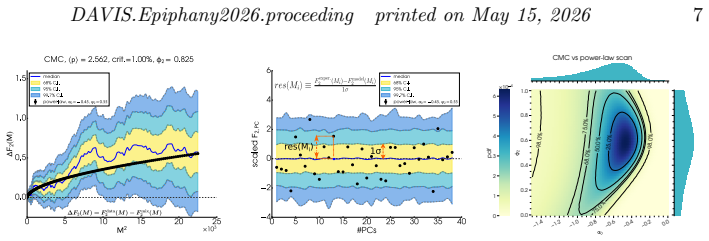
The NA61/SHINE experiment at the CERN SPS is a multipurpose fixed-target spectrometer for charged and neutral hadron measurements. Its research program includes studies of strong interactions as well as reference measurements for neutrino and cosmic-ray physics. One major goal of its strong interaction program is to determine the existence and pinpoint the location of the QCD critical point, an object of both experimental and theoretical studies. This contribution will summarize the current status of NA61/SHINE critical point searches in nucleus-nucleus collisions, in the collision energy range $\sqrt{s_{NN}} = 5-17$~GeV. The review includes studies of fluctuations of net-electric charge, femtoscopy analysis of $\pi-\pi$ pairs, as well as intermittency of protons and negatively charged hadrons. No clear indication of the critical point has been observed so far. Finally, we report on the development of novel methods aimed at solving the long-standing problem of bin-by-bin correlations in experimental intermittency analysis, and for a more accurate handling of systematics and uncertainties.
Editorial analysis
A structured set of objections, weighed in public.
Referee Report
Summary. The manuscript summarizes NA61/SHINE results on the search for the QCD critical point in nucleus-nucleus collisions at √s_NN = 5-17 GeV. It reviews analyses of net-electric charge fluctuations, π-π femtoscopy, and intermittency of protons and negatively charged hadrons, reporting no clear indication of the critical point. It additionally describes development of novel methods to address bin-by-bin correlations in intermittency analysis and improved treatment of systematics and uncertainties.
Significance. A substantiated null result across multiple observables would provide useful constraints on the location of the QCD critical point within the explored energy range. The new intermittency methods address a known technical issue and could strengthen future measurements. As a conference summary the overall impact is incremental rather than definitive.
major comments (1)
- [Abstract] Abstract: the central claim that 'no clear indication of the critical point has been observed so far' is presented without any quantitative measures (e.g., fluctuation measures, correlation lengths, or significance levels) or references to specific figures/tables showing the observables versus energy or centrality. This directly affects the ability to assess whether the chosen observables and energy range were in fact sensitive enough to produce a detectable signal.
Simulated Author's Rebuttal
We thank the referee for the detailed review and the specific suggestion regarding the abstract. We address the major comment below.
read point-by-point responses
-
Referee: [Abstract] Abstract: the central claim that 'no clear indication of the critical point has been observed so far' is presented without any quantitative measures (e.g., fluctuation measures, correlation lengths, or significance levels) or references to specific figures/tables showing the observables versus energy or centrality. This directly affects the ability to assess whether the chosen observables and energy range were in fact sensitive enough to produce a detectable signal.
Authors: We agree that the abstract would benefit from additional context to support the central claim. In the revised manuscript we will expand the abstract to include brief references to the specific figures and tables that present the net-electric charge fluctuation measures, pion femtoscopy radii and correlation lengths, and intermittency indices as functions of collision energy and centrality. These additions will allow readers to directly evaluate the sensitivity of the observables within the explored range without altering the overall length or scope of the contribution. revision: yes
Circularity Check
Experimental summary with no derivation chain
full rationale
The manuscript is a conference report summarizing direct experimental measurements of net-charge fluctuations, π-π femtoscopy, and hadron intermittency in the stated energy range. No equations, parameter fits, or model predictions are presented that could reduce to the input data by construction. The central statement follows from the reported absence of signals in the recorded observables. No self-citations or ansatzes are invoked as load-bearing elements for any claimed result.
Axiom & Free-Parameter Ledger
Reference graph
Works this paper leans on
-
[1]
NA61/SHINE facility at the CERN SPS: beams and detector system
N. Abgrall et al. (NA61/SHINE), JINST9, P06005 (2014),1401.4699
work page internal anchor Pith review Pith/arXiv arXiv 2014
-
[2]
Search for critical behavior of strongly interacting matter at the CERN Super Proton Synchrotron
M. Gazdzicki, P. Seyboth, Acta Phys. Polon. B47, 1201 (2016), 1506.08141
work page internal anchor Pith review Pith/arXiv arXiv 2016
-
[3]
Pion production from a critical QCD phase
N.G. Antoniou, Y.F. Contoyiannis, F.K. Diakonos, A.I. Karanikas, C.N. Ktorides, Nucl. Phys. A693, 799 (2001),hep-ph/0012164
work page internal anchor Pith review Pith/arXiv arXiv 2001
-
[4]
Critical QCD in Nuclear Collisions
N.G. Antoniou, Y.F. Contoyiannis, F.K. Diakonos, G. Mavro- manolakis, Nucl. Phys. A761, 149 (2005),hep-ph/0505185
work page internal anchor Pith review Pith/arXiv arXiv 2005
-
[5]
Critical Opalescence in Baryonic QCD Matter
N.G. Antoniou, F.K. Diakonos, A.S. Kapoyannis, K.S. Kousouris, Phys. Rev. Lett.97, 032002 (2006),hep-ph/0602051
work page internal anchor Pith review Pith/arXiv arXiv 2006
-
[6]
Energy and system size dependence of chemical freeze-out in relativistic nuclear collisions
F. Becattini, J. Manninen, M. Ga´ zdzicki, Phys. Rev. C73, 044905 (2006),hep-ph/0511092
work page internal anchor Pith review Pith/arXiv arXiv 2006
-
[7]
Adhikary et al
H. Adhikary et al. (NA61/SHINE), Tech. Rep. CERN-SPSC-2022-034, SPSC-SR-319, CERN, Geneva (2022)
2022
-
[8]
H. Adhikary et al. (NA61/SHINE), Eur. Phys. J. C85, 918 (2025), 2503.22484
-
[9]
Bose-Einstein or HBT correlation signature of a second order QCD phase transition
T. Cs¨ org˝ o, S. Hegyi, T. Novak, W.A. Zajc, AIP Conf. Proc.828, 525 (2006),nucl-th/0512060
work page internal anchor Pith review Pith/arXiv arXiv 2006
-
[10]
Porfy (NA61/SHINE), PoSICHEP2024, 603 (2025),2410.13975
B. Porfy (NA61/SHINE), PoSICHEP2024, 603 (2025),2410.13975
-
[11]
Proton number fluctuation as a signal of the QCD critical end-point
Y. Hatta, M.A. Stephanov, Phys. Rev. Lett.91, 102003 (2003), [Erra- tum: Phys.Rev.Lett. 91, 129901 (2003)],hep-ph/0302002
work page internal anchor Pith review Pith/arXiv arXiv 2003
-
[12]
Bialas, R.B
A. Bialas, R.B. Peschanski, Nucl. Phys. B273, 703 (1986)
1986
-
[13]
Bialas, M
A. Bialas, M. Gazdzicki, Phys. Lett. B252, 483 (1990)
1990
-
[14]
H. Adhikary et al. (NA61/SHINE), Eur. Phys. J. C83, 881 (2023), 2305.07557
-
[15]
H. Adhikary et al. (NA61/SHINE), Eur. Phys. J. C84, 741 (2024), 2401.03445
-
[16]
Critical fluctuations of the proton density in A+A collisions at $158A$ GeV
T. Anticic et al. (NA49), Eur. Phys. J. C75, 587 (2015),1208.5292
work page internal anchor Pith review Pith/arXiv arXiv 2015
-
[17]
Ortiz (NA61/SHINE), Ukr
V.Z.R. Ortiz (NA61/SHINE), Ukr. J. Phys.69, 858 (2024)
2024
-
[18]
M. Abdulhamid et al. (STAR), Phys. Lett. B845, 138165 (2023), 2301.11062
-
[19]
Metzger,Estimating the Uncertainties of Factorial Moments (2004), HEN-455 (unpublished)
W.J. Metzger,Estimating the Uncertainties of Factorial Moments (2004), HEN-455 (unpublished)
2004
- [20]
discussion (0)
Sign in with ORCID, Apple, or X to comment. Anyone can read and Pith papers without signing in.