Scattering and depletion in a flying focus from conformal transformations
Pith reviewed 2026-06-30 20:30 UTC · model grok-4.3
The pith
Photon emission amplitudes in totally depleting flying focus beams equal Gaussian averages of the corresponding plane-wave amplitudes.
A machine-rendered reading of the paper's core claim, the machinery that carries it, and where it could break.
Core claim
Flying focus fields are obtained from complex conformal transformations of plane waves, and the solutions to the massless wave equation in these fields are the conformal transformations of the Volkov solutions. This implies that photon emission amplitudes in a totally depleting flying focus beam are computed directly from the corresponding plane wave amplitudes by a simple Gaussian average over certain momentum variables, providing a direct method to include focusing effects in strong-field QED.
What carries the argument
The complex conformal transformation that maps plane waves to flying focus fields and maps Volkov solutions to the corresponding solutions of the massless wave equation in those fields.
If this is right
- Photon emission amplitudes in totally depleting flying focus beams reduce to Gaussian averages of the corresponding plane-wave amplitudes.
- Focusing effects enter strong-field QED calculations through this averaging step at no extra computational cost.
- The reduction applies when the flying focus beam is totally depleting.
- Scattering amplitudes with only partial depletion can be treated by extension of the same conformal construction, with first results available in the anti-self-dual limit.
Where Pith is reading between the lines
- The Gaussian averaging step may simplify other observables beyond single-photon emission in strong laser backgrounds.
- Analogous conformal mappings could reduce computational effort for different focused-beam profiles.
- Numerical checks of the averaged amplitudes against direct integration in specific flying focus fields would provide an immediate test of the mapping.
- The approach suggests that geometric transformations in field space can systematically lower the complexity of QED calculations in nonuniform backgrounds.
Load-bearing premise
The solutions of the massless wave equation in the flying focus fields obtained by complex conformal transformation are exactly the conformal transformations of the Volkov solutions.
What would settle it
A direct calculation of any photon emission amplitude inside a flying focus background that deviates from the Gaussian-averaged plane-wave result would disprove the central mapping.
Figures
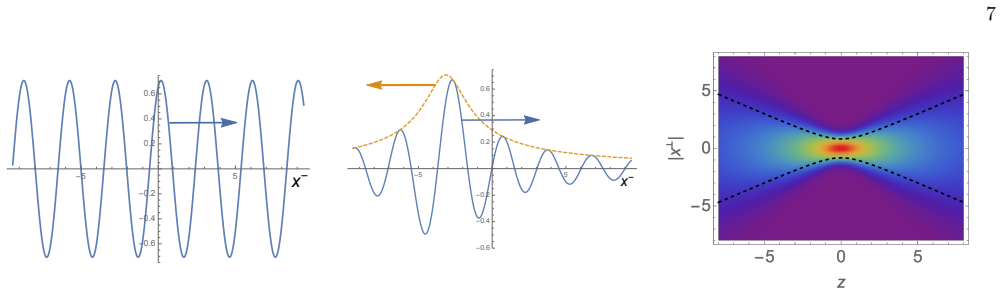
read the original abstract
We show that flying focus fields can be obtained from complex conformal transformation of plane waves, and that solutions of the massless wave equation in the so-obtained fields are, correspondingly, conformal transformations of the Volkov solutions. This leads to the result that photon emission amplitudes in a totally depleting flying focus beam may be computed directly from the corresponding plane wave amplitudes by taking a simple Gaussian average over certain momentum variables. In effect, this gives a way of introducing focussing effects into strong-field QED calculations `for free'. The extension of these results to scattering amplitudes including only partial depletion is discussed and some first results presented in the anti-self-dual limit.
Editorial analysis
A structured set of objections, weighed in public.
Referee Report
Summary. The paper claims that flying focus fields arise from complex conformal transformations of plane waves, that solutions of the massless wave equation in these fields are exactly the conformal images of the corresponding Volkov solutions, and therefore that photon emission amplitudes in a totally depleting flying focus beam are obtained from the plane-wave amplitudes by a Gaussian average over momentum variables. The same logic is extended to scattering amplitudes with partial depletion in the anti-self-dual limit.
Significance. If the central mapping is shown to hold exactly, the result supplies a parameter-free route to incorporate focusing and depletion into strong-field QED amplitudes, converting existing plane-wave calculations into flying-focus results at essentially no extra cost. This would be a useful technical advance for laser-plasma and strong-field phenomenology.
major comments (2)
- [Abstract] Abstract (first two sentences) and the derivation of the transformed solutions: the assertion that the conformal image of a Volkov solution satisfies the massless wave equation in the image background is stated without an explicit verification. The complex character of the map, the required transformation law for the vector potential, and any Jacobian or measure factors must be checked to confirm that the equation is preserved exactly; without this step the reduction to a Gaussian average does not follow.
- [Abstract] The claim that amplitudes reduce to a Gaussian average over plane-wave results (abstract, third sentence) is load-bearing for the entire method. An explicit derivation or counter-term analysis showing that the complex conformal map introduces no additional phase or normalization factors that survive the average is required; the current presentation leaves this as an unverified step.
minor comments (1)
- The extension to partial depletion is mentioned only briefly; a short paragraph or appendix outlining the anti-self-dual construction would improve readability.
Simulated Author's Rebuttal
We thank the referee for their thorough review and positive evaluation of the significance of our results. We address each major comment below and will revise the manuscript to incorporate the requested clarifications and explicit derivations.
read point-by-point responses
-
Referee: [Abstract] Abstract (first two sentences) and the derivation of the transformed solutions: the assertion that the conformal image of a Volkov solution satisfies the massless wave equation in the image background is stated without an explicit verification. The complex character of the map, the required transformation law for the vector potential, and any Jacobian or measure factors must be checked to confirm that the equation is preserved exactly; without this step the reduction to a Gaussian average does not follow.
Authors: We agree that an explicit verification of the preservation of the wave equation under the complex conformal transformation is important for rigor. In the revised manuscript, we will add a dedicated subsection or appendix providing this verification, including the transformation properties of the vector potential under the conformal map and confirmation that Jacobian factors do not introduce additional complications for the solutions. revision: yes
-
Referee: [Abstract] The claim that amplitudes reduce to a Gaussian average over plane-wave results (abstract, third sentence) is load-bearing for the entire method. An explicit derivation or counter-term analysis showing that the complex conformal map introduces no additional phase or normalization factors that survive the average is required; the current presentation leaves this as an unverified step.
Authors: We will include an explicit step-by-step derivation of how the photon emission amplitude in the flying focus background reduces to the Gaussian average over the plane-wave amplitudes. This will demonstrate that the complex nature of the map does not introduce surviving phase or normalization factors, by direct computation from the transformed solutions. The revised paper will contain this derivation. revision: yes
Circularity Check
No significant circularity; derivation applies external conformal properties to standard Volkov solutions
full rationale
The paper's central step invokes the mathematical action of complex conformal transformations on plane-wave backgrounds and their Volkov solutions to obtain the flying-focus fields and amplitudes. This mapping is presented as a direct consequence of the transformation properties of the massless wave equation, not as a definition, fit, or result imported solely via self-citation. The subsequent Gaussian averaging of amplitudes follows from that mapping without reducing any output quantity to an input parameter by construction. No load-bearing premise collapses to a prior paper by the same authors; the result remains self-contained against external mathematical benchmarks on conformal transformations and Volkov states.
Axiom & Free-Parameter Ledger
axioms (1)
- standard math Complex conformal transformations map solutions of the massless wave equation to other solutions of the same equation.
Reference graph
Works this paper leans on
-
[1]
H. Abramowiczet al., Eur. Phys. J. ST230, 2445 (2021), arXiv:2102.02032 [hep-ex]
-
[2]
G. Sarriet al., Eur. Phys. J. Plus140, 1151 (2025), arXiv:2504.02608 [hep-ph]
- [3]
-
[4]
A. Gonoskov, T. G. Blackburn, M. Marklund, and S. S. Bulanov, Rev. Mod. Phys.94, 045001 (2022), arXiv:2107.02161 [physics.plasm-ph]
-
[5]
A. Fedotov, A. Ilderton, F. Karbstein, B. King, D. Seipt, H. Taya, and G. Torgrimsson, Phys. Rept.1010, 1 (2023), arXiv:2203.00019 [hep-ph]
-
[6]
W. H. Furry, Phys. Rev.81, 115 (1951)
1951
-
[7]
D. M. Wolkow, Z. Phys.94, 250 (1935)
1935
-
[8]
Volkov States and Non-linear Compton Scattering in Short and Intense Laser Pulses
D. Seipt, inQuantum Field Theory at the Limits: from Strong Fields to Heavy Quarks(2017) pp. 24–43, arXiv:1701.03692 [physics.plasm-ph]
work page internal anchor Pith review Pith/arXiv arXiv 2017
-
[9]
A. M. Fedotov, Laser Physics19, 214 (2009)
2009
-
[10]
H. Gies, F. Karbstein, and N. Seegert, New J. Phys.15, 083002 (2013), arXiv:1305.2320 [hep-ph]
work page internal anchor Pith review Pith/arXiv arXiv 2013
-
[11]
Probing nonperturbative QED with optimally focused laser pulses
A. Gonoskov, I. Gonoskov, C. Harvey, A. Ilderton, A. Kim, M. Marklund, G. Mourou, and A. M. Sergeev, Phys. Rev. Lett.111, 060404 (2013), arXiv:1302.4653 [hep-ph]
work page internal anchor Pith review Pith/arXiv arXiv 2013
-
[12]
Exact classical and quantum dynamics in background electromagnetic fields
T. Heinzl and A. Ilderton, Phys. Rev. Lett.118, 113202 (2017), arXiv:1701.09166 [hep-ph]
work page internal anchor Pith review Pith/arXiv arXiv 2017
-
[13]
F. Karbstein, A. Blinne, H. Gies, and M. Zepf, Phys. Rev. Lett.123, 091802 (2019), arXiv:1905.00858 [hep-ph]
-
[14]
Di Piazza, Phys
A. Di Piazza, Phys. Rev. A103, 012215 (2021)
2021
-
[15]
G. Degli Esposti and G. Torgrimsson, Phys. Rev. D109, 016013 (2024), arXiv:2308.01659 [hep-ph]
-
[16]
Back-reflection in dipole fields and beyond
M. Valialshchikov, F. Karbstein, D. Seipt, and M. Zepf, Phys. Rev. D112, 116012 (2025), arXiv:2510.11764 [quant-ph]
work page internal anchor Pith review Pith/arXiv arXiv 2025
-
[17]
J. N. Brittingham, Journal of Applied Physics54, 1179 (1983)
1983
-
[18]
Sezginer, Journal of Applied Physics57, 678 (1985)
A. Sezginer, Journal of Applied Physics57, 678 (1985)
1985
-
[19]
Hillion, Wave Motion10, 143 (1988)
P. Hillion, Wave Motion10, 143 (1988)
1988
-
[20]
Hillion, Journal of Mathematical Physics33, 2749 (1992)
P. Hillion, Journal of Mathematical Physics33, 2749 (1992)
1992
-
[21]
D. H. Froula, D. Turnbull, A. S. Davies, T. J. Kessler, D. Haberberger, J. P. Palastro, S.-W. Bahk, I. A. Begishev, R. Boni, S. Bucht, J. Katz, and J. L. Shaw, Nature Photonics12, 262 (2018). 16
2018
-
[22]
S. W. Jolly, O. Gobert, A. Jeandet, and F. Qu´ er´ e, Opt. Express28, 4888 (2020)
2020
-
[23]
Kabacinski, E
A. Kabacinski, E. Oliva, F. Tissandier, J. Gautier, M. Kozlov´ a, J.-P. Goddet, I. A. Andriyash, C. Thaury, P. Zeitoun, and S. Sebban, Nature Photonics17, 354 (2023)
2023
-
[24]
S. Fu, B. Groussin, Y. Liu, A. Mysyrowicz, V. Tikhonchuk, and A. Houard, Phys. Rev. Lett.134, 045001 (2025)
2025
-
[25]
M. Formanek, D. Ramsey, J. P. Palastro, and A. Di Piazza, Phys. Rev. A105, L020203 (2022), arXiv:2108.09651 [hep-ph]
-
[26]
M. Formanek, J. P. Palastro, D. Ramsey, S. Weber, and A. Di Piazza, Phys. Rev. D109, 056009 (2024), arXiv:2307.11734 [hep-ph]
-
[27]
T. Adamo and A. Ilderton, Phys. Rev. D111, 125005 (2025), arXiv:2501.06109 [hep-ph]
-
[28]
A Modern Approach to Superradiance
S. Endlich and R. Penco, JHEP05, 052 (2017), arXiv:1609.06723 [hep-th]
work page internal anchor Pith review Pith/arXiv arXiv 2017
-
[29]
Back-reaction on background fields: a coherent state approach
A. Ilderton and D. Seipt, Phys. Rev. D97, 016007 (2018), arXiv:1709.10085 [hep-th]
work page internal anchor Pith review Pith/arXiv arXiv 2018
-
[30]
R. Aoude and A. Ochirov, JHEP12, 103 (2023), arXiv:2307.07504 [hep-th]
-
[31]
D. Seipt, T. Heinzl, M. Marklund, and S. S. Bulanov, Phys. Rev. Lett.118, 154803 (2017), arXiv:1605.00633 [hep-ph]
work page internal anchor Pith review Pith/arXiv arXiv 2017
-
[32]
L. M. Frantz, Phys. Rev.139, B1326 (1965)
1965
-
[33]
T. W. B. Kibble, Phys. Rev.138, B740 (1965)
1965
-
[34]
J. S. Schwinger, Phys. Rev.82, 664 (1951)
1951
-
[35]
Any geometry has a plane-wave limit,
R. Penrose, “Any geometry has a plane-wave limit,” inDifferential Geometry and Relativity, edited by M. Cahen and M. Flato (Reidel: Dordrecht, 1976) p. 271
1976
-
[36]
P. G. Bergmann and E. J. Flaherty, J. Math. Phys.19, 212 (1978)
1978
-
[37]
Trautman, J
A. Trautman, J. Phys. A13, L1 (1980)
1980
-
[38]
Superintegrable relativistic systems in spacetime-dependent background fields
T. Heinzl and A. Ilderton, J. Phys. A50, 345204 (2017), arXiv:1701.09168 [math-ph]
work page internal anchor Pith review Pith/arXiv arXiv 2017
-
[39]
Scattering on plane waves and the double copy
T. Adamo, E. Casali, L. Mason, and S. Nekovar, Class. Quant. Grav.35, 015004 (2018), arXiv:1706.08925 [hep-th]
work page internal anchor Pith review Pith/arXiv arXiv 2018
-
[40]
V. I. Ritus, J. Russ. Laser Res.6, 497 (1985)
1985
-
[41]
A. M. Fedotov and A. A. Mironov, Phys. Rev. A88, 062110 (2013), arXiv:1310.7258 [hep-ph]
work page internal anchor Pith review Pith/arXiv arXiv 2013
-
[42]
A. Ilderton, Phys. Rev. D100, 125018 (2019), arXiv:1909.02484 [hep-ph]
-
[43]
A. Ilderton and H. Kingham, Phys. Rev. D110, 105022 (2024), arXiv:2409.01372 [hep-ph]
-
[44]
A. J. MacLeod,private communication(2026)
2026
-
[45]
Bateman, Proc
H. Bateman, Proc. Lond. Math. Soc. s2-7, 70 (1909)
1909
-
[46]
Radiation damping in conformally flat universes,
J. M. Hobbs, “Radiation damping in conformally flat universes,” (1968)
1968
- [47]
-
[48]
Cunningham, Proc
E. Cunningham, Proc. Lond. Math. Soc. s2-8, 77 (1910)
1910
-
[49]
Bateman, Proc
H. Bateman, Proc. Lond. Math. Soc. s2-8, 223 (1910)
1910
-
[50]
A. Cristofoli, A. Elkhidir, A. Ilderton, and D. O’Connell, JHEP06, 204 (2023), arXiv:2211.16438 [hep-th]
-
[51]
A. Di Piazza, M. Formanek, D. Ramsey, and J. P. Palastro, (2024), arXiv:2409.15025 [hep-ph]
-
[52]
Arbitrary-Velocity Volkov Wavepackets
D. Ramsey, J. McKeown, and J. P. Palastro, (2026), arXiv:2604.11503 [quant-ph]
work page internal anchor Pith review Pith/arXiv arXiv 2026
-
[53]
D. Ramsey, A. Di Piazza, M. Formanek, P. Franke, D. H. Froula, B. Malaca, W. B. Mori, J. R. Pierce, T. T. Simpson, J. Vieira, M. Vranic, K. Weichman, and J. P. Palastro, Physical Review A107(2023), 10.1103/physreva.107.013513
-
[54]
M. Formanek, J. P. Palastro, M. Vranic, D. Ramsey, and A. Di Piazza, Phys. Rev. E107, 055213 (2023), arXiv:2301.08186 [physics.plasm-ph]
-
[55]
V. Dinu, T. Heinzl, and A. Ilderton, Phys. Rev. D86, 085037 (2012), arXiv:1206.3957 [hep-ph]
work page internal anchor Pith review Pith/arXiv arXiv 2012
-
[56]
Boca and V
M. Boca and V. Florescu, Phys. Rev. A80, 053403 (2009)
2009
-
[57]
An electromagnetic analog of gravitational wave memory
L. Bieri and D. Garfinkle, Class. Quant. Grav.30, 195009 (2013), arXiv:1307.5098 [gr-qc]
work page internal anchor Pith review Pith/arXiv arXiv 2013
-
[58]
G. V. Dunne and C. Schubert, Phys. Lett. B526, 55 (2002), arXiv:hep-th/0111134
work page internal anchor Pith review Pith/arXiv arXiv 2002
-
[59]
G. V. Dunne and C. Schubert, JHEP08, 053 (2002), arXiv:hep-th/0205004
work page internal anchor Pith review Pith/arXiv arXiv 2002
-
[60]
G. V. Dunne and C. Schubert, JHEP06, 042 (2002), arXiv:hep-th/0205005
work page internal anchor Pith review Pith/arXiv arXiv 2002
- [61]
- [62]
- [63]
-
[64]
K. Costello, N. M. Paquette, and A. Sharma, Phys. Rev. Lett.130, 061602 (2023), arXiv:2208.14233 [hep-th]
-
[65]
G. Bogna and L. Mason, JHEP08, 165 (2023), arXiv:2305.07542 [hep-th]
- [66]
- [67]
- [68]
-
[69]
N. Garner and N. M. Paquette, JHEP05, 228 (2025), arXiv:2408.11092 [hep-th]
- [70]
-
[71]
Self-Dual Gauge Theory from the Top Down
R. Bittleston, K. Costello, and K. Zeng, Commun. Math. Phys.407, 108 (2026), arXiv:2412.02680 [hep-th]
work page internal anchor Pith review Pith/arXiv arXiv 2026
-
[72]
Graviton scattering on self-dual black holes
T. Adamo, G. Bogna, L. Mason, and A. Sharma, Class. Quant. Grav.43, 055005 (2026), arXiv:2507.18605 [hep-th]
work page internal anchor Pith review Pith/arXiv arXiv 2026
-
[73]
R. Bittleston and K. Costello, (2026), arXiv:2602.17538 [hep-th]
- [74]
- [75]
-
[76]
A. Ilderton and W. Lindved, JHEP09, 156 (2025), arXiv:2505.16852 [hep-th]
-
[77]
The One-Loop QCD $\beta$-Function as an Index
R. Bittleston and K. Costello, (2025), arXiv:2510.26764 [hep-th]
work page internal anchor Pith review Pith/arXiv arXiv 2025
- [78]
- [79]
- [80]
discussion (0)
Sign in with ORCID, Apple, or X to comment. Anyone can read and Pith papers without signing in.