Radiative decays of the Λ(1520) as a dynamically generated resonance
Pith reviewed 2026-06-30 20:10 UTC · model grok-4.3
The pith
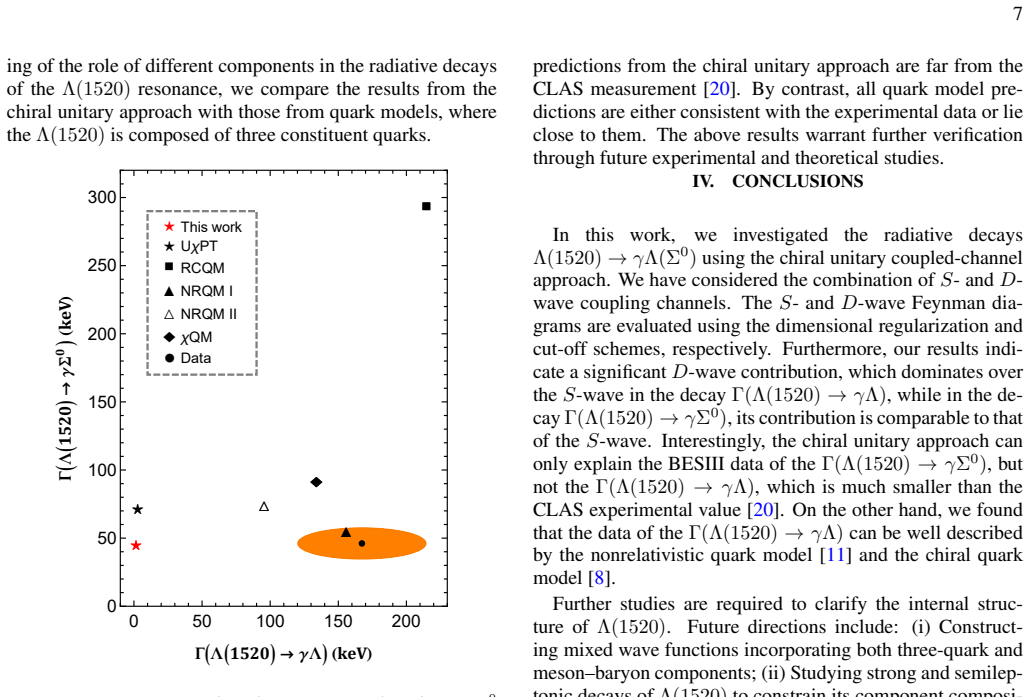
Treating the Λ(1520) as a dynamically generated resonance from meson-baryon scattering reproduces the measured radiative decay width to γΣ⁰ but underpredicts the width to γΛ.
A machine-rendered reading of the paper's core claim, the machinery that carries it, and where it could break.
Core claim
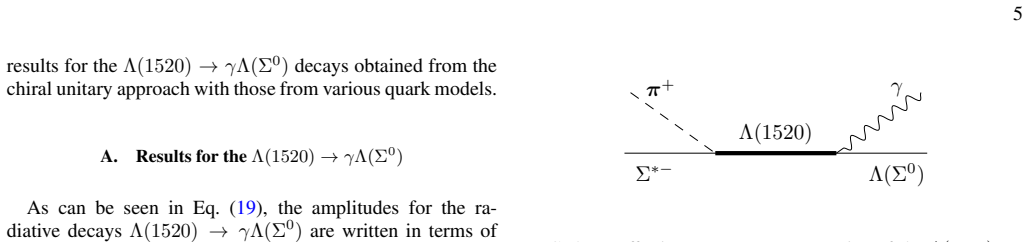
Within the chiral unitary framework the Λ(1520) is generated as a pole in the meson-baryon scattering amplitude; its radiative decays are then computed from the same amplitude by attaching a photon to the external legs or to the intermediate baryons. The partial width to γΣ⁰ agrees with the new BESIII measurement while the partial width to γΛ falls below the CLAS result, indicating that the resonance cannot be described by a single dominant component.
What carries the argument
Chiral unitary approach with dimensional regularization of S-wave loops and explicit photon coupling to intermediate baryons, which fixes the resonance properties before the decay calculation.
If this is right
- The agreement with BESIII supports the dynamical generation picture for this resonance.
- The discrepancy with CLAS for the Λ channel suggests the need for additional components or refined interactions in the model.
- Comparison with quark models highlights the complex, multi-component nature of the Λ(1520).
- Further experimental measurements of both channels are required to constrain the internal structure.
Where Pith is reading between the lines
- The mismatch in one channel may indicate missing higher-order terms or coupled channels not yet included.
- Resolving the CLAS discrepancy could distinguish between pure dynamical generation and hybrid quark-meson-baryon pictures.
- Improved data on these decays would test whether the chiral unitary framework needs extension for electromagnetic processes.
Load-bearing premise
The properties of the Λ(1520) are completely fixed by fitting the chiral unitary model to meson-baryon scattering data before any radiative decay is computed.
What would settle it
A new high-precision measurement of the Λ(1520) → γΛ partial width that either matches the predicted small value or deviates significantly from both the model and the existing CLAS result.
Figures

read the original abstract
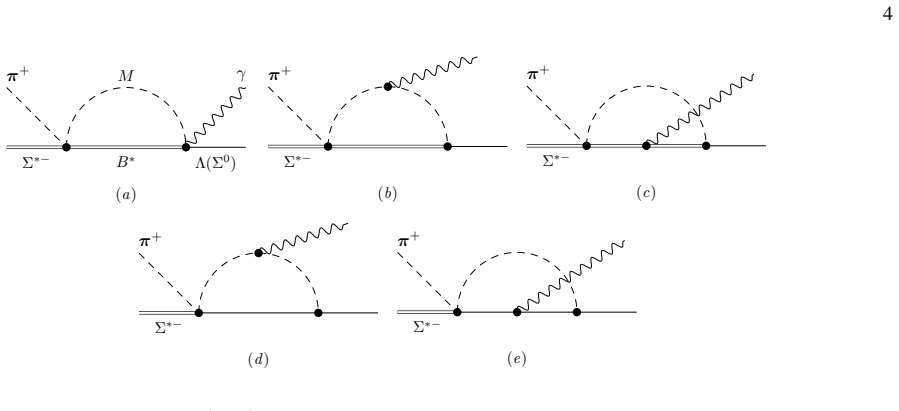
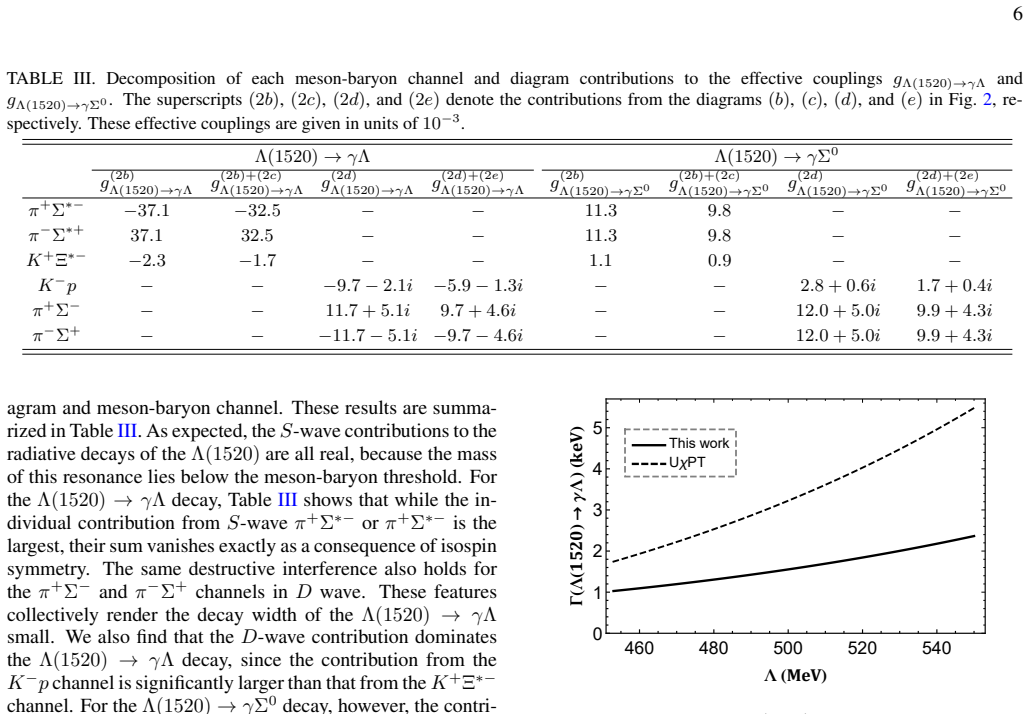
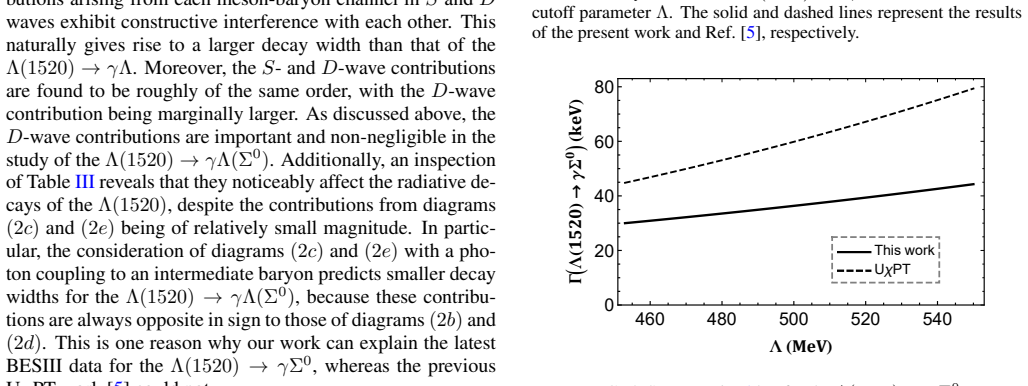
Inspired by the latest BESIII measurement of the $\Lambda(1520)\to\gamma\Sigma^0$ radiative decay, we systematically study the decays $\Lambda(1520)\to\gamma\Lambda(\Sigma^0)$ within the chiral unitary approach, where the $\Lambda(1520)$ is treated as a dynamically generated resonance from meson-baryon interactions. Compared with previous chiral unitary studies, we adopt dimensional regularization for $S$-wave loop integrals to preserve gauge invariance and, for the first time, include Feynman diagrams with photon coupling to intermediate baryons. Our calculated partial decay width $\Gamma(\Lambda(1520)\to\gamma\Sigma^0)$ agrees well with the new BESIII data, whereas the predicted $\Gamma(\Lambda(1520)\to\gamma\Lambda)$ is considerably smaller than the CLAS experimental result. By comparing our results with predictions from various quark models, we discuss the internal nature of the $\Lambda(1520)$ resonance, highlight its complex component structure, and stress the need for more refined theoretical frameworks and further experimental measurements.
Editorial analysis
A structured set of objections, weighed in public.
Referee Report
Summary. The manuscript claims that the Λ(1520) resonance, treated as dynamically generated from meson-baryon interactions in the chiral unitary approach, has radiative decay widths computed with dimensional regularization (to preserve gauge invariance) and with the addition of photon couplings to intermediate baryons. The resulting partial width Γ(Λ(1520)→γΣ⁰) agrees with the recent BESIII measurement, while Γ(Λ(1520)→γΛ) is considerably smaller than the CLAS result; the authors interpret the pattern, together with comparisons to quark models, as evidence for a complex internal structure of the resonance.
Significance. If the numerical results hold, the work supplies a non-trivial test of the dynamical-generation hypothesis through electromagnetic observables that are computed after the strong-sector parameters are fixed. Credit is due for the explicit choice of dimensional regularization to maintain gauge invariance and for the first inclusion of the photon–baryon coupling diagrams, both of which address documented limitations of earlier calculations. The direct comparison with two independent data sets (BESIII and CLAS) supplies a falsifiable element that can guide future experimental and theoretical work on the resonance’s composition.
minor comments (3)
- The abstract states numerical agreement with BESIII but does not quote the calculated central value or its uncertainty, making immediate comparison with the experimental number difficult.
- A table or dedicated subsection listing the subtraction constants (or low-energy couplings) inherited from prior fits, together with the resulting pole position and the two radiative widths, would improve traceability of the numerical results.
- The discussion of the resonance’s “complex component structure” would benefit from a short paragraph explicitly contrasting the present framework’s assumptions with those of the quark models cited, rather than leaving the comparison implicit.
Simulated Author's Rebuttal
We thank the referee for the positive assessment of our work, the recognition of the technical improvements (dimensional regularization and photon-baryon diagrams), and the recommendation for minor revision. No major comments were raised in the report.
Circularity Check
Derivation is self-contained; strong sector fixed before independent EM extension
full rationale
The paper generates the Λ(1520) pole and couplings from meson-baryon scattering in the chiral unitary framework (with dimensional regularization chosen for gauge invariance), then computes the two radiative widths by adding photon couplings to intermediate states as a separate step. Only one additional free parameter is introduced for the EM sector. The two channels are evaluated from the same fixed strong amplitudes, one matching BESIII data and one underpredicting CLAS; the discrepancy is presented as a physical observation rather than a fit. No equation reduces by construction to its input, no load-bearing premise rests solely on self-citation, and the EM calculation is not a renaming or re-fit of the strong-sector results. This satisfies the default expectation of no significant circularity.
Axiom & Free-Parameter Ledger
free parameters (1)
- subtraction constants or low-energy couplings
axioms (2)
- domain assumption Chiral symmetry and two-body unitarity govern the meson-baryon scattering amplitude
- domain assumption Dimensional regularization preserves electromagnetic gauge invariance for the S-wave loops
Reference graph
Works this paper leans on
-
[1]
The matrix elementsV 11, V12,V 21 andV 22 are derived from the lowest order chiral La- grangian in Eq
0 0 γ13q2 3 0γ 33q4 3 γ34q2 3q2 4 γ14q2 4 0γ 34q2 3q2 4 γ44q4 4 ,(12) whereq i is the on-shell three-momentum of the meson or baryon in the center-of-mass frame. The matrix elementsV 11, V12,V 21 andV 22 are derived from the lowest order chiral La- grangian in Eq. (3).V 23 andV 24 involving the tree-level in- teraction of theKΞ ∗ channel to theD-wa...
-
[2]
D ¨oring, (2025), arXiv:2510.13133 [nucl-th]
M. D ¨oring, (2025), arXiv:2510.13133 [nucl-th]
-
[3]
M. D ¨oring, J. Haidenbauer, M. Mai, and T. Sato, Prog. Part. Nucl. Phys.146, 104213 (2026), arXiv:2505.02745 [nucl-th]
-
[4]
L. S. Geng, E. Oset, and M. Doring, Eur. Phys. J. A32, 201 (2007), arXiv:hep-ph/0702093
work page internal anchor Pith review Pith/arXiv arXiv 2007
- [5]
-
[6]
Radiative decay of the Lambda(1520)
M. Doring, E. Oset, and S. Sarkar, Phys. Rev. C74, 065204 (2006), arXiv:nucl-th/0601027
work page internal anchor Pith review Pith/arXiv arXiv 2006
-
[7]
Helicity Amplitudes of the Lambda(1670) and two Lambda(1405) as dynamically generated resonances
M. Doring, D. Jido, and E. Oset, Eur. Phys. J. A45, 319 (2010), arXiv:1002.3688 [nucl-th]. 8
work page internal anchor Pith review Pith/arXiv arXiv 2010
-
[8]
Q.-H. Shen, J.-X. Lu, L.-S. Geng, X. Liu, and J.-J. Xie, Phys. Rev. D113, 036014 (2026), arXiv:2510.13623 [hep-ph]
-
[9]
Radiative Decays of Decuplet Baryons, $\Lambda(1405)$ and $\Lambda (1520)$ Hyperons
L. Yu, X.-L. Chen, W.-Z. Deng, and S.-L. Zhu, Phys. Rev. D 73, 114001 (2006), arXiv:hep-ph/0602171
work page internal anchor Pith review Pith/arXiv arXiv 2006
-
[10]
Helicity amplitudes and electromagnetic decays of hyperon resonances
T. Van Cauteren, J. Ryckebusch, B. Metsch, and H.-R. Petry, Eur. Phys. J. A26, 339 (2005), arXiv:nucl-th/0509047
work page internal anchor Pith review Pith/arXiv arXiv 2005
-
[11]
J. W. Darewych, M. Horbatsch, and R. Koniuk, Phys. Rev. D 28, 1125 (1983)
1983
-
[12]
Kaxiras, E
E. Kaxiras, E. J. Moniz, and M. Soyeur, Phys. Rev. D32, 695 (1985)
1985
-
[13]
Warns, W
M. Warns, W. Pfeil, and H. Rollnik, Phys. Lett. B258, 431 (1991)
1991
-
[14]
Koniuk and N
R. Koniuk and N. Isgur, Phys. Rev. D21, 1868 (1980), [Erra- tum: Phys.Rev.D 23, 818 (1981)]
1980
-
[15]
Quark Models of Baryon Masses and Decays
S. Capstick and W. Roberts, Prog. Part. Nucl. Phys.45, S241 (2000), arXiv:nucl-th/0008028
work page internal anchor Pith review Pith/arXiv arXiv 2000
-
[16]
C. S. An, B. Saghai, S. G. Yuan, and J. He, Phys. Rev. C81, 045203 (2010), arXiv:1002.4085 [nucl-th]
work page internal anchor Pith review Pith/arXiv arXiv 2010
-
[17]
Umino and F
Y . Umino and F. Myhrer, Nucl. Phys. A529, 713 (1991)
1991
- [18]
-
[19]
N. Salone and S. Leupold, Eur. Phys. J. A57, 183 (2021), arXiv:2104.05675 [hep-ph]
-
[20]
Algebraic Models of Hadron Structure II. Strange Baryons
R. Bijker, F. Iachello, and A. Leviatan, Annals Phys.284, 89 (2000), arXiv:nucl-th/0004034
work page internal anchor Pith review Pith/arXiv arXiv 2000
-
[21]
S. Tayloret al.(CLAS), Phys. Rev. C71, 054609 (2005), [Er- ratum: Phys.Rev.C 72, 039902 (2005)], arXiv:hep-ex/0503014
-
[22]
Bertini, Nucl
R. Bertini, Nucl. Phys. B279, 49 (1987)
1987
-
[23]
T. S. Mast, M. Alston-Garnjost, R. O. Bangerter, A. Barbaro- Galtieri, L. K. Gershwin, F. T. Solmitz, and R. D. Tripp, Phys. Rev. Lett.21, 1715 (1968)
1968
-
[24]
Y . M. Antipovet al.(SPHINX), Phys. Lett. B604, 22 (2004), arXiv:hep-ex/0406039
work page internal anchor Pith review Pith/arXiv arXiv 2004
-
[25]
Ablikimet al.(BESIII), Phys
M. Ablikimet al.(BESIII), Phys. Rev. Lett.136, 141801 (2026)
2026
-
[26]
Navaset al.(Particle Data Group), Phys
S. Navaset al.(Particle Data Group), Phys. Rev. D110, 030001 (2024)
2024
-
[27]
Chiral coupled channel dynamics of the Lambda(1520) and the K-P -> pi0 pi0 Lambda reaction
S. Sarkar, E. Oset, and M. J. Vicente Vacas, Phys. Rev. C72, 015206 (2005), arXiv:hep-ph/0503066
work page internal anchor Pith review Pith/arXiv arXiv 2005
-
[28]
Baryonic Resonances from Baryon Decuplet-Meson Octet Interaction
S. Sarkar, E. Oset, and M. J. Vicente Vacas, Nucl. Phys. A 750, 294 (2005), [Erratum: Nucl.Phys.A 780, 90–90 (2006)], arXiv:nucl-th/0407025
work page internal anchor Pith review Pith/arXiv arXiv 2005
-
[29]
L. Roca, S. Sarkar, V . K. Magas, and E. Oset, Phys. Rev. C73, 045208 (2006), arXiv:hep-ph/0603222
work page internal anchor Pith review Pith/arXiv arXiv 2006
-
[30]
L. S. Geng, E. Oset, and B. S. Zou, Eur. Phys. J. A38, 239 (2008), arXiv:0807.4798 [hep-ph]
work page internal anchor Pith review Pith/arXiv arXiv 2008
-
[31]
The composite nature of the $\Lambda(1520)$ resonance
F. Aceti, E. Oset, and L. Roca, Phys. Rev. C90, 025208 (2014), arXiv:1404.6128 [hep-ph]
work page internal anchor Pith review Pith/arXiv arXiv 2014
-
[32]
The inverse amplitude method in Chiral Perturbation Theory
A. Dobado and J. R. Pelaez, Phys. Rev. D56, 3057 (1997), arXiv:hep-ph/9604416
work page internal anchor Pith review Pith/arXiv arXiv 1997
-
[33]
J. A. Oller, E. Oset, and J. R. Pelaez, Phys. Rev. D59, 074001 (1999), [Erratum: Phys.Rev.D 60, 099906 (1999), Erratum: Phys.Rev.D 75, 099903 (2007)], arXiv:hep-ph/9804209
work page internal anchor Pith review Pith/arXiv arXiv 1999
-
[34]
J. A. Oller and E. Oset, Phys. Rev. D60, 074023 (1999), arXiv:hep-ph/9809337
work page internal anchor Pith review Pith/arXiv arXiv 1999
- [35]
-
[36]
E. Oset, S. Sarkar, M. J. Vicente Vacas, M. Kaskulov, L. Roca, V . K. Magas, A. Ramos, and H. Toki, Nucl. Phys. A782, 259 (2007), arXiv:nucl-th/0607051
work page internal anchor Pith review Pith/arXiv arXiv 2007
-
[37]
J. Nieves and E. Ruiz Arriola, Phys. Rev. D64, 116008 (2001), arXiv:hep-ph/0104307
work page internal anchor Pith review Pith/arXiv arXiv 2001
-
[38]
Non perturbative chiral approach to s-wave \bar{K}N interactions
E. Oset and A. Ramos, Nucl. Phys. A635, 99 (1998), arXiv:nucl-th/9711022
work page internal anchor Pith review Pith/arXiv arXiv 1998
-
[39]
Y . Xiao, X.-L. Ren, J.-X. Lu, L.-S. Geng, and U.-G. Meißner, Eur. Phys. J. C78, 489 (2018), arXiv:1803.04251 [hep-ph]
work page internal anchor Pith review Pith/arXiv arXiv 2018
- [40]
-
[41]
L. S. Geng, J. Martin Camalich, and M. J. Vicente Vacas, Phys. Rev. D80, 034027 (2009), arXiv:0907.0631 [hep-ph]
work page internal anchor Pith review Pith/arXiv arXiv 2009
-
[42]
L. S. Geng, J. Martin Camalich, and M. J. Vicente Vacas, Phys. Lett. B676, 63 (2009), arXiv:0903.0779 [hep-ph]
work page internal anchor Pith review Pith/arXiv arXiv 2009
-
[43]
X.-L. Ren, L. Geng, J. Meng, and H. Toki, Phys. Rev. D87, 074001 (2013), arXiv:1302.1953 [nucl-th]
work page internal anchor Pith review Pith/arXiv arXiv 2013
-
[44]
E. E. Jenkins and A. V . Manohar, Phys. Lett. B259, 353 (1991)
1991
-
[45]
X. L. Ren, L. S. Geng, J. Martin Camalich, J. Meng, and H. Toki, JHEP12, 073 (2012), arXiv:1209.3641 [nucl-th]
work page internal anchor Pith review Pith/arXiv arXiv 2012
-
[46]
L. S. Geng, J. Martin Camalich, L. Alvarez-Ruso, and M. J. Vicente Vacas, Phys. Rev. Lett.101, 222002 (2008), arXiv:0805.1419 [hep-ph]
work page internal anchor Pith review Pith/arXiv arXiv 2008
-
[47]
L. Roca, A. Hosaka, and E. Oset, Phys. Lett. B658, 17 (2007), arXiv:hep-ph/0611075
work page internal anchor Pith review Pith/arXiv arXiv 2007
-
[48]
Radiative decay of rho^0 and phi mesons in a chiral unitary approach
E. Marco, S. Hirenzaki, E. Oset, and H. Toki, Phys. Lett. B 470, 20 (1999), arXiv:hep-ph/9903217
work page internal anchor Pith review Pith/arXiv arXiv 1999
-
[49]
Coupled channels dynamics in the generation of the $\Omega (2012)$ resonance
R. Pavao and E. Oset, Eur. Phys. J. C78, 857 (2018), arXiv:1808.01950 [hep-ph]
work page internal anchor Pith review Pith/arXiv arXiv 2018
- [50]
-
[51]
L. G. Landsberg, Phys. Atom. Nucl.59, 2080 (1996)
2080
discussion (0)
Sign in with ORCID, Apple, or X to comment. Anyone can read and Pith papers without signing in.