Recognition: 2 theorem links
· Lean TheoremLarkin-Ovchinnikov-Fulde-Ferrell state of spin polarized atomic Fermi superfluid on a spherical surface
Pith reviewed 2026-05-15 02:55 UTC · model grok-4.3
The pith
Spin-polarized Fermi superfluids on a spherical surface support LOFF states with multiple nodes that become more stable at higher polarization but only near the uniform phase boundary.
A machine-rendered reading of the paper's core claim, the machinery that carries it, and where it could break.
Core claim
By solving the BdG equations for spin-polarized Fermi gases in a thin spherical shell, the work identifies LOFF states with modulating order parameters that survive near the phase boundary where uniform solutions cease to exist. The LOFF states with multiple nodes in the order parameter become more stable at higher spin polarization when compared via grand potentials, although the LOFF phase remains confined to a narrow parameter range adjacent to the boundary.
What carries the argument
The mean-field Bogoliubov-de Gennes (BdG) equations solved on a spherical surface for the pairing order parameter, which allow spatially modulated LOFF solutions with nodes.
If this is right
- LOFF states with multiple nodes are energetically favored over fewer-node variants at higher spin imbalance.
- The region of LOFF stability shrinks to a thin strip adjacent to the uniform superfluid disappearance line.
- Both the order parameter and particle densities exhibit spatial modulations in the LOFF phase.
- Uniform solutions dominate away from the boundary, limiting LOFF to high-polarization edges.
Where Pith is reading between the lines
- Experiments in spherical traps may require fine-tuning close to the critical polarization to detect LOFF modulations.
- Neglected effects like finite temperature or shell thickness could further narrow or eliminate the LOFF window.
- Similar fragility might appear in other compact geometries such as cylindrical or toroidal traps.
- Testing grand potential differences numerically beyond mean-field could confirm the stability trend.
Load-bearing premise
The thin spherical shell approximation together with the mean-field BdG treatment remains quantitatively accurate without significant corrections from radial thickness, quantum fluctuations, or finite-temperature effects.
What would settle it
Direct measurement of the order parameter modulation or grand potential comparison in a spherical trap showing whether multi-node LOFF solutions persist only near the polarization where uniform pairing vanishes.
Figures


read the original abstract
By implementing the Bogoliubov-de Gennes (BdG) formalism of population-imbalanced atomic Fermi gases with pairing interactions in a thin spherical shell, we characterize the Larkin-Ovchinnikov-Fulde-Ferrell (LOFF) state in such a compact geometry. We first construct a phase diagram showing where uniform solutions of spin-polarized Fermi superfluid from the BdG equation cease to exist due to the vanishing order parameter. Near the boundary, various LOFF states with spatially modulating order parameters and density profiles can survive as convergent solutions to the BdG equation. When both uniform and LOFF solutions are present, we compare their grand potentials to determine the energetically favorable state and find that the LOFF states with multiple nodes in the order parameter become more stable at higher spin polarization. However, the LOFF state only survives close to the phase boundary where the uniform solutions vanish, indicating fragility of the LOFF state on a spherical surface. We also briefly discuss possible implications.
Editorial analysis
A structured set of objections, weighed in public.
Referee Report
Summary. The paper implements the Bogoliubov-de Gennes (BdG) formalism for population-imbalanced Fermi superfluids confined to a thin spherical shell. It constructs a phase diagram for the disappearance of uniform solutions due to vanishing order parameter, identifies convergent LOFF solutions with spatially modulating order parameters and densities near that boundary, compares grand potentials to establish energetic preference, and concludes that multi-node LOFF states grow more stable with increasing spin polarization while remaining fragile because they exist only close to the uniform-solution boundary.
Significance. If the numerical stability ordering holds, the work provides a concrete characterization of LOFF states on a compact curved manifold, highlighting their fragility relative to flat-space or bulk geometries. This could inform future experiments with ultracold atoms in spherical-shell traps and tests of mean-field theory on finite manifolds.
major comments (2)
- [results on grand-potential comparison] The central claim that multi-node LOFF states become more stable at higher polarization rests on grand-potential comparisons between uniform and modulated solutions. No quantitative values, error bars, or convergence tests for these potentials are reported, so the ordering cannot be independently verified (abstract and results section on numerical solutions).
- [thin-shell BdG setup] The conclusion that LOFF states are fragile because they survive only near the uniform-solution boundary assumes the thin-shell limit is quantitatively accurate. No estimate is given for corrections arising from finite radial thickness, which could hybridize with angular modulations and extend the LOFF region (method section on spherical-shell approximation).
minor comments (2)
- [BdG formalism] Notation for the spherical harmonics or angular momentum quantum numbers used in the BdG expansion should be defined explicitly at first use.
- [phase diagram] The phase diagram would benefit from an inset or table listing the specific interaction strength and polarization values at which the grand-potential crossings occur.
Simulated Author's Rebuttal
We thank the referee for their careful reading of the manuscript and for the constructive comments. We address the two major comments point by point below, indicating the changes we will implement in the revised version.
read point-by-point responses
-
Referee: [results on grand-potential comparison] The central claim that multi-node LOFF states become more stable at higher polarization rests on grand-potential comparisons between uniform and modulated solutions. No quantitative values, error bars, or convergence tests for these potentials are reported, so the ordering cannot be independently verified (abstract and results section on numerical solutions).
Authors: We agree that quantitative values and convergence information would strengthen the presentation and allow independent verification. In the revised manuscript we will add a table (or supplementary figure) listing the grand-potential differences between the uniform and representative multi-node LOFF solutions at several polarization values. We will also include a brief convergence study with respect to the angular-momentum cutoff used in the spherical-harmonic expansion and report the numerical tolerance achieved in the self-consistent BdG iteration. Because the calculation is deterministic, statistical error bars are not applicable, but the achieved numerical precision will be stated explicitly. revision: yes
-
Referee: [thin-shell BdG setup] The conclusion that LOFF states are fragile because they survive only near the uniform-solution boundary assumes the thin-shell limit is quantitatively accurate. No estimate is given for corrections arising from finite radial thickness, which could hybridize with angular modulations and extend the LOFF region (method section on spherical-shell approximation).
Authors: The thin-shell approximation is adopted to isolate the effects of spherical curvature while keeping the numerical problem tractable. We acknowledge that a finite radial thickness could in principle couple to the angular modulations and alter the stability window. Providing a quantitative estimate of such corrections would require a full three-dimensional BdG treatment with radial degrees of freedom, which is beyond the scope of the present work. In the revision we will expand the discussion section to state this limitation explicitly and to note that the fragility conclusion is specific to the idealized thin-shell model. revision: partial
Circularity Check
No significant circularity: results follow from direct numerical solution of standard BdG equations
full rationale
The paper solves the Bogoliubov-de Gennes equations numerically on a thin spherical shell to locate uniform and spatially modulated LOFF solutions, then compares their grand potentials to determine stability. No parameters are fitted to the target LOFF properties, no order parameter is defined in terms of the quantities being predicted, and no load-bearing self-citations reduce the central claim to a tautology. The derivation chain consists of standard mean-field BdG minimization whose outputs are independent of the inputs by construction.
Axiom & Free-Parameter Ledger
free parameters (2)
- interaction strength
- spin polarization
axioms (1)
- domain assumption Mean-field BdG formalism is sufficient to capture the pairing physics in this regime.
Lean theorems connected to this paper
-
IndisputableMonolith/Foundation/AlexanderDuality.leanalexander_duality_circle_linking unclear?
unclearRelation between the paper passage and the cited Recognition theorem.
phase diagram... LOFF states with multiple nodes... only survives close to the phase boundary
What do these tags mean?
- matches
- The paper's claim is directly supported by a theorem in the formal canon.
- supports
- The theorem supports part of the paper's argument, but the paper may add assumptions or extra steps.
- extends
- The paper goes beyond the formal theorem; the theorem is a base layer rather than the whole result.
- uses
- The paper appears to rely on the theorem as machinery.
- contradicts
- The paper's claim conflicts with a theorem or certificate in the canon.
- unclear
- Pith found a possible connection, but the passage is too broad, indirect, or ambiguous to say the theorem truly supports the claim.
Reference graph
Works this paper leans on
-
[1]
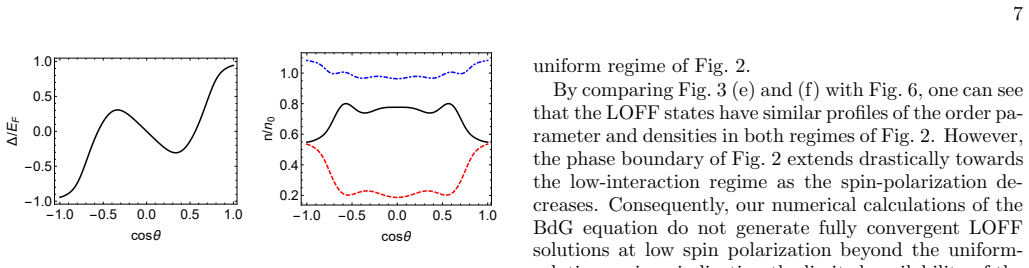
Within the uniform-solution regime Overlapping with the regime where uniform solutions can be found but near the phase boundary, the LOFF solutions can be obtained from the BdG equation. Fig. 3 shows some selected results of the LOFF solutions with different pairing interactions and population imbalance. The left column shows how ∆ behaves on the spherical...
-
[2]
35, and T = 0. tically to accommodate the polarization uniformly while the LOFF state allows modulating population imbalance in real space. We remark that a precise comparison between a LOFF state and a uniform state is complicated by the different spin-resolved densities in the convergent BdG solutions, making an exact match of the polarization and chemic...
-
[3]
Beyond the uniform-solution regime In the regime where uniform solutions are no longer possible in Fig. 2, the default solutions are phase separa- tion between BCS superfluid and polarized normal phase similar to 3D population imbalanced Fermi gases [54, 55]. We caution that phase separation with a BCS phase oc- cupying one part of the sphere and a polariz...
-
[4]
A. I. Larkin and Y. N. Ovchinnikov, Nonuniform state of superconductors, Zh. Eksperim. Teor. Fiz. 47, (1964)
work page 1964
-
[5]
P. Fulde and R. A. Ferrell, Superconductivity in a strong spin-exchange field, Phys. Rev. 135, A550 (1964)
work page 1964
-
[6]
F. Steglich, R. Modler, P. Gegenwart, M. Deppe, M. Wei- den, M. Lang, C. Geibel, T. L¨ uhmann, C. Paulsen, J. Tholence, Y. ¯Onuki, M. Tachiki, and S. Takahashi, Ex- perimental evidence for a generalized fflo state in clean type-ii superconductors with short coherence length and enhanced pauli susceptibility, Physica C: Superconduc- tivity 263, 498 (1996), p...
work page 1996
- [7]
-
[8]
K. Kinjo, M. Manago, S. Kitagawa, Z. Q. Mao, S. Yonezawa, Y. Maeno, and K. Ishida, Superconducting spin smecticity evidencing the fulde-ferrell-larkin- ovchinnikov state in sr 2ruo4, Science 376, 397 (2022), https://www.science.org/doi/pdf/10.1126/science.abb0332
-
[9]
P. Wan, O. Zheliuk, N. F. Q. Yuan, X. Peng, L. Zhang, M. Liang, U. Zeitler, S. Wiedmann, N. E. Hussey, T. T. M. Palstra, and J. Ye, Orbital fulde–ferrell–larkin– ovchinnikov state in an ising superconductor, Nature 619, 46 (2023)
work page 2023
-
[10]
A. I. Buzdin, Proximity effects in superconductor– ferromagnet heterostructures, Reviews of Modern Physics 77, 935 (2005)
work page 2005
-
[11]
F. S. Bergeret, A. F. Volkov, and K. B. Efetov, Odd triplet superconductivity and related phenomena in superconductor-ferromagnet structures, Rev. Mod. Phys. 77, 1321 (2005)
work page 2005
-
[12]
C. J. Pethick and H. Smith, Bose–Einstein Condensation in Dilute Gases , 2nd ed. (Cambridge University Press, 2008)
work page 2008
-
[13]
M. Ueda, Fundamentals and New Frontiers of Bose– Einstein Condensation (World Scientific, Singapore, 2010)
work page 2010
-
[14]
Zwerger, ed., The BCS–BEC Crossover and the Uni- tary Fermi Gas (Springer, Berlin, Heidelberg, 2012)
W. Zwerger, ed., The BCS–BEC Crossover and the Uni- tary Fermi Gas (Springer, Berlin, Heidelberg, 2012)
work page 2012
-
[15]
Y.-a. Liao, A. S. C. Rittner, T. Paprotta, W. Li, G. B. Partridge, R. G. Hulet, S. K. Baur, and E. J. Mueller, Spin imbalance in a one-dimensional Fermi gas, Nature 467, 567 (2010)
work page 2010
-
[16]
M. C. Revelle, J. A. Fry, B. A. Olsen, and R. G. Hulet, 1d to 3d crossover of a spin-imbalanced fermi gas, Physical Review Letters 117, 235301 (2016)
work page 2016
-
[17]
Dupuis, Larkin-ovchinnikov-fulde-ferrell state i n quasi-one-dimensional superconductors, Phys
N. Dupuis, Larkin-ovchinnikov-fulde-ferrell state i n quasi-one-dimensional superconductors, Phys. Rev. B 51, 9074 (1995)
work page 1995
-
[18]
Y. Matsuda and H. Shimahara, Fulde–ferrell–larkin–ovchinnikov state in heavy fermion superconductors, Journal of the Phys- ical Society of Japan 76, 051005 (2007), https://doi.org/10.1143/JPSJ.76.051005
-
[19]
L. He, M. Jin, and P. Zhuang, Loff pairing vs breached pairing in asymmetric fermion superfluids, Phys. Rev. B 73, 214527 (2006)
work page 2006
-
[20]
Q. Chen, Y. He, C.-C. Chien, and K. Levin, Theory of su- perfluids with population imbalance: Finite-temperature and bcs-bec crossover effects, Phys. Rev. B 75, 014521 (2007)
work page 2007
-
[21]
J. J. Kinnunen, J. E. Baarsma, J.-P. Martikainen, and P. T¨ orm¨ a, The Fulde–Ferrell–Larkin–Ovchinnikov state for ultracold fermions in lattice and harmonic potentials: 9 a review, Rep. Prog. Phys. 81, 046401 (2018)
work page 2018
-
[22]
R. A. Carollo, D. C. Aveline, B. Rhyno, S. Vishveshwara, C. Lannert, J. D. Murphree, E. R. Elliott, J. R. Williams, R. J. Thompson, and N. Lundblad, Observation of ultra- cold atomic bubbles in orbital microgravity, Nature 606, 281 (2022)
work page 2022
-
[23]
N. Lundblad, D. C. Aveline, A. Balaˇ z, E. Bentine, N. P. Bigelow, P. Boegel, M. A. Efremov, N. Gaaloul, M. Meis- ter, M. Olshanii, C. A. R. S. de Melo, A. Tononi, S. Vishveshwara, A. C. White, A. Wolf, and B. M. Gar- raway, Perspective on quantum bubbles in microgravity, Quantum Sci. Technol. 8, 024003 (2023)
work page 2023
-
[24]
S. G. Bhongale and E. Timmermans, Phase separated bec for high-sensitivity force measurement, Phys. Rev. Lett. 100, 185301 (2008)
work page 2008
-
[25]
S. F¨ olling, A. Widera, T. M¨ uller, F. Gerbier, and I. Bloch, Formation of spatial shell structure in the superfluid to mott insulator transition, Phys. Rev. Lett. 97, 060403 (2006)
work page 2006
-
[26]
F. Jia, Z. Huang, L. Qiu, R. Zhou, Y. Yan, and D. Wang, Expansion dynamics of a shell-shaped bose-einstein con- densate, Phys. Rev. Lett. 129, 243402 (2022)
work page 2022
-
[27]
A. Tononi and L. Salasnich, Bose-einstein condensatio n on the surface of a sphere, Phys. Rev. Lett. 123, 160403 (2019)
work page 2019
- [28]
-
[29]
N. S. M´ oller, F. E. A. dos Santos, V. S. Bagnato, and A. Pelster, Bose–Einstein condensation on curved mani- folds, New J. Phys. 22, 063059 (2020)
work page 2020
-
[30]
K. Padavi´ c, K. Sun, C. Lannert, and S. Vishveshwara, Vortex-antivortex physics in shell-shaped bose-einstein condensates, Phys. Rev. A 102, 043305 (2020)
work page 2020
-
[31]
S. J. Bereta, M. A. Caracanhas, and A. L. Fetter, Super- fluid vortex dynamics on a spherical film, Phys. Rev. A 103, 053306 (2021)
work page 2021
-
[32]
A. C. White, Triangular vortex lattices and giant vorti ces in rotating bubble bose-einstein condensates, Phys. Rev. A 109, 013301 (2024)
work page 2024
-
[33]
A. Andriati, L. Brito, L. Tomio, and A. Gammal, Stabil- ity of a bose-condensed mixture on a bubble trap, Phys. Rev. A 104, 033318 (2021)
work page 2021
-
[34]
A. Wolf, P. Boegel, M. Meister, A. Balaˇ z, N. Gaaloul, and M. A. Efremov, Shell-shaped bose-einstein conden- sates based on dual-species mixtures, Phys. Rev. A 106, 013309 (2022)
work page 2022
-
[35]
C. Lannert, T.-C. Wei, and S. Vishveshwara, Dynamics of condensate shells: Collective modes and expansion, Phys. Rev. A 75, 013611 (2007)
work page 2007
- [36]
- [37]
-
[38]
Y. He and C.-C. Chien, Winding real and order- parameter spaces via lump solitons of spinor bec on sphere, J. Phys. B: : At. Mol. Opt. Phys. 56, 215303 (2023)
work page 2023
- [39]
- [40]
- [41]
- [42]
-
[43]
A. Tononi and L. Salasnich, Low-dimensional quantum gases in curved geometries, Nat. Rev. Phys. 5, 398 (2023)
work page 2023
-
[44]
A. Tononi and L. Salasnich, Shell-shaped atomic gases, Phys. Rep. 1072, 1 (2024)
work page 2024
-
[45]
D. Cricchio, E. Fiordilino, and F. Persico, Electrons o n a spherical surface: Physical properties and hollow spheri- cal clusters, Phys. Rev. A 86, 013201 (2012)
work page 2012
-
[46]
Y. He, H. Guo, and C.-C. Chien, Bcs-bec crossover of atomic fermi superfluid in a spherical bubble trap, Phys. Rev. A 105, 033324 (2022)
work page 2022
-
[47]
Y. He and C.-C. Chien, Vortex structure and spectrum of an atomic fermi superfluid in a spherical bubble trap, Phys. Rev. A 108, 053303 (2023)
work page 2023
-
[48]
Y. He and C.-C. Chien, Two-component atomic fermi su- perfluid with spin-orbital coupling in thin-spherical-she ll geometry, Phys. Rev. A 111, 053309 (2025)
work page 2025
-
[49]
Y. He and C.-C. Chien, Two-component repulsive atomic fermi gases in a thin spherical shell, Phys. Rev. A 110, 063308 (2024)
work page 2024
-
[50]
de Gennes, Superconductivity of Metals and Alloys (CRC Press, Boca Raton, FL, 1999)
P.-G. de Gennes, Superconductivity of Metals and Alloys (CRC Press, Boca Raton, FL, 1999)
work page 1999
-
[51]
Zhu, Bogoliubov-de Gennes Method and Its Ap- plications, 1st ed., Lecture Notes in Physics, Vol
J.-X. Zhu, Bogoliubov-de Gennes Method and Its Ap- plications, 1st ed., Lecture Notes in Physics, Vol. 924 (Springer (Cham), 2016)
work page 2016
- [52]
-
[53]
A. L. Fetter and J. D. Walecka, Quantum Theory of Many-Particle Systems (McGraw-Hill, Boston, 1971)
work page 1971
-
[54]
Tinkham, Introduction to Superconductivity , 2nd ed
M. Tinkham, Introduction to Superconductivity , 2nd ed. (Dover publications, Garden City, NY, 2004)
work page 2004
-
[55]
A. M. Clogston, Upper limit for the critical field in hard superconductors, Phys. Rev. Lett. 9, 266 (1962)
work page 1962
-
[56]
B. S. Chandrasekhar, A note on the maximum critical field of high-field superconductors, Applied Physics Let- ters 1, 7 (1962)
work page 1962
- [57]
-
[58]
M. M. Parish, F. M. Marchetti, A. Lamacraft, and B. D. Simons, Finite-temperature phase diagram of a polarized fermi condensate, Nature Physics 3, 124 (2007)
work page 2007
-
[59]
J. Dobrzyniecki, G. Orso, and T. Sowi´ nski, Unconven- tional pairing in few-fermion systems tuned by external confinement, Phys. Rev. Res. 3, 043105 (2021)
work page 2021
-
[60]
M. W. Zwierlein, C. H. Schunck, A. Schirotzek, and W. Ketterle, Fermionic superfluidity with imbalanced spin populations, Science 311, 492 (2006)
work page 2006
-
[61]
G. B. Partridge, W. Li, R. I. Kamar, Y.-a. Liao, and R. G. Hulet, Pairing and phase separation in a polarized fermi gas, Science 311, 503–505 (2006)
work page 2006
-
[62]
M. Martinez-Dorantes, W. Alt, J. Gallego, S. Ghosh, L. Ratschbacher, and D. Meschede, State-dependent flu- orescence of neutral atoms in optical potentials, Phys. Rev. A 97, 023410 (2018). 10
work page 2018
-
[63]
D. V. Sheludko, S. C. Bell, R. Anderson, C. S. Hofmann, E. J. D. Vredenbregt, and R. E. Scholten, State-selective imaging of cold atoms, Phys. Rev. A 77, 033401 (2008)
work page 2008
-
[64]
Y. Shin, C. H. Schunck, A. Schirotzek, and W. Ketterle, Tomographic rf spectroscopy of a trapped fermi gas at unitarity, Phys. Rev. Lett. 99, 090403 (2007)
work page 2007
-
[65]
P. A. Murthy, M. Neidig, R. Klemt, L. Bayha, I. Boettcher, T. Enss, M. Holten, G. Z¨ urn, P. M. Preiss, and S. Jochim, High- temperature pairing in a strongly interacting two- dimensional Fermi gas, Science 359, 452 (2018), https://www.science.org/doi/pdf/10.1126/science.aan5950
-
[66]
V. L. Berezinskii, Destruction of long-range order in o ne- dimensional and two-dimensional systems having a con- tinuous symmetry group i. classical systems, Sov. Phys. JETP 32, 493 (1971)
work page 1971
-
[67]
V. L. Berezinskii, Destruction of long-range order in o ne- dimensional and two-dimensional systems having a con- tinuous symmetry group ii. quantum systems, Sov. Phys. JETP 34, 610 (1972)
work page 1972
-
[68]
J. M. Kosterlitz and D. J. Thouless, Ordering, metasta- bility and phase transitions in two-dimensional systems, J. Phys. C 6, 1181 (1973)
work page 1973
-
[69]
L. He, H. Lu, G. Cao, H. Hu, , and X.-J. Liu, Quantum fluctuations in the bcs-bec crossover of two-dimensional fermi gases, Phys. Rev. A 92, 023620 (2015)
work page 2015
-
[70]
C.-T. Wu, B. M. Anderson, R. Boyack, and K. Levin, Quasicondensation in two-dimensional fermi gases, Phys. Rev. Lett. 115, 240401 (2015)
work page 2015
-
[71]
I. Boettcher, L. Bayha, D. Kedar, P. A. Murthy, M. Nei- dig, M. G. Ries, A. N. Wenz, G. Zurn, S. Jochim, and T. Enss, Equation of state of ultracold fermions in the 2d bec-bcs crossover region, Phys. Rev. Lett. 116, 045303 (2016)
work page 2016
discussion (0)
Sign in with ORCID, Apple, or X to comment. Anyone can read and Pith papers without signing in.