Recognition: 2 theorem links
· Lean TheoremAccurate Modeling of Rydberg Atoms and Their Interactions: Theory and Implementation in PairInteraction
Pith reviewed 2026-05-15 02:48 UTC · model grok-4.3
The pith
A framework based on multi-channel quantum defect theory and Green's tensors accurately models Rydberg atoms of divalent species and their interactions in arbitrary geometries.
A machine-rendered reading of the paper's core claim, the machinery that carries it, and where it could break.
Core claim
The framework provides a precise description of Rydberg states of divalent atoms and a general approach for calculating interactions in arbitrary geometries, with the implementation achieving speedups of one order of magnitude and excellent agreement with experimental data for an exemplary Stark map of 174Yb.
What carries the argument
Multi-channel quantum defect theory combined with static electromagnetic Green's tensors, implemented in the PairInteraction software.
Load-bearing premise
The multi-channel quantum defect theory parameters together with the static Green's tensors are assumed to capture all relevant physics without extra corrections for dynamic or higher-order effects.
What would settle it
An experimental measurement of a Rydberg pair potential or Stark shift near a surface that differs markedly from the Green's tensor prediction would show the model is incomplete.
Figures



read the original abstract
Rydberg atoms provide a powerful platform for exploring strongly interacting quantum systems, both in free space and in structured electromagnetic environments, with growing applications in quantum technology. Accurately modeling their single-atom properties and mutual interactions is essential for interpreting experiments and designing new architectures. We present a unified theoretical framework for Rydberg atoms and their interactions based on multi-channel quantum defect theory (MQDT) and static electromagnetic Green's tensors. MQDT provides a precise description of Rydberg states of divalent atoms such as strontium and ytterbium, while the Green's tensor formalism provides a general and flexible approach for calculating interactions between two Rydberg atoms in arbitrary geometries, including modifications induced by nearby surfaces. We implement this framework in an updated version of the open-source PairInteraction software [Weber et al., J.~Phys.~B~50 (2017)]. The implementation leverages high-performance libraries and achieves speedups of one order of magnitude for pair-potential calculations compared to prior software. We demonstrate the capabilities of the framework through example applications to divalent atoms and show excellent agreement with experimental data for an exemplary Stark map of $^{174}$Yb. The modular software architecture enables the community to extend it further.
Editorial analysis
A structured set of objections, weighed in public.
Referee Report
Summary. The manuscript presents a unified theoretical framework combining multi-channel quantum defect theory (MQDT) for precise description of Rydberg states in divalent atoms such as strontium and ytterbium with the static electromagnetic Green's tensor formalism for calculating pairwise interactions in arbitrary geometries, including surface modifications. This is implemented in an updated open-source PairInteraction software package that leverages high-performance libraries to achieve speedups of one order of magnitude for pair-potential calculations. Capabilities are demonstrated through example applications to divalent atoms, with excellent agreement shown against experimental data for the Stark map of ^{174}Yb.
Significance. If the framework's approximations hold, the work provides a significant, extensible open-source resource for the Rydberg community, enabling efficient modeling of interactions in complex environments relevant to quantum simulation and sensing. The modular architecture and reported computational improvements are clear strengths that facilitate community extensions and practical use.
major comments (2)
- [§5] §5 (Stark map comparison): The sole experimental benchmark is the single-atom Stark map of ^{174}Yb, which validates only the MQDT component. No direct experimental or independent numerical comparison is provided for two-atom interaction energies under the static Green's tensor approximation in arbitrary geometries or near surfaces, leaving the central generality claim for pair potentials dependent on an unverified assumption.
- [§3.2] §3.2 (Green's tensor implementation): The adoption of frequency-independent static Green's tensors for interaction calculations is presented without quantitative assessment of the validity range or potential errors from neglecting dynamic effects or higher-multipole contributions, which is load-bearing for the surface-modified and arbitrary-geometry claims.
minor comments (2)
- [§4] The speedup claim of 'one order of magnitude' should be supported by explicit timing tables or figures specifying hardware, problem sizes, and baseline comparisons to allow quantitative assessment.
- [§2] Notation for MQDT channels and the definition of the interaction Hamiltonian could be clarified with an explicit table of symbols to improve readability for readers unfamiliar with the prior literature.
Simulated Author's Rebuttal
We thank the referee for the constructive feedback and positive assessment of the work's significance. We address each major comment below, proposing targeted revisions where appropriate to strengthen the manuscript while maintaining its focus as a software implementation paper.
read point-by-point responses
-
Referee: §5 (Stark map comparison): The sole experimental benchmark is the single-atom Stark map of ^{174}Yb, which validates only the MQDT component. No direct experimental or independent numerical comparison is provided for two-atom interaction energies under the static Green's tensor approximation in arbitrary geometries or near surfaces, leaving the central generality claim for pair potentials dependent on an unverified assumption.
Authors: We agree that the presented experimental validation focuses on the MQDT single-atom description. The Green's tensor formalism for pair interactions follows a well-established approach in the Rydberg literature, with prior validations for free-space cases. In the revised manuscript, we will add a new subsection in §5 comparing computed free-space pair potentials to analytical dipole-dipole and van der Waals expressions as well as to independent numerical results from other codes. We acknowledge that new experimental data for surface-modified or arbitrary-geometry interactions lies beyond the scope of this theoretical and software-focused work. revision: partial
-
Referee: §3.2 (Green's tensor implementation): The adoption of frequency-independent static Green's tensors for interaction calculations is presented without quantitative assessment of the validity range or potential errors from neglecting dynamic effects or higher-multipole contributions, which is load-bearing for the surface-modified and arbitrary-geometry claims.
Authors: We thank the referee for this observation. The revised manuscript will expand §3.2 with a dedicated paragraph providing quantitative estimates: the static approximation holds when interatomic distances are much smaller than the wavelength of relevant Rydberg transitions (typically valid for blockade radii), with error bounds derived from the retardation parameter. Higher-multipole corrections (quadrupole etc.) are shown to be suppressed by factors of order (n² a₀ / R) for typical separations, supporting the dipole approximation used. These additions will directly address the validity range for the claimed geometries. revision: yes
Circularity Check
Minor self-citation to prior software; central framework uses established MQDT and Green's tensors without reduction to self-defined inputs
specific steps
-
self citation load bearing
[Abstract]
"We implement this framework in an updated version of the open-source PairInteraction software [Weber et al., J.~Phys.~B~50 (2017)]."
This is a self-citation to prior work by co-author Sebastian Weber, but the citation supports only the software implementation details rather than any load-bearing theoretical step; the MQDT and Green's tensor components are drawn from external literature and do not reduce to this citation.
full rationale
The derivation relies on standard multi-channel quantum defect theory (MQDT) parameters drawn from prior literature and the static electromagnetic Green's tensor formalism, both independent of the present work. The only self-citation is to the original PairInteraction software paper for the implementation update; this does not bear the load of any core theoretical claim or prediction. No equation reduces a result to a fitted parameter defined by the paper itself, and no uniqueness theorem or ansatz is smuggled via self-citation. The Stark-map comparison is external validation, not a circular fit.
Axiom & Free-Parameter Ledger
axioms (2)
- domain assumption Multi-channel quantum defect theory accurately describes Rydberg states of divalent atoms such as strontium and ytterbium
- domain assumption Static electromagnetic Green's tensors provide a general description of interactions between two Rydberg atoms in arbitrary geometries including surface modifications
Lean theorems connected to this paper
-
IndisputableMonolith/Cost/FunctionalEquation.leanwashburn_uniqueness_aczel unclear?
unclearRelation between the paper passage and the cited Recognition theorem.
unified theoretical framework ... based on multi-channel quantum defect theory (MQDT) and static electromagnetic Green's tensors
-
IndisputableMonolith/Foundation/AlexanderDuality.leanalexander_duality_circle_linking unclear?
unclearRelation between the paper passage and the cited Recognition theorem.
Green’s tensor formalism provides a general and flexible approach for calculating interactions ... in arbitrary geometries
What do these tags mean?
- matches
- The paper's claim is directly supported by a theorem in the formal canon.
- supports
- The theorem supports part of the paper's argument, but the paper may add assumptions or extra steps.
- extends
- The paper goes beyond the formal theorem; the theorem is a base layer rather than the whole result.
- uses
- The paper appears to rely on the theorem as machinery.
- contradicts
- The paper's claim conflicts with a theorem or certificate in the canon.
- unclear
- Pith found a possible connection, but the passage is too broad, indirect, or ambiguous to say the theorem truly supports the claim.
Reference graph
Works this paper leans on
-
[1]
Its constructor allows the basis to be restricted by quantum numbers
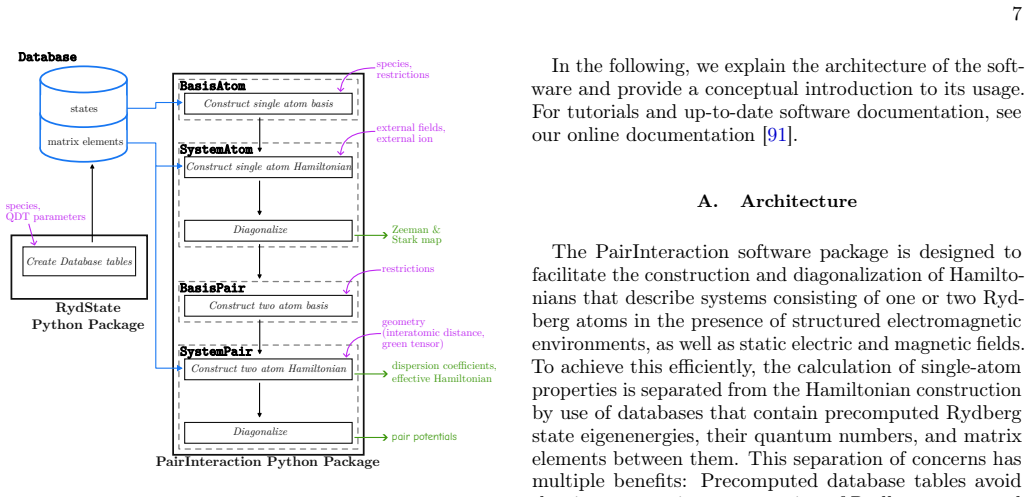
Constructing a System of a Single Atom A basis of the single-atom Hilbert space is created by instantiating the BasisAtom class. Its constructor allows the basis to be restricted by quantum numbers. In practice, the principal and orbital quantum numbers,n and l, can often be constrained to be close to those of the target state∣Ψ⟩. The reasoning is that th...
-
[2]
Constructing a System of Two Atoms For pair-potential calculations, two single-atom bases are constructed as described in the previous subsection: one around ∣Ψ1⟩and one around ∣Ψ2⟩. A basis of the two-atom Hilbert space is then created by instantiating the BasisPair class with two diagonalized single-atom systems. The basis states are direct products of ...
-
[3]
Quantum computing with neutral atoms
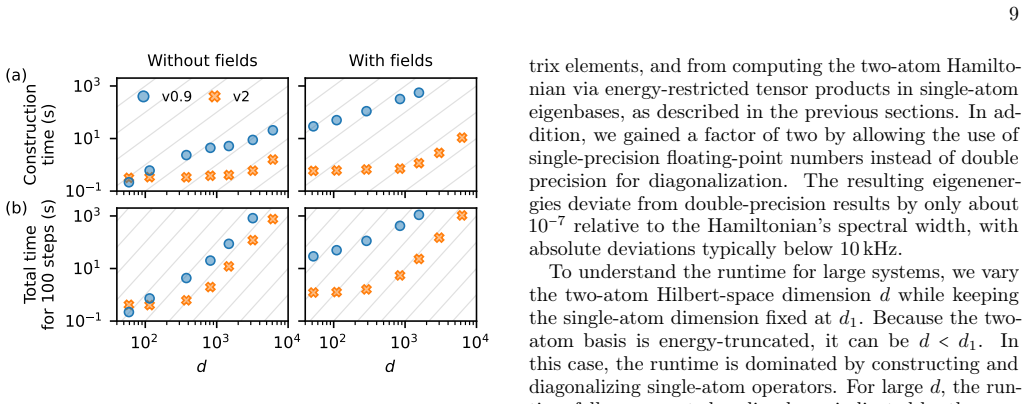
Analyzing a System Once a SystemAtom or SystemPair object is created, it can be diagonalized to obtain the eigenenergies and to analyze how these shift as a function of the magnetic and electric fields (Zeeman and Stark maps) or the inter- atomic distance (pair-potential curves). To identify the 9 10 1 101 103 Construction time (s) Without fields v0.9 v2 ...
work page 2025
-
[4]
T. Gallagher,Rydberg Atoms, Cambridge Monographs on Atomic, Molecular and Chemical Physics (Cambridge University Press, 1994)
work page 1994
- [5]
-
[6]
T. Wilk, A. Gaëtan, C. Evellin, J. Wolters, Y. Miroshny- chenko, P. Grangier, and A. Browaeys, Entanglement of Two Individual Neutral Atoms Using Rydberg Blockade, Physical Review Letters104, 010502 (2010)
work page 2010
- [7]
-
[8]
I. S. Madjarov, J. P. Covey, A. L. Shaw, J. Choi, A. Kale, A. Cooper, H. Pichler, V. Schkolnik, J. R. Williams, and M. Endres, High-fidelity entanglement and detection of alkaline-earth Rydberg atoms, Nature Physics16, 857 (2020)
work page 2020
-
[9]
T.M.Graham, Y.Song, J.Scott, C.Poole, L.Phuttitarn, K. Jooya, P. Eichler, X. Jiang, A. Marra, B. Grinke- meyer, M. Kwon, M. Ebert, J. Cherek, M. T. Licht- man, M. Gillette, J. Gilbert, D. Bowman, T. Ballance, C. Campbell, E. D. Dahl, O. Crawford, N. S. Blunt, B. Rogers, T. Noel, and M. Saffman, Multi-qubit en- 13 tanglement and algorithms on a neutral-ato...
work page 2022
- [10]
-
[11]
A. Cao, W. J. Eckner, T. Lukin Yelin, A. W. Young, S. Jandura, L. Yan, K. Kim, G. Pupillo, J. Ye, N. Dark- wah Oppong, and A. M. Kaufman, Multi-qubit gates and Schrödinger cat states in an optical clock, Nature 634, 315 (2024)
work page 2024
-
[12]
D. Bluvstein, S. J. Evered, A. A. Geim, S. H. Li, H. Zhou, T. Manovitz, S. Ebadi, M. Cain, M. Kali- nowski, D. Hangleiter, J. P. Bonilla Ataides, N. Maskara, I. Cong, X. Gao, P. Sales Rodriguez, T. Karolyshyn, G. Semeghini, M. J. Gullans, M. Greiner, V. Vuletić, and M. D. Lukin, Logical quantum processor based on reconfigurable atom arrays, Nature626, 58 (2024)
work page 2024
-
[13]
Y.-Y. Jau, A. M. Hankin, T. Keating, I. H. Deutsch, and G. W. Biedermann, Entangling atomic spins with a Rydberg-dressed spin-flip blockade, Nature Physics12, 71 (2016)
work page 2016
- [14]
- [15]
-
[16]
P. Weckesser, K. Srakaew, T. Blatz, D. Wei, D. Adler, S. Agrawal, A. Bohrdt, I. Bloch, and J. Zeiher, Real- ization of a Rydberg-dressed extended Bose-Hubbard model, Science390, 849 (2025)
work page 2025
-
[17]
J. A. Sedlacek, A. Schwettmann, H. Kübler, R. Löw, T. Pfau, and J. P. Shaffer, Microwave electrometry with Rydberg atoms in a vapour cell using bright atomic resonances, Nature Physics8, 819 (2012)
work page 2012
-
[18]
C. L. Holloway, J. A. Gordon, A. Schwarzkopf, D. A. Anderson, S. A. Miller, N. Thaicharoen, and G. Raithel, Sub-wavelength imaging and field mapping via electro- magnetically induced transparency and Autler-Townes splitting in Rydberg atoms, Applied Physics Letters104, 10.1063/1.4883635 (2014)
-
[19]
D.-S. Ding, Z.-K. Liu, B.-S. Shi, G.-C. Guo, K. Mølmer, and C. S. Adams, Enhanced metrology at the critical point of a many-body Rydberg atomic system, Nature Physics18, 1447 (2022)
work page 2022
-
[20]
Q. Wang, Y. Liang, Z. Wang, S. Guan, P. Yang, P. Zhang, G. Li, and T. Zhang, High-precision measurement of mi- crowave electric field by cavity-enhanced critical behavior in a many-body Rydberg atomic system, Science China Physics, Mechanics & Astronomy68, 264211 (2025)
work page 2025
-
[21]
A. V. Gorshkov, J. Otterbach, M. Fleischhauer, T. Pohl, and M. D. Lukin, Photon-Photon Interactions via Ry- dberg Blockade, Physical Review Letters107, 133602 (2011)
work page 2011
-
[22]
T. Peyronel, O. Firstenberg, Q.-Y. Liang, S. Hofferberth, A. V. Gorshkov, T. Pohl, M. D. Lukin, and V. Vuletić, Quantum nonlinear optics with single photons enabled by strongly interacting atoms, Nature488, 57 (2012)
work page 2012
-
[23]
O. Firstenberg, T. Peyronel, Q.-Y. Liang, A. V. Gor- shkov, M. D. Lukin, and V. Vuletić, Attractive photons in a quantum nonlinear medium, Nature502, 71 (2013)
work page 2013
-
[24]
O. Firstenberg, C. S. Adams, and S. Hofferberth, Nonlin- ear quantum optics mediated by Rydberg interactions, Journal of Physics B: Atomic, Molecular and Optical Physics49, 152003 (2016)
work page 2016
- [25]
- [26]
-
[27]
E.Suarez, P.Wolf, P.Weiss,andS.Slama,Superradiance decoherence caused by long-range Rydberg-atom pair interactions, Physical Review A105, L041302 (2022)
work page 2022
- [28]
-
[29]
P. L. Ocola, I. Dimitrova, B. Grinkemeyer, E. Guardado- Sanchez, T. Ðorđević, P. Samutpraphoot, V. Vuletić, and M. D. Lukin, Control and Entanglement of Individ- ual Rydberg Atoms near a Nanoscale Device, Physical Review Letters132, 113601 (2024)
work page 2024
-
[30]
J. Block and S. Scheel, Van der Waals interaction po- tential between Rydberg atoms near surfaces, Physical Review A96, 062509 (2017)
work page 2017
-
[31]
A. A. Morgan and S. D. Hogan, Coupling Rydberg Atoms to Microwave Fields in a Superconducting Copla- nar Waveguide Resonator, Physical Review Letters124, 193604 (2020)
work page 2020
-
[32]
M. Kaiser, C. Glaser, L. Y. Ley, J. Grimmel, H. Hatter- mann, D. Bothner, D. Koelle, R. Kleiner, D. Petrosyan, A. Günther, and J. Fortágh, Cavity-driven Rabi oscil- lations between Rydberg states of atoms trapped on a superconducting atom chip, Physical Review Research 4, 013207 (2022)
work page 2022
-
[33]
F. B. Dunning, T. C. Killian, S. Yoshida, and J. Burgdör- fer, Recent advances in Rydberg physics using alkaline- earth atoms, Journal of Physics B: Atomic, Molecular and Optical Physics49, 112003 (2016)
work page 2016
- [34]
-
[35]
A. Jenkins, J. W. Lis, A. Senoo, W. F. McGrew, and A. M. Kaufman, Ytterbium Nuclear-Spin Qubits in an Optical Tweezer Array, Physical Review X12, 021027 (2022)
work page 2022
-
[36]
S. Ma, G. Liu, P. Peng, B. Zhang, S. Jandura, J. Claes, A. P. Burgers, G. Pupillo, S. Puri, and J. D. Thompson, High-fidelity gates and mid-circuit erasure conversion in an atomic qubit, Nature622, 279 (2023)
work page 2023
- [37]
-
[38]
J. A. Muniz, M. Stone, D. T. Stack, M. Jaffe, J. M. Kindem, L. Wadleigh, E. Zalys-Geller, X. Zhang, C.-A. Chen, M. A. Norcia, J. Epstein, E. Halperin, F. Hum- mel, T. Wilkason, M. Li, K. Barnes, P. Battaglino, T. C. Bohdanowicz, G. Booth, A. Brown, M. O. Brown, W. B. Cairncross, K. Cassella, R. Coxe, D. Crow, M. Feldkamp, C. Griger, A. Heinz, A. M. W. Jon...
work page 2025
-
[39]
K. Barnes, P. Battaglino, B. J. Bloom, K. Cassella, R. Coxe, N. Crisosto, J. P. King, S. S. Kondov, K. Kotru, S. C. Larsen, J. Lauigan, B. J. Lester, M. McDonald, E. Megidish, S. Narayanaswami, C. Nishiguchi, R. Noter- mans, L. S. Peng, A. Ryou, T.-Y. Wu, and M. Yarwood, Assembly and coherent control of a register of nuclear spin qubits, Nature Communicat...
work page 2022
- [40]
-
[41]
Z. Jia, W. Huie, L. Li, W. K. C. Sun, X. Hu, Aakash, H. Kogan, A. Karve, J. Y. Lee, and J. P. Covey, An architecture for two-qubit encoding in neutral ytterbium- 171 atoms, npj Quantum Information10, 106 (2024)
work page 2024
-
[42]
M. Ammenwerth, H. Timme, F. Gyger, R. Tao, I. Bloch, andJ.Zeiher,Realizationofafasttriple-magicall-optical qutrit in 88Sr, Physical Review Letters135, 143401 (2025)
work page 2025
-
[43]
A. P. Burgers, S. Ma, S. Saskin, J. Wilson, M. A. Alarcón, C. H. Greene, and J. D. Thompson, Controlling Rydberg Excitations Using Ion-Core Transitions in Alkaline-Earth Atom-Tweezer Arrays, PRX Quantum3, 020326 (2022)
work page 2022
-
[44]
K.-L. Pham, T. F. Gallagher, P. Pillet, S. Lepoutre, and P. Cheinet, Coherent Light Shift on Alkaline-Earth Rydberg Atoms from Isolated Core Excitation without Autoionization, PRX Quantum3, 020327 (2022)
work page 2022
-
[45]
G. Lochead, D. Boddy, D. P. Sadler, C. S. Adams, and M. P. A. Jones, Number-resolved imaging of excited- state atoms using a scanning autoionization microscope, Physical Review A87, 053409 (2013)
work page 2013
-
[46]
R. Mukherjee, J. Millen, R. Nath, M. P. A. Jones, and T. Pohl, Many-body physics with alkaline-earth Rydberg lattices, Journal of Physics B: Atomic, Molecular and Optical Physics44, 184010 (2011)
work page 2011
-
[47]
J. T. Wilson, S. Saskin, Y. Meng, S. Ma, R. Dilip, A. P. Burgers, and J. D. Thompson, Trapping Alkaline Earth Rydberg Atoms Optical Tweezer Arrays, Physical Review Letters128, 033201 (2022)
work page 2022
-
[48]
F. Robicheaux, D. W. Booth, and M. Saffman, Theory of long-range interactions for Rydberg states attached to hyperfine-split cores, Physical Review A97, 022508 (2018)
work page 2018
-
[49]
M. J. Seaton, Quantum defect theory I. General for- mulation, Proceedings of the Physical Society88, 801 (1966)
work page 1966
-
[50]
U. Fano, Quantum defect theory ofl uncoupling inH 2 as an example of channel-interaction treatment, Physical Review A2, 353 (1970)
work page 1970
-
[51]
C. L. Vaillant, M. P. A. Jones, and R. M. Potvliege, Multichannel quantum defect theory of strontium bound Rydberg states, Journal of Physics B: Atomic, Molecular and Optical Physics47, 155001 (2014)
work page 2014
- [52]
-
[53]
Deiglmayr, Long-range interactions between Rydberg atoms, Physica Scripta91, 104007 (2016)
J. Deiglmayr, Long-range interactions between Rydberg atoms, Physica Scripta91, 104007 (2016)
work page 2016
- [54]
-
[55]
D. Comparat and P. Pillet, Dipole blockade in a cold Rydberg atomic sample [Invited], JOSA B27, A208 (2010)
work page 2010
-
[56]
C. L. Vaillant, M. P. A. Jones, and R. M. Potvliege, Long-range Rydberg–Rydberg interactions in calcium, strontium and ytterbium, Journal of Physics B: Atomic, Molecular and Optical Physics45, 135004 (2012)
work page 2012
-
[57]
F. Robicheaux, Calculations of long range interactions for 87Sr Rydberg states, Journal of Physics B: Atomic, Molecular and Optical Physics52, 244001 (2019)
work page 2019
-
[58]
E. J. Robertson, N. Šibalić, R. M. Potvliege, and M. P. A. Jones, ARC 3.0: An expanded Python toolbox for atomic physics calculations, Computer Physics Communications 261, 107814 (2021)
work page 2021
-
[59]
R. M. Potvliege, Mqdtfit: A collection of Python func- tions for empirical multichannel quantum defect calcula- tions, Computer Physics Communications300, 109172 (2024)
work page 2024
- [60]
-
[61]
M. Born and R. Oppenheimer, Zur Quantentheorie der Molekeln, Annalen der Physik389, 457 (1927)
work page 1927
-
[62]
M. J. Seaton, The Quantum Defect Method, Monthly Notices of the Royal Astronomical Society118, 504 (1958)
work page 1958
-
[63]
M. J. Seaton, Quantum defect theory, Reports on Progress in Physics46, 167 (1983)
work page 1983
-
[64]
U. V. Riss and H.-D. Meyer, Calculation of resonance energies and widths using the complex absorbing poten- tial method, Journal of Physics B: Atomic, Molecular and Optical Physics26, 4503 (1993)
work page 1993
-
[65]
J. G. Muga, J. P. Palao, B. Navarro, and I. L. Egusquiza, Complex absorbing potentials, Physics Reports395, 357 (2004)
work page 2004
-
[66]
D. A. Steck, Quantum and Atom Optics,http://steck. us/teaching(2007)
work page 2007
-
[67]
Milonni,The Quantum Vacuum: An Introduction to Quantum Electrodynamics(Elsevier Science, 1994)
P. Milonni,The Quantum Vacuum: An Introduction to Quantum Electrodynamics(Elsevier Science, 1994)
work page 1994
-
[68]
R. H. Lehmberg, Radiation from an N -Atom System. I. General Formalism, Physical Review A2, 883 (1970)
work page 1970
- [69]
-
[70]
H.T.Dung, L.Knöll,andD.-G.Welsch,Resonantdipole- dipole interaction in the presence of dispersing and ab- sorbing surroundings, Physical Review A66, 063810 (2002)
work page 2002
-
[71]
S. Y. Buhmann,Dispersion Forces I: Macroscopic Quantum Electrodynamics and Ground-State Casimir, Casimir–Polder and van Der Waals Forces, Springer Tracts in Modern Physics, Vol. 247 (Springer, Berlin, Heidelberg, 2012)
work page 2012
-
[72]
A. Asenjo-Garcia, J. D. Hood, D. E. Chang, and H. J. Kimble,Atom-lightinteractionsinquasi-one-dimensional 15 nanostructures: AGreen’s-functionperspective,Physical Review A95, 033818 (2017)
work page 2017
- [73]
-
[74]
S. Ribeiro, S. Yoshi Buhmann, T. Stielow, and S. Scheel, Casimir-Polder interaction from exact diagonalization and surface-induced state mixing, Europhysics Letters 110, 51003 (2015)
work page 2015
-
[75]
J. Block and S. Scheel, Casimir-Polder-induced Rydberg macrodimers, Physical Review A100, 062508 (2019)
work page 2019
-
[76]
R. J. Le Roy, Long-range potential coefficients from rkr turning points: c6 and c8 for b(3π+ Ou)-state Cl2, Br2, andI 2, Canadian Journal of Physics52, 246 (1974)
work page 1974
-
[77]
C. H. Greene and Ch. Jungen, Molecular applications of quantum defect theory (Academic Press, 1985) pp. 51–121
work page 1985
-
[78]
Ross, An MQDT Primer, AIP Conference Proceedings 225, 73 (1991)
S. Ross, An MQDT Primer, AIP Conference Proceedings 225, 73 (1991)
work page 1991
- [79]
-
[80]
H. Fu, M. Li, M. K. Tey, L. You, and B. Gao, Multiscale quantum-defect theory and its application to atomic spectrum, New Journal of Physics18, 103016 (2016)
work page 2016
discussion (0)
Sign in with ORCID, Apple, or X to comment. Anyone can read and Pith papers without signing in.