Recognition: 1 theorem link
· Lean TheoremJWST COMPASS Program: The 3--5μm transmission spectrum of LTT 1445 A b
Pith reviewed 2026-05-15 03:11 UTC · model grok-4.3
The pith
The JWST 3-5 micron transmission spectrum of LTT 1445 A b shows no detectable atmospheric features, limiting metallicity to at least 350 times solar under grey cloud models.
A machine-rendered reading of the paper's core claim, the machinery that carries it, and where it could break.
Core claim
The 3-5 μm transmission spectrum of LTT 1445 A b obtained with JWST NIRSpec/G395H exhibits no statistically significant spectral features at the achieved precision, which in turn constrains the atmospheric metallicity to ≳350× solar for grey opaque cloud decks at pressures greater than 0.01 bar when chemical equilibrium models are assumed.
What carries the argument
The NIRSpec/G395H transmission spectrum reduced independently with Eureka! and ExoTiC-JEDI pipelines, interpreted through a grid of chemical equilibrium models that incorporate grey opaque clouds to translate the featureless spectrum into metallicity bounds.
If this is right
- The atmosphere must be either extremely metal-rich or blanketed by thick clouds to explain the flat spectrum.
- Combining JWST and HST data extends the metallicity lower bound to ≳500× solar.
- Future transit and emission spectroscopy campaigns are required to test whether any atmospheric features become detectable at higher precision.
- The current single-visit precision already rules out low-metallicity scenarios under the adopted cloud and chemistry assumptions.
Where Pith is reading between the lines
- Similar high-metallicity or cloudy atmospheres may be common among close-in rocky planets around M dwarfs if this limit holds for the broader population.
- Multi-visit observations could distinguish between a high-metallicity gas envelope and a truly bare rocky surface.
- The wavelength range and precision achieved here set a practical benchmark for planning atmospheric studies of other nearby terrestrial exoplanets.
Load-bearing premise
The models assume that grey opaque clouds and chemical equilibrium capture all plausible atmospheres, so the lack of features truly excludes lower metallicities rather than arising from incomplete physics or residual systematics in the single-visit dataset.
What would settle it
A clear spectral feature appearing in a future multi-visit JWST transit observation or an emission spectrum that indicates lower metallicity would directly contradict the high-metallicity limit derived here.
Figures




read the original abstract
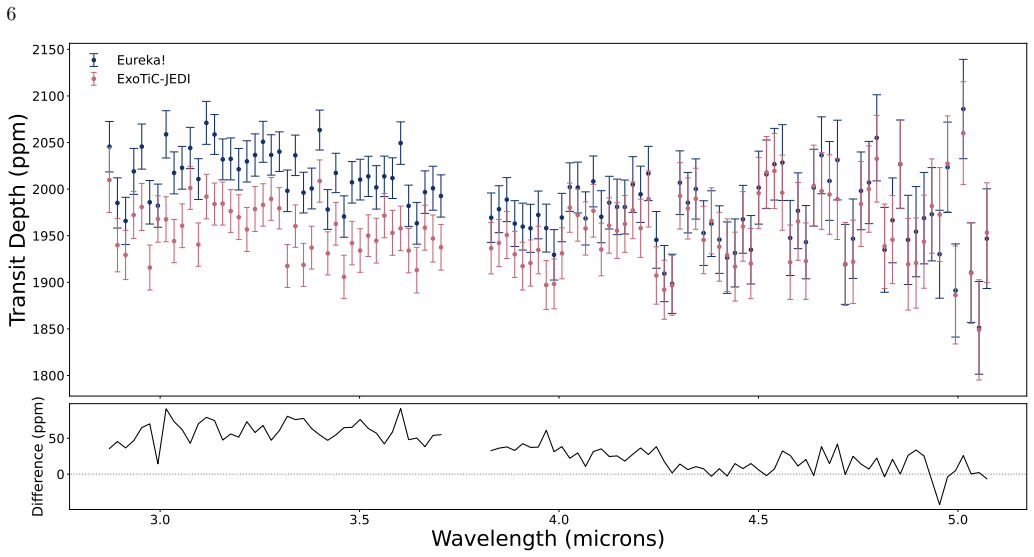
The search for an atmosphere on the closest rocky M dwarf planet, LTT 1445 A b, has been the subject of intense investigation from both the ground and space. Here, we present the first JWST transmission spectrum of LTT 1445 A b using a single visit spanning 3-5~$\mu$m using NIRSpec/G395H. We conduct two independent reductions of the data using both the Eureka! and ExoTiC-JEDI pipelines. Overall, we measure the NRS1 transit depths to a median precision of $\sim23$~ppm in 41 spectroscopic channels with uniform widths of 30 pixels ($\sim$ 0.02 $\mu$m), and the NRS2 transit depths to $\sim36$~ppm precision in 65 spectroscopic channels, also with uniform widths of 30 pixels. We rule out any statistically significant spectral features at this precision and place limits on atmospheric metallicity using a grid of chemical equilibrium models with grey opaque clouds. Using NIRSpec/G395H alone, we can place limits on the atmospheric metallicity of $\gtrsim350~\times$ Solar when the opaque pressure level is greater than 0.01~bars. We also conduct a combined analysis of JWST/NIRSpec and HST/WFC3 transmission data and find our atmospheric limits can be extended $\gtrsim500~\times$ Solar when considering both datasets. Future analyses both in transit and emission will uncover whether there are detectable atmospheric features.
Editorial analysis
A structured set of objections, weighed in public.
Referee Report
Summary. The manuscript presents the first JWST NIRSpec/G395H transmission spectrum of the rocky exoplanet LTT 1445 A b over 3-5 μm from a single transit visit. Two independent data reductions (Eureka! and ExoTiC-JEDI) agree on transit depths to median precisions of ~23 ppm (NRS1, 41 channels) and ~36 ppm (NRS2, 65 channels). No statistically significant spectral features are detected. Limits on atmospheric metallicity (≳350× solar for opaque pressure levels >0.01 bar using JWST alone; ≳500× solar when combined with HST/WFC3) are derived from a grid of chemical-equilibrium forward models that include grey opaque clouds at fixed pressure levels.
Significance. If the non-detection is robust and the model assumptions appropriate, the result supplies useful observational constraints on a nearby rocky planet's atmosphere and demonstrates JWST's precision for such targets. The dual-pipeline agreement is a clear strength, as is the straightforward reporting of the null result. The quantitative metallicity bounds are model-dependent but provide a concrete benchmark for future work under the stated assumptions of chemical equilibrium and grey clouds.
major comments (1)
- [§4] §4 (Atmospheric constraints): The metallicity limits of ≳350× solar (abstract and §4) are obtained by comparing the observed flat spectrum against a grid of chemical-equilibrium models with grey opaque clouds. For the non-detection to translate into these bounds, every lower-metallicity atmosphere must produce a feature exceeding the 23–36 ppm precision. The manuscript does not test or discuss the effects of disequilibrium chemistry, photochemistry, or non-grey/patchy clouds; without such checks the quantitative claim rests on the completeness of the chosen grid rather than the data alone.
minor comments (2)
- [Results] The text should explicitly state the exact wavelength ranges and channel counts for NRS1 and NRS2 in the results section to match the abstract values.
- [Figures] Figure captions for the transmission spectrum should include a direct statement of the median precision per channel and note which models are overplotted.
Simulated Author's Rebuttal
We thank the referee for their positive assessment and recommendation for minor revision. We address the major comment below.
read point-by-point responses
-
Referee: [§4] §4 (Atmospheric constraints): The metallicity limits of ≳350× solar (abstract and §4) are obtained by comparing the observed flat spectrum against a grid of chemical-equilibrium models with grey opaque clouds. For the non-detection to translate into these bounds, every lower-metallicity atmosphere must produce a feature exceeding the 23–36 ppm precision. The manuscript does not test or discuss the effects of disequilibrium chemistry, photochemistry, or non-grey/patchy clouds; without such checks the quantitative claim rests on the completeness of the chosen grid rather than the data alone.
Authors: We agree that the reported metallicity limits (≳350× solar from JWST alone) are derived under the assumptions of chemical equilibrium and grey opaque clouds at fixed pressure levels, as explicitly described in §4 and the abstract. The non-detection is robust across both reductions, but the quantitative translation to metallicity does rely on the completeness of this particular model grid. In the revised manuscript we will add a clarifying paragraph in §4 (and a brief note in the abstract) stating that these bounds assume chemical equilibrium and grey clouds, and that disequilibrium chemistry, photochemistry, or non-grey/patchy clouds could in principle permit lower metallicities without producing features above our 23–36 ppm precision. Such explorations are beyond the scope of the present work, which provides initial observational constraints using standard modeling assumptions; the featureless spectrum itself remains a model-independent result. revision: yes
Circularity Check
No significant circularity: observational non-detection with external forward-model limits
full rationale
The paper's chain begins with raw JWST NIRSpec/G395H time-series data processed through two fully independent pipelines (Eureka! and ExoTiC-JEDI). Transit depths are measured in fixed-width spectroscopic channels and tested for statistically significant features; none are found. Metallicity limits (≳350× solar for P_cloud > 0.01 bar) are then obtained by comparing the observed spectrum against a pre-computed grid of chemical-equilibrium forward models that assume grey opaque clouds. These models are external to the present dataset and are not fitted to it; the non-detection simply excludes the subset of the grid that would produce detectable features above the measured precision. No self-definitional equations, fitted-input predictions, load-bearing self-citations, or ansatz smuggling appear in the derivation. The result is therefore self-contained against external benchmarks.
Axiom & Free-Parameter Ledger
free parameters (1)
- opaque pressure level threshold
axioms (1)
- domain assumption Chemical equilibrium models with grey opaque clouds accurately capture possible atmospheric compositions
Reference graph
Works this paper leans on
-
[1]
Adams Redai, J., Wogan, N., Wallack, N. L., et al. 2025, AJ, 170, 219, doi: 10.3847/1538-3881/adee92
-
[2]
K., Gao, P., Adams Redai, J., et al
Alam, M. K., Gao, P., Adams Redai, J., et al. 2025, AJ, 169, 15, doi: 10.3847/1538-3881/ad8eb5
-
[3]
2022, Exo-TiC/ExoTiC-JEDI: v0.1-beta-release, v0.1, Zenodo, Zenodo, doi: 10.5281/zenodo.7185855
Alderson, L., Grant, D., & Wakeford, H. 2022, Exo-TiC/ExoTiC-JEDI: v0.1-beta-release, v0.1, Zenodo, Zenodo, doi: 10.5281/zenodo.7185855
-
[4]
Alderson, L., Wakeford, H. R., Alam, M. K., et al. 2023, Nature, 614, 664, doi: 10.1038/s41586-022-05591-3
-
[5]
Alderson, L., Batalha, N. E., Wakeford, H. R., et al. 2024, AJ, 167, 216, doi: 10.3847/1538-3881/ad32c9
-
[6]
Alderson, L., Moran, S. E., Wallack, N. L., et al. 2025, AJ, 169, 142, doi: 10.3847/1538-3881/adad64
-
[7]
F., Spiegelman, F., Leininger, T., & Molliere, P
Allard, N. F., Spiegelman, F., Leininger, T., & Molliere, P. 2019, A&A, 628, A120, doi: 10.1051/0004-6361/201935593
-
[8]
Allen, N. H., Espinoza, N., Boehm, V. A., et al. 2026, AJ, 171, 105, doi: 10.3847/1538-3881/ae28cb
-
[9]
Naumenko, O. V. 2016, Monthly Notices of the Royal Astronomical Society, 460, 4063, doi: 10.1093/mnras/stw1133
-
[10]
Barclay, T., Sheppard, K. B., Latouf, N., et al. 2025, AJ, 169, 241, doi: 10.3847/1538-3881/ada5f6
-
[11]
2025, Resampled Opacity Database for PICASO, Zenodo, doi: 10.5281/zenodo.14861730
Batalha, N., Freedman, R., Gharib-Nezhad, E., & Lupu, R. 2025, Resampled Opacity Database for PICASO, Zenodo, doi: 10.5281/zenodo.14861730
-
[12]
Batalha, N., Wallack, N., & Gordon, T. 2026, Data for: ”JWST COMPASS Program: The 3–5µm transmission spectrum of LTT 1445 A b”, Zenodo, doi: 10.5281/zenodo.19957166
-
[13]
Batalha, N., Teske, J., Alam, M., et al. 2021, Seeing the Forest and the Trees: Unveiling Small Planet Atmospheres with a Population-Level Framework, JWST Proposal. Cycle 1, ID. #2512
work page 2021
-
[14]
Batalha, N. E., Marley, M. S., Lewis, N. K., & Fortney, J. J. 2019a, ApJ, 878, 70, doi: 10.3847/1538-4357/ab1b51 —. 2019b, ApJ, 878, 70, doi: 10.3847/1538-4357/ab1b51
-
[15]
E., Mandell, A., Pontoppidan, K., et al
Batalha, N. E., Mandell, A., Pontoppidan, K., et al. 2017a, PASP, 129, 064501, doi: 10.1088/1538-3873/aa65b0 —. 2017b, PASP, 129, 064501, doi: 10.1088/1538-3873/aa65b0
-
[16]
Batalha, N. E., Rooney, C. M., Visscher, C., et al. 2026, AJ, 171, 98, doi: 10.3847/1538-3881/ae29e5
-
[17]
2022, The Journal of Open Source Software, 7, 4503, doi: 10.21105/joss.04503
Bell, T., Ahrer, E.-M., Brande, J., et al. 2022, The Journal of Open Source Software, 7, 4503, doi: 10.21105/joss.04503
-
[18]
Bello-Arufe, A., Damiano, M., Bennett, K. A., et al. 2025, ApJL, 980, L26, doi: 10.3847/2041-8213/adaf22
-
[19]
Bennett, K. A., Sing, D. K., Stevenson, K. B., et al. 2025a, AJ, 169, 111, doi: 10.3847/1538-3881/ad9dd1
-
[20]
Bennett, K. A., MacDonald, R. J., Peacock, S., et al. 2025b, AJ, 170, 205, doi: 10.3847/1538-3881/adf198
-
[21]
K., Wachiraphan, P., & Murray, C
Berta-Thompson, Z. K., Wachiraphan, P., & Murray, C. 2025, arXiv e-prints, arXiv:2507.02136, doi: 10.48550/arXiv.2507.02136
-
[22]
2021, The Journal of Open Source Software, 6, 3001, doi: 10.21105/joss.03001
Buchner, J. 2021, The Journal of Open Source Software, 6, 3001, doi: 10.21105/joss.03001
-
[23]
2025, JWST Calibration Pipeline, 1.18.0, doi: 10.5281/zenodo.7038885
Bushouse, H., Eisenhamer, J., Dencheva, N., et al. 2025, JWST Calibration Pipeline, 1.18.0, doi: 10.5281/zenodo.7038885
-
[24]
Claringbold, A. B., Fisher, C. E., Kirk, J., et al. 2026, MNRAS, 546, stag143, doi: 10.1093/mnras/stag143
-
[25]
2025, AJ, 170, 226, doi: 10.3847/1538-3881/adfc6a
Coulombe, L.-P., Benneke, B., Krissansen-Totton, J., et al. 2025, AJ, 170, 226, doi: 10.3847/1538-3881/adfc6a
-
[26]
Dai, L., Zhang, X., Shao, W. D., Bierson, C. J., & Cui, J. 2022, Journal of Geophysical Research (Planets), 127, e07060, doi: 10.1029/2021JE007060
-
[27]
2024, ApJL, 968, L22, doi: 10.3847/2041-8213/ad5204
Damiano, M., Bello-Arufe, A., Yang, J., & Hu, R. 2024, ApJL, 968, L22, doi: 10.3847/2041-8213/ad5204
-
[28]
2022, The Astronomical Journal, 164, 225 de Wit, J., Wakeford, H
Damiano, M., Hu, R., Barclay, T., et al. 2022, The Astronomical Journal, 164, 225 de Wit, J., Wakeford, H. R., Gillon, M., et al. 2016, Nature, 537, 69
work page 2022
-
[29]
Buchhave, L. A. 2023, AJ, 165, 169, doi: 10.3847/1538-3881/acbf39
-
[30]
Espinoza, N., Allen, N. H., Glidden, A., et al. 2025, ApJL, 990, L52, doi: 10.3847/2041-8213/adf42e
-
[31]
Fisher, C. E., Hooton, M. J., Gressier, A., et al. 2026, MNRAS, 545, staf2187, doi: 10.1093/mnras/staf2187
-
[32]
Foreman-Mackey, D., Hogg, D. W., Lang, D., & Goodman, J. 2013, Publications of the Astronomical Society of the Pacific, 125, 306, doi: 10.1086/670067
-
[33]
Fortune, M., Gibson, N. P., Diamond-Lowe, H., et al. 2025, A&A, 701, A25, doi: 10.1051/0004-6361/202554198
-
[34]
Lewis, N. K. 2017, AJ, 153, 139, doi: 10.3847/1538-3881/aa5fab 18
-
[35]
2022, Astronomy & Astrophysics, 665, A19
Garcia, L., Moran, S., Rackham, B., et al. 2022, Astronomy & Astrophysics, 665, A19
work page 2022
-
[36]
Gharib-Nezhad, E., Iyer, A. R., Line, M. R., et al. 2021, ApJS, 254, 34, doi: 10.3847/1538-4365/abf504
-
[37]
Gillon, M., Ducrot, E., Bell, T. J., et al. 2025, arXiv e-prints, arXiv:2509.02128, doi: 10.48550/arXiv.2509.02128
-
[38]
2025, ApJL, 990, L53, doi: 10.3847/2041-8213/adf62e
Glidden, A., Ranjan, S., Seager, S., et al. 2025, ApJL, 990, L53, doi: 10.3847/2041-8213/adf62e
-
[39]
Gordon, I. E., Rothman, L. S., Tan, Y., Kochanov, R. V., & Hill, C. 2017, in 72nd International Symposium on Molecular Spectroscopy, TJ08, doi: 10.15278/isms.2017.TJ08
-
[40]
Gordon, T. A., Batalha, N. M., Batalha, N. E., et al. 2026, AJ, 171, 178, doi: 10.3847/1538-3881/ae3de9
-
[41]
2024, The Journal of Open Source Software, 9, 6816, doi: 10.21105/joss.06816
Grant, D., & Wakeford, H. 2024, The Journal of Open Source Software, 9, 6816, doi: 10.21105/joss.06816
-
[42]
Grant, D., & Wakeford, H. R. 2022, Exo-TiC/ExoTiC-LD: ExoTiC-LD v3.0.0, v3.0.0, Zenodo, Zenodo, doi: 10.5281/zenodo.7437681
-
[43]
Greene, T. P., Bell, T. J., Ducrot, E., et al. 2023, Nature, 618, 39, doi: 10.1038/s41586-023-05951-7
-
[44]
2022, A&A, 658, A133, doi: 10.1051/0004-6361/202142140
Gressier, A., Mori, M., Changeat, Q., et al. 2022, A&A, 658, A133, doi: 10.1051/0004-6361/202142140
-
[45]
Gressier, A., Espinoza, N., Allen, N. H., et al. 2024, ApJL, 975, L10, doi: 10.3847/2041-8213/ad73d1
-
[46]
2010, A&A, 520, A27, doi: 10.1051/0004-6361/200913396
Guillot, T. 2010, A&A, 520, A27, doi: 10.1051/0004-6361/200913396
-
[47]
Hargreaves, R. J., Gordon, I. E., Rey, M., et al. 2020, ApJS, 247, 55, doi: 10.3847/1538-4365/ab7a1a
-
[48]
Harris, C. R., Millman, K. J., van der Walt, S. J., et al. 2020, Nature, 585, 357, doi: 10.1038/s41586-020-2649-2
-
[49]
Henry, T. J., & Jao, W.-C. 2024, ARA&A, 62, 593, doi: 10.1146/annurev-astro-052722-102740 H¨ orst, S. M., He, C., Lewis, N. K., et al. 2018, Nature Astronomy, 2, 303, doi: 10.1038/s41550-018-0397-0
-
[50]
Huang, X., Gamache, R. R., Freedman, R. S., Schwenke, D. W., & Lee, T. J. 2014, Journal of Quantitative Spectroscopy and Radiative Transfer, 147, 134 , doi: https://doi.org/10.1016/j.jqsrt.2014.05.015
-
[51]
M.-R., Lupu, R., Owusu-Asare, A., Slough, P., & Cale, B
Kempton, E. M.-R., Lupu, R., Owusu-Asare, A., Slough, P., & Cale, B. 2017, PASP, 129, 044402, doi: 10.1088/1538-3873/aa61ef
-
[52]
Kirk, J., Stevenson, K. B., Fu, G., et al. 2024, AJ, 167, 90, doi: 10.3847/1538-3881/ad19df
-
[53]
Kirk, J., Ahrer, E.-M., Claringbold, A. B., et al. 2025, MNRAS, 537, 3027, doi: 10.1093/mnras/staf208
-
[54]
Koll, D. D. B. 2022, ApJ, 924, 134, doi: 10.3847/1538-4357/ac3b48
-
[55]
Kopparapu, R. K. 2013, ApJL, 767, L8, doi: 10.1088/2041-8205/767/1/L8
-
[56]
2015, Publications of the Astronomical Society of the Pacific, 127, 1161, doi: 10.1086/683602
Kreidberg, L. 2015, Publications of the Astronomical Society of the Pacific, 127, 1161, doi: 10.1086/683602
-
[57]
Fortney, J. J. 2024, Nature Communications, 15, 8374, doi: 10.1038/s41467-024-52642-6
-
[58]
Lenzuni, P., Chernoff, D. F., & Salpeter, E. E. 1991, ApJS, 76, 759, doi: 10.1086/191580
-
[59]
Li, G., Gordon, I. E., Rothman, L. S., et al. 2015, ApJS, 216, 15, doi: 10.1088/0067-0049/216/1/15
-
[60]
2022, The Astronomical Journal, 164, 59
Diamond-Lowe, H., et al. 2022, The Astronomical Journal, 164, 59
work page 2022
-
[61]
Lodders, K., Palme, H., & Gail, H. P. 2009, Landolt B¨ ornstein, 4B, 712, doi: 10.1007/978-3-540-88055-434
-
[62]
Luque, R., Coy, B. P., Xue, Q., et al. 2025, AJ, 170, 49, doi: 10.3847/1538-3881/addb40
-
[63]
Lustig-Yaeger, J., Fu, G., May, E. M., et al. 2023, Nature Astronomy, 7, 1317, doi: 10.1038/s41550-023-02064-z
-
[64]
Lyons, J. R. 2008, Journal of Sulfur Chemistry, 29, 269
work page 2008
-
[65]
Mang, J., Batalha, N. E., Morley, C. V., et al. 2026, arXiv e-prints, arXiv:2602.22468, doi: 10.48550/arXiv.2602.22468
-
[66]
May, E. M., MacDonald, R. J., Bennett, K. A., et al. 2023, ApJL, 959, L9, doi: 10.3847/2041-8213/ad054f
-
[67]
Meech, A., Gao, P., Wallack, N. L., et al. 2026, arXiv e-prints, arXiv:2602.22329, doi: 10.48550/arXiv.2602.22329
-
[68]
Wakeford, H. R. 2018, AJ, 156, 252, doi: 10.3847/1538-3881/aae83a
-
[69]
Moran, S. E., H¨ orst, S. M., He, C., et al. 2022, Journal of Geophysical Research (Planets), 127, e06984, doi: 10.1029/2021JE006984
-
[70]
Moran, S. E., Stevenson, K. B., Sing, D. K., et al. 2023, ApJL, 948, L11, doi: 10.3847/2041-8213/accb9c
-
[71]
Pass, E. K., Winters, J. G., Charbonneau, D., et al. 2023, AJ, 166, 171, doi: 10.3847/1538-3881/acf561
-
[72]
Polyansky, O. L., Kyuberis, A. A., Zobov, N. F., et al. 2018, MNRAS, 480, 2597, doi: 10.1093/mnras/sty1877
-
[73]
2025, ApJL, 979, L5, doi: 10.3847/2041-8213/ada381
Radica, M., Piaulet-Ghorayeb, C., Taylor, J., et al. 2025, ApJL, 979, L5, doi: 10.3847/2041-8213/ada381
-
[74]
Rothman, L. S., Gordon, I. E., Babikov, Y., et al. 2013, Journal of Quantitative Spectroscopy and Radiative Transfer, 130, doi: 10.1016/j.jqsrt.2013.07.002
-
[75]
2025, Nature Astronomy, doi: 10.1038/s41550-025-02723-3 19
Roy, P.-A., Benneke, B., Fournier-Tondreau, M., et al. 2025, Nature Astronomy, doi: 10.1038/s41550-025-02723-3 19
-
[76]
Freedman, R. S. 2012, ApJ, 750, 74, doi: 10.1088/0004-637X/750/1/74
-
[77]
Scarsdale, N., Wogan, N., Wakeford, H. R., et al. 2024, AJ, 168, 276, doi: 10.3847/1538-3881/ad73cf
-
[78]
2017, PASP, 129, 015001, doi: 10.1088/1538-3873/129/971/015001
Schlawin, E., Rieke, M., Leisenring, J., et al. 2017, PASP, 129, 015001, doi: 10.1088/1538-3873/129/971/015001
-
[79]
Taylor, J., Radica, M., Chatterjee, R. D., et al. 2025, MNRAS, 540, 3677, doi: 10.1093/mnras/staf894
-
[80]
Teske, J., Batalha, N. E., Wallack, N. L., et al. 2025a, AJ, 169, 249, doi: 10.3847/1538-3881/adb975 —. 2025b, AJ, 169, 249, doi: 10.3847/1538-3881/adb975
discussion (0)
Sign in with ORCID, Apple, or X to comment. Anyone can read and Pith papers without signing in.