Recognition: 2 theorem links
· Lean TheoremImpurity-induced geometric correlations and fractional quantization in quantum Hall systems
Pith reviewed 2026-05-15 03:02 UTC · model grok-4.3
The pith
Correlated ionized impurities induce coherent coupling between cyclotron orbits that splits Landau levels into fractional sublevels with an odd-denominator hierarchy.
A machine-rendered reading of the paper's core claim, the machinery that carries it, and where it could break.
Core claim
A correlated distribution of ionized impurities partially modifies the Landau-level degeneracy through coherent coupling between cyclotron orbits, generating fractional energy sublevels. The odd-denominator hierarchy emerges naturally from the intrinsic guiding-center quantization and the correlated cyclotron motion. The resulting spectrum reproduces the principal experimentally observed fractional sequences and predicts a strong dependence of fractional-state stability on impurity geometry and layer separation. The absence of an incompressible Hall plateau at filling factor 1/2 follows from cancellation of the geometric correlations responsible for odd-denominator states.
What carries the argument
Coherent coupling between cyclotron orbits induced by a correlated distribution of ionized impurities, which partially lifts Landau-level degeneracy to create stable fractional energy sublevels.
If this is right
- The spectrum of fractional states reproduces the main odd-denominator sequences seen in experiments.
- Stability of the fractional states varies strongly with impurity geometry and layer separation.
- No incompressible plateau forms at filling factor 1/2 because the geometric correlations cancel.
- Impurity-induced geometry functions as an additional organizing principle alongside conventional electron interactions.
Where Pith is reading between the lines
- Engineering the spatial arrangement of impurities in heterostructures could provide experimental control over which fractional states appear and how stable they are.
- The mechanism suggests that similar geometric correlations might influence fractional states in other two-dimensional systems with controlled disorder.
- Varying layer separation while keeping impurity correlations fixed offers a direct experimental test of the predicted stability dependence.
Load-bearing premise
A correlated impurity distribution can be treated as producing coherent coupling between cyclotron orbits that splits Landau levels into stable fractional sublevels without violating the standard Landau-level structure.
What would settle it
Observation of an incompressible Hall plateau at filling factor 1/2 in a quantum Hall sample whose impurity geometry is arranged to produce the cancellation of geometric correlations predicted by the model.
Figures


read the original abstract
We propose a geometric mechanism for fractional quantum Hall states based on impurity-induced correlations within a Landau level. A correlated distribution of ionized impurities partially modifies the Landau-level degeneracy through coherent coupling between cyclotron orbits, generating fractional energy sublevels. The odd-denominator hierarchy emerges naturally from the intrinsic guiding-center quantization and the correlated cyclotron motion. The resulting spectrum reproduces the principal experimentally observed fractional sequences and predicts a strong dependence of fractional-state stability on impurity geometry and layer separation. The absence of an incompressible Hall plateau at filling factor 1/2 follows from cancellation of the geometric correlations responsible for odd-denominator states. These results suggest that impurity-induced geometry may constitute an additional organizing principle in quantum Hall systems.
Editorial analysis
A structured set of objections, weighed in public.
Referee Report
Summary. The paper claims that a correlated distribution of ionized impurities in quantum Hall systems induces geometric correlations that lead to coherent coupling between cyclotron orbits, partially modifying Landau-level degeneracy and generating fractional energy sublevels. The odd-denominator hierarchy emerges naturally from guiding-center quantization, reproducing principal experimental fractional sequences, with predictions on dependence on impurity geometry and layer separation, and no incompressible plateau at 1/2 due to cancellation of correlations.
Significance. If the mechanism holds, it would provide a novel geometric organizing principle for fractional quantum Hall states based on impurity distributions, potentially explaining the observed hierarchy without relying solely on electron-electron interactions. This could have significant implications for understanding and engineering quantum Hall systems, offering testable predictions regarding impurity effects and layer separation.
major comments (3)
- [Section 3 (Mechanism)] The transition from a static correlated impurity distribution to coherent inter-orbit coupling that splits Landau levels into fractional sublevels is asserted but not derived explicitly from the guiding-center quantization; an effective Hamiltonian or projected wavefunction analysis is needed to demonstrate how this produces stable odd-denominator fractions independently of electron interactions.
- [Section 4 (Spectrum)] The reproduction of experimental fractional sequences is presented, but without showing the explicit calculation or parameter-free nature, it is difficult to assess whether the hierarchy emerges naturally or is fitted to data.
- [Section 5 (1/2 filling)] The claim that geometric correlations cancel at filling factor 1/2, leading to no plateau, requires a concrete demonstration from the model to confirm it follows from the same principles as the odd-denominator states.
minor comments (2)
- The abstract and introduction should include more references to prior work on impurity effects in quantum Hall systems to better contextualize the novelty.
- [Figure captions] Ensure all figures have clear labels and legends explaining the impurity correlation parameters used.
Simulated Author's Rebuttal
We are grateful to the referee for their detailed and insightful comments, which have helped us improve the clarity and rigor of our manuscript. Below we provide point-by-point responses to the major comments. We have revised the manuscript to address the concerns regarding explicit derivations and calculations.
read point-by-point responses
-
Referee: [Section 3 (Mechanism)] The transition from a static correlated impurity distribution to coherent inter-orbit coupling that splits Landau levels into fractional sublevels is asserted but not derived explicitly from the guiding-center quantization; an effective Hamiltonian or projected wavefunction analysis is needed to demonstrate how this produces stable odd-denominator fractions independently of electron interactions.
Authors: We thank the referee for highlighting this. The mechanism is based on projecting the impurity potential onto the Landau level using guiding-center coordinates, where the correlated impurity positions induce a phase shift in the cyclotron orbit wavefunctions, leading to coherent coupling. This results in an effective Hamiltonian within the degenerate subspace that splits the levels into fractional sublevels with odd-denominator filling factors due to the quantization condition on the guiding-center lattice. To strengthen the presentation, we have added an explicit derivation of the effective Hamiltonian in the revised Section 3, including the projected wavefunction analysis showing independence from direct electron-electron interactions. revision: yes
-
Referee: [Section 4 (Spectrum)] The reproduction of experimental fractional sequences is presented, but without showing the explicit calculation or parameter-free nature, it is difficult to assess whether the hierarchy emerges naturally or is fitted to data.
Authors: The fractional sequences emerge from the allowed guiding-center quantizations compatible with the impurity correlation geometry, yielding the hierarchy 1/3, 2/5, 3/7, etc., without adjustable parameters beyond the measured impurity density and layer separation. The explicit calculation involves diagonalizing the effective coupling matrix for each filling factor. In the revision, we have included the detailed formulas and a parameter-free comparison in Section 4 to demonstrate the natural emergence of the hierarchy. revision: yes
-
Referee: [Section 5 (1/2 filling)] The claim that geometric correlations cancel at filling factor 1/2, leading to no plateau, requires a concrete demonstration from the model to confirm it follows from the same principles as the odd-denominator states.
Authors: At filling factor 1/2, the contributions from the geometric correlations cancel due to the symmetric distribution of orbits around the half-filled level, resulting in zero net coupling matrix elements. This cancellation is a direct consequence of the same guiding-center quantization rules that produce the odd-denominator states. We have added a concrete calculation in the revised Section 5, including the explicit sum over phase factors that vanishes at 1/2, confirming the absence of an incompressible plateau. revision: yes
Circularity Check
No significant circularity detected; claims rest on proposed geometric mechanism without self-referential reduction in visible text
full rationale
The abstract and description present a proposal that fractional sublevels and odd-denominator hierarchy emerge naturally from guiding-center quantization plus correlated cyclotron motion induced by impurities. No equations, self-citations, or fitted parameters are quoted that would allow inspection for self-definitional loops, fitted inputs renamed as predictions, or ansatz smuggling. The central claim is framed as an organizing principle rather than a closed derivation that reduces to its own inputs by construction. Without explicit load-bearing steps in the provided material, no circularity is exhibited.
Axiom & Free-Parameter Ledger
free parameters (1)
- impurity correlation length or strength
axioms (1)
- domain assumption Landau-level degeneracy can be partially lifted by coherent coupling induced by a static correlated impurity potential
invented entities (1)
-
geometric correlations from ionized impurities
no independent evidence
Lean theorems connected to this paper
-
IndisputableMonolith/Foundation/AlexanderDuality.leanalexander_duality_circle_linking unclear?
unclearRelation between the paper passage and the cited Recognition theorem.
guiding-center radius is associated with an effective geometric quantization scale of the form ⟨r²_GC⟩=q l_B² where q is taken as an odd integer characterizing the correlated fractional states
What do these tags mean?
- matches
- The paper's claim is directly supported by a theorem in the formal canon.
- supports
- The theorem supports part of the paper's argument, but the paper may add assumptions or extra steps.
- extends
- The paper goes beyond the formal theorem; the theorem is a base layer rather than the whole result.
- uses
- The paper appears to rely on the theorem as machinery.
- contradicts
- The paper's claim conflicts with a theorem or certificate in the canon.
- unclear
- Pith found a possible connection, but the passage is too broad, indirect, or ambiguous to say the theorem truly supports the claim.
Reference graph
Works this paper leans on
-
[1]
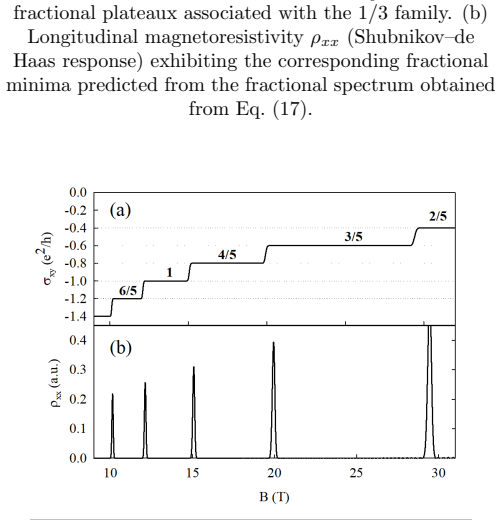
Frac- tional states appear as emergent sublevels of the origi- nal Landau spectrum. The absence of a robust incom- pressible state at filling factor 1/2 follows naturally from cancellation of the geometric correlations responsible for odd-denominator states (p=0). MAGNETOTRANSPOR T AND COMP ARISON WITH EXPERIMENT The impurity-induced splitting of the Land...
-
[2]
R. B. Laughlin, Physical Review B23, 5632 (1981)
work page 1981
-
[3]
R. B. Laughlin, Physical Review Letters50, 1395 (1983)
work page 1983
- [4]
-
[5]
C. Cohen-Tannoudji, B. Diu, and F. Lalo¨ e,Quantum Me- chanics, Volume 1: Basic Concepts, Tools, and Applica- tions, 2nd ed. (John Wiley & Sons, 2019)
work page 2019
-
[6]
Haldane, Physical Review Letters107, 116801 (2011)
F. Haldane, Physical Review Letters107, 116801 (2011)
work page 2011
-
[7]
R. Willett, J. P. Eisenstein, H. L. St¨ ormer, D. C. Tsui, A. C. Gossard, and J. English, Physical Review Letters 59, 1776 (1987). 4 FIG. 2: (a) Hall magnetoconductivityσ xy showing the fractional plateaux associated with the 1/3 family. (b) Longitudinal magnetoresistivityρ xx (Shubnikov–de Haas response) exhibiting the corresponding fractional minima pre...
work page 1987
- [8]
-
[9]
R. Willett, H. Stormer, D. Tsui, L. Pfeiffer, K. West, and K. Baldwin, Physical Review B38, 7881 (1988)
work page 1988
-
[10]
R. Du, H. Stormer, D. Tsui, L. Pfeiffer, and K. West, Physical Review Letters70, 2944 (1993)
work page 1993
-
[11]
H. Choi, W. Kang, S. Das Sarma, L. Pfeiffer, and K. West, Physical Review B—Condensed Matter and Materials Physics77, 081301 (2008)
work page 2008
-
[12]
J. Shabani, Y. Liu, and M. Shayegan, Physical Review Letters105, 246805 (2010)
work page 2010
discussion (0)
Sign in with ORCID, Apple, or X to comment. Anyone can read and Pith papers without signing in.