Separating Intrinsic Ambiguity from Estimation Uncertainty in Deep Generative Models for Linear Inverse Problems
Pith reviewed 2026-06-30 21:24 UTC · model grok-4.3
The pith
A structural decomposition isolates intrinsic ambiguity from estimation uncertainty in deep generative models for linear inverse problems.
A machine-rendered reading of the paper's core claim, the machinery that carries it, and where it could break.
Core claim
The central discovery is a structural decomposition of posterior uncertainty that separates the intrinsic ambiguity due to the forward operator from the uncertainty propagated through the inference process in deep generative models. By formulating this as a cascade, the intrinsic ambiguity becomes accessible for calibration analysis, enabling diagnostics that identify failure modes not apparent from reconstruction quality metrics alone. The approach is validated analytically on Gaussian examples and applied to accelerated MRI and EEG source imaging tasks.
What carries the argument
The cascade formulation that structures the decomposition of posterior uncertainty into intrinsic and estimation components.
If this is right
- Qualitative diagnostics become possible for assessing model behavior in inverse problems.
- Simulation-based calibration tests can be applied to reveal hidden failure modes.
- Model selection can consider calibration beyond just reconstruction accuracy.
- Insights apply to applications in medical imaging such as MRI and EEG.
Where Pith is reading between the lines
- The decomposition might extend to nonlinear forward operators if the cascade structure holds.
- Future generative models could be trained to minimize the estimation uncertainty component specifically.
- Similar separations could inform uncertainty quantification in other probabilistic modeling domains.
Load-bearing premise
The cascade formulation cleanly separates intrinsic ambiguity from estimation uncertainty without requiring additional assumptions on the generative model or forward operator.
What would settle it
A mismatch between the decomposed components and the analytically known posterior uncertainty in the Gaussian linear inverse problem example would falsify the separation.
Figures

read the original abstract
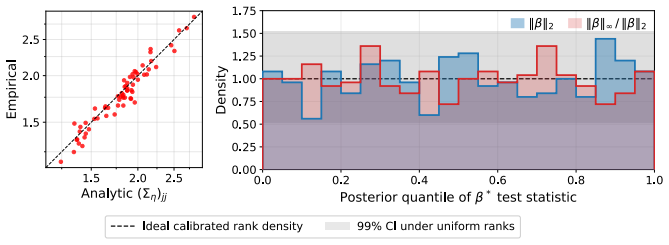
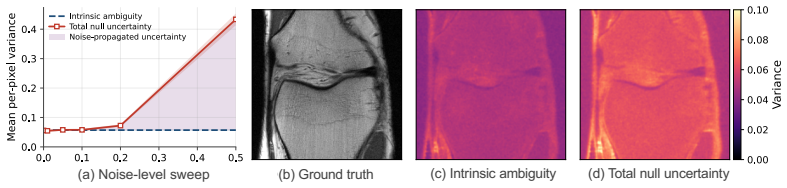
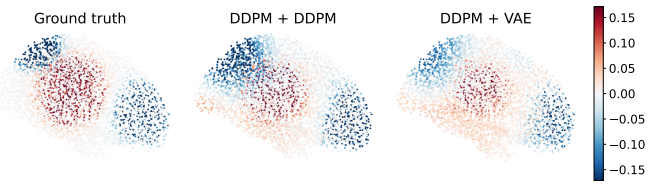
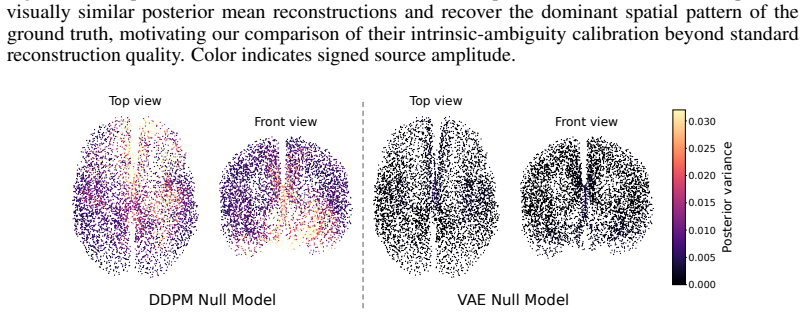
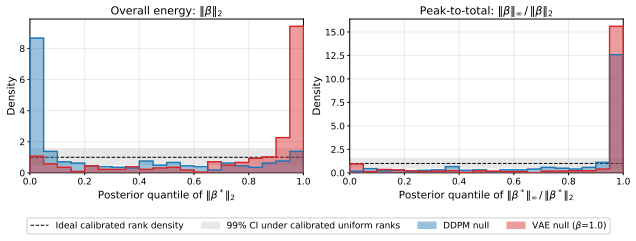
Recently, deep generative models have been used for posterior inference in inverse problems, including high-stakes applications in medical imaging and scientific discovery, where the uncertainty of a prediction can matter as much as the prediction itself. However, posterior uncertainty is difficult to interpret because it can mix ambiguity inherent to the forward operator with uncertainty propagated through inference. We introduce a structural decomposition of posterior uncertainty that isolates intrinsic ambiguity. A cascade formulation makes this ambiguity accessible for calibration analysis, enabling qualitative diagnostics and simulation-based calibration tests that reveal failure modes that remain hidden when models are selected by reconstruction quality alone. We first validate the approach on a Gaussian example with analytical posterior structure, then illustrate the decomposition on accelerated magnetic resonance imaging (MRI), and finally apply the calibration diagnostics to electroencephalography (EEG) source imaging.
Editorial analysis
A structured set of objections, weighed in public.
Referee Report
Summary. The paper introduces a structural decomposition of posterior uncertainty for deep generative models applied to linear inverse problems. This decomposition isolates intrinsic ambiguity (inherent to the forward operator) from estimation uncertainty (propagated through the generative model). A cascade formulation renders the ambiguity accessible for calibration analysis, supporting qualitative diagnostics and simulation-based calibration tests. The approach is first validated on a Gaussian example possessing closed-form posterior structure, then illustrated on accelerated MRI, and finally applied to EEG source imaging to reveal failure modes not visible from reconstruction quality alone.
Significance. If the decomposition holds, the work offers a principled way to interpret and calibrate uncertainty in high-stakes inverse problems such as medical imaging. Credit is due for the direct validation on the Gaussian example with analytical posterior structure, which provides a concrete test of whether the cascade isolates the claimed quantities. This strengthens the central claim beyond illustration-only applications and enables falsifiable calibration diagnostics.
minor comments (2)
- [§3] The cascade formulation is central to accessibility of the ambiguity; a brief explicit statement in §3 or §4 confirming that the separation requires no additional assumptions on the generative model beyond those used in the Gaussian case would improve clarity.
- [EEG section] In the EEG application, the simulation-based calibration tests are described qualitatively; adding a short quantitative summary (e.g., rank statistics or coverage metrics) would aid reproducibility without altering the main narrative.
Simulated Author's Rebuttal
We thank the referee for the positive summary, the recognition of the Gaussian validation's value for falsifiability, and the recommendation of minor revision. No major comments were raised in the report.
Circularity Check
No significant circularity; derivation self-contained via external Gaussian validation
full rationale
The paper introduces a structural decomposition of posterior uncertainty via a cascade formulation and directly validates the separation of intrinsic ambiguity (from the forward operator) versus estimation uncertainty (from the generative model) on a Gaussian example with closed-form analytical posterior structure. This provides an independent benchmark that does not rely on the decomposition itself. No equations, self-citations, or fitted parameters are visible in the provided text that would reduce the central claim to a definitional equivalence or input renaming. Applications to MRI and EEG are presented only as illustrations after the Gaussian validation, leaving the core derivation independent of its target results.
Axiom & Free-Parameter Ledger
Reference graph
Works this paper leans on
-
[1]
Gans trained by a two time-scale update rule converge to a local nash equilibrium.Advances in neural information processing systems, 30, 2017
Martin Heusel, Hubert Ramsauer, Thomas Unterthiner, Bernhard Nessler, and Sepp Hochreiter. Gans trained by a two time-scale update rule converge to a local nash equilibrium.Advances in neural information processing systems, 30, 2017
2017
-
[2]
Learning transferable visual models from natural language supervision
Alec Radford, Jong Wook Kim, Chris Hallacy, Aditya Ramesh, Gabriel Goh, Sandhini Agarwal, Girish Sastry, Amanda Askell, Pamela Mishkin, Jack Clark, et al. Learning transferable visual models from natural language supervision. InInternational conference on machine learning, pages 8748–8763. PmLR, 2021
2021
-
[3]
Michael Lustig, David Donoho, and John M Pauly. Sparse mri: The application of compressed sensing for rapid mr imaging.Magnetic Resonance in Medicine: An Official Journal of the International Society for Magnetic Resonance in Medicine, 58(6):1182–1195, 2007
2007
-
[4]
Deconvolution in astronomy: A review.Publications of the Astronomical Society of the Pacific, 114(800):1051–1069, 2002
Jean-Luc Starck, Eric Pantin, and Fionn Murtagh. Deconvolution in astronomy: A review.Publications of the Astronomical Society of the Pacific, 114(800):1051–1069, 2002
2002
-
[5]
Image super-resolution using deep convolutional networks.IEEE transactions on pattern analysis and machine intelligence, 38(2):295–307, 2015
Chao Dong, Chen Change Loy, Kaiming He, and Xiaoou Tang. Image super-resolution using deep convolutional networks.IEEE transactions on pattern analysis and machine intelligence, 38(2):295–307, 2015
2015
-
[6]
Diffusion Posterior Sampling for General Noisy Inverse Problems
Hyungjin Chung, Jeongsol Kim, Michael T Mccann, Marc L Klasky, and Jong Chul Ye. Diffusion posterior sampling for general noisy inverse problems.arXiv preprint arXiv:2209.14687, 2022
work page internal anchor Pith review Pith/arXiv arXiv 2022
-
[7]
A Survey on Diffusion Models for Inverse Problems
Giannis Daras, Hyungjin Chung, Chieh-Hsin Lai, Yuki Mitsufuji, Jong Chul Ye, Peyman Milanfar, Alexandros G Dimakis, and Mauricio Delbracio. A survey on diffusion models for inverse problems.arXiv preprint arXiv:2410.00083, 2024
work page internal anchor Pith review Pith/arXiv arXiv 2024
-
[8]
Denoising diffusion restoration models
Bahjat Kawar, Michael Elad, Stefano Ermon, and Jiaming Song. Denoising diffusion restoration models. Advances in neural information processing systems, 35:23593–23606, 2022
2022
-
[9]
Zero-shot im- age restoration using denoising diffusion null-space model
Yinhuai Wang, Jiwen Yu, and Jian Zhang. Zero-shot image restoration using denoising diffusion null-space model.arXiv preprint arXiv:2212.00490, 2022
-
[10]
A conditional normalizing flow for accelerated multi-coil mr imaging.Proceedings of machine learning research, 202:36926, 2023
Jeffrey Wen, Rizwan Ahmad, and Philip Schniter. A conditional normalizing flow for accelerated multi-coil mr imaging.Proceedings of machine learning research, 202:36926, 2023
2023
-
[11]
Beyond Accuracy: Evaluating Posterior Fidelity of Diffusion Inverse Solvers
Xiaoyu Qiu, Taewon Yang, Zhanhao Liu, Guanyang Wang, and Liyue Shen. Benchmarking uncer- tainty quantification of plug-and-play diffusion priors for inverse problems solving.arXiv preprint arXiv:2602.04189, 2026
work page internal anchor Pith review Pith/arXiv arXiv 2026
-
[12]
2018, arXiv e-prints, arXiv:1804.06788
Sean Talts, Michael Betancourt, Daniel Simpson, Aki Vehtari, and Andrew Gelman. Validating bayesian inference algorithms with simulation-based calibration.arXiv preprint arXiv:1804.06788, 2018
-
[13]
Mayank Nautiyal, Andreas Hellander, and Prashant Singh. Condisim: Conditional diffusion models for simulation based inference.arXiv preprint arXiv:2505.08403, 2025
-
[14]
Denoising diffusion probabilistic models.Advances in neural information processing systems, 33:6840–6851, 2020
Jonathan Ho, Ajay Jain, and Pieter Abbeel. Denoising diffusion probabilistic models.Advances in neural information processing systems, 33:6840–6851, 2020
2020
-
[15]
fastmri: A publicly available raw k-space and dicom dataset of knee images for accelerated mr image reconstruction using machine learning
Florian Knoll, Jure Zbontar, Anuroop Sriram, Matthew J Muckley, Mary Bruno, Aaron Defazio, Marc Parente, Krzysztof J Geras, Joe Katsnelson, Hersh Chandarana, et al. fastmri: A publicly available raw k-space and dicom dataset of knee images for accelerated mr image reconstruction using machine learning. Radiology: Artificial Intelligence, 2(1):e190007, 2020
2020
-
[16]
fastMRI: An Open Dataset and Benchmarks for Accelerated MRI
Jure Zbontar, Florian Knoll, Anuroop Sriram, Tullie Murrell, Zhengnan Huang, Matthew J Muckley, Aaron Defazio, Ruben Stern, Patricia Johnson, Mary Bruno, et al. fastmri: An open dataset and benchmarks for accelerated mri.arXiv preprint arXiv:1811.08839, 2018
work page internal anchor Pith review Pith/arXiv arXiv 2018
-
[17]
Eeg source imaging: a practical review of the analysis steps
Christoph M Michel and Denis Brunet. Eeg source imaging: a practical review of the analysis steps. Frontiers in neurology, 10:325, 2019
2019
-
[18]
Meg and eeg data analysis with mne-python.Frontiers in Neuroinformatics, 7:267, 2013
Alexandre Gramfort, Martin Luessi, Eric Larson, Denis A Engemann, Daniel Strohmeier, Christian Brodbeck, Roman Goj, Mainak Jas, Teon Brooks, Lauri Parkkonen, et al. Meg and eeg data analysis with mne-python.Frontiers in Neuroinformatics, 7:267, 2013
2013
-
[19]
Magnetoen- cephalography—theory, instrumentation, and applications to noninvasive studies of the working human brain.Reviews of modern Physics, 65(2):413, 1993
Matti Hämäläinen, Riitta Hari, Risto J Ilmoniemi, Jukka Knuutila, and Olli V Lounasmaa. Magnetoen- cephalography—theory, instrumentation, and applications to noninvasive studies of the working human brain.Reviews of modern Physics, 65(2):413, 1993. 10
1993
-
[20]
Burgess, Xavier Glorot, Matthew M
Irina Higgins, Loïc Matthey, Arka Pal, Christopher P. Burgess, Xavier Glorot, Matthew M. Botvinick, Shakir Mohamed, and Alexander Lerchner. beta-vae: Learning basic visual concepts with a constrained variational framework. InInternational Conference on Learning Representations, 2016
2016
-
[21]
Deep learning based source imaging provides strong sublobar localization of epileptogenic zone from meg interictal spikes.NeuroImage, 281:120366, 2023
Rui Sun, Wenbo Zhang, Anto Bagi´c, and Bin He. Deep learning based source imaging provides strong sublobar localization of epileptogenic zone from meg interictal spikes.NeuroImage, 281:120366, 2023
2023
-
[22]
Towards an objective evaluation of eeg/meg source estimation methods–the linear approach.Neuroimage, 255:119177, 2022
Olaf Hauk, Matti Stenroos, and Matthias S Treder. Towards an objective evaluation of eeg/meg source estimation methods–the linear approach.Neuroimage, 255:119177, 2022
2022
-
[23]
Neural silences can be localized rapidly using noninvasive scalp eeg.Communications biology, 4(1):429, 2021
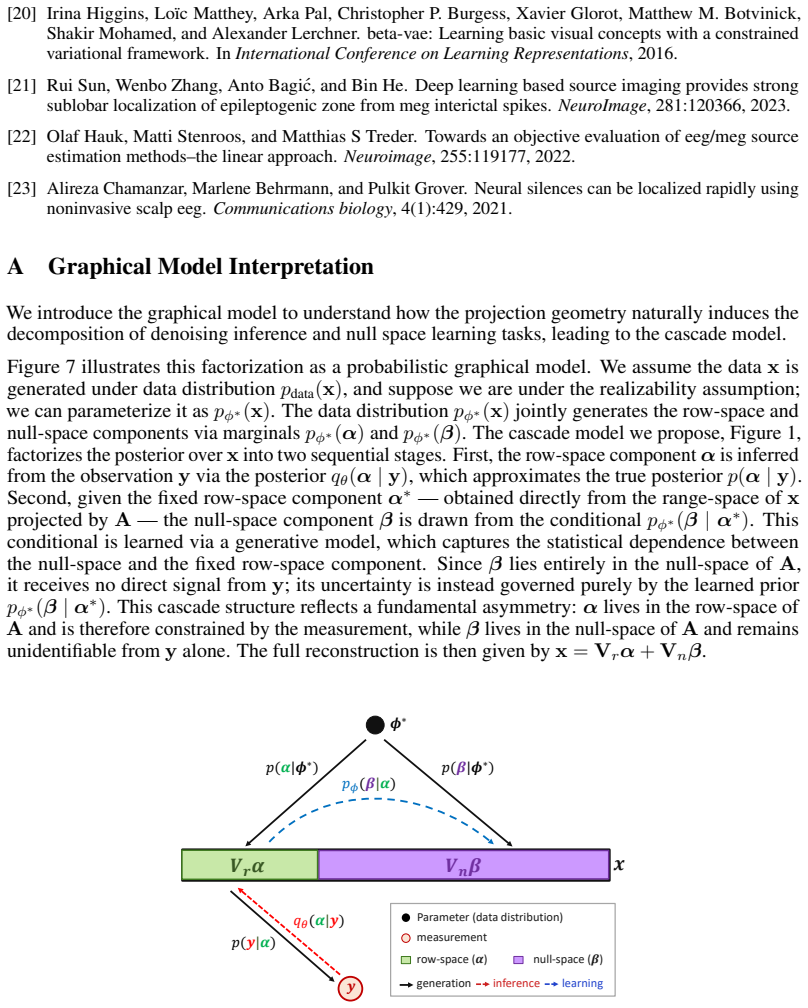
Alireza Chamanzar, Marlene Behrmann, and Pulkit Grover. Neural silences can be localized rapidly using noninvasive scalp eeg.Communications biology, 4(1):429, 2021. A Graphical Model Interpretation We introduce the graphical model to understand how the projection geometry naturally induces the decomposition of denoising inference and null space learning t...
2021
discussion (0)
Sign in with ORCID, Apple, or X to comment. Anyone can read and Pith papers without signing in.