Recognition: 2 theorem links
· Lean TheoremEnergy efficiency of quantum computers
Pith reviewed 2026-05-15 03:13 UTC · model grok-4.3
The pith
Energy efficiency of a quantum computer is defined as the number of algorithms it can run per unit of energy consumed, including all hardware overheads.
A machine-rendered reading of the paper's core claim, the machinery that carries it, and where it could break.
Core claim
The authors define the energy efficiency of a quantum computer as the number of algorithms it can perform during a given time divided by the energy consumed by the hardware during that time. They evaluate this quantity across the leading physical platforms by combining expert assessments of power draw with algorithm compilation constraints, thereby generating numerical energy figures for existing devices and establishing a reusable framework for comparing any future quantum computing architecture.
What carries the argument
The energy-efficiency ratio (algorithms per unit energy), which incorporates full-system power consumption including cooling, control electronics, and compilation costs to rank platforms.
If this is right
- Each of the five platforms exhibits distinct energy efficiencies once cooling, control, and compilation overheads are included.
- Current quantum computers have concrete, benchmarkable energy-consumption values that differ by platform.
- The framework enables consistent side-by-side evaluation of any new quantum architecture on energy grounds.
- Expert-derived insights identify platform-specific advantages such as lower cooling demands and inconveniences such as higher control power.
Where Pith is reading between the lines
- The metric could inform hardware selection for future energy-constrained quantum data centers.
- Reductions in classical control electronics or compiler efficiency could improve overall energy performance without changes to the quantum hardware.
- The approach could be extended to hybrid quantum-classical workloads to capture complete end-to-end energy costs.
Load-bearing premise
The energy consumption estimates for each platform, including overheads from cooling, control systems, and algorithm compilation, are accurate and representative based on expert insights.
What would settle it
A direct measurement of the total electrical energy drawn by an operational quantum computer of each platform while running a standardized set of algorithms, compared against the paper's estimated figures.
Figures







read the original abstract
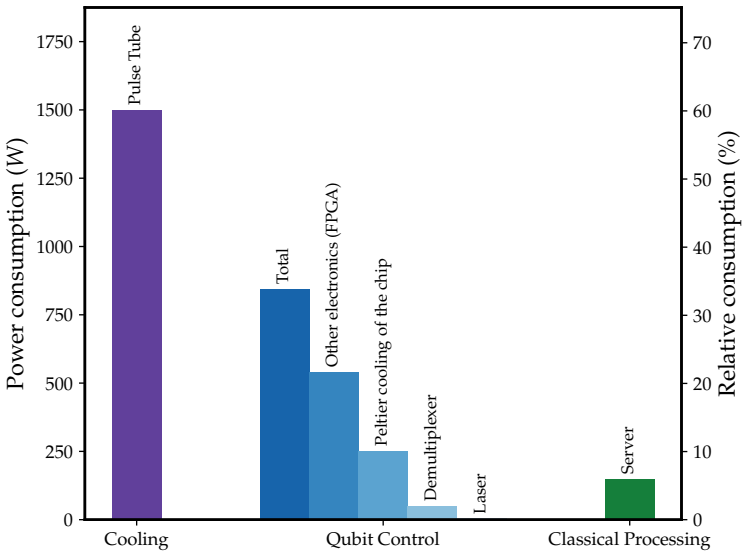
How much energy does a quantum computer consume? Are they more efficient than their classical counterparts? In this work, we make a step towards answering these questions. We define the energy efficiency of a quantum computer as the ratio of the number of algorithms it can perform during a given time over the energy consumed by the hardware during this time. We analyze the most representative physical platforms currently envisioned to be used as building blocks of quantum computers: superconducting qubits, silicon spin qubits, trapped ions, neutral atoms and photonic qubits. Including insights from experts in all these technologies and taking into account algorithm compilation constraints, we discuss the advantages and inconveniences of each platform from an energy standpoint. Beyond providing concrete values of the energy consumption of current quantum computers, we lay the foundation of a framework to benchmark the energy efficiency of any future quantum computing architecture.
Editorial analysis
A structured set of objections, weighed in public.
Referee Report
Summary. The paper defines the energy efficiency of a quantum computer as the ratio of the number of algorithms it can perform during a given time over the energy consumed by the hardware during this time. It evaluates this metric across five representative platforms (superconducting qubits, silicon spin qubits, trapped ions, neutral atoms, and photonic qubits), incorporating expert insights on power draw including cooling, control electronics, and compilation overheads, provides concrete numerical estimates, and discusses platform-specific advantages and disadvantages to establish a benchmarking framework for future architectures.
Significance. If the platform-specific energy estimates prove accurate and robust, the proposed framework offers a practical tool for comparing quantum hardware on energy efficiency beyond speed or qubit count alone, with the inclusion of compilation constraints adding realism. The work's strength lies in its attempt to quantify overheads across diverse technologies, but its value as a reproducible benchmark hinges on the transparency of the underlying numbers.
major comments (2)
- [Platform analysis and energy estimates] The concrete numerical values for energy consumption (including cryogenic cooling for superconducting qubits, laser power for trapped ions, etc.) are obtained via expert consultations rather than explicit derivations, published measurements, or first-principles formulas. This is load-bearing for the central claim because the efficiency ratios and resulting platform rankings depend directly on these figures; any systematic offset would invert the ordering without altering the formal definition.
- [Discussion of advantages and inconveniences] No sensitivity analysis or error propagation is provided for the expert-derived parameters (e.g., how variations in cooling overhead estimates affect the final ratios). This undermines the robustness of the cross-platform comparisons presented.
minor comments (2)
- [Definition section] Clarify the time interval T used in the efficiency definition and whether it is normalized across platforms or chosen per platform.
- [Results on concrete values] Add units and ranges explicitly when reporting the concrete energy values in the platform comparisons.
Simulated Author's Rebuttal
We thank the referee for their constructive comments, which have helped us improve the clarity and robustness of our work. We address each major comment below and outline the revisions we plan to implement.
read point-by-point responses
-
Referee: [Platform analysis and energy estimates] The concrete numerical values for energy consumption (including cryogenic cooling for superconducting qubits, laser power for trapped ions, etc.) are obtained via expert consultations rather than explicit derivations, published measurements, or first-principles formulas. This is load-bearing for the central claim because the efficiency ratios and resulting platform rankings depend directly on these figures; any systematic offset would invert the ordering without altering the formal definition.
Authors: We agree that the reliance on expert consultations for the numerical estimates is a limitation in terms of reproducibility. However, this approach was necessary because detailed, published measurements of full-system power consumption for these quantum platforms are not widely available in the literature. In the revised manuscript, we will add an appendix detailing the specific expert inputs and any supporting references or measurements used, along with a clearer discussion of the uncertainties involved. This will make the basis for our estimates more transparent. revision: partial
-
Referee: [Discussion of advantages and inconveniences] No sensitivity analysis or error propagation is provided for the expert-derived parameters (e.g., how variations in cooling overhead estimates affect the final ratios). This undermines the robustness of the cross-platform comparisons presented.
Authors: We acknowledge the absence of sensitivity analysis in the original submission. To address this, we will incorporate a dedicated sensitivity analysis section in the revised manuscript. This will include varying key parameters such as cooling power overheads and control electronics consumption within plausible ranges (e.g., ±20-50% based on expert feedback) and showing the impact on the efficiency metrics and platform rankings. We believe this will demonstrate that our main conclusions remain robust. revision: yes
Circularity Check
No circularity: energy-efficiency definition is independent and platform values are external expert inputs
full rationale
The paper defines energy efficiency directly as the ratio of executable algorithms per unit time to hardware energy consumed during that interval. This definition stands alone and does not reduce to any fitted parameter, self-citation chain, or prior result by construction. Energy-consumption figures for the five platforms are stated to come from expert consultations that incorporate cooling, control, and compilation overheads; these are external inputs rather than quantities derived from the efficiency metric itself. No equations, uniqueness theorems, or ansatzes are shown to be smuggled in via self-citation or to rename a known empirical pattern. The resulting platform comparisons therefore rest on independent (if subjective) data rather than tautological re-expression of the paper's own inputs.
Axiom & Free-Parameter Ledger
free parameters (1)
- Platform-specific energy consumption estimates
axioms (1)
- domain assumption Expert insights provide accurate representations of energy use and compilation constraints for each physical platform.
Lean theorems connected to this paper
-
IndisputableMonolith/Cost/FunctionalEquation.leanwashburn_uniqueness_aczel unclear?
unclearRelation between the paper passage and the cited Recognition theorem.
We define the energy efficiency of a quantum computer as the ratio of the number of algorithms it can perform during a given time over the energy consumed by the hardware during this time.
-
IndisputableMonolith/Foundation/DimensionForcing.leanreality_from_one_distinction unclear?
unclearRelation between the paper passage and the cited Recognition theorem.
P_π = sum P_i over hardware elements (cryostats, lasers, control electronics)
What do these tags mean?
- matches
- The paper's claim is directly supported by a theorem in the formal canon.
- supports
- The theorem supports part of the paper's argument, but the paper may add assumptions or extra steps.
- extends
- The paper goes beyond the formal theorem; the theorem is a base layer rather than the whole result.
- uses
- The paper appears to rely on the theorem as machinery.
- contradicts
- The paper's claim conflicts with a theorem or certificate in the canon.
- unclear
- Pith found a possible connection, but the passage is too broad, indirect, or ambiguous to say the theorem truly supports the claim.
Reference graph
Works this paper leans on
-
[1]
Quantum technologies need a quantum energy initiative.PRX Quantum, 3:020101, Jun 2022
Alexia Auffèves. Quantum technologies need a quantum energy initiative.PRX Quantum, 3:020101, Jun 2022
work page 2022
-
[2]
Mind the gaps: The fraught road to quantum advantage, 2025
Jens Eisert and John Preskill. Mind the gaps: The fraught road to quantum advantage, 2025
work page 2025
-
[3]
Marco Fellous-Asiani, Jing Hao Chai, Yvain Thonnart, Hui Khoon Ng, Robert S. Whitney, and Alexia Auffèves. Optimizing Resource Efficiencies for Scalable Full-Stack Quantum Computers. PRX Quantum, 4(4):040319, October 2023
work page 2023
-
[4]
Andreas J. C. Woitzik, Lukas Hoffmann, Andreas Buchleitner, and Edoardo G. Carnio. An En- ergy Estimation Benchmark for Quantum Computers.Open Systems & Information Dynamics, 31(01):2450006, March 2024
work page 2024
-
[5]
Energetic analysis of emerging quantum communication protocols,
RajaYehia, YoannPiétri, CarlosPascual-García, PascalLefebvre, andFedericoCentrone. Energetic Analysis of Emerging Quantum Communication Protocols, March 2025. arXiv:2410.10661 [quant- ph]
-
[6]
Quantum benchmarking initiative: https://www.darpa.mil/research/programs/quantum- benchmarking-initiative
-
[7]
Quantum Energy Initiative IEEE working group, https://sagroups.ieee.org/qei/
-
[8]
Qiskit Documentation from IBM: https://quantum.cloud.ibm.com/docs/en/api/qiskit
-
[9]
Steven A. Cuccaro, Thomas G. Draper, Samuel A. Kutin, and David Petrie Moulton. A new quantum ripple-carry addition circuit, 2004
work page 2004
-
[10]
Estimation of shor’s circuit for 2048-bit integers based on quantum simulator
JunpeiYamaguchi, MasafumiYamazaki, AkihiroTabuchi, TakumiHonda, TetsuyaIzu, andNoboru Kunihiro. Estimation of shor’s circuit for 2048-bit integers based on quantum simulator. Cryptology ePrint Archive, Paper 2023/092, 2023
work page 2048
-
[11]
Craig Gidney and Martin Ekerå. How to factor 2048 bit RSA integers in 8 hours using 20 million noisy qubits.Quantum, 5:433, April 2021
work page 2048
-
[12]
Approximate Quantum Fourier Transform in Logarithmic Depth on a Line, April 2025
Elisa Bäumer, David Sutter, and Stefan Woerner. Approximate Quantum Fourier Transform in Logarithmic Depth on a Line, April 2025
work page 2025
-
[13]
Fast parallel circuits for the quantum Fourier transform, June 2000
Richard Cleve and John Watrous. Fast parallel circuits for the quantum Fourier transform, June 2000
work page 2000
-
[14]
Svore, Dave Wecker, and Matthias Troyer
Markus Reiher, Nathan Wiebe, Krysta M. Svore, Dave Wecker, and Matthias Troyer. Elucidating Reaction Mechanisms on Quantum Computers.Proceedings of the National Academy of Sciences, 114(29):7555–7560, July 2017. 53
work page 2017
-
[15]
Berry, Craig Gidney, William J
Joonho Lee, Dominic W. Berry, Craig Gidney, William J. Huggins, Jarrod R. McClean, Nathan Wiebe, and Ryan Babbush. Even more efficient quantum computations of chemistry through tensor hypercontraction.PRX Quantum, 2(3):030305, July 2021
work page 2021
-
[16]
Yu Zhang, Lukasz Cincio, Christian Negre, Piotr Czarnik, Patrick Coles, Petr Anisimov, Susan Mniszewski, Sergei Tretiak, and Pavel Dub. Variational quantum eigensolver with reduced circuit complexity.npj Quantum Information, 8, August 2022
work page 2022
-
[17]
Perspective on superconducting qubit quantum computing.Eur
Olivier Ezratty. Perspective on superconducting qubit quantum computing.Eur. Phys. J. A, 59(5):1–18, May 2023
work page 2023
-
[18]
Youngseok Kim, Andrew Eddins, Sajant Anand, Ken Xuan Wei, Ewout van den Berg, Sami Rosen- blatt, Hasan Nayfeh, Yantao Wu, Michael Zaletel, Kristan Temme, and Abhinav Kandala. Evidence for the utility of quantum computing before fault tolerance.Nature, 618(7965):500–505, June 2023
work page 2023
-
[19]
Abanin, Laleh Aghababaie-Beni, Igor Aleiner, Trond I
Rajeev Acharya, Dmitry A. Abanin, Laleh Aghababaie-Beni, Igor Aleiner, Trond I. Andersen, Markus Ansmann, et al. Quantum error correction below the surface code threshold.Nature, 638(8052):920–926, February 2025
work page 2025
-
[20]
Andrew D. King, Alberto Nocera, Marek M. Rams, Jacek Dziarmaga, Roeland Wiersema, et al. Beyond-classical computation in quantum simulation.Science, 388(6743):199–204, April 2025
work page 2025
-
[21]
EliM.Levenson-FalkandSadmanAhmedShanto. AReviewofDesignConcernsinSuperconducting Quantum Circuits.Materials for Quantum Technology, 5(2):022003, June 2025
work page 2025
-
[22]
B. D. Josephson. The discovery of tunnelling supercurrents.Rev. Mod. Phys., 46(2):251–254, April 1974
work page 1974
-
[23]
Schwartz, Jochen Braumüller, Philip Krantz, Joel I.-Jan Wang, Simon Gustavsson, and William D
Morten Kjaergaard, Mollie E. Schwartz, Jochen Braumüller, Philip Krantz, Joel I.-Jan Wang, Simon Gustavsson, and William D. Oliver. Superconducting Qubits: Current State of Play.Annu. Rev. Condens. Matter Phys., 11(1):369–395, March 2020
work page 2020
-
[24]
SuperconductingQuantumComputing: A Review.Sci
He-LiangHuang, DachaoWu, DaojinFan, andXiaoboZhu. SuperconductingQuantumComputing: A Review.Sci. China Inf. Sci., 63(8):180501, August 2020
work page 2020
-
[25]
Alexandre Blais, Ren-Shou Huang, Andreas Wallraff, S. M. Girvin, and R. J. Schoelkopf. Cav- ity quantum electrodynamics for superconducting electrical circuits: An architecture for quantum computation.Phys. Rev. A, 69(6):062320, June 2004
work page 2004
-
[26]
Circuit QED and engineering charge-based super- conducting qubits.Phys
S M Girvin, M H Devoret, and R J Schoelkopf. Circuit QED and engineering charge-based super- conducting qubits.Phys. Scr., 2009(T137):014012, December 2009
work page 2009
-
[27]
Manucharyan, Jens Koch, Leonid I
Vladimir E. Manucharyan, Jens Koch, Leonid I. Glazman, and Michel H. Devoret. Fluxonium: Single cooper-pair circuit free of charge offsets.Science, 326(5949):113–116, October 2009
work page 2009
-
[28]
Feng Bao, Hao Deng, Dawei Ding, Ran Gao, Xun Gao, Cupjin Huang, Xun Jiang, Hsiang-Sheng Ku, Zhisheng Li, Xizheng Ma, Xiaotong Ni, Jin Qin, Zhijun Song, Hantao Sun, Chengchun Tang, Tenghui Wang, Feng Wu, Tian Xia, Wenlong Yu, Fang Zhang, Gengyan Zhang, Xiaohang Zhang, JingweiZhou, XingZhu, YaoyunShi, JianxinChen, Hui-HaiZhao, andChunqingDeng. Fluxonium: An...
work page 2022
- [29]
-
[30]
X. Y. Jin, A. Kamal, A. P. Sears, T. Gudmundsen, D. Hover, J. Miloshi, R. Slattery, F. Yan, J. Yoder, T. P. Orlando, S. Gustavsson, and W. D. Oliver. Thermal and Residual Excited-State Population in a 3D Transmon Qubit.Phys. Rev. Lett., 114(24):240501, June 2015. 54
work page 2015
-
[31]
H. Zu, W. Dai, and A.T.A.M. De Waele. Development of dilution refrigerators—A review.Cryo- genics, 121:103390, January 2022
work page 2022
-
[32]
Qmio: A tightly integrated hybrid hpcqc system, 2025
Javier Cacheiro, Álvaro C Sánchez, Russell Rundle, George B Long, Gavin Dold, Jamie Friel, and Andrés Gómez. Qmio: A tightly integrated hybrid hpcqc system, 2025
work page 2025
-
[33]
Daniel Loss and David P. DiVincenzo. Quantum computation with quantum dots.Phys. Rev. A, 57:120–126, Jan 1998
work page 1998
-
[34]
de Snoo, Davide Degli Esposti, Giordano Scappucci, Eliška Greplová, and Lieven M
BrennanUndseth, NicolaMeggiato, Yi-HsienWu, SamR.Katiraee-Far, LarysaTryputen, SanderL. de Snoo, Davide Degli Esposti, Giordano Scappucci, Eliška Greplová, and Lieven M. K. Vander- sypen. Weight-four parity checks with silicon spin qubits, January 2026
work page 2026
-
[35]
B. E. Kane. A silicon-based nuclear spin quantum computer.Nature, 393(6681):133–137, May
-
[36]
Publisher: Nature Publishing Group
-
[37]
Universal Quantum Computation with Spin-$1/2$ Pairs and Heisenberg Exchange
Jeremy Levy. Universal Quantum Computation with Spin-$1/2$ Pairs and Heisenberg Exchange. Physical Review Letters, 89(14):147902, September 2002. Publisher: American Physical Society
work page 2002
-
[38]
D. P. DiVincenzo, D. Bacon, J. Kempe, G. Burkard, and K. B. Whaley. Universal quantum computation with the exchange interaction.Nature, 408(6810):339–342, November 2000. Publisher: Nature Publishing Group
work page 2000
-
[39]
Hubert C. George, Mateusz T. Mądzik, Eric M. Henry, Andrew J. Wagner, Mohammad M. Is- lam, Felix Borjans, Elliot J. Connors, J. Corrigan, Matthew Curry, Michael K. Harper, Daniel Keith, Lester Lampert, Florian Luthi, Fahd A. Mohiyaddin, Sandra Murcia, Rohit Nair, Rambert Nahm, Aditi Nethwewala, Samuel Neyens, Bishnu Patra, Roy D. Raharjo, Carly Rogan, Ros...
work page 2025
-
[40]
Yu, Barnaby van Straaten, Esteban A
Valentin John, Cécile X. Yu, Barnaby van Straaten, Esteban A. Rodríguez-Mena, Mauricio Ro- dríguez, Stefan Oosterhout, Lucas E. A. Stehouwer, Giordano Scappucci, Stefano Bosco, Max- imilian Rimbach-Russ, Yann-Michel Niquet, Francesco Borsoi, and Menno Veldhorst. A two- dimensional 10-qubit array in germanium with robust and localised qubit control. Februa...
-
[41]
Jun Yoneda, Kenta Takeda, Tomohiro Otsuka, Takashi Nakajima, Matthieu R. Delbecq, Giles Allison, Takumu Honda, Tetsuo Kodera, Shunri Oda, Yusuke Hoshi, Noritaka Usami, Kohei M. Itoh, and Seigo Tarucha. A quantum-dot spin qubit with coherence limited by charge noise and fidelity higher than 99.9%.Nature Nanotechnology, 13(2):102–106, February 2018. Publish...
work page 2018
-
[42]
M. Veldhorst, J. C. C. Hwang, C. H. Yang, A. W. Leenstra, B. de Ronde, J. P. Dehollain, J. T. Muhonen, F. E. Hudson, K. M. Itoh, A. Morello, and A. S. Dzurak. An addressable quantum dot qubit with fault-tolerant control-fidelity.Nature Nanotechnology, 9(12):981–985, 2014
work page 2014
-
[43]
Xiao Xue, Maximilian Russ, Nodar Samkharadze, Brennan Undseth, Amir Sammak, Giordano Scappucci, and Lieven M. K. Vandersypen. Quantum logic with spin qubits crossing the surface code threshold.Nature, 601(7893):343–347, January 2022. Publisher: Nature Publishing Group
work page 2022
-
[44]
Akito Noiri, Kenta Takeda, Takashi Nakajima, Takashi Kobayashi, Amir Sammak, Giordano Scap- pucci, and Seigo Tarucha. Fast universal quantum gate above the fault-tolerance threshold in silicon.Nature, 601(7893):338–342, January 2022. Publisher: Nature Publishing Group. 55
work page 2022
-
[45]
Adam R. Mills, Charles R. Guinn, Michael J. Gullans, Anthony J. Sigillito, Mayer M. Feldman, Erik Nielsen, and Jason R. Petta. Two-qubit silicon quantum processor with operation fidelity exceeding 99%.Science Advances, 8(14):eabn5130, April 2022. Publisher: American Association for the Advancement of Science
work page 2022
-
[46]
R. Maurand, X. Jehl, D. Kotekar-Patil, A. Corna, H. Bohuslavskyi, R. Laviéville, L. Hutin, S. Bar- raud, M. Vinet, M. Sanquer, and S. De Franceschi. A CMOS silicon spin qubit.Nature Commu- nications, 7(1):13575, November 2016. Number: 1 Publisher: Nature Publishing Group
work page 2016
-
[47]
M. Pioro-Ladrière, T. Obata, Y. Tokura, Y.-S. Shin, T. Kubo, K. Yoshida, T. Taniyama, and S. Tarucha. Electrically driven single-electron spin resonance in a slanting Zeeman field.Nature Physics, 4(10):776–779, October 2008. Publisher: Nature Publishing Group
work page 2008
-
[48]
M. Veldhorst, C. H. Yang, J. C. C. Hwang, W. Huang, J. P. Dehollain, J. T. Muhonen, S. Simmons, A. Laucht, F. E. Hudson, K. M. Itoh, A. Morello, and A. S. Dzurak. A two-qubit logic gate in silicon.Nature, 526(7573):410–414, October 2015. Publisher: Springer Science and Business Media LLC
work page 2015
-
[49]
de Snoo, Guoji Zheng, Amir Sammak, Giordano Scappucci, and Lieven M
Jurgen Dijkema, Xiao Xue, Patrick Harvey-Collard, Maximilian Rimbach-Russ, Sander L. de Snoo, Guoji Zheng, Amir Sammak, Giordano Scappucci, and Lieven M. K. Vandersypen. Cavity-mediated iSWAP oscillations between distant spins.Nature Physics, 21(1):168–174, January 2025. Publisher: Nature Publishing Group
work page 2025
-
[50]
F. H. L. Koppens, C. Buizert, K. J. Tielrooij, I. T. Vink, K. C. Nowack, T. Meunier, L. P. Kouwen- hoven, and L. M. K. Vandersypen. Driven coherent oscillations of a single electron spin in a quantum dot.Nature, 442(7104):766–771, 2006
work page 2006
-
[51]
Pierre Hamonic, Mathieu Toubeix, Guillermo Haas, Jayshankar Nath, Matthieu C. Dartiailh, Biel Martinez, Benoit Bertrand, Heimanu Niebojewski, Maud Vinet, Christopher Bäuerle, Franck Bale- stro, Tristan Meunier, and Matias Urdampilleta. A foundry-fabricated spin qubit unit cell with in-situ dispersive readout, April 2025. arXiv:2504.20572 [cond-mat]
-
[52]
K. D. Petersson, L. W. McFaul, M. D. Schroer, M. Jung, J. M. Taylor, A. A. Houck, and J. R. Petta. Circuit quantum electrodynamics with a spin qubit.Nature, 490(7420):380–383, October
-
[53]
Number: 7420 Publisher: Nature Publishing Group
-
[54]
Camenzind, Simon Geyer, Andreas Fuhrer, Richard J
Leon C. Camenzind, Simon Geyer, Andreas Fuhrer, Richard J. Warburton, Dominik M. Zumbühl, and Andreas V. Kuhlmann. A hole spin qubit in a fin field-effect transistor above 4 kelvin.Nature Electronics, 5(3):178–183, March 2022. Number: 3 Publisher: Nature Publishing Group
work page 2022
-
[55]
Peter Stano and Daniel Loss. Review of performance metrics of spin qubits in gated semicon- ducting nanostructures.Nature Reviews Physics, 4(10):672–688, October 2022. Publisher: Nature Publishing Group
work page 2022
-
[56]
Franke, Juan Pablo Dehollain, Jonas Helsen, Mark Steudtner, Nicole K
Ruoyu Li, Luca Petit, David P. Franke, Juan Pablo Dehollain, Jonas Helsen, Mark Steudtner, Nicole K. Thomas, Zachary R. Yoscovits, Kanwal J. Singh, Stephanie Wehner, Lieven M. K. Van- dersypen, James S. Clarke, and Menno Veldhorst. A crossbar network for silicon quantum dot qubits.Science Advances, 4(7):eaar3960, 2018
work page 2018
-
[57]
Bruzewicz, John Chiaverini, Robert McConnell, and Jeremy M
Colin D. Bruzewicz, John Chiaverini, Robert McConnell, and Jeremy M. Sage. Trapped-Ion Quan- tum Computing: Progress and Challenges.Applied Physics Reviews, 6(2):021314, June 2019
work page 2019
-
[58]
Quantum computing with trapped ions: A beginner’s guide, September 2023
Francesco Bernardini, Abhijit Chakraborty, and Carlos Ordóñez. Quantum computing with trapped ions: A beginner’s guide, September 2023
work page 2023
-
[59]
J. I. Cirac and P. Zoller. Quantum Computations with Cold Trapped Ions.Phys. Rev. Lett., 74(20):4091–4094, May 1995. 56
work page 1995
-
[60]
Q. A. Turchette, C. S. Wood, B. E. King, C. J. Myatt, D. Leibfried, W. M. Itano, C. Monroe, and D. J. Wineland. Deterministic Entanglement of Two Trapped Ions.Phys. Rev. Lett., 81(17):3631– 3634, October 1998
work page 1998
-
[61]
D. Leibfried, R. Blatt, C. Monroe, and D. Wineland. Quantum dynamics of single trapped ions. Rev. Mod. Phys., 75(1):281–324, March 2003
work page 2003
-
[62]
Quantum error correction for long chains of trapped ions, April 2025
Min Ye and Nicolas Delfosse. Quantum error correction for long chains of trapped ions, April 2025
work page 2025
-
[63]
Jordan Berg, Shouvanik Chakrabarti, Florian J
Minzhao Liu, Ruslan Shaydulin, Pradeep Niroula, Matthew DeCross, Shih-Han Hung, Wen Yu Kon, Enrique Cervero-Martín, Kaushik Chakraborty, Omar Amer, Scott Aaronson, Atithi Acharya, Yuri Alexeev, K. Jordan Berg, Shouvanik Chakrabarti, Florian J. Curchod, Joan M. Dreiling, Neal Erickson, Cameron Foltz, Michael Foss-Feig, David Hayes, Travis S. Humble, Niraj ...
work page 2025
-
[64]
K. R. Brown, A. C. Wilson, Y. Colombe, C. Ospelkaus, A. M. Meier, E. Knill, D. Leibfried, and D. J. Wineland. Single-qubit-gate error below 10 - 4 in a trapped ion.Phys. Rev. A, 84(3):030303, September 2011
work page 2011
-
[65]
C. J. Ballance, T. P. Harty, N. M. Linke, M. A. Sepiol, and D. M. Lucas. High-Fidelity Quantum Logic Gates Using Trapped-Ion Hyperfine Qubits.Phys. Rev. Lett., 117(6):060504, August 2016
work page 2016
-
[66]
A.C.Hughes, R.Srinivas, C.M.Löschnauer, H.M.Knaack, R.Matt, C.J.Ballance, M.Malinowski, T. P. Harty, and R. T. Sutherland. Trapped-ion two-qubit gates with>99.99% fidelity without ground-state cooling, October 2025
work page 2025
-
[67]
David Kielpinski, Christopher R. Monroe, and David J. Wineland. Architecture for a large-scale ion-trap quantum computer.Nature, 417:709–711, 2002
work page 2002
-
[68]
S. L. Todaro, V. B. Verma, K. C. McCormick, D. T. C. Allcock, R. P. Mirin, D. J. Wineland, S. W. Nam, A. C. Wilson, D. Leibfried, and D. H. Slichter. State Readout of a Trapped Ion Qubit Using a Trap-Integrated Superconducting Photon Detector.Phys. Rev. Lett., 126(1):010501, January 2021
work page 2021
-
[69]
D. T. C. Allcock, T. P. Harty, C. J. Ballance, B. C. Keitch, N. M. Linke, D. N. Stacey, and D. M. Lucas. A microfabricated ion trap with integrated microwave circuitry.Applied Physics Letters, 102(4):044103, January 2013
work page 2013
-
[70]
M. A. Weber, C. Löschnauer, J. Wolf, M. F. Gely, R. K. Hanley, J. F. Goodwin, C. J. Ballance, T. P. Harty, and D. M. Lucas. Cryogenic ion trap system for high-fidelity near-field microwave-driven quantum logic.Quantum Sci. Technol., 9(1):015007, January 2024
work page 2024
-
[71]
Wayne M Itano, J C Bergquist, J J Bollinger, and D J Wineland. Cooling methods in ion traps. Phys. Scr., T59:106–120, January 1995
work page 1995
-
[72]
Metcalf and Peter Van Der Straten.Laser Cooling and Trapping
Harold J. Metcalf and Peter Van Der Straten.Laser Cooling and Trapping. Graduate Texts in Contemporary Physics. Springer, New York, NY, 1999
work page 1999
-
[73]
J. M. Pino, J. M. Dreiling, C. Figgatt, J. P. Gaebler, S. A. Moses, M. S. Allman, C. H. Baldwin, M. Foss-Feig, D. Hayes, K. Mayer, C. Ryan-Anderson, and B. Neyenhuis. Demonstration of the trapped-ion quantum CCD computer architecture.Nature, 592(7853):209–213, April 2021
work page 2021
-
[74]
Anthony Ransford, M. S. Allman, Jake Arkinstall, J. P. Campora, Samuel F. Cooper, Robert D. Delaney, Joan M. Dreiling, Brian Estey, Caroline Figgatt, Alex Hall, Ali A. Husain, Akhil Isanaka, Colin J. Kennedy, Nikhil Kotibhaskar, Ivaylo S. Madjarov, Karl Mayer, Alistair R. Milne, An- nie J. Park, Adam P. Reed, Riley Ancona, Molly P. Andersen, Pablo Andres-...
work page 2025
-
[75]
Michael A. Nielsen and Isaac L. Chuang.Quantum Computation and Quantum Information: 10th Anniversary Edition. Cambridge University Press, December 2010
work page 2010
-
[76]
I. M. Georgescu, S. Ashhab, and Franco Nori. Quantum simulation.Rev. Mod. Phys., 86:153–185, Mar 2014
work page 2014
- [77]
-
[78]
Wang, Sepehr Ebadi, Hannes Bernien, Markus Greiner, Vladan Vuletić, Hannes Pichler, and Mikhail D
Harry Levine, Alexander Keesling, Giulia Semeghini, Ahmed Omran, Tout T. Wang, Sepehr Ebadi, Hannes Bernien, Markus Greiner, Vladan Vuletić, Hannes Pichler, and Mikhail D. Lukin. Parallel Implementation of High-Fidelity Multiqubit Gates with Neutral Atoms.Physical Review Letters, 123(17):170503, October 2019
work page 2019
-
[79]
Evered, Dolev Bluvstein, Marcin Kalinowski, Sepehr Ebadi, Tom Manovitz, Hengyun Zhou, Sophie H
Simon J. Evered, Dolev Bluvstein, Marcin Kalinowski, Sepehr Ebadi, Tom Manovitz, Hengyun Zhou, Sophie H. Li, Alexandra A. Geim, Tout T. Wang, Nishad Maskara, Harry Levine, Giulia Semeghini, Markus Greiner, Vladan Vuletić, and Mikhail D. Lukin. High-fidelity parallel entangling gates on a neutral-atom quantum computer.Nature, 622(7982):268–272, October 2023
work page 2023
-
[81]
Reichardt, Adam Paetznick, David Aasen, Ivan Basov, Juan M
Ben W. Reichardt, Adam Paetznick, David Aasen, Ivan Basov, Juan M. Bello-Rivas, Parsa Bonder- son, Rui Chao, Wim van Dam, Matthew B. Hastings, Ryan V. Mishmash, Andres Paz, Marcus P. 58 da Silva, Aarthi Sundaram, Krysta M. Svore, Alexander Vaschillo, Zhenghan Wang, Matt Zanner, WilliamB.Cairncross, Cheng-AnChen, DanielCrow, HyosubKim, JonathanM.Kindem, Jo...
discussion (0)
Sign in with ORCID, Apple, or X to comment. Anyone can read and Pith papers without signing in.