Recognition: 1 theorem link
· Lean TheoremDownlink Performance Analysis of Pinching Antenna Systems: WDMA or NOMA?
Pith reviewed 2026-05-15 02:55 UTC · model grok-4.3
The pith
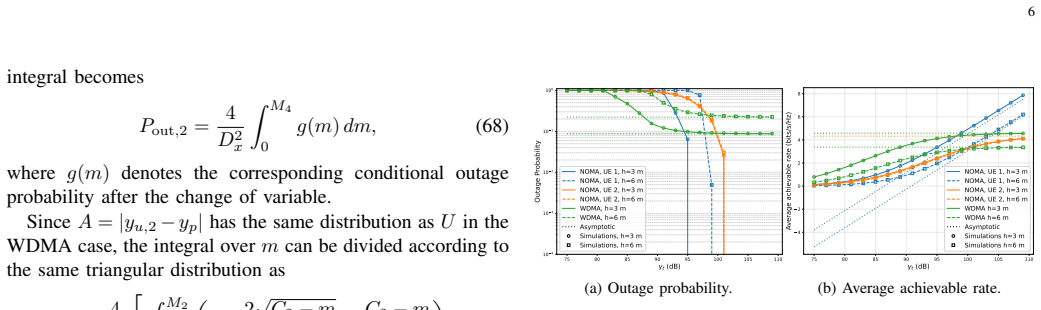
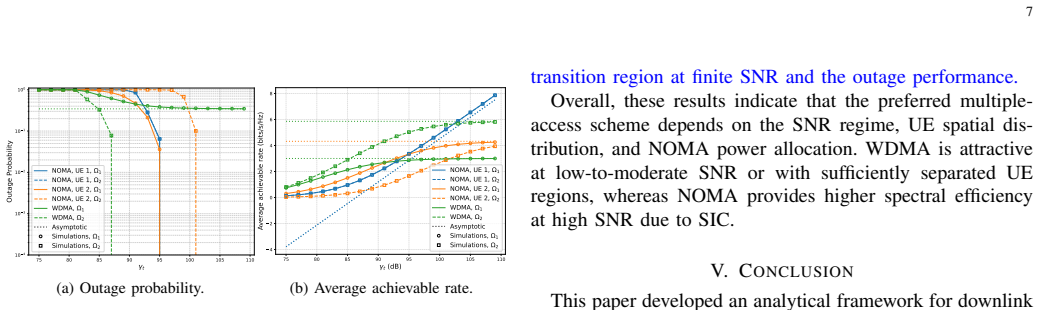
In pinching antenna systems, NOMA delivers higher spectral efficiency at high SNR via successive interference cancellation while WDMA remains more reliable at low to moderate SNR but encounters outage floors.
A machine-rendered reading of the paper's core claim, the machinery that carries it, and where it could break.
Core claim
The authors claim that closed-form outage probability and single-integral average-rate expressions derived from the unified channel model establish NOMA's superiority in spectral efficiency at high transmit SNR through successive interference cancellation, while WDMA provides lower outage at low to moderate SNR yet exhibits an outage floor and rate saturation at high SNR, with greater sensitivity to user spatial distribution due to spatially dependent interference.
What carries the argument
A unified channel model that captures antenna deployment, user spatial distribution, and path loss to produce outage probability and achievable-rate expressions for WDMA and NOMA.
If this is right
- NOMA should be chosen when operating at high transmit SNR to maximize spectral efficiency.
- WDMA suits low-to-moderate SNR regimes where reliability matters more than peak rate.
- Antenna placement strategies must account for spatially dependent interference when using WDMA.
- Successive interference cancellation is the mechanism that enables NOMA's high-SNR gain.
- The derived expressions allow direct numerical evaluation of performance without repeated simulations.
Where Pith is reading between the lines
- The same unified model could be reused to compare other multiple-access schemes such as rate-splitting multiple access in pinching antenna systems.
- Optimizing waveguide spacing or user clustering might reduce WDMA's sensitivity to spatial distribution.
- Incorporating realistic hardware impairments would likely narrow the high-SNR gap between NOMA and WDMA.
Load-bearing premise
The unified channel model accurately represents antenna placement, user locations, and path loss without unmodeled interference or hardware effects that would change the outage and rate formulas.
What would settle it
Monte Carlo simulations that deviate from the derived closed-form outage probabilities or single-integral rates at high SNR would falsify the claimed NOMA advantage and WDMA outage floor.
Figures


read the original abstract
This paper presents an analytical framework for downlink pinching antenna systems (PASS) employing waveguide division multiple access (WDMA) and non-orthogonal multiple access (NOMA). A unified channel model is developed to capture antenna deployment, user spatial distribution, and path loss. Closed-form and single-integral expressions for the outage probability and average achievable rate are derived and validated via Monte Carlo simulations. The results show that NOMA achieves higher spectral efficiency at high transmit signal-to-noise ratio (SNR) due to successive interference cancellation (SIC), whereas WDMA offers more reliable performance at low to moderate SNR but suffers from an outage floor and rate saturation at high SNR. Moreover, WDMA performance is more sensitive to the user spatial distribution due to the spatially dependent inter-waveguide interference. These findings provide design insights for access-scheme selection and antenna placement in PASS.
Editorial analysis
A structured set of objections, weighed in public.
Referee Report
Summary. The paper develops a unified channel model for pinching antenna systems (PASS) incorporating antenna placement, user spatial distribution, and path loss. It derives closed-form and single-integral expressions for outage probability and average achievable rate under WDMA and NOMA, validated by Monte Carlo simulations. The central results indicate NOMA achieves higher spectral efficiency at high SNR via SIC, while WDMA is more reliable at low-to-moderate SNR but exhibits an outage floor, rate saturation, and greater sensitivity to user locations due to inter-waveguide interference.
Significance. If the derivations and model assumptions hold, the work provides useful analytical tools and design insights for selecting between WDMA and NOMA in PASS architectures, including guidance on SNR regimes and antenna placement. The closed-form expressions and simulation validation are strengths that facilitate performance evaluation in this emerging wireless technology area.
minor comments (2)
- [Abstract] Abstract: the term 'pinching antenna systems (PASS)' is introduced without a brief definition or reference to foundational prior work, which could improve accessibility for readers outside the immediate subfield.
- [Simulation Results] Simulation section: the Monte Carlo validation is described but lacks details such as the number of realizations or any reported confidence intervals, which would strengthen reproducibility of the outage and rate comparisons.
Simulated Author's Rebuttal
We thank the referee for the positive summary of our manuscript and the recommendation for minor revision. The provided description accurately captures the unified channel model, derived expressions for outage probability and achievable rate, and the comparative insights between WDMA and NOMA in pinching antenna systems.
Circularity Check
No significant circularity in derivation chain
full rationale
The paper develops a unified channel model from antenna deployment, user spatial distribution, and standard path-loss assumptions. Closed-form and single-integral expressions for outage probability and achievable rate are derived directly via probabilistic analysis and validated independently by Monte Carlo simulations. No parameters are fitted to subsets of data and then relabeled as predictions, no self-definitional loops exist in the equations, and no load-bearing self-citations or imported uniqueness theorems reduce the central claims to prior inputs by construction. The NOMA versus WDMA performance distinctions at different SNR regimes follow from the derived expressions without circular reduction.
Axiom & Free-Parameter Ledger
free parameters (2)
- path loss exponent
- user spatial distribution parameters
axioms (2)
- domain assumption Path loss follows a deterministic power-law model with additive fading
- domain assumption Successive interference cancellation perfectly decodes and subtracts stronger signals in NOMA
Lean theorems connected to this paper
-
IndisputableMonolith/Foundation/RealityFromDistinction.leanreality_from_one_distinction unclear?
unclearRelation between the paper passage and the cited Recognition theorem.
unified channel model... closed-form and single-integral expressions for the outage probability and average achievable rate
What do these tags mean?
- matches
- The paper's claim is directly supported by a theorem in the formal canon.
- supports
- The theorem supports part of the paper's argument, but the paper may add assumptions or extra steps.
- extends
- The paper goes beyond the formal theorem; the theorem is a base layer rather than the whole result.
- uses
- The paper appears to rely on the theorem as machinery.
- contradicts
- The paper's claim conflicts with a theorem or certificate in the canon.
- unclear
- Pith found a possible connection, but the passage is too broad, indirect, or ambiguous to say the theorem truly supports the claim.
Reference graph
Works this paper leans on
-
[1]
Yang, Songjie and An, Jiancheng and Xiu, Yue and Lyu, Wanting and Ning, Boyu and Zhang, Zhongpei and Debbah, M. IEEE Trans. Wireless Commun. , title=. 2025 , volume=
work page 2025
-
[2]
Pan, Cunhua and Ren, Hong and Wang, Kezhi and Kolb, Jonas Florentin and Elkashlan, Maged and Chen, Ming and Di Renzo, Marco and Hao, Yang and Wang, Jiangzhou and Swindlehurst, A. Lee and others , journal=
-
[3]
New, Wee Kiat and Wong, Kai-Kit and Xu, Hao and Wang, Chao and Ghadi, Farshad Rostami and Zhang, Jichen and Rao, Junhui and Murch, Ross and Ram. IEEE Commun. Surveys Tuts. , title=. 2025 , volume=
work page 2025
-
[4]
Zhu, Lipeng and Ma, Wenyan and Zhang, Rui , journal=
-
[5]
Ding, Zhiguo and Schober, Robert and Vincent Poor, H. , journal=. 2025 , volume=
work page 2025
-
[6]
Wang, Kaidi and Ding, Zhiguo and Schober, Robert , journal=. Antenna Activation for. 2025 , volume=
work page 2025
-
[7]
Zhao, Jingjing and Mu, Xidong and Cai, Kaiquan and Zhu, Yanbo and Liu, Yuanwei , journal=. 2026 , volume=
work page 2026
-
[8]
Ren, Qiao and Mu, Xidong and Lin, Siyu and Liu, Yuanwei , journal=. 2026 , volume=
work page 2026
-
[9]
On Performance of Intelligent Reflecting Surface Aided Wireless Powered
Kumar, Deepak and Singya, Praveen Kumar and Krejcar, Ondrej and Choi, Kwonhue and Bhatia, Vimal , journal=. On Performance of Intelligent Reflecting Surface Aided Wireless Powered
-
[10]
Table of Integrals, Series, and Products , author=. 2007 , publisher=
work page 2007
-
[11]
Dynamic Placement of Pinching Antennas for Multicast
Chen, Jung-Chieh and Wu, Po-Ching and Wong, Kai-Kit , journal=. Dynamic Placement of Pinching Antennas for Multicast. 2025 , volume=
work page 2025
-
[12]
Bridging Theory and Practice in Reconfigurable Fluid Antenna Systems , year=
Yang, Halvin and Zhao, Yizhe and Wong, Kai-Kit and Chen, Hsiao-Hwa and Chae, Chan-Byoung , journal=. Bridging Theory and Practice in Reconfigurable Fluid Antenna Systems , year=
discussion (0)
Sign in with ORCID, Apple, or X to comment. Anyone can read and Pith papers without signing in.