Recognition: 2 theorem links
· Lean TheoremEffective Matter Flavor Conversion Mediated by Pseudo-Sterile States as the Possible Origin of Neutrino Oscillation Anomalies
Pith reviewed 2026-05-15 03:04 UTC · model grok-4.3
The pith
A new matter potential felt by sterile neutrinos reconciles multiple neutrino oscillation anomalies in a 3+1 model.
A machine-rendered reading of the paper's core claim, the machinery that carries it, and where it could break.
Core claim
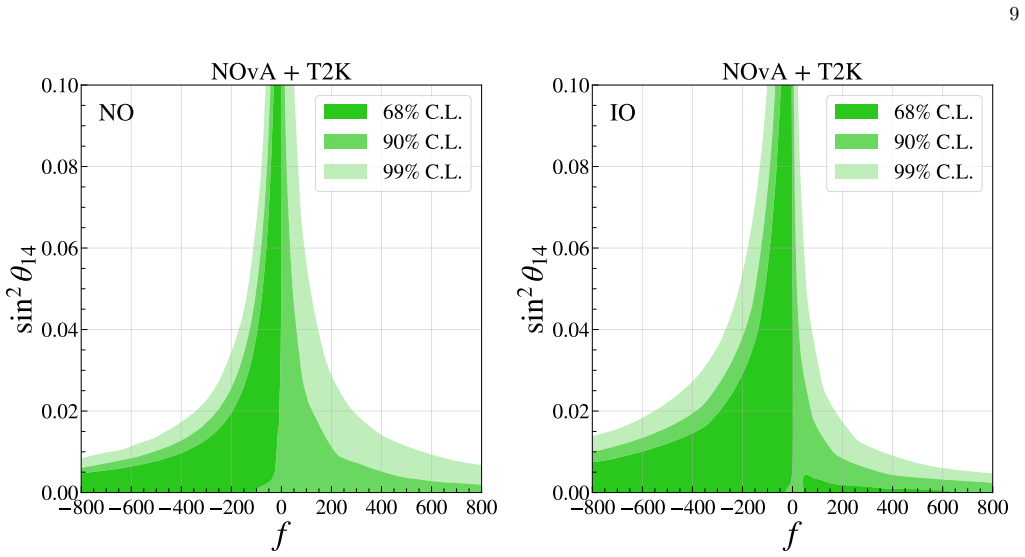
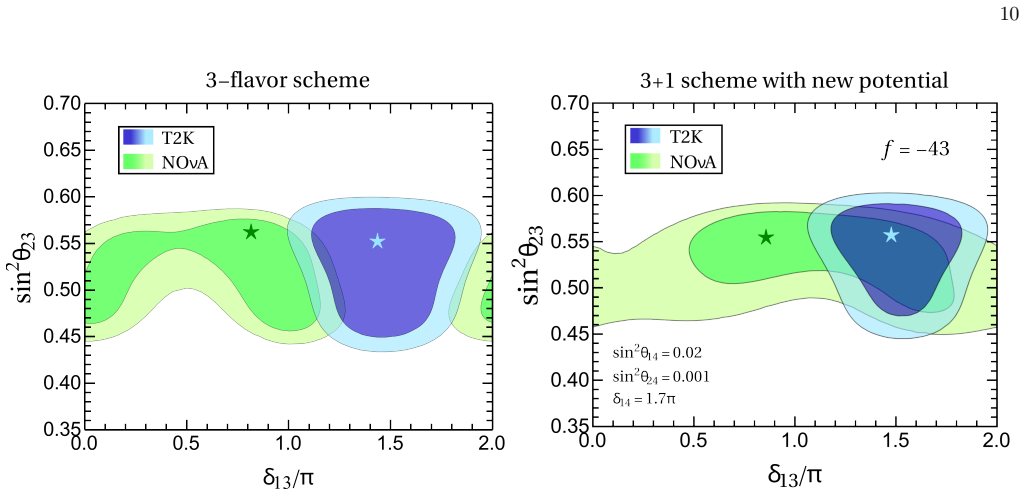
In the 3+1 scheme the sterile state feels a matter potential Vs = f * |V_NC| with f approximately -20. This term creates an irreducible three-level dynamics that produces effective active-neutrino mixing angles in matter, eliminates the NOvA-T2K discrepancy at low energy, explains the Super-Kamiokande atmospheric excess through a shifted resonance, and yields a high-energy resonance near 10 TeV. The required parameters are Delta m^2_41 approximately 60 eV^2, sin^2 theta14 approximately 0.01-0.03, and sin^2 theta24 approximately 10^-4 to 10^-3.
What carries the argument
The sterile-neutrino matter potential Vs, which augments the standard MSW Hamiltonian and drives new resonances among the four flavor states.
If this is right
- The model removes the tension between NOvA and T2K provided Vs is negative and the two sterile mixing angles are nonzero.
- It accounts for the Super-Kamiokande atmospheric electron-like excess by shifting the three-flavor resonance at a few GeV.
- At high energy it produces a resonant enhancement near 10 TeV that matches the IceCube hint while the small muon-sterile mixing avoids conflict with disappearance searches.
- The scenario is directly testable by KATRIN through its sensitivity to the electron-sterile admixture at large Delta m^2_41.
Where Pith is reading between the lines
- If confirmed, the potential could be generated by a new long-range force coupled to ordinary or dark-matter density, suggesting a link between neutrino oscillations and dark-sector physics.
- The same mechanism might produce observable effects in other dense environments such as supernovae or the early universe.
- Future high-statistics atmospheric and accelerator data could distinguish this density-dependent effect from constant non-standard interaction parameters.
Load-bearing premise
The existence of a negative sterile matter potential with the specific ratio f approximately -20, introduced by hand to match the anomalies.
What would settle it
A high-precision measurement of the electron-sterile mixing angle by KATRIN in the mass-squared region near 60 eV^2, or the absence of the predicted resonance feature in IceCube data around 10 TeV.
Figures



read the original abstract
Neutrino oscillation experiments present anomalous results across a vast range of baselines and energies. Here we show that a 3+1 scenario in which sterile neutrinos feel a novel matter potential $V_s$ proportional to background density of ordinary or (asymmetric) dark matter is able to explain several anomalies. At low-energies ($E\lesssim$ 1 TeV) the model behaves as an effective 3-flavor NSI-like scheme among active flavors and eliminates the tension between the two LBL experiments NOvA and T2K provided that the potential is negative and the two sterile mixing angles $\theta_{14}$ and $\theta_{24}$ are non-zero. A further indication in favor of a negative non-zero potential comes from the anomalous excess of $\nu_e$-like events observed in Super-Kamiokande atmospheric neutrinos, which, in the new scenario is explained by a modification of the 3-flavor resonance at few GeV. A high energies ($E\gtrsim $ 1 TeV) the new framework reveals its 4-flavor nature and produces a resonant behavior at $E \simeq$ 10 TeV as hinted at by IceCube. We identify an irreducible 3-level dynamics generating a new resonance in the $(\nu_e, \nu_\mu)$ sector intertwined with two conventional resonances in the $(\nu_e, \nu_s$) and $(\nu_\mu, \nu_s)$ systems. The novel amplification mechanism manifests with the emergence of effective mixing angles in matter ($\theta_{12}^m$ or $\theta_{13}^m$) involving active neutrinos. The scenario requires values of $f = V_s/|V_{NC}| \sim -20 $, $\Delta m^2_{41} \sim 60 $ eV$^2$, $|U_{e4}|^2\simeq \sin^2\theta_{14} \simeq 0.01-0.03$ and $|U_{\mu4}|^2 \simeq \sin^2\theta_{24}\simeq 10^{-4}-10^{-3}$. Such a very small size of $|U_{\mu4}|^2$ eliminates the tension between IceCube and the other $\nu_\mu$ disappearance searches. The model can be directly probed by KATRIN, which is very sensitive to the electron-sterile neutrino admixture in the region of high $\Delta m^2_{41}$.
Editorial analysis
A structured set of objections, weighed in public.
Referee Report
Summary. The paper claims that a 3+1 neutrino scenario with sterile neutrinos subject to a novel matter potential Vs proportional to the density of ordinary or asymmetric dark matter can explain multiple neutrino oscillation anomalies. At low energies, it mimics 3-flavor NSI to resolve NOvA-T2K tension for negative f ≈ -20 with non-zero θ14 and θ24. It accounts for Super-K atmospheric νe excess via modified resonance and predicts a resonance at E ≈ 10 TeV matching IceCube hints. The required parameters are f ∼ -20, Δm²41 ∼ 60 eV², |Ue4|² ≈ 0.01-0.03, |Uμ4|² ≈ 10^{-4}-10^{-3}, and it is testable at KATRIN.
Significance. Should the ad hoc sterile matter potential be grounded in a more fundamental theory, this model would represent a significant advance by providing a unified phenomenological framework for anomalies in long-baseline, atmospheric, and high-energy neutrino data. It introduces an amplification mechanism through 3-level dynamics and effective matter mixing angles, potentially opening new avenues for sterile neutrino searches and dark matter interactions. The small μ-sterile mixing helps consistency with existing bounds.
major comments (3)
- Abstract: The specific value f ≈ -20 for the sterile potential Vs = f |V_NC| is chosen to reproduce the NOvA-T2K tension and Super-K excess rather than derived from a Lagrangian or symmetry, as no such derivation is indicated; this makes the explanation circular as noted in the parameter selection.
- Abstract: The emergence of the 10 TeV resonance is tied directly to the input Δm²41 ≈ 60 eV² and the assumed form of Vs, so it does not constitute an independent prediction but follows by construction from the tuned parameters.
- Abstract: The manuscript does not provide quantitative measures of fit quality, such as χ²/dof or statistical significance for how well the model resolves the mentioned anomalies, which is necessary to assess the strength of the claims.
minor comments (1)
- Abstract: The notation for the potential Vs and f could be clarified with an explicit equation in the main text for better readability.
Simulated Author's Rebuttal
We thank the referee for the careful review and constructive feedback on our manuscript. We address each major comment below, providing clarifications on the phenomenological nature of the model while committing to revisions that improve the presentation without misrepresenting the work.
read point-by-point responses
-
Referee: Abstract: The specific value f ≈ -20 for the sterile potential Vs = f |V_NC| is chosen to reproduce the NOvA-T2K tension and Super-K excess rather than derived from a Lagrangian or symmetry, as no such derivation is indicated; this makes the explanation circular as noted in the parameter selection.
Authors: We agree that f ≈ -20 is a phenomenological choice selected to accommodate the NOvA-T2K tension and Super-K excess within the effective 3+1 framework. The model introduces Vs as an effective matter potential (possibly linked to dark matter interactions) without claiming a fundamental Lagrangian derivation in this work, which is standard for effective neutrino models. This is not circular but reflects the data-driven parameter selection common in oscillation phenomenology. We will revise the abstract and introduction to explicitly state the phenomenological status and briefly discuss possible microscopic origins. revision: partial
-
Referee: Abstract: The emergence of the 10 TeV resonance is tied directly to the input Δm²41 ≈ 60 eV² and the assumed form of Vs, so it does not constitute an independent prediction but follows by construction from the tuned parameters.
Authors: The 10 TeV resonance arises from the 4-flavor dynamics and 3-level amplification mechanism once Δm²41 and Vs are fixed by lower-energy data. While the position depends on these inputs, the model unifies the low-energy anomalies with the high-energy IceCube hint through the same parameters, which we view as a non-trivial consistency check rather than an independent prediction. We will add clarifying language in the abstract and discussion section to note this dependence explicitly. revision: yes
-
Referee: Abstract: The manuscript does not provide quantitative measures of fit quality, such as χ²/dof or statistical significance for how well the model resolves the mentioned anomalies, which is necessary to assess the strength of the claims.
Authors: We acknowledge that quantitative fit metrics are important for assessing the model's performance. The current work emphasizes the qualitative resolution of tensions and the emergence of resonances across energy scales, with parameter ranges identified to accommodate the data. In the revised manuscript we will include a dedicated section or table providing χ² estimates or goodness-of-fit indicators for the relevant datasets (NOvA, T2K, Super-K, IceCube) using the quoted parameter values. revision: yes
- A fundamental derivation of the sterile matter potential Vs from an underlying Lagrangian or symmetry principle.
Circularity Check
Sterile matter potential f ≈ -20 and oscillation parameters chosen to fit anomalies, making claimed explanations and resonances equivalent to input tuning
specific steps
-
fitted input called prediction
[Abstract]
"The scenario requires values of f = V_s/|V_{NC}| ∼ -20 , Δm²₄₁ ∼ 60 eV², |U_{e4}|^2 ≃ sin²θ₁₄ ≃ 0.01-0.03 and |U_μ4|^2 ≃ sin²θ₂₄ ≃ 10^{-4}-10^{-3}."
These numerical values are not derived from any underlying interaction or symmetry but are instead required to reproduce the observed anomalies (NOvA-T2K tension, Super-K excess, IceCube resonance). The low-energy NSI-like behavior and the high-energy 3-level resonance at ∼10 TeV are therefore direct consequences of the parameter choice rather than independent predictions.
full rationale
The paper introduces a 3+1 model with a novel sterile matter potential Vs = f V_NC (f ∼ -20) to resolve NOvA-T2K tension, Super-K atmospheric excess, and IceCube high-energy hints. The abstract explicitly states that the scenario 'requires' these specific values of f, Δm²₄₁ ∼ 60 eV², and the mixing angles to produce the effective NSI-like behavior at low energy and the 10 TeV resonance. No Lagrangian, symmetry, or first-principles derivation is supplied for the sign or magnitude of f; the parameters are selected to match the very data sets the model claims to explain. Consequently the 'predictions' (resonance location, effective mixing angles in matter) reduce directly to the fitted inputs by construction, satisfying the fitted-input-called-prediction pattern.
Axiom & Free-Parameter Ledger
free parameters (4)
- f = Vs / |V_NC|
- Δm²₄₁
- sin²θ₁₄
- sin²θ₂₄
axioms (2)
- standard math Standard 3+1 neutrino mixing matrix and MSW matter Hamiltonian apply without modification except for the added Vs term on the sterile state.
- ad hoc to paper The new potential Vs is proportional to background density and can be negative.
invented entities (1)
-
sterile matter potential Vs
no independent evidence
Lean theorems connected to this paper
-
IndisputableMonolith/Cost/FunctionalEquation.leanwashburn_uniqueness_aczel contradicts?
contradictsCONTRADICTS: the theorem conflicts with this paper passage, or marks a claim that would need revision before publication.
the scenario requires values of f = Vs/|V_NC| ~ -20, Δm²₄₁ ~ 60 eV² ... introduced ... to fit the data rather than derived from a deeper theory
-
IndisputableMonolith/Foundation/DimensionForcing.leanalexander_duality_circle_linking unclear?
unclearRelation between the paper passage and the cited Recognition theorem.
a novel matter potential Vs proportional to background density ... parameterized as f ~ -20
What do these tags mean?
- matches
- The paper's claim is directly supported by a theorem in the formal canon.
- supports
- The theorem supports part of the paper's argument, but the paper may add assumptions or extra steps.
- extends
- The paper goes beyond the formal theorem; the theorem is a base layer rather than the whole result.
- uses
- The paper appears to rely on the theorem as machinery.
- contradicts
- The paper's claim conflicts with a theorem or certificate in the canon.
- unclear
- Pith found a possible connection, but the passage is too broad, indirect, or ambiguous to say the theorem truly supports the claim.
Reference graph
Works this paper leans on
-
[1]
This implies that, for a fixed resonance energy (determined by IceCube), we have ∆m 2 ≃2E res|VCC |/s2 14, which is in- dependent of ¯f. We have verified that this equality is a good approximation provided that| ¯f|is sufficiently large (| ¯f|≳10 3). Considering our dark NSI-like solution, for whichε ⊕ ee = ¯f s2 14 ≃ −2 and| ¯f| ≃2/s 2 14, we see that fo...
work page internal anchor Pith review Pith/arXiv arXiv 2022
-
[2]
The Reactor Antineutrino Anomaly
G. Mention, M. Fechner, T. Lasserre, T. A. Mueller, D. Lhuillier, M. Cribier, and A. Letourneau, “The Reactor Antineutrino Anomaly,”Phys. Rev. D83(2011) 073006,arXiv:1101.2755 [hep-ex]. 39 [3]GALLEXCollaboration, P. Anselmannet al., “First results from the Cr-51 neutrino source experiment with the GALLEX detector,”Phys. Lett. B342(1995) 440–450. [4]GALLEX...
work page internal anchor Pith review Pith/arXiv arXiv 2011
-
[3]
Reanalysis of the GALLEX solar neutrino flux and source experiments
F. Kaether, W. Hampel, G. Heusser, J. Kiko, and T. Kirsten, “Reanalysis of the GALLEX solar neutrino flux and source experiments,”Phys. Lett. B685(2010) 47–54,arXiv:1001.2731 [hep-ex]
work page internal anchor Pith review Pith/arXiv arXiv 2010
-
[4]
D. N. Abdurashitovet al., “The Russian-American gallium experiment (SAGE) Cr neutrino source measurement,” Phys. Rev. Lett.77(1996) 4708–4711. [7]SAGECollaboration, J. N. Abdurashitovet al., “Measurement of the solar neutrino capture rate with gallium metal. III: Results for the 2002–2007 data-taking period,”Phys. Rev. C80(2009) 015807,arXiv:0901.2200 [nucl-ex]
work page internal anchor Pith review Pith/arXiv arXiv 1996
-
[5]
Results from the Baksan Experiment on Sterile Transitions (BEST),
V. V. Barinovet al., “Results from the Baksan Experiment on Sterile Transitions (BEST),”Phys. Rev. Lett.128no. 23, (2022) 232501,arXiv:2109.11482 [nucl-ex]
-
[6]
Search for electron-neutrino transitions to sterile states in the BEST experiment,
V. V. Barinovet al., “Search for electron-neutrino transitions to sterile states in the BEST experiment,”Phys. Rev. C 105no. 6, (2022) 065502,arXiv:2201.07364 [nucl-ex]. [10]NEUTRINO-4Collaboration, A. P. Serebrovet al., “First Observation of the Oscillation Effect in the Neutrino-4 Experiment on the Search for the Sterile Neutrino,”Pisma Zh. Eksp. Teor. ...
-
[7]
New Neutrino Oscillations Results from NOνA with 10 years of Data,
J. Wolcott, “New Neutrino Oscillations Results from NOνA with 10 years of Data,”Talk presented at Neutrino 2024, 16-22 Jun 2024(2024) .https://indico.fnal.gov/event/43209/timetable/#20200622.detailed
work page 2024
-
[8]
T2K Experiments Status and Plan,
C. Giganti, “T2K Experiments Status and Plan,”Talk presented at Neutrino 2024, 16-22 Jun 2024(2024) .https:// agenda.infn.it/event/37867/contributions/233954/attachments/121809/177671/Neutrino2024_T2K_Claudio.pdf
work page 2024
-
[9]
CP-Violating Neutrino Nonstandard Interactions in Long-Baseline-Accelerator Data,
P. B. Denton, J. Gehrlein, and R. Pestes, “CP-Violating Neutrino Nonstandard Interactions in Long-Baseline-Accelerator Data,”Phys. Rev. Lett.126no. 5, (2021) 051801,arXiv:2008.01110 [hep-ph]
-
[10]
Nonstandard Neutrino Interactions as a Solution to theN OνAand T2K Discrepancy,
S. S. Chatterjee and A. Palazzo, “Nonstandard Neutrino Interactions as a Solution to theN OνAand T2K Discrepancy,”Phys. Rev. Lett.126no. 5, (2021) 051802,arXiv:2008.04161 [hep-ph]
-
[11]
S. S. Chatterjee and A. Palazzo, “Status of tension between NOvA and T2K after Neutrino 2024 and possible role of nonstandard neutrino interactions,”Phys. Rev. D110no. 11, (2024) 113002,arXiv:2409.10599 [hep-ph]. [20]Super-KamiokandeCollaboration, T. Westeret al., “Atmospheric neutrino oscillation analysis with neutron tagging and an expanded fiducial vol...
-
[12]
B. Dasgupta and J. Kopp, “Sterile Neutrinos,”Phys. Rept.928(2021) 1–63,arXiv:2106.05913 [hep-ph]
-
[13]
White paper on light sterile neutrino searches and related phenomenology,
M. A. Aceroet al., “White paper on light sterile neutrino searches and related phenomenology,”J. Phys. G51no. 12, (2024) 120501,arXiv:2203.07323 [hep-ex]
-
[14]
S. Gariazzo, C. Giunti, M. Laveder, Y. F. Li, and E. M. Zavanin, “Light sterile neutrinos,”J. Phys. G43(2016) 033001,arXiv:1507.08204 [hep-ph]
work page internal anchor Pith review Pith/arXiv arXiv 2016
-
[15]
Updated global analysis of neutrino oscillations in the presence of eV-scale sterile neutrinos
M. Dentler, ´A. Hern´ andez-Cabezudo, J. Kopp, P. A. N. Machado, M. Maltoni, I. Martinez-Soler, and T. Schwetz, “Updated Global Analysis of Neutrino Oscillations in the Presence of eV-Scale Sterile Neutrinos,”JHEP08(2018) 010, arXiv:1803.10661 [hep-ph]
work page internal anchor Pith review Pith/arXiv arXiv 2018
-
[16]
Where Are We With Light Sterile Neutrinos?,
A. Diaz, C. A. Arg¨ uelles, G. H. Collin, J. M. Conrad, and M. H. Shaevitz, “Where Are We With Light Sterile Neutrinos?,”Phys. Rept.884(2020) 1–59,arXiv:1906.00045 [hep-ex]
-
[17]
A Frequentist Simulation-Based Inference Treatment of Sterile Neutrino Global Fits,
J. Villarreal, J. Woodward, J. Hardin, and J. Conrad, “A Frequentist Simulation-Based Inference Treatment of Sterile Neutrino Global Fits,”Mach. Learn. Sci. Tech.6(2025) 035053,arXiv:2507.01153 [hep-ph]. [27]MicroBooNECollaboration, P. Abratenkoet al., “Search for light sterile neutrinos with two neutrino beams at MicroBooNE,”Nature648no. 8092, (2025) 64–...
-
[18]
Constraining Sterile Neutrino Cosmology with Terrestrial Oscillation Experiments,
J. M. Berryman, “Constraining Sterile Neutrino Cosmology with Terrestrial Oscillation Experiments,”Phys. Rev. D 100no. 2, (2019) 023540,arXiv:1905.03254 [hep-ph]
-
[19]
Bounds on light sterile neutrino mass and mixing from cosmology and laboratory searches,
S. Hagstotz, P. F. de Salas, S. Gariazzo, M. Gerbino, M. Lattanzi, S. Vagnozzi, K. Freese, and S. Pastor, “Bounds on light sterile neutrino mass and mixing from cosmology and laboratory searches,”Phys. Rev. D104no. 12, (2021) 123524,arXiv:2003.02289 [astro-ph.CO]
-
[20]
Two Sides of the Same Coin: Sterile Neutrinos and Dark Radiation, Status and Perspectives,
M. Archidiacono and S. Gariazzo, “Two Sides of the Same Coin: Sterile Neutrinos and Dark Radiation, Status and Perspectives,”Universe8no. 3, (2022) 175,arXiv:2201.10319 [hep-ph]
-
[21]
eV-scale sterile neutrino: A window open to non-unitarity?,
H. Minakata, “eV-scale sterile neutrino: A window open to non-unitarity?,”arXiv:2503.09280 [hep-ph]
-
[22]
Combining Sterile Neutrino 40 Fits to Short Baseline Data with IceCube Data,
M. H. Moulai, C. A. Arg¨ uelles, G. H. Collin, J. M. Conrad, A. Diaz, and M. H. Shaevitz, “Combining Sterile Neutrino 40 Fits to Short Baseline Data with IceCube Data,”Phys. Rev. D101no. 5, (2020) 055020,arXiv:1910.13456 [hep-ph]
-
[23]
New Clues about light sterile neutrinos: preference for models with damping effects in global fits,
J. M. Hardin, I. Martinez-Soler, A. Diaz, M. Jin, N. W. Kamp, C. A. Arg¨ uelles, J. M. Conrad, and M. H. Shaevitz, “New Clues about light sterile neutrinos: preference for models with damping effects in global fits,”JHEP09(2023) 058,arXiv:2211.02610 [hep-ph]
-
[24]
Explaining LSND by a decaying sterile neutrino
S. Palomares-Ruiz, S. Pascoli, and T. Schwetz, “Explaining LSND by a decaying sterile neutrino,”JHEP09(2005) 048, arXiv:hep-ph/0505216
work page internal anchor Pith review Pith/arXiv arXiv 2005
-
[25]
Three Twin Neutrinos: Evidence from LSND and MiniBooNE
Y. Bai, R. Lu, S. Lu, J. Salvado, and B. A. Stefanek, “Three Twin Neutrinos: Evidence from LSND and MiniBooNE,” Phys. Rev. D93no. 7, (2016) 073004,arXiv:1512.05357 [hep-ph]
work page internal anchor Pith review Pith/arXiv arXiv 2016
-
[26]
Decaying Sterile Neutrinos and the Short Baseline Oscillation Anomalies,
M. Dentler, I. Esteban, J. Kopp, and P. Machado, “Decaying Sterile Neutrinos and the Short Baseline Oscillation Anomalies,”Phys. Rev. D101no. 11, (2020) 115013,arXiv:1911.01427 [hep-ph]
-
[27]
On The Decaying-Sterile Neutrino Solution to the Electron (Anti)Neutrino Appearance Anomalies,
A. de Gouvˆ ea, O. L. G. Peres, S. Prakash, and G. V. Stenico, “On The Decaying-Sterile Neutrino Solution to the Electron (Anti)Neutrino Appearance Anomalies,”JHEP07(2020) 141,arXiv:1911.01447 [hep-ph]
-
[28]
Decaying sterile neutrinos at short baselines,
M. Hostert, K. J. Kelly, and T. Zhou, “Decaying sterile neutrinos at short baselines,”Phys. Rev. D110no. 7, (2024) 075002,arXiv:2406.04401 [hep-ph]
-
[29]
How secret interactions can reconcile sterile neutrinos with cosmology
S. Hannestad, R. S. Hansen, and T. Tram, “How Self-Interactions can Reconcile Sterile Neutrinos with Cosmology,” Phys. Rev. Lett.112no. 3, (2014) 031802,arXiv:1310.5926 [astro-ph.CO]
work page internal anchor Pith review Pith/arXiv arXiv 2014
-
[30]
A m\'enage \`a trois of eV-scale sterile neutrinos, cosmology, and structure formation
B. Dasgupta and J. Kopp, “Cosmologically Safe eV-Scale Sterile Neutrinos and Improved Dark Matter Structure,” Phys. Rev. Lett.112no. 3, (2014) 031803,arXiv:1310.6337 [hep-ph]
work page internal anchor Pith review Pith/arXiv arXiv 2014
-
[31]
Cosmology with self-interacting sterile neutrinos and dark matter - A pseudoscalar model
M. Archidiacono, S. Hannestad, R. S. Hansen, and T. Tram, “Cosmology with self-interacting sterile neutrinos and dark matter - A pseudoscalar model,”Phys. Rev. D91no. 6, (2015) 065021,arXiv:1404.5915 [astro-ph.CO]
work page internal anchor Pith review Pith/arXiv arXiv 2015
-
[32]
Unveiling secret interactions among sterile neutrinos with big-bang nucleosynthesis
N. Saviano, O. Pisanti, G. Mangano, and A. Mirizzi, “Unveiling secret interactions among sterile neutrinos with big-bang nucleosynthesis,”Phys. Rev. D90no. 11, (2014) 113009,arXiv:1409.1680 [astro-ph.CO]
work page internal anchor Pith review Pith/arXiv arXiv 2014
-
[33]
Collisional production of sterile neutrinos via secret interactions and cosmological implications
A. Mirizzi, G. Mangano, O. Pisanti, and N. Saviano, “Collisional production of sterile neutrinos via secret interactions and cosmological implications,”Phys. Rev. D91no. 2, (2015) 025019,arXiv:1410.1385 [hep-ph]
work page internal anchor Pith review Pith/arXiv arXiv 2015
-
[34]
Sterile neutrinos with secret interactions—lasting friendship with cosmology,
X. Chu, B. Dasgupta, and J. Kopp, “Sterile neutrinos with secret interactions—lasting friendship with cosmology,” JCAP10(2015) 011,arXiv:1505.02795 [hep-ph]
-
[35]
Short-baseline neutrino oscillations, Planck, and IceCube
J. F. Cherry, A. Friedland, and I. M. Shoemaker, “Short-baseline neutrino oscillations, Planck, and IceCube,” arXiv:1605.06506 [hep-ph]
work page internal anchor Pith review Pith/arXiv arXiv
-
[36]
Pseudoscalar - sterile neutrino interactions: reconciling the cosmos with neutrino oscillations
M. Archidiacono, S. Gariazzo, C. Giunti, S. Hannestad, R. Hansen, M. Laveder, and T. Tram, “Pseudoscalar—sterile neutrino interactions: reconciling the cosmos with neutrino oscillations,”JCAP08(2016) 067,arXiv:1606.07673 [astro-ph.CO]
work page internal anchor Pith review Pith/arXiv arXiv 2016
-
[37]
Sterile neutrinos with secret interactions—cosmological discord?,
X. Chu, B. Dasgupta, M. Dentler, J. Kopp, and N. Saviano, “Sterile neutrinos with secret interactions—cosmological discord?,”JCAP11(2018) 049,arXiv:1806.10629 [hep-ph]
-
[38]
Ultra-light scalar saving the 3 + 1 neutrino scheme from the cosmological bounds,
Y. Farzan, “Ultra-light scalar saving the 3 + 1 neutrino scheme from the cosmological bounds,”Phys. Lett. B797 (2019) 134911,arXiv:1907.04271 [hep-ph]
-
[39]
Viable secret neutrino interactions with ultralight dark matter,
J. M. Cline, “Viable secret neutrino interactions with ultralight dark matter,”Phys. Lett. B802(2020) 135182, arXiv:1908.02278 [hep-ph]
-
[40]
Sterile neutrino self-interactions:H 0 tension and short-baseline anomalies,
M. Archidiacono, S. Gariazzo, C. Giunti, S. Hannestad, and T. Tram, “Sterile neutrino self-interactions:H 0 tension and short-baseline anomalies,”JCAP12(2020) 029,arXiv:2006.12885 [astro-ph.CO]
-
[41]
Constraint on anomalous 4nu interaction,
K. M. Belotsky, A. L. Sudarikov, and M. Y. Khlopov, “Constraint on anomalous 4nu interaction,”Phys. Atom. Nucl. 64(2001) 1637–1642
work page 2001
-
[42]
Short Baseline Neutrino Oscillations and a New Light Gauge Boson
A. E. Nelson and J. Walsh, “Short Baseline Neutrino Oscillations and a New Light Gauge Boson,”Phys. Rev. D77 (2008) 033001,arXiv:0711.1363 [hep-ph]
work page internal anchor Pith review Pith/arXiv arXiv 2008
-
[43]
Apparent CPT Violation in Neutrino Oscillation Experiments
N. Engelhardt, A. E. Nelson, and J. R. Walsh, “Apparent CPT Violation in Neutrino Oscillation Experiments,”Phys. Rev. D81(2010) 113001,arXiv:1002.4452 [hep-ph]
work page internal anchor Pith review Pith/arXiv arXiv 2010
-
[44]
Neutrino Physics with Dark Matter Experiments and the Signature of New Baryonic Neutral Currents
M. Pospelov, “Neutrino Physics with Dark Matter Experiments and the Signature of New Baryonic Neutral Currents,” Phys. Rev. D84(2011) 085008,arXiv:1103.3261 [hep-ph]
work page internal anchor Pith review Pith/arXiv arXiv 2011
-
[45]
G. Karagiorgi, M. H. Shaevitz, and J. M. Conrad, “Confronting the Short-Baseline Oscillation Anomalies with a Single Sterile Neutrino and Non-Standard Matter Effects,”arXiv:1202.1024 [hep-ph]
work page internal anchor Pith review Pith/arXiv arXiv
-
[46]
J. Kopp and J. Welter, “The Not-So-Sterile 4th Neutrino: Constraints on New Gauge Interactions from Neutrino Oscillation Experiments,”JHEP12(2014) 104,arXiv:1408.0289 [hep-ph]
work page internal anchor Pith review Pith/arXiv arXiv 2014
-
[47]
Particle physics origin of the 5 MeV bump in the reactor antineutrino spectrum?
J. M. Berryman, V. Brdar, and P. Huber, “Particle physics origin of the 5 MeV bump in the reactor antineutrino spectrum?,”Phys. Rev. D99no. 5, (2019) 055045,arXiv:1803.08506 [hep-ph]
work page internal anchor Pith review Pith/arXiv arXiv 2019
-
[48]
MiniBooNE, MINOS+ and IceCube data imply a baroque neutrino sector
J. Liao, D. Marfatia, and K. Whisnant, “MiniBooNE, MINOS+ and IceCube data imply a baroque neutrino sector,” Phys. Rev. D99no. 1, (2019) 015016,arXiv:1810.01000 [hep-ph]
work page internal anchor Pith review Pith/arXiv arXiv 2019
-
[49]
A. Esmaili and H. Nunokawa, “On the robustness of IceCube’s bound on sterile neutrinos in the presence of non-standard interactions,”Eur. Phys. J. C79no. 1, (2019) 70,arXiv:1810.11940 [hep-ph]
work page internal anchor Pith review Pith/arXiv arXiv 2019
-
[50]
Activating the 4th Neutrino of the 3+1 Scheme
P. B. Denton, Y. Farzan, and I. M. Shoemaker, “Activating the fourth neutrino of the 3+1 scheme,”Phys. Rev. D99 no. 3, (2019) 035003,arXiv:1811.01310 [hep-ph]
work page internal anchor Pith review Pith/arXiv arXiv 2019
-
[51]
D. S. M. Alves, W. C. Louis, and P. G. deNiverville, “Quasi-sterile neutrinos from dark sectors. Part I. BSM matter effects in neutrino oscillations and the short-baseline anomalies.,”JHEP08(2022) 034,arXiv:2201.00876 [hep-ph]
-
[52]
Resonant Neutrino Flavor Conversion in the Atmosphere,
C. Sponsler, M. Hostert, I. Martinez-Soler, and C. A. Arg¨ uelles, “Resonant Neutrino Flavor Conversion in the Atmosphere,”arXiv:2405.12140 [hep-ph]
-
[53]
Does the 220 PeV Event at KM3NeT Point to New Physics?,
V. Brdar and D. S. Chattopadhyay, “Does the 220 PeV Event at KM3NeT Point to New Physics?,”arXiv:2502.21299 41 [hep-ph]
-
[54]
Three Neutrino Oscillations and the Solar Neutrino Experiments,
T.-K. Kuo and J. T. Pantaleone, “Three Neutrino Oscillations and the Solar Neutrino Experiments,”Phys. Rev. D35 (1987) 3432. [65]MINOS+Collaboration, P. Adamsonet al., “Search for sterile neutrinos in MINOS and MINOS+ using a two-detector fit,”Phys. Rev. Lett.122no. 9, (2019) 091803,arXiv:1710.06488 [hep-ex]. [66]NOvACollaboration, M. A. Aceroet al., “Dua...
-
[55]
Imprints of CP violation induced by sterile neutrinos in T2K data
N. Klop and A. Palazzo, “Imprints of CP violation induced by sterile neutrinos in T2K data,”Phys. Rev. D91no. 7, (2015) 073017,arXiv:1412.7524 [hep-ph]
work page internal anchor Pith review Pith/arXiv arXiv 2015
-
[56]
Signals of eV-scale sterile neutrino at long baseline neutrino experiments,
S. Parveen, K. Sharma, S. Patra, and P. Mehta, “Signals of eV-scale sterile neutrino at long baseline neutrino experiments,”Eur. Phys. J. C85no. 2, (2025) 181,arXiv:2305.16824 [hep-ph]
-
[57]
Physics Reach of DUNE with a Light Sterile Neutrino
S. K. Agarwalla, S. S. Chatterjee, and A. Palazzo, “Physics Reach of DUNE with a Light Sterile Neutrino,” arXiv:1603.03759 [hep-ph]
work page internal anchor Pith review Pith/arXiv arXiv
-
[58]
Interpretation of NOνA and T2K data in the presence of a light sterile neutrino,
S. S. Chatterjee and A. Palazzo, “Interpretation of NOνA and T2K data in the presence of a light sterile neutrino,” arXiv:2005.10338 [hep-ph]
-
[59]
Evidence for Mikheyev-Smirnov-Wolfenstein effects in solar neutrino flavor transitions
G. L. Fogli, E. Lisi, A. Marrone, and A. Palazzo, “Evidence for Mikheyev-Smirnov-Wolfenstein effects in solar neutrino flavor transitions,”Phys. Lett. B583(2004) 149–156,arXiv:hep-ph/0309100
work page internal anchor Pith review Pith/arXiv arXiv 2004
-
[60]
Updated bounds on the (1,2) neutrino oscillation parameters after first JUNO results,
F. Capozzi, E. Lisi, F. Marcone, A. Marrone, and A. Palazzo, “Updated bounds on the (1,2) neutrino oscillation parameters after first JUNO results,”arXiv:2511.21650 [hep-ph]
-
[61]
Lessons from the first JUNO results
I. Esteban, M. C. Gonzalez-Garcia, M. Maltoni, I. Martinez-Soler, J. P. Pinheiro, and T. Schwetz, “Lessons from the first JUNO results,”arXiv:2601.09791 [hep-ph]
work page internal anchor Pith review Pith/arXiv arXiv
-
[62]
Neutrino masses and mixing: Entering the era of subpercent precision,
F. Capozzi, W. Giar` e, E. Lisi, A. Marrone, A. Melchiorri, and A. Palazzo, “Neutrino masses and mixing: Entering the era of subpercent precision,”Phys. Rev. D111no. 9, (2025) 093006,arXiv:2503.07752 [hep-ph]
-
[63]
NuFit-6.0: Updated global analysis of three-flavor neutrino oscillations
I. Esteban, M. C. Gonzalez-Garcia, M. Maltoni, I. Martinez-Soler, J. P. Pinheiro, and T. Schwetz, “NuFit-6.0: updated global analysis of three-flavor neutrino oscillations,”JHEP12(2024) 216,arXiv:2410.05380 [hep-ph]
work page internal anchor Pith review Pith/arXiv arXiv 2024
-
[64]
2020 global reassessment of the neutrino oscillation picture,
P. F. de Salas, D. V. Forero, S. Gariazzo, P. Mart´ ınez-Mirav´ e, O. Mena, C. A. Ternes, M. T´ ortola, and J. W. F. Valle, “2020 global reassessment of the neutrino oscillation picture,”JHEP02(2021) 071,arXiv:2006.11237 [hep-ph]
-
[65]
Simulation of long-baseline neutrino oscillation experiments with GLoBES
P. Huber, M. Lindner, and W. Winter, “Simulation of long-baseline neutrino oscillation experiments with GLoBES (General Long Baseline Experiment Simulator),”Comput.Phys.Commun.167(2005) 195,arXiv:hep-ph/0407333 [hep-ph]
work page internal anchor Pith review Pith/arXiv arXiv 2005
-
[66]
New features in the simulation of neutrino oscillation experiments with GLoBES 3.0
P. Huber, J. Kopp, M. Lindner, M. Rolinec, and W. Winter, “New features in the simulation of neutrino oscillation experiments with GLoBES 3.0: General Long Baseline Experiment Simulator,”Comput.Phys.Commun.177(2007) 432–438,arXiv:hep-ph/0701187 [hep-ph]
work page internal anchor Pith review Pith/arXiv arXiv 2007
-
[67]
KoppSterile neutrinos and non-standard neutrino interactions in GLoBES(2019)
J. KoppSterile neutrinos and non-standard neutrino interactions in GLoBES(2019) . https://www.mpi-hd.mpg.de/personalhomes/globes/tools/snu-1.0.pdf
work page 2019
-
[68]
Are solar neutrino oscillations robust?
O. G. Miranda, M. A. Tortola, and J. W. F. Valle, “Are solar neutrino oscillations robust?,”JHEP10(2006) 008, arXiv:hep-ph/0406280 [hep-ph]
work page internal anchor Pith review Pith/arXiv arXiv 2006
-
[69]
Generalized mass ordering degeneracy in neutrino oscillation experiments
P. Coloma and T. Schwetz, “Generalized mass ordering degeneracy in neutrino oscillation experiments,” arXiv:1604.05772 [hep-ph]
work page internal anchor Pith review Pith/arXiv arXiv
-
[70]
Neutrino Oscillations in Matter,
L. Wolfenstein, “Neutrino Oscillations in Matter,”Phys.Rev.D17(1978) 2369–2374. [83]ANTARESCollaboration, A. Albertet al., “Search for non-standard neutrino interactions with 10 years of ANTARES data,”JHEP07(2022) 048,arXiv:2112.14517 [hep-ex]. [84](IceCube Collaboration)*, IceCubeCollaboration, R. Abbasiet al., “All-flavor constraints on nonstandard neut...
-
[71]
Testing the very-short-baseline neutrino anomalies at the solar sector
A. Palazzo, “Testing the very-short-baseline neutrino anomalies at the solar sector,”Phys. Rev. D83(2011) 113013, arXiv:1105.1705 [hep-ph]
work page internal anchor Pith review Pith/arXiv arXiv 2011
-
[72]
Matter Effects in Active-Sterile Solar Neutrino Oscillations
C. Giunti and Y. F. Li, “Matter Effects in Active-Sterile Solar Neutrino Oscillations,”Phys. Rev. D80(2009) 113007, arXiv:0910.5856 [hep-ph]
work page internal anchor Pith review Pith/arXiv arXiv 2009
-
[73]
Solar Neutrinos as a Probe of Dark Matter-Neutrino Interactions
F. Capozzi, I. M. Shoemaker, and L. Vecchi, “Solar Neutrinos as a Probe of Dark Matter-Neutrino Interactions,”JCAP 07(2017) 021,arXiv:1702.08464 [hep-ph]
work page internal anchor Pith review Pith/arXiv arXiv 2017
-
[74]
Neutrino Oscillations in Matter,
T.-K. Kuo and J. T. Pantaleone, “Neutrino Oscillations in Matter,”Rev. Mod. Phys.61(1989) 937
work page 1989
-
[75]
An estimate of theta_14 independent of the reactor antineutrino flux determinations
A. Palazzo, “An estimate ofθ 14 independent of the reactor antineutrino flux determinations,”Phys. Rev. D85(2012) 077301,arXiv:1201.4280 [hep-ph]
work page internal anchor Pith review Pith/arXiv arXiv 2012
-
[76]
Testing sterile neutrino mixing with present and future solar neutrino data,
K. Goldhagen, M. Maltoni, S. E. Reichard, and T. Schwetz, “Testing sterile neutrino mixing with present and future solar neutrino data,”Eur. Phys. J. C82no. 2, (2022) 116,arXiv:2109.14898 [hep-ph]
-
[77]
Solar model independent constraints on the sterile neutrino interpretation of the Gallium Anomaly,
M. C. Gonzalez-Garcia, M. Maltoni, and J. P. Pinheiro, “Solar model independent constraints on the sterile neutrino interpretation of the Gallium Anomaly,”Phys. Lett. B862(2025) 139297,arXiv:2411.16840 [hep-ph]
-
[78]
Combined Analysis of all Three Phases of Solar Neutrino Data from the Sudbury Neutrino Observatory
B. T. Cleveland, T. Daily, R. Davis, Jr., J. R. Distel, K. Lande, C. K. Lee, P. S. Wildenhain, and J. Ullman, “Measurement of the solar electron neutrino flux with the Homestake chlorine detector,”Astrophys. J.496(1998) 42 505–526. [95]SNOCollaboration, B. Aharmimet al., “Combined Analysis of all Three Phases of Solar Neutrino Data from the Sudbury Neutri...
work page internal anchor Pith review Pith/arXiv arXiv 1998
-
[79]
Precision measurement of the 7Be solar neutrino interaction rate in Borexino
G. Belliniet al., “Precision measurement of the 7Be solar neutrino interaction rate in Borexino,”Phys. Rev. Lett.107 (2011) 141302,arXiv:1104.1816 [hep-ex]. [98]BOREXINOCollaboration, G. Belliniet al., “Neutrinos from the primary proton–proton fusion process in the Sun,” Nature512no. 7515, (2014) 383–386. [99]BorexinoCollaboration, M. Agostiniet al., “Fir...
work page internal anchor Pith review Pith/arXiv arXiv 2011
-
[80]
Standard Solar Models B23/SF-III,
Y. Herrera and A. Serenelli, “Standard Solar Models B23/SF-III,”.https://doi.org/10.5281/zenodo.10174170. [101]JUNOCollaboration, A. Abuslemeet al., “First measurement of reactor neutrino oscillations at JUNO,” arXiv:2511.14593 [hep-ex]
discussion (0)
Sign in with ORCID, Apple, or X to comment. Anyone can read and Pith papers without signing in.