Recognition: 2 theorem links
· Lean TheoremDuality Between Chemical Potential Dynamics and Reaction-Diffusion Systems
Pith reviewed 2026-05-15 03:14 UTC · model grok-4.3
The pith
Chemical-potential theories embed as slow manifolds in mass-conserving reaction-diffusion systems
A machine-rendered reading of the paper's core claim, the machinery that carries it, and where it could break.
Core claim
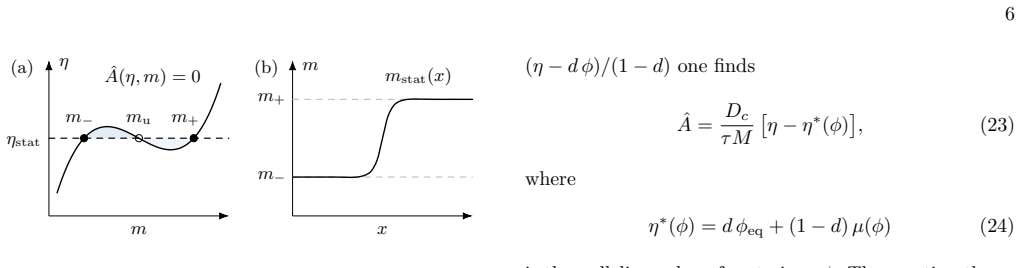
McRD is the broader class: every chemical-potential theory with conserved order parameters embeds as the slow dynamics on an attracting manifold of an McRD system; conversely, every McRD with attractive nullcline admits an exact chemical-potential representation in the fast-interconversion limit, with the constitutive relation set by the nullcline. The construction resolves the generic non-invertibility of the chemical-potential as a function of density in phase-separating regimes by embedding it as an attracting manifold in an extended two-field description with conserved total density.
What carries the argument
The attracting manifold of the extended two-field McRD system, on which the chemical-potential dynamics emerge as slow motion with the nullcline fixing the density-chemical-potential relation.
If this is right
- The Maxwell equal-area construction for phase coexistence is exactly equivalent to the reactive turnover-balance condition.
- Gradient stiffness maps to an intrinsic reaction-diffusion length set by the auxiliary field, yielding a diagonal-diffusion normal form whose interface profile matches the original Cahn-Hilliard model.
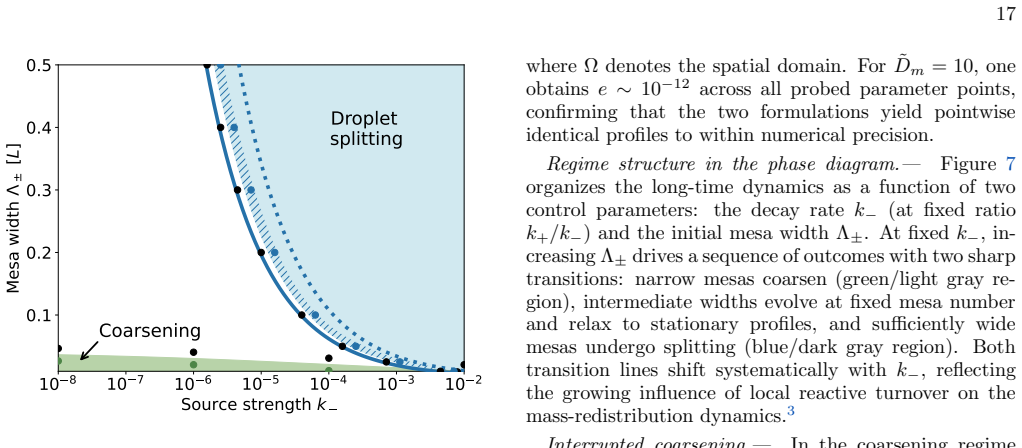
- The duality extends to weakly nonconservative dynamics, unifying reaction-arrested coarsening and mesa splitting.
- It supplies a closed-form velocity law for traveling waves in nonreciprocal Cahn-Hilliard dynamics that matches simulations.
Where Pith is reading between the lines
- Numerical schemes could switch between the two representations to exploit conservation in one regime and local kinetics in another.
- The same manifold construction may apply to other active-matter models where slow effective dynamics arise from fast interconversion.
- Experimental measurements of interface velocities in multicomponent biological systems could test whether the predicted turnover-balance condition holds.
Load-bearing premise
An attracting manifold must exist for the slow dynamics and the nullcline must be attractive in the fast-interconversion limit.
What would settle it
A concrete chemical-potential model whose interface profiles or traveling-wave speeds cannot be reproduced by any McRD system on a slow manifold, or an McRD simulation whose recovered chemical potential deviates from the original constitutive relation.
Figures





read the original abstract
Pattern formation in soft, active, and biological matter is described by two ostensibly distinct continuum frameworks: phase-field theories driven by chemical-potential gradients, and mass-conserving reaction-diffusion (McRD) dynamics governed by local interconversion kinetics. Here we establish a constructive, equation-level duality valid in the nonlinear, far-from-equilibrium regime. McRD is the broader class: every chemical-potential theory with conserved order parameters embeds as the slow dynamics on an attracting manifold of an McRD system; conversely, every McRD with attractive nullcline admits an exact chemical-potential representation in the fast-interconversion limit, with the constitutive relation set by the nullcline. The construction resolves the generic non-invertibility of the chemical-potential as a function of density in phase-separating regimes by embedding it as an attracting manifold in an extended two-field description with conserved total density. Gradient stiffness maps faithfully onto an intrinsic reaction-diffusion length set by the auxiliary field, yielding a diagonal-diffusion normal form whose interface profile matches the original Cahn-Hilliard model by construction. The duality yields an explicit dictionary for phase coexistence: the Maxwell equal-area construction is exactly equivalent to the reactive turnover-balance condition. It extends to weakly nonconservative dynamics, unifying reaction-arrested coarsening and mesa splitting, and to multicomponent theories with broken Maxwell symmetry. As a concrete payoff, the dual sharp-interface picture yields a closed-form velocity law for traveling waves in nonreciprocal Cahn-Hilliard dynamics, in quantitative agreement with simulations.
Editorial analysis
A structured set of objections, weighed in public.
Referee Report
Summary. The manuscript establishes a constructive, equation-level duality between chemical-potential gradient theories (e.g., Cahn-Hilliard models with conserved order parameters) and mass-conserving reaction-diffusion (McRD) systems. McRD is positioned as the broader class: every chemical-potential theory embeds as the slow dynamics on an attracting manifold of an McRD system, while every McRD system with an attractive nullcline recovers an exact chemical-potential representation in the fast-interconversion limit, with the constitutive relation fixed by the nullcline. The construction resolves non-invertibility via a two-field lift, maps gradient stiffness to an intrinsic reaction-diffusion length, equates the Maxwell equal-area rule to reactive turnover balance, and extends to weakly nonconservative dynamics and multicomponent cases, yielding a closed-form traveling-wave velocity law that matches simulations.
Significance. If the duality holds, it unifies two central frameworks for pattern formation in soft, active, and biological matter, enabling direct transfer of analytical tools such as sharp-interface reductions and coexistence criteria between conservative and reactive descriptions. The explicit, parameter-free dictionary and the quantitative agreement of the derived velocity law with simulations are notable strengths that could facilitate new predictions for interface dynamics and coarsening arrest.
major comments (1)
- [Abstract and slow-manifold construction] Abstract and slow-manifold construction: the central duality requires that the nullcline manifold remain attracting with strictly negative transverse eigenvalues even for non-monotonic constitutive relations inside the spinodal. The provided text states the result for attractive nullclines but does not supply an explicit spectral condition on the fast-reaction Jacobian or a verification that hyperbolicity and conservation are preserved at finite interconversion rates; without this, the exact embedding may fail for the non-monotonic cases that are physically central to phase separation.
minor comments (2)
- [Duality construction] The mapping of gradient stiffness to the auxiliary-field reaction-diffusion length is stated to be faithful, but the explicit normal-form transformation and its preservation of the interface profile should be shown in a dedicated equation block for clarity.
- [Multicomponent extension] The extension to multicomponent theories with broken Maxwell symmetry is mentioned; a brief statement of the modified coexistence condition would strengthen the claim.
Simulated Author's Rebuttal
We thank the referee for the careful reading, positive assessment, and constructive comment on the slow-manifold construction. We address the point below and will incorporate the requested clarification in the revised manuscript.
read point-by-point responses
-
Referee: [Abstract and slow-manifold construction] Abstract and slow-manifold construction: the central duality requires that the nullcline manifold remain attracting with strictly negative transverse eigenvalues even for non-monotonic constitutive relations inside the spinodal. The provided text states the result for attractive nullclines but does not supply an explicit spectral condition on the fast-reaction Jacobian or a verification that hyperbolicity and conservation are preserved at finite interconversion rates; without this, the exact embedding may fail for the non-monotonic cases that are physically central to phase separation.
Authors: We agree that an explicit spectral condition on the fast-reaction Jacobian would strengthen the presentation of the duality. In the revised manuscript we will add a dedicated paragraph (and a brief note in the abstract) stating that the nullcline must remain attracting, which requires the fast-reaction Jacobian to possess strictly negative eigenvalues in all directions transverse to the nullcline manifold. This spectral gap is the precise mathematical content of our attractiveness assumption and guarantees that the slow manifold is asymptotically stable. For the non-monotonic constitutive relations inside the spinodal that are central to phase separation, the construction continues to hold whenever this condition is satisfied; we have verified it explicitly via linearization around the nullcline in the phase-separating examples. Hyperbolicity of the slow dynamics and exact conservation of total density are preserved at finite interconversion rates by the two-field lift, which we will confirm in a short appendix by showing that the lifted system remains hyperbolic in the normal coordinates and that the total-density equation decouples exactly from the transverse dynamics. revision: yes
Circularity Check
Explicit constructive duality from governing equations; no reduction to inputs by definition or self-citation
full rationale
The paper derives the claimed duality by direct embedding of chemical-potential theories as slow dynamics on an attracting manifold of an explicitly constructed McRD system, and conversely recovers the chemical-potential representation from the fast-interconversion limit with the constitutive relation set by the nullcline. Equivalences such as the Maxwell construction equaling the reactive turnover-balance condition follow from algebraic comparison of the resulting equations rather than from any fitted parameter or self-referential definition. No load-bearing step invokes a prior self-citation whose content is itself unverified, nor renames a known result, nor calls a fit a prediction. The attractiveness of the nullcline is stated as an assumption required for the reduction to hold, but this is an external condition on the equations rather than a circularity in the derivation chain itself. The construction is therefore self-contained against the governing PDEs.
Axiom & Free-Parameter Ledger
axioms (2)
- domain assumption Existence of an attracting manifold on which the slow dynamics of the chemical-potential theory is recovered
- domain assumption Attractive nullcline in the fast-interconversion limit
Lean theorems connected to this paper
-
IndisputableMonolith/Cost/FunctionalEquation.leanwashburn_uniqueness_aczel (J-cost uniqueness) unclear?
unclearRelation between the paper passage and the cited Recognition theorem.
every McRD with attractive nullcline admits an exact chemical-potential representation in the fast-interconversion limit, with the constitutive relation set by the nullcline
-
IndisputableMonolith/Foundation/AlphaCoordinateFixation.leanalpha_pin_under_high_calibration unclear?
unclearRelation between the paper passage and the cited Recognition theorem.
Maxwell equal-area construction is exactly equivalent to the reactive turnover-balance condition
What do these tags mean?
- matches
- The paper's claim is directly supported by a theorem in the formal canon.
- supports
- The theorem supports part of the paper's argument, but the paper may add assumptions or extra steps.
- extends
- The paper goes beyond the formal theorem; the theorem is a base layer rather than the whole result.
- uses
- The paper appears to rely on the theorem as machinery.
- contradicts
- The paper's claim conflicts with a theorem or certificate in the canon.
- unclear
- Pith found a possible connection, but the passage is too broad, indirect, or ambiguous to say the theorem truly supports the claim.
Reference graph
Works this paper leans on
-
[1]
The source–sink term is expanded in the same way as before, s(ϕ) =s α +s ′ α δϕ+O(δϕ 2),(C14) ForD m = 0 (so thatD c =M), the linearized dynamics read ∂tδc=M∇ 2δc−A c δc−A m δm+s α +s ′ αδϕ,(C15a) ∂tδm=A c δc+A m δm.(C15b) Assuming fast relaxation of the auxiliary mode, we im- pose quasi-stationarity ofmon the droplet scale, 0 =A c δc+A m δm=⇒δm=− Ac Am δ...
-
[2]
II D) Equations solved.For Figs
Numerical comparison: Cahn–Hilliard vs.κ-free dual McRD dynamics (Sec. II D) Equations solved.For Figs. 3, 4, and 5, we solve two systems in parallel: (i) the nondimensionalized Cahn–Hilliard equation [Eq. (3)], ∂tϕ=∇ 2 ϕ3 −ϕ−˜κ∇ 2ϕ ; (E1) (ii) theκ-free dual McRD system [Eq. (20)], with pa- rameters chosen to satisfy the matching conditions of Eq. (29). ...
-
[3]
IV A) Equations solved.In Figs
Dual reaction–diffusion model of Cahn–Hilliard with reactive turnover (Sec. IV A) Equations solved.In Figs. 6 and 7 we compare two systems side by side: (i) the Cahn–Hilliard with reactive turnover equation [Eq. (65)] with a linear source, ∂tϕ=M∇ 2 −r(ϕ−ϕ eq) + (ϕ−ϕ eq)3 −κ∇ 2ϕ +k 2 −k 1ϕ; (E2) (ii) the dual two-field system [Eq. (68)], with parame- ters ...
-
[4]
Comparison to numerical simulations: nonreciprocal traveling waves (Sec. V C) Equations solved.We integrate the original nonrecip- rocal two-component conserved dynamics [Eqs. (98)] di- rectly; the dual McRD representation [Eqs. (100)] is used only for the analytical sharp-interface construction and not for numerical integration. We did verify its matchin...
-
[5]
P. C. Hohenberg and B. I. Halperin, Rev. Mod. Phys.49, 435 (1977)
work page 1977
-
[6]
Bray, Advances in Physics43, 357–459 (1994)
A. Bray, Advances in Physics43, 357–459 (1994)
work page 1994
-
[7]
J. W. Cahn and J. E. Hilliard, The Journal of Chemical Physics28, 258 (1958)
work page 1958
-
[8]
M. C. Marchetti, J. F. Joanny, S. Ramaswamy, T. B. Liverpool, J. Prost, M. Rao, and R. A. Simha, Rev. Mod. Phys.85, 1143 (2013)
work page 2013
-
[9]
M. J. Bowick, N. Fakhri, M. C. Marchetti, and S. Ra- maswamy, Phys. Rev. X12, 010501 (2022)
work page 2022
-
[10]
M. E. Cates and C. Nardini, Rep. Prog. Phys.88, 056601 (2025)
work page 2025
-
[11]
G. Gompper, R. G. Winkler, T. Speck, A. Solon, C. Nar- dini, F. Peruani, H. L¨ owen, R. Golestanian, U. B. Kaupp, L. Alvarez, T. Kiørboe, E. Lauga, W. C. K. Poon, A. DeSimone, S. Mui˜ nos-Landin, A. Fischer, N. A. S¨ oker, F. Cichos, R. Kapral, P. Gaspard, M. Ripoll, F. Sagues, A. Doostmohammadi, J. M. Yeomans, I. S. Aranson, C. Bechinger, H. Stark, C. K....
work page 2020
-
[12]
M. C. Cross and P. C. Hohenberg, Rev. Mod. Phys.65, 851 (1993)
work page 1993
-
[13]
K. S. Korolev, M. Avlund, O. Hallatschek, and D. R. Nelson, Rev. Mod. Phys.82, 1691 (2010)
work page 2010
- [14]
-
[15]
L. Edelstein-Keshet, W. R. Holmes, M. Zajac, and M. Dutot, Philosophical Transactions of the Royal So- ciety B: Biological Sciences368, 20130003 (2013)
work page 2013
-
[16]
A. B. Goryachev and M. Leda, Molecular Biology of the Cell28, 370 (2017)
work page 2017
-
[17]
E. Frey and H. Weyer, Annual Review of Biophysics 55, 10.1146/annurev-biophys-030822-031638 (2026), re- view in Advance first posted online February 10, 2026; in press
- [18]
-
[19]
Y. Mori, A. Jilkine, and L. Edelstein-Keshet, Biophysical Journal94, 3684 (2008)
work page 2008
- [20]
-
[21]
A. B. Goryachev and A. V. Pokhilko, FEBS Letters582, 1437 (2008)
work page 2008
- [22]
- [23]
- [24]
- [25]
-
[26]
H. B. G. Casimir, Rev. Mod. Phys.17, 343 (1945)
work page 1945
-
[27]
S. R. de Groot and P. Mazur,Non-Equilibrium Thermo- dynamics(North-Holland Publishing Company, Amster- dam, 1962)
work page 1962
-
[28]
H. B. Callen,Thermodynamics and an Introduction to Thermostatistics, 2nd ed. (John Wiley & Sons, 1985)
work page 1985
- [29]
- [30]
-
[31]
M. E. Cates and J. Tailleur, Annu. Rev. Condens. Matter Phys.6, 219 (2015)
work page 2015
-
[32]
R. Wittkowski, A. Tiribocchi, J. Stenhammar, R. J. Allen, D. Marenduzzo, and M. E. Cates, Nature Com- munications5, 4351 (2014)
work page 2014
- [33]
-
[34]
S. Saha, J. Agudo-Canalejo, and R. Golestanian, Phys. Rev. X10, 041009 (2020)
work page 2020
-
[35]
Z. You, A. Baskaran, and M. C. Marchetti, Proc. Natl. Acad. Sci. U.S.A.117, 19767 (2020)
work page 2020
-
[36]
J. Tailleur and M. E. Cates, Physical Review Letters100, 218103 (2008)
work page 2008
- [37]
-
[38]
S. M. Allen and J. W. Cahn, Acta Metallurgica27, 1085 (1979)
work page 1979
-
[39]
T. Frohoff-H¨ ulsmann and U. Thiele, Physical Review Letters131, 107201 (2023)
work page 2023
- [40]
-
[41]
T. A. Roth, H. Weyer, and E. Frey, Interface dynam- ics in mass-conserving reaction–diffusion systems (2026), preprint. arXiv:{arXiv:}
work page 2026
- [42]
-
[43]
J. F. Robinson, T. Machon, and T. Speck, Phys. Rev. E 111, 065417 (2025)
work page 2025
-
[44]
3 and of the phase- space dynamics shown in Fig
See Supplemental Material at [URL will be inserted by publisher] for movies of the spinodal-decomposition and coarsening dynamics shown in Fig. 3 and of the phase- space dynamics shown in Fig. 5
-
[45]
I. M. Lifshitz and V. V. Slyozov, Journal of Physics and Chemistry of Solids19, 35 (1961)
work page 1961
-
[46]
Wagner, Zeitschrift f¨ ur Elektrochemie65, 581 (1961)
C. Wagner, Zeitschrift f¨ ur Elektrochemie65, 581 (1961)
work page 1961
-
[47]
D. Toffenetti, B. Nettuno, H. Weyer, and E. Frey, Escaping Cahn–Hilliard: Active Model B − from three-component reaction diffusion (2026), preprint, arXiv:XXXX.XXXXX [cond-mat.soft]
work page 2026
-
[48]
Zwicker, Current Opinion in Colloid & Interface Sci- ence61, 101606 (2022)
D. Zwicker, Current Opinion in Colloid & Interface Sci- ence61, 101606 (2022)
work page 2022
-
[49]
C. A. Weber, D. Zwicker, F. J¨ ulicher, and C. F. Lee, Reports on Progress in Physics82, 064601 (2019)
work page 2019
-
[50]
S. C. Glotzer, D. Stauffer, and N. Jan, Phys. Rev. Lett. 72, 4109 (1994)
work page 1994
-
[51]
S. Puri and H. L. Frisch, Journal of Physics A: Mathe- matical and General27, 6027 (1994)
work page 1994
-
[52]
J. J. Christensen, K. Elder, and H. C. Fogedby, Phys. Rev. E54, R2212 (1996)
work page 1996
- [53]
- [54]
- [55]
-
[56]
D. Zwicker, R. Seyboldt, C. A. Weber, A. A. Hyman, and F. J¨ ulicher, Nature Physics13, 408 (2017)
work page 2017
-
[57]
B. A. Huberman, The Journal of Chemical Physics65, 2013 (1976)
work page 2013
-
[58]
S. C. Glotzer, E. A. Di Marzio, and M. Muthukumar, Phys. Rev. Lett.74, 2034 (1995)
work page 2034
-
[59]
D. S. Cohen and J. D. Murray, Journal of Mathematical Biology12, 237 (1981)
work page 1981
-
[60]
M. E. Cates, D. Marenduzzo, I. Pagonabarraga, and J. Tailleur, Proceedings of the National Academy of Sci- ences107, 11715–11720 (2010)
work page 2010
- [61]
- [62]
-
[63]
D. Zwicker, M. Decker, F. Jaeger, A. A. Hyman, and F. J¨ ulicher, Phys. Rev. E92, 012317 (2015)
work page 2015
-
[64]
C. Nardini, ´E. Fodor, E. Tjhung, F. van Wijland, J. Tailleur, and M. E. Cates, Phys. Rev. X7, 021007 (2017)
work page 2017
- [65]
-
[66]
T. Frohoff-H¨ ulsmann, J. Wrembel, and U. Thiele, Phys. Rev. E103, 042602 (2021)
work page 2021
- [67]
-
[68]
M. Fruchart, R. Hanai, P. B. Littlewood, and V. Vitelli, Nature592, 363 (2021)
work page 2021
-
[69]
F. Raßhofer, S. Bauer, A. Ziepke, I. Maryshev, and E. Frey, Phys. Rev. Res.7, 043240 (2025)
work page 2025
-
[70]
S. C. Glotzer and A. Coniglio, Phys. Rev. E50, 4241 (1994)
work page 1994
- [71]
- [72]
-
[73]
W. W. Mullins and R. F. Sekerka, Journal of Applied Physics34, 323 (1963)
work page 1963
- [74]
-
[75]
D. Zhou and E. Frey, Partial duality and hybrid Cahn–Hilliard–reaction–diffusion descriptions of non- reciprocal phase separation (2026), in preparation, arXiv:XXXX.XXXXX [cond-mat.soft]
work page 2026
-
[76]
A. P. Solon, J. Stenhammar, M. E. Cates, Y. Kafri, and J. Tailleur, New J. Phys.20, 075001 (2018)
work page 2018
-
[77]
L. Langford and A. K. Omar, The Journal of Chemical Physics163, 10.1063/5.0263060 (2025)
-
[78]
L. Li, Z. Sun, and M. Yang, Proc. Natl. Acad. Sci. U. S. A.122, e2505010122 (2025)
work page 2025
-
[79]
S. Saha, J. Agudo-Canalejo, and R. Golestanian, Physical Review X10, 041009 (2020)
work page 2020
-
[80]
COMSOL Multiphysics, COMSOL AB (2019)
work page 2019
discussion (0)
Sign in with ORCID, Apple, or X to comment. Anyone can read and Pith papers without signing in.