Recognition: 2 theorem links
· Lean TheoremPrimordial Black Hole from Tensor-induced Density Fluctuation: First-order Phase Transitions and Domain Walls
Pith reviewed 2026-05-15 02:49 UTC · model grok-4.3
The pith
First-order tensor perturbations from phase transitions and domain walls induce second-order curvature that forms primordial black holes able to comprise all dark matter.
A machine-rendered reading of the paper's core claim, the machinery that carries it, and where it could break.
Core claim
We present a novel gauge-invariant and minimal formation mechanism of primordial black holes in first-order phase transitions and domain walls separately. This is based on the first-order tensor perturbations, generated during FOPT from bubble collisions and sound waves, and from DW annihilation, sourcing curvature at second-order in perturbation theory. PBH formation implies model-independent constraints on FOPT parameters (β/H, α, T⋆) and on DW parameters (α_ann, V_bias, σ) from existing PBH constraints. Asteroid mass PBHs can become the entire dark matter for T⋆ in (4×10², 10⁴) GeV with β/H ≃ 6 and α > O(1), or for σ^{1/3} in [10⁶, 10⁸] TeV and V_bias^{1/4} in [10⁷, 10^{10}] MeV. The semi
What carries the argument
Second-order scalar curvature perturbations induced by first-order tensor modes sourced by bubble collisions, sound waves, or domain wall annihilation.
If this is right
- Asteroid-mass PBHs formed this way can constitute all dark matter when the transition temperature lies between 400 GeV and 10,000 GeV for β/H around 6 and large transition strength.
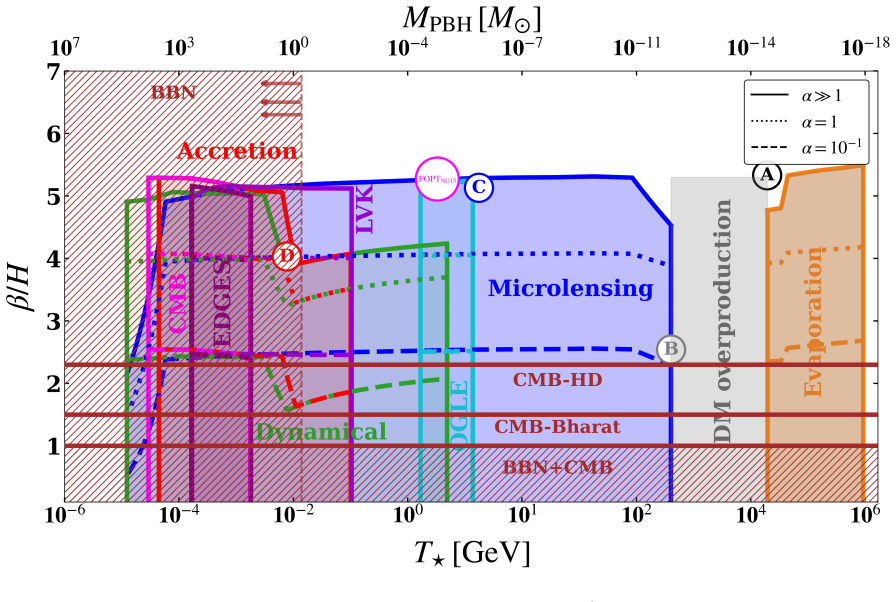
- The same parameters produce a gravitational wave spectrum peaking near 10^{-8} in energy density at frequencies between 10^{-5} and 10^{-2} Hz, inside LISA and SKA reach.
- For domain walls the corresponding window is σ^{1/3} between 10^6 and 10^8 TeV and bias scale between 10^7 and 10^{10} MeV, yielding a wave peak near 10^{-9} at frequencies 4×10^{-4} to 10^{-1} Hz.
- Existing PBH constraints translate directly into bounds on the phase-transition parameters β/H, α, T⋆ and the domain-wall parameters α_ann, V_bias, σ.
- Semi-analytical formulae link the induced density spectrum, black-hole mass, and dark-matter fraction to the underlying FOPT or DW parameters, thereby constraining their particle-physics origins.
Where Pith is reading between the lines
- Any sufficiently strong first-order transition or domain-wall network in the early universe could produce a population of primordial black holes without extra scalar-field tuning.
- Non-observation of the predicted gravitational waves would exclude the parameter regions where this channel supplies all dark matter.
- The same tensor-to-curvature conversion could be examined for other early-universe tensor sources such as cosmic strings to test whether they likewise generate observable black-hole fractions.
- The mechanism supplies a direct observational bridge between hidden-sector phase transitions and both dark-matter abundance and gravitational-wave backgrounds.
Load-bearing premise
The second-order curvature perturbations induced by the first-order tensors reach amplitudes large enough to exceed the threshold for PBH collapse without significant backreaction or higher-order corrections.
What would settle it
A calculation or simulation showing that the induced density contrast remains below the collapse threshold for the stated ranges of β/H, α, and T⋆, or the absence of the predicted gravitational wave peak in LISA data combined with tight PBH abundance limits.
Figures






read the original abstract
We present a novel \textit{gauge-invariant and minimal} formation mechanism of primordial black holes (PBHs) in first-order phase transition (FOPT) and domain walls (DW) separately. This is based on the first-order tensor perturbations, generated during FOPT from bubble collisions \& sound waves, and from DW annihilation, sourcing curvature, at second-order in perturbation theory. We show that the PBH formation implies \textit{model-independent constraints} on FOPT parameters ($\beta/H, \alpha, T_{\star}$ ) and on DW parameters, ($\alpha_{\rm ann}, V_{\rm bias}, \sigma$), from existing PBH constraints. We find that asteroid mass PBHs can become the entire dark matter (DM) of the Universe, for $T_{\star} \in (4 \times 10^{2}, 10^{4})$ GeV, for $\beta/H \simeq 6$, involving $\alpha >\mathcal{O}(1)$ values. The corresponding FOPT Gravitational Waves (GW) amplitude will have its characteristic peak at $\Omega_{\rm GW}^{\rm p} h^2$ $\sim \mathcal{O}(10^{-8})$ between frequencies $f_{\rm p} \in ({10^{-5},10^{-2}})$ Hz which is within the reach in LISA and SKA detectors. PBH as entire DM is possible for $\sigma^{1/3} \in [10^{6}, 10^{8}]$ TeV, for $V_{\rm bias}^{1/4} \in [10^7, 10^{10}]$ MeV with the corresponding GW amplitude peak from DW annihilation $\Omega_{\rm GW}^{\rm p} h^2$ $\sim \mathcal{O}(10^{-9})$ (for $\alpha_{\rm ann} \sim 10^{-2}$) and peak frequencies between $f_{\rm p} \in (4 \times {10^{-4},10^{-1}})$ Hz with ($T_{\rm ann} \in 4.5 \times [10^3, 10^6] $) GeV within the reach in LISA and ET detectors. We also provide semi-analytical formulae for the tensor-induced density spectrum, $P_{\delta^{(2)}}$, $M_{\rm PBH}$ and $f_{\rm PBH}$, relating them in terms of FOPT and DW parameters which in turn, are related to viable particle physics origin of such FOPT and DW, and therefore, constrain such microphysics, either in the visible, or in dark sector models.
Editorial analysis
A structured set of objections, weighed in public.
Referee Report
Summary. The manuscript proposes a novel gauge-invariant mechanism for primordial black hole (PBH) formation in which first-order tensor perturbations generated during first-order phase transitions (FOPT) from bubble collisions and sound waves, and from domain wall (DW) annihilation, source second-order scalar curvature perturbations. It supplies semi-analytical formulae relating the induced density power spectrum P_δ^(2), PBH mass M_PBH and abundance f_PBH to FOPT parameters (β/H, α, T_*) and DW parameters (α_ann, V_bias, σ), and concludes that asteroid-mass PBHs can comprise all dark matter for T_* in (4×10^2, 10^4) GeV with β/H ≃ 6 and α > O(1), together with associated gravitational-wave signals detectable by LISA, SKA and ET.
Significance. If the central derivation is sound, the work would establish a minimal, gauge-invariant channel connecting FOPTs and DWs to PBH dark matter and observable GWs, thereby furnishing model-independent constraints on microphysical parameters in visible or dark-sector models. The provision of semi-analytical formulae linking microphysics to P_δ^(2), M_PBH and f_PBH would be a useful contribution for future studies.
major comments (3)
- [Abstract and results section] Abstract and the section presenting the semi-analytical formulae: the expressions for P_δ^(2), M_PBH and f_PBH are stated without derivation steps, explicit kernel integration, error estimates or validation against known limits of second-order tensor-to-scalar sourcing; second-order perturbation theory contains well-known subtleties (gauge invariance, transfer functions, back-reaction) that are not addressed.
- [Results and discussion of constraints] The parameter windows β/H ≃ 6, α > O(1), T_* ~ 10^3 GeV (and the analogous DW ranges) are selected so that f_PBH = 1 for asteroid-mass PBHs; this choice appears tuned to reproduce the target abundance rather than derived independently from the microphysical parameters, undermining the claim of model-independent constraints.
- [PBH formation section] The central claim that the induced δ^(2) exceeds the collapse threshold δ_c ≈ 0.45–0.67 is not supported by explicit calculation of the peak amplitude of P_δ^(2) for the benchmark values; without this step it remains possible that the variance stays below threshold once gauge-invariant variables and transfer functions are included.
minor comments (2)
- [Abstract] Notation for peak quantities (Ω_GW^p h^2, f_p) should be defined consistently and the superscript 'p' clarified as 'peak'.
- [Introduction] Add explicit references to prior literature on second-order tensor-induced curvature perturbations and PBH formation to situate the novelty claim.
Simulated Author's Rebuttal
We thank the referee for the careful reading and constructive comments on our manuscript. We agree that additional details are needed to strengthen the presentation of the derivations and calculations. We address each major comment below and will incorporate the corresponding revisions in the next version of the manuscript.
read point-by-point responses
-
Referee: [Abstract and results section] Abstract and the section presenting the semi-analytical formulae: the expressions for P_δ^(2), M_PBH and f_PBH are stated without derivation steps, explicit kernel integration, error estimates or validation against known limits of second-order tensor-to-scalar sourcing; second-order perturbation theory contains well-known subtleties (gauge invariance, transfer functions, back-reaction) that are not addressed.
Authors: We agree that the original manuscript did not provide sufficient explicit steps for the kernel integration or validation. In the revised version we will add a dedicated appendix containing the full second-order kernel integration for the tensor-to-scalar sourcing, error estimates on the semi-analytical formulae, and direct comparisons to established limits (e.g., radiation-era results from the literature). We will also include a brief discussion of the gauge-invariant variables employed and the transfer functions used, thereby addressing the noted subtleties of second-order perturbation theory. revision: yes
-
Referee: [Results and discussion of constraints] The parameter windows β/H ≃ 6, α > O(1), T_* ~ 10^3 GeV (and the analogous DW ranges) are selected so that f_PBH = 1 for asteroid-mass PBHs; this choice appears tuned to reproduce the target abundance rather than derived independently from the microphysical parameters, undermining the claim of model-independent constraints.
Authors: The quoted ranges are not arbitrary but follow from requiring the induced density variance to reach the collapse threshold for the given FOPT and DW microphysical parameters; this is the physical condition that defines viable parameter space for PBH formation. Nevertheless, we accept that the presentation could be misread as tuning. In the revision we will derive the windows more explicitly from the underlying parameters, show the mapping from microphysics to f_PBH, and clarify that the model-independent constraints arise from the existing PBH abundance limits applied to this mechanism. revision: partial
-
Referee: [PBH formation section] The central claim that the induced δ^(2) exceeds the collapse threshold δ_c ≈ 0.45–0.67 is not supported by explicit calculation of the peak amplitude of P_δ^(2) for the benchmark values; without this step it remains possible that the variance stays below threshold once gauge-invariant variables and transfer functions are included.
Authors: We will add explicit numerical evaluations of the peak amplitude of P_δ^(2) for the benchmark points in the revised manuscript. These calculations will incorporate the gauge-invariant formulation and transfer functions, demonstrating that the variance exceeds δ_c for the quoted parameter choices. The new figures and accompanying text will make this step transparent. revision: yes
Circularity Check
No significant circularity; derivation maps parameters to abundance via standard second-order kernels
full rationale
The paper derives semi-analytical expressions for the tensor-induced density power spectrum P_δ^(2) from first-order tensor modes (bubble collisions/sound waves or DW annihilation) using established second-order perturbation theory, then applies the conventional PBH collapse threshold δ_c to obtain M_PBH and f_PBH as explicit functions of the input parameters (β/H, α, T_*, α_ann, V_bias, σ). The quoted windows (e.g., β/H ≃ 6, T_* ∈ [4×10^2, 10^4] GeV) are simply the values at which the computed f_PBH reaches order unity for asteroid-mass PBHs; this is a direct forward evaluation of the formulae rather than a fit or redefinition. No equation reduces the output abundance to the input parameters by construction, no load-bearing self-citation chain is invoked for the kernel or threshold, and the central claim rests on gauge-invariant perturbation theory that is independent of the target f_PBH = 1 result.
Axiom & Free-Parameter Ledger
free parameters (3)
- β/H =
6
- α =
>O(1)
- T⋆ =
4e2 to 1e4 GeV
axioms (2)
- standard math First-order tensor perturbations source second-order scalar curvature perturbations via standard cosmological perturbation theory
- domain assumption Standard spherical-collapse threshold for PBH formation applies to the induced density fluctuations
Lean theorems connected to this paper
-
IndisputableMonolith/Cost/FunctionalEquation.leanwashburn_uniqueness_aczel unclear?
unclearRelation between the paper passage and the cited Recognition theorem.
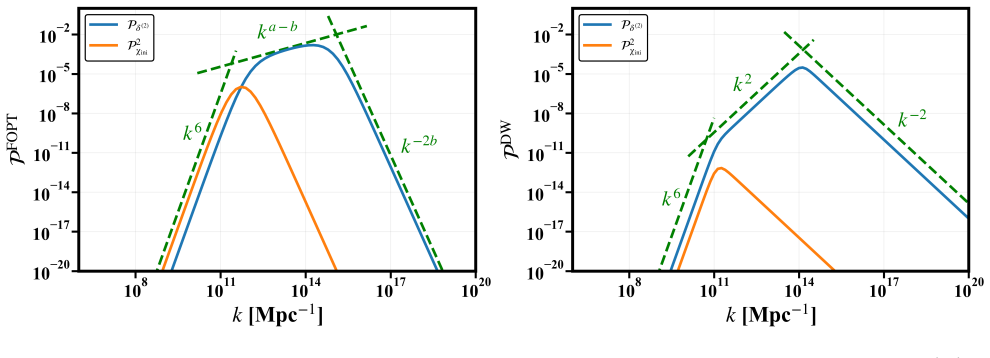
δ^(2) = −π/12 ∑ ∫ ϵ_σ_ij ϵ_σ'_ij (q/k |k−q|/k)^(−1/2) I(x,q,|k−q|) χ_σ χ_σ' (Eq. 14); P_δ^(2) = 1/2 ∫ dv du f(u,v) I²(u,v) P_χini(ku) P_χini(kv) (Eq. 16)
-
IndisputableMonolith/Foundation/RealityFromDistinction.leanreality_from_one_distinction unclear?
unclearRelation between the paper passage and the cited Recognition theorem.
f_PBH(M_PBH) expressed via β(M_H) integral over Gaussian P(δ_nl) with δ_th = 0.51 and critical-collapse scaling M_PBH = K M_H (δ − δ_th)^γ
What do these tags mean?
- matches
- The paper's claim is directly supported by a theorem in the formal canon.
- supports
- The theorem supports part of the paper's argument, but the paper may add assumptions or extra steps.
- extends
- The paper goes beyond the formal theorem; the theorem is a base layer rather than the whole result.
- uses
- The paper appears to rely on the theorem as machinery.
- contradicts
- The paper's claim conflicts with a theorem or certificate in the canon.
- unclear
- Pith found a possible connection, but the passage is too broad, indirect, or ambiguous to say the theorem truly supports the claim.
Reference graph
Works this paper leans on
-
[1]
First-order Phase Transition The first-orderP ζ generated due to FOPT, following [288]13,P ζ ∝k 3 on super-horizon scales, can be approximated asP ζ as Pζ(k) =A α 1 +α 2 (k/kmax)3(β/Hn)−3 [a+ (k/k max)2(β/Hn)−2]3 × 1 (b+β/H n)2 Θ(kmax −k),(C1) where Θ is the heaviside step function withA= 0.0038,a= 0.043, andb= 1.77. The peak wave numberk max and the rehe...
-
[2]
Domain Walls The primary power spectrum arising due to domain walls can be expressed as [231, 291]: Pϕ(k) = B2 2π2k8 = kB k 8 ,(C3) with B= 2 3 2 π 5 2 a2 i G2σ2 3η2 i .(C4) with i representing some initial time kB ≃ Gσ η0 1/2 .(C5) This indicates that the power spectrum scales ask −8, emphasizing it becomes dominant at larger scales. By employing the typ...
-
[3]
First-order Phase Transition Bubbles (FOPT) During cosmogical strong FOPT bubble collide and lead to GW formation from collission as well as from the sound wabes in the plasma outside the bubbles. A theoretically attractive and very minimal model invlving such 28 striog FOPT along with generation of neutrino masses for the SM via type-I seesaw, introduces...
-
[4]
Domain Walls (DW) Any discrete symmetry breaking, for instanceZ 2, would lead to the formation of DW in early universe. One may consider a minimal model of Dirac neutrino seesaw mass generation which also accommodates Dirac leptogenesis, 29 following Ref. [294], the standard model (SM) particle content is augmented by three copies of vector-like neutral s...
work page 2023
-
[5]
A. G. Cohen, D. B. Kaplan, and A. E. Nelson, Phys. Lett. B245, 561 (1990)
work page 1990
-
[6]
Baryogenesis in the Two-Higgs Doublet Model
L. Fromme, S. J. Huber, and M. Seniuch, JHEP11, 038 (2006), arXiv:hep-ph/0605242
work page internal anchor Pith review Pith/arXiv arXiv 2006
- [7]
-
[8]
Elor et al., in Snowmass 2021 (2022) arXiv:2203.05010 [hep-ph]
G. Elor et al., in Snowmass 2021 (2022) arXiv:2203.05010 [hep-ph]
-
[9]
Changes in Dark Matter Properties After Freeze-Out
T. Cohen, D. E. Morrissey, and A. Pierce, Phys. Rev. D78, 111701 (2008), arXiv:0808.3994 [hep-ph]
work page internal anchor Pith review Pith/arXiv arXiv 2008
-
[10]
K. M. Zurek, Phys. Rept.537, 91 (2014), arXiv:1308.0338 [hep-ph]
work page internal anchor Pith review Pith/arXiv arXiv 2014
-
[11]
M. J. Baker and J. Kopp, Phys. Rev. Lett.119, 061801 (2017), arXiv:1608.07578 [hep-ph]
work page internal anchor Pith review Pith/arXiv arXiv 2017
- [12]
- [13]
- [14]
- [15]
- [16]
-
[17]
Asadi et al., (2022), arXiv:2203.06680 [hep-ph]
P. Asadi et al., (2022), arXiv:2203.06680 [hep-ph]
-
[18]
Singlet Higgs Phenomenology and the Electroweak Phase Transition
S. Profumo, M. J. Ramsey-Musolf, and G. Shaughnessy, JHEP08, 010 (2007), arXiv:0705.2425 [hep-ph]
work page internal anchor Pith review Pith/arXiv arXiv 2007
-
[19]
The Twin Higgs: Natural Electroweak Breaking from Mirror Symmetry
Z. Chacko, H.-S. Goh, and R. Harnik, Phys. Rev. Lett.96, 231802 (2006), arXiv:hep-ph/0506256
work page internal anchor Pith review Pith/arXiv arXiv 2006
-
[20]
Gravitational Waves From a Dark (Twin) Phase Transition
P. Schwaller, Phys. Rev. Lett.115, 181101 (2015), arXiv:1504.07263 [hep-ph]
work page internal anchor Pith review Pith/arXiv arXiv 2015
-
[21]
I. P. Ivanov, Prog. Part. Nucl. Phys.95, 160 (2017), arXiv:1702.03776 [hep-ph]
work page internal anchor Pith review Pith/arXiv arXiv 2017
-
[22]
Holography and the Electroweak Phase Transition
P. Creminelli, A. Nicolis, and R. Rattazzi, JHEP03, 051 (2002), arXiv:hep-th/0107141
work page internal anchor Pith review Pith/arXiv arXiv 2002
-
[23]
Gravitational Waves from Warped Spacetime
L. Randall and G. Servant, JHEP05, 054 (2007), arXiv:hep-ph/0607158
work page internal anchor Pith review Pith/arXiv arXiv 2007
-
[24]
A Confining Strong First-Order Electroweak Phase Transition
G. Nardini, M. Quiros, and A. Wulzer, JHEP09, 077 (2007), arXiv:0706.3388 [hep-ph]
work page internal anchor Pith review Pith/arXiv arXiv 2007
-
[25]
Gravitational Backreaction Effects on the Holographic Phase Transition
T. Konstandin, G. Nardini, and M. Quiros, Phys. Rev. D82, 083513 (2010), arXiv:1007.1468 [hep-ph]
work page internal anchor Pith review Pith/arXiv arXiv 2010
-
[26]
Cosmological Consequences of Nearly Conformal Dynamics at the TeV scale
T. Konstandin and G. Servant, JCAP12, 009 (2011), arXiv:1104.4791 [hep-ph]
work page internal anchor Pith review Pith/arXiv arXiv 2011
-
[27]
P. Baratella, A. Pomarol, and F. Rompineve, JHEP03, 100 (2019), arXiv:1812.06996 [hep-ph]
work page internal anchor Pith review Pith/arXiv arXiv 2019
- [28]
- [29]
- [30]
- [31]
- [32]
-
[33]
A. Kosowsky, M. S. Turner, and R. Watkins, Phys. Rev. Lett.69, 2026 (1992)
work page 2026
- [34]
-
[35]
A. Kosowsky and M. S. Turner, Phys. Rev. D47, 4372 (1993), arXiv:astro-ph/9211004
work page internal anchor Pith review Pith/arXiv arXiv 1993
-
[36]
Gravitational Radiation from First-Order Phase Transitions
M. Kamionkowski, A. Kosowsky, and M. S. Turner, Phys. Rev. D49, 2837 (1994), arXiv:astro-ph/9310044
work page internal anchor Pith review Pith/arXiv arXiv 1994
-
[37]
C. Caprini et al., JCAP04, 001 (2016), arXiv:1512.06239 [astro-ph.CO]
work page internal anchor Pith review Pith/arXiv arXiv 2016
-
[38]
Caprini et al., JCAP03, 024 (2020), arXiv:1910.13125 [astro-ph.CO]
C. Caprini et al., JCAP03, 024 (2020), arXiv:1910.13125 [astro-ph.CO]
-
[39]
R. Caldwell et al., Gen. Rel. Grav.54, 156 (2022), arXiv:2203.07972 [gr-qc]
-
[40]
P. Auclair et al. (LISA Cosmology Working Group), Living Rev. Rel.26, 5 (2023), arXiv:2204.05434 [astro-ph.CO]
-
[42]
The NANOGrav 15-year Data Set: Evidence for a Gravitational-Wave Background
G. Agazie et al. (NANOGrav), Astrophys. J. Lett.951, L8 (2023), arXiv:2306.16213 [astro-ph.HE]
work page internal anchor Pith review Pith/arXiv arXiv 2023
-
[43]
A. Afzal et al. (NANOGrav), Astrophys. J. Lett.951, L11 (2023), [Erratum: Astrophys.J.Lett. 971, L27 (2024), Erratum: Astrophys.J. 971, L27 (2024)], arXiv:2306.16219 [astro-ph.HE]
-
[44]
Antoniadiset al.(EPTA, InPTA:), Astron
J. Antoniadis et al. (EPTA, InPTA:), Astron. Astrophys.678, A50 (2023), arXiv:2306.16214 [astro-ph.HE]
-
[45]
D. J. Reardon et al., Astrophys. J. Lett.951, L6 (2023), arXiv:2306.16215 [astro-ph.HE]
work page internal anchor Pith review Pith/arXiv arXiv 2023
-
[46]
H. Xu et al., Res. Astron. Astrophys.23, 075024 (2023), arXiv:2306.16216 [astro-ph.HE]
work page internal anchor Pith review Pith/arXiv arXiv 2023
-
[47]
A. G. Riess et al., Astrophys. J. Lett.934, L7 (2022), arXiv:2112.04510 [astro-ph.CO]
work page internal anchor Pith review Pith/arXiv arXiv 2022
-
[48]
Planck 2018 results. VI. Cosmological parameters
N. Aghanim et al. (Planck), Astron. Astrophys.641, A6 (2020), [Erratum: Astron.Astrophys. 652, C4 (2021)], arXiv:1807.06209 [astro-ph.CO]
work page internal anchor Pith review Pith/arXiv arXiv 2020
-
[49]
N. Sch¨ oneberg, G. Franco Abell´ an, A. P´ erez S´ anchez, S. J. Witte, V. Poulin, and J. Lesgourgues, Phys. Rept.984, 1 (2022), arXiv:2107.10291 [astro-ph.CO]
- [50]
- [51]
- [52]
-
[53]
W. H. Press, B. S. Ryden, and D. N. Spergel, Astrophys. J.347, 590 (1989)
work page 1989
-
[54]
A. Vilenkin and E. P. S. Shellard, Cosmic Strings and Other Topological Defects (Cambridge University Press, 2000)
work page 2000
-
[55]
T. W. B. Kibble, J. Phys. A9, 1387 (1976)
work page 1976
- [56]
- [57]
-
[58]
G. B. Gelmini, M. Gleiser, and E. W. Kolb, Phys. Rev. D39, 1558 (1989)
work page 1989
-
[59]
A review of gravitational waves from cosmic domain walls
K. Saikawa, Universe3, 40 (2017), arXiv:1703.02576 [hep-ph]
work page internal anchor Pith review Pith/arXiv arXiv 2017
-
[60]
B. Carr, K. Kohri, Y. Sendouda, and J. Yokoyama, Rept. Prog. Phys.84, 116902 (2021), arXiv:2002.12778 [astro-ph.CO]
work page internal anchor Pith review Pith/arXiv arXiv 2021
-
[61]
S. W. Hawking, Nature248, 30 (1974)
work page 1974
-
[62]
S. W. Hawking, Commun. Math. Phys.43, 199 (1975), [Erratum: Commun.Math.Phys. 46, 206 (1976)]
work page 1975
-
[63]
Baryon Asymmetry, Dark Matter, and Density Perturbation from PBH
T. Fujita, M. Kawasaki, K. Harigaya, and R. Matsuda, Phys. Rev. D89, 103501 (2014), arXiv:1401.1909 [astro-ph.CO]
work page internal anchor Pith review Pith/arXiv arXiv 2014
-
[64]
Non-thermal Production of Dark Matter from Primordial Black Holes
R. Allahverdi, J. Dent, and J. Osinski, Phys. Rev. D97, 055013 (2018), arXiv:1711.10511 [astro-ph.CO]
work page internal anchor Pith review Pith/arXiv arXiv 2018
-
[65]
Black Hole Genesis of Dark Matter
O. Lennon, J. March-Russell, R. Petrossian-Byrne, and H. Tillim, JCAP04, 009 (2018), arXiv:1712.07664 [hep-ph]
work page internal anchor Pith review Pith/arXiv arXiv 2018
- [66]
-
[67]
I. Masina, Eur. Phys. J. Plus135, 552 (2020), arXiv:2004.04740 [hep-ph]
- [68]
-
[69]
P. Gondolo, P. Sandick, and B. Shams Es Haghi, Phys. Rev. D102, 095018 (2020), arXiv:2009.02424 [hep-ph]
-
[70]
N. Bernal and ´O. Zapata, JCAP03, 015 (2021), arXiv:2011.12306 [astro-ph.CO]
-
[71]
D. Hooper and G. Krnjaic, Phys. Rev. D103, 043504 (2021), arXiv:2010.01134 [hep-ph]
- [72]
-
[73]
N. Bhaumik, A. Ghoshal, and M. Lewicki, JHEP07, 130 (2022), arXiv:2205.06260 [astro-ph.CO]
-
[74]
Primordial Black Hole Scenario for the Gravitational-Wave Event GW150914
M. Sasaki, T. Suyama, T. Tanaka, and S. Yokoyama, Phys. Rev. Lett.117, 061101 (2016), [Erratum: Phys.Rev.Lett. 121, 059901 (2018)], arXiv:1603.08338 [astro-ph.CO]
work page internal anchor Pith review Pith/arXiv arXiv 2016
-
[75]
S. Bird, I. Cholis, J. B. Mu˜ noz, Y. Ali-Ha¨ ımoud, M. Kamionkowski, E. D. Kovetz, A. Raccanelli, and A. G. Riess, Phys. Rev. Lett.116, 201301 (2016), arXiv:1603.00464 [astro-ph.CO]
work page internal anchor Pith review Pith/arXiv arXiv 2016
-
[76]
S. Clesse and J. Garc´ ıa-Bellido, Phys. Dark Univ.15, 142 (2017), arXiv:1603.05234 [astro-ph.CO]
work page internal anchor Pith review Pith/arXiv arXiv 2017
-
[77]
G. H¨ utsi, M. Raidal, V. Vaskonen, and H. Veerm¨ ae, JCAP03, 068 (2021), arXiv:2012.02786 [astro-ph.CO]
- [78]
-
[79]
G. Franciolini, V. Baibhav, V. De Luca, K. K. Y. Ng, K. W. K. Wong, E. Berti, P. Pani, A. Riotto, and S. Vitale, Phys. Rev. D105, 083526 (2022), arXiv:2105.03349 [gr-qc]
- [80]
-
[81]
Primordial Black Holes as Generators of Cosmic Structures
B. Carr and J. Silk, Mon. Not. Roy. Astron. Soc.478, 3756 (2018), arXiv:1801.00672 [astro-ph.CO]
work page internal anchor Pith review Pith/arXiv arXiv 2018
discussion (0)
Sign in with ORCID, Apple, or X to comment. Anyone can read and Pith papers without signing in.