Microscopic derivation of the interacting boson model parameters with machine learning
Pith reviewed 2026-05-19 19:43 UTC · model grok-4.3
The pith
A neural network maps microscopic potential energy landscapes to interacting boson model parameters for nuclei.
A machine-rendered reading of the paper's core claim, the machinery that carries it, and where it could break.
Core claim
By training a physics-guided neural network to map potential energy landscapes from density functional theory onto the space of interacting boson model parameters, incorporating a quadrupole collectivity indicator and valence nucleon numbers, the method yields a set of parameters and resulting energy spectra for rare-earth nuclei that reproduce the microscopic landscapes and reflect the evolution of nuclear structure without any manual parameter tuning.
What carries the argument
The physics-guided neural network that takes potential energy landscapes, a global quadrupole collectivity indicator, and valence nucleon numbers as inputs to output interacting boson model parameters.
If this is right
- Parameters and spectra are obtained automatically without manual tuning for each nucleus.
- The derived parameters reflect the nuclear structural evolution across the rare-earth region.
- This provides a robust alternative microscopic description of nuclear collectivity.
- Energy spectra from the boson model match features of the microscopic calculations.
Where Pith is reading between the lines
- If successful, this method could be extended to other mass regions to test universality of the mapping.
- It suggests that energy landscapes encode enough information to fix collective model parameters uniquely when supplemented with global indicators.
- Future work might use the network to predict spectra for nuclei where experimental data is sparse.
Load-bearing premise
The combination of potential energy landscapes from density functional theory with a quadrupole collectivity indicator and valence nucleon numbers supplies enough information to uniquely determine the interacting boson model parameters.
What would settle it
A direct comparison showing that the energy spectra or parameters from the network deviate significantly from those obtained by traditional fitting methods or from experimental data for the same rare-earth nuclei would falsify the claim.
Figures



read the original abstract
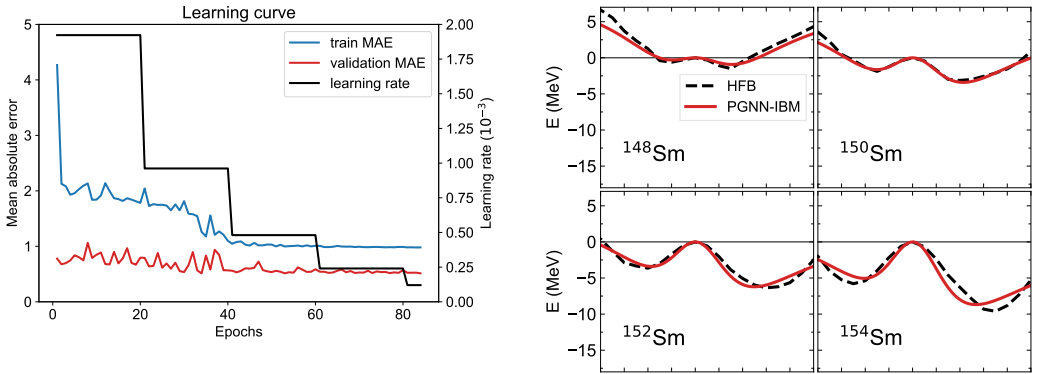
Machine learning is applied to derive microscopically parameters of the interacting boson model for nuclear spectroscopy. A physics-guided neural network is proposed, which is trained to map the potential energy landscapes that are calculated within the nuclear density functional theory onto the bosonic parameter space. To incorporate the underlying nuclear structure information and mitigate parameter degeneracy, the network integrates a global quadrupole collectivity indicator and valence nucleon numbers as key input features. In its applications to rare-earth nuclei, by reproducing the microscopic energy landscapes without any manual parameter tuning, the trained network is shown to provide a set of the model parameters and energy spectra that reflect the nuclear structural evolution, offering a robust alternative microscopic description of nuclear collectivity.
Editorial analysis
A structured set of objections, weighed in public.
Referee Report
Summary. The paper applies a physics-guided neural network to map potential energy surfaces computed in nuclear density functional theory, augmented by a global quadrupole collectivity indicator and valence nucleon numbers, onto the parameter space of the interacting boson model (IBM). For rare-earth nuclei the trained network is reported to reproduce the input microscopic landscapes without manual tuning and to yield IBM parameters and spectra that track nuclear shape evolution, thereby supplying a microscopic route to IBM spectroscopy.
Significance. A validated, degeneracy-controlled mapping from DFT landscapes to IBM parameters would furnish a systematic, largely parameter-free bridge between microscopic calculations and algebraic models, enabling spectroscopic predictions across isotopic chains where direct IBM fitting is ambiguous. The explicit inclusion of collectivity and valence features is a constructive attempt to embed nuclear-structure priors into the ML pipeline.
major comments (2)
- [Abstract] Abstract: the central claim that the network reproduces microscopic energy landscapes 'without any manual parameter tuning' and supplies a 'robust alternative microscopic description' rests on the assertion that the added quadrupole indicator and valence numbers resolve IBM parameter degeneracies. No quantitative validation metrics, error bars, baseline comparisons, or cross-validation details are supplied to demonstrate that the learned mapping is unique rather than merely consistent with the training data.
- [Network architecture and training] The section describing the network architecture and loss function: while the abstract states that the extra features 'mitigate parameter degeneracy,' the manuscript provides no concrete test (e.g., recovery of known degenerate IBM parameter sets, analysis of the output distribution for fixed inputs, or comparison of coherent-state PES residuals across multiple solutions) showing that the training objective actually enforces uniqueness rather than permitting multiple IBM Hamiltonians that reproduce the same input landscape.
minor comments (1)
- [Introduction] The notation used for the IBM Hamiltonian parameters and the precise definition of the global quadrupole collectivity indicator should be stated explicitly in the introduction or methods to allow readers to reproduce the input feature construction.
Simulated Author's Rebuttal
We thank the referee for the constructive comments and the recognition of the potential impact of our work. Below we provide point-by-point responses to the major comments and describe the changes we will implement in the revised manuscript.
read point-by-point responses
-
Referee: [Abstract] Abstract: the central claim that the network reproduces microscopic energy landscapes 'without any manual parameter tuning' and supplies a 'robust alternative microscopic description' rests on the assertion that the added quadrupole indicator and valence numbers resolve IBM parameter degeneracies. No quantitative validation metrics, error bars, baseline comparisons, or cross-validation details are supplied to demonstrate that the learned mapping is unique rather than merely consistent with the training data.
Authors: We acknowledge that the abstract advances strong claims about uniqueness and the absence of manual tuning. The manuscript demonstrates the mapping through direct reproduction of DFT landscapes and the resulting spectra that follow the known shape evolution across rare-earth chains. To address the lack of quantitative support for uniqueness, we will add in revision explicit metrics including root-mean-square deviations between input and reproduced potential energy surfaces, standard deviations across multiple training runs, and a baseline comparison against a network trained without the collectivity and valence features. A description of the training/validation split and any cross-validation procedure will also be included. revision: yes
-
Referee: [Network architecture and training] The section describing the network architecture and loss function: while the abstract states that the extra features 'mitigate parameter degeneracy,' the manuscript provides no concrete test (e.g., recovery of known degenerate IBM parameter sets, analysis of the output distribution for fixed inputs, or comparison of coherent-state PES residuals across multiple solutions) showing that the training objective actually enforces uniqueness rather than permitting multiple IBM Hamiltonians that reproduce the same input landscape.
Authors: The referee correctly identifies that the current text does not contain explicit numerical tests for uniqueness. The additional input features are introduced on the basis of established nuclear-structure considerations to reduce the well-known degeneracies in IBM fits. The results for the isotopic chains show stable, physically interpretable parameters. In the revision we will add an analysis of the spread in predicted parameters for repeated forward passes on identical inputs and, where alternative solutions exist, a comparison of the corresponding coherent-state PES residuals. These additions will be placed in the network-architecture section. revision: yes
Circularity Check
Network trained to reproduce DFT PES yields IBM parameters by construction of the learning objective
specific steps
-
fitted input called prediction
[Abstract]
"A physics-guided neural network is proposed, which is trained to map the potential energy landscapes that are calculated within the nuclear density functional theory onto the bosonic parameter space. ... by reproducing the microscopic energy landscapes without any manual parameter tuning, the trained network is shown to provide a set of the model parameters and energy spectra that reflect the nuclear structural evolution"
The network's training objective is to produce IBM parameters whose coherent-state PES matches the supplied DFT landscapes. Consequently, the 'reproduction' and the derived parameters are achieved by construction of the supervised mapping rather than by an independent microscopic derivation from first principles.
full rationale
The derivation chain consists of training a physics-guided NN to map DFT potential energy surfaces (plus quadrupole indicator and valence numbers) onto IBM parameters, then showing that the resulting IBM coherent-state PES reproduces the microscopic input. This reproduction is the explicit training target, so the output parameters are a learned fit rather than an independent first-principles extraction. The added input features are intended to resolve degeneracy, but the central claim still reduces to supervised matching of the supplied landscapes. No self-citation load-bearing or ansatz smuggling is present; the process is data-driven fitting with physical guidance. This produces moderate circularity (score 4) without fully collapsing the result to tautology.
Axiom & Free-Parameter Ledger
axioms (2)
- domain assumption Nuclear density functional theory calculations yield reliable potential energy landscapes that encode the essential collective degrees of freedom for rare-earth nuclei.
- domain assumption Adding a global quadrupole collectivity indicator and valence nucleon numbers resolves parameter degeneracy in the boson model space.
Reference graph
Works this paper leans on
-
[1]
A. Bohr, B. R. Mottelson, Nuclear Structure, V ol. II, Ben- jamin, New York, USA, 1975
work page 1975
-
[2]
P. Ring, P. Schuck, The Nuclear Many-Body Problem, Springer-Verlag, Berlin, 1980
work page 1980
-
[3]
P. Cejnar, J. Jolie, R. F. Casten, Quantum phase transitions in the shapes of atomic nuclei, Rev. Mod. Phys. 82 (2010) 2155–2212.doi:10.1103/RevModPhys.82.2155
-
[4]
Iachello, Quantum phase transitions in algebraic models, Revista Nuovo Cimento 34 (2011) 617
F. Iachello, Quantum phase transitions in algebraic models, Revista Nuovo Cimento 34 (2011) 617. doi:10.1393/ncr/i2011-10070-7. URLhttps://doi.org/10.1393/ncr/ i2011-10070-7
-
[5]
Fortunato, Quantum phase transitions in algebraic and collective models of nuclear structure, Prog
L. Fortunato, Quantum phase transitions in algebraic and collective models of nuclear structure, Prog. Part. Nucl. Phys. 121 (2021) 103891.doi:https: //doi.org/10.1016/j.ppnp.2021.103891. URLhttps://www.sciencedirect.com/science/ article/pii/S0146641021000508
-
[6]
J. L. Wood, K. Heyde, W. Nazarewicz, M. Huyse, P. van Duppen, Coexistence in even-mass nuclei, Phys. Rep. 215 (3-4) (1992) 101 – 201.doi:10.1016/ 0370-1573(92)90095-H
work page 1992
-
[7]
K. Heyde, J. L. Wood, Shape coexistence in atomic nuclei, Rev. Mod. Phys. 83 (2011) 1467–1521. doi:10.1103/RevModPhys.83.1467. URLhttps://link.aps.org/doi/10.1103/ RevModPhys.83.1467
-
[8]
P. E. Garrett, M. Zieli ´nska, E. Clément, An exper- imental view on shape coexistence in nuclei, Prog. Part. Nucl. Phys. 124 (2022) 103931.doi:https: //doi.org/10.1016/j.ppnp.2021.103931. URLhttps://www.sciencedirect.com/science/ article/pii/S0146641021000922
-
[9]
S. Leoni, B. Fornal, A. Bracco, Y . Tsunoda, T. Otsuka, Multifaceted character of shape coex- istence phenomena in atomic nuclei, Prog. Part. Nucl. Phys. 139 (2024) 104119.doi:https: //doi.org/10.1016/j.ppnp.2024.104119. URLhttps://www.sciencedirect.com/science/ article/pii/S0146641024000231
-
[10]
F. Iachello, A. Arima, The interacting boson model, Cam- bridge University Press, Cambridge, 1987
work page 1987
-
[11]
T. Otsuka, A. Arima, F. Iachello, I. Talmi, Shell model de- scription of interacting bosons, Phys. Lett. B 76 (2) (1978) 139 – 143.doi:10.1016/0370-2693(78)90260-5
-
[12]
T. Otsuka, A. Arima, F. Iachello, Nuclear shell model and interacting bosons, Nucl. Phys. A 309 (1–2) (1978) 1.doi:10.1016/0375-9474(78)90532-8
-
[13]
T. Otsuka, Microscopic basis and introduction to ibm- 2, in: Algebraic Approaches to Nuclear Structure, CRC Press, 2020, pp. 195–249
work page 2020
-
[14]
T. Mizusaki, T. Otsuka, Microscopic calculations foro(6) nuclei by the interacting boson model, Prog. Theor. Phys. Suppl. 125 (1996) 97–150.doi:10.1143/PTPS.125. 97. 6
-
[15]
K. Nomura, N. Shimizu, T. Otsuka, Mean-field deriva- tion of the interacting boson model hamiltonian and ex- otic nuclei, Phys. Rev. Lett. 101 (2008) 142501.doi: 10.1103/PhysRevLett.101.142501
-
[16]
K. Nomura, N. Shimizu, T. Otsuka, Formulating the in- teracting boson model by mean-field methods, Phys. Rev. C 81 (2010) 044307.doi:10.1103/PhysRevC.81. 044307
- [17]
-
[18]
K. Nomura, N. Shimizu, D. Vretenar, T. Nikši ´c, T. Ot- suka, Robust regularity inγ-soft nuclei and its micro- scopic realization, Phys. Rev. Lett. 108 (2012) 132501. doi:10.1103/PhysRevLett.108.132501
-
[19]
M. Bender, P.-H. Heenen, P.-G. Reinhard, Self-consistent mean-field models for nuclear structure, Rev. Mod. Phys. 75 (2003) 121.doi:10.1103/RevModPhys.75.121
-
[20]
D. Vretenar, A. V . Afanasjev, G. A. Lalazissis, P. Ring, Relativistic hartree-bogoliubov theory: static and dy- namic aspects of exotic nuclear structure, Phys. Rep. 409 (2005) 101.doi:10.1016/j.physrep.2004.10.001
-
[21]
L. M. Robledo, T. R. Rodríguez, R. R. Rodríguez- Guzmán, Mean field and beyond description of nuclear structure with the gogny force: a review, J. Phys. G: Nucl. Part. Phys. 46 (1) (2019) 013001. URLhttp://stacks.iop.org/0954-3899/46/i=1/ a=013001
work page 2019
-
[22]
Nomura, Mapped interacting boson model for nuclear structure studies, Eur
K. Nomura, Mapped interacting boson model for nuclear structure studies, Eur. Phys. J. A 61 (6) (2025) 139. doi:10.1140/epja/s10050-025-01604-7. URLhttps://doi.org/10.1140/epja/ s10050-025-01604-7
-
[23]
A. Boehnlein, M. Diefenthaler, N. Sato, M. Schram, V . Ziegler, C. Fanelli, M. Hjorth-Jensen, T. Horn, M. P. Kuchera, D. Lee, W. Nazarewicz, P. Ostroumov, K. Orginos, A. Poon, X.-N. Wang, A. Scheinker, M. S. Smith, L.-G. Pang, Colloquium: Machine learning in nuclear physics, Rev. Mod. Phys. 94 (2022) 031003. doi:10.1103/RevModPhys.94.031003. URLhttps://li...
-
[24]
S. Akkoyun, T. Bayram, S. O. Kara, N. Yildiz, Consistent empirical physical formulas for potential energy curves of 38–66ti isotopes by using neural net- works, Phys. Part. Nucl. Lett. 10 (6) (2013) 528–534. doi:10.1134/S1547477113060022. URLhttps://doi.org/10.1134/ S1547477113060022
-
[25]
R.-D. Lasseri, D. Regnier, J.-P. Ebran, A. Penon, Taming nuclear complexity with a committee of multilayer neural networks, Phys. Rev. Lett. 124 (2020) 162502. doi:10.1103/PhysRevLett.124.162502. URLhttps://link.aps.org/doi/10.1103/ PhysRevLett.124.162502
-
[26]
D. Lay, E. Flynn, S. A. Giuliani, W. Nazarewicz, L. Neufcourt, Neural network emulation of spon- taneous fission, Phys. Rev. C 109 (2024) 044305. doi:10.1103/PhysRevC.109.044305. URLhttps://link.aps.org/doi/10.1103/ PhysRevC.109.044305
-
[27]
B. F. Lv, Y . Wang, Z. Li, C. M. Petrache, Machine learn- ing for decoding spin-zero and octupole excitations, Phys. Rev. C 111 (2025) 064324.doi:10.1103/vjwy-m9xv. URLhttps://link.aps.org/doi/10.1103/ vjwy-m9xv
-
[28]
M. Ahmad, A. Bindra, Nuclear structure of medium and heavy mass nuclei: From collectivity trends to machine learning approaches, Nucl. Phys. A 1067 (2026) 123288.doi:https://doi.org/10.1016/j. nuclphysa.2025.123288
work page doi:10.1016/j 2026
-
[29]
X. Zhang, L. Fortunato, Prediction of $$2ˆ{+}$$energies in even–even nuclei of the terra incognita with bayesian neural network, Eur. Phys. J. Plus 141 (2) (2026) 121. doi:10.1140/epjp/s13360-026-07362-9. URLhttps://doi.org/10.1140/epjp/ s13360-026-07362-9
-
[30]
Z. L. Li, B. F. Lv, Y . J. Wang, C. M. Petrache, Study of yrast and yrare low-lying excited states using machine learning approaches, Chin. Phys. C 50 (1) (2026) 014107. doi:10.1088/1674-1137/adfe54. URLhttps://hepnp.ihep.ac.cn/en/article/ doi/10.1088/1674-1137/adfe54
-
[31]
G. Ke, Q. Meng, T. Finley, T. Wang, W. Chen, W. Ma, Q. Ye, T.-Y . Liu, Lightgbm: A highly efficient gradient boosting decision tree, in: I. Guyon, U. V . Luxburg, S. Bengio, H. Wallach, R. Fergus, S. Vishwanathan, R. Garnett (Eds.), Advances in Neural Information Processing Systems, V ol. 30, Curran Associates, Inc., 2017. URLhttps://proceedings.neurips. ...
work page 2017
-
[32]
M. Raissi, P. Perdikaris, G. E. Karniadakis, Physics- informed neural networks: A deep learning framework for solving forward and inverse problems involving nonlinear partial differential equations, J. Comput. Phys. 378 (2019) 686–707.doi:10.1016/j.jcp.2018.10.045
-
[33]
F. Iachello, Analytic description of critical point nuclei in a spherical-axially deformed shape phase transition, 7 Phys. Rev. Lett. 87 (2001) 052502.doi:10.1103/ PhysRevLett.87.052502
work page 2001
-
[34]
R. F. Casten, N. V . Zamfir, Empirical realiza- tion of a critical point description in atomic nuclei, Phys. Rev. Lett. 87 (2001) 052503. doi:10.1103/PhysRevLett.87.052503. URLhttps://link.aps.org/doi/10.1103/ PhysRevLett.87.052503
-
[35]
J. F. Berger, M. Girod, D. Gogny, Microscopic analysis of collective dynamics in low energy fission, Nucl. Phys. A 428 (0) (1984) 23 – 36.doi:10.1016/0375-9474(84) 90240-9
-
[36]
J. Decharge and M. Girod and D. Gogny, Self consis- tent calculations and quadrupole moments of even sm iso- topes, Phys. Lett. B 55 (4) (1975) 361.doi:10.1016/ 0370-2693(75)90359-7
work page 1975
-
[37]
S. Hilaire, M. Girod, Large-scale mean-field calcula- tions from proton to neutron drip lines using the d1s gogny force, Eur. Phys. J. A 33 (2) (2007) 237–241. doi:10.1140/epja/i2007-10450-2. URLhttps://doi.org/10.1140/epja/ i2007-10450-2
-
[38]
fr/science_en_ligne/carte_potentiels_ microscopiques/carte_potentiel_nucleaire_ eng.htm
AMEDEE database,https://www-phynu.cea. fr/science_en_ligne/carte_potentiels_ microscopiques/carte_potentiel_nucleaire_ eng.htm
-
[39]
A. E. L. Dieperink, O. Scholten, F. Iachello, Classical limit of the interacting-boson model, Phys. Rev. Lett. 44 (1980) 1747–1750.doi: 10.1103/PhysRevLett.44.1747. URLhttps://link.aps.org/doi/10.1103/ PhysRevLett.44.1747
-
[40]
J. N. Ginocchio, M. W. Kirson, Relationship between the bohr collective hamiltonian and the interacting- boson model, Phys. Rev. Lett. 44 (1980) 1744–1747. doi:10.1103/PhysRevLett.44.1744. URLhttps://link.aps.org/doi/10.1103/ PhysRevLett.44.1744
-
[41]
A. Bohr, B. R. Mottelson, Features of nuclear deforma- tions produced by the alignment of individual particles or pairs, Phys. Scr. 22 (5) (1980) 468–474.doi:10.1088/ 0031-8949/22/5/008
work page 1980
-
[42]
J. N. Ginocchio, M. W. Kirson, An intrinsic state for the interacting boson model and its relationship to the bohr- mottelson model, Nucl. Phys. A 350 (1980) 31.doi:10. 1016/0375-9474(80)90387-5
work page 1980
-
[43]
R. F. Casten, D. S. Brenner, P. E. Haustein, Valence p-n interactions and the development of collectivity in heavy nuclei, Phys. Rev. Lett. 58 (1987) 658–661. doi:10.1103/PhysRevLett.58.658. URLhttps://link.aps.org/doi/10.1103/ PhysRevLett.58.658
-
[44]
B. Lv, Z. Li, Y . Wang, C. Petrache, Mapping low-lying states and b(e2;01+→21+) in even-even nuclei with machine learning, Phys. Lett. B 857 (2024) 139013. doi:https://doi.org/10.1016/j.physletb. 2024.139013. URLhttps://www.sciencedirect.com/science/ article/pii/S0370269324005719
-
[45]
Scholten, The interacting boson approximation model and applications, Ph.D
O. Scholten, The interacting boson approximation model and applications, Ph.D. thesis, University of Groningen (1980)
work page 1980
-
[46]
Scholten, Microscopic calculations for the interacting boson model, Phys
O. Scholten, Microscopic calculations for the interacting boson model, Phys. Rev. C 28 (1983) 1783–1790. doi:10.1103/PhysRevC.28.1783. URLhttps://link.aps.org/doi/10.1103/ PhysRevC.28.1783
- [47]
- [48]
-
[49]
Otsuka, Boson model of medium-heavy nuclei, Ph.D
T. Otsuka, Boson model of medium-heavy nuclei, Ph.D. thesis, University of Tokyo (1979)
work page 1979
-
[50]
Otsuka, Rotational states and interacting bosons, Nucl
T. Otsuka, Rotational states and interacting bosons, Nucl. Phys. A 368 (2) (1981) 244–284.doi:https: //doi.org/10.1016/0375-9474(81)90685-0. URLhttps://www.sciencedirect.com/science/ article/pii/0375947481906850
-
[51]
H. Schaaser, D. M. Brink, The moment of inertia in the interacting boson model, Nucl. Phys. A 452 (1) (1986) 1 – 29.doi:10.1016/0375-9474(86)90505-1
-
[52]
D. J. Thouless, J. G. Valatin, Time-dependent hartree- fock equations and rotational states of nuclei, Nucl. Phys. 31 (0) (1962) 211 – 230.doi:10.1016/0029-5582(62) 90741-1
-
[53]
National Nuclear Data Center (NNDC), Nudat 3 database, https://www.nndc.bnl.gov/nudat3/
-
[54]
Y . Tsunoda, N. Shimizu, T. Otsuka, Shape transition of nd and sm isotopes and the neutrinoless double-β-decay nuclear matrix element of 150Nd, Phys. Rev. C 108 (2023) L021302.doi:10.1103/PhysRevC.108.L021302. URLhttps://link.aps.org/doi/10.1103/ PhysRevC.108.L021302
-
[55]
Nomura, Configuration mixing effects on neutrinolessββ-decay nuclear matrix elements, Phys
K. Nomura, Configuration mixing effects on neutrinolessββ-decay nuclear matrix elements, Phys. Lett. B 871 (2025) 139995.doi:https: 8 //doi.org/10.1016/j.physletb.2025.139995. URLhttps://www.sciencedirect.com/science/ article/pii/S0370269325007531 9
discussion (0)
Sign in with ORCID, Apple, or X to comment. Anyone can read and Pith papers without signing in.