Critical quench dynamics of Wegner's mathbb{Z}₂ gauge model: a geometric perspective
Pith reviewed 2026-05-19 19:23 UTC · model grok-4.3
The pith
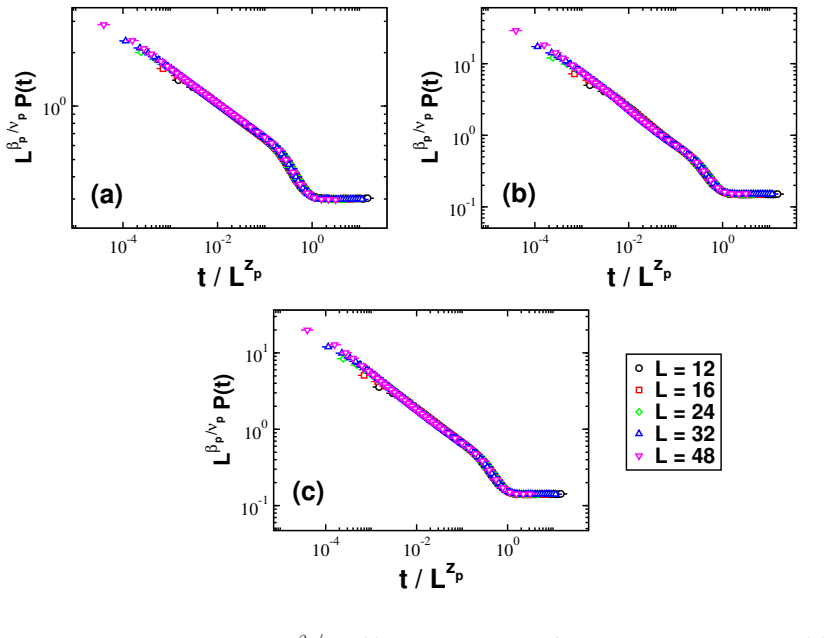
In Wegner's Z2 gauge model the percolation order parameter relaxes at criticality with dynamical exponent z_p approximately 2.6, the same value found for the energy density.
A machine-rendered reading of the paper's core claim, the machinery that carries it, and where it could break.
Core claim
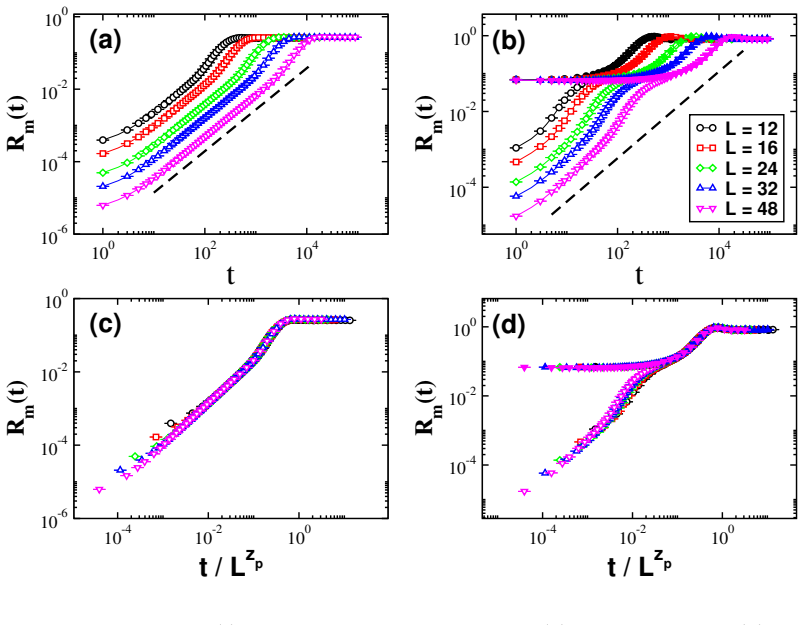
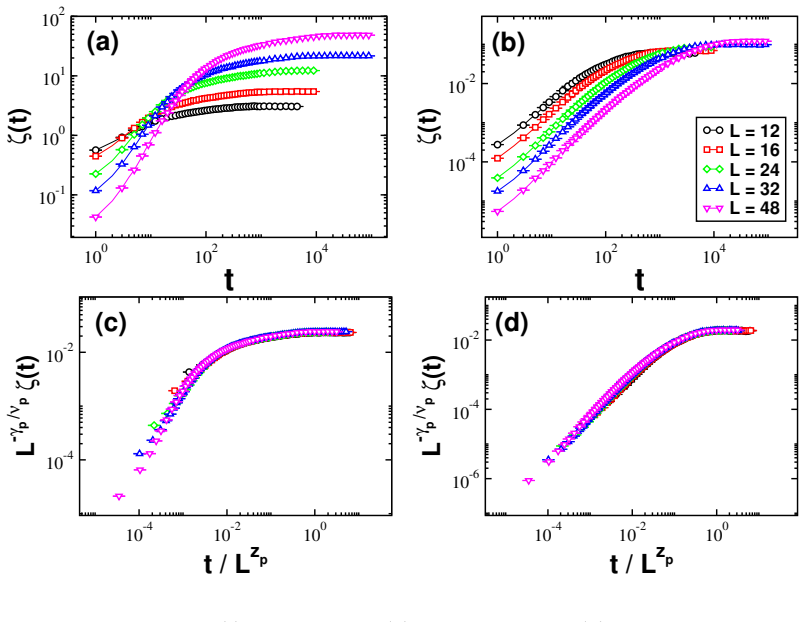
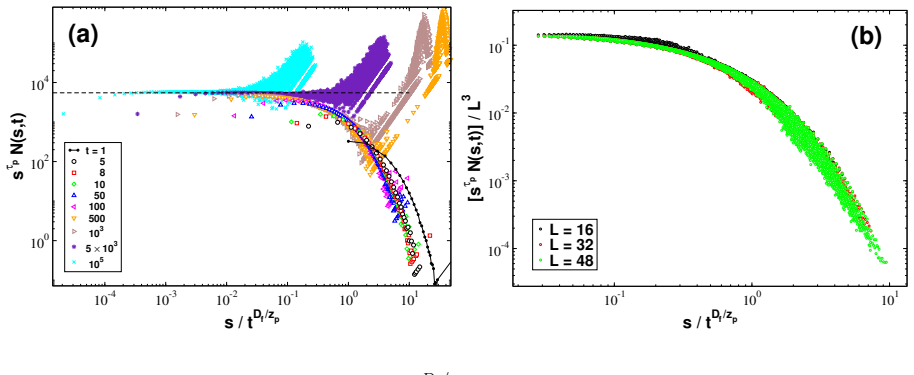
The critical non-equilibrium relaxation of the percolation order parameter is governed by a dynamical exponent z_p ≃ 2.6, consistent with that associated with the energy density, z_c. The value of z_p is robust with respect to the initial quench condition and the choice of geometrical objects. The quench dynamics obeys dynamic scaling in terms of a growing lengthscale, ξ_p(t) ∼ t^{1/z_p}, despite the absence of a local order parameter.
What carries the argument
Time-dependent finite-size scaling analysis performed on the percolation order parameter together with geometric observables such as loop excitations and Fortuin-Kasteleyn clusters.
If this is right
- The same dynamical exponent governs both the percolation order parameter and the energy density.
- The exponent remains unchanged when the quench starts from the high-temperature percolation phase or from the zero-temperature ground state.
- Dynamic scaling holds in terms of a single growing length ξ_p(t) ∼ t^{1/z_p} extracted from geometric quantities.
- Kinetics of different geometrical objects can be characterized throughout the relaxation from the percolation phase.
Where Pith is reading between the lines
- Geometric percolation measures may serve as practical diagnostics for critical dynamics in other lattice gauge theories where local order parameters are absent.
- The robustness of z_p suggests that similar scaling could appear in experimental realizations of Z2 gauge models on quantum simulators.
- Extending the analysis to quenches across the transition line might reveal how the growing length controls the approach to confined or deconfined phases.
Load-bearing premise
Time-dependent finite-size scaling can be applied reliably to the percolation order parameter and geometric observables even without a local order parameter or detailed knowledge of finite-size corrections.
What would settle it
Numerical data showing that the relaxation time of the percolation order parameter at criticality scales with system size L with an exponent clearly different from 2.6 would falsify the claim.
Figures






read the original abstract
Wegner's $\mathbb{Z}_2$ gauge model is the earliest formulation of pure lattice gauge theory and predicts the topological nature of the confinement-deconfinement transition. In three dimensions ($D=3$), the equilibrium critical behavior of the model is understood in terms of geometrically defined objects, namely loop excitations and Fortuin-Kasteleyn (FK) clusters. This work investigates the critical quench dynamics of this model from a geometric perspective, following quenches from both a high-temperature percolation phase and the zero-temperature ground state. Using time-dependent finite-size scaling analysis, we find that the critical non-equilibrium relaxation of the percolation order parameter is governed by a dynamical exponent $z_{\rm p} \simeq 2.6$, consistent with that associated with the energy density, $z_{\rm c}$. Importantly, the value of $z_{\rm p}$ is robust with respect to the initial quench condition and the choice of geometrical objects. Furthermore, we provide a detailed characterization of the kinetics of different geometrical objects during the evolution from the percolation phase. Notably, we observe that the quench dynamics obeys dynamic scaling in terms of a growing lengthscale, $\xi_{\rm p}(t) \sim t^{1/z_{\rm p}}$, despite the absence of a local order parameter.
Editorial analysis
A structured set of objections, weighed in public.
Referee Report
Summary. The manuscript investigates the critical quench dynamics of Wegner's Z_2 gauge model in three dimensions from a geometric perspective, considering quenches from both the high-temperature percolation phase and the zero-temperature ground state. Using time-dependent finite-size scaling on the percolation order parameter defined via Fortuin-Kasteleyn clusters and loop excitations, it reports a dynamical exponent z_p ≃ 2.6 that is consistent with the energy-density exponent z_c. The work claims this value is robust to initial conditions and choice of geometrical objects, provides a characterization of the kinetics of these objects, and asserts that dynamic scaling holds with a growing length scale ξ_p(t) ~ t^{1/z_p} despite the absence of a local order parameter.
Significance. If the central result holds, the paper extends the established geometric characterization of the equilibrium confinement-deconfinement transition to the non-equilibrium regime. It demonstrates that percolation-based observables can yield consistent dynamical scaling in a model without a conventional local order parameter, which may inform studies of relaxation in gauge theories and related systems. The reported robustness across initial conditions and object types, if substantiated with quantitative detail, would strengthen the geometric approach to out-of-equilibrium critical dynamics.
major comments (2)
- [§4] §4 (time-dependent finite-size scaling analysis): The extraction of z_p ≃ 2.6 from the percolation order parameter supplies no error bars, no list of system sizes, and no explicit discussion of the fitting window or equilibration-time definition. Because the model lacks a local order parameter, the standard form of corrections to scaling is not guaranteed; without these controls the effective exponent could shift by an amount comparable to the reported precision, directly affecting the claim of consistency with z_c.
- [§3] §3 (definition of geometrical observables and scaling form): The robustness statement with respect to initial quench conditions and choice of objects (FK clusters versus loops) is asserted but not supported by quantitative comparisons of scaling collapses or separate exponent fits. Any difference in the leading irrelevant operator between these definitions would undermine the central claim that z_p is insensitive to these choices.
minor comments (2)
- [Abstract] The abstract states z_p ≃ 2.6 without any indication of uncertainty or the range of system sizes; adding a parenthetical note on the numerical reliability would improve clarity for readers.
- [§2] Notation for the growing length scale ξ_p(t) and the two dynamical exponents z_p and z_c should be introduced with a single, explicit equation early in §2 or §3 to avoid later ambiguity.
Simulated Author's Rebuttal
We thank the referee for the careful reading and constructive comments on our manuscript. We address each major comment below and outline the revisions we will implement to improve clarity and support for our claims.
read point-by-point responses
-
Referee: §4 (time-dependent finite-size scaling analysis): The extraction of z_p ≃ 2.6 from the percolation order parameter supplies no error bars, no list of system sizes, and no explicit discussion of the fitting window or equilibration-time definition. Because the model lacks a local order parameter, the standard form of corrections to scaling is not guaranteed; without these controls the effective exponent could shift by an amount comparable to the reported precision, directly affecting the claim of consistency with z_c.
Authors: We agree that additional technical details are needed to substantiate the exponent extraction. In the revised manuscript we will add a table specifying all system sizes used (L = 8 to L = 32), report error bars on z_p obtained from multiple fitting windows, and provide an explicit definition of the equilibration time. We will also include a short discussion of corrections to scaling, noting that the quality of the data collapses remains high even without a conventional local order parameter; any residual corrections appear sub-dominant within the accessed time and length scales. revision: yes
-
Referee: §3 (definition of geometrical observables and scaling form): The robustness statement with respect to initial quench conditions and choice of objects (FK clusters versus loops) is asserted but not supported by quantitative comparisons of scaling collapses or separate exponent fits. Any difference in the leading irrelevant operator between these definitions would undermine the central claim that z_p is insensitive to these choices.
Authors: The manuscript already shows results for both initial conditions and both geometrical objects, with the extracted z_p appearing consistent at the reported precision. To make the robustness quantitative, we will add, in the revised version, overlaid scaling-collapse figures for the different cases together with a table of independent exponent fits (including uncertainties). This will allow direct assessment of any differences arising from irrelevant operators and will strengthen the claim that z_p is insensitive to these choices. revision: yes
Circularity Check
No circularity: dynamical exponent extracted from direct numerical scaling analysis
full rationale
The paper extracts z_p via time-dependent finite-size scaling applied to measured percolation order parameter and geometric observables (FK clusters, loops) after explicit quenches. This is a standard numerical procedure on simulation data, not a reduction of the reported value to a prior fit, self-defined quantity, or load-bearing self-citation. Consistency with z_c is noted as an observation rather than an input used to derive z_p. The derivation remains self-contained against external benchmarks of equilibration and scaling forms, with robustness checks to initial conditions and object choice providing independent content.
Axiom & Free-Parameter Ledger
Lean theorems connected to this paper
-
IndisputableMonolith/Foundation/AlexanderDuality.leanalexander_duality_circle_linking unclear?
unclearRelation between the paper passage and the cited Recognition theorem.
Using time-dependent finite-size scaling analysis, we find that the critical non-equilibrium relaxation of the percolation order parameter is governed by a dynamical exponent z_p ≃ 2.6 ... despite the absence of a local order parameter.
-
IndisputableMonolith/Cost/FunctionalEquation.leanwashburn_uniqueness_aczel unclear?
unclearRelation between the paper passage and the cited Recognition theorem.
the quench dynamics obeys dynamic scaling in terms of a growing lengthscale, ξ_p(t) ∼ t^{1/z_p}
What do these tags mean?
- matches
- The paper's claim is directly supported by a theorem in the formal canon.
- supports
- The theorem supports part of the paper's argument, but the paper may add assumptions or extra steps.
- extends
- The paper goes beyond the formal theorem; the theorem is a base layer rather than the whole result.
- uses
- The paper appears to rely on the theorem as machinery.
- contradicts
- The paper's claim conflicts with a theorem or certificate in the canon.
- unclear
- Pith found a possible connection, but the passage is too broad, indirect, or ambiguous to say the theorem truly supports the claim.
Reference graph
Works this paper leans on
-
[1]
The critical relaxation of the percolation order parameter is governed by a dynamical exponentz p ≃2.6, consistent with the corresponding exponent for energy relaxation, zc
-
[2]
The value ofz p is robust, within error bars, with respect to both the quench protocol and the choice of geometrically defined objects
-
[3]
The time evolution of the number statisticsN(s, t) of geometrical objects of sizes, following a quench from the percolation phase, supports a dynamic scaling framework governed by a time-dependent lengthscaleξ p(t)∼t 1/zp
-
[4]
We structure this paper as follows
The statistics of geometrical objects exhibit rich crossovers between distinct dynamical regimes. We structure this paper as follows. In Sec. II we provide details of the geometrically defined objects, while Sec. III discusses the numerical implementation of the simulations. Secs. IV and V present our main results. In Sec. IV, we investigate the dynamical...
-
[5]
At early times, large multiple-spanning objects shrink so that smaller ones can accom- modate
-
[6]
Small-sized objects progressively reorganize into structures with critical characteris- tics, such that the number statisticsN(s, t) at smallscrosses over to a critical form N(s, t)∼s −τ, withτ≃2.21 for FK clusters andτ≃2.73 for line loops
-
[7]
Large line loops, irrespective of the reconnection rule, resemble the statistics of fully packed loop models [53–55]. Finally, we demonstrated the usefulness of percolation-based observables in understanding 25 dynamical critical phenomena and we provided new insights into systems with global order parameters, including gauge-theoretic models. As a future...
-
[8]
F. J. Wegner, J. Math. Phys.12, 2259 (1971)
work page 1971
-
[9]
K. G. Wilson, Phys. Rev. D10, 2445 (1974). 26
work page 1974
-
[10]
J. B. Kogut, Rev. Mod. Phys.51, 659 (1979)
work page 1979
- [11]
-
[12]
R. Agrawal, L. F. Cugliandolo, L. Faoro, L. B. Ioffe, and M. Picco, Phys. Rev. Lett.135, 120601 (2025)
work page 2025
-
[13]
K. G. Wilson and M. E. Fisher, Phys. Rev. Lett.28, 240 (1972); A. M. Ferrenberg, J. Xu, and D. P. Landau, Phys. Rev. E97, 043301 (2018)
work page 1972
-
[14]
P. C. Hohenberg and B. I. Halperin, Rev. Mod. Phys.49, 435 (1977)
work page 1977
-
[15]
U. C. T¨ auber,Critical dynamics: a field theory approach to equilibrium and non-equilibrium scaling behavior(Cambridge University Press, 2014)
work page 2014
- [16]
-
[17]
R. Agrawal, L. F. Cugliandolo, L. Faoro, L. B. Ioffe, and M. Picco, Phys. Rev. E108, 064131 (2023)
work page 2023
-
[18]
R. Agrawal, L. F. Cugliandolo, L. Faoro, L. B. Ioffe, and M. Picco, Phys. Rev. E110, 034120 (2024)
work page 2024
-
[19]
C. De Grandi, V. Gritsev, and A. Polkovnikov, Phys. Rev. B81, 012303 (2010)
work page 2010
- [20]
- [21]
- [22]
-
[23]
N. Xu, C. Castelnovo, R. G. Melko, C. Chamon, and A. W. Sandvik, Phys. Rev. B97, 024432 (2018)
work page 2018
- [24]
-
[25]
F. Wang, N. Hatano, and M. Suzuki, J. Phys. A: Math. Gen.28, 4543 (1995)
work page 1995
-
[26]
F. Liu, M. Mondello, and N. Goldenfeld, Phys. Rev. Lett.66, 3071 (1991)
work page 1991
- [27]
- [28]
-
[29]
G. J. Stephens, L. M. A. Bettencourt, and W. H. Zurek, Phys. Rev. Lett.88, 137004 (2002)
work page 2002
-
[30]
C. Lannert, S. Vishveshwara, and M. P. A. Fisher, Phys. Rev. Lett.92, 097004 (2004)
work page 2004
- [31]
-
[32]
Quantum Decoherence of the Surface Code: A Generalized Caldeira-Leggett Approach
E. Novais and A. H. Castro-Neto, “Quantum decoherence of the surface code: A generalized caldeira-leggett approach,” (2026), arXiv:2604.18968 [quant-ph]. 27
work page internal anchor Pith review Pith/arXiv arXiv 2026
-
[33]
D. Stauffer and A. Aharony,Introduction to percolation theory(CRC press, 2018)
work page 2018
-
[34]
J. W. Essam, Rep. Prog. Phys.43, 833 (1980)
work page 1980
-
[35]
A. A. Saberi, Phys. Rep.578, 1 (2015)
work page 2015
-
[36]
A. Sicilia, J. J. Arenzon, A. J. Bray, and L. F. Cugliandolo, Phys. Rev. E76, 061116 (2007)
work page 2007
-
[37]
T. Blanchard, L. F. Cugliandolo, and M. Picco, J. Stat. Mech.2012, P05026 (2012)
work page 2012
- [38]
-
[39]
R. Agrawal, F. Corberi, F. Insalata, and S. Puri, Phys. Rev. E105, 034131 (2022)
work page 2022
-
[40]
T. W. B. Kibble, J. Phys. A: Math. Gen.9, 1387 (1976)
work page 1976
- [41]
-
[42]
K. O’Holleran, M. R. Dennis, F. Flossmann, and M. J. Padgett, Phys. Rev. Lett.100, 053902 (2008)
work page 2008
- [43]
-
[44]
K. Kajantie, M. Laine, T. Neuhaus, A. Rajantie, and K. Rummukainen, Phys. Lett. B482, 114 (2000)
work page 2000
- [45]
- [46]
-
[47]
P. Digregorio, C. Rorai, I. Pagonabarraga, and F. Toschi, Phys. Rev. Lett.132, 258301 (2024)
work page 2024
-
[48]
Evolution of vortex strings after a thermal quench in a holographic superfluid,
C.-Y. Xia, A. Grabarits, H.-B. Zeng, and A. del Campo, “Evolution of vortex strings after a thermal quench in a holographic superfluid,” (2026), arXiv:2601.14328 [hep-th]
- [49]
- [50]
- [51]
-
[52]
M. Newman and G. Barkema,Monte Carlo Methods in Statistical Physics(Oxford University Press, New York, 1999)
work page 1999
-
[53]
Efron,The Jackknife, the Bootstrap and Other Resampling Plans(SIAM, Philadelphia, PA, 1982)
B. Efron,The Jackknife, the Bootstrap and Other Resampling Plans(SIAM, Philadelphia, PA, 1982)
work page 1982
- [54]
-
[55]
H. Janssen, B. Schaub, and B. Schmittmann, Z. Phys. B: Cond. Matt.73, 539 (1989)
work page 1989
- [56]
-
[57]
E. V. Albano, M. A. Bab, G. Baglietto, R. A. Borzi, T. S. Grigera, E. S. Loscar, D. E. Rodr´ ıguez, M. L. R. Puzzo, and G. P. Saracco, Rep. Prog. Phys.74, 026501 (2011)
work page 2011
-
[58]
In magnetic systems this assumption is based on the behavior of the time-dependent correla- tion lengthξ c(t)∼t 1/zc
-
[59]
De Gennes,Scaling concepts in polymer physics(Cornell University Press, 1979)
P.-G. De Gennes,Scaling concepts in polymer physics(Cornell University Press, 1979)
work page 1979
- [60]
-
[61]
L. D. C. Jaubert, M. Haque, and R. Moessner, Phys. Rev. Lett.107, 177202 (2011)
work page 2011
- [62]
- [63]
- [64]
- [65]
discussion (0)
Sign in with ORCID, Apple, or X to comment. Anyone can read and Pith papers without signing in.