Benchmarking empirical and machine-learned interatomic potentials using phase diagram predictions for Lead
Pith reviewed 2026-05-20 17:08 UTC · model grok-4.3
The pith
The machine-learned EDDP potential predicts lead's FCC-to-HCP transition at 15 GPa while EAM and MEAM keep FCC stable to 60 GPa.
A machine-rendered reading of the paper's core claim, the machinery that carries it, and where it could break.
Core claim
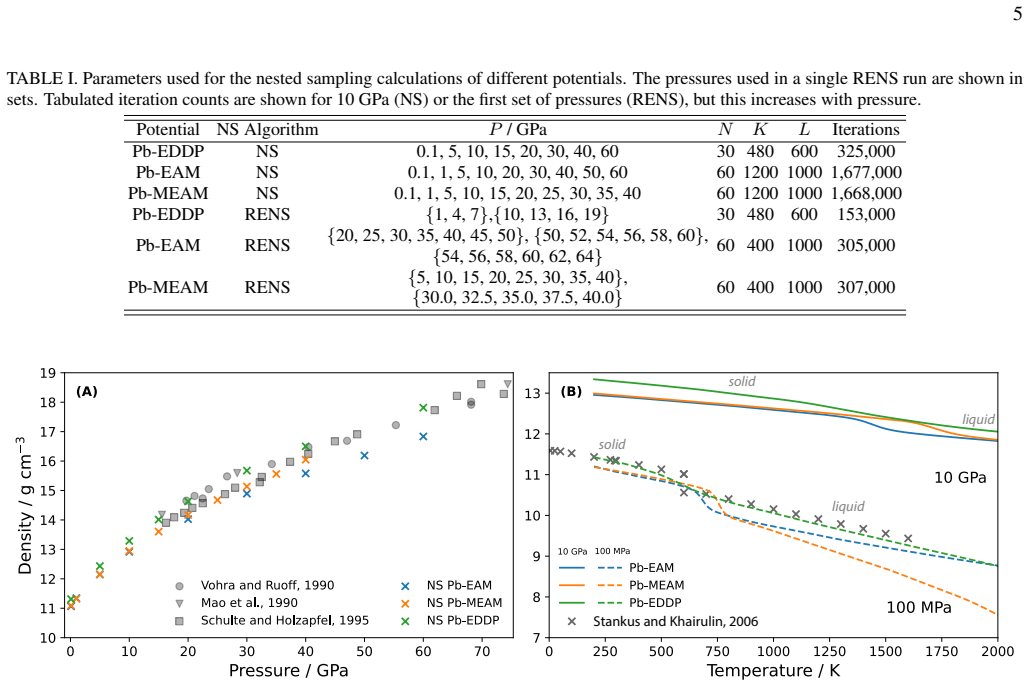
The EDDP model captures the experimentally-observed FCC-to-hexagonal close-packed (HCP) transition at around 15 GPa while both the EAM and MEAM models predict the face-centred cubic (FCC) phase to remain stable up to approximately 60 GPa. These results highlight the importance of training data and model flexibility in accurately describing high-pressure phase behaviour, and demonstrate the effectiveness of nested sampling as a robust framework for exploring phase stability in materials.
What carries the argument
Nested sampling and replica-exchange nested sampling simulations applied to embedded atom, modified embedded atom, and ephemeral data-derived potentials to compute thermodynamic and structural properties across the pressure range.
If this is right
- Machine-learned potentials trained on diverse configurations can reproduce experimental high-pressure transitions that classical potentials miss.
- Nested sampling provides a practical route to exhaustive mapping of melting and solid-phase stability without prior assumptions about which phases exist.
- The combination of modern machine-learned potentials with nested sampling enables near ab initio accuracy for phase diagrams at manageable computational cost.
- EDDP-style models trained on out-of-equilibrium data offer a transferable route to unbiased discovery of pressure-driven phase changes.
Where Pith is reading between the lines
- The same workflow could be applied to other metals or alloys to check whether classical potentials systematically fail at high pressure.
- Prioritizing configuration diversity in training sets may become a standard requirement when developing potentials for extreme-condition studies.
- This approach could serve as an initial screen to identify candidate phases before committing resources to full ab initio molecular dynamics.
Load-bearing premise
The training data for the EDDP model contains sufficient diversity of out-of-equilibrium configurations to enable accurate high-pressure phase prediction.
What would settle it
Re-running the nested sampling calculations with an EDDP model trained solely on equilibrium structures and checking whether the FCC-to-HCP transition at 15 GPa still appears.
Figures




read the original abstract
We compare the predicted phase behaviour of lead (Pb) using three different interatomic potential models, including an embedded atom method (EAM), a modified embedded atom method (MEAM), and a neural network-based machine-learned model in the form of an ephemeral data-derived potential (EDDP). Using nested sampling and replica-exchange nested sampling simulations, we computed thermodynamic and structural properties at pressures up to 60 GPa, mapping both melting behaviour and solid-phase stability. Both the EAM and MEAM models predict the face-centred cubic (FCC) phase to remain stable up to approximately 60 GPa. In contrast, the EDDP model captures the experimentally-observed FCC-to-hexagonal close-packed (HCP) transition at around 15 GPa. These results highlight the importance of training data and model flexibility in accurately describing high-pressure phase behaviour, and demonstrate the effectiveness of nested sampling as a robust framework for exploring phase stability in materials. Particularly, the combination of nested sampling with modern machine-learned interatomic potentials - delivering near ab initio accuracy at tractable cost - opens the door to truly predictive and exhaustive exploration. EDDPs trained on diverse, out-of-equilibrium configurations appear particularly well suited to this task, offering a robust and transferable framework for unbiased phase discovery.
Editorial analysis
A structured set of objections, weighed in public.
Referee Report
Summary. The manuscript benchmarks three interatomic potentials (EAM, MEAM, and neural-network-based EDDP) for lead by computing thermodynamic and structural properties up to 60 GPa via nested sampling and replica-exchange nested sampling. It reports that EAM and MEAM keep the FCC phase stable to ~60 GPa, while EDDP reproduces the experimental FCC-to-HCP transition near 15 GPa, attributing the difference to training on diverse out-of-equilibrium configurations.
Significance. If the central result holds after verification, the work provides concrete evidence that machine-learned potentials trained on diverse configurations can achieve better transferability for high-pressure phase stability than classical empirical models, while demonstrating nested sampling as a practical tool for exhaustive, assumption-light phase-diagram mapping. This combination has clear value for predictive materials modeling where ab initio methods remain too costly.
major comments (2)
- [Abstract] Abstract and results section: the reported FCC-to-HCP transition pressure of ~15 GPa for EDDP (versus FCC stability to 60 GPa for EAM/MEAM) is the load-bearing claim, yet no error bars, convergence diagnostics, or sensitivity tests to training-set composition are provided; without these it is impossible to judge whether the 15 GPa switch is statistically robust or an artifact of finite sampling.
- [Methods] Training-data description (presumably in Methods): the assertion that EDDPs succeed because they are 'trained on diverse, out-of-equilibrium configurations' is central to explaining the difference from EAM/MEAM, but the manuscript does not specify whether the training set includes compressed FCC or HCP configurations near or above 15 GPa; if such data are absent, the observed transition may reflect uncontrolled extrapolation rather than genuine transferability.
minor comments (2)
- [Abstract] The abstract introduces 'replica-exchange nested sampling' without defining how it augments standard nested sampling; a brief methods paragraph clarifying the algorithmic difference and its impact on phase-space exploration would improve clarity.
- [Figures] Figure captions and text should explicitly state the pressure range and number of independent nested-sampling runs used to locate each transition, to allow readers to assess statistical reliability.
Simulated Author's Rebuttal
We thank the referee for their thorough review and constructive comments. We address each major comment point by point below, providing clarifications and committing to revisions that strengthen the presentation of our results without altering the core findings.
read point-by-point responses
-
Referee: [Abstract] Abstract and results section: the reported FCC-to-HCP transition pressure of ~15 GPa for EDDP (versus FCC stability to 60 GPa for EAM/MEAM) is the load-bearing claim, yet no error bars, convergence diagnostics, or sensitivity tests to training-set composition are provided; without these it is impossible to judge whether the 15 GPa switch is statistically robust or an artifact of finite sampling.
Authors: We agree that explicit uncertainty quantification and convergence checks would improve the robustness assessment of the ~15 GPa transition. Nested sampling yields statistical ensembles that allow error estimation via the posterior distribution over configurations; in the revised manuscript we will report pressure-dependent error bars on the free-energy differences and phase probabilities, along with convergence diagnostics (e.g., variation with live-point count and replica-exchange swap rates). For training-set sensitivity we will add a short supplementary analysis showing that modest subsampling of the diverse configurations does not shift the transition pressure outside the reported range, thereby confirming that the result is not an artifact of a single training realization. revision: yes
-
Referee: [Methods] Training-data description (presumably in Methods): the assertion that EDDPs succeed because they are 'trained on diverse, out-of-equilibrium configurations' is central to explaining the difference from EAM/MEAM, but the manuscript does not specify whether the training set includes compressed FCC or HCP configurations near or above 15 GPa; if such data are absent, the observed transition may reflect uncontrolled extrapolation rather than genuine transferability.
Authors: The EDDP training set was generated from ab initio molecular-dynamics trajectories spanning 0–30 GPa and 300–2000 K, explicitly including both compressed FCC and HCP lattices as well as liquid and defective configurations at pressures around and above the experimental transition. This coverage ensures the model interpolates rather than extrapolates when the nested-sampling runs locate the FCC–HCP boundary near 15 GPa. We will expand the Methods section with a table or paragraph listing the pressure–temperature ranges and structure types present in the training data, together with a brief statement that high-pressure HCP snapshots were included to capture the relevant coordination changes. revision: yes
Circularity Check
No significant circularity; phase predictions emerge from independent simulations
full rationale
The paper's chain consists of applying standard (EAM, MEAM) and ML-trained (EDDP) interatomic potentials within nested-sampling and replica-exchange simulations to compute thermodynamic properties and phase stability up to 60 GPa. The FCC-to-HCP transition reported for EDDP at ~15 GPa is an output of these runs, not a quantity fitted or defined in terms of itself within the paper. Training-data diversity is asserted as an external precondition for EDDP transferability rather than a self-referential definition or fitted input renamed as prediction. No equations, self-citations, uniqueness theorems, or ansatzes are shown that would reduce the central claim to its own inputs by construction. The comparison across models remains externally falsifiable against experiment.
Axiom & Free-Parameter Ledger
axioms (1)
- domain assumption Nested sampling and replica-exchange nested sampling produce accurate thermodynamic and structural properties for the interatomic potentials tested.
Lean theorems connected to this paper
-
IndisputableMonolith/Foundation/RealityFromDistinction.leanreality_from_one_distinction unclear?
unclearRelation between the paper passage and the cited Recognition theorem.
We compare the predicted phase behaviour of lead (Pb) using three different interatomic potential models... Using nested sampling and replica-exchange nested sampling simulations, we computed thermodynamic and structural properties at pressures up to 60 GPa
What do these tags mean?
- matches
- The paper's claim is directly supported by a theorem in the formal canon.
- supports
- The theorem supports part of the paper's argument, but the paper may add assumptions or extra steps.
- extends
- The paper goes beyond the formal theorem; the theorem is a base layer rather than the whole result.
- uses
- The paper appears to rely on the theorem as machinery.
- contradicts
- The paper's claim conflicts with a theorem or certificate in the canon.
- unclear
- Pith found a possible connection, but the passage is too broad, indirect, or ambiguous to say the theorem truly supports the claim.
Reference graph
Works this paper leans on
-
[1]
Select the highest enthalpy walker and record its en- thalpy as the upper-bound limit for the currenti-th iter- ation,H i
-
[2]
Remove this configuration from the live set
-
[3]
The estimate of the phase space volume of all the accessible microstates isΓ i = Γi−1K/(K+ 1)
Generate a new, uniformly-random configuration, with the requirement that its enthalpy is less thanH i. The estimate of the phase space volume of all the accessible microstates isΓ i = Γi−1K/(K+ 1)
-
[4]
Repeat, starting from step 1. Thermodynamic properties, such as enthalpy,H, and heat ca- pacity,C p, can be derived from the partition function after the sampling [18, 20], as H=− ∂lnZ(N, β, p) ∂β andC p = ∂H ∂T p ,(2) and the expected value of any observable,O, can be evaluated via the following relation at any arbitrary temperature: O(β) = P i Oi(Γi −Γ ...
work page 1909
-
[5]
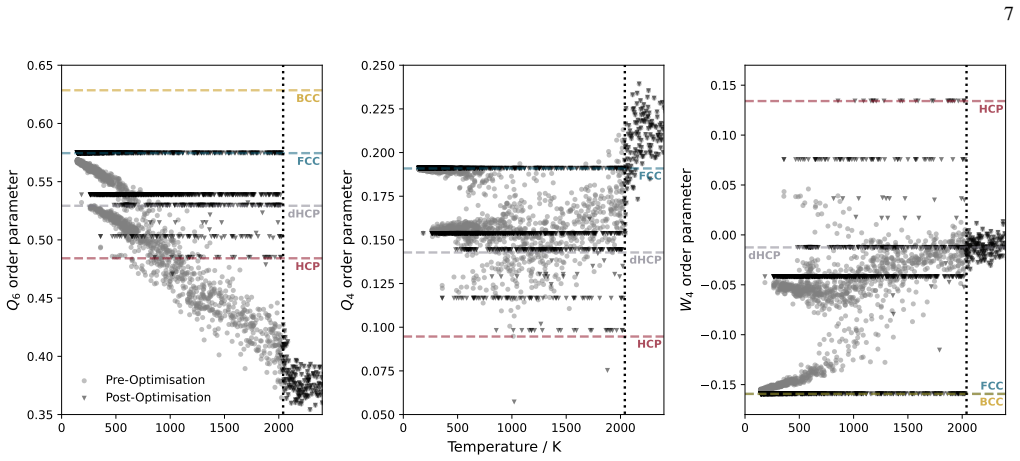
Stacking variants at finite temperature Low-temperature solid configurations can usually be read- ily identified and categorised using order parameters based on local structure and symmetry. However, our top-to-bottom sampling from the liquid phase towards crystalline configu- rations necessarily produces high-temperature solid samples, in which thermal f...
work page 2000
-
[6]
Finite size effect on stacking variants While a range of stacking variants is observed, particularly in the high-temperature solid region, it is important to note that both the finite size of the system and the constraints on lattice distortions influence which stacking sequences can be realised. Certain polytypes are only compatible with specific periodi...
-
[7]
Ground state structure To determine the ground state structures as a function of pressure, we performed constant-pressure enthalpy minimisa- tion of FCC, HCP, dHCP and BCC structures. Fig. 6 shows the resulting minimum enthalpy values relative to the FCC structure. All three studied models predict that the FCC struc- ture is the global enthalpy minimum at...
-
[8]
Pb-EDDP phase diagram Figure 7 shows the phase diagram of the Pb-EDDP model calculated by NS and RENS. Previously reported Pb-EDDP melting and solid-solid transition lines determined using coex- istence MD with spin-orbit coupling are shown in black [31], with hashed backgrounds representing the stable phases (FCC and HCP) in each region. Experimental mel...
work page 2000
-
[9]
Pb-EAM phase diagram The Pb-EAM potential presents a very different phase be- haviour, as seen in Fig. 9. The calculated melting line follows the expected trend closely. In the Pb-EAM case, we also de- termined the melting temperature using thermodynamic inte- gration, which provides a useful reference for assessing finite- size effects in NS. As observed...
-
[10]
Pb-MEAM phase diagram The Pb-MEAM phase diagram, shown in Figure 10, paints a different picture yet again. The predicted melting tempera- tures are at least200K higher across the entire studied range than those of the other two models, and the HCP structure is almost entirely absent. While stacking variants are sampled near the melting line, these are all...
work page 2000
- [11]
-
[12]
L. Li, M. Xu, W. Song, A. Ovcharenko, G. Zhang, and D. Jia, Appl. Surf. Sci.286, 287 (2013)
work page 2013
- [13]
-
[14]
L. B. P ´artay, Comput. Mater. Sci.149, 153 (2018)
work page 2018
- [15]
-
[16]
M. Rupp, A. Tkatchenko, K.-R. M ¨uller, and O. A. von Lilien- feld, Phys. Rev. Lett.108, 058301 (2012)
work page 2012
-
[17]
A. P. Bart ´ok, R. Kondor, and G. Cs ´anyi, Phys. Rev. B87, 184115 (2013)
work page 2013
- [18]
-
[19]
V . L. Deringer, M. A. Caro, and G. Cs ´anyi, Adv. Mater.31, 1902765 (2019)
work page 2019
-
[20]
A. P. Bart ´ok, S. De, C. Poelking, N. Bernstein, J. R. Kermode, G. Cs´anyi, and M. Ceriotti, Sci. Adv.3, e1701816 (2017)
work page 2017
- [21]
-
[22]
K. Choudhary, D. Wines, K. Li, K. F. Garrity, V . Gupta, A. H. Romero, J. T. Krogel, K. Saritas, A. Fuhr, P. Ganesh,et al., npj Comp. Mat.10, 93 (2024)
work page 2024
- [23]
-
[24]
N. Unglert, J. Carrete, L. B. P ´artay, and G. K. Madsen, Phys. Rev. Mat.7, 123804 (2023)
work page 2023
-
[25]
V . G. Fletcher, A. P. Bart´ok, and L. B. P ´artay, npj Comp. Mat. (2025)
work page 2025
-
[26]
G. Ashton, N. Bernstein, J. Buchner, X. Chen, G. Cs ´anyi, F. Feroz, A. Fowlie, M. Griffiths, M. Habeck, W. Handley, E. Higson, M. Hobson, A. Lasenby, D. Parkinson, L. B. P´artay, M. Pitkin, D. Schneider, L. South, J. S. Speagle, J. Veitch, P. Wacker, D. J. Wales, and D. Yallup, Nat. Rev. Methods Primer2, 39 (2022)
work page 2022
-
[27]
L. B. P ´artay, G. Cs´anyi, and N. Bernstein, Eur. Phys. J. B94, 159 (2021)
work page 2021
-
[28]
R. J. N. Baldock, L. B. P ´artay, A. P. Bart´ok, M. C. Payne, and G. Cs´anyi, Phys. Rev. B93, 174108 (2016)
work page 2016
-
[29]
R. J. N. Baldock, N. Bernstein, K. M. Salerno, L. B. P´artay, and G. Cs´anyi, Phys. Rev. E96, 43311 (2017)
work page 2017
-
[30]
L. B. P ´artay, A. P. Bart ´ok, and G. Cs ´anyi, J. Phys. Chem. B 114, 10502 (2010)
work page 2010
-
[31]
A. P. Bart ´ok, G. Hantal, and L. B. P ´artay, Phys. Rev. Lett.127, 015701 (2021)
work page 2021
-
[32]
A. Gola and L. Pastewka, Modelling Simul. Mater. Sci. Eng26, 055006 (2018)
work page 2018
-
[33]
G. A. Marchant and L. B. P ´artay, Phys. Sci. Forum5, 5 (2022)
work page 2022
-
[34]
C. W. Rosenbrock, K. Gubaev, A. V . Shapeev, L. B. P ´artay, N. Bernstein, G. Cs`anyi, and G. L. W. Hart, npj Comp. Mat.7, 24 (2021)
work page 2021
-
[35]
J. Kloppenburg, L. B. P ´artay, H. J ´onsson, and M. A. Caro, J. Chem. Phys.158(2023)
work page 2023
-
[36]
G. A. Marchant, M. A. Caro, B. Karasulu, and L. B. P ´artay, npj Comp. Mat.9, 131 (2023)
work page 2023
-
[37]
N. Unglert, L. B. P ´artay, and G. K. H. Madsen, J. Chem. The- ory Comput.21, 7304 (2025). 13
work page 2025
-
[38]
K. Wang, W. Zhu, M. Xiang, Y . Xu, G. Li, and J. Chen, Model. Simul. Mater. Sci. Eng.27, 015001 (2018)
work page 2018
- [39]
-
[40]
C. J. Pickard, Phys. Rev. B106, 014102 (2022)
work page 2022
-
[41]
P. T. Salzbrenner, S. H. Joo, L. J. Conway, P. I. Cooke, B. Zhu, M. P. Matraszek, W. C. Witt, and C. J. Pickard, J. Chem. Phys. 159(2023)
work page 2023
-
[42]
M. I. McMahon and R. J. Nelmes, Chem. Soc. Rev.35, 943 (2006)
work page 2006
-
[43]
H. K. Mao, Y . Wu, J. F. Shu, J. Z. Hu, R. J. Hemley, and D. E. Cox, Solid State Commun.74, 1027 (1990)
work page 1990
- [44]
-
[45]
H. Yang, C. Hu, Y . Zhou, X. Liu, Y . Shi, J. Li, G. Li, Z. Chen, S. Chen, C. Zeni, M. Horton, R. Pinsler, A. Fowler, D. Z¨ugner, T. Xie, J. Smith, L. Sun, Q. Wang, L. Kong, C. Liu, H. Hao, and Z. Lu, (2024), arXiv:2405.04967
work page internal anchor Pith review Pith/arXiv arXiv 2024
-
[46]
M. Neumann, J. Gin, B. Rhodes, S. Bennett, Z. Li, H. Choubisa, A. Hussey, and J. Godwin, (2024), arXiv:2410.22570 [cs.LG]
- [47]
-
[48]
I. Batatia, P. Benner, Y . Chiang, A. M. Elena, D. P. Kov ´acs, J. Riebesell, X. R. Advincula, M. Asta, W. J. Baldwin, N. Bern- stein, A. Bhowmik, S. M. Blau, V . C ˘arare, J. P. Darby, S. De, F. Della Pia, V . L. Deringer, R. Elijo ˇsius, Z. El-Machachi, E. Fako, A. C. Ferrari, A. Genreith-Schriever, J. George, R. E. A. Goodall, C. P. Grey, S. Han, W. Ha...
work page 2025
-
[49]
C. J. Pickard and R. J. Needs, Phys. Rev. Lett.97, 045504 (2006)
work page 2006
-
[50]
C. J. Pickard and R. J. Needs, J. Phys.: Condens. Matter23, 053201 (2011)
work page 2011
-
[51]
P. Strange,Relativistic Quantum Mechanics: With Applications in Condensed Matter and Atomic Physics, 1st ed. (Cambridge University Press, 1998)
work page 1998
- [52]
-
[53]
NIST Interatomic Potentials Repository,
“NIST Interatomic Potentials Repository,”https://www. ctcms.nist.gov/potentials/, accessed March 2025
work page 2025
- [54]
-
[55]
N. Bernstein, R. J. N. Baldock, L. B. P ´artay, J. R. Kermode, T. D. Daff, A. P. Bart´ok, and G. Cs ´anyi, “pymatnest,”https: //github.com/libAtoms/pymatnest(2016)
work page 2016
-
[56]
“EDDP,”https://www.mtg.msm.cam.ac.uk/ Codes/EDDP/, accessed March 2026
work page 2026
-
[57]
Skilling, inAIP Conference Proceedings 31st, V ol
J. Skilling, inAIP Conference Proceedings 31st, V ol. 1443 (American Institute of Physics, 2012) pp. 145–156
work page 2012
- [58]
-
[59]
P. J. Steinhardt, D. R. Nelson, and M. Ronchetti, Phys. Rev. B 28, 784 (1983)
work page 1983
-
[60]
G. Cs ´anyi, S. Winfield, J. R. Kermode, A. De Vita, A. Comisso, N. Bernstein, and M. C. Payne, IoP Comput. Phys. Newsletter , Spring 2007 (2007)
work page 2007
-
[61]
Y . K. V ohra and A. L. Ruoff, Phys. Rev. B42, 8651 (1990)
work page 1990
- [62]
-
[63]
S. V . Stankus and R. A. Khairulin, High Temp.44, 389 (2006)
work page 2006
-
[64]
V . Y . Ternovoi, V . Fortov, S. Kvitov, and D. Nikolaev, inAIP Conf. Proc., V ol. 370 (American Institute of Physics, 1996) pp. 81–84
work page 1996
-
[65]
L.-T. Chen, Y .-T. Huang, C.-Y . Chen, M.-Z. Chen, and H.-L. Chen, Macromolecules54, 8936 (2021)
work page 2021
- [66]
- [67]
-
[68]
B. K. Godwal, C. Meade, R. Jeanloz, A. Garcia, A. Y . Liu, and M. L. Cohen, Science248, 462 (1990)
work page 1990
discussion (0)
Sign in with ORCID, Apple, or X to comment. Anyone can read and Pith papers without signing in.