Study of dark interactions through strong gravitational lenses
Pith reviewed 2026-05-20 16:11 UTC · model grok-4.3
The pith
Strong gravitational lensing data support interacting dark energy models with an earlier transition to cosmic acceleration than the standard model predicts.
A machine-rendered reading of the paper's core claim, the machinery that carries it, and where it could break.
Core claim
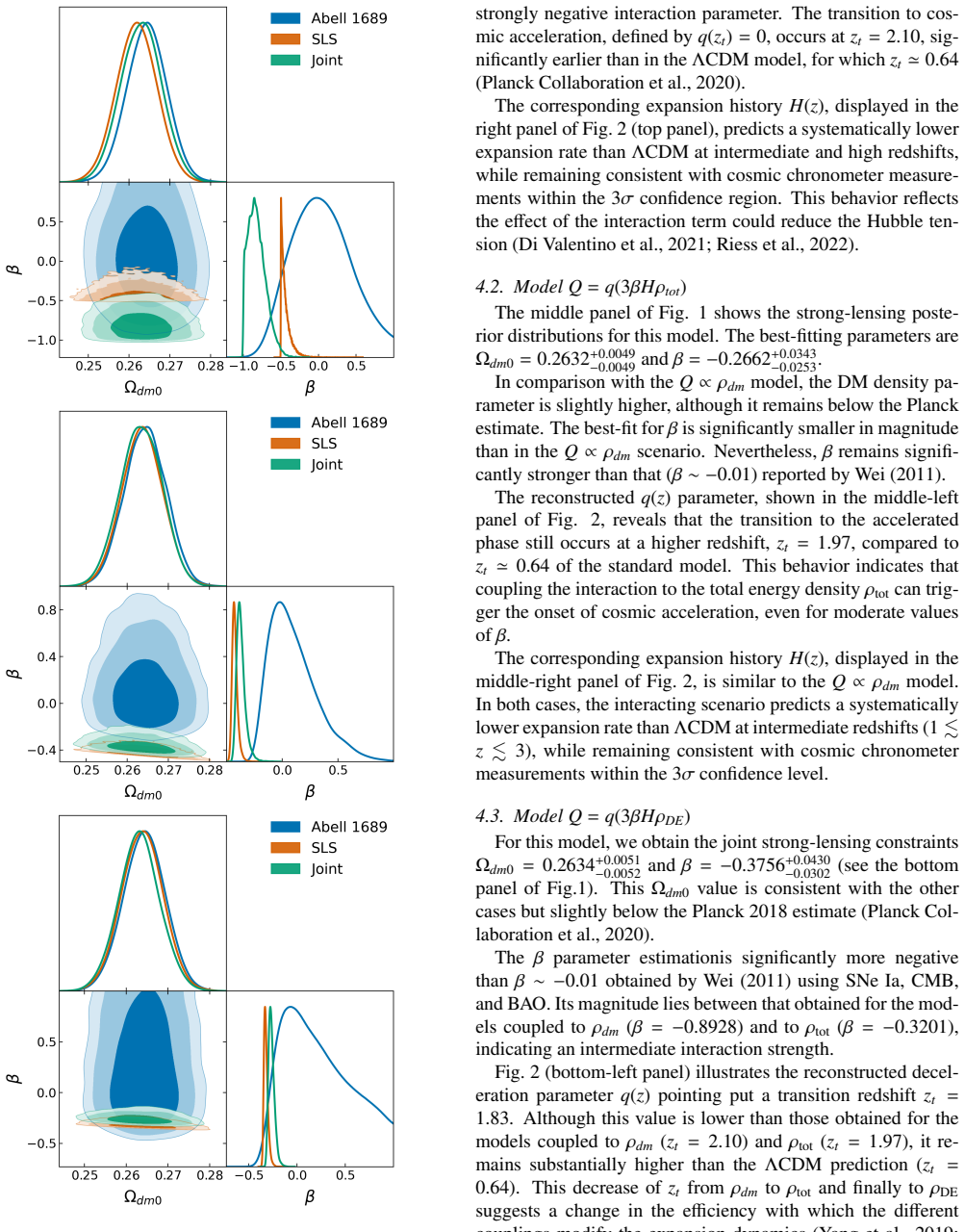
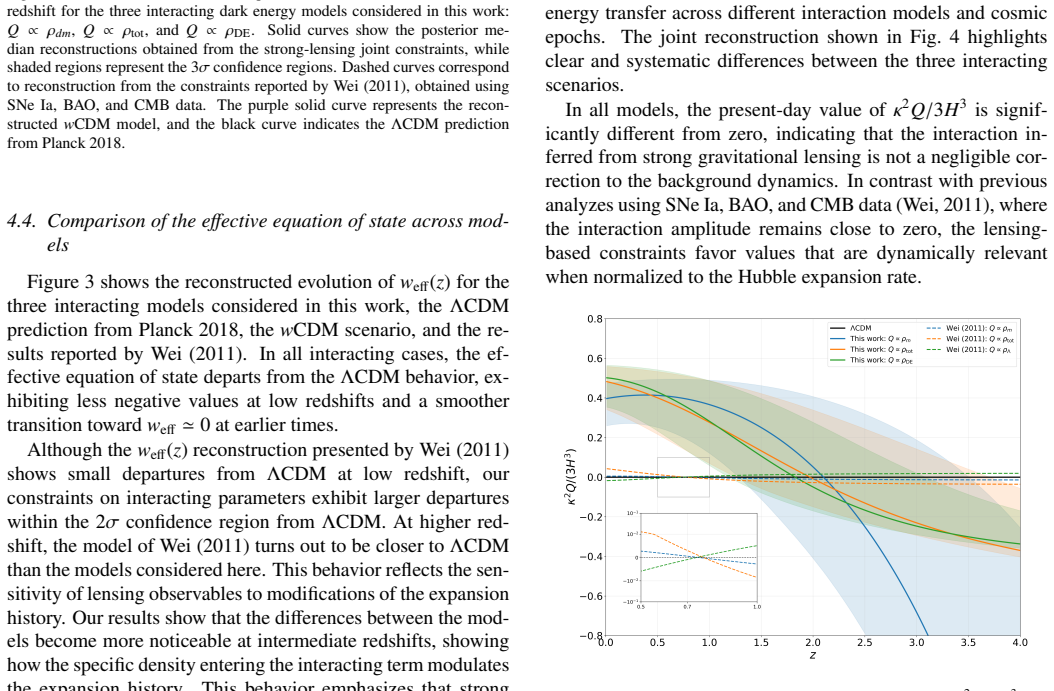
Combining strong lensing data on galaxy and cluster scales with three sign-changeable interaction models shows that the interaction parameter beta is negative for all choices of the coupling term Q. These beta values exceed in magnitude those obtained from Type Ia supernovae, CMB, and BAO analyses. The models reconstruct an expansion history in which cosmic acceleration begins at redshifts z_t approximately 1.8 to 2.1, earlier than the LambdaCDM expectation, yet the results stay consistent with cosmic chronometer constraints inside the derived confidence intervals. This establishes strong gravitational lensing as a viable and competitive probe of dark-sector interactions.
What carries the argument
Sign-changeable interaction coupling Q that depends on the deceleration parameter q and scales with dark matter density, dark energy density, or total density, constrained using strong gravitational lensing time-delay and image-position data from early-type galaxies and Abell 1689.
If this is right
- The interaction strength beta is negative in all three models, pointing to energy transfer between dark components.
- Beta values are larger in magnitude than those reported from supernovae, CMB, and BAO observations.
- The deceleration-to-acceleration transition occurs at z_t between 1.8 and 2.1.
- Reconstructed expansion histories agree with cosmic chronometer data within uncertainties.
- Strong lensing observations can independently test interacting dark energy scenarios.
Where Pith is reading between the lines
- If these earlier transition redshifts hold, they may ease apparent discrepancies between high-redshift and low-redshift expansion measurements.
- Applying the same lensing approach to larger samples could help decide which form of the coupling term Q best describes the data.
- Extensions to weak lensing or other intermediate-redshift probes might map the redshift dependence of any dark interaction.
Load-bearing premise
The measured lensing quantities are assumed to trace the background expansion history cleanly, without substantial bias from uncertainties in modeling the lens mass distributions or from selection effects in the galaxy and cluster samples.
What would settle it
Finding a transition redshift near 0.7 from independent high-redshift expansion measurements or detecting positive interaction strengths across multiple probes would contradict the reported constraints.
Figures


read the original abstract
The possible interaction between the dark components of the Universe (dark matter and dark energy) stands as an attractive alternative to the standard $\Lambda$CDM cosmological model. In this work, we present a novel analysis of three sign-changeable interaction models whose coupling term $Q$ depends explicitly on the deceleration parameter $q$ and is proportional to different energy densities: dark matter, dark energy, and total energy density. To constrain these models, we combine strong gravitational lensing data on two complementary scales: a sample of early-type galaxies acting as lenses and the galaxy cluster Abell 1689. Our results show that the interaction strength $\beta$ depends on the choice of the coupling term $Q$, with all models yielding negative values of $\beta$, indicative of a dark interaction scenario. The $\beta$ values obtained in this work are significantly larger in magnitude than those previously reported using Type Ia supernovae, CMB, and BAO. The strong-lensing constraints indicate a transition to cosmic acceleration at earlier redshifts ($z_t \sim 1.8-2.1$) than that predicted by the $\Lambda$CDM model, while remaining consistent with cosmic chronometer measurements within the reconstructed confidence regions. Therefore, our study shows that strong gravitational lensing data provide an independent and competitive cosmological probe capable of testing interacting dark energy scenarios. The sensitivity of lensing observables to the expansion history enables access to complementary information about dark-sector dynamics beyond standard cosmological probes.
Editorial analysis
A structured set of objections, weighed in public.
Referee Report
Summary. The manuscript examines three sign-changeable interacting dark-energy models in which the coupling term Q is proportional to the deceleration parameter q and to one of three energy densities (dark matter, dark energy, or total). Strong-lensing observables from a sample of early-type galaxies and the cluster Abell 1689 are used to constrain the interaction strength β. The reported results are negative β values of larger magnitude than those obtained from SNIa+CMB+BAO, together with an acceleration transition redshift z_t ≈ 1.8–2.1 that is earlier than the ΛCDM prediction while remaining consistent with cosmic-chronometer data.
Significance. If the lensing-derived constraints prove robust, the work establishes strong gravitational lensing as a competitive, independent probe of interacting dark-sector models. The use of two complementary scales (galaxy and cluster) and the explicit q-dependence in Q are positive features that could supply falsifiable predictions for future surveys.
major comments (2)
- [Abstract and §4] Abstract and §4 (Data and Methodology): the central claim that lensing observables directly encode the background expansion history and yield z_t ∼ 1.8–2.1 rests on the assumption that Einstein radii and image positions are free of significant contamination from lens-mass-profile systematics (SIS or power-law for galaxies; multi-component NFW or free-form for Abell 1689). No explicit marginalization over profile parameters or selection effects is described; any residual mismatch propagates directly into the inferred distance ratios and therefore into β and q(z). This is load-bearing for the reported deviation from ΛCDM.
- [§5] §5 (Results): the abstract states negative β values and an earlier z_t without accompanying error budgets, covariance matrices, or tables of best-fit parameters and χ² values. Without these, it is impossible to judge whether the larger |β| and the shift in z_t are statistically significant or sensitive to the choice of priors on the lens redshifts and velocity dispersions.
minor comments (3)
- [§2] Define the three explicit functional forms of Q(q,ρ) in the introduction or §2 so that the reader can immediately see how each model differs.
- [§4] Add a table listing the lens redshifts, Einstein radii, and velocity dispersions used for the early-type galaxy sample.
- [Figures] Ensure all figures display 1σ and 2σ contours and label the ΛCDM reference line for direct visual comparison.
Simulated Author's Rebuttal
We thank the referee for the thoughtful and constructive report. We address each major comment in turn below, indicating where revisions have been made to improve the manuscript.
read point-by-point responses
-
Referee: [Abstract and §4] Abstract and §4 (Data and Methodology): the central claim that lensing observables directly encode the background expansion history and yield z_t ∼ 1.8–2.1 rests on the assumption that Einstein radii and image positions are free of significant contamination from lens-mass-profile systematics (SIS or power-law for galaxies; multi-component NFW or free-form for Abell 1689). No explicit marginalization over profile parameters or selection effects is described; any residual mismatch propagates directly into the inferred distance ratios and therefore into β and q(z). This is load-bearing for the reported deviation from ΛCDM.
Authors: We agree that the mass-profile assumptions are important and that explicit checks strengthen the analysis. The original manuscript adopted the SIS profile for the early-type galaxy sample and a multi-component NFW model for Abell 1689, choices justified by the well-studied properties of these systems and consistent with prior lensing studies. To address the referee’s concern directly, the revised §4 now includes marginalization over the power-law density slope for the galaxies and over the NFW concentration parameter for the cluster. A short discussion of possible selection effects has also been added. The updated constraints on β and z_t remain consistent with the original results within the enlarged uncertainties and are reported in the revised §5. revision: yes
-
Referee: [§5] §5 (Results): the abstract states negative β values and an earlier z_t without accompanying error budgets, covariance matrices, or tables of best-fit parameters and χ² values. Without these, it is impossible to judge whether the larger |β| and the shift in z_t are statistically significant or sensitive to the choice of priors on the lens redshifts and velocity dispersions.
Authors: We acknowledge that the statistical presentation was insufficient. The revised manuscript adds a new table in §5 that reports the best-fit values and 1σ uncertainties for β and z_t in each model, together with χ²/dof and the covariance matrix for the key parameters. We have also added an explicit test of sensitivity to priors on lens redshifts and velocity dispersions, confirming that the negative β values and the shift in z_t are robust. The abstract has been updated to quote the uncertainties on the reported β values. revision: yes
Circularity Check
No circularity: lensing observables fitted to interaction models yield independent z_t and β constraints
full rationale
The paper constrains three Q(q)-dependent interaction models by fitting β directly to strong-lensing data (Einstein radii and image positions from early-type galaxies plus Abell 1689). The reported transition redshift z_t ∼ 1.8–2.1 is obtained by solving the fitted Friedmann equation for the deceleration-parameter zero-crossing; this is a standard forward prediction from the posterior, not a re-expression of the input data or a self-citation chain. No equations redefine observables in terms of the target quantities, no uniqueness theorem is imported from prior author work, and no ansatz is smuggled via citation. The derivation therefore remains self-contained against external lensing and chronometer benchmarks.
Axiom & Free-Parameter Ledger
free parameters (1)
- β
axioms (1)
- domain assumption Background evolution follows the standard Friedmann equations modified by the interaction term Q.
invented entities (1)
-
sign-changeable interaction term Q(q, ρ)
no independent evidence
Lean theorems connected to this paper
-
IndisputableMonolith.Cost.FunctionalEquationwashburn_uniqueness_aczel unclear?
unclearRelation between the paper passage and the cited Recognition theorem.
three sign-changeable interaction models whose coupling term Q depends explicitly on the deceleration parameter q and is proportional to different energy densities... β∈[−1,1]
-
IndisputableMonolith.Foundation.RealityFromDistinctionreality_from_one_distinction unclear?
unclearRelation between the paper passage and the cited Recognition theorem.
The strong-lensing constraints indicate a transition to cosmic acceleration at earlier redshifts (z_t ∼ 1.8-2.1)
What do these tags mean?
- matches
- The paper's claim is directly supported by a theorem in the formal canon.
- supports
- The theorem supports part of the paper's argument, but the paper may add assumptions or extra steps.
- extends
- The paper goes beyond the formal theorem; the theorem is a base layer rather than the whole result.
- uses
- The paper appears to rely on the theorem as machinery.
- contradicts
- The paper's claim conflicts with a theorem or certificate in the canon.
- unclear
- Pith found a possible connection, but the passage is too broad, indirect, or ambiguous to say the theorem truly supports the claim.
Reference graph
Works this paper leans on
-
[1]
Caminha, G. B. and Suyu, S. H. and Grillo, C. and Rosati, P. Galaxy cluster strong lensing cosmography - Cosmological constraints from a sample of regular galaxy clusters. Astron. Astrophys. 2022. doi:10.1051/0004-6361/202141994. arXiv:2110.06232
-
[2]
Discriminating interacting dark energy models using Statefinder diagnostic
Carrasco, Raul and Rincon, Angel and Saavedra, Joel and Videla, Nelson. Discriminating interacting dark energy models using Statefinder diagnostic. Eur. Phys. J. C. 2024. doi:10.1140/epjc/s10052-024-12733-6. arXiv:2310.04324
-
[3]
On sign-changeable interaction in FLRW cosmology
Arevalo, Fabiola and Cid, Antonella and Chimento, Luis P. and Mella, Patricio. On sign-changeable interaction in FLRW cosmology. Eur. Phys. J. C. 2019. doi:10.1140/epjc/s10052-019-6872-7. arXiv:1901.04300
work page internal anchor Pith review Pith/arXiv arXiv doi:10.1140/epjc/s10052-019-6872-7 2019
-
[4]
Di Valentino, Eleonora and others. The CosmoVerse White Paper: Addressing observational tensions in cosmology with systematics and fundamental physics. Phys. Dark Univ. 2025. doi:10.1016/j.dark.2025.101965. arXiv:2504.01669
-
[5]
Bolotin, Yu. L. and Kostenko, A. and Lemets, O. A. and Yerokhin, D. A. Cosmological Evolution With Interaction Between Dark Energy And Dark Matter. Int. J. Mod. Phys. D. 2014. doi:10.1142/S0218271815300074. arXiv:1310.0085
work page internal anchor Pith review Pith/arXiv arXiv doi:10.1142/s0218271815300074 2014
-
[6]
Can interacting dark energy solve the $H_0$ tension?
Can interacting dark energy solve the H _ 0 tension?. Physical Review D , keywords =. doi:10.1103/PhysRevD.96.043503 , archivePrefix =. 1704.08342 , primaryClass =
work page internal anchor Pith review Pith/arXiv arXiv doi:10.1103/physrevd.96.043503
-
[7]
and Hern \'a ndez-Almada, Alberto and Maga \ n a, Juan and Verdugo, Tom \'a s
Motta, Ver \'o nica and Garc \' a-Aspeitia, Miguel A. and Hern \'a ndez-Almada, Alberto and Maga \ n a, Juan and Verdugo, Tom \'a s. Taxonomy of Dark Energy Models. Universe. 2021. doi:10.3390/universe7060163. arXiv:2104.04642
-
[8]
The Pantheon+ Analysis: The Full Dataset and Light-Curve Release
Scolnic, Dan and others. The Pantheon+ Analysis: The Full Data Set and Light-curve Release. Astrophys. J. 2022. doi:10.3847/1538-4357/ac8b7a. arXiv:2112.03863
work page internal anchor Pith review Pith/arXiv arXiv doi:10.3847/1538-4357/ac8b7a 2022
-
[9]
A Comprehensive Measurement of the Local Value of the Hubble Constant with 1 km s ^ -1 Mpc ^ -1 Uncertainty from the Hubble Space Telescope and the SH0ES Team. The Astrophysical Journall , keywords =. doi:10.3847/2041-8213/ac5c5b , archivePrefix =. 2112.04510 , primaryClass =
work page internal anchor Pith review Pith/arXiv arXiv doi:10.3847/2041-8213/ac5c5b 2041
-
[10]
Observational Evidence from Supernovae for an Accelerating Universe and a Cosmological Constant. The Astronomical Journal , year = 1998, volume = 116, pages =. doi:10.1086/300499 , adsurl =
work page internal anchor Pith review doi:10.1086/300499 1998
-
[11]
1999, The Astrophysical Journal, 517, 565, doi: 10.1086/307221
Measurements of and from 42 High-Redshift Supernovae. The Astrophysical Journal , year = 1999, volume = 517, pages =. doi:10.1086/307221 , adsurl =
work page internal anchor Pith review doi:10.1086/307221 1999
-
[12]
Planck 2018 results. VI. Cosmological parameters. Astronomy and Astrophysics , year = 2020, volume = 641, pages =. doi:10.1051/0004-6361/201833910 , adsurl =
-
[13]
Cosmological Constraints on the Sign-Changeable Interactions , volume=
Wei, Hao , year=. Cosmological Constraints on the Sign-Changeable Interactions , volume=. Communications in Theoretical Physics , publisher=. doi:10.1088/0253-6102/56/5/29 , number=
-
[14]
Testing dark energy models with a new sample of strong-lensing systems , volume=
Amante, Mario H and Magaña, Juan and Motta, V and García-Aspeitia, Miguel A and Verdugo, Tomás , year=. Testing dark energy models with a new sample of strong-lensing systems , volume=. Monthly Notices of the Royal Astronomical Society , publisher=. doi:10.1093/mnras/staa2760 , number=
-
[15]
Science , year = 2010, volume = 329, pages =
Cosmological Constraints from Strong Gravitational Lensing in Clusters of Galaxies. Science , year = 2010, volume = 329, pages =. doi:10.1126/science.1185759 , adsurl =
-
[16]
European Physical Journal C , keywords =
Synchronize your chrono-brane: testing a variable brane tension model with strong gravitational lensing. European Physical Journal C , keywords =. doi:10.1140/epjc/s10052-024-12434-0 , archivePrefix =. 2401.06376 , primaryClass =
-
[17]
Moresco, Michele and Pozzetti, Lucia and Cimatti, Andrea and Jimenez, Raul and Maraston, Claudia and Verde, Licia and Thomas, Daniel and Citro, Annalisa and Tojeiro, Rita and Wilkinson, David. A 6 \. JCAP. 2016. doi:10.1088/1475-7516/2016/05/014. arXiv:1601.01701
work page internal anchor Pith review Pith/arXiv arXiv doi:10.1088/1475-7516/2016/05/014 2016
-
[19]
In the Realm of the Hubble tension $-$ a Review of Solutions
In the realm of the Hubble tension-a review of solutions. Classical and Quantum Gravity , keywords =. doi:10.1088/1361-6382/ac086d , archivePrefix =. 2103.01183 , primaryClass =
work page internal anchor Pith review Pith/arXiv arXiv doi:10.1088/1361-6382/ac086d
-
[20]
Strong Lensing Modeling in Galaxy Clusters as a Promising Method to Test Cosmography. I. Parametric Dark Energy Models. The Astrophysical Journal , keywords =. doi:10.3847/1538-4357/aada7d , archivePrefix =. 1711.00829 , primaryClass =
work page internal anchor Pith review Pith/arXiv arXiv doi:10.3847/1538-4357/aada7d
-
[21]
Dynamics of Dark Energy. International Journal of Modern Physics D , keywords =. doi:10.1142/S021827180600942X , archivePrefix =. hep-th/0603057 , primaryClass =
work page internal anchor Pith review Pith/arXiv arXiv doi:10.1142/s021827180600942x
-
[22]
Dark energy cosmology: the equivalent description via different theoretical models and cosmography tests. Astrophysics and Space Science , keywords =. doi:10.1007/s10509-012-1181-8 , archivePrefix =. 1205.3421 , primaryClass =
work page internal anchor Pith review Pith/arXiv arXiv doi:10.1007/s10509-012-1181-8
-
[23]
Dark matter and dark energy interactions: theoretical challenges, cosmological implications and observational signatures. Reports on Progress in Physics , keywords =. doi:10.1088/0034-4885/79/9/096901 , archivePrefix =. 1603.08299 , primaryClass =
work page internal anchor Pith review Pith/arXiv arXiv doi:10.1088/0034-4885/79/9/096901
-
[24]
Echo of interactions in the dark sector
Echo of interactions in the dark sector. Physical Review D , keywords =. doi:10.1103/PhysRevD.96.103511 , archivePrefix =. 1702.02143 , primaryClass =
work page internal anchor Pith review Pith/arXiv arXiv doi:10.1103/physrevd.96.103511
-
[25]
Cai, Rong-Gen and Su, Qiping , title =. Phys. Rev. D , volume =. 2010 , doi =. 0912.1943 , archivePrefix =
work page internal anchor Pith review Pith/arXiv arXiv 2010
-
[26]
Schneider, P. and Ehlers, J. and Falco, E. E. , Title =. 1992 , Pages =
work page 1992
-
[27]
Peebles, P. J. E. and Ratra, Bharat , title =. Reviews of Modern Physics , volume =. 2003 , doi =
work page 2003
- [28]
-
[29]
Limousin, M. and Richard, J. and Jullo, E. and Kneib, J.-P. and Fort, B. and Soucail, G. and El. Combining Strong and Weak Gravitational Lensing in Abell 1689 , journal =. 2007 , month =
work page 2007
-
[30]
Jullo, E. and Kneib, J.-P. and Limousin, M. and. A Bayesian approach to strong lensing modelling of galaxy clusters , journal =. 2007 , volume =. doi:10.1088/1367-2630/9/12/447 , note =
- [31]
-
[32]
IEEE transactions on automatic control , volume=
A new look at the statistical model identification , author=. IEEE transactions on automatic control , volume=. 1974 , publisher=
work page 1974
-
[33]
The annals of statistics , volume=
Estimating the dimension of a model , author=. The annals of statistics , volume=. 1978 , publisher=
work page 1978
-
[34]
Physical Review Letters , volume =
Quintessence, Cosmic Coincidence, and the Cosmological Constant , author =. Physical Review Letters , volume =. 1999 , doi =
work page 1999
-
[35]
Model Selection with Strong-lensing Systems
Leaf, Kyle and Melia, Fulvio , title =. Monthly Notices of the Royal Astronomical Society , volume =. 2018 , doi =. 1805.08640 , archivePrefix =
work page internal anchor Pith review Pith/arXiv arXiv 2018
-
[36]
Cao, S. and Biesiada, M. and Gavazzi, R. and Pi. Cosmology with Strong Lensing Systems , journal =. 2015 , doi =
work page 2015
-
[37]
M. Chevallier and D. Polarski , title =. Int. J. Mod. Phys. D , volume =. 2001 , eprint =
work page 2001
-
[38]
Exploring the Expansion History of the Universe , author =. Phys. Rev. Lett. , volume =. 2003 , month =. doi:10.1103/PhysRevLett.90.091301 , url =
-
[39]
Jassal, H. K. and Bagla, J. S. and Padmanabhan, T. , title =. Monthly Notices of the Royal Astronomical Society: Letters , volume =. 2005 , month =. doi:10.1111/j.1745-3933.2005.08577.x , url =
-
[40]
Barboza, E.M. and Alcaniz, J.S. , year=. A parametric model for dark energy , volume=. Physics Letters B , publisher=. doi:10.1016/j.physletb.2008.08.012 , number=
-
[41]
A new class of parametrization for dark energy without divergence , volume=
Feng, Chao-Jun and Shen, Xian-Yong and Li, Ping and Li, Xin-Zhou , year=. A new class of parametrization for dark energy without divergence , volume=. Journal of Cosmology and Astroparticle Physics , publisher=. doi:10.1088/1475-7516/2012/09/023 , number=
-
[42]
Sendra, Irene and Lazkoz, Ruth , year=. Supernova and baryon acoustic oscillation constraints on (new) polynomial dark energy parametrizations: current results and forecasts: Constraints on dark energy parametrizations , volume=. Monthly Notices of the Royal Astronomical Society , publisher=. doi:10.1111/j.1365-2966.2012.20661.x , number=
-
[43]
M. Moresco and A. Cimatti and R. Jimenez and L. Pozzetti and G. Zamorani and M. Bolzonella and J. Dunlop and F. Lamareille and M. Mignoli and H. Pearce and P. Rosati and D. Stern and L. Verde and E. Zucca and C.M. Carollo and T. Contini and J.-P. Kneib and O. Le Fèvre and S.J. Lilly and V. Mainieri and A. Renzini and M. Scodeggio and I. Balestra and R. Go...
work page internal anchor Pith review doi:10.1088/1475-7516/2012/08/006 2012
-
[44]
Moresco, Michele and Jimenez, Raul and Cimatti, Andrea and Pozzetti, Lucia , year=. Constraining the expansion rate of the Universe using low-redshift ellipticals as cosmic chronometers , volume=. Journal of Cosmology and Astroparticle Physics , publisher=. doi:10.1088/1475-7516/2011/03/045 , number=
-
[45]
Effects of Anisotropic Stress in Interacting Dark Matter - Dark Energy Scenarios
Effects of anisotropic stress in interacting dark matter - dark energy scenarios. Monthly Notices of the Royal Astronomical Society , keywords =. doi:10.1093/mnras/sty2789 , archivePrefix =. 1804.08455 , primaryClass =
work page internal anchor Pith review Pith/arXiv arXiv doi:10.1093/mnras/sty2789
-
[46]
Physics of the Dark Universe , keywords =
Exploring parametrized dark energy models in interacting scenario. Physics of the Dark Universe , keywords =. doi:10.1016/j.dark.2025.101951 , archivePrefix =. 2505.16438 , primaryClass =
-
[47]
Mapping the Cosmological Expansion
Mapping the cosmological expansion. Reports on Progress in Physics , keywords =. doi:10.1088/0034-4885/71/5/056901 , archivePrefix =. 0801.2968 , primaryClass =
work page internal anchor Pith review Pith/arXiv arXiv doi:10.1088/0034-4885/71/5/056901
-
[48]
Constraints on cosmological models from strong gravitational lensing systems
Constraints on cosmological models from strong gravitational lensing systems. Journal of Cosmology and Astroparticle Physics , keywords =. doi:10.1088/1475-7516/2012/03/016 , archivePrefix =. 1105.6226 , primaryClass =
work page internal anchor Pith review Pith/arXiv arXiv doi:10.1088/1475-7516/2012/03/016 2012
-
[49]
A magnified glance into the dark sector: probing cosmological models with strong lensing in A1689
A Magnified Glance into the Dark Sector: Probing Cosmological Models with Strong Lensing in A1689. The Astrophysical Journal , keywords =. doi:10.1088/0004-637X/813/1/69 , archivePrefix =. 1509.08162 , primaryClass =
work page internal anchor Pith review Pith/arXiv arXiv doi:10.1088/0004-637x/813/1/69
-
[50]
Strong Gravitational Lensing and Dark Energy Complementarity
Strong gravitational lensing and dark energy complementarity. Physical Review D , keywords =. doi:10.1103/PhysRevD.70.043534 , archivePrefix =. astro-ph/0401433 , primaryClass =
work page internal anchor Pith review Pith/arXiv arXiv doi:10.1103/physrevd.70.043534
-
[51]
Lensing Time Delays and Cosmological Complementarity
Lensing time delays and cosmological complementarity. Physical Review D , keywords =. doi:10.1103/PhysRevD.84.123529 , archivePrefix =. 1109.2592 , primaryClass =
work page internal anchor Pith review Pith/arXiv arXiv doi:10.1103/physrevd.84.123529
-
[52]
Journal of High Energy Astrophysics , keywords =
Cosmological constraints on the phenomenological interacting dark energy model with Fermi gamma-ray bursts and DESI DR2. Journal of High Energy Astrophysics , keywords =. doi:10.1016/j.jheap.2025.100534 , archivePrefix =. 2511.16032 , primaryClass =
-
[53]
Nuclear Physics B , keywords =
The peculiar case of the Viaggiu holographic dark energy. Nuclear Physics B , keywords =. doi:10.1016/j.nuclphysb.2026.117368 , archivePrefix =. 2603.15067 , primaryClass =
-
[54]
Viaggiu holographic dark energy in light of DESI DR2
Viaggiu holographic dark energy in light of DESI DR2. arXiv e-prints , keywords =. doi:10.48550/arXiv.2603.15178 , archivePrefix =. 2603.15178 , primaryClass =
work page internal anchor Pith review Pith/arXiv arXiv doi:10.48550/arxiv.2603.15178
-
[55]
Reconstructing the cosmic expansion with a generalized q(z) parameterization: A decelerating Universe from late-time constraints. arXiv e-prints , keywords =
-
[56]
Reports on Progress in Physics , keywords =
Further understanding the interaction between dark energy and dark matter: current status and future directions. Reports on Progress in Physics , keywords =. doi:10.1088/1361-6633/ad2527 , archivePrefix =. 2402.00819 , primaryClass =
-
[57]
Constraints on interacting dark energy models from Planck 2015 and redshift-space distortion data
Constraints on interacting dark energy models from Planck 2015 and redshift-space distortion data. Journal of Cosmology and Astroparticle Physics , keywords =. doi:10.1088/1475-7516/2017/01/028 , archivePrefix =. 1605.04138 , primaryClass =
work page internal anchor Pith review Pith/arXiv arXiv doi:10.1088/1475-7516/2017/01/028 2015
-
[58]
Physical Review D , keywords =
Interacting dark energy after DESI DR2: A challenge for the CDM paradigm?. Physical Review D , keywords =. doi:10.1103/5y21-k39n , archivePrefix =. 2504.00994 , primaryClass =
-
[59]
Aspects of Everpresent . Part I. A fluctuating cosmological constant from spacetime discreteness. Journal of Cosmology and Astroparticle Physics , keywords =. doi:10.1088/1475-7516/2023/10/047 , archivePrefix =. 2304.03819 , primaryClass =
-
[60]
The Quintom theory of dark energy after DESI DR2
The Quintom theory of dark energy after DESI DR2. arXiv e-prints , keywords =. doi:10.48550/arXiv.2505.24732 , archivePrefix =. 2505.24732 , primaryClass =
work page internal anchor Pith review Pith/arXiv arXiv doi:10.48550/arxiv.2505.24732
-
[61]
Journal of Cosmology and Astroparticle Physics , keywords =
Is local H _ 0 at odds with dark energy EFT?. Journal of Cosmology and Astroparticle Physics , keywords =. doi:10.1088/1475-7516/2022/04/004 , archivePrefix =. 2202.03906 , primaryClass =
-
[62]
Physics of the Dark Universe , keywords =
How much has DESI dark energy evolved since DR1?. Physics of the Dark Universe , keywords =. doi:10.1016/j.dark.2026.102268 , archivePrefix =. 2504.04417 , primaryClass =
-
[63]
Nonparametric late-time expansion history reconstruction and implications for the Hubble tension in light of recent DESI and type Ia supernovae data , author =. Phys. Rev. D , volume =. 2024 , month =. doi:10.1103/PhysRevD.110.123519 , url =
discussion (0)
Sign in with ORCID, Apple, or X to comment. Anyone can read and Pith papers without signing in.