Covariant Holographic Entanglement Entropy Inversion to Reconstruct Bulk Geometry
Pith reviewed 2026-05-20 18:02 UTC · model grok-4.3
The pith
Covariant holographic entanglement entropy reconstructs the bulk radial geometry only when fixed-kappa family reconstructions agree on a shared radial coordinate.
A machine-rendered reading of the paper's core claim, the machinery that carries it, and where it could break.
Core claim
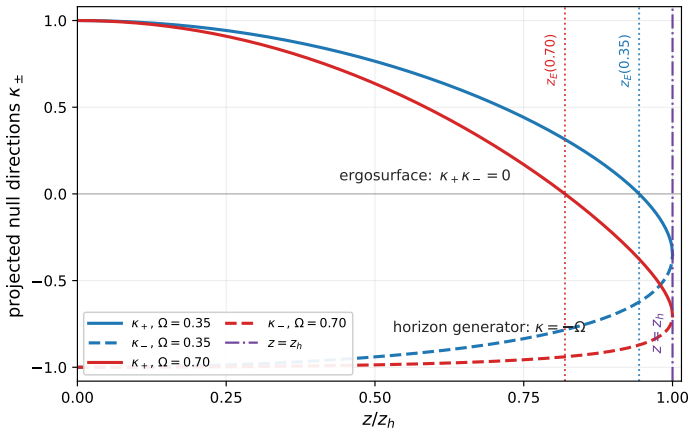
In stationary homogeneous three-dimensional geometries the renormalized interval entropy S(Δt, Δx) is an on-shell Hamilton-Jacobi functional. Its endpoint derivatives fix the conserved charges of the extremal geodesic, and the ratio of these charges organizes the data into fixed-kappa families. For each family an Abel-type reconstruction produces a radial metric block. A single classical geometry is recovered precisely when the blocks from distinct fixed-kappa families agree as functions of one common radial coordinate; this cross-family agreement is the integrability condition of the covariant inverse problem. Satisfaction of the condition determines the projected Lorentzian light cone, the
What carries the argument
The cross-family compatibility condition that equates radial-metric reconstructions from different fixed-kappa families, serving as the integrability condition for the covariant inverse problem.
If this is right
- When the compatibility condition is satisfied, the reconstructed radial metric block uniquely determines the frame-dragging term and the locations of the horizon generator and stationary-limit surface.
- The method recovers the expected geometries for pure AdS, rotating BTZ, and a boosted Einstein-scalar black brane.
- For a thin-shell obstruction or multi-branch data the compatibility condition fails, signaling that no single classical radial geometry exists.
- The projected Lorentzian light cone is fixed once the radial block is obtained, including causal structure information.
Where Pith is reading between the lines
- The same integrability requirement may serve as a diagnostic for whether a given set of entanglement data is consistent with a classical bulk in less symmetric settings.
- Numerical checks on holographic models with known exact solutions could verify whether the radial-coordinate matching holds to the expected precision.
- Extending the construction to include sub-leading corrections in the entropy functional would test how robust the integrability condition remains beyond the classical area term.
Load-bearing premise
The assumption that the HRT problem reduces to a one-dimensional radial variational problem for stationary homogeneous three-dimensional geometries.
What would settle it
Explicit computation for a known solution such as rotating BTZ showing that the radial metric block reconstructed from one fixed-kappa family differs from the block obtained from a second family at some common radial coordinate.
Figures
read the original abstract
We present an analytic inversion of covariant holographic entanglement entropy beyond equal-time inversion, in which only one effective radial coefficient remains after the radial gauge and transverse density are fixed. The formula reconstructs the stationary radial metric block probed by the corresponding HRT geodesics, including a nontrivial spatial warp factor and the the stationary shift associated with frame dragging. In this sector, the renormalized interval entropy \(S(\Delta t,\Delta x)\) is an on-shell Hamilton--Jacobi functional. Its endpoint derivatives determine the conserved charges of the corresponding extremal geodesic, and their ratio characterizes the projective class of the endpoint covector associated with the boundary interval, $\kappa=E/J=-\partial_{\Delta t} S_{\rm ren}/\partial_{\Delta x} S_{\rm ren}$. For each fixed \(\kappa\), the entropy data define an Abel-type reconstruction of a radial metric block. A single classical geometry is obtained only when the reconstructions from different fixed-\(\kappa\) families agree as functions of one common radial coordinate. This cross-family compatibility condition is the integrability condition of the covariant inverse problem. The analysis is restricted to the classical Hubeny--Rangamani- Takayanagi(HRT) area term.
Editorial analysis
A structured set of objections, weighed in public.
Referee Report
Summary. The manuscript develops a method to reconstruct the bulk radial geometry from covariant holographic entanglement entropy (HEE) in stationary homogeneous three-dimensional spacetimes. It reduces the Hubeny-Rangamani-Takayanagi (HRT) extremization to a one-dimensional radial variational problem, interprets the renormalized interval entropy S(Δt, Δx) as an on-shell Hamilton-Jacobi functional whose endpoint derivatives supply conserved charges, organizes data into fixed-κ families via the charge ratio, performs an Abel-type inversion to obtain a radial metric block for each family, and identifies agreement of these blocks on a single common radial coordinate as the integrability condition required for a unique classical geometry. When satisfied, the block determines the projected Lorentzian light cone, frame dragging, horizon generator, and stationary-limit surface. The construction is illustrated with explicit derivations and examples including pure AdS, rotating BTZ, static warped metrics, boosted Einstein-scalar branes, higher-dimensional strips, and thin-shell obstructions, all restricted to the classical area term and smooth single-branch data.
Significance. If the central construction holds, the paper supplies a concrete, data-driven procedure for inverting covariant HEE to recover bulk geometry within a well-defined sector, using variational principles and a cross-family compatibility condition as the integrability requirement. Strengths include the explicit reduction to the radial problem, charge extraction from the Hamilton-Jacobi structure, the inversion formula, the light-cone reconstruction, and multiple worked examples that verify the compatibility condition is both necessary and sufficient inside the stated restrictions. These elements provide a falsifiable test for the inverse problem and could inform broader efforts to extract bulk data from entanglement in holographic settings.
major comments (2)
- [§2] §2 (reduction to radial variational problem): the claim that the HRT problem reduces exactly to a one-dimensional radial problem for stationary homogeneous 3D geometries is load-bearing for the entire inversion; while the examples are consistent, an explicit derivation showing that the extremal surface equation decouples from angular or time dependence under the homogeneity assumption would confirm the reduction is not an additional restriction.
- [§4] §4 (Abel-type inversion and cross-family agreement): the statement that agreement of reconstructions from different fixed-κ families on a common radial coordinate is the integrability condition is central; the examples demonstrate necessity and sufficiency within the sector, but a general argument that this condition is independent of the input entropy function (rather than tautological by construction of the families) would strengthen the claim that a single geometry is recovered.
minor comments (3)
- The notation for the radial coordinate in the reconstructed metric block should be distinguished explicitly from the boundary interval coordinates (Δt, Δx) to avoid confusion when comparing input data to output geometry.
- In the thin-shell obstruction example, include a brief statement of how the compatibility condition fails quantitatively (e.g., mismatch in the radial functions) to make the obstruction more transparent.
- A short table summarizing the reconstructed metric components for each example (pure AdS, BTZ, etc.) would improve readability and allow direct verification of the cross-family agreement.
Simulated Author's Rebuttal
We thank the referee for the careful reading and constructive comments on our manuscript. We address each major comment below.
read point-by-point responses
-
Referee: [§2] §2 (reduction to radial variational problem): the claim that the HRT problem reduces exactly to a one-dimensional radial problem for stationary homogeneous 3D geometries is load-bearing for the entire inversion; while the examples are consistent, an explicit derivation showing that the extremal surface equation decouples from angular or time dependence under the homogeneity assumption would confirm the reduction is not an additional restriction.
Authors: We agree that an explicit derivation would strengthen the manuscript. In the revised version, we will include a detailed derivation in §2 showing how the homogeneity and stationarity assumptions lead to the decoupling of the extremal surface equations from angular and time dependence, reducing the HRT problem to a one-dimensional radial variational problem. This will confirm that the reduction follows directly from the spacetime symmetries without imposing additional restrictions. revision: yes
-
Referee: [§4] §4 (Abel-type inversion and cross-family agreement): the statement that agreement of reconstructions from different fixed-κ families on a common radial coordinate is the integrability condition is central; the examples demonstrate necessity and sufficiency within the sector, but a general argument that this condition is independent of the input entropy function (rather than tautological by construction of the families) would strengthen the claim that a single geometry is recovered.
Authors: We thank the referee for highlighting this point. The fixed-κ families are obtained by partitioning the same entropy data according to different values of the charge ratio κ. Each family then yields an independent Abel-type inversion for a candidate radial metric block. The requirement that these blocks coincide when expressed as functions of a single common radial coordinate is not tautological by construction; it is the condition that ensures the entropy data is consistent with a single bulk geometry. In the revised manuscript we will add a general argument in §4 establishing that this compatibility condition is independent of the specific functional form of the input entropy (within the smooth single-branch sector) and constitutes the integrability requirement for recovering a unique classical geometry. revision: yes
Circularity Check
No significant circularity; derivation is self-contained
full rationale
The paper explicitly derives the reduction of the HRT problem to a one-dimensional radial variational problem for stationary homogeneous 3D geometries, identifies the renormalized interval entropy as an on-shell Hamilton-Jacobi functional whose endpoint derivatives yield conserved charges, organizes data into fixed-κ families via their ratio, supplies an Abel-type inversion formula for each family, and identifies cross-family agreement on a common radial coordinate as the integrability condition. All steps are supported by explicit derivations, charge extraction, light-cone reconstruction, and worked examples (pure AdS, rotating BTZ, warped metric, boosted brane, higher-D strip, thin-shell) that confirm necessity and sufficiency inside the classical area term and smooth single-branch assumptions. No step reduces the final geometry to a fitted input by construction, and no load-bearing premise relies on unverified self-citation chains.
Axiom & Free-Parameter Ledger
axioms (2)
- domain assumption The renormalized interval entropy S(Δt, Δx) is an on-shell Hamilton-Jacobi functional whose endpoint derivatives determine the conserved charges of the extremal geodesic.
- domain assumption For stationary homogeneous 3D geometries the HRT problem reduces to a one-dimensional radial variational problem.
Lean theorems connected to this paper
-
IndisputableMonolith/Foundation/AlexanderDuality.leanalexander_duality_circle_linking unclear?
unclearRelation between the paper passage and the cited Recognition theorem.
the HRT problem reduces to a one-dimensional radial variational problem for stationary homogeneous three-dimensional geometries... cross-family compatibility condition is the integrability condition of the covariant inverse problem
What do these tags mean?
- matches
- The paper's claim is directly supported by a theorem in the formal canon.
- supports
- The theorem supports part of the paper's argument, but the paper may add assumptions or extra steps.
- extends
- The paper goes beyond the formal theorem; the theorem is a base layer rather than the whole result.
- uses
- The paper appears to rely on the theorem as machinery.
- contradicts
- The paper's claim conflicts with a theorem or certificate in the canon.
- unclear
- Pith found a possible connection, but the passage is too broad, indirect, or ambiguous to say the theorem truly supports the claim.
discussion (0)
Sign in with ORCID, Apple, or X to comment. Anyone can read and Pith papers without signing in.