Feasibility of Low-Energy True Muonium Photoproduction
Pith reviewed 2026-05-19 21:09 UTC · model grok-4.3
The pith
Proposed gamma sources could supply the energies and rates needed to produce true muonium near threshold with backgrounds kept below signal level.
A machine-rendered reading of the paper's core claim, the machinery that carries it, and where it could break.
Core claim
True muonium production via near-threshold photoproduction on a fixed target is feasible when the photon source provides the required energies and intensities, and cut-based selections applied to the simulated events suppress dominant backgrounds below the expected signal level.
What carries the argument
Monte Carlo simulation of the photoproduction signal and dominant backgrounds combined with cut-based event selections that reduce background below signal.
If this is right
- True muonium could be observed for the first time.
- Its lifetime could be measured directly.
- Hyperfine splitting could be determined experimentally.
- The Lamb shift could be studied to test bound-state quantum electrodynamics.
Where Pith is reading between the lines
- A successful observation would give a purely leptonic system for QED tests that avoids uncertainties from proton structure.
- The same photoproduction approach might be adapted to search for related exotic lepton bound states at future facilities.
Load-bearing premise
The Monte Carlo simulations of signal and dominant background processes accurately represent the real physics, and the proposed gamma sources will deliver the projected photon fluxes and energies.
What would settle it
An experiment at a proposed gamma source that records no excess events consistent with true muonium after the described cuts, or a measured rate far below the simulated expectation, would show the feasibility claim does not hold.
Figures




read the original abstract
True muonium, the bound state of a muon and an antimuon, is a theoretically well-understood but experimentally unobserved exotic atom. Its purely leptonic nature makes it a sensitive probe for bound-state quantum electrodynamics and possible physics beyond the Standard Model. We present a feasibility study of low-energy true muonium production via near-threshold photoproduction on a fixed target. The study includes simulations of the signal and dominant background processes, estimates of the required photon fluxes, and an overview of possible gamma sources. We show that the proposed Gamma Factory at CERN could provide the necessary photon energies and rates for the production of true muonium. Furthermore, cut-based selections are shown to suppress the background below the expected signal level. Finally, we discuss possible physics opportunities beyond the first observation, including measurements of its lifetime, hyperfine splitting, and Lamb shift.
Editorial analysis
A structured set of objections, weighed in public.
Referee Report
Summary. The manuscript presents a feasibility study for low-energy true muonium production via near-threshold photoproduction on a fixed target. It reports Monte Carlo simulations of the signal and dominant backgrounds, estimates of required photon fluxes, and an overview of gamma sources including the proposed Gamma Factory at CERN. The central claims are that the Gamma Factory can deliver the necessary photon energies and rates, and that cut-based selections can suppress backgrounds below the expected signal level. The paper also discusses follow-on measurements of lifetime, hyperfine splitting, and Lamb shift.
Significance. If the Monte Carlo modeling and Gamma Factory projections hold, the work identifies a concrete experimental path to the first observation of true muonium, enabling precision tests of bound-state QED in a purely leptonic system and potential BSM searches. The study is timely given ongoing development of high-intensity photon sources and provides a starting point for experimental planning.
major comments (2)
- [Simulations section (background modeling and cut optimization)] The assertion that cut-based selections drive background below signal (abstract and simulation results) rests on Monte Carlo predictions whose validation, systematic uncertainties, and quantitative justification for the chosen cuts are not provided. This is load-bearing for the feasibility conclusion and requires explicit comparison to existing data or benchmark processes.
- [Photon source and flux estimates] Photon flux and energy requirements are derived from external Gamma Factory design projections rather than measured performance; the manuscript should include a sensitivity study to variations in these projections, as they directly determine the expected signal rates.
minor comments (2)
- [Introduction] Clarify the precise definition of 'near-threshold' kinematics and the corresponding photon energy range in the introduction or methods.
- [Results] Add a table summarizing the dominant background processes, their cross sections, and the rejection factors achieved by the cuts.
Simulated Author's Rebuttal
We thank the referee for their positive evaluation of the significance of our work and for the detailed, constructive comments. We address each major comment below and have revised the manuscript to incorporate additional material where feasible.
read point-by-point responses
-
Referee: The assertion that cut-based selections drive background below signal (abstract and simulation results) rests on Monte Carlo predictions whose validation, systematic uncertainties, and quantitative justification for the chosen cuts are not provided. This is load-bearing for the feasibility conclusion and requires explicit comparison to existing data or benchmark processes.
Authors: We agree that the Monte Carlo modeling is central to the feasibility claim and that further documentation strengthens the paper. In the revised manuscript we have expanded the Simulations section with a new subsection on validation: we compare our simulation framework (using the same generators and detector response) to published data on near-threshold dimuon photoproduction and on muon-pair production in photon-nucleus interactions. We also provide tables of per-cut efficiencies for signal and each background component, together with a quantitative discussion of the dominant systematic uncertainties arising from generator modeling and from the assumed detector resolution. Because true muonium has not yet been observed, direct experimental validation for the signal process is unavailable; the added material therefore relies on these well-measured benchmark channels. revision: yes
-
Referee: Photon flux and energy requirements are derived from external Gamma Factory design projections rather than measured performance; the manuscript should include a sensitivity study to variations in these projections, as they directly determine the expected signal rates.
Authors: We acknowledge that the Gamma Factory parameters remain design projections. The revised manuscript now contains an explicit sensitivity study in which the photon flux is varied by factors of 0.5–2.0 and the energy spectrum is shifted within the quoted design uncertainties. For each variation we recompute the expected signal yield, the required running time, and the signal-to-background ratio after cuts. The results demonstrate that the feasibility conclusion holds under conservative assumptions on the delivered luminosity. revision: yes
Circularity Check
No circularity: feasibility study uses external projections and standard simulations
full rationale
The paper is a Monte Carlo-based feasibility study for true muonium photoproduction at a proposed Gamma Factory. It simulates signal and background processes, applies cut-based selections, and references external design projections for photon fluxes and energies. No load-bearing derivation, prediction, or result reduces by construction to fitted parameters, self-citations, or ansatzes internal to the paper. The central claims rest on independent external inputs (Gamma Factory projections) and standard simulation tools rather than any self-referential loop. This is a normal non-circular outcome for a simulation feasibility analysis.
Axiom & Free-Parameter Ledger
free parameters (1)
- Required photon flux
axioms (2)
- standard math True muonium production cross-sections near threshold follow standard QED calculations
- domain assumption Gamma Factory will achieve projected photon energies and intensities
Lean theorems connected to this paper
-
IndisputableMonolith/Cost/FunctionalEquation.leanwashburn_uniqueness_aczel unclear?
unclearRelation between the paper passage and the cited Recognition theorem.
We performed simulations using Geant4 v11.3.0 … cut-based event selection strategy … 60° < α < 140° … background efficiency < 9.8×10⁻¹³
-
IndisputableMonolith/Foundation/RealityFromDistinction.leanreality_from_one_distinction unclear?
unclearRelation between the paper passage and the cited Recognition theorem.
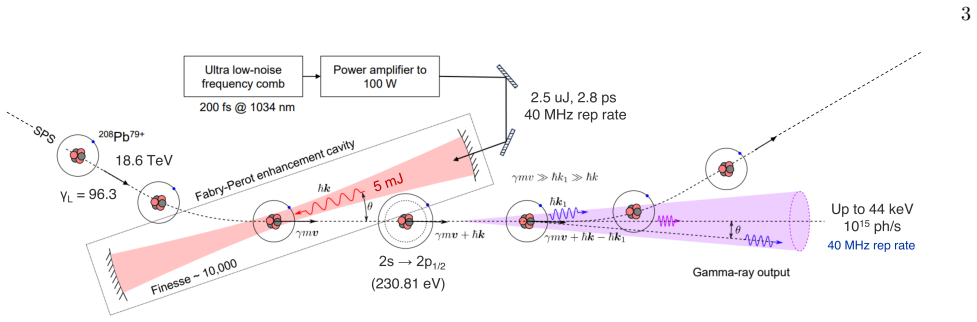
Gamma Factory … photon energies up to 400 MeV … rates of more than 10¹⁶ photons/s
What do these tags mean?
- matches
- The paper's claim is directly supported by a theorem in the formal canon.
- supports
- The theorem supports part of the paper's argument, but the paper may add assumptions or extra steps.
- extends
- The paper goes beyond the formal theorem; the theorem is a base layer rather than the whole result.
- uses
- The paper appears to rely on the theorem as machinery.
- contradicts
- The paper's claim conflicts with a theorem or certificate in the canon.
- unclear
- Pith found a possible connection, but the passage is too broad, indirect, or ambiguous to say the theorem truly supports the claim.
Reference graph
Works this paper leans on
-
[1]
True muonium: the atom that has it all
H. Lamm, True muonium: the atom that has it all, in 12th Conference on the Intersections of Particle and Nu- clear Physics(2015) arXiv:1509.09306 [hep-ph]
work page internal anchor Pith review Pith/arXiv arXiv 2015
-
[2]
H. Lamm and Y. Ji, Predicting and Discovering True Muonium (µ+µ−), EPJ Web Conf.181, 01016 (2018)
work page 2018
-
[3]
Abiet al.(Muon g-2), Measurement of the Positive Muon Anomalous Magnetic Moment to 0.46 ppm, Phys
B. Abiet al.(Muon g-2), Measurement of the Positive Muon Anomalous Magnetic Moment to 0.46 ppm, Phys. Rev. Lett.126, 141801 (2021)
work page 2021
-
[4]
A. Keshavarzi, K. S. Khaw, and T. Yoshioka, Muon g−2: A review, Nucl. Phys. B975, 115675 (2022)
work page 2022
-
[5]
S. G. Karshenboim, Precision physics of simple atoms: QED tests, nuclear structure and fundamental constants, Phys. Rept.422, 1 (2005)
work page 2005
-
[6]
S. J. Brodsky and R. F. Lebed, Production of the Small- est QED Atom: True Muonium (mu+ mu-), Phys. Rev. Lett.102, 213401 (2009)
work page 2009
-
[7]
A. Bogomyagkov, V. Druzhinin, E. Levichev, A. Milstein, and S. Sinyatkin, Low-energy electron-positron collider to search and study (\muˆ+\muˆ-) bound state, EPJ Web Conf.181, 01032 (2018)
work page 2018
-
[8]
P. J. Fox, S. R. Jindariani, and V. D. Shiltsev, DIMUS: super-compact Dimuonium Spectroscopy collider at Fer- milab, JINST18(08), T08007
-
[9]
A. Banburski and P. Schuster, The Production and Dis- covery of True Muonium in Fixed-Target Experiments, Phys. Rev. D86, 093007 (2012)
work page 2012
-
[10]
R. Gargiulo, S. Palmisano, and E. Di Meco, Feasibility study of true muonium discovery with the CERN-SPS H4 positron beam, Phys. Rev. D110, 092015 (2024), arXiv:2409.11342 [hep-ex]
-
[11]
Agapovet al., Other science opportunities at the FCC- ee, Eur
I. Agapovet al., Other science opportunities at the FCC- ee, Eur. Phys. J. Plus141, 271 (2026)
work page 2026
-
[12]
X. Cid Vidal, P. Ilten, J. Plews, B. Shuve, and Y. Soreq, Discovering True Muonium at LHCb, Phys. Rev. D100, 053003 (2019)
work page 2019
-
[13]
I. F. Ginzburg, U. D. Jentschura, S. G. Karshenboim, F. Krauss, V. G. Serbo, and G. Soff, Production of bound mu+ mu- systems in relativistic heavy ion collisions, Phys. Rev. C58, 3565 (1998)
work page 1998
-
[14]
N. Arteaga-Romero, C. Carimalo, and V. G. Serbo, Pro- 7 duction of bound triplet mu+ mu- system in collisions of electrons with atoms, Phys. Rev. A62, 032501 (2000)
work page 2000
-
[15]
C. R. Howellet al., International workshop on next gen- eration gamma-ray source, J. Phys. G49, 010502 (2022)
work page 2022
-
[16]
A. Korol,Novel Lights Sources Beyond Free Electron Lasers, 1st ed., Particle Acceleration and Detection Se- ries (Springer International Publishing AG, Cham, 2022)
work page 2022
-
[17]
L. Bandieraet al., Investigation of the Electromagnetic Radiation Emitted by Sub-GeV Electrons in a Bent Crys- tal, Phys. Rev. Lett.115, 025504 (2015)
work page 2015
-
[18]
A. Sytovet al., Geant4 simulation model of electro- magnetic processes in oriented crystals for accelerator physics, J. Korean Phys. Soc.83, 132 (2023)
work page 2023
-
[19]
Sampathet al., Extremely Dense Gamma-Ray Pulses in Electron Beam-Multifoil Collisions, Phys
A. Sampathet al., Extremely Dense Gamma-Ray Pulses in Electron Beam-Multifoil Collisions, Phys. Rev. Lett. 126, 064801 (2021)
work page 2021
-
[20]
X.-L. Zhu, M. Chen, S.-M. Weng, T.-P. Yu, W.-M. Wang, F. He, Z.-M. Sheng, P. McKenna, D. A. Jaroszynski, and J. Zhang, Extremely brilliant GeVγ-rays from a two-stage laser-plasma accelerator, Sci. Adv.6, eaaz7240 (2020)
work page 2020
-
[21]
R. Alemany Fern´ andezet al.(PBC), Summary Report of the Physics Beyond Colliders Study at CERN (2025), arXiv:2505.00947 [hep-ex]
- [22]
-
[23]
J. Biero´ n, M. W. Krasny, W. Placzek, and S. Pustelny, Optical Excitation of Ultra-Relativistic Partially Stripped Ions, Annalen Phys.534, 2100250 (2022)
work page 2022
-
[24]
Agostinelliet al.(GEANT4), GEANT4 - A Simulation Toolkit, Nucl
S. Agostinelliet al.(GEANT4), GEANT4 - A Simulation Toolkit, Nucl. Instrum. Meth. A506, 250 (2003)
work page 2003
-
[25]
Ivanchenkoet al., Geant4 electromagnetic physics progress, EPJ Web Conf.245, 02009 (2020)
V. Ivanchenkoet al., Geant4 electromagnetic physics progress, EPJ Web Conf.245, 02009 (2020)
work page 2020
-
[26]
E. Holvik and H. A. Olsen, Creation of Relativistic Fermionium in Collisions of Electrons with Atoms, Phys. Rev. D35, 2124 (1987)
work page 1987
-
[27]
A. S. Krass, Photoproduction of Muon Pairs, Phys. Rev. 138, B1268 (1965)
work page 1965
-
[28]
E. Granadoset al., Prospects for extreme light sources at the CERN accelerator complex, Optica175, ETu3A.3 (2024)
work page 2024
-
[29]
Krasny, The Gamma Factory proposal for CERN, CERN Proc.1, 249 (2018)
M. Krasny, The Gamma Factory proposal for CERN, CERN Proc.1, 249 (2018)
work page 2018
-
[30]
M. W. Krasny, A. Martens, and Y. Dutheil (Gamma Fac- tory Study Group), Gamma Factory Proof-of-Principle experiment (2019), cERN-SPSC-2019-031, SPSC-I-253
work page 2019
-
[31]
S. Wilbrandt, O. Stenzel, H. Nakamura, D. Wulff-Molder, A. Duparr´ e, and N. Kaiser, Protected and enhanced alu- minum mirrors for the VUV, Applied Optics53, A125 (2014)
work page 2014
-
[32]
An alternative approach could be to use a laser with a wavelength of 300 nm, excite the 1s-2s transition via two- photon excitation, and use a strong dipole to quench the 2s-2p transition
-
[33]
K. Omidvar, Transition probabilities and branching ra- tios for electric-dipole transitions between arbitrary levels of hydrogen-like atoms, Atom. Data Nucl. Data Tabl.28, 1 (1983)
work page 1983
-
[34]
Arndtet al.(Mu3e), Technical design of the phase I Mu3e experiment, Nucl
K. Arndtet al.(Mu3e), Technical design of the phase I Mu3e experiment, Nucl. Instrum. Meth. A1014, 165679 (2021)
work page 2021
-
[35]
A. Loreti, Vertex Fitting In Low-Material Budget Pixel Detectors (2024), arXiv:2401.13538 [physics.ins-det]
-
[36]
Ohayonet al.(Mu-MASS), Precision Measurement of the Lamb Shift in Muonium, Phys
B. Ohayonet al.(Mu-MASS), Precision Measurement of the Lamb Shift in Muonium, Phys. Rev. Lett.128, 011802 (2022)
work page 2022
discussion (0)
Sign in with ORCID, Apple, or X to comment. Anyone can read and Pith papers without signing in.