Analysis of Fluid Antenna Systems with Continuous Positioning and Spatial Correlation
Pith reviewed 2026-05-19 19:55 UTC · model grok-4.3
pith:YROCKBVN Add to your LaTeX paper
What is a Pith Number?\usepackage{pith}
\pithnumber{YROCKBVN}
Prints a linked pith:YROCKBVN badge after your title and writes the identifier into PDF metadata. Compiles on arXiv with no extra files. Learn more
The pith
A level-crossing-rate framework supplies asymptotically exact approximations and tight bounds for the CDF of the supremum performance metric in fluid antenna systems with continuous positioning under spatial correlation.
A machine-rendered reading of the paper's core claim, the machinery that carries it, and where it could break.
Core claim
We develop a level-crossing-rate (LCR) framework that yields asymptotically exact approximations and tight bounds for the cumulative distribution function (cdf) of the optimized metric S* = sup_{0 <= l <= L} S(l).
What carries the argument
Level-crossing-rate (LCR) framework that tracks crossings of performance levels to approximate and bound the distribution of the supremum metric over the continuous positioning interval.
If this is right
- High-threshold tail probabilities of the optimized metric scale linearly with the track length L.
- The track length L required to neutralize a co-channel interferer follows directly from the framework.
- Movement over roughly one wavelength reduces outage probability by three orders of magnitude.
- New LCR expressions handle the case where array-element correlation and positional correlation are coupled.
Where Pith is reading between the lines
- The same crossing-rate technique could be applied to optimize positioning trajectories in time-varying environments.
- Bounds derived here may serve as design rules for choosing track length in practical fluid-antenna deployments.
- Connections to level-crossing analysis in other continuous-parameter wireless problems could yield similar closed-form insights.
Load-bearing premise
The spatial correlation model renders exact performance distributions analytically intractable, so that level-crossing-rate methods are required to approximate and bound the distribution of the supremum metric.
What would settle it
Monte Carlo simulations that produce CDFs for S* deviating substantially from the LCR approximations and bounds across a range of thresholds and track lengths L would falsify the claimed accuracy.
Figures





read the original abstract
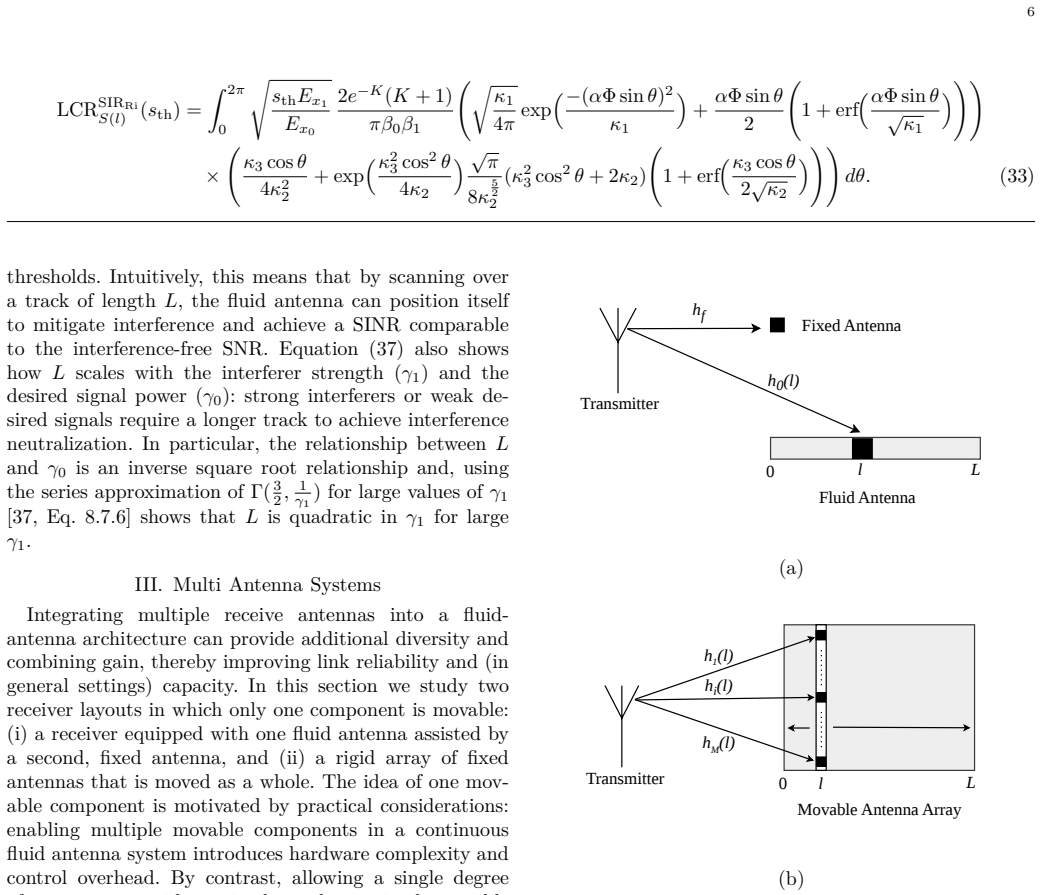
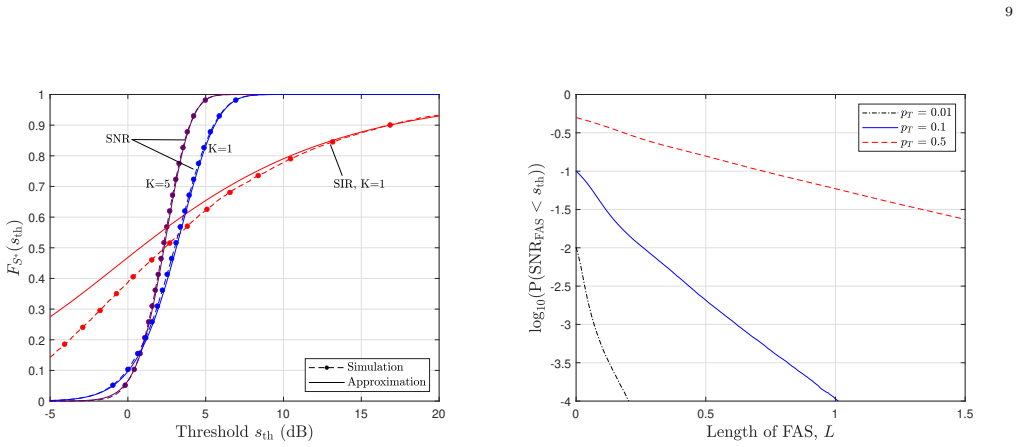
We analyze multi-user fluid antenna systems with continuous positioning over a track of length L under a spatial correlation model, where exact performance distributions become analytically intractable. We develop a level-crossing-rate (LCR) framework that yields asymptotically exact approximations and tight bounds for the cumulative distribution function (cdf) of the optimized metric S* = sup_{0 <= l <= L}, where S(l) denotes the performance metric at antenna position l. For a single fluid antenna, we characterize the cdfs of signal-to-noise ratio (SNR), signal-to interference ratio (SIR) and signal-to-interference-plus-noise ratio (SINR) under Rayleigh fading and extend the approach to Ricean desired channels. We further treat two multi-antenna receiver layouts with maximum-ratio combining: (i) a fluid antenna with a fixed antenna and (ii) a two-element moving array, deriving new LCR results for the practically important case where array-element correlation and positional correlation are inherently coupled. The analysis provides actionable insights: high-threshold tail probabilities scale linearly with L, we derive the required L to neutralize a co-channel interferer, and we show that about one wavelength of movement can reduce outage by three orders of magnitude. Monte Carlo results validate the accuracy across the considered scenarios and regimes.
Editorial analysis
A structured set of objections, weighed in public.
Referee Report
Summary. The manuscript analyzes multi-user fluid antenna systems with continuous positioning over a track of length L under a spatial correlation model, where exact performance distributions are analytically intractable. It develops a level-crossing-rate (LCR) framework yielding asymptotically exact approximations and tight bounds for the CDF of the optimized metric S* = sup_{0 <= l <= L} S(l). For a single fluid antenna, the CDFs of SNR, SIR, and SINR are characterized under Rayleigh fading (with extension to Ricean desired channels). The approach is extended to two multi-antenna receiver layouts with maximum-ratio combining: (i) a fluid antenna with a fixed antenna and (ii) a two-element moving array, with new LCR derivations for the case of coupled array-element and positional correlation. Monte Carlo simulations validate the approximations, and the analysis yields insights such as linear scaling of high-threshold tail probabilities with L and substantial outage reduction from approximately one wavelength of movement.
Significance. If the LCR approximations and bounds hold, the work supplies practical analytical tools for performance evaluation in fluid antenna systems, a setting where direct CDF derivation is intractable due to spatial correlation. The explicit treatment of coupled correlations in the multi-antenna cases and the derived design insights (e.g., required L to neutralize a co-channel interferer) represent a useful extension of level-crossing techniques. Monte Carlo validation across scenarios adds credibility to the numerical accuracy of the results.
major comments (1)
- [LCR framework and CDF approximation (abstract and main derivation sections)] The central claim that the LCR framework supplies asymptotically exact approximations for the CDF of S* = sup S(l) (via the standard mapping P(no upcrossing) ≈ exp(−∫ LCR(·) dl) or equivalent) is load-bearing. The manuscript derives new LCR expressions for the coupled correlation case but does not state the limiting regime (high threshold or large separation) under which crossings form a Poisson point process, nor does it supply an error bound or demonstrate that the joint statistics preserve crossing independence when array-element and positional correlations are coupled. Monte Carlo agreement alone cannot establish the asymptotic property.
minor comments (2)
- [Abstract] The abstract refers to 'two multi-antenna receiver layouts' without naming them; adding the descriptors '(i) fluid antenna with fixed antenna and (ii) two-element moving array' would improve immediate clarity.
- [Numerical results] In the Monte Carlo validation sections, reporting the number of trials and any confidence intervals on the empirical CDFs would strengthen the presentation of numerical agreement.
Simulated Author's Rebuttal
We thank the referee for the careful and constructive review. We address the major comment below and indicate where revisions will be incorporated.
read point-by-point responses
-
Referee: The central claim that the LCR framework supplies asymptotically exact approximations for the CDF of S* = sup S(l) (via the standard mapping P(no upcrossing) ≈ exp(−∫ LCR(·) dl) or equivalent) is load-bearing. The manuscript derives new LCR expressions for the coupled correlation case but does not state the limiting regime (high threshold or large separation) under which crossings form a Poisson point process, nor does it supply an error bound or demonstrate that the joint statistics preserve crossing independence when array-element and positional correlations are coupled. Monte Carlo agreement alone cannot establish the asymptotic property.
Authors: We appreciate the referee highlighting the need for explicit clarification on the asymptotic regime. The LCR-based CDF approximation for the supremum relies on the standard result that level crossings form a Poisson point process in the high-threshold limit for processes satisfying appropriate regularity and mixing conditions. We will revise the abstract and the main derivation sections to state this limiting regime explicitly. For the coupled-correlation case, the LCR expressions are derived from the joint distribution of the performance metric and its spatial derivative; the covariance functions used in these derivations directly incorporate both the array-element correlation and the positional correlation, so the dependence structure is accounted for in the rate. While we do not supply a new analytical error bound (which would require further extreme-value analysis beyond the present scope), the Monte Carlo validation across multiple thresholds, correlation values, and system configurations demonstrates the accuracy of the approximations in the regimes of practical interest. revision: partial
- Supplying a rigorous error bound or formal proof that crossing independence is preserved under the coupled array-element and positional correlations.
Circularity Check
LCR framework extends established techniques to new fluid-antenna setting without reducing target CDF to self-defined or fitted quantities
full rationale
The paper applies standard level-crossing-rate methods to derive expressions for the CDF of the supremum metric S* under continuous positioning and spatial correlation, including the coupled array-element/positional case. No derivation step defines the target CDF in terms of itself, renames a fitted parameter as a prediction, or relies on a load-bearing self-citation whose validity is internal to the present work. The claimed asymptotic exactness and bounds follow from the LCR construction applied to the new model; Monte Carlo validation is presented as external numerical support rather than part of the analytic chain. The derivation chain is therefore self-contained against external benchmarks.
Axiom & Free-Parameter Ledger
axioms (2)
- domain assumption Rayleigh fading for interfering links and Rayleigh or Ricean for the desired link
- domain assumption Spatial correlation model renders exact distributions analytically intractable
Lean theorems connected to this paper
-
IndisputableMonolith/Cost/FunctionalEquation.leanwashburn_uniqueness_aczel unclear?
unclearRelation between the paper passage and the cited Recognition theorem.
We develop a level-crossing-rate (LCR) framework that yields asymptotically exact approximations and tight bounds for the cumulative distribution function (cdf) of the optimized metric S* = sup_{0 ≤ l ≤ L} S(l).
-
IndisputableMonolith/Foundation/AlphaCoordinateFixation.leancostAlphaLog_high_calibrated_iff unclear?
unclearRelation between the paper passage and the cited Recognition theorem.
Under a classic isotropic scattering assumption, the correlation between channels ... is modeled via Jakes’ model ρ(τ) ≜ J0(2πτ)
What do these tags mean?
- matches
- The paper's claim is directly supported by a theorem in the formal canon.
- supports
- The theorem supports part of the paper's argument, but the paper may add assumptions or extra steps.
- extends
- The paper goes beyond the formal theorem; the theorem is a base layer rather than the whole result.
- uses
- The paper appears to rely on the theorem as machinery.
- contradicts
- The paper's claim conflicts with a theorem or certificate in the canon.
- unclear
- Pith found a possible connection, but the passage is too broad, indirect, or ambiguous to say the theorem truly supports the claim.
Reference graph
Works this paper leans on
-
[1]
Prospective multiple antenna technologies for beyond 5G,
J. Zhang, E. Björnson, M. Matthaiou, D. W. K. Ng, H. Yang, and D. J. Love, “Prospective multiple antenna technologies for beyond 5G,” IEEE J. Sel. Areas Commun., vol. 38, no. 8, p. 1637–1660, Aug. 2020
work page 2020
-
[2]
A. J. Paulraj and T. Kailath, “Increasing capacity in wireless broadcast systems using distributed transmission/directional reception (DTDR),” US Patent 5 (599A), vol. 345, 1994
work page 1994
-
[3]
Massive MIMO for next generation wireless systems,
E. G. Larsson, O. Edfors, F. Tufvesson, and T. L. Marzetta, “Massive MIMO for next generation wireless systems,” IEEE Commun. Mag., vol. 52, no. 2, pp. 186–195, 2014
work page 2014
-
[4]
W. K. New, K.-K. Wong, H. Xu, C. Wang, F. R. Ghadi, J. Zhang, J. Rao, R. Murch, P. Ramírez-Espinosa, D. Morales- Jimenez, C.-B. Chae, and K.-F. Tong, “A tutorial on fluid antenna system for 6G networks: Encompassing communication theory, optimization methods and hardware designs,” IEEE Commun. Surv. Tutor., pp. 1–1, 2024
work page 2024
-
[5]
Multifunctional reconfigurable MEMS integrated antennas for adaptive MIMO systems,
B. Cetiner, H. Jafarkhani, J.-Y. Qian, H. J. Yoo, A. Grau, and F. De Flaviis, “Multifunctional reconfigurable MEMS integrated antennas for adaptive MIMO systems,” IEEE Commun. Mag., vol. 42, no. 12, pp. 62–70, Dec. 2004
work page 2004
-
[6]
J. Zhang, J. Rao, Z. Li, Z. Ming, C.-Y. Chiu, K.-K. Wong, K.-F. Tong, and R. Murch, “A novel pixel-based reconfigurable antenna applied in fluid antenna systems with high switching speed,” IEEE Open J. Antennas Propag., pp. 1–1, 2024
work page 2024
-
[7]
Liquid antennas: Past, present and future,
Y. Huang, L. Xing, C. Song, S. Wang, and F. Elhouni, “Liquid antennas: Past, present and future,” IEEE Open J. Antennas Propag., vol. 2, pp. 473–487, 2021
work page 2021
-
[8]
Low- cost 3D-printed coupling-fed frequency agile fluidic monopole antenna system,
C. Borda-Fortuny, L. Cai, K. F. Tong, and K.-K. Wong, “Low- cost 3D-printed coupling-fed frequency agile fluidic monopole antenna system,” IEEE Access, vol. 7, pp. 95 058–95 064, 2019
work page 2019
-
[9]
Movable antennas for wireless communication: Opportunities and challenges,
L. Zhu, W. Ma, and R. Zhang, “Movable antennas for wireless communication: Opportunities and challenges,” IEEE Commun. Mag., vol. 62, no. 6, pp. 114–120, June 2024
work page 2024
-
[10]
Movable- antenna enhanced multiuser communication via antenna position optimization,
L. Zhu, W. Ma, B. Ning, and R. Zhang, “Movable- antenna enhanced multiuser communication via antenna position optimization,” 2024. [Online]. A vailable: https: //arxiv.org/abs/2302.06978
-
[11]
A. F. M. S. Shah, M. Ali Karabulut, E. Cinar, and K. M. Rabie, “A survey on fluid antenna multiple access for 6G: A new multiple access technology that provides great diversity in a small space,” IEEE Access, vol. 12, pp. 88 410–88 425, 2024
work page 2024
-
[12]
Performance limits of fluid antenna systems,
K. K. Wong, A. Shojaeifard, K.-F. Tong, and Y. Zhang, “Performance limits of fluid antenna systems,” IEEE Commun. Lett., vol. 24, no. 11, pp. 2469–2472, 2020
work page 2020
-
[13]
K.-K. Wong, A. Shojaeifard, K.-F. Tong, and Y. Zhang, “Fluid antenna systems,” IEEE Trans. Wireless Commun., vol. 20, no. 3, pp. 1950–1962, Mar. 2021
work page 1950
-
[14]
A new spatial block-correlation model for fluid antenna systems,
P. Ramírez-Espinosa, D. Morales-Jimenez, and K.-K. Wong, “A new spatial block-correlation model for fluid antenna systems,” IEEE Trans. Wireless Commun., vol. 23, no. 11, pp. 15 829– 15 843, 2024
work page 2024
-
[15]
A new analytical approximation of the fluid antenna system channel,
M. Khammassi, A. Kammoun, and M.-S. Alouini, “A new analytical approximation of the fluid antenna system channel,” IEEE Trans. Wireless Commun., vol. 22, no. 12, pp. 8843–8858, 2023
work page 2023
-
[16]
K. K. Wong, K. F. Tong, Y. Chen, and Y. Zhang, “Closed-form expressions for spatial correlation parameters for performance analysis of fluid antenna systems,” Electron. Lett., vol. 58, no. 11, pp. 454–457, 2022
work page 2022
-
[17]
Copula-based performance analysis for fluid antenna systems under arbitrary fading channels,
F. Rostami Ghadi, K.-K. Wong, F. J. López-Martínez, and K.- F. Tong, “Copula-based performance analysis for fluid antenna systems under arbitrary fading channels,” IEEE Commun. Lett., vol. 27, no. 11, pp. 3068–3072, 2023
work page 2023
-
[18]
A Gaussian copula approach to the performance analysis of fluid antenna systems,
F. Rostami Ghadi, K.-K. Wong, F. Javier López-Martínez, C.-B. Chae, K.-F. Tong, and Y. Zhang, “A Gaussian copula approach to the performance analysis of fluid antenna systems,” IEEE Trans. Wireless Commun., vol. 23, no. 11, pp. 17 573–17 585, 2024
work page 2024
-
[19]
Fluid antenna multiple access,
K.-K. Wong and K.-F. Tong, “Fluid antenna multiple access,” IEEE Trans. Wireless Commun., vol. 21, no. 7, pp. 4801–4815, July 2022
work page 2022
-
[20]
On the diversity and coded modulation design of fluid antenna systems,
C. Psomas, G. M. Kraidy, K.-K. Wong, and I. Krikidis, “On the diversity and coded modulation design of fluid antenna systems,” IEEE Trans. Wireless Commun., vol. 23, no. 3, pp. 2082–2096, 2024
work page 2082
-
[21]
Fluid antenna system: New insights on outage probability and diversity gain,
W. K. New, K.-K. Wong, H. Xu, K.-F. Tong, and C.-B. Chae, “Fluid antenna system: New insights on outage probability and diversity gain,” IEEE Transactions on Wireless Communica- tions, vol. 23, no. 1, pp. 128–140, 2024
work page 2024
-
[22]
Continuous fluid antenna systems: Modeling and analysis,
C. Psomas, P. J. Smith, H. A. Suraweera, and I. Krikidis, “Continuous fluid antenna systems: Modeling and analysis,” IEEE Commun. Lett., vol. 27, no. 12, pp. 3370–3374, Dec. 2023
work page 2023
-
[23]
Fluid antenna-assisted MIMO transmission exploiting statis- tical CSI,
Y. Ye, L. You, J. Wang, H. Xu, K.-K. Wong, and X. Gao, “Fluid antenna-assisted MIMO transmission exploiting statis- tical CSI,” IEEE Commun. Lett., vol. 28, no. 1, pp. 223–227, 2024
work page 2024
-
[24]
Movable-antenna enhanced multiuser communication via antenna position op- timization,
L. Zhu, W. Ma, B. Ning, and R. Zhang, “Movable-antenna enhanced multiuser communication via antenna position op- timization,” IEEE Trans. Wireless Commun., vol. 23, no. 7, pp. 7214–7229, 2024
work page 2024
-
[25]
G. Hu, Q. Wu, K. Xu, J. Ouyang, J. Si, Y. Cai, and N. Al- Dhahir, “Fluid antennas-enabled multiuser uplink: A low- complexity gradient descent for total transmit power minimiza- tion,” IEEE Commun. Lett., vol. 28, no. 3, pp. 602–606, 2024
work page 2024
-
[26]
H. Qin, W. Chen, Z. Li, Q. Wu, N. Cheng, and F. Chen, “An- tenna positioning and beamforming design for fluid antenna- assisted multi-user downlink communications,” IEEE Wirel. Commun. Lett., vol. 13, no. 4, pp. 1073–1077, 2024
work page 2024
-
[27]
A simple single integral represen- tation of the bivariate Rayleigh distribution,
M. Simon and M.-S. Alouini, “A simple single integral represen- tation of the bivariate Rayleigh distribution,” IEEE Commun. Lett., vol. 2, no. 5, pp. 128–130, 1998
work page 1998
-
[28]
Infi- nite series representations of the trivariate and quadrivariate Nakagami-m distributions,
P. Dharmawansa, N. Rajatheva, and C. Tellambura, “Infi- nite series representations of the trivariate and quadrivariate Nakagami-m distributions,” IEEE Trans. Wireless Commun., vol. 6, no. 12, pp. 4320–4328, 2007
work page 2007
-
[29]
Analytical insights into outage prob- ability and ergodic capacity of fluid antenna systems,
H. Zhao and D. Slock, “Analytical insights into outage prob- ability and ergodic capacity of fluid antenna systems,” IEEE Wireless Communications Letters, vol. 14, no. 5, pp. 1581–1585, 2025
work page 2025
-
[30]
R. W. Heath and A. Lozano, Foundations of MIMO Communi- cation. Cambridge University Press, 2018
work page 2018
-
[31]
I. S. Gradshteyn and I. M. Ryzhik, Table of Integrals, Series, and Products. San Diego, CA: Academic Press, 2007
work page 2007
-
[32]
New channel model for wireless communications: Finite-state phase-type semi-Markov channel model,
J. Wang, J. Cai, and A. S. Alfa, “New channel model for wireless communications: Finite-state phase-type semi-Markov channel model,” in 2008 IEEE International Conference on Communications, 2008, pp. 4461–4465
work page 2008
-
[33]
W. C. Jakes and D. C. Cox, Microwave Mobile Communications. Wiley-IEEE Press, 1994
work page 1994
-
[34]
Level crossing rates and average outage durations of SINR with multiple co-channel interferers,
R. Annavajjala and J. Zhang, “Level crossing rates and average outage durations of SINR with multiple co-channel interferers,” in Proc. IEEE Military Commun. Conf. (MILCOM 2010), Oct. 2010, pp. 1233–1238
work page 2010
-
[35]
Second order statistics of non-isotropic mobile-to-mobile Ricean fading channels,
X. Cheng, C.-X. Wang, D. I. Laurenson, and A. V. Vasi- lakos, “Second order statistics of non-isotropic mobile-to-mobile Ricean fading channels,” in Proc. IEEE Intl. Conf. Commun. (ICC 2009), June 2009, pp. 1–5
work page 2009
-
[36]
A new twist on the Marcum Q-function and its application,
M. Simon, “A new twist on the Marcum Q-function and its application,” IEEE Commun, Lett., vol. 2, no. 2, pp. 39–41, 1998
work page 1998
-
[37]
Chapter 8: Incomplete gamma and related functions,
R. B. Paris, “Chapter 8: Incomplete gamma and related functions,” 2026. [Online]. A vailable: https://dlmf.nist.gov/8
work page 2026
-
[38]
Second-order statistics for diversity-combining techniques in Nakagami-fading channels,
M. Yacoub, C. da Silva, and J. Vargas Bautista, “Second-order statistics for diversity-combining techniques in Nakagami-fading channels,” IEEE Trans. Veh. Technol., vol. 50, no. 6, pp. 1464– 1470, Nov. 2001
work page 2001
-
[39]
M. Abramowitz and I. A. Stegun, Handbook of Mathematical Functions with Formulas, Graphs, and Mathematical Tables. Washington: US Govt. Print, 2006
work page 2006
-
[40]
N. L. Johnson and S. Kotz, Continuous Univariate Distribu- tions. Boston, MA: Houghton Mifflin, 1971
work page 1971
-
[41]
N. Zlatanov, Z. Hadzi-Velkov, and G. K. Karagiannidis, “Level crossing rate and average fade duration of the double Nakagami- m random process and application in MIMO keyhole fading 16 channels,” IEEE Commun. Lett., vol. 12, no. 11, pp. 822–824, Nov. 2008
work page 2008
-
[42]
K. S. Miller, Complex Stochastic Processes: An Introduction to Theory and Application. Addison-Wesley Publishing Company, 1974
work page 1974
-
[43]
N. L. Johnson, S. Kotz, and N. Balakrishnan, Continuous Univariate Distributions, Volume 2. John Wiley & Sons, 1995
work page 1995
-
[44]
A. Papoulis and S. U. Pillai, Probability, Random Variables, and Stochastic Processes. McGraw-Hill Europe: New York, NY, USA, 2002
work page 2002
-
[45]
King, Statistics for Process Control Engineers: A Practical Approach
M. King, Statistics for Process Control Engineers: A Practical Approach. John Wiley & Sons, 2017
work page 2017
discussion (0)
Sign in with ORCID, Apple, or X to comment. Anyone can read and Pith papers without signing in.