Leveraging Deep Reinforcement Learning for Clustered Cell-Free Networking Over User Mobility
Pith reviewed 2026-05-19 23:22 UTC · model grok-4.3
pith:JZXSMH5S Add to your LaTeX paper
What is a Pith Number?\usepackage{pith}
\pithnumber{JZXSMH5S}
Prints a linked pith:JZXSMH5S badge after your title and writes the identifier into PDF metadata. Compiles on arXiv with no extra files. Learn more
The pith
Deep reinforcement learning partitions cell-free networks into clusters using only one channel estimate per access point.
A machine-rendered reading of the paper's core claim, the machinery that carries it, and where it could break.
Core claim
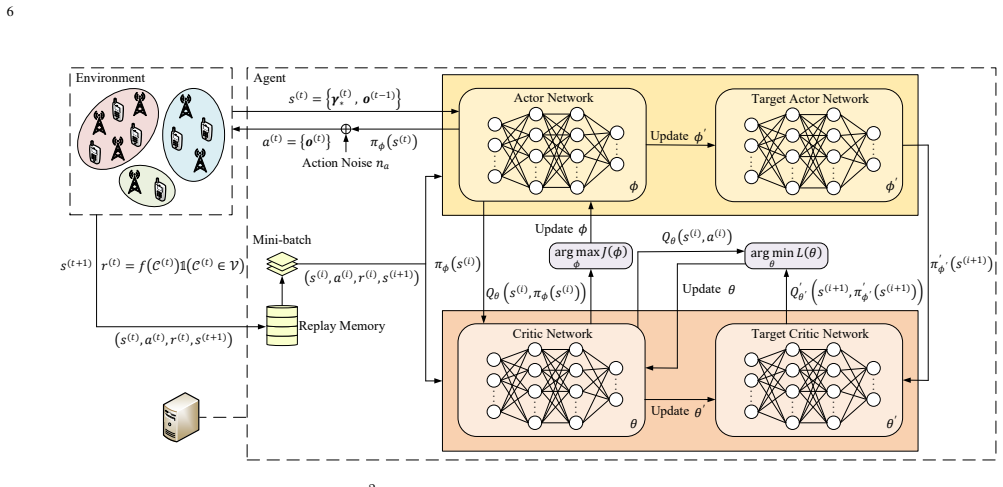
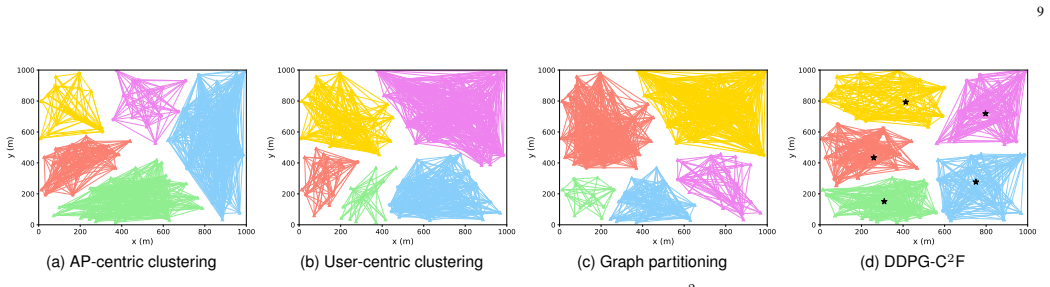
The authors introduce the DDPG-C²F framework based on deep deterministic policy gradient that learns to partition the cell-free network into non-overlapping subnetworks for joint transmission. It takes as input only one channel estimate per access point rather than the full channel matrix, which reduces measurement and computational costs. The framework is demonstrated to adapt to multiple clustered cell-free problems with varying objectives and constraints, to reduce handover costs under user mobility, and to remain robust in scenarios where users randomly join or leave.
What carries the argument
The DDPG-C²F framework, which uses a deep deterministic policy gradient agent to select network partitions from single per-access-point channel estimates as state input.
If this is right
- The framework lowers channel measurement costs substantially by needing only one estimate per access point.
- It enables faster adaptation to user movements, reducing the frequency and cost of handovers.
- The same trained structure applies to different optimization targets and constraints without major redesign.
- It maintains performance when the number of active users changes dynamically.
- It achieves better results than clustering algorithms, graph partitioning, and conventional optimization in simulated scenarios.
Where Pith is reading between the lines
- If single channel estimates prove sufficient, reinforcement learning could replace full CSI requirements in other network management tasks.
- The method suggests a path to scaling cell-free systems by reducing pilot overhead for clustering decisions.
- Further work could test whether policies learned in simulation transfer to real-world mobility without additional fine-tuning.
Load-bearing premise
A single channel estimate per access point supplies enough state information for the neural network to generate effective clustering decisions that work across varying network sizes and real mobility patterns.
What would settle it
Running experiments where full channel information is used for clustering and comparing the resulting sum-rate or handover rates against the single-estimate version under the same mobility traces; if the single-estimate version shows large performance gaps, the cost-saving claim would not hold.
Figures




read the original abstract
Clustered cell-free networking paves a new way for enabling scalable joint transmission among access points (APs) by partitioning the whole network into non-overlapping subnetworks. Previous works adopted clustering algorithms, graph partitioning methods or conventional continuous optimization theories to partition a network based on the channels between all users and all APs, resulting in huge channel measurement and computational costs. This makes these methods difficult to be implemented in practical systems since the optimal network partition could vary frequently due to user mobility. In addition, existing methods were usually designed for specific clustered cell-free networking problems with different optimization algorithms employed. In this paper, we leverage deep reinforcement learning (DRL) for clustered cell-free networking so as to rapidly adapt to user movements in dynamic environments, and propose a deep deterministic policy gradient based clustered cell-free networking (DDPG-C$^{2}$F) framework that can be adapted in various application scenarios. Moreover, in our framework, only one single channel needs to be estimated at each AP as the input of the neural network, which greatly reduces the channel measurement costs for clustered cell-free networking, and the training and inference costs of our framework. The proposed DDPG-C$^{2}$F framework is then applied to various clustered cell-free networking problems with different objectives and constraints to demonstrate its performance. Simulation results show that our framework outperforms existing baselines in all scenarios. Moreover, we show that the proposed framework can reduce the handover cost over user mobility, and is robust to dynamic scenarios with random user joining or leaving.
Editorial analysis
A structured set of objections, weighed in public.
Referee Report
Summary. The manuscript proposes a deep deterministic policy gradient based clustered cell-free networking (DDPG-C²F) framework that partitions cell-free networks into non-overlapping subnetworks using DRL. It claims that only a single channel estimate per access point is needed as neural network input, enabling rapid adaptation to user mobility, reduced handover costs, outperformance over baselines across scenarios with varying objectives/constraints, and robustness to dynamic user join/leave events.
Significance. If the performance claims hold under detailed scrutiny, the work could advance practical deployment of cell-free systems by drastically lowering channel measurement overhead compared to full-matrix methods, while providing a flexible DRL template adaptable to different optimization goals. The emphasis on mobility handling addresses a key practical limitation of prior clustering approaches.
major comments (3)
- Abstract: the central claims of outperformance, handover reduction, and robustness rest on simulation results, yet the abstract (and by extension the evaluation) provides no details on simulation parameters, baseline implementations, number of Monte Carlo runs, statistical significance tests, or error bars, preventing assessment of whether the reported gains are reliable or generalizable.
- Framework description (state input): the assertion that a single channel estimate per AP suffices as NN state for effective clustering decisions is load-bearing for the reduced-cost claim and all mobility results, but no analysis or ablation is provided showing that this scalar/vector captures the cross-user spatial correlations present in the full channel matrix; standard cell-free objectives depend on the entire matrix, and the paper should demonstrate why mobility-induced changes remain trackable.
- Evaluation section: the robustness claim to random user joining/leaving and the generalization across network sizes lack supporting experiments with varying AP/user counts or explicit tests of the single-estimate state under realistic mobility traces; without these, the adaptability advantage over conventional methods cannot be confirmed.
minor comments (2)
- Notation: the superscript in DDPG-C²F should be consistently rendered and defined on first use.
- References: ensure all cited clustering and DRL baselines are from the most recent relevant literature in cell-free MIMO.
Simulated Author's Rebuttal
We thank the referee for the constructive comments. We address each major point below and indicate the revisions planned for the next version of the manuscript.
read point-by-point responses
-
Referee: Abstract: the central claims of outperformance, handover reduction, and robustness rest on simulation results, yet the abstract (and by extension the evaluation) provides no details on simulation parameters, baseline implementations, number of Monte Carlo runs, statistical significance tests, or error bars, preventing assessment of whether the reported gains are reliable or generalizable.
Authors: We agree that additional details on the experimental setup would improve reproducibility and allow better assessment of result reliability. In the revised manuscript we will expand the evaluation section to specify simulation parameters, baseline implementation details, the number of Monte Carlo runs, error bars, and statistical significance tests where appropriate. revision: yes
-
Referee: Framework description (state input): the assertion that a single channel estimate per AP suffices as NN state for effective clustering decisions is load-bearing for the reduced-cost claim and all mobility results, but no analysis or ablation is provided showing that this scalar/vector captures the cross-user spatial correlations present in the full channel matrix; standard cell-free objectives depend on the entire matrix, and the paper should demonstrate why mobility-induced changes remain trackable.
Authors: The single-channel state per AP is selected specifically to reduce measurement overhead while still permitting the DRL agent to learn clustering policies that adapt to mobility, as evidenced by the reported simulation performance. We acknowledge the absence of an explicit ablation study. We will add a discussion of the rationale for this state representation together with an ablation comparing it against fuller channel information to show that the essential spatial correlations for mobility tracking are retained. revision: yes
-
Referee: Evaluation section: the robustness claim to random user joining/leaving and the generalization across network sizes lack supporting experiments with varying AP/user counts or explicit tests of the single-estimate state under realistic mobility traces; without these, the adaptability advantage over conventional methods cannot be confirmed.
Authors: We agree that further experiments would strengthen the robustness and generalization claims. In the revised manuscript we will include additional results with varying numbers of APs and users, together with evaluations under realistic mobility traces that explicitly test the single-estimate state in dynamic join/leave scenarios. revision: yes
Circularity Check
No significant circularity in DDPG-C²F framework proposal
full rationale
The paper introduces a novel DRL-based framework (DDPG-C²F) for dynamic clustered cell-free networking, using a single channel estimate per AP as NN input to enable adaptation to user mobility. It evaluates the approach via simulations against external baselines across multiple scenarios with varying objectives, showing empirical gains in performance, handover reduction, and robustness to join/leave dynamics. No load-bearing step reduces by construction to a fitted input, self-definition, or self-citation chain; the central claims rest on independent simulation results rather than renaming or re-deriving the inputs themselves.
Axiom & Free-Parameter Ledger
free parameters (1)
- DDPG hyperparameters (learning rates, network sizes, exploration noise)
axioms (1)
- domain assumption The clustering decision process can be formulated as a Markov decision process with the chosen single-channel state representation.
Lean theorems connected to this paper
-
IndisputableMonolith/Cost/FunctionalEquation.leanwashburn_uniqueness_aczel unclear?
unclearRelation between the paper passage and the cited Recognition theorem.
only one single channel needs to be estimated at each AP as the input of the neural network... state s(t) = {γ∗(t), o(t−1)} ... action a(t) = {o(t)} ... r(t) = f(C(t)) · 1(C(t) ∈ V)
-
IndisputableMonolith/Foundation/RealityFromDistinction.leanreality_from_one_distinction unclear?
unclearRelation between the paper passage and the cited Recognition theorem.
DDPG-C2F framework... learns the features of a number of subnetwork anchors... dimensionality of the action space is |A|=2M or 3M
What do these tags mean?
- matches
- The paper's claim is directly supported by a theorem in the formal canon.
- supports
- The theorem supports part of the paper's argument, but the paper may add assumptions or extra steps.
- extends
- The paper goes beyond the formal theorem; the theorem is a base layer rather than the whole result.
- uses
- The paper appears to rely on the theorem as machinery.
- contradicts
- The paper's claim conflicts with a theorem or certificate in the canon.
- unclear
- Pith found a possible connection, but the passage is too broad, indirect, or ambiguous to say the theorem truly supports the claim.
Reference graph
Works this paper leans on
-
[1]
A deep reinforcement learning framework for clustered cell-free networking over user mobility,
O. Zhou, J. Wang, and Y . Ji, “A deep reinforcement learning framework for clustered cell-free networking over user mobility,” inProc. IEEE WCNC, Mar. 2025
work page 2025
-
[2]
5G-advanced toward 6G: Past, present, and future,
W. Chen, X. Lin, J. Lee, A. Toskala, S. Sun, C. F. Chiasserini, and L. Liu, “5G-advanced toward 6G: Past, present, and future,”IEEE J. Sel. Areas Commun., vol. 41, no. 6, pp. 1592–1619, Jun. 2023
work page 2023
-
[3]
Asymptotic rate analysis of downlink multi-user systems with co-located and distributed antennas,
J. Wang and L. Dai, “Asymptotic rate analysis of downlink multi-user systems with co-located and distributed antennas,”IEEE Trans. Wireless Commun., vol. 14, no. 6, pp. 3046–3058, Jun. 2015
work page 2015
-
[4]
H. Huh, A. M. Tulino, and G. Caire, “Network MIMO with linear zero- forcing beamforming: Large system analysis, impact of channel esti- mation, and reduced-complexity scheduling,”IEEE Trans. Inf. Theory, vol. 58, no. 5, pp. 2911–2934, May 2012
work page 2012
-
[5]
User-centric C- RAN architecture for ultra-dense 6G networks: Challenges and method- ologies,
C. Pan, M. Elkashlan, J. Wang, J. Yuan, and H. Lajos, “User-centric C- RAN architecture for ultra-dense 6G networks: Challenges and method- ologies,”IEEE Commun. Mag., vol. 56, no. 6, pp. 14–20, Jun. 2018
work page 2018
-
[6]
User-centric cell-free massive MIMO networks: A survey of opportunities, challenges and solutions,
H. A. Ammar, R. Adve, S. Shahbazpanahi, G. Boudreau, and K. V . Srinivas, “User-centric cell-free massive MIMO networks: A survey of opportunities, challenges and solutions,”IEEE Commun. Surv. Tutor., vol. 24, no. 1, pp. 611–652, Jan. 2022
work page 2022
-
[7]
L. Dai, “An uplink capacity analysis of the distributed antenna system (DAS): From cellular DAS to DAS with virtual cells,”IEEE Trans. Wireless Commun., vol. 13, no. 5, pp. 2717–2731, May 2014
work page 2014
-
[8]
User-centric joint transmission in virtual-cell-based ultra-dense networks,
Y . Zhang, S. Bi, and Y .-J. A. Zhang, “User-centric joint transmission in virtual-cell-based ultra-dense networks,”IEEE Trans. Veh. Technol., vol. 67, no. 5, pp. 4640–4644, May 2018
work page 2018
-
[9]
Downlink rate analysis for virtual-cell based large-scale distributed antenna systems,
J. Wang and L. Dai, “Downlink rate analysis for virtual-cell based large-scale distributed antenna systems,”IEEE Trans. Wireless Commun., vol. 15, no. 3, pp. 1998–2011, Mar. 2016
work page 1998
-
[10]
Optimal decomposition for large-scale infrastructure- based wireless networks,
L. Dai and B. Bai, “Optimal decomposition for large-scale infrastructure- based wireless networks,”IEEE Trans. Wireless Commun., vol. 16, no. 8, pp. 4956–4969, Aug. 2017
work page 2017
-
[11]
Rate-constrained network decomposition for clustered cell-free networking,
J. Wang, L. Dai, L. Yang, and B. Bai, “Rate-constrained network decomposition for clustered cell-free networking,” inProc. IEEE ICC, May 2022, pp. 2549–2554
work page 2022
-
[12]
Clustered cell-free networking: A graph partitioning approach,
J. Wang, L. Dai, L. Yang, and B. Bai, “Clustered cell-free networking: A graph partitioning approach,”IEEE Trans. Wireless Commun., vol. 22, no. 8, pp. 5349–5364, Aug. 2023
work page 2023
-
[13]
Optimal resource allocation for cellular networks with virtual cell joint decoding,
M. Yemini and A. J. Goldsmith, “Optimal resource allocation for cellular networks with virtual cell joint decoding,” inProc. IEEE ISIT, Jul. 2019, pp. 2519–2523. 16
work page 2019
-
[14]
P. Biswas, R. K. Mallik, and K. B. Letaief, “Optimal access point centric clustering for cell-free massive MIMO using Gaussian mixture model clustering,”IEEE Trans. Mach. Learn. Commun. Netw., vol. 2, pp. 675– 687, May 2024
work page 2024
-
[15]
Clustered cell-free massive MIMO,
F. Riera-Palou, G. Femenias, A. G. Armada, and A. P ´erez-Neira, “Clustered cell-free massive MIMO,” inProc. IEEE Globecom, Dec. 2018
work page 2018
-
[16]
Energy-efficient clustered cell- free networking with access point selection,
O. Zhou, J. Wang, F. Liu, and J. Wang, “Energy-efficient clustered cell- free networking with access point selection,”IEEE Open J. Commun. Soc., vol. 5, pp. 1551–1565, Mar. 2024
work page 2024
-
[17]
X. Zeng, J. Wang, K. Yue, M. Dong, and B. Bai, “Tunable weighted kernel k-means for clustered cell-free networking acceleration and beam on-off control,” inProc. IEEE ICC, Jun. 2024, pp. 4311–4316
work page 2024
-
[18]
Exploring evolutionary spectral clustering for temporal-smoothed clustered cell-free networking,
J. Wang, T. Wu, O. Zhou, and Y . Zhu, “Exploring evolutionary spectral clustering for temporal-smoothed clustered cell-free networking,”IEEE Wireless Commun. Lett., vol. 14, no. 2, pp. 494–498, Dec. 2024
work page 2024
-
[19]
Complexity-constrained clustered cell-free network- ing for sum capacity maximization,
F. Xia and J. Wang, “Complexity-constrained clustered cell-free network- ing for sum capacity maximization,” inProc. IEEE ISIT, Jun. 2023, pp. 2691–2696
work page 2023
-
[20]
B. Ren, H. Hao, Z. Lyu, J. Peng, J. Wang, and H. Wu, “Tight differ- entiable relaxation of sum ergodic capacity maximization for clustered cell-free networking,” inProc. IEEE ISIT, Jul. 2024, pp. 2448–2453
work page 2024
-
[21]
F. Xia, J. Wang, and L. Dai, “Optimizing clustered cell-free networking for sum ergodic capacity maximization with joint processing constraint,” IEEE Trans. Wireless Commun., vol. 24, no. 1, pp. 571–584, Jan. 2025
work page 2025
-
[22]
Balanced clustered cell-free networking with individual rate guarantees,
C. Deng, B. Ren, Z. Lyu, J. Wang, and H. Wu, “Balanced clustered cell-free networking with individual rate guarantees,”IEEE Trans. Veh. Technol., pp. 1–5, Apr. 2025
work page 2025
-
[23]
Double-layer power control for mobile cell-free XL-MIMO with multi-agent reinforcement learning,
Z. Liu, J. Zhang, Z. Liu, H. Xiao, and B. Ai, “Double-layer power control for mobile cell-free XL-MIMO with multi-agent reinforcement learning,”IEEE Trans. Wireless Commun., vol. 23, no. 5, pp. 4658–4674, May 2024
work page 2024
-
[24]
C. F. Mendoza, M. Kaneko, M. Rupp, and S. Schwarz, “Accelerated deep reinforcement learning for uplink power control in a dynamic cell-free massive MIMO network,”IEEE Wireless Commun. Lett., vol. 13, no. 6, pp. 1710–1714, Apr. 2024
work page 2024
-
[25]
Downlink power control for cell-free massive MIMO with deep reinforcement learning,
L. Luo, J. Zhang, S. Chen, X. Zhang, B. Ai, and D. W. K. Ng, “Downlink power control for cell-free massive MIMO with deep reinforcement learning,”IEEE Trans. Veh. Technol., vol. 71, no. 6, pp. 6772–6777, Mar. 2022
work page 2022
-
[26]
F. Fredj, Y . Al-Eryani, S. Maghsudi, M. Akrout, and E. Hossain, “Distributed beamforming techniques for cell-free wireless networks using deep reinforcement learning,”IEEE Trans. Cogn. Commun. Netw., vol. 8, no. 2, pp. 1186–1201, Apr. 2022
work page 2022
-
[27]
Y . Li, C. Zhang, and Y . Huang, “Distributed beam selection for millimeter-wave cell-free massive MIMO based on multi-agent deep reinforcement learning,” inProc. IEEE WCNC, Apr. 2024
work page 2024
-
[28]
Y . Al-Eryani and E. Hossain, “Self-organizing mmwave MIMO cell-free networks with hybrid beamforming: A hierarchical DRL-based design,” IEEE Trans. Commun., vol. 70, no. 5, pp. 3169–3185, Mar. 2022
work page 2022
-
[29]
R. Y . Chang, S.-F. Han, and F.-T. Chien, “Reinforcement learning-based joint cooperation clustering and content caching in cell-free massive MIMO networks,” inProc. IEEE VTC, Sep. 2021, pp. 1–7
work page 2021
-
[30]
N. Ghiasi, S. Mashhadi, S. Farahmand, S. M. Razavizadeh, and I. Lee, “Energy efficient AP selection for cell-free massive MIMO systems: Deep reinforcement learning approach,”IEEE Trans. Green Commun. Netw., vol. 7, no. 1, pp. 29–41, Aug. 2023
work page 2023
-
[31]
DRL-based AP selection in downlink cell-free massive MIMO network with pilot contamination,
Z. Gao, Q. Zhang, J. Liu, Z. Du, and Y . Li, “DRL-based AP selection in downlink cell-free massive MIMO network with pilot contamination,” IEEE Commun. Lett., vol. 28, no. 6, pp. 1432–1436, Apr. 2024
work page 2024
-
[32]
J. Moon, S. Kim, H. Ju, and B. Shim, “Energy-efficient user association in mmwave/THz ultra-dense network via multi-agent deep reinforcement learning,”IEEE Trans. Green Commun. Netw., vol. 7, no. 2, pp. 692–706, Jan. 2023
work page 2023
-
[33]
L. Sun, J. Hou, and R. Chapman, “Multi-agent deep reinforcement learning for access point activation strategy in cell-free massive MIMO networks,” inProc. IEEE Infocom Workshops, May. 2023
work page 2023
-
[34]
B. Banerjee, R. C. Elliott, W. A. Krzymie ˜n, and M. Medra, “Access point clustering in cell-free massive MIMO using conventional and federated multi-agent reinforcement learning,”IEEE Trans. Mach. Learn. Commun. Netw., vol. 1, pp. 107–123, Jun. 2023
work page 2023
-
[35]
A quantitative measure of fairness and discrimination,
R. K. Jain, D.-M. W. Chiu, and W. R. Hawe, “A quantitative measure of fairness and discrimination,” Eastern Res. Lab., Digit. Equip. Corp., Hudson, MA, USA, 1984
work page 1984
-
[36]
Applications of deep reinforcement learning in communications and networking: A survey,
N. C. Luong, D. T. Hoang, S. Gong, D. Niyato, P. Wang, Y .-C. Liang, and D. I. Kim, “Applications of deep reinforcement learning in communications and networking: A survey,”IEEE Commun. Surveys Tuts., vol. 21, no. 4, pp. 3133–3174, May 2019
work page 2019
-
[37]
Convergence results for single-step on-policy reinforcement-learning algorithms,
S. Singh, T. Jaakkola, M. L. Littman, and C. Szepesv ´ari, “Convergence results for single-step on-policy reinforcement-learning algorithms,” Mach. Learn., vol. 38, no. 3, pp. 287–308, Mar. 2000
work page 2000
-
[38]
R. Sutton and A. Barto,Reinforcement Learning: An Introduction. Cambridge, MA, USA: MIT Press, 2018
work page 2018
-
[39]
Fundamentals of mobility- aware performance characterization of cellular networks: A tutorial,
H. Tabassum, M. Salehi, and E. Hossain, “Fundamentals of mobility- aware performance characterization of cellular networks: A tutorial,” IEEE Commun. Surveys Tuts., vol. 21, no. 3, pp. 2288–2308, Mar. 2019
work page 2019
-
[40]
Energy-efficient resource allocation in coordinated downlink multicell OFDMA systems,
X. Wang, F.-C. Zheng, P. Zhu, and X. You, “Energy-efficient resource allocation in coordinated downlink multicell OFDMA systems,”IEEE Trans. Veh. Technol., vol. 65, no. 3, pp. 1395–1408, Mar. 2016
work page 2016
-
[41]
Joint power allocation and access point selection for cell-free massive MIMO,
T. X. Vu, S. Chatzinotas, S. ShahbazPanahi, and B. Ottersten, “Joint power allocation and access point selection for cell-free massive MIMO,” inProc. IEEE ICC, Jul. 2020. Ouyang Zhoureceived the B.S. degree from Nankai University, Tianjin, China, in 2019. He is currently pursuing the Ph.D. degree with the College of Electronic and Information Engineering,...
work page 2020
discussion (0)
Sign in with ORCID, Apple, or X to comment. Anyone can read and Pith papers without signing in.