Competition and coexistence of superconducting symmetries in p-wave magnets
Pith reviewed 2026-05-19 21:57 UTC · model grok-4.3
pith:T6FEQSDZ Add to your LaTeX paper
What is a Pith Number?\usepackage{pith}
\pithnumber{T6FEQSDZ}
Prints a linked pith:T6FEQSDZ badge after your title and writes the identifier into PDF metadata. Compiles on arXiv with no extra files. Learn more
The pith
P-wave magnetic order promotes and stabilizes spin-triplet p-wave superconductivity rather than only suppressing spin-singlet s-wave pairing.
A machine-rendered reading of the paper's core claim, the machinery that carries it, and where it could break.
Core claim
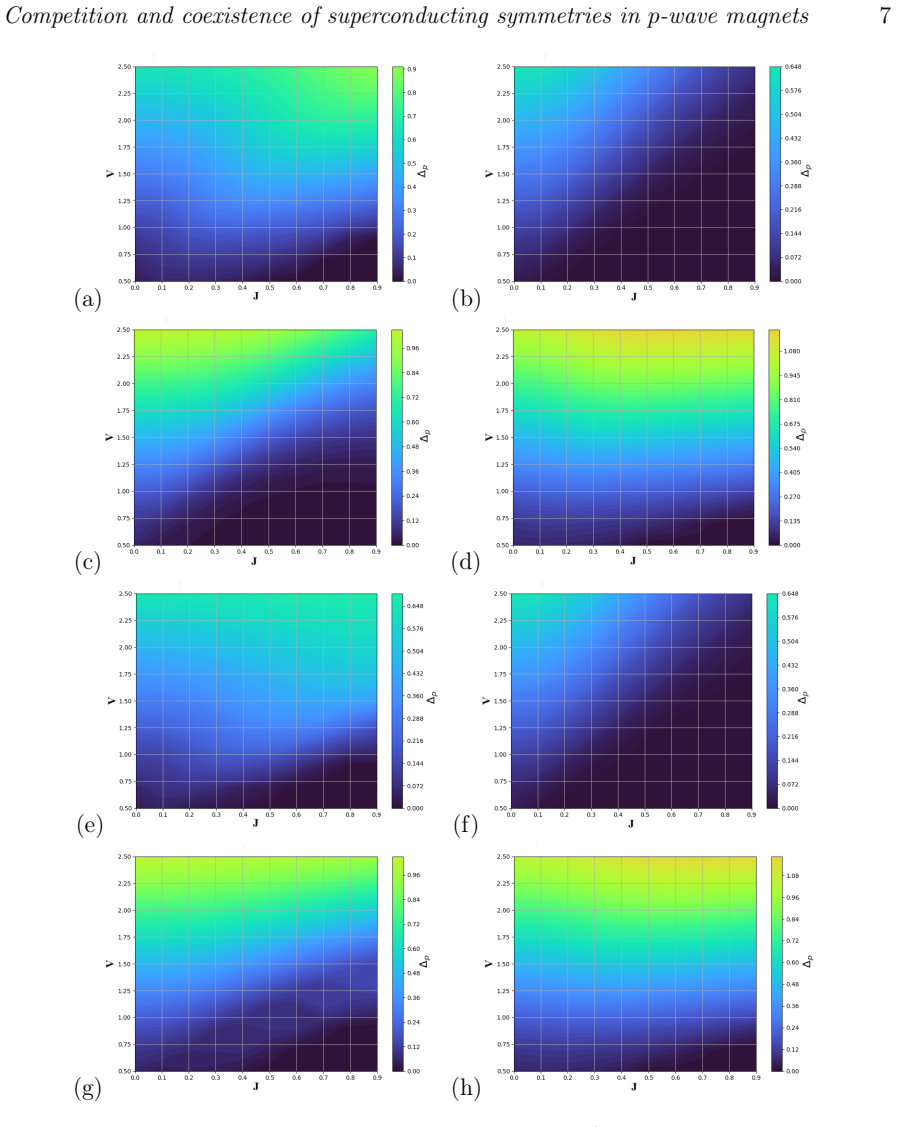
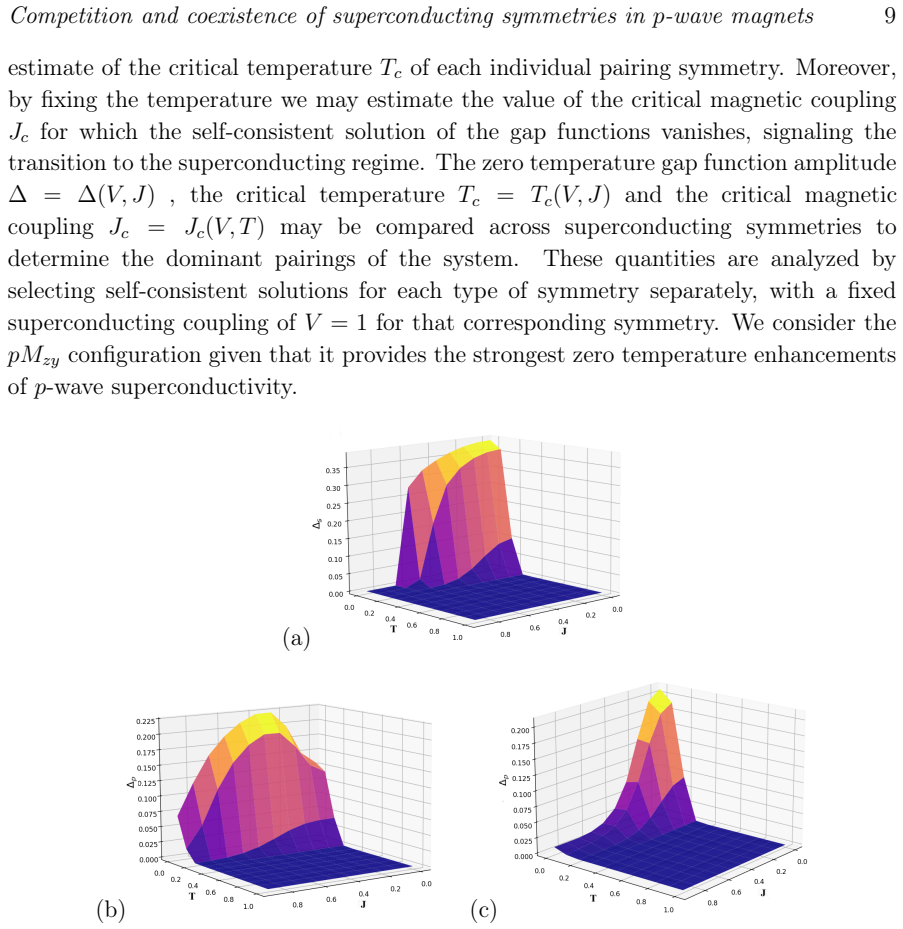
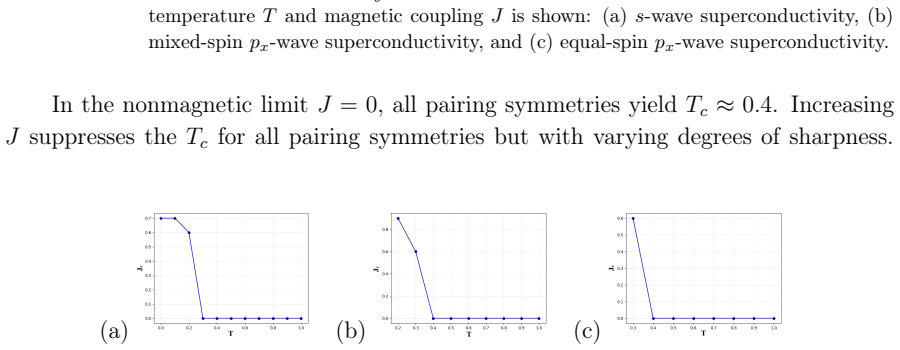
In the model with helical p-wave magnetic order, the self-consistent treatment shows that increasing magnetic coupling strength drives two quantum phase transitions: the first from dominant spin-singlet s-wave to mixed-spin triplet p_x-wave in coexistence, and the second from spin-singlet s-wave plus mixed-spin triplet p-wave (S_z=0) to dominant equal-spin triplet p_y-wave (S_z=±1) in mutually exclusive phases. The magnetic helix therefore actively enhances and stabilizes spin-triplet p-wave pairings both on their own and near spin-singlet s-wave superconductors.
What carries the argument
The helical magnetic texture with p-wave symmetry, examined via self-consistent Bogoliubov-de-Gennes equations limited to s-wave and p-wave pairing channels on the square lattice.
Load-bearing premise
The chosen helical magnetic texture repeated along the perpendicular lattice direction, together with the restriction to s-wave and p-wave channels in the self-consistent equations, is sufficient to capture the dominant physics without additional orbital or disorder effects.
What would settle it
Measurement of the sequence of two quantum phase transitions in dominant pairing symmetry as magnetic coupling strength is tuned in a candidate p-wave magnet material.
Figures




read the original abstract
We investigate the interplay between unconventional magnetism and superconductivity in a model of a $p$-wave magnet on a square lattice. Using a self-consistent Bogoliubov-de-Gennes approach, we analyze the pairing amplitudes, competition, and coexistence of spin-singlet $s$-wave and spin-triplet $p$-wave pairings in the presence of a magnetic texture with a helical structure along the $x$ direction that is repeated in the $y$ direction. We find that the magnetic helix selectively stabilizes different pairing symmetries depending on its orientation and strength. In particular, mixed-spin $p_x$-wave pairing is enhanced at intermediate magnetic couplings and equal-spin $p_y$-wave pairing is robust and insensitive to all coupling intensities. When the multiple order parameters are simultaneously considered, we find regimes of coexistence and competition. Increasing the magnetic coupling drives two quantum phase transitions. The first from dominant spin-singlet $s$-wave to mixed-spin triplet $p_x$-wave pairings in a regime of coexistence. The second from spin-singlet $s$-wave and mixed-spin triplet $p$-wave pairings with total spin projection $S_z=0$ to dominant equal-spin triplet $p_y$-wave pairings with $S_z=\pm1$ in a regime of mutually exclusive superconducting phases. Our results demonstrate that $p$-wave magnetic order does not merely diminish spin-singlet $s$-wave superconductivity but can actively promote and stabilize spin-triplet $p$-wave pairing, both intrinsically and in proximity to spin-singlet $s$-wave superconductors. These findings highlight unconventional magnets as promising materials for realizing robust triplet superconductivity.
Editorial analysis
A structured set of objections, weighed in public.
Referee Report
Summary. The manuscript investigates the interplay between p-wave magnetism and superconductivity on a square lattice using a self-consistent Bogoliubov-de-Gennes (BdG) approach. It considers a helical magnetic texture along x repeated in y and examines competition/coexistence between spin-singlet s-wave and spin-triplet p-wave (both mixed-spin p_x and equal-spin p_y) pairings. The central claims are that increasing magnetic coupling drives two quantum phase transitions (s-wave dominant to mixed-spin p_x coexistence, then to equal-spin p_y dominant), and that p-wave magnetic order actively promotes and stabilizes triplet p-wave pairing rather than merely suppressing singlet superconductivity.
Significance. If the numerical results hold under the stated assumptions, the demonstration that p-wave magnetism can enhance specific triplet channels and produce coexistence regimes would be of interest to the field of unconventional superconductivity, suggesting new routes to robust triplet pairing in magnetic materials. The work provides concrete phase-diagram information from self-consistent calculations, which is a strength when the model is representative.
major comments (2)
- [Abstract] Abstract and numerical results section: the reported quantum phase transitions and coexistence regimes are presented without error bars, convergence checks with system size or iteration tolerance, or sensitivity analysis to the magnetic coupling strength and lattice parameters. This absence makes it difficult to confirm that the transitions are not sensitive to numerical details or parameter choices.
- [Model and Methods] Model definition and BdG implementation: the central claim that p-wave magnetism actively stabilizes triplet p-wave pairing rests on a single helical texture repeated along y together with explicit truncation of the pairing kernel to s- and p-wave channels only. If d-wave or higher harmonics become competitive at intermediate coupling, or if other magnetic periodicities are relevant, the reported sequence of transitions and the promotion of equal-spin p_y pairing could change.
minor comments (1)
- [Abstract] The abstract would be clearer if it stated the range of magnetic coupling values explored and the criterion used to identify the dominant pairing symmetry in each regime.
Simulated Author's Rebuttal
We thank the referee for the careful reading and constructive comments on our manuscript. The feedback highlights key issues of numerical robustness and the scope of our model choices. We address each major comment point by point below, indicating where revisions have been made to the manuscript.
read point-by-point responses
-
Referee: [Abstract] Abstract and numerical results section: the reported quantum phase transitions and coexistence regimes are presented without error bars, convergence checks with system size or iteration tolerance, or sensitivity analysis to the magnetic coupling strength and lattice parameters. This absence makes it difficult to confirm that the transitions are not sensitive to numerical details or parameter choices.
Authors: We agree that explicit documentation of numerical convergence strengthens the results. In the revised manuscript we have added a dedicated subsection to the Methods section that reports convergence tests performed on lattices from 16x16 to 48x48 sites, with self-consistency tolerances tightened to 10^{-6} in the order-parameter residuals. The locations of both quantum phase transitions remain unchanged to within 2% across this range. We have also included a brief sensitivity analysis varying the nearest-neighbor hopping by ±10% and the chemical potential by ±0.05t; the sequence of dominant pairings and the coexistence windows are preserved. Because the calculations are deterministic mean-field solutions, statistical error bars are not applicable, but we now quote the numerical precision of each order parameter (typically <10^{-4}). These additions confirm that the reported transitions are robust within the explored parameter space. revision: yes
-
Referee: [Model and Methods] Model definition and BdG implementation: the central claim that p-wave magnetism actively stabilizes triplet p-wave pairing rests on a single helical texture repeated along y together with explicit truncation of the pairing kernel to s- and p-wave channels only. If d-wave or higher harmonics become competitive at intermediate coupling, or if other magnetic periodicities are relevant, the reported sequence of transitions and the promotion of equal-spin p_y pairing could change.
Authors: The helical magnetic texture with period along x and repetition along y is the defining symmetry of the p-wave magnet model we study, as introduced in the Hamiltonian and motivated by the target material class. We truncate the pairing interaction to s- and p-wave channels because these are the symmetries permitted by the magnetic order and the square-lattice point group; higher harmonics (including d-wave) are symmetry-orthogonal and do not mix at linear order. In the revised text we now explicitly monitor the amplitudes of all higher harmonics during the self-consistent iterations and report that they remain below 0.01 throughout the coupling range of interest. We have added a paragraph in the Discussion section acknowledging that other magnetic periodicities lie outside the present scope and would constitute a separate investigation; our conclusions are therefore stated to apply specifically to the helical configuration examined. Within this well-defined setting the stabilization of the equal-spin p_y channel and the two transitions remain robust. revision: partial
Circularity Check
No circularity: numerical self-consistency on explicit model inputs
full rationale
The paper defines an explicit lattice model with a chosen helical magnetic texture (repeated along y) as input, then solves the self-consistent BdG equations truncated to s- and p-wave channels. The reported pairing amplitudes, coexistence regimes, and quantum phase transitions are outputs of that numerical iteration rather than definitions or fits that presuppose the target results. No self-citation chain, ansatz smuggling, or renaming of known results is load-bearing in the derivation; the central claim follows directly from the solved order parameters on the stated Hamiltonian.
Axiom & Free-Parameter Ledger
free parameters (1)
- magnetic coupling strength
axioms (2)
- domain assumption Square lattice with helical magnetic texture along x repeated along y accurately represents p-wave magnets
- domain assumption Only s-wave singlet and p-wave triplet channels need to be retained in the pairing interaction
Lean theorems connected to this paper
-
IndisputableMonolith/Cost/FunctionalEquation.leanwashburn_uniqueness_aczel unclear?
unclearRelation between the paper passage and the cited Recognition theorem.
self-consistent Bogoliubov-de-Gennes approach... helical structure along the x direction... pM_zy : M_A=(0,0,1), M_B=(0,1,0)...
-
IndisputableMonolith/Foundation/AlexanderDuality.leanalexander_duality_circle_linking unclear?
unclearRelation between the paper passage and the cited Recognition theorem.
Increasing the magnetic coupling drives two quantum phase transitions... from dominant spin-singlet s-wave to mixed-spin triplet p_x-wave
What do these tags mean?
- matches
- The paper's claim is directly supported by a theorem in the formal canon.
- supports
- The theorem supports part of the paper's argument, but the paper may add assumptions or extra steps.
- extends
- The paper goes beyond the formal theorem; the theorem is a base layer rather than the whole result.
- uses
- The paper appears to rely on the theorem as machinery.
- contradicts
- The paper's claim conflicts with a theorem or certificate in the canon.
- unclear
- Pith found a possible connection, but the passage is too broad, indirect, or ambiguous to say the theorem truly supports the claim.
Reference graph
Works this paper leans on
-
[1]
L. Šmejkal, J. Sinova, and T. Jungwirth,Emerging Research Landscape of Altermagnetism, Phys. Rev. X12, 040501 (2022)
work page 2022
-
[2]
Mazin and The PRX Editors,Editorial: Altermagnetism—A New Punch Line of Fundamental Magnetism, Phys
I. Mazin and The PRX Editors,Editorial: Altermagnetism—A New Punch Line of Fundamental Magnetism, Phys. Rev. X12, 040002 (2022)
work page 2022
-
[3]
A. B. Hellenes et al.,P-wave magnets, arXiv:2309.01607 (2024)
work page internal anchor Pith review Pith/arXiv arXiv 2024
-
[4]
Brekke et al.,Minimal Models and Transport Properties of Unconventional p-Wave Magnets, Phys
B. Brekke et al.,Minimal Models and Transport Properties of Unconventional p-Wave Magnets, Phys. Rev. Lett.133, 236703 (2024)
work page 2024
- [5]
- [6]
-
[7]
A.- M. Guo, and Q.- F. Sun,Spin-Selective Transport of Electron in DNA Double Helix, Phys. Rev. Lett.108, 218102 (2012)
work page 2012
-
[8]
R. Gutierrez, E. Díaz, R. Naaman, and G. Cuniberti,Spin-selective transport through helical molecular systems, Phys. Rev. B85, 081404(R) (2012)
work page 2012
-
[9]
A. A. Eremko and V. M. Loktev,Spin Sensitive Transmission Through Helical Potentials, Phys. Rev. B88, 165409 (2013)
work page 2013
-
[10]
R. Gutierrez, E. Díaz, C. Gaul, T. Brumme, F. Domínguez-Adame, and G. Cuniberti,Modeling Spin Transport in Helical Fields: Derivation of an Effective Low-Dimensional Hamiltonian, J. Phys. Chem. C117, 22276 (2013)
work page 2013
-
[11]
R. Gutierrez, and G. Cuniberti,Spin-Dependent Effects in Helical Molecular Systems with Rashba- Like Spin-Orbit Interaction, Acta Phys. Polon. A127, 185 (2015)
work page 2015
-
[12]
R. Naaman and D. H. Waldeck,Spintronics and chirality: Spin selectivity in electron transport through chiral molecules, Annu. Rev. Phys. Chem.66, 263 (2015)
work page 2015
- [13]
-
[14]
R. A. Caetano,Spin-Current and Spin-Splitting in Helicoidal Molecules Due to Spin-Orbit Coupling, Sci. Reports6, 23452 (2016)
work page 2016
-
[15]
S. Matityahu, Y. Utsumi, A. Aharony, O. E.- Wohlman, and C. A. Balseiro,Spin-dependent transport through a chiral molecule in the presence of spin-orbit interaction and nonunitary effects, Phys. Rev. B93, 075407 (2016)
work page 2016
- [16]
-
[17]
Inui et al.,Chirality-Induced Spin-Polarized State of a Chiral Crystal CrNb3S6, Phys
A. Inui et al.,Chirality-Induced Spin-Polarized State of a Chiral Crystal CrNb3S6, Phys. Rev. Lett. 124, 166602 (2020)
work page 2020
-
[18]
Evers et al.,Theory of Chirality Induced Spin Selectivity: Progress and Challenges, Adv
F. Evers et al.,Theory of Chirality Induced Spin Selectivity: Progress and Challenges, Adv. Mater. 34, 2106629 (2022), arXiv:2108.09998
-
[19]
P. D. Sacramento and M. F. Madeira,Topological states in chiral electronic chains, Phys. Rev. B 106, 085130 (2022)
work page 2022
-
[20]
Khodas et al.,Nonrelativistic-Ising superconductivity in p-wave magnets, arXiv:2601.19829 (2026)
M. Khodas et al.,Nonrelativistic-Ising superconductivity in p-wave magnets, arXiv:2601.19829 (2026). Competition and coexistence of superconducting symmetries inp-wave magnets16
- [21]
-
[22]
Fukaya et al.,Superconducting phenomena in systems with unconventional magnets, J
Y. Fukaya et al.,Superconducting phenomena in systems with unconventional magnets, J. Phys.: Condens. Matter37, 313003 (2025)
work page 2025
-
[23]
Li et al.,Enhancement of d-wave Pairing in Strongly Correlated Altermagnet, arXiv:2505.12342 (2025)
J. Li et al.,Enhancement of d-wave Pairing in Strongly Correlated Altermagnet, arXiv:2505.12342 (2025)
-
[24]
C. Lu et al.,Inter-orbital spin-triplet superconductivity from altermagnetic fluctuations, arXiv:2510.19083 (2025)
-
[25]
Sukhachov et al.,Coexistence ofp-wave Magnetism and Superconductivity, arXiv:2412.14245 (2025)
P. Sukhachov et al.,Coexistence ofp-wave Magnetism and Superconductivity, arXiv:2412.14245 (2025)
- [26]
-
[27]
Fu et al.,Floquet engineering spin triplet states in unconventional magnets, arXiv:2505.20205 (2025)
P.-H. Fu et al.,Floquet engineering spin triplet states in unconventional magnets, arXiv:2505.20205 (2025)
-
[28]
P.-H. Fu et al.,Light-induced Floquet spin-triplet Cooper pairs in unconventional magnets, SciPost Phys.20, 059 (2026)
work page 2026
-
[29]
Monthoux et al.,Superconductivity without phonons, Nature450, 1177 (2007)
P. Monthoux et al.,Superconductivity without phonons, Nature450, 1177 (2007)
work page 2007
-
[30]
Pfleiderer,Superconducting phases of f-electron compounds, Rev
C. Pfleiderer,Superconducting phases of f-electron compounds, Rev. Mod. Phys.81, 1551 (2009)
work page 2009
-
[31]
F. M. Grosche et al.,Anomalous low temperature states in CeNi2Ge2 and CePd2Si2, J. Phys. Condens. Matter12, L533 (2000)
work page 2000
-
[32]
G. Knebel et al.,Electronic properties of CeIn3 under high pressure near the quantum critical point, Phys. Rev. B65, 024425 (2001)
work page 2001
-
[33]
P.D.Sacramento,Coexistence of antiferromagnetism and superconductivity in the Anderson lattice, J. Phys.: Condens. Matter15, 6285 (2003)
work page 2003
-
[34]
Damascelli et al.,Angle-resolved photoemission spectroscopy of the cuprate superconductors, Rev
A. Damascelli et al.,Angle-resolved photoemission spectroscopy of the cuprate superconductors, Rev. Mod. Phys.75, 473 (2003)
work page 2003
-
[35]
P. A. Lee, N. Nagaosa and X.-G. Wen,Doping a Mott insulator: Physics of high-temperature superconductivity, Rev. Mod. Phys.78, 17 (2006)
work page 2006
-
[36]
J. Zhao et al.,Structural and magnetic phase diagram of CeFeAsO1−xFx and its relation to high- temperature superconductivity, Nat. Mater.7, 953 (2008)
work page 2008
-
[37]
H.Luetkensetal.,The electronic phase diagram of the LaO1−xFxFeAs superconductor, Nat.Mater. 8, 305 (2009)
work page 2009
-
[38]
Brando et al.,Metallic quantum ferromagnets, Rev
M. Brando et al.,Metallic quantum ferromagnets, Rev. Mod. Phys.88, 025006 (2016)
work page 2016
-
[39]
M. Ezawa,Topological insulators and superconductors based onp-wave magnets: Electrical control and detection of a domain wall, Phys. Rev. B110, 165429 (2024)
work page 2024
-
[40]
Y. Fukaya et al.,p-wave superconductivity and Josephson current inp-wave unconventional magnet/s-wave superconductor hybrid systems, arXiv:2512.18636 (2026)
-
[41]
Salehi,Transverse Spin Supercurrent at p-wave magnetic Josephson Junctions, arXiv:2507.11397 (2025)
M. Salehi,Transverse Spin Supercurrent at p-wave magnetic Josephson Junctions, arXiv:2507.11397 (2025)
-
[42]
O. Alam et al.,Proximity-induced superconductivity and emerging topological phases in altermagnet-based heterostructures, arXiv:2510.26894 (2025)
work page internal anchor Pith review Pith/arXiv arXiv 2025
-
[43]
B. Fu et al.,Altermagnetism Induced Bogoliubov Fermi Surfaces Form Topological Superconduc- tivity, arXiv:2512.20049 (2025)
-
[44]
Engineering subgap states in superconductors by the symmetry of altermagnetism
B. Lu et al.,Engineering subgap states in superconductors by the symmetry of altermagnetism, arXiv:2508.03364 (2026)
work page internal anchor Pith review Pith/arXiv arXiv 2026
-
[45]
S.-B. Zhang and L.-H. Hu,Finite-momentum mixed singlet-triplet pairing in chiral antiferromag- nets induced by even-parity spin texture, Phys. Rev. B112, L100501 (2025)
work page 2025
-
[46]
F. Kayatz et al.,Superconducting properties of transition metal dichalcogenides in proximity to a conventional superconductor, arXiv:2601.21994 (2026)
discussion (0)
Sign in with ORCID, Apple, or X to comment. Anyone can read and Pith papers without signing in.