Heralded Generation of Multipartite Free-Electron W-State Entanglement
Pith reviewed 2026-05-20 11:10 UTC · model grok-4.3
The pith
Projecting atoms onto their ground state after local electron interactions maps atomic W-state entanglement onto an exact N-electron W-state in the upper sidebands.
A machine-rendered reading of the paper's core claim, the machinery that carries it, and where it could break.
Core claim
Projecting the atoms onto the all-ground state maps the initial atomic excitation manifold onto the electronic upper-sideband manifold and prepares an exact N-electron W_N-type state. The heralding probability is obtained in closed form for resonant and detuned regimes, and the heralded state retains the multipartite entanglement structure of the atomic resource for arbitrary N.
What carries the argument
The heralding projection onto the collective atomic ground state, which transfers the atomic W_N resource to the free-electron upper-sideband manifold while preserving the symmetric superposition structure.
If this is right
- The protocol succeeds with probability scaling as e^{-1}/N at resonance in the large-N limit.
- The generated electronic state inherits the full multipartite entanglement of the atomic W_N resource for any N.
- The scheme remains valid in both resonant and detuned regimes with explicit closed-form success probabilities.
- Corrections from detuning, weak symmetry breaking, and Gaussian envelopes can be quantified without losing the core mapping.
Where Pith is reading between the lines
- The approach could be combined with existing quantum electron optics techniques to distribute entanglement over longer distances.
- Numerical simulations of non-uniform couplings would test how robust the W-state fidelity remains under realistic experimental imperfections.
- Similar projection-based transfer might apply to other atomic entangled resources beyond W states, such as GHZ states.
Load-bearing premise
The couplings are uniform across all arms and share a common detuning so that the multi-arm dynamics admit an exact analytical solution inside the rotating-wave approximation.
What would settle it
After the atoms are measured in the all-ground state, perform full tomography or parity checks on the N electrons to verify that their state matches the symmetric W-state superposition with high fidelity.
Figures




read the original abstract
We propose a heralded protocol for generating multipartite free-electron entanglement from atomic $W_N$ resources in a sideband-resolved interaction regime. The scheme consists of $N$ independent electron--atom interaction arms, where each free electron couples locally to one two-level system. For uniform couplings and common detuning, the dynamics is solved analytically within the rotating-wave approximation. Projecting the atoms onto the all-ground state maps the initial atomic excitation manifold onto the electronic upper-sideband manifold and prepares an exact $N$-electron $W_N$-type state. The heralding probability is obtained in closed form for resonant and detuned regimes. At resonance, the optimal success probability obeys the large-$N$ scaling $P_{G_N}^{\max}\sim e^{-1}/N$. The heralded state retains the multipartite entanglement structure of the atomic resource, as shown for arbitrary $N$ and illustrated explicitly for $N=3$. Detuning, weak symmetry breaking, beyond-rotating-wave corrections, and Gaussian coupling envelopes are discussed. The protocol provides a scalable route toward multipartite free-electron entanglement generation from localized atomic resources within quantum electron optics.
Editorial analysis
A structured set of objections, weighed in public.
Referee Report
Summary. The paper proposes a heralded protocol for generating multipartite free-electron entanglement from atomic W_N resources in a sideband-resolved interaction regime. The scheme consists of N independent electron-atom interaction arms, where each free electron couples locally to one two-level system. For uniform couplings and common detuning, the dynamics is solved analytically within the rotating-wave approximation. Projecting the atoms onto the all-ground state maps the initial atomic excitation manifold onto the electronic upper-sideband manifold and prepares an exact N-electron W_N-type state. The heralding probability is obtained in closed form for resonant and detuned regimes, with optimal success probability scaling as ~e^{-1}/N for large N at resonance. The heralded state retains the multipartite entanglement structure of the atomic resource, as shown for arbitrary N and illustrated explicitly for N=3. Detuning, weak symmetry breaking, beyond-rotating-wave corrections, and Gaussian coupling envelopes are discussed.
Significance. If the analytical mapping holds under the stated assumptions, the work is significant for providing a scalable theoretical route to multipartite free-electron entanglement from atomic resources within quantum electron optics. The closed-form heralding probabilities, large-N scaling result, and explicit N=3 illustration are strengths that make the proposal concrete and falsifiable. The inclusion of non-ideal effects such as detuning and weak symmetry breaking adds practical value, though the idealized uniformity assumption limits immediate experimental translation.
major comments (1)
- [Abstract and dynamics/analysis sections] The central claim of an 'exact' N-electron W_N-type state via atomic ground-state projection (abstract and dynamics section) is derived under the uniform couplings and common detuning assumption required for the closed-form RWA solution. While weak symmetry breaking and Gaussian envelopes are discussed, the manuscript should include quantitative fidelity or overlap calculations (e.g., with the ideal W-state) for small realistic deviations in electron velocity or position to address robustness, as these variations are load-bearing for experimental relevance of the mapping.
Simulated Author's Rebuttal
We thank the referee for the positive assessment and constructive feedback recommending minor revision. We address the major comment below.
read point-by-point responses
-
Referee: [Abstract and dynamics/analysis sections] The central claim of an 'exact' N-electron W_N-type state via atomic ground-state projection (abstract and dynamics section) is derived under the uniform couplings and common detuning assumption required for the closed-form RWA solution. While weak symmetry breaking and Gaussian envelopes are discussed, the manuscript should include quantitative fidelity or overlap calculations (e.g., with the ideal W-state) for small realistic deviations in electron velocity or position to address robustness, as these variations are load-bearing for experimental relevance of the mapping.
Authors: We agree that explicit quantitative fidelity calculations for small deviations in electron velocity and position would strengthen the experimental relevance of the protocol. The current manuscript discusses weak symmetry breaking and Gaussian envelopes but does not provide numerical overlap metrics for these specific perturbations. In the revised version we will add a short subsection (or extended paragraph) in the analysis section presenting fidelity and overlap calculations with the ideal W_N state for small realistic variations in velocity (which shift the effective detuning) and position (which modulate the local coupling strength). These will be shown explicitly for N=3 and summarized for general N, using the same RWA framework already employed. revision: yes
Circularity Check
No significant circularity; analytical mapping follows directly from model equations
full rationale
The paper solves the time-dependent Schrödinger equation for N independent electron-atom arms under the rotating-wave approximation, assuming uniform couplings and common detuning as stated in the abstract and full text. The projection onto the atomic ground state then maps the initial atomic W_N manifold onto the electronic upper-sideband manifold by direct substitution into the closed-form time-evolution operator. This is a standard derivation from the Hamiltonian, not a self-definition, fitted parameter renamed as prediction, or load-bearing self-citation. The uniformity assumption is explicit and external to the result itself; no step reduces the claimed W-state preparation to its own inputs by construction. The protocol remains self-contained against the stated model.
Axiom & Free-Parameter Ledger
axioms (1)
- domain assumption Rotating-wave approximation is applicable in the sideband-resolved regime
Lean theorems connected to this paper
-
IndisputableMonolith/Cost/FunctionalEquation.leanwashburn_uniqueness_aczel unclear?
unclearRelation between the paper passage and the cited Recognition theorem.
For uniform couplings and common detuning, the dynamics is solved analytically within the rotating-wave approximation. Projecting the atoms onto the all-ground state maps the initial atomic excitation manifold onto the electronic upper-sideband manifold and prepares an exact N-electron W_N-type state.
-
IndisputableMonolith/Foundation/AbsoluteFloorClosure.leanabsolute_floor_iff_bare_distinguishability unclear?
unclearRelation between the paper passage and the cited Recognition theorem.
The heralding probability is obtained in closed form for resonant and detuned regimes. At resonance, the optimal success probability obeys the large-N scaling P_GN^max ~ e^{-1}/N.
What do these tags mean?
- matches
- The paper's claim is directly supported by a theorem in the formal canon.
- supports
- The theorem supports part of the paper's argument, but the paper may add assumptions or extra steps.
- extends
- The paper goes beyond the formal theorem; the theorem is a base layer rather than the whole result.
- uses
- The paper appears to rely on the theorem as machinery.
- contradicts
- The paper's claim conflicts with a theorem or certificate in the canon.
- unclear
- Pith found a possible connection, but the passage is too broad, indirect, or ambiguous to say the theorem truly supports the claim.
Reference graph
Works this paper leans on
-
[1]
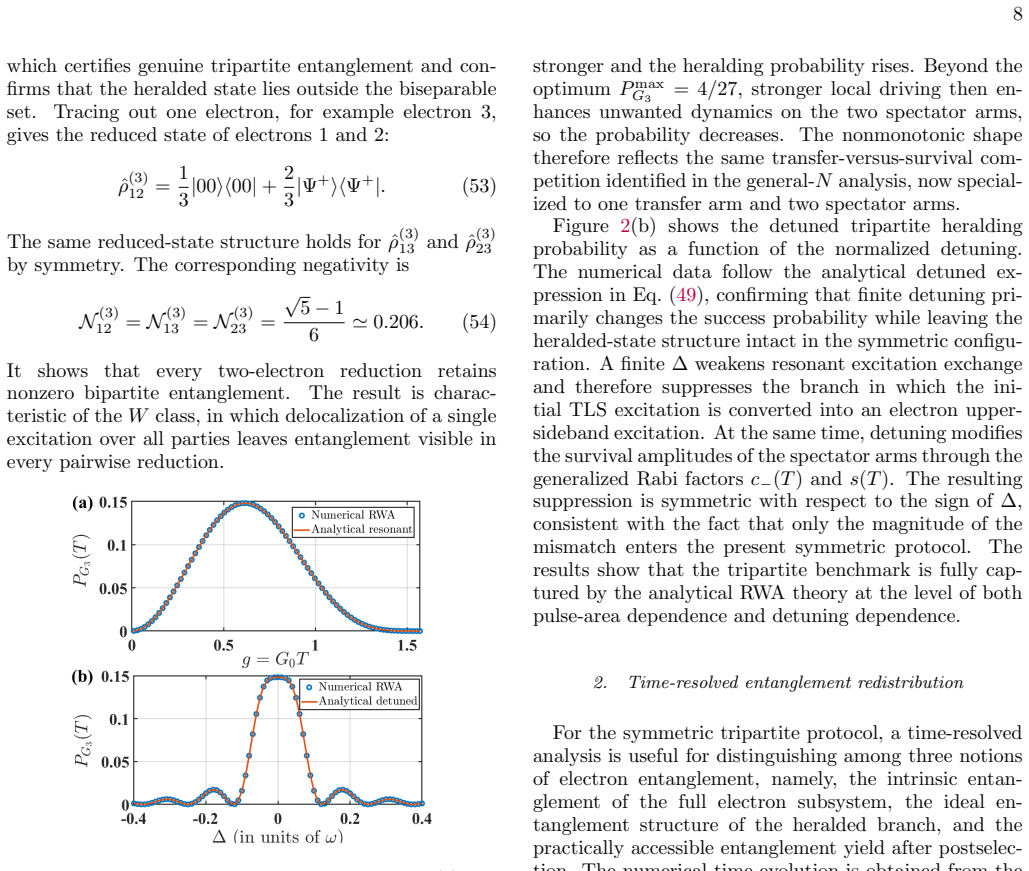
Heralded tripartite free-electronWstate To make the multipartite structure and the redistri- bution of correlations explicit, we specialize the general protocol to the tripartite caseN= 3. The tripartite case provides the minimal genuinely multipartite setting for the heralded transfer protocol. The initial atomic re- source is taken as |W3(0)⟩TLS = 1√ 3(...
-
[2]
The numerical time evolution is obtained from the Schr¨ odinger equation (31)
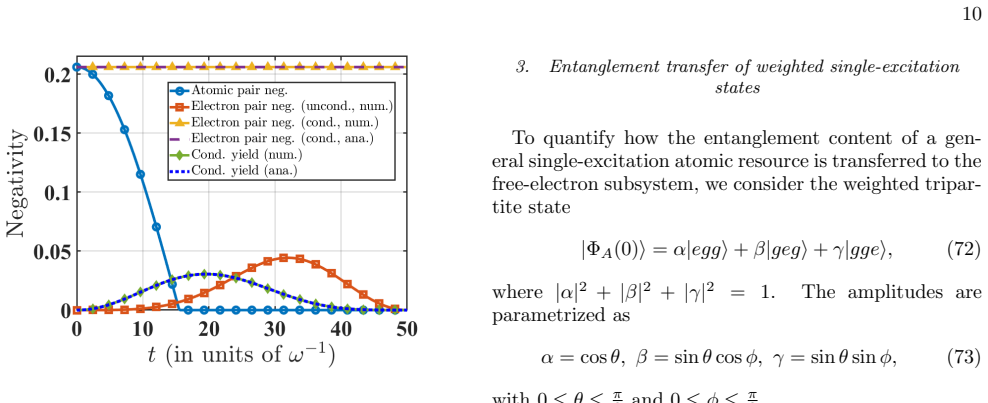
Time-resolved entanglement redistribution For the symmetric tripartite protocol, a time-resolved analysis is useful for distinguishing among three notions of electron entanglement, namely, the intrinsic entan- glement of the full electron subsystem, the ideal en- tanglement structure of the heralded branch, and the practically accessible entanglement yiel...
-
[3]
The amplitudes are parametrized as α= cosθ,β= sinθcosϕ,γ= sinθsinϕ, (73) with 0≤θ≤ π 2 and 0≤ϕ≤ π 2
Entanglement transfer of weighted single-excitation states To quantify how the entanglement content of a gen- eral single-excitation atomic resource is transferred to the free-electron subsystem, we consider the weighted tripar- tite state |ΦA(0)⟩=α|egg⟩+β|geg⟩+γ|gge⟩, (72) where|α| 2 +|β| 2 +|γ| 2 = 1. The amplitudes are parametrized as α= cosθ,β= sinθco...
-
[4]
Quantum telepor- tation in high dimensions
Yi-Han Luo, Han-Sen Zhong, Manuel Erhard, Xi-Lin Wang, Li-Chao Peng, Mario Krenn, Xiao Jiang, Li Li, Nai-Le Liu, Chao-Yang Lu, et al. Quantum telepor- tation in high dimensions. Physical review letters, 123(7):070505, 2019
work page 2019
-
[5]
Quantum cryptography based on bell’s theorem
Artur K Ekert. Quantum cryptography based on bell’s theorem. Physical review letters, 67(6):661, 1991
work page 1991
-
[6]
Teleporting an unknown quantum state via dual classi- cal and einstein-podolsky-rosen channels
Charles H Bennett, Gilles Brassard, Claude Cr´ epeau, Richard Jozsa, Asher Peres, and William K Wootters. Teleporting an unknown quantum state via dual classi- cal and einstein-podolsky-rosen channels. Physical review letters, 70(13):1895, 1993
work page 1993
-
[7]
Daniel Gottesman and Isaac L Chuang. Demonstrat- ing the viability of universal quantum computation us- ing teleportation and single-qubit operations. Nature, 402(6760):390–393, 1999
work page 1999
-
[8]
Ex- perimental test of bell’s inequalities using time-varying analyzers
Alain Aspect, Jean Dalibard, and G´ erard Roger. Ex- perimental test of bell’s inequalities using time-varying analyzers. Physical review letters, 49(25):1804, 1982
work page 1982
-
[9]
Dilip Paneru, Amit Te’eni, Bar Y Peled, James Hub- ble, Yingwen Zhang, Avishy Carmi, Eliahu Cohen, and Ebrahim Karimi. Experimental tests of multiplicative bell inequalities and the fundamental role of local corre- lations. Physical Review Research, 3(1):L012025, 2021
work page 2021
-
[10]
Heralded generation of entanglement with photons
Imogen Forbes, Farzad Ghafari, Edward CR Deacon, Sukhjit P Singh, Emilien Lavie, Patrick Yard, Reece D Shaw, Anthony Laing, and Nora Tischler. Heralded generation of entanglement with photons. Reports on Progress in Physics, 88(8):086002, 2025
work page 2025
-
[11]
Quantum entanglement on photonic chips: a review
Xiaojiong Chen, Zhaorong Fu, Qihuang Gong, and Jian- wei Wang. Quantum entanglement on photonic chips: a review. Advanced Photonics, 3(6):064002–064002, 2021
work page 2021
-
[12]
Entan- glement of two individual neutral atoms using rydberg blockade
Tatjana Wilk, A Ga¨ etan, C Evellin, J Wolters, Y Mirosh- nychenko, P Grangier, and Antoine Browaeys. Entan- glement of two individual neutral atoms using rydberg blockade. Physical review letters, 104(1):010502, 2010
work page 2010
-
[13]
Ground- state blockade of rydberg atoms and application in en- tanglement generation
XQ Shao, DX Li, YQ Ji, JH Wu, and XX Yi. Ground- state blockade of rydberg atoms and application in en- tanglement generation. Physical Review A, 96(1):012328, 2017
work page 2017
-
[14]
Changling Chen, Kai Tang, Yuxuan Zhou, KangYuan Yi, Xuan Zhang, Xu Zhang, Haosheng Guo, Song Liu, Yuanzhen Chen, Tongxing Yan, et al. Hardware-efficient stabilization of entanglement via engineered dissipation in superconducting circuits. Physical Review Research, 7(2):L022018, 2025
work page 2025
-
[15]
Guo-Qiang Zhang, Wei Feng, Wei Xiong, Da Xu, Qi- Ping Su, and Chui-Ping Yang. Generating bell states and n-partite w states of long-distance qubits in super- conducting waveguide qed. Physical Review Applied, 20(4):044014, 2023
work page 2023
-
[16]
Efficient scheme for two-atom entanglement and quantum information processing in cavity qed
Shi-Biao Zheng and Guang-Can Guo. Efficient scheme for two-atom entanglement and quantum information processing in cavity qed. Physical Review Letters, 85(11):2392, 2000
work page 2000
-
[17]
One-step synthesis of multiatom greenberger-horne-zeilinger states
Shi-Biao Zheng. One-step synthesis of multiatom greenberger-horne-zeilinger states. Physical review letters, 87(23):230404, 2001
work page 2001
-
[18]
Steady bell state generation via magnon-photon coupling
HY Yuan, Peng Yan, Shasha Zheng, QY He, Ke Xia, and Man-Hong Yung. Steady bell state generation via magnon-photon coupling. Physical Review Letters, 124(5):053602, 2020
work page 2020
-
[19]
Bell- state generation for spin qubits via dissipative coupling
Ji Zou, Shu Zhang, and Yaroslav Tserkovnyak. Bell- state generation for spin qubits via dissipative coupling. Physical Review B, 106(18):L180406, 2022
work page 2022
-
[20]
Mingzhu Weng, Hongwei Yu, and Zhihai Wang. High- fidelity generation of bell and w states in a giant-atom system via bound states in the continuum. Physical Review A, 111(5):053711, 2025
work page 2025
-
[21]
Chui-Ping Yang and Zhen-Fei Zheng. Deterministic gen- eration of greenberger–horne–zeilinger entangled states of cat-state qubits in circuit qed. Optics Letters, 43(20):5126–5129, 2018
work page 2018
-
[22]
Fast generation of ghz-like states using collective-spin xyz model
Xuanchen Zhang, Zhiyao Hu, and Yong-Chun Liu. Fast generation of ghz-like states using collective-spin xyz model. Physical Review Letters, 132(11):113402, 2024
work page 2024
-
[23]
One-photon solu- tions to the multiqubit multimode quantum rabi model for fast w-state generation
Jie Peng, Juncong Zheng, Jing Yu, Pinghua Tang, G Al- varado Barrios, Jianxin Zhong, Enrique Solano, F Al- barr´ an-Arriagada, and Lucas Lamata. One-photon solu- tions to the multiqubit multimode quantum rabi model for fast w-state generation. Physical Review Letters, 127(4):043604, 2021
work page 2021
-
[24]
Deterministic generation of large scale atomic w states
Xue-Ping Zang, Ming Yang, Fatih Ozaydin, Wei Song, and Zhuo-Liang Cao. Deterministic generation of large scale atomic w states. Optics express, 24(11):12293– 12300, 2016. 18
work page 2016
-
[25]
Deterministic gen- eration of multiparticle entanglement by quantum zeno dynamics
Giovanni Barontini, Leander Hohmann, Florian Haas, J´ erˆ ome Est` eve, and Jakob Reichel. Deterministic gen- eration of multiparticle entanglement by quantum zeno dynamics. Science, 349(6254):1317–1321, 2015
work page 2015
-
[26]
Adiabatic passage for three-dimensional entan- glement generation through quantum zeno dynamics
Yan Liang, Shi-Lei Su, Qi-Cheng Wu, Xin Ji, and Shou Zhang. Adiabatic passage for three-dimensional entan- glement generation through quantum zeno dynamics. Optics Express, 23(4):5064–5077, 2015
work page 2015
-
[27]
Quan- tum entanglement via two-qubit quantum zeno dynam- ics
Xiang-Bin Wang, JQ You, and Franco Nori. Quan- tum entanglement via two-qubit quantum zeno dynam- ics. Physical Review A, 77(6):062339, 2008
work page 2008
-
[28]
Remote entanglement via adiabatic passage using a tunably dissipative quantum communication system
H-S Chang, YP Zhong, Audrey Bienfait, M-H Chou, Christopher R Conner, ´Etienne Dumur, Joel Grebel, Gregory A Peairs, Rhys G Povey, Kevin J Satzinger, et al. Remote entanglement via adiabatic passage using a tunably dissipative quantum communication system. Physical Review Letters, 124(24):240502, 2020
work page 2020
-
[29]
Dicke state generation and extreme spin squeezing via rapid adiabatic passage
Sebastian C Carrasco, Michael H Goerz, Svetlana A Malinovskaya, Vladan Vuleti´ c, Wolfgang P Schleich, and Vladimir S Malinovsky. Dicke state generation and extreme spin squeezing via rapid adiabatic passage. Physical Review Letters, 132(15):153603, 2024
work page 2024
-
[30]
Efficient generation of multiqubit entanglement states using rapid adiabatic passage
Shijie Xu, Xinwei Li, Xiangliang Li, Jinbin Li, and Ming Xue. Efficient generation of multiqubit entanglement states using rapid adiabatic passage. Physical Review A, 110(2):023108, 2024
work page 2024
-
[31]
Steady-state entanglement production in a quantum thermal machine with continuous feedback control
Giovanni Francesco Diotallevi, Bj¨ orn Annby-Andersson, Peter Samuelsson, Armin Tavakoli, and Pharnam Bakhshinezhad. Steady-state entanglement production in a quantum thermal machine with continuous feedback control. New Journal of Physics, 26(5):053005, 2024
work page 2024
-
[32]
Akel Hashim, Ming Yuan, Pranav Gokhale, Larry Chen, Christian J¨ unger, Neelay Fruitwala, Yilun Xu, Gang Huang, Kasra Nowrouzi, Liang Jiang, et al. Efficient gen- eration of multi-partite entanglement between non-local superconducting qubits using classical feedback. APL Quantum, 2(4), 2025
work page 2025
-
[33]
Dissipative preparation of en- tanglement in optical cavities
Michael James Kastoryano, Florentin Reiter, and An- ders Søndberg Sørensen. Dissipative preparation of en- tanglement in optical cavities. Physical review letters, 106(9):090502, 2011
work page 2011
-
[34]
Resource-efficient dissipative entangle- ment of two trapped-ion qubits
Daniel C Cole, Stephen D Erickson, Giorgio Zaran- tonello, Karl P Horn, Pan-Yu Hou, Jenny J Wu, Daniel H Slichter, Florentin Reiter, Christiane P Koch, and Di- etrich Leibfried. Resource-efficient dissipative entangle- ment of two trapped-ion qubits. Physical Review Letters, 128(8):080502, 2022
work page 2022
-
[35]
Generation of long-lived w states via reservoir engineering in dissipatively coupled systems
Guo-Qiang Zhang, Wei Feng, Wei Xiong, Qi-Ping Su, and Chui-Ping Yang. Generation of long-lived w states via reservoir engineering in dissipatively coupled systems. Physical Review A, 107(1):012410, 2023
work page 2023
-
[36]
Com- plete conditions for entanglement transfer
Mauro Paternostro, Wonmin Son, and MS Kim. Com- plete conditions for entanglement transfer. Physical review letters, 92(19):197901, 2004
work page 2004
-
[37]
Entanglement reciprocation between qubits and continuous variables
Jinhyoung Lee, Mauro Paternostro, MS Kim, and Sougato Bose. Entanglement reciprocation between qubits and continuous variables. Physical review letters, 96(8):080501, 2006
work page 2006
-
[38]
Enhanced dynamical entanglement transfer with multi- ple qubits
A Serafini, Mauro Paternostro, MS Kim, and S Bose. Enhanced dynamical entanglement transfer with multi- ple qubits. Physical Review A, 73(2):022312, 2006
work page 2006
-
[39]
Entanglement transfer from entangled two-mode fields to a pair of separable and mixed qubits
Jian Zou, Jun Gang Li, Bin Shao, Jian Li, and Qian ShuLi. Entanglement transfer from entangled two-mode fields to a pair of separable and mixed qubits. Physical Review A, 73(4):042319, 2006
work page 2006
-
[40]
Federico Casagrande, Alfredo Lulli, and Matteo GA Paris. Improving the entanglement transfer from continuous-variable systems to localized qubits using non-gaussian states. Physical Review A—Atomic, Molecular, and Optical Physics, 75(3):032336, 2007
work page 2007
-
[41]
Theory of shaping elec- tron wavepackets with light.ACS Photonics, 7(10):2859– 2870, 2020
Ori Reinhardt and Ido Kaminer. Theory of shaping elec- tron wavepackets with light.ACS Photonics, 7(10):2859– 2870, 2020
work page 2020
-
[42]
Bin Zhang, Reuven Ianconescu, Aharon Friedman, Jacob Scheuer, Mikhail Tokman, Yiming Pan, and Avraham Gover. Spontaneous photon emission by shaped quan- tum electron wavepackets and the qed origin of bunched electron beam superradiance. Reports on Progress in Physics, 88(1):017601, 2025
work page 2025
-
[43]
Ultrafast transverse modu- lation of free electrons by interaction with shaped optical fields
Ivan Madan, Veronica Leccese, Adam Mazur, Francesco Barantani, Thomas LaGrange, Alexey Sapozhnik, Phoebe M Tengdin, Simone Gargiulo, Enzo Rotunno, Jean-Christophe Olaya, et al. Ultrafast transverse modu- lation of free electrons by interaction with shaped optical fields. ACS photonics, 9(10):3215–3224, 2022
work page 2022
-
[44]
Attosec- ond coherent control of free-electron wave functions us- ing semi-infinite light fields
Giovanni M Vanacore, I Madan, G Berruto, K Wang, E Pomarico, RJ Lamb, D McGrouther, I Kaminer, B Barwick, F Javier Garc´ ıa de Abajo, et al. Attosec- ond coherent control of free-electron wave functions us- ing semi-infinite light fields. Nature communications, 9(1):2694, 2018
work page 2018
-
[45]
Control of quantum elec- trodynamical processes by shaping electron wavepackets
Liang Jie Wong, Nicholas Rivera, Chitraang Murdia, Thomas Christensen, John D Joannopoulos, Marin Soljaˇ ci´ c, and Ido Kaminer. Control of quantum elec- trodynamical processes by shaping electron wavepackets. Nature communications, 12(1):1700, 2021
work page 2021
-
[46]
Spatio-temporal shaping of a free-electron wave function via coherent light–electron interaction
Giovanni Maria Vanacore, Ivan Madan, and Fabrizio Carbone. Spatio-temporal shaping of a free-electron wave function via coherent light–electron interaction. La Rivista del Nuovo Cimento, 43(11):567–597, 2020
work page 2020
-
[47]
Probing quantum optical excitations with fast electrons
Valerio Di Giulio, Mathieu Kociak, and F Javier Garc´ ıa de Abajo. Probing quantum optical excitations with fast electrons. Optica, 6(12):1524–1534, 2019
work page 2019
-
[48]
Optical coherence transfer medi- ated by free electrons
Ofer Kfir, Valerio Di Giulio, F Javier Garc´ ıa de Abajo, and Claus Ropers. Optical coherence transfer medi- ated by free electrons. Science Advances, 7(18):eabf6380, 2021
work page 2021
-
[49]
Feng-Xiao Sun, Yiqi Fang, Qiongyi He, and Yunquan Liu. Generating optical cat states via quantum inter- ference of multi-path free-electron–photons interactions. Science Bulletin, 68(13):1366–1371, 2023
work page 2023
-
[50]
Shap- ing quantum photonic states using free electrons
Adi Ben Hayun, Ori Reinhardt, Jonathan Nemirovsky, Aviv Karnieli, Nicholas Rivera, and Ido Kaminer. Shap- ing quantum photonic states using free electrons. Science Advances, 7(11):eabe4270, 2021
work page 2021
-
[51]
Measure- ment of temporal coherence of free electrons by time- domain electron interferometry
M Tsarev, Andrey Ryabov, and Peter Baum. Measure- ment of temporal coherence of free electrons by time- domain electron interferometry. Physical Review Letters, 127(16):165501, 2021
work page 2021
-
[52]
Optical excitations with electron beams: challenges and oppor- tunities
F Javier Garcia de Abajo and Valerio Di Giulio. Optical excitations with electron beams: challenges and oppor- tunities. ACS photonics, 8(4):945–974, 2021
work page 2021
-
[53]
Electrons herald non-classical light
Germaine Arend, Guanhao Huang, Armin Feist, Yu- jia Yang, Jan-Wilke Henke, Zheru Qiu, Hao Jeng, Ar- slan Sajid Raja, Rudolf Haindl, Rui Ning Wang, et al. Electrons herald non-classical light. Nature Physics, pages 1–8, 2025. 19
work page 2025
- [54]
-
[55]
Alexander Preimesberger, Sergei Bogdanov, Isobel C Bicket, Phila Rembold, and Philipp Haslinger. Ex- perimental verification of electron-photon entanglement. arXiv preprint arXiv:2504.13163, 2025
-
[56]
Free-electron–bound- electron resonant interaction
Avraham Gover and Amnon Yariv. Free-electron–bound- electron resonant interaction. Physical Review Letters, 124(6):064801, 2020
work page 2020
-
[57]
Quantum wave-particle duality in free-electron– bound-electron interaction
Bin Zhang, Du Ran, Reuven Ianconescu, Aharon Fried- man, Jacob Scheuer, Amnon Yariv, and Avraham Gover. Quantum wave-particle duality in free-electron– bound-electron interaction. Physical Review Letters, 126(24):244801, 2021
work page 2021
-
[58]
Quantum state interrogation using a preshaped free electron wavefunction
Bin Zhang, Du Ran, Reuven Ianconescu, Aharon Fried- man, Jacob Scheuer, Amnon Yariv, and Avraham Gover. Quantum state interrogation using a preshaped free electron wavefunction. Physical Review Research, 4(3):033071, 2022
work page 2022
-
[59]
Du Ran, Bin Zhang, Reuven Ianconescu, Aharon Fried- man, Jacob Scheuer, Amnon Yariv, and Avraham Gover. Coherent excitation of bound electron quantum state with quantum electron wavepackets.Frontiersin Physics, 10:920701, 2022
work page 2022
-
[60]
Quan- tum entanglement and modulation enhancement of free- electron–bound-electron interaction
Zhexin Zhao, Xiao-Qi Sun, and Shanhui Fan. Quan- tum entanglement and modulation enhancement of free- electron–bound-electron interaction. Physical Review Letters, 126(23):233402, 2021
work page 2021
-
[61]
Toward atomic-resolution quantum measurements with coherently shaped free elec- trons
Ron Ruimy, Alexey Gorlach, Chen Mechel, Nicholas Rivera, and Ido Kaminer. Toward atomic-resolution quantum measurements with coherently shaped free elec- trons. Physical Review Letters, 126(23):233403, 2021
work page 2021
-
[62]
Probing quantum- coherent dynamics with free electrons
HB Crispin and N Talebi. Probing quantum- coherent dynamics with free electrons. arXiv preprint arXiv:2512.24883, 2025
-
[63]
Tai- lored high-contrast attosecond electron pulses for coher- ent excitation and scattering
Sergey V Yalunin, Armin Feist, and Claus Ropers. Tai- lored high-contrast attosecond electron pulses for coher- ent excitation and scattering. Physical Review Research, 3(3):L032036, 2021
work page 2021
-
[64]
Coherent scattering of an optically modulated elec- tron beam by atoms
Yuya Morimoto, Peter Hommelhoff, and Lars Bojer Mad- sen. Coherent scattering of an optically modulated elec- tron beam by atoms. Physical Review A, 103(4):043110, 2021
work page 2021
-
[65]
Controlling quantum systems with modulated electron beams
Dennis R¨ atzel, Daniel Hartley, Osip Schwartz, and Philipp Haslinger. Controlling quantum systems with modulated electron beams. Physical review research, 3(2):023247, 2021
work page 2021
-
[66]
Probing electron-photon entanglement using a quantum eraser
Jan-Wilke Henke, Hao Jeng, and Claus Ropers. Probing electron-photon entanglement using a quantum eraser. Physical Review A, 111(1):012610, 2025
work page 2025
-
[67]
Superradiance and subradiance due to quan- tum interference of entangled free electrons
Aviv Karnieli, Nicholas Rivera, Ady Arie, and Ido Kaminer. Superradiance and subradiance due to quan- tum interference of entangled free electrons. Physical Review Letters, 127(6):060403, 2021
work page 2021
-
[68]
Jaynes-cummings in- teraction between low-energy free electrons and cavity photons
Aviv Karnieli and Shanhui Fan. Jaynes-cummings in- teraction between low-energy free electrons and cavity photons. Science advances, 9(22):eadh2425, 2023
work page 2023
-
[69]
Heralded Entanglement Transfer from Entangled Atomic Pair to Free Electrons
Du Ran, Reuven Ianconescu, Shuai Liu, Ya-dong Li, Ji- Yuan Bai, Ze-Long He, Zhi-Cheng Shi, Yan Xia, and Avraham Gover. Heralded entanglement transfer from entangled atomic pair to free electrons. arXiv preprint arXiv:2604.22974, 2026
work page internal anchor Pith review Pith/arXiv arXiv 2026
-
[70]
Free-electron ramsey-type interferometry for enhanced amplitude and phase imaging of nearfields
Tomer Bucher, Ron Ruimy, Shai Tsesses, Raphael Da- han, Guy Bartal, Giovanni Maria Vanacore, and Ido Kaminer. Free-electron ramsey-type interferometry for enhanced amplitude and phase imaging of nearfields. Science Advances, 9(51):eadi5729, 2023
work page 2023
-
[71]
Tunable photon-induced spatial modulation of free electrons
Shai Tsesses, Raphael Dahan, Kangpeng Wang, Tomer Bucher, Kobi Cohen, Ori Reinhardt, Guy Bartal, and Ido Kaminer. Tunable photon-induced spatial modulation of free electrons. Nature Materials, 22(3):345–352, 2023
work page 2023
-
[72]
Scalable multiparticle en- tanglement of trapped ions
Hartmut H¨ affner, Wolfgang H¨ ansel, CF Roos, Jan Ben- helm, D Chek-al Kar, M Chwalla, T K¨ orber, UD Rapol, M Riebe, PO Schmidt, et al. Scalable multiparticle en- tanglement of trapped ions. Nature, 438(7068):643–646, 2005
work page 2005
-
[73]
Dissipation-induced w state in a rydberg-atom-cavity system
Dong-Xiao Li, Xiao-Qiang Shao, Jin-Hui Wu, and XX Yi. Dissipation-induced w state in a rydberg-atom-cavity system. Optics Letters, 43(8):1639–1642, 2018
work page 2018
discussion (0)
Sign in with ORCID, Apple, or X to comment. Anyone can read and Pith papers without signing in.