DAD4TS: Data-Augmentation-Oriented Diffusion Model for Time-Series Forecasting with Small-Scale Data
Pith reviewed 2026-05-20 12:18 UTC · model grok-4.3
The pith
A diffusion model jointly trained with a forecaster and steered by reinforcement learning generates synthetic samples that raise accuracy on small time-series datasets.
A machine-rendered reading of the paper's core claim, the machinery that carries it, and where it could break.
Core claim
DAD4TS trains a diffusion model to produce time-series augmentations by first mapping the scarce data into geometric space through mathematical projection rather than a VAE. A reinforcement learning agent then controls the generator so that only samples improving the joint forecasting objective are retained, while the forecaster and generator improve together in a single training loop.
What carries the argument
The reinforcement learning controller that selects diffusion-generated augmentations while the data generator and time-series forecaster are trained simultaneously.
If this is right
- Forecasting accuracy rises on real-world datasets that contain only a few hundred observations.
- The same joint-training recipe works across multiple forecasting architectures without architecture-specific changes.
- Generated samples improve both point forecasts and uncertainty estimates in the tested models.
- The method reduces the amount of real data needed to reach a target accuracy level.
Where Pith is reading between the lines
- The geometric-projection step could let diffusion models handle other sequential data types that lack large pretraining corpora.
- Extending the reinforcement learning reward to multi-step forecast horizons might further stabilize long-range predictions.
- The joint-training loop could be adapted to online settings where new observations arrive continuously.
Load-bearing premise
Mapping time-series data into geometric space with mathematical methods produces a diffusion model whose outputs are genuine improvements rather than noise that hurts forecasting.
What would settle it
Run the same forecasting models on the original small data versus the original data plus DAD4TS samples and check whether forecast error stays the same or increases on held-out test sets.
Figures



read the original abstract
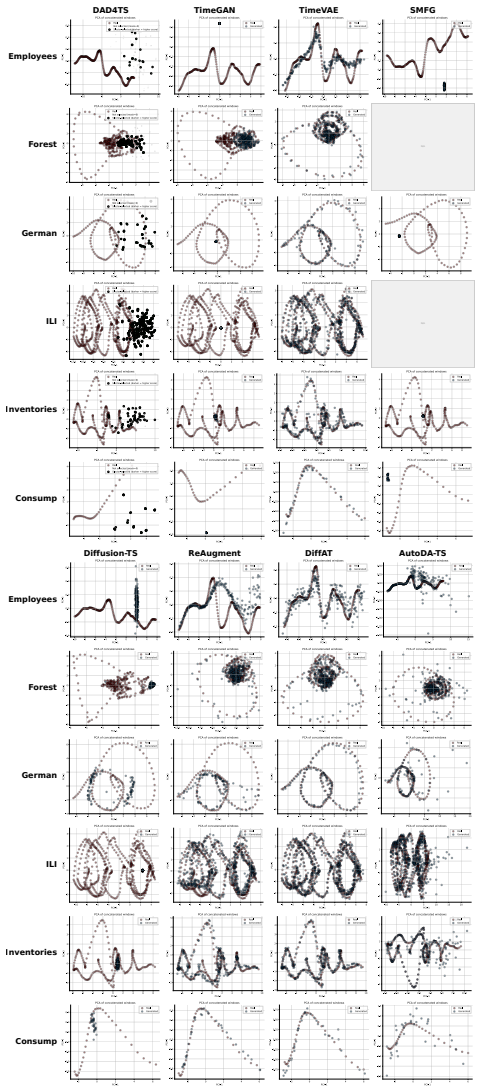
Small-scale data is a critical problem in time-series forecasting tasks. Data augmentation is an effective strategy for this task, but it has a limitation in generating meaningful data. To address this limitation, we propose DAD4TS, a diffusion-model-based data augmentation method with reinforcement learning, designed for time-series forecasting with small-scale data. In DAD4TS, a data generator is simultaneously trained with a time-series model and controlled by a reinforcement learning model to efficiently generate samples that improve the forecast accuracy of the time-series model. To support small-scale data, we use mathematical methods instead of conventional VAE methods to train the diffusion model by projecting the time-series data into the geometric space. We validated the effectiveness of DAD4TS with seven comparative methods through qualitative and quantitative experiments on six real-world datasets and eight time-series models. As a result, DAD4TS was validated on five datasets.
Editorial analysis
A structured set of objections, weighed in public.
Referee Report
Summary. The manuscript proposes DAD4TS, a diffusion-model-based data augmentation framework for time-series forecasting on small-scale data. A data generator is trained jointly with a forecasting model and steered by a reinforcement learning controller to produce augmentations that improve downstream accuracy. Time-series data are projected into geometric space via mathematical methods (rather than VAE) to enable diffusion training under limited samples. The approach is evaluated qualitatively and quantitatively against seven baselines on six real-world datasets using eight forecasting models, with reported effectiveness on five of the six datasets.
Significance. If the empirical results are substantiated, the work could provide a practical route to targeted data augmentation for small time-series datasets by coupling diffusion generation with RL-driven selection and a non-VAE geometric projection step. This combination addresses a common bottleneck in forecasting applications where data scarcity limits model performance.
major comments (1)
- [Abstract] Abstract: the claim of quantitative validation on six datasets with seven comparative methods and eight models is stated without any reported metrics, error bars, statistical significance tests, data-split details, or baseline implementations. Because the central claim rests on demonstrated improvement in forecast accuracy, the absence of these elements leaves the empirical support for the method unassessable from the provided description.
minor comments (2)
- Clarify the precise mathematical projection used to map time-series into geometric space and how it replaces VAE training; include a short derivation or pseudocode if the projection is novel.
- Provide the exact RL reward formulation and the joint training schedule (e.g., how often the generator, forecaster, and RL controller are updated) so that the simultaneous-training procedure can be reproduced.
Simulated Author's Rebuttal
We thank the referee for their detailed review and constructive comments on our manuscript. We address the major comment point by point below and will revise the paper accordingly to strengthen the presentation of our empirical results.
read point-by-point responses
-
Referee: [Abstract] Abstract: the claim of quantitative validation on six datasets with seven comparative methods and eight models is stated without any reported metrics, error bars, statistical significance tests, data-split details, or baseline implementations. Because the central claim rests on demonstrated improvement in forecast accuracy, the absence of these elements leaves the empirical support for the method unassessable from the provided description.
Authors: We acknowledge that the abstract, as currently written, provides a high-level summary without specific quantitative details. The full manuscript includes these elements in the Experiments section, including tables with metrics, error bars from multiple runs, details on data splits, baseline implementations, and statistical significance tests. To address this, we will revise the abstract to include a brief mention of key results, such as the average improvement in forecasting accuracy across the datasets where DAD4TS showed effectiveness, and note the use of statistical validation. This will make the central claim more assessable from the abstract alone. revision: yes
Circularity Check
No significant circularity in derivation chain
full rationale
The paper presents an empirical method for data augmentation in time-series forecasting using a diffusion model trained jointly with a forecaster and guided by reinforcement learning, with a geometric projection step substituted for VAE to handle small data. No load-bearing derivation, equation, or prediction is shown to reduce to its own inputs by construction. The central claims rest on the described training procedure and reported validation across six datasets and eight models rather than any self-referential fitting or self-citation chain that forces the result. The approach is self-contained as an engineering proposal with external experimental checks.
Axiom & Free-Parameter Ledger
axioms (1)
- domain assumption Projecting time-series data into geometric space using mathematical methods enables effective diffusion model training for small-scale data without conventional VAE methods.
Lean theorems connected to this paper
-
IndisputableMonolith/Foundation/Cost/FunctionalEquation.leanwashburn_uniqueness_aczel unclear?
unclearRelation between the paper passage and the cited Recognition theorem.
we use mathematical methods instead of conventional VAE methods to train the diffusion model by projecting the time-series data into the geometric space
-
IndisputableMonolith/Foundation/ArithmeticFromLogic.leanLogicNat.induction unclear?
unclearRelation between the paper passage and the cited Recognition theorem.
The Selector is trained to evaluate the utility of each generated sample by using improvements in the forecasting performance ... as the reward signal
What do these tags mean?
- matches
- The paper's claim is directly supported by a theorem in the formal canon.
- supports
- The theorem supports part of the paper's argument, but the paper may add assumptions or extra steps.
- extends
- The paper goes beyond the formal theorem; the theorem is a base layer rather than the whole result.
- uses
- The paper appears to rely on the theorem as machinery.
- contradicts
- The paper's claim conflicts with a theorem or certificate in the canon.
- unclear
- Pith found a possible connection, but the passage is too broad, indirect, or ambiguous to say the theorem truly supports the claim.
discussion (0)
Sign in with ORCID, Apple, or X to comment. Anyone can read and Pith papers without signing in.