Positivity of the effective range for finite range attractive potentials with a repulsive core
Pith reviewed 2026-05-20 09:52 UTC · model grok-4.3
The pith
Finite-range potentials with an inner repulsive core and outer attractive tail have strictly positive effective range when the scattering length exceeds the potential range.
A machine-rendered reading of the paper's core claim, the machinery that carries it, and where it could break.
Core claim
We rigorously prove that for finite-range potentials, characterized by an inner repulsive core and an outer attractive tail, the effective range remains strictly positive provided that the scattering length is greater than the range of the potential (a > R).
What carries the argument
The finite-range potential with inner repulsive core and outer attractive tail, which imposes positivity of the effective range through the structure of the scattering wave function when a > R.
If this is right
- The effective range cannot be negative for any potential satisfying the core-tail structure and a > R.
- Positive effective range supports the interpretation of certain exotic hadrons as loosely bound molecular states.
- The bound applies only to single-channel local finite-range interactions and does not extend automatically to other potential classes.
- Scattering parameters are constrained in a way that narrows the allowed region in the a-r0 plane for such potentials.
Where Pith is reading between the lines
- The same structural argument could be checked numerically on solvable models such as piecewise-constant potentials to confirm the bound holds with room to spare.
- Extensions to systems with small but finite range violations or weak non-localities might reveal how sharply the positivity threshold depends on the core-tail separation.
- In effective theories of hadrons, this positivity result supplies a consistency check that any fitted low-energy constants must respect for molecular assignments.
Load-bearing premise
The interaction must be a single-channel local potential of finite range that features an inner repulsive core and an outer attractive tail.
What would settle it
A concrete solvable potential with the required core-plus-tail shape that produces a non-positive effective range despite the scattering length exceeding the range.
Figures




read the original abstract
In the phenomenological study of exotic hadrons, the sign of the effective range, $r_0$, is invoked as a criterion to distinguish between compact multiquark configurations (associated with $r_0 < 0$) and loosely bound hadronic molecules ($r_0 > 0$). Motivated by this, we investigate the fundamental constraints on the sign of the effective range for single-channel local interactions. We rigorously prove that for finite-range potentials, characterized by an inner repulsive core and an outer attractive tail, the effective range remains strictly positive provided that the scattering length is greater than the range of the potential ($a > R$).
Editorial analysis
A structured set of objections, weighed in public.
Referee Report
Summary. The paper claims to rigorously prove that for single-channel local finite-range potentials featuring an inner repulsive core and an outer attractive tail, the effective range r0 is strictly positive whenever the scattering length satisfies a > R. The argument starts from the zero-energy solution of the Schrödinger equation, constructs an integral representation for the effective range, and invokes the sign structure of the potential together with the a > R condition to establish strict positivity.
Significance. If the central claim holds, the result supplies a parameter-free mathematical constraint on the sign of the effective range for a well-defined class of potentials. This directly supports the phenomenological use of r0 > 0 as a diagnostic for loosely bound hadronic molecules versus compact multiquark configurations in exotic hadron studies. The manuscript's strength lies in its direct derivation from the Schrödinger equation without reliance on numerical fits or external theorems.
minor comments (2)
- The abstract and introduction could more explicitly state the precise definition of the potential range R (e.g., the outermost point where V(r) becomes zero) to avoid any ambiguity when applying the a > R condition.
- A brief remark on the regularity conditions imposed on the wave function at the origin and at r = R would improve readability for readers outside the immediate scattering-theory community.
Simulated Author's Rebuttal
We thank the referee for their careful reading of the manuscript, for the accurate summary of our central result, and for the positive recommendation to accept. We are pleased that the referee recognizes the direct derivation from the Schrödinger equation and the potential relevance to exotic hadron phenomenology.
Circularity Check
No significant circularity; derivation is self-contained mathematical proof
full rationale
The paper presents a direct proof starting from the zero-energy Schrödinger equation for a single-channel local finite-range potential with specified sign structure (repulsive core + attractive tail). It derives an integral representation of the effective range r0 and uses the condition a > R together with the potential's sign properties to establish r0 > 0. No steps reduce to fitted parameters, self-referential definitions, or load-bearing self-citations; the argument remains within the stated assumptions and does not invoke external results that loop back to the present work. This is a standard rigorous derivation for a defined class of potentials.
Axiom & Free-Parameter Ledger
axioms (1)
- domain assumption The interaction is described by a single-channel local potential with finite range R, inner repulsive core, and outer attractive tail.
Reference graph
Works this paper leans on
-
[1]
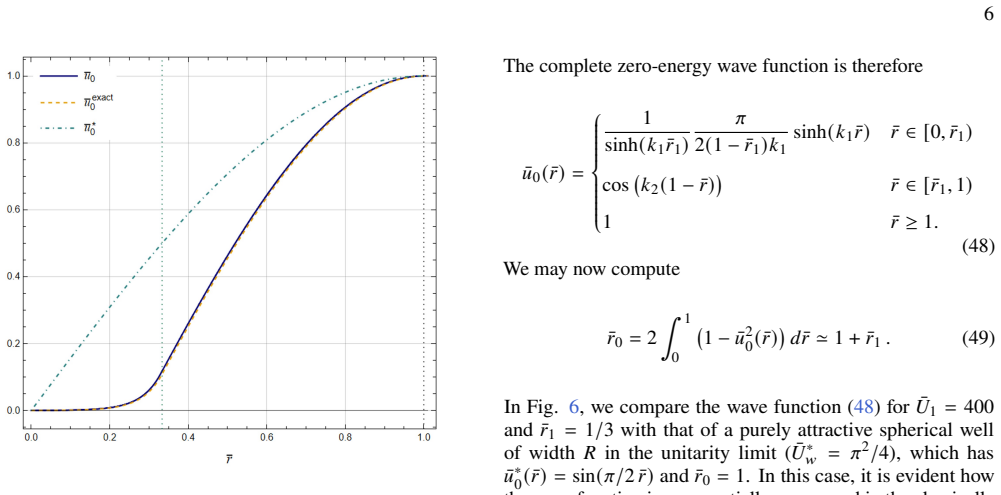
Spherical barrier and well We consider the potential 𝑉𝑤 (𝑟)= 𝑉1 𝑟∈ [0, 𝑟 1), −𝑉2 𝑟∈ [𝑟 1, 𝑅), 0𝑟 > 𝑅, (35) with 𝑉𝑖 >0 . For generality, we rewrite the problem in terms of the dimensionless variable ¯𝑟= 𝑟 𝑅 .(36) Thus ¯𝑈𝑤 (¯𝑟)= 2𝑚 ℏ2 𝑅2𝑉𝑤 (¯𝑟)(37) and ¯𝑢𝑘 (¯𝑟)= √ 𝑅 𝑢𝑘 (¯𝑟),(38) sothattheequationtosolvefor 𝑎=𝑅¯𝑎 and 𝑟0 =𝑅¯𝑟0becomes4 −¯𝑢′′ 0 (¯𝑟)...
-
[2]
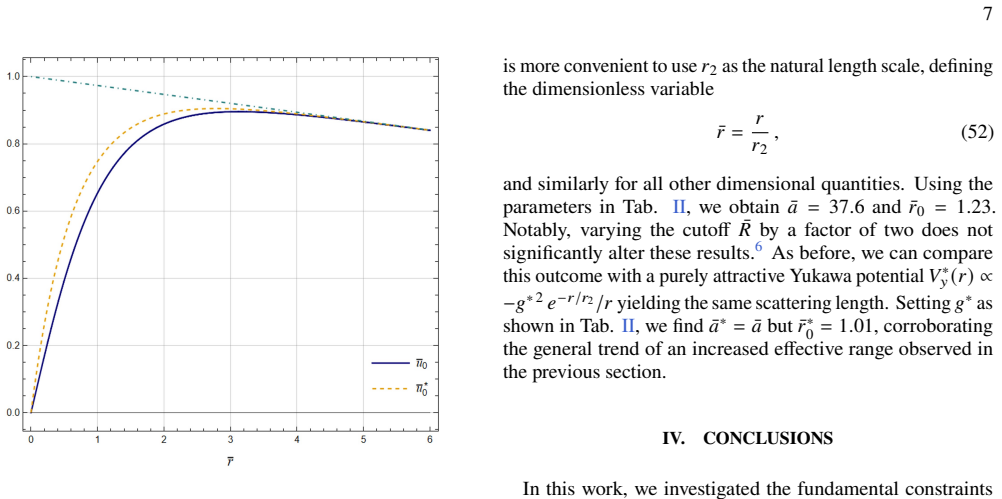
Yukawa potential FIG. 7. Solid line: zero-energy wavefunction for the potential in Eq.(50)withtheparameterslistedinTab.II.Thedashedlineindicates the solution for the purely attractive problem. The dash-dotted line represents the asymptotic solution1−¯𝑟/¯𝑎, which is common to both solutions since they share the same scattering length. Although the Yukawa p...
-
[3]
Furthermore, it illustrates the rapid convergence to the asymptotic solution due to the steep exponential decay of the potentials. independentofthiscutoff. 5 Wethereforeconsiderthepotential 𝑉𝑦 (𝑟)= ℏ2 2𝑚𝑟2 𝑔2 1 𝑒−𝑟/𝑟1 𝑟 −𝑔 2 2 𝑒−𝑟/𝑟2 𝑟 𝜃(𝑅−𝑟),(50) where 𝜃(𝑥) istheHeavisidestepfunctionand 𝑟1 < 𝑟 2,ensuring the potential has an attractive tail. We also choo...
-
[4]
Butterworth-Heinemann, Oxford, 1991
LevDavidovichLandauandE.M.Lifshits.QuantumMechanics: Non-Relativistic Theory, volume v.3 ofCourse of Theoretical Physics. Butterworth-Heinemann, Oxford, 1991. 5 Restricting the potential to a compact support also prevents non-analyticity issues in the complex𝑘plane [2]. 6 For instance, setting¯𝑅=6changes¯𝑎by only2%. This indicates that, due to the exponen...
work page 1991
-
[5]
J R Taylor.Scattering theory: the quantum theory of nonrela- tivistic collisions.1972, 01 1972
work page 1972
-
[6]
TheoryoftheEffectiveRangeinNuclearScattering
H.A.Bethe. TheoryoftheEffectiveRangeinNuclearScattering. Phys.Rev., 76:38, 1949
work page 1949
-
[7]
Ontheneutron-protonforce.Phys.Rev.,74:92–96, Jul 1948
JohnM.Blatt. Ontheneutron-protonforce.Phys.Rev.,74:92–96, Jul 1948
work page 1948
-
[8]
John Markus Blatt and Victor Frederick Weisskopf.Theoretical nuclear physics. Springer, New York, 1952
work page 1952
-
[9]
Scattering length and effective range of microscopic two-body potentials.Rev
Mathias Macêdo-Lima and Lucas Madeira. Scattering length and effective range of microscopic two-body potentials.Rev. 8 Bras. Ens. Fis., 45:e20230079, 2023
work page 2023
-
[10]
Ya. A. Smorodinsky. Normalization of the deuteron wave func- tion.Dokl.Akad.Nauk SSSR., 60:217, 1948
work page 1948
-
[11]
AngeloEsposito,LucianoMaiani,AlessandroPilloni,AntonioD. Polosa,andVeronicaRiquer. FromthelineshapeoftheX(3872) to its structure.Phys. Rev. D, 105(3):L031503, 2022
work page 2022
-
[12]
AngeloEsposito,AlfredoGlioti,DavideGermani,andAntonioD. Polosa. A short review on the compositeness of the X(3872). Riv. Nuovo Cim., 48(2):95–155, 2025
work page 2025
-
[13]
Effective range expansion for narrow near-threshold resonances.Phys
Vadim Baru, Xiang-Kun Dong, Meng-Lin Du, Arseniy Filin, Feng-Kun Guo, Christoph Hanhart, Alexey Nefediev, Juan Nieves, and Qian Wang. Effective range expansion for narrow near-threshold resonances.Phys. Lett. B, 833:137290, 2022
work page 2022
-
[14]
ImplicationofanegativeeffectiverangeontheDD ¯*interaction and the nature of X(3872).Phys
Yi-Bo Shen, Ming-Zhu Liu, Zhi-Wei Liu, and Li-Sheng Geng. ImplicationofanegativeeffectiverangeontheDD ¯*interaction and the nature of X(3872).Phys. Rev. D, 111(3):034001, 2025
work page 2025
-
[15]
Compositeness of Tcc and X(3872) by considering decay and coupled-channels effects
Tomona Kinugawa and Tetsuo Hyodo. Compositeness of Tcc and X(3872) by considering decay and coupled-channels effects. Phys. Rev. C, 109(4):045205, 2024
work page 2024
-
[16]
Evidence That the Deuteron Is Not an Ele- mentary Particle.Phys
Steven Weinberg. Evidence That the Deuteron Is Not an Ele- mentary Particle.Phys. Rev., 137:B672–B678, 1965
work page 1965
-
[17]
Polosa, RiccardoRattazzi, andMicheleTarquini
Angelo Esposito, Davide Germani, Alfredo Glioti, Antonio D. Polosa, RiccardoRattazzi, andMicheleTarquini. Theroleofthe pion in the lineshape of the X(3872).Phys. Lett. B, 847:138285, 2023
work page 2023
discussion (0)
Sign in with ORCID, Apple, or X to comment. Anyone can read and Pith papers without signing in.