Baseband-Efficient WMMSE Precoding: From a Signal Weighting Cost Perspective
Pith reviewed 2026-05-20 00:03 UTC · model grok-4.3
The pith
The optimal precoder under both sparse architectures resides strictly in a low-dimensional subspace determined by the channel matrices.
A machine-rendered reading of the paper's core claim, the machinery that carries it, and where it could break.
Core claim
For the mixed-integer nonlinear program that maximizes sum-rate under row-sparse constraints, the optimal precoder under both the common-support and user-specific row-sparse architectures lies exactly in the low-dimensional subspace determined by the channel matrices, thereby reducing the dimensionality of the optimization variables.
What carries the argument
The low-dimensional subspace determined by the channel matrices, which confines every feasible optimal precoder and thereby reduces the number of variables that must be optimized.
Load-bearing premise
That restricting the search to the channel-determined subspace produces only negligible loss in achievable sum-rate compared with the unrestricted problem.
What would settle it
For small antenna and user counts where the original mixed-integer program can be solved to global optimality, compare the sum-rate obtained with versus without the subspace restriction to measure any actual performance gap.
Figures





read the original abstract
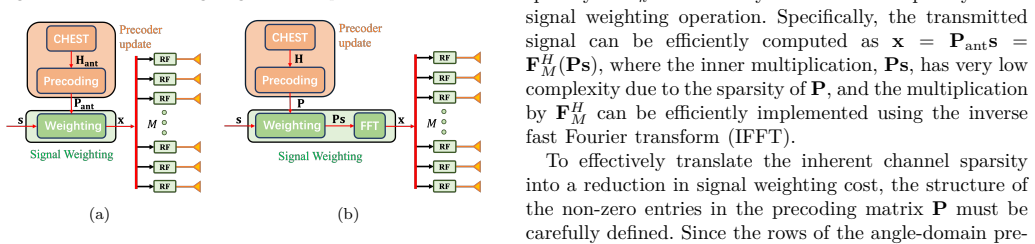
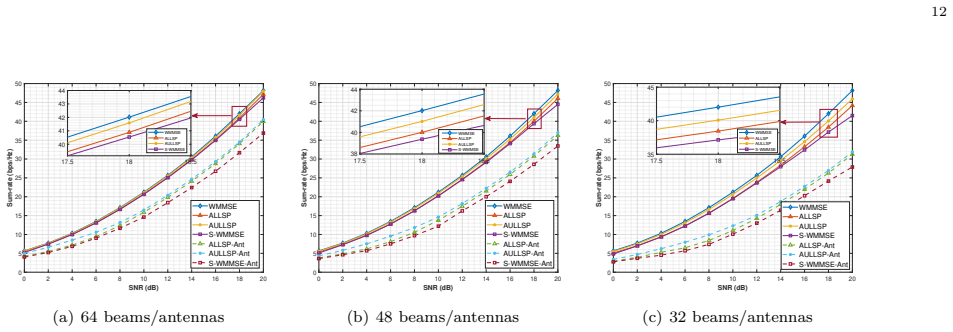
For downlink transmission in massive multi-user multiple-input multiple-output (MU-MIMO) systems, conventional precoding research heavily focuses on reducing the computational complexity of precoding matrix design, while largely overlooking another critical bottleneck: the substantial signal weighting cost incurred by repeatedly applying the precoder to high-speed data streams. To address both challenges simultaneously, this paper proposes a novel sparse precoding framework tailored for fully-digital architectures. Within this framework, from the sum-rate maximization perspective, we design two sparse precoding architectures: a common-support row-sparse architecture and a user-specific row-sparse architecture, so as to reduce the number of multiplication operations required in baseband signal weighting without sacrificing system capacity. For the formulated mixed-integer non-linear programming (MINLP) problem, we rigorously prove, for the first time, that the optimal precoder under both sparse architectures strictly resides in a specific low-dimensional subspace determined by the channel matrices, thereby reducing the dimensionality of the optimization variables. Based on this insight, an alternating optimization algorithm is developed within the weighted minimum mean square error (WMMSE) framework to jointly optimize sparse beam selection and low-dimensional precoding coefficients. The combinatorial beam selection problem is handled using an efficient penalty-based majorize-minimization (MM) method, yielding a low-complexity closed-form solution. Simulation results demonstrate that the proposed scheme achieves near-optimal sum-rate performance while substantially reducing both the precoding computation complexity and the overall signal weighting cost.
Editorial analysis
A structured set of objections, weighed in public.
Referee Report
Summary. The paper proposes two row-sparse precoding architectures (common-support and user-specific) for fully-digital massive MU-MIMO to reduce baseband signal weighting cost while preserving sum-rate. It formulates the designs as MINLPs, claims a rigorous first-time proof that the optimal precoders lie exactly in a low-dimensional subspace determined by the channel matrices, and develops a WMMSE alternating optimization algorithm that uses penalty-based majorize-minimization to handle the combinatorial beam selection, yielding closed-form updates and near-optimal performance in simulations.
Significance. If the subspace reduction is valid for the original MINLP, the work offers a concrete dimensionality reduction for sparse precoder optimization and a practical way to lower both precoding complexity and repeated signal-weighting operations, which are important for high-speed baseband processing in massive MIMO. The penalty-MM closed-form solution for selection is a positive technical feature.
major comments (1)
- [Proof of subspace property (Theorem 1 / §3)] The central subspace claim (abstract and the proof section deriving the low-dimensional property from stationarity conditions) is load-bearing for the dimensionality reduction and the subsequent algorithm. The derivation appears to set gradients of the continuous WMMSE objective to zero without explicit conditioning on the binary row-selection variables; it is therefore unclear whether an optimal solution to the MINLP must lie in the same subspace. Please supply the exact steps showing how the integer constraints are respected or why the property survives the combinatorial restriction.
minor comments (2)
- [Numerical results] In the simulation section, state the exact antenna/user counts, SNR range, and number of Monte-Carlo trials so that the reported sum-rate gaps can be reproduced.
- [System model and algorithm] Notation for the two architectures (common-support vs. user-specific) is occasionally interchanged in the algorithm description; a single consistent symbol table would help.
Simulated Author's Rebuttal
We thank the referee for the careful and constructive review. The comment regarding the subspace property proof is important, and we will revise the manuscript to make the handling of the integer constraints explicit. Our detailed response is provided below.
read point-by-point responses
-
Referee: [Proof of subspace property (Theorem 1 / §3)] The central subspace claim (abstract and the proof section deriving the low-dimensional property from stationarity conditions) is load-bearing for the dimensionality reduction and the subsequent algorithm. The derivation appears to set gradients of the continuous WMMSE objective to zero without explicit conditioning on the binary row-selection variables; it is therefore unclear whether an optimal solution to the MINLP must lie in the same subspace. Please supply the exact steps showing how the integer constraints are respected or why the property survives the combinatorial restriction.
Authors: We thank the referee for this observation. The proof of Theorem 1 proceeds by first fixing the binary row-selection variables (i.e., the support), which reduces the MINLP to a continuous problem over the active precoding coefficients. For any such fixed support, the stationarity condition obtained by setting the gradient of the WMMSE objective with respect to the continuous variables to zero directly implies that the optimal precoder lies in the low-dimensional subspace spanned by the relevant columns of the channel matrix. Because every feasible point of the original MINLP corresponds to some binary selection, and the optimal continuous coefficients for that selection satisfy the subspace property, the globally optimal solution of the MINLP (which is optimal for its particular support) must also lie in the same subspace. We will revise §3 to insert an explicit paragraph that first conditions on the binary variables being fixed, derives the stationarity condition, and then lifts the result to the combinatorial case. This clarification preserves the original claim while addressing the concern directly. revision: yes
Circularity Check
Subspace optimality proof and WMMSE alternating algorithm presented as independent of fitted parameters or self-citation chains
full rationale
The paper formulates an MINLP for row-sparse precoding and claims a rigorous first-time proof that the optimal precoder resides in a channel-determined low-dimensional subspace. This proof is positioned as a mathematical result on the MINLP itself rather than a reduction of the objective to a fitted quantity or a self-citation. The subsequent alternating optimization within the WMMSE framework and penalty-based MM for beam selection are derived from standard WMMSE stationarity conditions and majorization techniques without evidence that the subspace property or sum-rate claims are forced by construction from internal definitions. No load-bearing self-citations or ansatz smuggling are indicated in the derivation chain. The result is therefore self-contained against external benchmarks.
Axiom & Free-Parameter Ledger
Lean theorems connected to this paper
-
IndisputableMonolith/Foundation/AlexanderDuality.leanalexander_duality_circle_linking unclear?
unclearRelation between the paper passage and the cited Recognition theorem.
Proposition 1 (Subspace Characterization). The optimal angle-domain sparse precoding matrix Δ∗V∗k lies in the subspace spanned by Δ∗HH.
-
IndisputableMonolith/Cost/FunctionalEquation.leanwashburn_uniqueness_aczel unclear?
unclearRelation between the paper passage and the cited Recognition theorem.
We rigorously prove, for the first time, that the optimal precoder under both sparse architectures strictly resides in a specific low-dimensional subspace
What do these tags mean?
- matches
- The paper's claim is directly supported by a theorem in the formal canon.
- supports
- The theorem supports part of the paper's argument, but the paper may add assumptions or extra steps.
- extends
- The paper goes beyond the formal theorem; the theorem is a base layer rather than the whole result.
- uses
- The paper appears to rely on the theorem as machinery.
- contradicts
- The paper's claim conflicts with a theorem or certificate in the canon.
- unclear
- Pith found a possible connection, but the passage is too broad, indirect, or ambiguous to say the theorem truly supports the claim.
Reference graph
Works this paper leans on
-
[1]
Massive MIMO in 5g: How beamforming, codebooks, and feedback enable larger arrays,
R. M. Dreifuerst and R. W. Heath, “Massive MIMO in 5g: How beamforming, codebooks, and feedback enable larger arrays,” IEEE Communications Magazine, vol. 61, no. 12, pp. 18–23, 2023
work page 2023
-
[2]
An overview of massive MIMO for 5g and 6g,
F. A. P. De Figueiredo, “An overview of massive MIMO for 5g and 6g,” IEEE Latin America Transactions, vol. 20, no. 6, pp. 931–940, 2022
work page 2022
-
[3]
Extremely large-scale MIMO: Fundamentals, challenges, solutions, and future directions,
Z. Wang, J. Zhang, H. Du, W. E. Sha, B. Ai, D. Niyato, and M. Debbah, “Extremely large-scale MIMO: Fundamentals, challenges, solutions, and future directions,” IEEE Wireless Communications, vol. 31, no. 3, pp. 117–124, 2023
work page 2023
-
[4]
Z. Wang, J. Zhang, H. Du, D. Niyato, S. Cui, B. Ai, M. Debbah, K. B. Letaief, and H. V. Poor, “A tutorial on extremely large- scale MIMO for 6g: Fundamentals, signal processing, and appli- cations,” IEEE Communications Surveys & Tutorials, vol. 26, no. 3, pp. 1560–1605, 2024
work page 2024
-
[5]
Energy and spectral efficiency of very large multiuser MIMO systems,
H. Q. Ngo, E. G. Larsson, and T. L. Marzetta, “Energy and spectral efficiency of very large multiuser MIMO systems,” IEEE Transactions on Communications, vol. 61, no. 4, pp. 1436–1449, 2013
work page 2013
-
[6]
An overview of massive MIMO: Benefits and chal- lenges,
L. Lu, G. Y. Li, A. L. Swindlehurst, A. Ashikhmin, and R. Zhang, “An overview of massive MIMO: Benefits and chal- lenges,” IEEE journal of selected topics in signal processing, vol. 8, no. 5, pp. 742–758, 2014
work page 2014
-
[7]
Weighted sum-rate maximization using weighted mmse for MIMO-BC beamforming design,
S. S. Christensen, R. Agarwal, E. De Carvalho, and J. M. Cioffi, “Weighted sum-rate maximization using weighted mmse for MIMO-BC beamforming design,” IEEE Transactions on Wireless Communications, vol. 7, no. 12, pp. 4792–4799, 2008
work page 2008
-
[8]
Q. Shi, M. Razaviyayn, Z.-Q. Luo, and C. He, “An iter- atively weighted mmse approach to distributed sum-utility maximization for a MIMO interfering broadcast channel,” IEEE Transactions on Signal Processing, vol. 59, no. 9, pp. 4331–4340, 2011
work page 2011
-
[9]
Low- complexity linear precoding for downlink large-scale MIMO sys- tems,
S. Zarei, W. Gerstacker, R. R. Müller, and R. Schober, “Low- complexity linear precoding for downlink large-scale MIMO sys- tems,” in 2013 IEEE 24th Annual International Symposium on Personal, Indoor, and Mobile Radio Communications (PIMRC). IEEE, 2013, pp. 1119–1124
work page 2013
-
[10]
A deep learning-based frame- work for low complexity multiuser MIMO precoding design,
M. Zhang, J. Gao, and C. Zhong, “A deep learning-based frame- work for low complexity multiuser MIMO precoding design,” IEEE Transactions on Wireless Communications, vol. 21, no. 12, pp. 11 193–11 206, 2022
work page 2022
-
[11]
Robust wmmse precoder with deep learning design for massive MIMO,
J. Shi, A.-A. Lu, W. Zhong, X. Gao, and G. Y. Li, “Robust wmmse precoder with deep learning design for massive MIMO,” IEEE Transactions on Communications, vol. 71, no. 7, pp. 3963– 3976, 2023
work page 2023
-
[12]
Q. Hu, Y. Cai, Q. Shi, K. Xu, G. Yu, and Z. Ding, “Iterative algorithm induced deep-unfolding neural networks: Precoding design for multiuser MIMO systems,” IEEE Transactions on Wireless Communications, vol. 20, no. 2, pp. 1394–1410, 2020
work page 2020
-
[13]
E. Dahlman, S. Parkvall, and J. Skold, 5G NR: The next generation wireless access technology. Academic Press, 2020. 14
work page 2020
-
[14]
Hardware-aware beamspace precoding for all-digital mmwave massive MU-MIMO,
E. Gönültaş, S. Taner, A. Gallyas-Sanhueza, S. H. Mirfarsh- bafan, and C. Studer, “Hardware-aware beamspace precoding for all-digital mmwave massive MU-MIMO,” IEEE Communi- cations Letters, vol. 25, no. 11, pp. 3709–3713, 2021
work page 2021
-
[15]
Low-complexity angular domain pre- coding in all-digital massive MU-MIMO system,
K. Tong and W. Zhou, “Low-complexity angular domain pre- coding in all-digital massive MU-MIMO system,” in 2023 8th International Conference on Computer and Communication Systems (ICCCS). IEEE, 2023, pp. 187–192
work page 2023
-
[16]
Spatially sparse precoding in millimeter wave MIMO systems,
O. El Ayach, S. Rajagopal, S. Abu-Surra, Z. Pi, and R. W. Heath, “Spatially sparse precoding in millimeter wave MIMO systems,” IEEE transactions on wireless communications, vol. 13, no. 3, pp. 1499–1513, 2014
work page 2014
-
[17]
MIMO precoding and combining solutions for millimeter-wave systems,
A. Alkhateeb, J. Mo, N. Gonzalez-Prelcic, and R. W. Heath, “MIMO precoding and combining solutions for millimeter-wave systems,” IEEE Communications Magazine, vol. 52, no. 12, pp. 122–131, 2014
work page 2014
-
[18]
Alternating minimization algorithms for hybrid precoding in millimeter wave MIMO systems,
X. Yu, J.-C. Shen, J. Zhang, and K. B. Letaief, “Alternating minimization algorithms for hybrid precoding in millimeter wave MIMO systems,” IEEE Journal of Selected Topics in Signal Processing, vol. 10, no. 3, pp. 485–500, 2016
work page 2016
-
[19]
Joint transmit beamforming and antenna selection in MIMO systems,
M. Zhao, X. Chen, Q. Shi, and W. Xu, “Joint transmit beamforming and antenna selection in MIMO systems,” IEEE wireless communications letters, vol. 7, no. 5, pp. 716–719, 2018
work page 2018
-
[20]
Sparse array beam- former design via admm,
H. Huang, H. C. So, and A. M. Zoubir, “Sparse array beam- former design via admm,” IEEE Transactions on Signal Pro- cessing, vol. 71, pp. 3357–3372, 2023
work page 2023
-
[21]
M. Hong, R. Sun, H. Baligh, and Z.-Q. Luo, “Joint base station clustering and beamformer design for partial coordinated transmission in heterogeneous networks,” IEEE Journal on Selected Areas in Communications, vol. 31, no. 2, pp. 226–240, 2013
work page 2013
-
[22]
R. Guo, Y. Cai, M. Zhao, Q. Shi, B. Champagne, and L. Hanzo, “Joint design of beam selection and precoding matrices for mmwave MU-MIMO systems relying on lens antenna arrays,” IEEE Journal of Selected Topics in Signal Processing, vol. 12, no. 2, pp. 313–325, 2018
work page 2018
-
[23]
Q. Hu, Y. Liu, Y. Cai, G. Yu, and Z. Ding, “Joint deep rein- forcement learning and unfolding: Beam selection and precoding for mmwave multiuser MIMO with lens arrays,” IEEE Journal on Selected Areas in Communications, vol. 39, no. 8, pp. 2289– 2304, 2021
work page 2021
-
[24]
Joint user grouping and beam selection for beamspace mmwave multi-user MIMO system,
J. Sun, M. Jia, Q. Guo, and X. Gu, “Joint user grouping and beam selection for beamspace mmwave multi-user MIMO system,” IEEE Communications Letters, vol. 26, no. 5, pp. 1170–1174, 2022
work page 2022
-
[25]
Low-complexity joint user and beam selection for beamspace mmwave MIMO systems,
Z. Cheng, Z. Wei, and H. Yang, “Low-complexity joint user and beam selection for beamspace mmwave MIMO systems,” IEEE Communications Letters, vol. 24, no. 9, pp. 2065–2069, 2020
work page 2065
-
[26]
Angle domain hybrid precoding and channel tracking for millimeter wave massive MIMO systems,
J. Zhao, F. Gao, W. Jia, S. Zhang, S. Jin, and H. Lin, “Angle domain hybrid precoding and channel tracking for millimeter wave massive MIMO systems,” IEEE Transactions on Wireless Communications, vol. 16, no. 10, pp. 6868–6880, 2017
work page 2017
-
[27]
C. Xu, Y. Jia, S. He, Y. Huang, and D. Niyato, “Joint user scheduling, base station clustering, and beamforming design based on deep unfolding technique,” IEEE Transactions on Communications, vol. 71, no. 10, pp. 5831–5845, 2023
work page 2023
-
[28]
Quadriga: A 3-d multi-cell channel model with time evolution for enabling virtual field trials,
S. Jaeckel, L. Raschkowski, K. Börner, and L. Thiele, “Quadriga: A 3-d multi-cell channel model with time evolution for enabling virtual field trials,” IEEE transactions on antennas and propa- gation, vol. 62, no. 6, pp. 3242–3256, 2014
work page 2014
discussion (0)
Sign in with ORCID, Apple, or X to comment. Anyone can read and Pith papers without signing in.