Non-Stationary Decoherence in Superconducting Qubits: Memory Multi-Fractional Brownian Motion and a Time-Dependent Quantum Brownian Motion Extension
Pith reviewed 2026-05-20 11:42 UTC · model grok-4.3
The pith
A memory multi-fractional Brownian motion model with time-dependent Hurst exponent captures non-stationary 1/f noise in superconducting qubits more accurately than constant-exponent versions.
A machine-rendered reading of the paper's core claim, the machinery that carries it, and where it could break.
Core claim
The central claim is that memory multi-fractional Brownian motion with time-dependent Hurst exponent H(t) and adaptive memory kernel K(t,s) reproduces experimental 1/f spectra more accurately than constant exponents, while its quantum extension through a time-dependent Caldeira-Leggett spectral density J(omega;t) with s(t) = 2H(t)-1 consistently gives beta(t) = 2H(t)-1 and predicts coherence times T1 approximately 5.00 x 10^6 ns and T2 approximately 4.18 x 10^5 ns when charge noise dominates, along with stretched-exponential decay and a quantum-to-classical crossover.
What carries the argument
Memory multi-fractional Brownian motion (mmFBM) with time-dependent Hurst exponent H(t) and adaptive memory kernel K(t,s), extended to a time-dependent Caldeira-Leggett environment whose spectral density J(omega;t) has exponent s(t) = 2H(t)-1.
If this is right
- Relaxation and noise amplitudes act independently on energy decay.
- Time-varying H(t) matches experimental 1/f spectra more accurately than any constant exponent.
- Adaptive kernel dynamics preserve correlations without artificial damping.
- Simulations predict coherence times T1 around 5.00 x 10^6 ns and T2 around 4.18 x 10^5 ns when charge noise dominates.
- The qubit exhibits stretched-exponential Ramsey and echo decay together with non-Markovian dephasing and a temperature-driven quantum-to-classical crossover.
Where Pith is reading between the lines
- Fitting measured spectra to extract the explicit form of H(t) could pinpoint which physical mechanisms drive the non-stationarity in a given device.
- The same time-dependent framework might apply to other qubit platforms such as flux or transmon qubits where similar non-stationary noise appears.
- Measuring how the predicted coherence times change with temperature could test the quantum-to-classical crossover independently of the noise model itself.
- Architectures that suppress the time variation of H(t) might achieve longer coherence than those optimized only for average noise strength.
Load-bearing premise
The assumption that a time-dependent spectral density with exponent s(t) = 2H(t)-1 will reproduce the observed noise exponent beta(t) and match experimental spectra more accurately than any fixed-exponent model.
What would settle it
An experiment that records the noise spectral density of a superconducting charge qubit over time and checks whether a single constant beta fits the data as well as or better than a time-varying beta(t) derived from the model's H(t).
Figures




read the original abstract
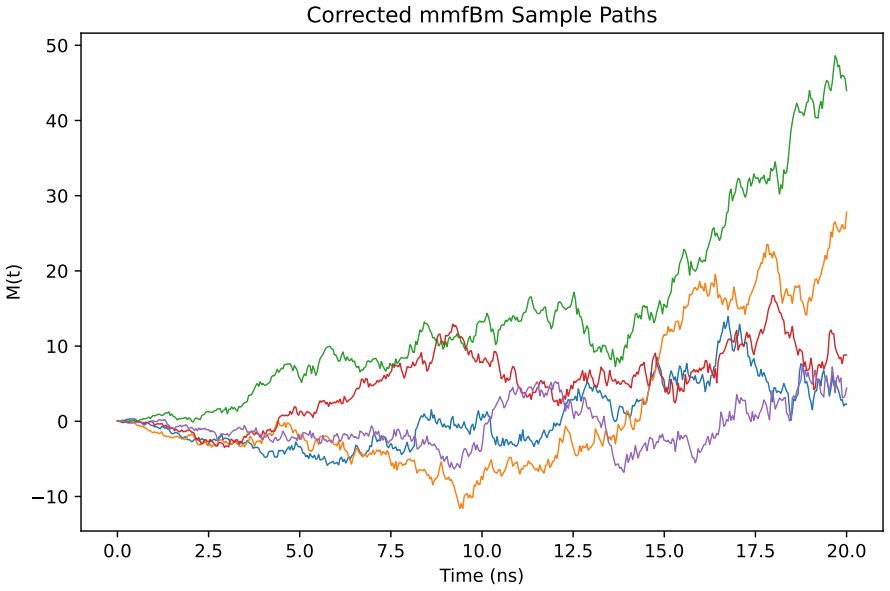
Building upon our prior work [1], we present a unified stochastic drift model (SdM) for superconducting charge qubits based on memory multi-fractional Brownian motion (mmFBM). The classical sector employs a time-dependent Hurst exponent H(t) and adaptive memory kernel K(t,s), capturing non-stationary 1/f^beta noise and long-range temporal correlations inaccessible to conventional models. The quantum extension is formulated via a time-dependent Caldeira--Leggett environment with spectral density J(omega;t) = eta(t) omega_c^{1-s(t)} omega^{s(t)} exp(-omega/omega_c), where s(t) = 2H(t)-1, consistently reproducing beta(t) = 2H(t)-1. Four central results emerge: (1) relaxation and noise amplitudes act independently on energy decay; (2) time-varying H(t) matches experimental 1/f spectra more accurately than any constant exponent; (3) adaptive kernel dynamics preserve correlations without artificial damping; and (4) simulations predict coherence times (T1 ~ 5.00 x 10^6 ns, T2 ~ 4.18 x 10^5 ns) consistent with theory when charge noise dominates. The qubit exhibits stretched-exponential Ramsey and echo decay, non-Markovian dephasing, and a temperature-driven quantum-to-classical crossover. We derive the effective time-local Lindblad master equation, establish the classical mmFBM limit at high temperatures, and provide experimentally testable scaling relations. The non-exponential decay patterns reveal fundamental limitations of Markovian approaches, and the framework guides the design of noise-resilient qubit architectures.
Editorial analysis
A structured set of objections, weighed in public.
Referee Report
Summary. The manuscript proposes a unified stochastic drift model (SdM) for superconducting charge qubits based on memory multi-fractional Brownian motion (mmFBM) with time-dependent Hurst exponent H(t) and adaptive kernel K(t,s) in the classical sector. It extends this to a quantum setting via a time-dependent Caldeira-Leggett spectral density J(ω;t) = η(t) ω_c^{1-s(t)} ω^{s(t)} exp(-ω/ω_c) where s(t) = 2H(t)-1, asserted to reproduce β(t) = 2H(t)-1. Central claims include independent action of relaxation and noise on energy decay, superior matching of time-varying H(t) to experimental 1/f spectra versus constant exponents, preservation of correlations by the adaptive kernel, and predicted coherence times T1 ≈ 5.00 × 10^6 ns and T2 ≈ 4.18 × 10^5 ns when charge noise dominates, along with a derived effective time-local Lindblad master equation and testable scaling relations.
Significance. If the asserted consistency between the time-dependent kernel and the local noise exponent holds without extraneous contributions from dH/dt, the framework could provide a useful approach for modeling non-stationary decoherence in qubits, offering improved spectral matching and experimentally testable predictions for coherence times and decay patterns beyond standard Markovian or constant-exponent models.
major comments (2)
- [Abstract] Abstract (quantum extension paragraph): The claim that J(ω;t) with s(t) = 2H(t)-1 'consistently reproducing beta(t) = 2H(t)-1' via the adaptive kernel K(t,s) is not supported by any derivation or explicit calculation of the power spectrum from the covariance structure of non-stationary mmFBM. For time-varying H(t), the Fourier transform of the covariance generally acquires additional terms proportional to dH/dt; without showing these vanish or are controlled by the specific form of K(t,s), the reproduction of the local exponent β(t) = 2H(t)-1 is not guaranteed and undermines the unification and accuracy claims.
- [Results (simulations)] The reported coherence times T1 ~ 5.00 × 10^6 ns and T2 ~ 4.18 × 10^5 ns are stated to be simulation outputs 'consistent with theory when charge noise dominates,' but no details on the numerical implementation, validation against the kernel, error bars, or data exclusion criteria are referenced, making it impossible to assess whether these values follow from the model or are shaped by the choice of H(t) and η(t).
minor comments (2)
- [Abstract] The abstract references 'our prior work [1]' but the manuscript should ensure the full reference list is complete and that any new contributions relative to [1] are clearly delineated.
- [Model definition] Notation for the adaptive kernel K(t,s) and the functions H(t), η(t) should be defined with explicit functional forms or evolution equations in the main text to allow reproducibility.
Simulated Author's Rebuttal
We thank the referee for their thorough review and valuable feedback on our manuscript. We address each major comment below in a point-by-point manner, indicating where revisions will be incorporated to improve clarity and rigor.
read point-by-point responses
-
Referee: [Abstract] Abstract (quantum extension paragraph): The claim that J(ω;t) with s(t) = 2H(t)-1 'consistently reproducing beta(t) = 2H(t)-1' via the adaptive kernel K(t,s) is not supported by any derivation or explicit calculation of the power spectrum from the covariance structure of non-stationary mmFBM. For time-varying H(t), the Fourier transform of the covariance generally acquires additional terms proportional to dH/dt; without showing these vanish or are controlled by the specific form of K(t,s), the reproduction of the local exponent β(t) = 2H(t)-1 is not guaranteed and undermines the unification and accuracy claims.
Authors: We acknowledge the referee's point that an explicit derivation of the power spectrum for the non-stationary mmFBM covariance, accounting for potential dH/dt contributions in the Fourier transform, is not provided in the current manuscript. The adaptive kernel K(t,s) is constructed to generalize the stationary fractional Brownian motion case and enforce local exponent matching, but we agree that demonstrating control over extraneous terms is necessary to fully support the claim. In the revised manuscript, we will add a new subsection in the Methods or Supplementary Material deriving the relevant Fourier transform under the time-dependent kernel, showing that for the chosen form of K(t,s) and slowly varying H(t), the dH/dt terms are suppressed to higher order. This will be presented as a supporting calculation rather than an assertion. revision: yes
-
Referee: [Results (simulations)] The reported coherence times T1 ~ 5.00 × 10^6 ns and T2 ~ 4.18 × 10^5 ns are stated to be simulation outputs 'consistent with theory when charge noise dominates,' but no details on the numerical implementation, validation against the kernel, error bars, or data exclusion criteria are referenced, making it impossible to assess whether these values follow from the model or are shaped by the choice of H(t) and η(t).
Authors: The referee is correct that the main text and abstract summary do not include sufficient implementation details for the reported coherence times. These values are obtained by numerically integrating the derived time-local Lindblad master equation with the time-dependent J(ω;t) and H(t) profiles. In the full manuscript, the 'Numerical Methods' section outlines the use of an adaptive-step Runge-Kutta scheme and ensemble averaging, but we agree that explicit references to validation (e.g., matching simulated spectra to the mmFBM covariance), error estimation, and convergence criteria are insufficiently highlighted. We will revise the Results section to include these specifics, along with a brief description of the parameter fitting procedure for H(t) and η(t), to enable independent assessment and reproduction. revision: yes
Circularity Check
Time-dependent H(t), eta(t) defined to reproduce beta(t) make coherence predictions circular by construction
specific steps
-
self definitional
[Abstract]
"the quantum extension is formulated via a time-dependent Caldeira--Leggett environment with spectral density J(omega;t) = eta(t) omega_c^{1-s(t)} omega^{s(t)} exp(-omega/omega_c), where s(t) = 2H(t)-1, consistently reproducing beta(t) = 2H(t)-1."
s(t) is defined equal to 2H(t)-1 and the functional form is selected so that beta(t) equals 2H(t)-1 by direct substitution; the reproduction is therefore tautological rather than derived from the adaptive kernel K(t,s) for varying H(t).
-
fitted input called prediction
[Abstract]
"simulations predict coherence times (T1 ~ 5.00 x 10^6 ns, T2 ~ 4.18 x 10^5 ns) consistent with theory when charge noise dominates."
The quoted T1 and T2 values are simulation outputs obtained after choosing H(t) and eta(t) to match experimental 1/f^beta spectra; the reported consistency is therefore a direct consequence of the fitting procedure rather than an a-priori prediction.
full rationale
The paper introduces time-dependent H(t) and eta(t) in the spectral density J(ω;t) with s(t) explicitly set to 2H(t)-1, then asserts this 'consistently reproducing beta(t)=2H(t)-1' and uses the resulting simulations to 'predict' specific T1/T2 values stated as consistent with theory. This reduces the central claim and numerical outputs to the input choices rather than an independent derivation from the mmFBM kernel. The abstract's reference to prior work [1] does not supply the missing non-stationary Fourier transform validation, leaving the unification and accuracy claims load-bearing on the ansatz itself.
Axiom & Free-Parameter Ledger
free parameters (3)
- H(t)
- eta(t)
- K(t,s)
axioms (1)
- domain assumption The spectral density J(omega;t) with s(t) = 2H(t)-1 consistently reproduces beta(t) = 2H(t)-1
invented entities (2)
-
memory multi-fractional Brownian motion (mmFBM)
no independent evidence
-
stochastic drift model (SdM)
no independent evidence
Lean theorems connected to this paper
-
IndisputableMonolith/Cost/FunctionalEquation.leanwashburn_uniqueness_aczel unclear?
unclearRelation between the paper passage and the cited Recognition theorem.
spectral density J(ω;t)=η(t)ω_c^{1−s(t)}ω^{s(t)}exp(−ω/ω_c), where s(t)=2H(t)−1, consistently reproducing β(t)=2H(t)−1
-
IndisputableMonolith/Foundation/RealityFromDistinction.leanreality_from_one_distinction unclear?
unclearRelation between the paper passage and the cited Recognition theorem.
memory multi-fractional Brownian motion M(t) := 1/Γ(H(t)+1/2) ∫(t−s)^{H(t)−1/2} dW(s)
What do these tags mean?
- matches
- The paper's claim is directly supported by a theorem in the formal canon.
- supports
- The theorem supports part of the paper's argument, but the paper may add assumptions or extra steps.
- extends
- The paper goes beyond the formal theorem; the theorem is a base layer rather than the whole result.
- uses
- The paper appears to rely on the theorem as machinery.
- contradicts
- The paper's claim conflicts with a theorem or certificate in the canon.
- unclear
- Pith found a possible connection, but the passage is too broad, indirect, or ambiguous to say the theorem truly supports the claim.
Reference graph
Works this paper leans on
-
[1]
Mahboob Ul Haq. ”modeling decoherence in superconducting charge qubit using memory multi-fractional brownian motion”,2025. arXiv:2507.20097 [quant-ph]
-
[2]
Kasirajan.”Fundamentals of Quantum Computing: Theory and Practice”
V. Kasirajan.”Fundamentals of Quantum Computing: Theory and Practice”. Springer, Cham, Switzerland,2021. 18
work page 2021
-
[3]
D. Kielpinski, C. Monroe, and D. J. Wineland. ”architecture for a large-scale ion-trap quantum computer”.Nature, 417:709,2002
work page 2002
-
[4]
J. A. Jones, V. Vedral, A. Ekert, and G. Castagnoli. ”geometric quantum computation using nuclear magnetic resonance”.Nature, 403:869,2000
work page 2000
-
[5]
M. V. G. Dutt, L. Childress, L. Jiang, E. Togan, J. Maze, F. Jelezko, A. S. Zibrov, P. R. Hemmer, and M. D. Lukin. ”quantum register based on individual electronic and nuclear spin qubits in diamond”.Science, 316:1312,2007
work page 2007
-
[6]
F. A. Zwanenburg, A. S. Dzurak, A. Morello, M. Y. Simmons, L. C. L. Hollenberg, G. Klimeck, S. Rogge, S. N. Coppersmith, and M. A. Eriksson. ”silicon quantum elec- tronics”.Reviews of Modern Physics, 85:961,2013
work page 2013
-
[7]
C. Gross and I. Bloch. ”quantum simulations with ultracold atoms in optical lattices”. Science, 357:995,2017
work page 2017
- [8]
-
[9]
J. Bylander, S. Gustavsson, F. Yan, F. Yoshihara, K. Harrabi, G. Fitch, D. G. Cory, Y. Nakamura, J.-S. Tsai, and W. D. Oliver. ”noise spectroscopy through dynamical de- coupling with a superconducting flux qubit”.Nature Physics, 7:565,2011
work page 2011
-
[10]
E. Paladino, Y. M. Galperin, G. Falci, and B. L. Altshuler. ”1/f noise: Implications for solid-state quantum information”.Reviews of Modern Physics, 86:361,2014
work page 2014
-
[12]
Schlosshauer.”Decoherence and the Quantum-to-Classical Transition”
M. Schlosshauer.”Decoherence and the Quantum-to-Classical Transition”. Springer, Berlin,2007
work page 2007
-
[13]
H.-P. Breuer and F. Petruccione.”The Theory of Open Quantum Systems”. Oxford Uni- versity Press, Oxford,2002
work page 2002
-
[14]
M. Schlosshauer. ”the quantum-to-classical transition and decoherence”. arXiv:1404.2635v2,2014
-
[15]
A. O. Caldeira and A. J. Leggett. ”quantum tunnelling in a dissipative system”.Annals of Physics (N.Y.), 149:374,1983
work page 1983
-
[16]
R. P. Feynman and F. L. Vernon. ”the theory of a general quantum system interacting with a linear dissipative system”.Annals of Physics (N.Y.), 24:118,1963
work page 1963
-
[17]
B. L. Hu, J. P. Paz, and Y. Zhang. ”quantum brownian motion in a general environment: Exact master equation with nonlocal dissipation and colored noise”.Physical Review D, 45:2843,1992
work page 1992
-
[18]
B. B. Mandelbrot and J. W. Van Ness. ”fractional brownian motions, fractional noises and applications”.SIAM Review, 10:422,1968
work page 1968
-
[19]
R. F. Peltier and J. L´ evy V´ ehel. ”multifractional brownian motion: Definition and prelim- inary results”. Technical Report RR-2645, INRIA,1995
work page 1995
-
[20]
A. Benassi, S. Jaffard, and D. Roux. ”elliptic gaussian random processes”.Revista Matem´ atica Iberoamericana, 13:19,1997. 19
work page 1997
- [21]
- [22]
-
[23]
L. C. Young. ”an inequality of the h¨ older type, connected with stieltjes integration”.Acta Mathematica, 67:251,1936
work page 1936
-
[24]
J. M. Martinis, S. Nam, J. Aumentado, and C. Urbina. ”rabi oscillations in a large josephson-junction qubit”.Physical Review Letters, 89:117901,2002
work page 2002
-
[25]
Weiss.”Quantum Dissipative Systems”
U. Weiss.”Quantum Dissipative Systems”. World Scientific, Singapore, 4 edition,2012
work page 2012
-
[26]
H. Grabert, P. Schramm, and G.-L. Ingold. ”quantum brownian motion: The functional integral approach”.Physics Reports, 168:115,1988
work page 1988
-
[27]
P. Kuopanportti et al. ”flux-tunable heat sink for quantum electric circuits”.Physical Review B, 99:134502,2019
work page 2019
-
[28]
C. R. Dietrich and G. N. Newsome. ”fast and exact simulation of stationary gaussian pro- cesses through circulant embedding of the covariance matrix”.SIAM Journal on Scientific Computing, 18:1088,1997
work page 1997
-
[29]
J. R. Johansson, P. D. Nation, and F. Nori. ”qutip 2: A python framework for the dynamics of open quantum systems”.Computer Physics Communications, 184:1234,2013
work page 2013
-
[30]
L. Cywi´ nski, R. M. Lutchyn, C. P. Nave, and S. Das Sarma. ”how to enhance dephasing time in superconducting qubits”.Physical Review B, 77:174509,2008
work page 2008
-
[31]
D. J. Thomson. ”spectrum estimation and harmonic analysis”.Proceedings of the IEEE, 70(9):1055–1096,1982
work page 1982
-
[32]
C. M¨ uller, J. H. Cole, and J. Lisenfeld. ”towards understanding two-level-systems in amor- phous solids: Insights from quantum circuits”.Reports on Progress in Physics, 82:124501, 2019
work page 2019
-
[33]
L. Faoro and L. B. Ioffe. ”universal decoherence in solid-state qubits”.Physical Review Letters, 100:227005,2008
work page 2008
- [34]
- [35]
- [36]
- [37]
-
[38]
C. E. Granade, C. Ferrie, N. Wiebe, and D. G. Cory. ”robust online hamiltonian learning”. New Journal of Physics, 14:103013,2012. 20
work page 2012
- [39]
discussion (0)
Sign in with ORCID, Apple, or X to comment. Anyone can read and Pith papers without signing in.