Planetary formation tracks on the Hertzsprung-Russell diagram: Visualising the processes of giant planet growth
Pith reviewed 2026-05-20 07:43 UTC · model grok-4.3
pith:2LRFZHIR Add to your LaTeX paper
What is a Pith Number?\usepackage{pith}
\pithnumber{2LRFZHIR}
Prints a linked pith:2LRFZHIR badge after your title and writes the identifier into PDF metadata. Compiles on arXiv with no extra files. Learn more
The pith
Forming giant planets trace three distinct branches on an extended Hertzsprung-Russell diagram.
A machine-rendered reading of the paper's core claim, the machinery that carries it, and where it could break.
Core claim
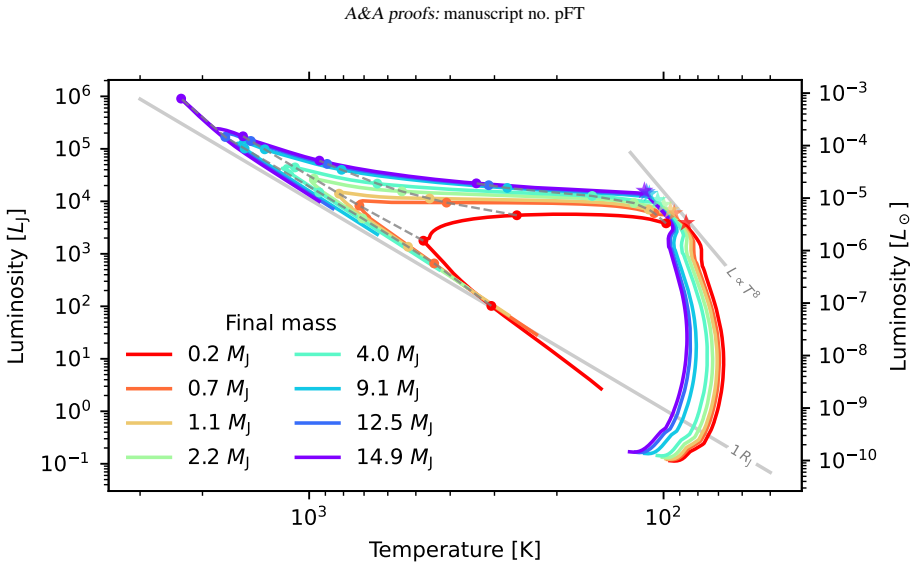
Planetary HRDs exhibit three branches corresponding to successive phases: an ascending branch during solid-dominated growth, strongly set by the size of accreted bodies and by migration, with an analytic result of L proportional to T to the eighth for in-situ planetesimal accretion; a near-horizontal branch beginning at detachment when gas accretion becomes disk-limited, where hot accretion, higher masses, and pebble accretion bend tracks upward; and a descending branch where accretion ends and planets join constant-mass cooling tracks with weak radius evolution and L similar to T to the fourth. The tracks are computed using the Bern model coupled to radiation-hydrodynamical simulations for
What carries the argument
The three-branch structure of planetary formation tracks on the Hertzsprung-Russell diagram, enabled by coupling the Bern planet formation model with radiation-hydrodynamical simulations to determine time-dependent shock heating efficiency.
If this is right
- In-situ planetesimal accretion leads to an analytic scaling where luminosity is proportional to temperature to the eighth power on the ascending branch.
- After detachment, electron degeneracy increases, lowering interior temperatures and stabilizing planetary radii.
- Hot gas accretion and pebble accretion cause the tracks to bend upward on the near-horizontal branch.
- Once accretion ceases, planets follow standard cooling tracks where luminosity scales roughly as temperature to the fourth power.
Where Pith is reading between the lines
- Future direct imaging of young embedded planets could test these tracks if models account for circumplanetary disk emission.
- The framework might be applied to populations of lower-mass planets to see if similar branches appear.
- Observational placement of planets on such diagrams could constrain the dominant mode of solid accretion in real systems.
Load-bearing premise
The Bern model combined with radiation-hydrodynamical simulations accurately captures time-dependent accretion-shock heating efficiency and interior structures throughout the entire formation and early evolution phases.
What would settle it
Detection of a young giant planet whose measured luminosity and temperature place it outside the three predicted branches or violate the L proportional to T to the eighth relation during the solid accretion phase.
Figures




read the original abstract
The Hertzsprung-Russell diagram (HRD) is central to stellar astrophysics but has rarely been used to interpret planet formation. We extend the HRD concept to forming planets and study how solid and gas accretion, cooling/contraction, and migration shape luminosity-temperature tracks in different formation scenarios. We compute planetary interior structures throughout formation and evolution with the Bern model and, for the first time, couple it to radiation-hydrodynamical simulations to obtain a time-dependent accretion-shock heating efficiency, helping to address the cold-/hot-start ambiguity. Planetary HRDs exhibit three branches corresponding to successive phases: (i) an ascending branch during solid-dominated growth, strongly set by the size of accreted bodies (and thus the solid accretion rate) and by migration; for in-situ planetesimal accretion we find analytically $L \propto T^8$. (ii) A near-horizontal branch beginning at detachment when gas accretion becomes disk-limited and contraction accelerates; hot accretion, higher masses, and pebble accretion bend tracks upward. Increasing electron degeneracy after detachment lowers interior temperatures and stabilises radii. (iii) A descending branch where accretion ends and planets join constant-mass cooling tracks with weak radius evolution and $L \sim T^4$. Our tracks agree well with synthetic populations and are broadly consistent with directly imaged planets. Populating the short-lived early branches observationally will be difficult, and embedded accreting planets require models including accretion-shock emission and circumplanetary-disk reprocessing.
Editorial analysis
A structured set of objections, weighed in public.
Referee Report
Summary. The manuscript extends the Hertzsprung-Russell diagram concept to forming giant planets by computing luminosity-temperature tracks with the Bern 1D formation model. For the first time, this model is coupled to radiation-hydrodynamical simulations to obtain a time-dependent accretion-shock heating efficiency. The resulting tracks display three branches: (i) an ascending branch during solid-dominated growth (with an analytical L ∝ T^8 relation derived for in-situ planetesimal accretion, controlled by accreted body size and migration), (ii) a near-horizontal branch after detachment when gas accretion becomes disk-limited, and (iii) a descending branch on constant-mass cooling tracks with L ∼ T^4. The tracks are compared to synthetic populations and directly imaged planets; the work notes observational challenges for early phases and the need for circumplanetary-disk reprocessing in future models.
Significance. If the central results hold, the paper supplies a useful visualization framework that links specific formation processes (solid accretion rate, migration, hot vs. cold accretion, degeneracy effects) to observable HRD loci. The analytical L ∝ T^8 scaling and the explicit coupling to radiation-hydrodynamical runs to address the cold-/hot-start ambiguity are concrete strengths that could help interpret future direct-imaging data of young planets and guide population synthesis comparisons.
major comments (2)
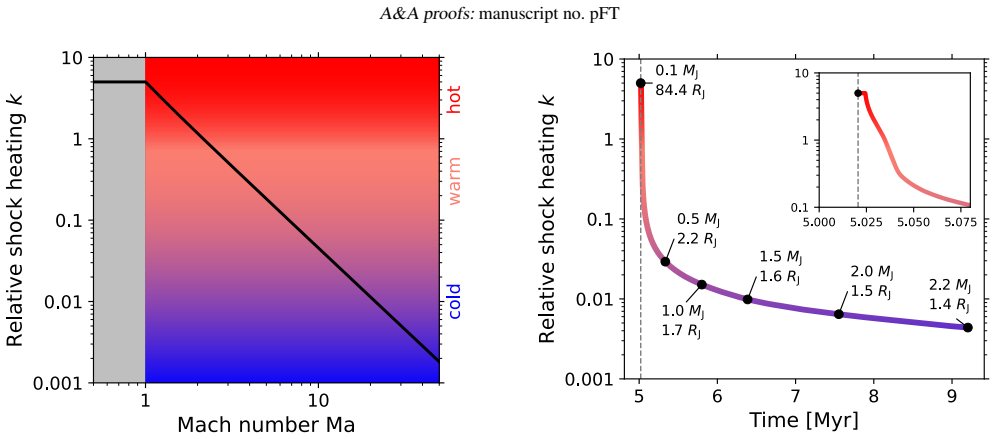
- [Methods section on model coupling] The coupling between the Bern 1D model and the radiation-hydrodynamical simulations is described at a high level only (abstract and methods). No explicit statement is given on how entropy or luminosity continuity is enforced at the shock boundary, nor on how circumplanetary-disk reprocessing (explicitly flagged as still required) is omitted. Because the ascending-branch slope and the location of detachment both depend directly on the adopted shock-heating efficiency, this interface detail is load-bearing for the claimed three-branch structure.
- [Section presenting the analytical relation] The analytical derivation of L ∝ T^8 for in-situ planetesimal accretion is stated without the intermediate steps, the assumed solid accretion rate scaling, or the interior temperature profile used. This relation underpins the physical interpretation of the ascending branch and its dependence on body size; its robustness cannot be assessed from the given information.
minor comments (2)
- [Figure captions] Figure captions should explicitly label the three branches, indicate which parameters are varied in each panel (e.g., planetesimal vs. pebble accretion, migration rate), and note the assumed accretion-shock efficiency.
- [Abstract and results] The abstract claims broad consistency with directly imaged planets but does not quantify the comparison (e.g., overlap in luminosity or temperature ranges); a short table or inset would strengthen this statement.
Simulated Author's Rebuttal
We thank the referee for their constructive report and positive assessment of the work. Their comments identify areas where additional detail will improve clarity. We address each major comment below and have revised the manuscript accordingly.
read point-by-point responses
-
Referee: [Methods section on model coupling] The coupling between the Bern 1D model and the radiation-hydrodynamical simulations is described at a high level only (abstract and methods). No explicit statement is given on how entropy or luminosity continuity is enforced at the shock boundary, nor on how circumplanetary-disk reprocessing (explicitly flagged as still required) is omitted. Because the ascending-branch slope and the location of detachment both depend directly on the adopted shock-heating efficiency, this interface detail is load-bearing for the claimed three-branch structure.
Authors: We agree that the coupling requires more explicit description. In the revised manuscript we have added a dedicated subsection in Methods that details the interface: luminosity continuity is enforced by matching the interior luminosity to the time-dependent shock luminosity computed from the RHD runs, while entropy continuity is achieved by adopting the post-shock entropy from the simulations as the outer boundary condition for the 1D structure integration. Circumplanetary-disk reprocessing is omitted, as already noted in the abstract; the present study isolates the effect of the accretion-shock efficiency, with CPD reprocessing identified as a necessary future extension. These additions directly address the dependence of the ascending branch and detachment on the adopted heating efficiency. revision: yes
-
Referee: [Section presenting the analytical relation] The analytical derivation of L ∝ T^8 for in-situ planetesimal accretion is stated without the intermediate steps, the assumed solid accretion rate scaling, or the interior temperature profile used. This relation underpins the physical interpretation of the ascending branch and its dependence on body size; its robustness cannot be assessed from the given information.
Authors: We thank the referee for this observation. The L ∝ T^8 scaling was derived under the assumptions of in-situ planetesimal accretion with solid accretion rate scaling as Ṁ_solid ∝ R_p² and an interior temperature profile obtained from radiative-convective equilibrium with constant opacity. We have now included the full step-by-step derivation, with all intermediate equations and assumptions, as Appendix A of the revised manuscript. This makes the physical origin of the relation and its sensitivity to accreted body size fully transparent and reproducible. revision: yes
Circularity Check
No circularity detected; tracks are model outputs, not self-definitions
full rationale
The paper generates planetary HRD tracks by running the Bern model coupled to external radiation-hydrodynamical simulations that supply time-dependent accretion-shock heating efficiencies. The three-branch structure, the detachment point, and the stated analytic scaling L ∝ T^8 for in-situ planetesimal accretion are presented as direct consequences of those computations and of the phase-dependent accretion regimes, rather than as quantities fitted to or defined by the target result itself. No self-citation chain is invoked to justify uniqueness, no ansatz is smuggled via prior work, and no fitted parameter is relabeled as a prediction. The derivation therefore remains independent of the final tracks and rests on the external simulations and the model's internal equations.
Axiom & Free-Parameter Ledger
free parameters (1)
- accretion-shock heating efficiency
axioms (1)
- domain assumption The Bern model correctly computes planetary interior structures and evolution throughout formation
Reference graph
Works this paper leans on
-
[1]
Astrophysics of planet formation, Second Edition
-
[2]
Evolutionary models for low-mass stars and brown dwarfs: uncertainties and limits at very young ages
Evolutionary models for low-mass stars and brown dwarfs: Uncertainties and limits at very young ages. , keywords =. doi:10.1051/0004-6361:20011638 , archivePrefix =. astro-ph/0111385 , primaryClass =
work page internal anchor Pith review Pith/arXiv arXiv doi:10.1051/0004-6361:20011638
-
[3]
New evolutionary models for pre-main sequence and main sequence low-mass stars down to the hydrogen-burning limit. , keywords =. doi:10.1051/0004-6361/201425481 , archivePrefix =. 1503.04107 , primaryClass =
work page internal anchor Pith review Pith/arXiv arXiv doi:10.1051/0004-6361/201425481
-
[4]
, archivePrefix = "arXiv", eprint =
Observed Luminosity Spread in Young Clusters and FU Ori Stars: A Unified Picture. , archivePrefix = "arXiv", eprint =. doi:10.1088/0004-637X/756/2/118 , adsurl =
-
[5]
, archivePrefix = "arXiv", eprint =
Self-consistent evolution of accreting low-mass stars and brown dwarfs. , archivePrefix = "arXiv", eprint =. doi:10.1051/0004-6361/201629303 , adsurl =
-
[6]
On the Terminal Rotation Rates of Giant Planets
On the Terminal Rotation Rates of Giant Planets. , keywords =. doi:10.3847/1538-3881/aab54e , archivePrefix =. 1803.07106 , primaryClass =
work page internal anchor Pith review Pith/arXiv arXiv doi:10.3847/1538-3881/aab54e
-
[7]
Determination of Jupiter's primordial physical state. , keywords =. doi:10.1038/s41550-025-02512-y , archivePrefix =. 2505.12652 , primaryClass =
-
[8]
Using FU Orionis Outbursts to Constrain Self-Regulated Protostellar Disk Models
Using FU Orionis Outbursts to Constrain Self-regulated Protostellar Disk Models. , keywords =. doi:10.1086/174206 , archivePrefix =. astro-ph/9312015 , primaryClass =
work page internal anchor Pith review Pith/arXiv arXiv doi:10.1086/174206
-
[9]
A Circumplanetary Disk around PDS70c. , keywords =. doi:10.3847/2041-8213/ac0f83 , archivePrefix =. 2108.07123 , primaryClass =
-
[10]
Hot Start Giant Planets Form With Radiative Interiors
Hot-start Giant Planets Form with Radiative Interiors. , keywords =. doi:10.3847/2041-8213/aa81c0 , archivePrefix =. 1707.00740 , primaryClass =
work page internal anchor Pith review Pith/arXiv arXiv doi:10.3847/2041-8213/aa81c0 2041
-
[11]
Evolution of Gas Giant Entropy During Formation by Runaway Accretion
The Evolution of Gas Giant Entropy During Formation by Runaway Accretion. , keywords =. doi:10.3847/1538-4357/834/2/149 , archivePrefix =. 1609.09126 , primaryClass =
work page internal anchor Pith review Pith/arXiv arXiv doi:10.3847/1538-4357/834/2/149
-
[12]
, archivePrefix = "arXiv", eprint =
The primordial entropy of Jupiter. , archivePrefix = "arXiv", eprint =. doi:10.1093/mnras/sty1000 , adsurl =
-
[13]
A simple model for the evolution of the dust population in protoplanetary disks
A simple model for the evolution of the dust population in protoplanetary disks. , keywords =. doi:10.1051/0004-6361/201118136 , archivePrefix =. 1201.5781 , primaryClass =
work page internal anchor Pith review Pith/arXiv arXiv doi:10.1051/0004-6361/201118136
-
[14]
Pebble-isolation mass: Scaling law and implications for the formation of super-Earths and gas giants. , keywords =. doi:10.1051/0004-6361/201731931 , archivePrefix =. 1801.02341 , primaryClass =
work page internal anchor Pith review Pith/arXiv arXiv doi:10.1051/0004-6361/201731931
-
[15]
SPHERE+: Imaging young Jupiters down to the snowline. arXiv e-prints , keywords =. doi:10.48550/arXiv.2003.05714 , archivePrefix =. 2003.05714 , primaryClass =
-
[16]
Complete observations, data reduction and analysis, detection performances, and final results
The SPHERE infrared survey for exoplanets (SHINE): IV. Complete observations, data reduction and analysis, detection performances, and final results. , keywords =. doi:10.1051/0004-6361/202451751 , archivePrefix =. 2501.12002 , primaryClass =
-
[17]
Deuterium Burning in Massive Giant Planets and Low-mass Brown Dwarfs Formed by Core-nucleated Accretion. , keywords =. doi:10.1088/0004-637X/770/2/120 , archivePrefix =. 1305.0980 , primaryClass =
work page internal anchor Pith review Pith/arXiv arXiv doi:10.1088/0004-637x/770/2/120
-
[18]
Models of the in Situ Formation of Detected Extrasolar Giant Planets. , keywords =. doi:10.1006/icar.1999.6246 , archivePrefix =. 2111.08776 , primaryClass =
-
[19]
Two Directly Imaged, Wide-orbit Giant Planets around the Young, Solar Analog TYC 8998-760-1. , keywords =. doi:10.3847/2041-8213/aba27e , archivePrefix =. 2007.10991 , primaryClass =
-
[20]
Physical and orbital properties of Beta Pictoris b
Physical and orbital properties of Pictoris b. , keywords =. doi:10.1051/0004-6361/201424041 , archivePrefix =. 1407.4001 , primaryClass =
work page internal anchor Pith review Pith/arXiv arXiv doi:10.1051/0004-6361/201424041
-
[21]
Limits on the mass and initial entropy of 51 Eri b from Gaia EDR3 astrometry. , keywords =. doi:10.1093/mnras/stab3148 , archivePrefix =. 2110.13173 , primaryClass =
-
[22]
The First Dynamical Mass Measurement in the HR 8799 System. , keywords =. doi:10.3847/2041-8213/ac0540 , archivePrefix =. 2105.12820 , primaryClass =
-
[23]
First light of the VLT planet finder SPHERE. IV. Physical and chemical properties of the planets around HR8799. , keywords =. doi:10.1051/0004-6361/201526906 , archivePrefix =. 1511.04082 , primaryClass =
work page internal anchor Pith review Pith/arXiv arXiv doi:10.1051/0004-6361/201526906
-
[24]
Constraints on observing brightness asymmetries in protoplanetary disks at solar system scale
Constraints on observing brightness asymmetries in protoplanetary disks at solar system scale. , keywords =. doi:10.1051/0004-6361/201731907 , archivePrefix =. 1709.02148 , primaryClass =
work page internal anchor Pith review Pith/arXiv arXiv doi:10.1051/0004-6361/201731907
-
[25]
Formation of the Galilean Satellites: Conditions of Accretion. , keywords =. doi:10.1086/344684 , adsurl =
-
[26]
Updated Electron-Conduction Opacities: The Impact on Low-Mass Stellar Models
Updated Electron-Conduction Opacities: The Impact on Low-Mass Stellar Models. , keywords =. doi:10.1086/516819 , archivePrefix =. astro-ph/0703011 , primaryClass =
work page internal anchor Pith review Pith/arXiv arXiv doi:10.1086/516819
-
[27]
Theory of Low-Mass Stars and Substellar Objects
Theory of Low-Mass Stars and Substellar Objects. , keywords =. doi:10.1146/annurev.astro.38.1.337 , archivePrefix =. astro-ph/0006383 , primaryClass =
work page internal anchor Pith review Pith/arXiv arXiv doi:10.1146/annurev.astro.38.1.337
-
[28]
A New Equation of State for Dense Hydrogen-Helium Mixtures. II. Taking into Account Hydrogen-Helium Interactions. , keywords =. doi:10.3847/1538-4357/abfc48 , archivePrefix =. 2107.04434 , primaryClass =
-
[29]
Discovery of a warm, dusty giant planet around HIP65426
Discovery of a warm, dusty giant planet around HIP 65426. , keywords =. doi:10.1051/0004-6361/201731152 , archivePrefix =. 1707.01413 , primaryClass =
work page internal anchor Pith review Pith/arXiv arXiv doi:10.1051/0004-6361/201731152
-
[30]
, year = 2009, month = jan, volume =
Energy flux determines magnetic field strength of planets and stars. , year = 2009, month = jan, volume =. doi:10.1038/nature07626 , adsurl =
-
[31]
Evidence for a circumplanetary disk around protoplanet PDS 70 b
Evidence for a Circumplanetary Disk around Protoplanet PDS 70 b. , keywords =. doi:10.3847/2041-8213/ab212b , archivePrefix =. 1905.06370 , primaryClass =
work page internal anchor Pith review Pith/arXiv arXiv doi:10.3847/2041-8213/ab212b 2041
-
[32]
Screening Factors for Nuclear Reactions. I. General Theory. , year = 1973, month = apr, volume =. doi:10.1086/152061 , adsurl =
-
[33]
Toward a population synthesis of disks and planets. II. Confronting disk models and observations at the population level. , keywords =. doi:10.1051/0004-6361/202244767 , archivePrefix =. 2301.04656 , primaryClass =
-
[34]
The New Generation Planetary Population Synthesis (NGPPS). I. Bern global model of planet formation and evolution, model tests, and emerging planetary systems. , keywords =. doi:10.1051/0004-6361/202038553 , archivePrefix =. 2007.05561 , primaryClass =
-
[35]
Line and Mean Opacities for Ultracool Dwarfs and Extrasolar Planets
Line and Mean Opacities for Ultracool Dwarfs and Extrasolar Planets. , keywords =. doi:10.1086/521793 , archivePrefix =. 0706.2374 , primaryClass =
work page internal anchor Pith review Pith/arXiv arXiv doi:10.1086/521793
-
[36]
Implications of the discovery of AF Lep b. The mass-luminosity relation for planets in the Pic Moving Group and the L-T transition for young companions and free-floating planets. , keywords =. doi:10.1051/0004-6361/202348012 , archivePrefix =. 2402.09067 , primaryClass =
-
[37]
First direct detection of an exoplanet by optical interferometry. Astrometry and K-band spectroscopy of HR 8799 e. , keywords =. doi:10.1051/0004-6361/201935253 , archivePrefix =. 1903.11903 , primaryClass =
work page internal anchor Pith review Pith/arXiv arXiv doi:10.1051/0004-6361/201935253 1903
-
[38]
Breaking the centrifugal barrier to giant planet contraction by magnetic disc braking. , keywords =. doi:10.1093/mnrasl/slz164 , archivePrefix =. 1910.11885 , primaryClass =
-
[39]
THE INTERIORS OF GIANT PLANETS: Models and Outstanding Questions. , keywords =. doi:10.1146/annurev.earth.32.101802.120325 , archivePrefix =. astro-ph/0502068 , primaryClass =
-
[40]
Giant Planets at Small Orbital Distances
Giant Planets at Small Orbital Distances. , keywords =. doi:10.1086/309935 , archivePrefix =. astro-ph/9511109 , primaryClass =
work page internal anchor Pith review Pith/arXiv arXiv doi:10.1086/309935
-
[41]
Protostars and Planets VII , year = 2023, editor =
Giant Planets from the Inside-Out. Protostars and Planets VII , year = 2023, editor =. doi:10.48550/arXiv.2205.04100 , archivePrefix =. 2205.04100 , primaryClass =
-
[42]
Two accreting protoplanets around the young star PDS 70
Two accreting protoplanets around the young star PDS 70. , keywords =. doi:10.1038/s41550-019-0780-5 , archivePrefix =. 1906.01486 , primaryClass =
work page internal anchor Pith review Pith/arXiv arXiv doi:10.1038/s41550-019-0780-5 1906
-
[43]
Accretion Properties of PDS 70b with MUSE. , keywords =. doi:10.3847/1538-3881/ab811e , archivePrefix =. 2003.07922 , primaryClass =
-
[44]
, year = 1961, month = dec, volume =
Stellar evolution in early phases of gravitational contraction. , year = 1961, month = dec, volume =
work page 1961
-
[45]
, year = 1955, month = jun, volume =
The Early Phases of Stellar Evolution. , year = 1955, month = jun, volume =. doi:10.1086/126791 , adsurl =
-
[46]
\"U ber die Sterne der Unterabteilungen c und ac nach der Spektralklassifikation von Antonia C. Maury. Astronomische Nachrichten , year = 1909, month = jan, volume =. doi:10.1002/asna.19081792402 , adsurl =
-
[47]
Submillimeter emission associated with candidate protoplanets
Detection of Continuum Submillimeter Emission Associated with Candidate Protoplanets. , keywords =. doi:10.3847/2041-8213/ab2a12 , archivePrefix =. 1906.06308 , primaryClass =
work page internal anchor Pith review Pith/arXiv arXiv doi:10.3847/2041-8213/ab2a12 2041
-
[48]
Discovery of a planetary-mass companion within the gap of the transition disk around PDS 70
Discovery of a planetary-mass companion within the gap of the transition disk around PDS 70. , keywords =. doi:10.1051/0004-6361/201832957 , archivePrefix =. 1806.11568 , primaryClass =
work page internal anchor Pith review Pith/arXiv arXiv doi:10.1051/0004-6361/201832957
-
[49]
doi:10.1007/978-3-642-30304-3 , adsurl =
Stellar Structure and Evolution. doi:10.1007/978-3-642-30304-3 , adsurl =
-
[50]
Interior dynamics of envelopes around disk-embedded planets. arXiv e-prints , keywords =. doi:10.48550/arXiv.2601.12074 , archivePrefix =. 2601.12074 , primaryClass =
-
[51]
Rapid growth of gas-giant cores by pebble accretion
Rapid growth of gas-giant cores by pebble accretion. , keywords =. doi:10.1051/0004-6361/201219127 , archivePrefix =. 1205.3030 , primaryClass =
work page internal anchor Pith review Pith/arXiv arXiv doi:10.1051/0004-6361/201219127
-
[52]
Models of Jupiter's Growth Incorporating Thermal and Hydrodynamic Constraints
Models of Jupiter's growth incorporating thermal and hydrodynamic constraints. , keywords =. doi:10.1016/j.icarus.2008.10.004 , archivePrefix =. 0810.5186 , primaryClass =
work page internal anchor Pith review Pith/arXiv arXiv doi:10.1016/j.icarus.2008.10.004 2008
-
[53]
The newborn planet population emerging from ring-like structures in discs
The newborn planet population emerging from ring-like structures in discs. , keywords =. doi:10.1093/mnras/stz913 , archivePrefix =. 1903.05117 , primaryClass =
work page internal anchor Pith review Pith/arXiv arXiv doi:10.1093/mnras/stz913 1903
-
[54]
The Messenger , year = 2014, month = sep, volume =
An Overview of the MATISSE Instrument Science, Concept and Current Status. The Messenger , year = 2014, month = sep, volume =
work page 2014
-
[55]
Ground-based and Airborne Instrumentation for Astronomy IX , year = 2022, editor =
RISTRETTO: high-resolution spectroscopy at the diffraction limit of the VLT. Ground-based and Airborne Instrumentation for Astronomy IX , year = 2022, editor =. doi:10.1117/12.2627923 , archivePrefix =. 2208.14838 , primaryClass =
-
[56]
RISTRETTO: reflected-light exoplanet spectroscopy at the diffraction limit of the VLT. arXiv e-prints , keywords =. doi:10.48550/arXiv.2409.02875 , archivePrefix =. 2409.02875 , primaryClass =
-
[57]
Constraining the initial entropy of directly-detected exoplanets
Constraining the initial entropy of directly detected exoplanets. , keywords =. doi:10.1093/mnras/stt1967 , archivePrefix =. 1302.1517 , primaryClass =
work page internal anchor Pith review Pith/arXiv arXiv doi:10.1093/mnras/stt1967
-
[58]
Exploring the formation by core accretion and the luminosity evolution of directly imaged planets. The case of HIP 65426 b. , keywords =. doi:10.1051/0004-6361/201833597 , archivePrefix =. 1902.01869 , primaryClass =
work page internal anchor Pith review Pith/arXiv arXiv doi:10.1051/0004-6361/201833597 1902
-
[59]
The Planetary Accretion Shock. I. Framework for Radiation-hydrodynamical Simulations and First Results. , keywords =. doi:10.3847/1538-4357/836/2/221 , archivePrefix =. 1701.02747 , primaryClass =
work page internal anchor Pith review Pith/arXiv arXiv doi:10.3847/1538-4357/836/2/221
-
[60]
The Planetary Accretion Shock. II. Grid of Postshock Entropies and Radiative Shock Efficiencies for Nonequilibrium Radiation Transport. , keywords =. doi:10.3847/1538-4357/ab245b , archivePrefix =. 1906.05869 , primaryClass =
-
[61]
The Planetary Accretion Shock. III. Smoothing-free 2.5D Simulations and Calculation of H Emission. , keywords =. doi:10.3847/1538-4357/accf12 , archivePrefix =. 2305.01679 , primaryClass =
-
[62]
Magnetic field generation in electrically conducting fluids
-
[63]
Deuterium burning in objects forming via the core accretion scenario - Brown dwarfs or planets?
Deuterium burning in objects forming via the core accretion scenario. Brown dwarfs or planets?. , keywords =. doi:10.1051/0004-6361/201219844 , archivePrefix =. 1210.0538 , primaryClass =
work page internal anchor Pith review Pith/arXiv arXiv doi:10.1051/0004-6361/201219844
-
[64]
Luminosity of young Jupiters revisited. Massive cores make hot planets
Luminosity of young Jupiters revisited. Massive cores make hot planets. , keywords =. doi:10.1051/0004-6361/201321617 , archivePrefix =. 1306.5746 , primaryClass =
work page internal anchor Pith review Pith/arXiv arXiv doi:10.1051/0004-6361/201321617
-
[65]
Characterization of exoplanets from their formation. II. The planetary mass-radius relationship. , keywords =. doi:10.1051/0004-6361/201118464 , archivePrefix =. 1206.3303 , primaryClass =
work page internal anchor Pith review Pith/arXiv arXiv doi:10.1051/0004-6361/201118464
-
[66]
Characterization of exoplanets from their formation. III. The statistics of planetary luminosities. , keywords =. doi:10.1051/0004-6361/201630077 , archivePrefix =. 1708.00868 , primaryClass =
work page internal anchor Pith review Pith/arXiv arXiv doi:10.1051/0004-6361/201630077
-
[67]
Grain opacity and the bulk composition of extrasolar planets. I. Results from scaling the ISM opacity. , keywords =. doi:10.1051/0004-6361/201321479 , archivePrefix =. 1403.5272 , primaryClass =
work page internal anchor Pith review Pith/arXiv arXiv doi:10.1051/0004-6361/201321479
-
[68]
Grain opacity and the bulk composition of extrasolar planets. II. An analytical model for grain opacity in protoplanetary atmospheres. , keywords =. doi:10.1051/0004-6361/201423702 , archivePrefix =. 1406.4127 , primaryClass =
work page internal anchor Pith review Pith/arXiv arXiv doi:10.1051/0004-6361/201423702
-
[69]
Orbital and atmospheric characterization of the planet within the gap of the PDS 70 transition disk
Orbital and atmospheric characterization of the planet within the gap of the PDS 70 transition disk. , keywords =. doi:10.1051/0004-6361/201833584 , archivePrefix =. 1806.11567 , primaryClass =
work page internal anchor Pith review Pith/arXiv arXiv doi:10.1051/0004-6361/201833584
-
[70]
Frontiers in Astronomy and Space Sciences , keywords =
Warm giant exoplanet characterisation: current state, challenges and outlook. Frontiers in Astronomy and Space Sciences , keywords =. doi:10.3389/fspas.2023.1179000 , archivePrefix =. 2304.12782 , primaryClass =
-
[71]
An Atmospheric Structure Equation for Grain Growth
An Atmospheric Structure Equation for Grain Growth. , keywords =. doi:10.1088/2041-8205/789/1/L18 , archivePrefix =. 1406.4146 , primaryClass =
work page internal anchor Pith review Pith/arXiv arXiv doi:10.1088/2041-8205/789/1/l18 2041
-
[72]
Formation, Evolution, and Dynamics of Young Solar Systems , year = 2017, editor =
The Emerging Paradigm of Pebble Accretion. Formation, Evolution, and Dynamics of Young Solar Systems , year = 2017, editor =. doi:10.1007/978-3-319-60609-5_7 , adsurl =
-
[73]
Disk-Planet Interactions During Planet Formation
Disk-Planet Interactions During Planet Formation. Protostars and Planets V , year = 2007, editor =. doi:10.48550/arXiv.astro-ph/0603196 , archivePrefix =. astro-ph/0603196 , primaryClass =
work page internal anchor Pith review Pith/arXiv arXiv doi:10.48550/arxiv.astro-ph/0603196 2007
-
[74]
Nine Localized Deviations from Keplerian Rotation in the DSHARP Circumstellar Disks: Kinematic Evidence for Protoplanets Carving the Gaps. , keywords =. doi:10.3847/2041-8213/ab6dda , archivePrefix =. 2001.07720 , primaryClass =
-
[75]
Kinematic detection of a planet carving a gap in a protoplanetary disk. , keywords =. doi:10.1038/s41550-019-0852-6 , archivePrefix =. 1907.02538 , primaryClass =
-
[76]
Popular Astronomy , year = 1914, month = may, volume =
Relations Between the Spectra and Other Characteristics of the Stars. Popular Astronomy , year = 1914, month = may, volume =
work page 1914
-
[77]
Spectral and atmospheric characterization of 51 Eridani b using VLT/SPHERE
Spectral and atmospheric characterization of 51 Eridani b using VLT/SPHERE. , keywords =. doi:10.1051/0004-6361/201629767 , archivePrefix =. 1704.02987 , primaryClass =
work page internal anchor Pith review Pith/arXiv arXiv doi:10.1051/0004-6361/201629767
-
[78]
An Equation of State for Low-Mass Stars and Giant Planets. , keywords =. doi:10.1086/192204 , adsurl =
-
[79]
A Theory of Extrasolar Giant Planets
A Theory of Extrasolar Giant Planets. , keywords =. doi:10.1086/177027 , archivePrefix =. astro-ph/9510046 , primaryClass =
work page internal anchor Pith review Pith/arXiv arXiv doi:10.1086/177027
-
[80]
Constraints on PDS 70 b and c from the dust continuum emission of the circumplanetary discs considering in situ dust evolution. , keywords =. doi:10.1051/0004-6361/202449522 , archivePrefix =. 2404.14298 , primaryClass =
discussion (0)
Sign in with ORCID, Apple, or X to comment. Anyone can read and Pith papers without signing in.