Cavity-modified exciton-exciton annihilation in disordered molecular systems
Pith reviewed 2026-05-20 07:16 UTC · model grok-4.3
The pith
Strong coupling increases exciton-exciton annihilation in disordered low-mobility systems but can decrease it in high-mobility ones.
A machine-rendered reading of the paper's core claim, the machinery that carries it, and where it could break.
Core claim
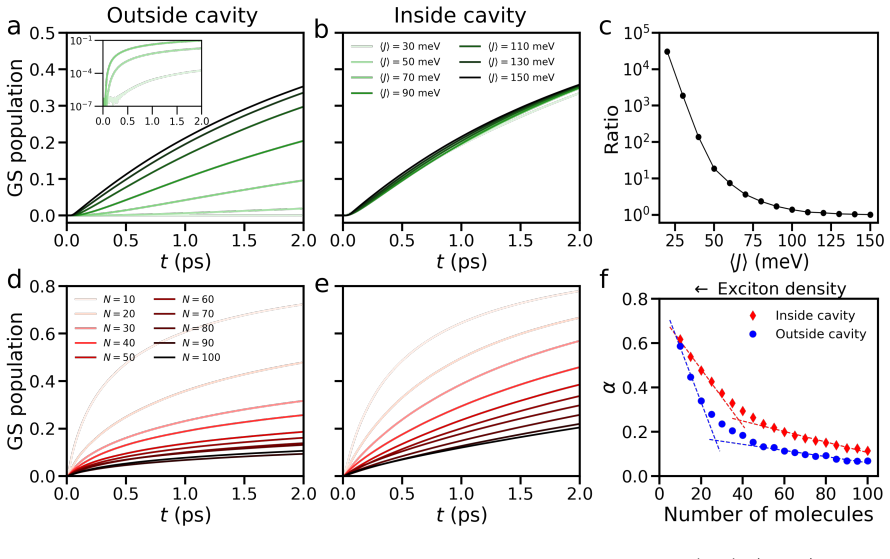
Strong coupling allows to partially overcome disorder in systems with poor exciton mobility via delocalisation of excitons owing to the interaction with the common cavity mode. This leads to an enhanced connectivity between excitons and, consequently, to an increase in the EEA rate. Conversely, in systems with high exciton mobility, in which disorder has a much smaller effect on excitation energy transfer, excitons can interact strongly even without coupling to the cavity photons at the exciton densities at which EEA typically occurs. In this case, the EEA rate can be even lower than in bare molecules due to the existence of a competing decay channel associated with photon leakage through,
What carries the argument
Numerical simulations of polariton dynamics that track exciton delocalisation through coupling to a shared cavity photon mode.
If this is right
- In low-mobility disordered systems strong coupling raises the EEA rate through improved exciton connectivity.
- In high-mobility systems strong coupling can lower the EEA rate by opening a competing photon-leakage channel.
- Weak coupling suppresses the EEA rate via the leakage channel regardless of exciton transport properties.
- Lowering the EEA rate supports more feasible Bose-Einstein condensation of polaritons.
Where Pith is reading between the lines
- Cavity design could deliberately select high-mobility molecules to exploit leakage for suppressing unwanted annihilation.
- The delocalisation mechanism may influence other cavity-modified energy-transfer or relaxation processes beyond annihilation.
- Varying only disorder while holding mobility and cavity parameters fixed would isolate the connectivity effect in future tests.
Load-bearing premise
The numerical model of polariton dynamics together with the chosen values for disorder strength, exciton mobility, and cavity decay rates accurately represent the experimental systems that produced contradictory EEA observations.
What would settle it
Direct measurement of the EEA rate in a low-mobility disordered molecular film placed inside a cavity tuned to the strong-coupling regime, compared against the same film outside the cavity at matched exciton density.
Figures



read the original abstract
Recent experiments have shown contradictory effects of strong light-matter coupling on exciton-exciton annihilation (EEA) in organic molecular systems. In this work, we perform numerical simulations of polariton dynamics and reveal the role of strong coupling in changing the EEA rate. The results of our simulations suggest that strong coupling allows to partially overcome disorder in systems with poor exciton mobility via delocalisation of excitons owing to the interaction with the common cavity mode. This leads to an enhanced connectivity between excitons and, consequently, to an increase in the EEA rate. Conversely, in systems with high exciton mobility, in which disorder has a much smaller effect on excitation energy transfer, excitons can interact strongly even without coupling to the cavity photons at the exciton densities at which EEA typically occurs. In this case, the EEA rate can be even lower than in bare molecules due to the existence of a competing decay channel associated with photon leakage through the cavity mirrors. We also find that in the weak coupling regime, the EEA rate appears to be suppressed due to this decay channel regardless of the exciton transport properties. Our simulations resolve the experimental controversy on the effect of strong coupling on EEA and provide guidance for minimising the EEA rate towards a more feasible realisation of Bose-Einstein condensation of polaritons.
Editorial analysis
A structured set of objections, weighed in public.
Referee Report
Summary. The manuscript uses numerical simulations of polariton dynamics in disordered molecular systems to examine cavity effects on exciton-exciton annihilation (EEA). It claims that strong coupling increases the EEA rate in low-mobility disordered systems by delocalizing excitons via the common cavity mode (enhancing connectivity), while decreasing it in high-mobility systems due to competing photon leakage; weak coupling suppresses EEA regardless of mobility. These trends are presented as resolving contradictory experimental reports and guiding minimization of EEA for polariton condensation.
Significance. If the simulated trends hold under experimentally relevant conditions, the work supplies a mechanistic account of how cavity-induced delocalization and leakage compete with disorder and mobility to control EEA. This could inform strategies for suppressing annihilation in organic polariton devices and help reconcile prior conflicting observations on cavity-modified EEA.
major comments (2)
- [Numerical Model] Numerical Model section: the central claim of a sign change in EEA rate (increase for low mobility, decrease for high mobility) depends on the specific numerical values chosen for disorder strength, exciton hopping rate, and cavity decay rate κ. No sensitivity analysis or direct quantitative mapping to the experimental systems cited in the introduction is provided, so it is unclear whether the reported trends transfer to the physical conditions where contradictory EEA effects were observed.
- [Results] Results on EEA rate vs. density (likely Fig. 3 or equivalent): the enhancement of EEA in the low-mobility strong-coupling case is attributed to cavity-induced delocalization, but the manuscript does not quantify the change in exciton connectivity (e.g., via participation ratio or effective hopping) or demonstrate that this effect dominates over other model assumptions such as the form of the EEA operator.
minor comments (2)
- [Abstract] The abstract states that 'in the weak coupling regime, the EEA rate appears to be suppressed due to this decay channel regardless of the exciton transport properties,' but the corresponding simulation data and parameter regime are not clearly cross-referenced in the main text.
- Notation for the polariton Hamiltonian and the EEA term should be defined consistently; several symbols (e.g., for disorder distribution) are introduced without explicit reference to their first appearance.
Simulated Author's Rebuttal
We are grateful to the referee for the detailed and insightful report. The comments highlight important aspects that will improve the clarity and robustness of our manuscript. Below we provide point-by-point responses to the major comments.
read point-by-point responses
-
Referee: Numerical Model section: the central claim of a sign change in EEA rate (increase for low mobility, decrease for high mobility) depends on the specific numerical values chosen for disorder strength, exciton hopping rate, and cavity decay rate κ. No sensitivity analysis or direct quantitative mapping to the experimental systems cited in the introduction is provided, so it is unclear whether the reported trends transfer to the physical conditions where contradictory EEA effects were observed.
Authors: We thank the referee for this observation. The parameter values were selected to represent distinct regimes of exciton mobility in disordered systems, as motivated by the experimental literature. However, to address the concern, in the revised manuscript we will perform and present a sensitivity analysis by varying the disorder strength, hopping rate, and κ within physically plausible ranges. This will demonstrate that the qualitative trends, including the sign change in the cavity effect on EEA rate, persist. Regarding direct quantitative mapping, our model is phenomenological and uses representative values rather than fitted to specific experiments; we will expand the discussion to better relate the chosen parameters to the cited experimental systems and note the limitations in achieving exact quantitative correspondence without additional experimental input. revision: yes
-
Referee: Results on EEA rate vs. density (likely Fig. 3 or equivalent): the enhancement of EEA in the low-mobility strong-coupling case is attributed to cavity-induced delocalization, but the manuscript does not quantify the change in exciton connectivity (e.g., via participation ratio or effective hopping) or demonstrate that this effect dominates over other model assumptions such as the form of the EEA operator.
Authors: We agree that providing quantitative measures of delocalization would strengthen the interpretation. In the revised manuscript, we will calculate and include the participation ratio for the exciton states and the effective exciton hopping rates in the presence and absence of the cavity to explicitly show the enhanced connectivity due to the common cavity mode. Additionally, we will discuss the form of the EEA operator used in our model and argue, based on the simulation results, that the observed trends are primarily driven by the delocalization effect rather than the specific operator details. If space permits, we may include a brief comparison with an alternative EEA operator to support this. revision: yes
Circularity Check
Numerical simulations of polariton dynamics produce EEA trends without reduction to fitted inputs or self-citations by construction
full rationale
The paper's central results are obtained from numerical simulations of polariton dynamics in disordered systems, where strong coupling induces exciton delocalisation via the common cavity mode, leading to modified EEA rates depending on mobility and disorder. These outcomes are presented as direct consequences of solving the time-dependent dynamics under the chosen Hamiltonian and decay channels, rather than any parameter fitting that is then relabeled as a prediction. No self-definitional equations, uniqueness theorems imported from prior self-work, or ansatzes smuggled via citation appear in the derivation chain. The abstract and described approach remain self-contained against external benchmarks, with the sign change in EEA rate emerging from the interplay of delocalisation, photon leakage, and transport properties in the model equations.
Axiom & Free-Parameter Ledger
Lean theorems connected to this paper
-
IndisputableMonolith/Cost/FunctionalEquation.leanwashburn_uniqueness_aczel unclear?
unclearRelation between the paper passage and the cited Recognition theorem.
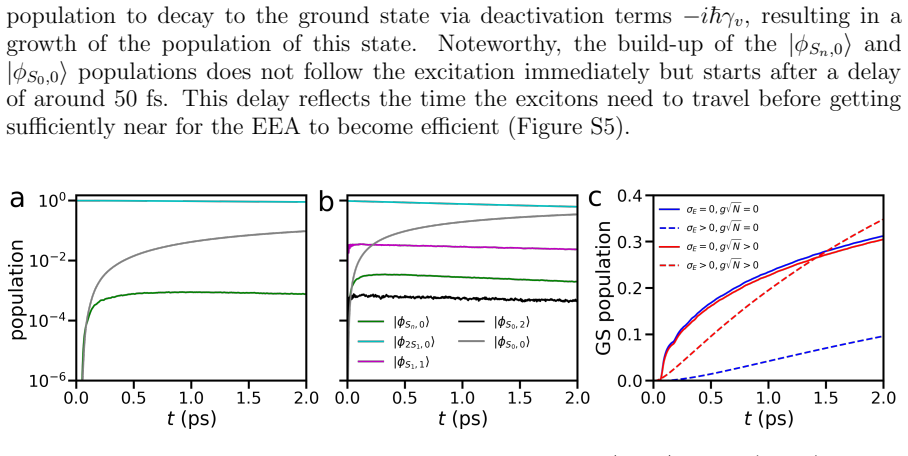
We performed numerical simulations of polariton dynamics... Hamiltonian in the second excitation subspace... deactivation terms −iℏγ_v ... cavity decay rate γ_c
-
IndisputableMonolith/Foundation/DimensionForcing.leanalexander_duality_circle_linking unclear?
unclearRelation between the paper passage and the cited Recognition theorem.
strong coupling allows to partially overcome disorder... via delocalisation of excitons owing to the interaction with the common cavity mode
What do these tags mean?
- matches
- The paper's claim is directly supported by a theorem in the formal canon.
- supports
- The theorem supports part of the paper's argument, but the paper may add assumptions or extra steps.
- extends
- The paper goes beyond the formal theorem; the theorem is a base layer rather than the whole result.
- uses
- The paper appears to rely on the theorem as machinery.
- contradicts
- The paper's claim conflicts with a theorem or certificate in the canon.
- unclear
- Pith found a possible connection, but the passage is too broad, indirect, or ambiguous to say the theorem truly supports the claim.
Reference graph
Works this paper leans on
-
[1]
Green, Dale and Humphries, Ben S. and Dijkstra, Arend G. and Jones, Garth A. , title =. J. Chem. Phys. , year =
-
[2]
Green, Dale and Camargo, Franco V. A. and Heisler, Ismael A. and Dijkstra, Arend G. and Jones, Garth A. , title =. J. Phys. Chem. Lett. , year =
-
[3]
Nguyen-Phan and Richard Cogdell and T
Fan Wu and Tu C. Nguyen-Phan and Richard Cogdell and T. Efficient cavity-mediated energy transfer between photosynthetic light harvesting complexes from strong to weak coupling regime , journal =. 2025 , volume =
work page 2025
-
[4]
Qureshi, Hassan A. and Papachatzakis, Michael A. and Abdelmagid, Ahmed Gaber and Salomäki, Mikko and Mäkilä, Ermei and Tuomi, Oskar and Siltanen, Olli and Daskalakis, Konstantinos S. , title =. Adv. Opt. Mater. , volume =
-
[5]
Tempelaar, Roel and Jansen, Thomas L. C. and Knoester, Jasper , title =. J. Phys. Chem. Lett. , volume =
-
[6]
Doveiko, Daniel and Kubiak-Ossowska, Karina and Chen, Yu , title =. J. Phys. Chem. A , volume =
-
[7]
Borges, Lucas and Schnappinger, Thomas and Kowalewski, Markus , title =. J. Phys. Chem. Lett. , volume =
-
[8]
Super-Radiant SERS Enhancement by Plasmonic Particle Gratings , journal =
Se. Super-Radiant SERS Enhancement by Plasmonic Particle Gratings , journal =
-
[9]
M. S. Rider and W. L. Barnes , title =. Contemp. Phys. , volume =
-
[10]
Generalized rotating-wave approximation for the two-qubit quantum Rabi model , author =. Phys. Rev. A , volume =
-
[11]
Lu, Tian and Chen, Feiwu , title =. J. Comput. Chem. , volume =
-
[12]
Lu, Tian , title =. J. Chem. Phys. , volume =
- [13]
-
[14]
and Daskalakis, Konstantinos S
Siltanen, Olli and Luoma, Kimmo and Musser, Andrew J. and Daskalakis, Konstantinos S. , title =. Adv. Opt. Mater. , volume =
-
[15]
Campos-Gonzalez-Angulo, Jorge A. and Yuen-Zhou, Joel , title =. J. Chem. Phys. , volume =
-
[16]
Li, Kai and Kok, Hui Taou and Gui, Manting and Kaul, Nidhi and Wang, Yuanheng and Rand, Barry P. and Scholes, Gregory D. , title =. J. Phys. Chem. Lett. , volume =
-
[17]
Bin Liu and Xinjing Huang and Shaocong Hou and Dejiu Fan and Stephen R. Forrest , journal =. Photocurrent generation following long-range propagation of organic exciton--polaritons , volume =
-
[18]
Enhancement of the internal quantum efficiency in strongly coupled P3HT-C60 organic photovoltaic cells using Fabry–Perot cavities with varied cavity confinement , author =. Nanophotonics , year =
-
[19]
Peruffo, Nicola and Chen, Runwan and Li, Dongyan and Wu, Qinghe and Börjesson, Karl , title =. Adv. Funct. Mater , pages =. 2026 , volume =
work page 2026
-
[20]
K\'ena-Cohen and S. R. Forrest , title =. Nat. Photon. , year =
-
[21]
Alexey Kavokin and Timothy C. H. Liew and Christian Schneider and Pavlos G. Lagoudakis and Sebastian Klembt and Sven Hoefling , title =. Naat. Rev. Phys. , year =
-
[22]
Garcia-Vidal and Cristiano Ciuti and Thomas W
Francisco J. Garcia-Vidal and Cristiano Ciuti and Thomas W. Ebbesen , title =. Science , volume =
-
[23]
Luca Sortino and Merve Gülmüs and Benjamin Tilmann and Leonardo de S. Menezes and Stefan A. Maie , title =. Light Sci. Appl. , year =
-
[24]
S. K\'. Room-temperature polariton lasing in an organic single-crystal microcavity , year = 2010, journal =
work page 2010
-
[25]
Mohammad Ramezani and Alexei Halpin and Antonio I. Fern\'. Plasmon-exciton-polariton lasing , volume =. Optica , number =
-
[26]
Chen, Xingzhou and Alnatah, Hassan and Mao, Danqun and Xu, Mengyao and Fan, Yuening and Wan, Qiaochu and Beaumariage, Jonathan and Xie, Wei and Xu, Hongxing and Shi, Zhe-Yu and Snoke, David and Sun, Zheng and Wu, Jian , title =. Nano Letters , volume =
-
[27]
Nonequilibrium condensates and lasers without inversion: Exciton-polariton lasers , author =. Phys. Rev. A , volume =
-
[28]
P\'erez-S\'anchez and Joel Yuen-Zhou , title =
Juan B. P\'erez-S\'anchez and Joel Yuen-Zhou , title =. Nat. Commun. , year =
-
[29]
and Xiong, Wei and Giebink, Noel C
Schwennicke, Kai and Koner, Arghadip and Pérez-Sánchez, Juan B. and Xiong, Wei and Giebink, Noel C. and Weichman, Marissa L. and Yuen-Zhou, Joel. When do molecular polaritons behave like optical filters?. Chem. Soc. Rev. 2025
work page 2025
-
[30]
Bose–Einstein Condensation of Exciton-Polaritons in Organic Microcavities
Keeling, Jonathan and Kéna-Cohen, Stéphane. Bose–Einstein Condensation of Exciton-Polaritons in Organic Microcavities. Annu. Rev. Phys. Chem. 2020
work page 2020
-
[31]
The Rise and Current Status of Polaritonic Photochemistry and Photophysics , journal =
Bhuyan, Rahul and Mony, J. The Rise and Current Status of Polaritonic Photochemistry and Photophysics , journal =
-
[32]
Mikhnenko, Oleksandr V. and Blom, Paul W. M. and Nguyen, Thuc-Quyen. Exciton diffusion in organic semiconductors. Energy Environ. Sci. 2015
work page 2015
-
[33]
Gleb M. Akselrod and Elizabeth R. Young and M. Scott Bradley and Vladimir Bulovi\'. Lasing through a strongly-coupled mode by intra-cavity pumping , volume =. Opt. Express , number =
-
[34]
and Michetti, Paolo and Musser, Andrew J
Grant, Richard T. and Michetti, Paolo and Musser, Andrew J. and Gregoire, Pascal and Virgili, Tersilla and Vella, Eleonora and Cavazzini, Marco and Georgiou, Kyriacos and Galeotti, Francesco and Clark, Caspar and Clark, Jenny and Silva, Carlos and Lidzey, David G. , title =. Adv. Opt. Mater. , volume =
-
[35]
L. Population of Exciton–Polaritons via Luminescent sp3 Defects in Single-Walled Carbon Nanotubes , journal =
-
[36]
Cavity polaritons in microcavities containing disordered organic semiconductors , author =. Phys. Rev. B , volume =
-
[37]
Fast polariton relaxation in strongly coupled organic microcavities , journal =. 2004 , author =
work page 2004
-
[38]
and Michetti, Paolo and Clark, Caspar and Tsoi, Wing Chung and Adawi, Ali M
Coles, David M. and Michetti, Paolo and Clark, Caspar and Tsoi, Wing Chung and Adawi, Ali M. and Kim, Ji-Seon and Lidzey, David G. , title =. Adv. Funct. Mater. , volume =
-
[39]
Somaschi, N. and Mouchliadis, L. and Coles, D. and Perakis, I. E. and Lidzey, D. G. and Lagoudakis, P. G. and Savvidis, P. G. , title =. Appl. Phys. Lett. , volume =
-
[40]
Javier del Pino and Johannes Feist and Francisco J. Garcia-Vidal , title =. New J. Phys. , volume =
-
[41]
Martínez-Martínez and Joel Yuen-Zhou and Stéphane Kéna-Cohen , title =
Elad Eizner and Luis A. Martínez-Martínez and Joel Yuen-Zhou and Stéphane Kéna-Cohen , title =. Sci. Adv. , volume =
-
[42]
Ulusoy, Inga S. and Gomez, Johana A. and Vendrell, Oriol , title =. J. Phys. Chem. A. , volume =
-
[43]
Bhuyan, Rahul and Lednev, Maksim and Feist, Johannes and Börjesson, Karl , title =. Adv. Opt. Mater. , volume =
-
[44]
Davidsson, Eric and Kowalewski, Markus , title =. J. Chem. Phys. , volume =
-
[45]
Sokolovskii, Ilia and Morozov, Dmitry and Groenhof, Gerrit , title =. J. Chem. Phys. , volume =
-
[46]
Experimentelle und theoretische Untersuchung des zwischenmolekularen Übergangs von Elektronenanregungsenergie , author =. ZNA , year =
-
[47]
Dexter, D. L. , title =. J. Chem. Phys. , volume =
-
[48]
Characterization of electronic transitions in complex molecules
Kasha, Michael. Characterization of electronic transitions in complex molecules. Discuss. Faraday Soc. 1950
work page 1950
-
[49]
Bimolecular quenching of excitons and fluorescence in the photosynthetic unit , journal =. 1976 , author =
work page 1976
-
[50]
Exciton-exciton annihilation in organic polariton microcavities , author =. Phys. Rev. B , volume =
-
[51]
and Keeling, Jonathan and Dalla Torre, Emanuele G
Kirton, Peter and Roses, Mor M. and Keeling, Jonathan and Dalla Torre, Emanuele G. , title =. Adv. Quantum Technol. , volume =
-
[52]
Ryzhov, I. V. and Kozlov, G. G. and Malyshev, V. A. and Knoester, J. , title =. J. Chem. Phys. , volume =
-
[53]
Ultrafast multiexciton dynamics in molecular systems: Inclusion of exciton-exciton annihilation , author =. Phys. Rev. B , volume =
-
[54]
Cerd\'a, Jes\'us and Giannini, Samuele and Xu, Lai and Wang, Linjun and Beljonne, David , title =. J. Phys. Chem. Lett. , volume =
-
[55]
Ultrastrong coupling regimes of light-matter interaction , author =. Rev. Mod. Phys. , volume =
- [56]
- [57]
-
[58]
Selwyn, Judith E. and Steinfeld, Jeffrey I. , title =. J. Phys. Chem. , volume =
-
[59]
Fei, Rao and Hautzinger, Matthew P. and Rose, Aaron H. and Dong, Yifan and Smalyukh, Ivan I. and Beard, Matthew C. and van de Lagemaat, Jao , title =. J. Phys. Chem. Lett. , volume =
-
[60]
Identifying Vibrations that Control Non-Adiabatic Relaxation of Polaritons in Strongly Coupled Molecule-Cavity Systems , author=. J. Phys. Chem. Lett. , volume =
-
[61]
I. Sokolovskii and R.H. Tichauer and D. Morozov and J. Feist and G. Groenhof , title =. Nat. Commun. , year =
-
[62]
Büttner, Simon and Philipp, Luca Nils and Lüttig, Julian and Rödel, Maximilian and Hensen, Matthias and Pflaum, Jens and Mitric, Roland and Brixner, Tobias , title =. J. Chem. Phys. , volume =
-
[63]
Ultrafast excitation energy transfer dynamics in photosynthetic pigment–protein complexes , journal =. 2001 , author =
work page 2001
- [64]
- [65]
-
[66]
Phillips, James C. and Hardy, David J. and Maia, Julio D. C. and Stone, John E. and Ribeiro, João V. and Bernardi, Rafael C. and Buch, Ronak and Fiorin, Giacomo and Hénin, Jérôme and Jiang, Wei and McGreevy, Ryan and Melo, Marcelo C. R. and Radak, Brian K. and Skeel, Robert D. and Singharoy, Abhishek and Wang, Yi and Roux, Benoît and Aksimentiev, Aleksei ...
-
[67]
Gavrilenko, V. I. and Noginov, M. A. , title =. J. Chem. Phys. , volume =
-
[68]
Valdes-Aguilera, Oscar and Neckers, D. C. , title =. Acc. Chem. Res. , volume =
-
[69]
UV–Vis spectroscopic and chemometric study on the aggregation of ionic dyes in water , journal =. 1999 , author =
work page 1999
-
[70]
Inhomogeneous Electron Gas , author =. Phys. Rev. , volume =
-
[71]
Density-Functional Theory for Time-Dependent Systems , author =. Phys. Rev. Lett. , volume =
-
[72]
Chai, Jeng-Da and Head-Gordon, Martin , title =. J. Chem. Phys. , volume =
-
[73]
Caldeweyher, Eike and Ehlert, Sebastian and Hansen, Andreas and Neugebauer, Hagen and Spicher, Sebastian and Bannwarth, Christoph and Grimme, Stefan , title =. J. Chem. Phys. , volume =
-
[74]
Weigend, Florian and Ahlrichs, Reinhart. Balanced basis sets of split valence , triple zeta valence and quadruple zeta valence quality for H to Rn: Design and assessment of accuracy. Phys. Chem. Chem. Phys. 2005
work page 2005
-
[75]
Madjet, M. E. and Abdurahman, A. and Renger, T. , title =. J. Phys. Chem. B. , volume =
-
[76]
Michaud-Agrawal, Naveen and Denning, Elizabeth J. and Woolf, Thomas B. and Beckstein, Oliver , title =. J. Comput. Chem. , volume =
-
[77]
and Linke, Max and Barnoud, Jonathan and Reddy, Tyler J
Gowers, Richard J. and Linke, Max and Barnoud, Jonathan and Reddy, Tyler J. E. and Melo, Manuel N. and Seyler, Sean L. and Domański, Jan and Dotson, David L. and Buchoux, Sébastien and Kenney, Ian M. and Beckstein, Oliver , title =. SciPy 2016 , year =
work page 2016
- [78]
-
[79]
Exciton transport in molecular organic semiconductors boosted by transient quantum delocalization , author =. Nat. Commun. , volume =
- [80]
discussion (0)
Sign in with ORCID, Apple, or X to comment. Anyone can read and Pith papers without signing in.