Automotive Radar Performance in Environments with Multiple Interference Sources
Pith reviewed 2026-05-22 09:07 UTC · model grok-4.3
The pith
Automotive radars experience major drops in detection probability and range amid rising numbers of nearby interfering radars, with time-frequency coding proving most resilient.
A machine-rendered reading of the paper's core claim, the machinery that carries it, and where it could break.
Core claim
In high-density interference environments, automotive radar systems face substantial reductions in detection probability and effective range. Among the evaluated mitigation techniques, time-frequency coding delivers the most robust results by preserving high detection probability even when radar penetration rates rise. These outcomes rest on an IF-level simulation framework plus validation experiments that place a host radar against up to thirty interfering units in anechoic and real-world conditions.
What carries the argument
End-to-end IF-level simulation framework that incorporates analytical interference modeling and complete radar signal processing steps, used to compare mitigation techniques including time-frequency coding.
If this is right
- Detection probability falls sharply once radar density exceeds current levels.
- Effective operating range shrinks noticeably under high interference.
- Time-frequency coding outperforms other conventional mitigation methods across the tested scenarios.
- Current mitigation approaches reach practical limits and will require coordinated management strategies.
Where Pith is reading between the lines
- Automotive radar standards may need to incorporate mandatory coordination protocols to limit mutual interference.
- Spectrum regulators could use these density thresholds when setting future allocation rules for vehicle radars.
- The same interference scaling issues are likely to appear in other high-density radar applications such as maritime traffic monitoring.
Load-bearing premise
The simulation framework and the experiments with up to thirty interfering radars accurately reflect the interference statistics and propagation conditions that will occur in future high-density automotive scenes.
What would settle it
A dense-traffic field measurement campaign that finds no meaningful decline in detection probability or range despite dozens of nearby radars would disprove the claimed degradation.
Figures




read the original abstract
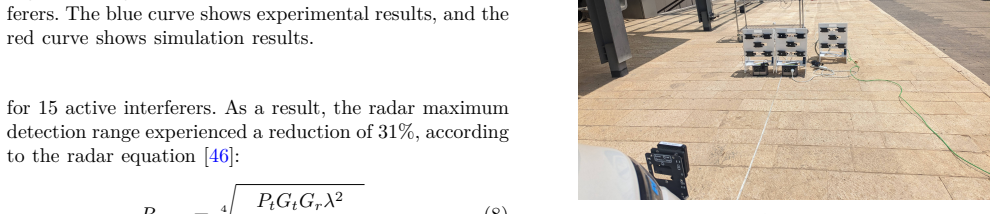
Automotive radars are increasingly susceptible to mutual interference from neighboring radar systems, which can lead to false target detections and the masking of valid targets. While current interference levels remain manageable due to the relatively low penetration of radar-equipped vehicles, this assumption is expected to break down as radar adoption and per-vehicle radar density continue to increase. This paper presents a comprehensive analysis of automotive radar performance in high-density interference environments. A realistic end-to-end simulation framework is developed at the intermediate frequency (IF) level, incorporating analytical interference modeling and detailed radar signal processing. The study evaluates the impact of interference across a range of future scenarios characterized by increased radar density and multiple radar configurations per vehicle. Conventional interference mitigation techniques are systematically assessed to validate the simulation results, controlled experiments were conducted using a host radar exposed to up to 30 interfering radars in both anechoic and real-world environments. The results demonstrate significant performance degradation under high interference conditions, with substantial reductions in detection probability and effective range. Among the evaluated techniques, time-frequency coding consistently provides the most robust performance, maintaining high detection probability even at elevated radar penetration rates. These findings highlight the limitations of current mitigation approaches and emphasize the need for coordinated and scalable interference management strategies in future automotive radar systems.
Editorial analysis
A structured set of objections, weighed in public.
Referee Report
Summary. The paper develops an end-to-end IF-level simulation framework for automotive radar under high-density mutual interference and validates it with controlled experiments using up to 30 interferers in anechoic and real-world settings. It reports substantial drops in detection probability and effective range as radar penetration increases, and ranks conventional mitigation methods, concluding that time-frequency coding maintains the highest detection probability even at elevated densities.
Significance. If the simulation and experiments faithfully capture future dense-scenario statistics, the work provides concrete evidence of performance limits under rising radar adoption and identifies time-frequency coding as a relatively robust existing technique. The combination of analytical IF-level modeling with hardware tests up to 30 interferers is a strength that could inform coordinated interference-management strategies.
major comments (2)
- Abstract and framework description: the headline degradation numbers and the ranking of mitigation techniques rest on the premise that the IF-level simulator and 30-radar experiments reproduce the interference power distribution, temporal statistics, and propagation conditions of future high-density scenes, yet no explicit account is given of how multi-radar geometry, antenna patterns, clutter, or multipath are sampled; this is load-bearing for both absolute performance claims and relative technique ordering.
- Experimental validation section: the reported reductions in detection probability lack quantitative error bars, exact parameter values (e.g., transmit powers, bandwidths, processing thresholds), and a complete description of the end-to-end processing chain, preventing independent confirmation of the quantitative results that support the central claim of significant degradation.
minor comments (1)
- The abstract states that 'controlled experiments were conducted' but does not clarify whether the anechoic and real-world tests used identical radar configurations or penetration rates; a brief table or sentence reconciling the two environments would improve clarity.
Simulated Author's Rebuttal
We thank the referee for the thorough and constructive review of our manuscript. We have addressed each of the major comments in detail below and revised the manuscript to improve clarity and reproducibility.
read point-by-point responses
-
Referee: Abstract and framework description: the headline degradation numbers and the ranking of mitigation techniques rest on the premise that the IF-level simulator and 30-radar experiments reproduce the interference power distribution, temporal statistics, and propagation conditions of future high-density scenes, yet no explicit account is given of how multi-radar geometry, antenna patterns, clutter, or multipath are sampled; this is load-bearing for both absolute performance claims and relative technique ordering.
Authors: We thank the referee for highlighting this important aspect. Upon review, we recognize that while the simulation framework uses analytical models for interference that implicitly incorporate geometry, antenna patterns, clutter, and multipath through statistical distributions derived from real-world measurements and standard automotive radar scenarios, a more explicit description was indeed warranted. In the revised version, we have expanded the framework description section to include detailed explanations of the sampling procedures: multi-radar geometries are sampled from Poisson point processes with densities corresponding to future penetration rates; antenna patterns follow typical automotive radar beamwidths and sidelobe levels; clutter and multipath are modeled using established statistical models with parameters tuned to urban and highway environments. These additions ensure the interference statistics are transparently justified and support the reported degradation and technique rankings. revision: yes
-
Referee: Experimental validation section: the reported reductions in detection probability lack quantitative error bars, exact parameter values (e.g., transmit powers, bandwidths, processing thresholds), and a complete description of the end-to-end processing chain, preventing independent confirmation of the quantitative results that support the central claim of significant degradation.
Authors: We agree with the referee that reproducibility requires these details. The original manuscript included key parameters in the text and figures, but to enhance clarity, we have added a comprehensive table listing all simulation and experimental parameters, including transmit powers, bandwidths, processing thresholds, and other relevant values. Additionally, we have included error bars on the detection probability curves, calculated from 100 Monte Carlo trials per scenario to quantify variability. The end-to-end processing chain is now described in full detail in a new subsection, outlining each step from IF signal acquisition through FFT processing, CFAR detection, and mitigation application. These revisions allow independent verification of the quantitative results. revision: yes
Circularity Check
No circularity in simulation and experimental results
full rationale
The paper derives its performance claims on detection probability and range degradation directly from forward execution of an end-to-end IF-level simulator that applies analytical interference models to input radar densities and configurations, together with separate controlled hardware experiments using up to 30 physical interfering radars. These steps generate outputs from external models and measurements rather than from any quantity defined in terms of the outputs themselves; no self-citation chain, fitted parameter renamed as prediction, or ansatz smuggled via prior work is present in the described framework or validation sections. The central results therefore remain independent of the target metrics and constitute a self-contained empirical evaluation.
Axiom & Free-Parameter Ledger
axioms (1)
- domain assumption Interference from neighboring radars can be modeled analytically at the intermediate-frequency level
Lean theorems connected to this paper
-
IndisputableMonolith/Cost/FunctionalEquation.leanwashburn_uniqueness_aczel unclear?
unclearRelation between the paper passage and the cited Recognition theorem.
A realistic end-to-end simulation framework is developed at the intermediate frequency (IF) level, incorporating analytical interference modeling and detailed radar signal processing.
-
IndisputableMonolith/Foundation/RealityFromDistinction.leanreality_from_one_distinction unclear?
unclearRelation between the paper passage and the cited Recognition theorem.
The results demonstrate significant performance degradation under high interference conditions, with substantial reductions in detection probability and effective range.
What do these tags mean?
- matches
- The paper's claim is directly supported by a theorem in the formal canon.
- supports
- The theorem supports part of the paper's argument, but the paper may add assumptions or extra steps.
- extends
- The paper goes beyond the formal theorem; the theorem is a base layer rather than the whole result.
- uses
- The paper appears to rely on the theorem as machinery.
- contradicts
- The paper's claim conflicts with a theorem or certificate in the canon.
- unclear
- Pith found a possible connection, but the passage is too broad, indirect, or ambiguous to say the theorem truly supports the claim.
Reference graph
Works this paper leans on
-
[1]
Three decades of driver assistance systems: Review and future perspectives,
K. Bengler, K. Dietmayer, B. Farber, M. Maurer, C. Stiller, and H. Winner, “Three decades of driver assistance systems: Review and future perspectives,” IEEE Intelligent transportation sys- tems magazine, vol. 6, no. 4, pp. 6–22, 2014
work page 2014
-
[2]
Taxonomy and definitions for terms related to on-road motor vehicle automated driving systems,
S. O.-R. A. V. S. Committee et al., “Taxonomy and definitions for terms related to on-road motor vehicle automated driving systems,” SAE Standard J, vol. 3016, p. 1, 2014
work page 2014
-
[3]
Mutual interference of millimeter-wave radar systems,
G. M. Brooker, “Mutual interference of millimeter-wave radar systems,” IEEE Transactions on Electromagnetic Compatibil- ity, vol. 49, no. 1, pp. 170–181, 2007
work page 2007
-
[4]
Recent development of auto- motive LiDAR technology, industry and trends,
F. Zhao, H. Jiang, and Z. Liu, “Recent development of auto- motive LiDAR technology, industry and trends,” in Eleventh International Conference on Digital Image Processing (ICDIP 2019), vol. 11179. SPIE, 2019, pp. 1132–1139
work page 2019
-
[5]
An ultrasonic sensor for distance measurement in automotive applications,
A. Carullo, M. Parvis et al., “An ultrasonic sensor for distance measurement in automotive applications,” IEEE Sensors jour- nal, vol. 1, no. 2, p. 143, 2001
work page 2001
-
[6]
North America publishes report on recent automaker auto- matic emergency braking commitment,
“North America publishes report on recent automaker auto- matic emergency braking commitment,” JATO, 2016
work page 2016
-
[7]
“Parliament approves EU rules requiring life-saving technologies in vehicles | news | European parliament,” Europarl.europa.eu, 2019
work page 2019
-
[8]
AEB to be required on new cars in Japan,
“AEB to be required on new cars in Japan,” The Brake Report, 2019
work page 2019
-
[9]
A peer-to-peer interference anal- ysis for automotive chirp sequence radars,
G. Kim, J. Mun, and J. Lee, “A peer-to-peer interference anal- ysis for automotive chirp sequence radars,” IEEE Transactions on Vehicular Technology, vol. 67, no. 9, pp. 8110–8117, 2018
work page 2018
-
[10]
Phenomenology of automotive radar interfer- ence,
F. Norouzian, A. Pirkani, E. Hoare, M. Cherniakov, and M. Gashinova, “Phenomenology of automotive radar interfer- ence,” IET Radar, Sonar & Navigation, vol. 15, no. 9, pp. 1045– 1060, 2021
work page 2021
-
[11]
Interference-aware cognitive radar: A remedy to the automotive interference prob- lem,
G. Hakobyan, K. Armanious, and B. Yang, “Interference-aware cognitive radar: A remedy to the automotive interference prob- lem,” IEEE Transactions on Aerospace and Electronic Systems, vol. 56, no. 3, pp. 2326–2339, 2019
work page 2019
-
[12]
An overview of cognitive radar: Past, present, and future,
S. Z. Gurbuz, H. D. Griffiths, A. Charlish, M. Rangaswamy, M. S. Greco, and K. Bell, “An overview of cognitive radar: Past, present, and future,” IEEE Aerospace and Electronic Systems Magazine, vol. 34, no. 12, pp. 6–18, 2019
work page 2019
-
[13]
Cognitive radar principles and application to interference reduction,
M. Steck, C. Neumann, and M. Bockmair, “Cognitive radar principles and application to interference reduction,” in 2018 19th International Radar Symposium (IRS). IEEE, 2018, pp. 1–10
work page 2018
-
[14]
Vanet- assisted interference mitigation for millimeter-wave automotive radar sensors,
M. Zhang, S. He, C. Yang, J. Chen, and J. Zhang, “Vanet- assisted interference mitigation for millimeter-wave automotive radar sensors,” IEEE Network, vol. 34, no. 2, pp. 238–245, 2020
work page 2020
-
[15]
Performance analysis of uncoordinated interference mitigation for automotive radar,
Y. Wang, Q. Zhang, Z. Wei, L. Kui, F. Liu, and Z. Feng, “Performance analysis of uncoordinated interference mitigation for automotive radar,” IEEE Transactions on Vehicular Tech- nology, vol. 72, no. 4, pp. 4222–4235, 2023
work page 2023
-
[16]
CDMA- MIMO radar with the tansec waveform,
G. Solodky, O. Longman, S. Villeval, and I. Bilik, “CDMA- MIMO radar with the tansec waveform,” IEEE Transactions on Aerospace and Electronic Systems, vol. 57, no. 1, pp. 76–89, 2020
work page 2020
-
[17]
H. Deng and B. Himed, “Interference mitigation processing for spectrum-sharing between radar and wireless communications systems,” IEEE Transactions on Aerospace and Electronic Systems, vol. 49, no. 3, pp. 1911–1919, 2013
work page 1911
-
[18]
Radar interference mitigation for automated driving: Exploring proactive strategies,
C. Aydogdu, M. F. Keskin, G. K. Carvajal, O. Eriksson, H. Hell- sten, H. Herbertsson, E. Nilsson, M. Rydstrom, K. Vanas, and H. Wymeersch, “Radar interference mitigation for automated driving: Exploring proactive strategies,” IEEE Signal Processing Magazine, vol. 37, no. 4, pp. 72–84, 2020
work page 2020
-
[19]
IMIKO-radar project: Laboratory interfer- ence measurements of automotive radar sensors,
A. Ossowska, L. Sit, S. Manchala, T. Vogler, K. Krupinski, and U. Luebbert, “IMIKO-radar project: Laboratory interfer- ence measurements of automotive radar sensors,” in 2020 21st International Radar Symposium (IRS), 2020, pp. 334–338
work page 2020
-
[20]
Analysis of automotive radar interference mitigation for real- world environments,
M. Toth, J. Rock, P. Meissner, A. Melzer, and K. Witrisal, “Analysis of automotive radar interference mitigation for real- world environments,” in 2020 17th European Radar Conference (EuRAD), 2021, pp. 176–179
work page 2020
-
[21]
Interference avoidance and mitigation in automotive radar,
M. Alhumaidi and M. Wintermantel, “Interference avoidance and mitigation in automotive radar,” in 2020 17th European Radar Conference (EuRAD). IEEE, 2021, pp. 172–175
work page 2020
-
[22]
Mitigation of automotive radar inter- ference,
F. Uysal and S. Sanka, “Mitigation of automotive radar inter- ference,” in 2018 IEEE Radar Conference (RadarConf18), 2018, pp. 0405–0410
work page 2018
-
[23]
P. Liu, Y. Liu, T. Huang, Y. Lu, and X. Wang, “Decentralized automotive radar spectrum allocation to avoid mutual inter- ference using reinforcement learning,” IEEE Transactions on Aerospace and Electronic Systems, vol. 57, no. 1, pp. 190–205, 2020
work page 2020
-
[24]
CLEAN receiver for CDMA MIMO radar,
G. Solodky, O. Longman, I. Eljarat, and I. Bilik, “CLEAN receiver for CDMA MIMO radar,” in 29th European Signal Processing Conference (EUSIPCO), 2021, pp. 1760–1764
work page 2021
-
[25]
The EU project MOSARIM: A general overview of project objectives and conducted work,
M. Kunert, “The EU project MOSARIM: A general overview of project objectives and conducted work,” in 2012 9th European Radar Conference. IEEE, 2012, pp. 1–5
work page 2012
-
[26]
——, “D5. 3–recommendations on sensor design, mounting and operational parameters to minimize radar interference,” MOSARIM project report, 2012
work page 2012
-
[27]
W. Buller, B. Wilson, J. Garbarino, J. Kelly, B. Thelen, B. M. Belzowski et al., “Radar congestion study,” United States. Department of Transportation. National Highway Traffic Safety, Tech. Rep., 2018
work page 2018
-
[28]
Stochastic geometry interference analysis of radar network performance,
A. Munari, L. Simić, and M. Petrova, “Stochastic geometry interference analysis of radar network performance,” IEEE Communications Letters, vol. 22, no. 11, pp. 2362–2365, 2018
work page 2018
-
[29]
Impact of phase noise on mutual interference of FMCW and PMCW automotive radars,
H. C. Yildirim, M. Bauduin, A. Bourdoux, and F. Horlin, “Impact of phase noise on mutual interference of FMCW and PMCW automotive radars,” in 2019 16th European Radar Conference (EuRAD). IEEE, 2019, pp. 181–184
work page 2019
-
[30]
Automotive radar interference characterization: FMCW or PMCW?
K. U. Mazher, A. Graff, N. González-Prelcic, and R. W. Heath, “Automotive radar interference characterization: FMCW or PMCW?” in ICASSP 2024-2024 IEEE International Conference on Acoustics, Speech and Signal Processing (ICASSP), 2024, pp. 13 406–13 410
work page 2024
-
[31]
Automotive radar– investigation of mutual interference mechanisms,
M. Goppelt, H.-L. Blöcher, and W. Menzel, “Automotive radar– investigation of mutual interference mechanisms,” Advances in Radio Science, vol. 8, pp. 55–60, 2010
work page 2010
-
[32]
Detection of pedestrians in road environments with mutual interference,
C. Fischer, M. Barjenbruch, H.-L. Bloecher, and W. Menzel, “Detection of pedestrians in road environments with mutual interference,” in 2013 14th International Radar Symposium (IRS), vol. 2, 2013, pp. 746–751
work page 2013
-
[33]
I. Bilik, O. Longman, S. Villeval, and J. Tabrikian, “The rise of radar for autonomous vehicles: Signal processing solutions and future research directions,” IEEE signal processing Magazine, vol. 36, no. 5, pp. 20–31, 2019
work page 2019
-
[34]
Interference characterization in FMCW radars,
S. Rao and A. V. Mani, “Interference characterization in FMCW radars,” in 2020 IEEE Radar Conference (RadarConf20), 2020, pp. 1–6
work page 2020
-
[35]
3rd Generation Partnership Project, Technical Specification Group Radio Access Network, “Study on evaluation methodol- ogy of new vehicle-to-everything (V2X) use cases for LTE and NR, (release 15),” 3GPP Technical Report (TR) 37.885 V15.3.0, June, 2019
work page 2019
-
[36]
Stochastic geometry methods for modeling auto- motive radar interference,
A. Al-Hourani, R. J. Evans, S. Kandeepan, B. Moran, and H. Eltom, “Stochastic geometry methods for modeling auto- motive radar interference,” IEEE Transactions on Intelligent Transportation Systems, vol. 19, no. 2, pp. 333–344, 2017
work page 2017
-
[37]
Multi-band vehicle-to-vehicle channel characterization in the presence of vehicle blockage,
M. Boban, D. Dupleich, N. Iqbal, J. Luo, C. Schneider, R. Müller, Z. Yu, D. Steer, T. Jämsä, J. Li et al., “Multi-band vehicle-to-vehicle channel characterization in the presence of vehicle blockage,” IEEE access, vol. 7, pp. 9724–9735, 2019
work page 2019
-
[38]
Automotive radar multipath propagation in uncertain environments,
A. Kamann, P. Held, F. Perras, P. Zaumseil, T. Brandmeier, and U. T. Schwarz, “Automotive radar multipath propagation in uncertain environments,” in 2018 21st International Conference on Intelligent Transportation Systems (ITSC). IEEE, 2018, pp. 859–864
work page 2018
-
[39]
Road surface characteristics for the automotive 77 GHz band,
V. Kurz, H. Stuelzebach, F. Pfeiffer, C. van Driesten, and E. Biebl, “Road surface characteristics for the automotive 77 GHz band,” Advances in Radio Science, vol. 19, no. F., pp. 165–172, 2021
work page 2021
-
[40]
Full physics simulation study of guardrail radar- returns for 77 GHz automotive radar systems,
U. Chipengo, “Full physics simulation study of guardrail radar- returns for 77 GHz automotive radar systems,” IEEE Access, vol. 6, pp. 70 053–70 060, 2018
work page 2018
-
[41]
Simulative prediction of the interference potential between radars in common road scenarios,
T. Schipper, S. Prophet, M. Harter, L. Zwirello, and T. Zwick, “Simulative prediction of the interference potential between radars in common road scenarios,” IEEE Transactions on Elec- tromagnetic Compatibility, vol. 57, no. 3, pp. 322–328, 2015
work page 2015
-
[42]
Radar to radar interference in common traffic scenarios,
D. Terbas, F. Laghezza, F. Jansen, A. Filippi, and J. Overdevest, “Radar to radar interference in common traffic scenarios,” in 2019 16th European Radar Conference (EuRAD), 2019, pp. 177–180
work page 2019
-
[43]
Interference analysis for mmwave automotive radar considering blockage effect,
L. Kui, S. Huang, and Z. Feng, “Interference analysis for mmwave automotive radar considering blockage effect,” Sensors, vol. 21, no. 12, p. 3962, 2021
work page 2021
-
[44]
K. Sato, H. Kozima, H. Masuzawa, T. Manabe, T. Ihara, Y. Kasashima, and K. Yamaki, “Measurements of reflection characteristics and refractive indices of interior construction ma- terials in millimeter-wave bands,” in 1995 IEEE 45th Vehicular Technology Conference. Countdown to the Wireless Twenty- First Century, vol. 1, 1995, pp. 449–453
work page 1995
-
[45]
Au- tomotive multi-mode cascaded radar data processing embedded system,
I. Bilik, S. Villeval, D. Brodeski, H. Ringel, O. Longman, P. Goswami, C. Y. Kumar, S. Rao, P. Swami, A. Jain et al., “Au- tomotive multi-mode cascaded radar data processing embedded system,” in 2018 IEEE Radar Conference (RadarConf18), 2018, pp. 0372–0376
work page 2018
-
[46]
Skolnik, Radar Handbook, Third Edition
M. Skolnik, Radar Handbook, Third Edition. Mcgraw-hill New York, 2008
work page 2008
-
[47]
M. A. Richards et al., Fundamentals of radar signal processing. Mcgraw-hill New York, 2005, vol. 1
work page 2005
- [48]
discussion (0)
Sign in with ORCID, Apple, or X to comment. Anyone can read and Pith papers without signing in.