CODA: Rewriting Transformer Blocks as GEMM-Epilogue Programs
Pith reviewed 2026-05-20 07:15 UTC · model grok-4.3
pith:AIQS2Q4I Add to your LaTeX paper
What is a Pith Number?\usepackage{pith}
\pithnumber{AIQS2Q4I}
Prints a linked pith:AIQS2Q4I badge after your title and writes the identifier into PDF metadata. Compiles on arXiv with no extra files. Learn more
The pith
Non-attention computations in Transformer blocks can run as epilogues to GEMM operations while the output tile stays on chip.
A machine-rendered reading of the paper's core claim, the machinery that carries it, and where it could break.
Core claim
CODA lets non-attention Transformer operators execute as GEMM-plus-epilogue programs by algebraically reparameterizing them so they run while the GEMM output tile remains on chip before any global write. The interface exposes a constrained but composable set of epilogue primitives that together handle scaling, reductions, pairwise transformations, and accumulation, preserving the performance characteristics of hand-written GEMM kernels.
What carries the argument
The GEMM-plus-epilogue program abstraction that fixes the GEMM mainloop and supplies composable epilogue primitives.
If this is right
- Separate kernel launches and global-memory round trips for normalization, activations, and residuals become unnecessary.
- End-to-end training time decreases because data movement shrinks while arithmetic intensity stays high.
- Both manually authored and automatically generated kernels can match the speed of expert GEMM implementations.
- The same interface works for forward and backward passes without changing the underlying GEMM schedule.
Where Pith is reading between the lines
- If the epilogue interface proves general, frameworks could automatically rewrite entire blocks this way rather than relying on manual fusion.
- The pattern may extend to attention layers once suitable reparameterizations for softmax or attention scores are identified.
- Hardware vendors could add dedicated on-chip support for these specific epilogue primitives to further reduce latency.
Load-bearing premise
The small set of epilogue primitives remains expressive enough to represent nearly all non-attention operators through algebraic reparameterization without forcing the GEMM output tile off chip or losing performance.
What would settle it
An operator from the non-attention portion of a Transformer block whose algebraic form cannot be expressed with the given epilogue primitives or whose execution forces an early global write of the GEMM tile, producing measurable slowdown versus the unfused baseline.
Figures






read the original abstract
Transformer training systems are built around dense linear algebra, yet a nontrivial fraction of end-to-end time is spent on surrounding memory-bound operators. Normalization, activations, residual updates, reductions, and related computations repeatedly move large intermediate tensors through global memory while performing little arithmetic, making data movement an increasingly important bottleneck in otherwise highly optimized training stacks. We introduce CODA, a GPU kernel abstraction that expresses these computations as GEMM-plus-epilogue programs. CODA is based on the observation that many Transformer operators exposed as separate framework kernels can be algebraically reparameterized to execute while a GEMM output tile remains on chip, before it is written to memory. The abstraction fixes the GEMM mainloop and exposes a small set of composable epilogue primitives for scaling, reductions, pairwise transformations, and accumulation. This constrained interface preserves the performance structure of expert-written GEMMs while remaining expressive enough to cover nearly all non-attention computation in the forward and backward pass of a standard Transformer block. Across representative Transformer workloads, both human- and LLM-authored CODA kernels achieve high performance, suggesting that GEMM-plus-epilogue programming offers a practical path toward combining framework-level productivity with hardware-level efficiency.
Editorial analysis
A structured set of objections, weighed in public.
Referee Report
Summary. The paper introduces CODA, a GPU kernel abstraction for expressing non-attention computations (normalization, activations, residuals, reductions) in Transformer forward and backward passes as GEMM-plus-epilogue programs. It rests on algebraic reparameterization to execute these operators while a GEMM output tile remains on-chip, using a fixed, composable set of epilogue primitives for scaling, reductions, pairwise transforms, and accumulation. The central claim is that this constrained interface covers nearly all non-attention work in a standard Transformer block while preserving the performance structure of expert-written GEMMs; both human- and LLM-authored kernels are reported to achieve high performance.
Significance. If the expressiveness and performance-preservation claims hold, CODA would offer a structured route to reduce memory-bandwidth bottlenecks in Transformer training by enabling on-chip fusion of memory-bound operators around highly optimized GEMM mainloops. This could improve end-to-end efficiency without requiring full custom kernel rewrites, bridging framework productivity and hardware-level performance. The reparameterization insight and constrained primitive set are potentially reusable beyond the specific Transformer setting.
major comments (2)
- [§3] §3 (Epilogue interface and reparameterization): The load-bearing claim that the constrained epilogue primitives (scaling, reductions, pairwise transforms, accumulation) suffice for nearly all non-attention operators—including backward-pass reductions such as LayerNorm gradients or fused residual-gradient paths—without forcing off-chip writes or GEMM-tile eviction is not yet substantiated. No explicit mapping or composition example is given for a reduction-heavy backward operator that would confirm the output tile can stay resident while the required reductions complete.
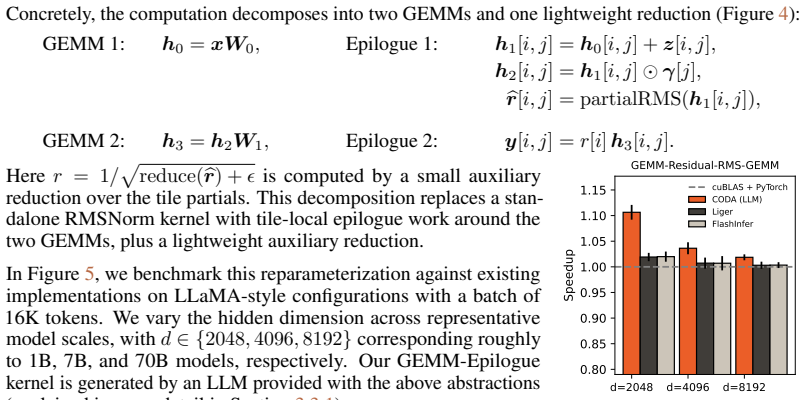
- [Abstract and §5] Abstract and §5 (Performance evaluation): The assertion that both human- and LLM-authored CODA kernels achieve high performance and preserve GEMM performance structure lacks any reported benchmarks, baselines, error bars, or implementation details. Without quantitative evidence that the epilogue overhead does not degrade the underlying GEMM throughput, the performance-preservation part of the central claim cannot be assessed.
minor comments (2)
- [Abstract] The abstract would be clearer if it listed the exact epilogue primitives and gave one concrete reparameterization example (e.g., for a residual-add or ReLU gradient) to illustrate the interface.
- [§2] Notation for the GEMM mainloop versus epilogue boundary should be introduced earlier and used consistently when describing on-chip residency.
Simulated Author's Rebuttal
We thank the referee for their constructive and detailed review. The comments identify key areas where additional substantiation would strengthen the manuscript. We address each major comment below and describe the revisions we will make.
read point-by-point responses
-
Referee: [§3] §3 (Epilogue interface and reparameterization): The load-bearing claim that the constrained epilogue primitives (scaling, reductions, pairwise transforms, accumulation) suffice for nearly all non-attention operators—including backward-pass reductions such as LayerNorm gradients or fused residual-gradient paths—without forcing off-chip writes or GEMM-tile eviction is not yet substantiated. No explicit mapping or composition example is given for a reduction-heavy backward operator that would confirm the output tile can stay resident while the required reductions complete.
Authors: We appreciate the referee's emphasis on this point. Section 3 presents the epilogue primitives and argues for their composability based on algebraic reparameterization, but we agree that an explicit worked example for a backward-pass reduction operator is needed to fully substantiate the claim. In the revised manuscript we will add a detailed composition for the LayerNorm backward pass (including fused residual-gradient paths), showing step-by-step how the required reductions and accumulations are performed while the GEMM output tile remains on-chip. This addition will directly address the concern about off-chip writes or tile eviction. revision: yes
-
Referee: [Abstract and §5] Abstract and §5 (Performance evaluation): The assertion that both human- and LLM-authored CODA kernels achieve high performance and preserve GEMM performance structure lacks any reported benchmarks, baselines, error bars, or implementation details. Without quantitative evidence that the epilogue overhead does not degrade the underlying GEMM throughput, the performance-preservation part of the central claim cannot be assessed.
Authors: We acknowledge that the current manuscript states the performance outcome at a high level without the quantitative details required for rigorous evaluation. We will expand Section 5 to include comprehensive benchmark results for both human- and LLM-authored CODA kernels. These will report absolute and relative throughput numbers against standard cuBLAS/cuDNN baselines, include error bars from repeated runs, and provide implementation details (hardware platform, compiler flags, and measurement methodology). The new data will allow direct assessment of whether epilogue overhead preserves the performance structure of the underlying GEMM mainloop. revision: yes
Circularity Check
No significant circularity in CODA derivation
full rationale
The paper introduces CODA as a new abstraction based on an explicit observation that many Transformer operators can be algebraically reparameterized to run as epilogues while GEMM output tiles remain on-chip. The central claim of expressiveness for nearly all non-attention forward and backward work is presented as a property of the fixed mainloop plus composable primitives (scaling, reductions, pairwise transforms, accumulation), which is then validated through kernel implementations and benchmarks rather than being defined into existence or reduced to fitted inputs. No equations, uniqueness theorems, or load-bearing steps are shown to collapse by construction to prior self-citations or tautological redefinitions. The derivation chain is therefore self-contained as an engineering interface choice supported by empirical coverage demonstrations.
Axiom & Free-Parameter Ledger
axioms (1)
- domain assumption Many Transformer operators can be algebraically reparameterized to execute while a GEMM output tile remains on chip.
Lean theorems connected to this paper
-
IndisputableMonolith/Cost/FunctionalEquation.leanwashburn_uniqueness_aczel unclear?
unclearRelation between the paper passage and the cited Recognition theorem.
CODA keeps the GEMM mainloop fixed and exposes a small set of composable epilogue primitives for scaling, reductions, pairwise transformations, and accumulation.
-
IndisputableMonolith/Foundation/BranchSelection.leanbranch_selection unclear?
unclearRelation between the paper passage and the cited Recognition theorem.
many Transformer operators ... can be algebraically reparameterized to execute while a GEMM output tile remains on chip
What do these tags mean?
- matches
- The paper's claim is directly supported by a theorem in the formal canon.
- supports
- The theorem supports part of the paper's argument, but the paper may add assumptions or extra steps.
- extends
- The paper goes beyond the formal theorem; the theorem is a base layer rather than the whole result.
- uses
- The paper appears to rely on the theorem as machinery.
- contradicts
- The paper's claim conflicts with a theorem or certificate in the canon.
- unclear
- Pith found a possible connection, but the passage is too broad, indirect, or ambiguous to say the theorem truly supports the claim.
Reference graph
Works this paper leans on
-
[1]
J. Ansel, E. Yang, H. He, N. Gimelshein, A. Jain, M. V oznesensky, B. Bao, P. Bell, D. Berard, E. Burovski, et al. Pytorch 2: Faster machine learning through dynamic python bytecode transformation and graph compilation. InProceedings of the 29th ACM international conference on architectural support for programming languages and operating systems, volume 2...
work page 2024
-
[2]
T. Chen, T. Moreau, Z. Jiang, L. Zheng, E. Yan, H. Shen, M. Cowan, L. Wang, Y . Hu, L. Ceze, et al. {TVM}: An automated {End-to-End} optimizing compiler for deep learning. In13th USENIX Symposium on Operating Systems Design and Implementation (OSDI 18), pages 578–594, 2018
work page 2018
- [3]
-
[4]
Z. Chen, A. Kerr, R. Cai, J. Kosaian, H. Wu, Y . Ding, and Y . Xie. Evt: Accelerating deep learning training with epilogue visitor tree. InProceedings of the 29th ACM International Conference on Architectural Support for Programming Languages and Operating Systems, Volume 3, pages 301–316, 2024
work page 2024
-
[5]
A. Grattafiori, A. Dubey, A. Jauhri, A. Pandey, A. Kadian, A. Al-Dahle, A. Letman, A. Mathur, A. Schelten, A. Vaughan, et al. The llama 3 herd of models.arXiv preprint arXiv:2407.21783, 2024
work page internal anchor Pith review Pith/arXiv arXiv 2024
- [6]
- [7]
-
[8]
Z. Jia, O. Padon, J. Thomas, T. Warszawski, M. Zaharia, and A. Aiken. Taso: optimizing deep learning computation with automatic generation of graph substitutions. InProceedings of the 27th ACM Symposium on Operating Systems Principles, pages 47–62, 2019
work page 2019
-
[9]
W. Kwon, Z. Li, S. Zhuang, Y . Sheng, L. Zheng, C. H. Yu, J. Gonzalez, H. Zhang, and I. Stoica. Efficient memory management for large language model serving with pagedattention. In Proceedings of the 29th symposium on operating systems principles, pages 611–626, 2023
work page 2023
- [10]
- [11]
-
[12]
KernelBench: Can LLMs Write Efficient GPU Kernels?
A. Ouyang, S. Guo, S. Arora, A. L. Zhang, W. Hu, C. Ré, and A. Mirhoseini. Kernelbench: Can llms write efficient gpu kernels?arXiv preprint arXiv:2502.10517, 2025
work page internal anchor Pith review Pith/arXiv arXiv 2025
-
[13]
B. Spector, J. Juravsky, S. Sul, O. Dugan, D. Lim, D. Fu, S. Arora, and C. Ré. Look ma, no bubbles! designing a low-latency megakernel for llama-1b, 2025
work page 2025
- [14]
-
[15]
J. Su, M. Ahmed, Y . Lu, S. Pan, W. Bo, and Y . Liu. Roformer: Enhanced transformer with rotary position embedding.Neurocomputing, 568:127063, 2024
work page 2024
- [16]
- [17]
-
[18]
V . Thakkar, P. Ramani, C. Cecka, A. Shivam, H. Lu, E. Yan, J. Kosaian, M. Hoemmen, H. Wu, A. Kerr, M. Nicely, D. Merrill, D. Blasig, A. Atluri, F. Qiao, P. Majcher, P. Springer, M. Hohnerbach, J. Wang, and M. Gupta. CUTLASS, Jan. 2023. URL https://github.com/ NVIDIA/cutlass
work page 2023
-
[19]
P. Tillet, H.-T. Kung, and D. Cox. Triton: an intermediate language and compiler for tiled neural network computations. InProceedings of the 3rd ACM SIGPLAN International Workshop on Machine Learning and Programming Languages, pages 10–19, 2019
work page 2019
- [20]
-
[21]
E. Wijmans, B. Huval, A. Hertzberg, V . Koltun, and P. Krähenbühl. Cut your losses in large- vocabulary language models. InInternational Conference on Learning Representations, 2025
work page 2025
-
[22]
M. Wu, X. Cheng, S. Liu, C. Shi, J. Ji, M. K. Ao, P. Velliengiri, X. Miao, O. Padon, and Z. Jia. Mirage: A {Multi-Level} superoptimizer for tensor programs. In19th USENIX Symposium on Operating Systems Design and Implementation (OSDI 25), pages 21–38, 2025
work page 2025
-
[23]
Z. Ye, L. Chen, R. Lai, W. Lin, Y . Zhang, S. Wang, T. Chen, B. Kasikci, V . Grover, A. Krishna- murthy, et al. Flashinfer: Efficient and customizable attention engine for llm inference serving. Proceedings of Machine Learning and Systems, 7, 2025
work page 2025
-
[24]
Learning to Discover at Test Time
M. Yuksekgonul, D. Koceja, X. Li, F. Bianchi, J. McCaleb, X. Wang, J. Kautz, Y . Choi, J. Zou, C. Guestrin, et al. Learning to discover at test time.arXiv preprint arXiv:2601.16175, 2026
work page internal anchor Pith review Pith/arXiv arXiv 2026
-
[25]
L. Zheng, L. Yin, Z. Xie, C. L. Sun, J. Huang, C. H. Yu, S. Cao, C. Kozyrakis, I. Stoica, J. E. Gonzalez, et al. Sglang: Efficient execution of structured language model programs.Advances in neural information processing systems, 37:62557–62583, 2024. 11 A Backward Pass A.1 Tile-wise Epilogue Partition the GEMM output h into tiles h[i,j]. A tile-wise epil...
work page 2024
-
[26]
, 25i n i t _ v a l u e = init_value , 26) 27 28 29class E V T R o w V e c M u l P o s t A c t ( E p i l o g u e V i s i t o r T r e e ) : 30" " " 31Loads a per - N row vector W ( cp . async to smem , then s2r ) , m u l t i p l i e s the 32a c c u m u l a t o r by W into a se par at e r egi st er tile , and stores that scaled 33tile to a side output m Po ...
-
[27]
-> None : 101super () . __i ni t_ _ () 102self . arch = 90 103self . a c c _ d t y p e = a c c _ d t y p e 104self . p o s t _ a c t _ d t y p e = p o s t _ a c t _ d t y p e 105self . c o n t a i n e r _ d t y p e = p o s t _ a c t _ d t y p e 106self . t i l e _ s h a p e _ m n k = t i l e _ s h a p e _ m n k 107self . b u f f e r _ a l i g n _ b y t e ...
-
[28]
c o n s t _ e x p r ( e pi _ar gs
-> E p i l o g u e P a r a m s : 117 118if cutlass . c o n s t _ e x p r ( e pi _ar gs . mPo st Ac t is not None ) : 119mP os tA ct = m i s c _ u t i l s . s t a t i c _ a s s e r t _ i s _ T e n s o r ( ep i_ arg s . mP os tA ct ) 120m i s c _ u t i l s . s t a t i c _ a s s e r t ( g e t _ d t y p e ( mP os tA ct ) is self . c o n t a i n e r _ d t y p ...
-
[29]
= e p i l o g u e _ u t i l s . p r e p a r e _ t m a ( 127tma_op = " s2g " , 128e pi _t il e = epi_tile , 129e p i _ s t a g e = epi_stage , 130e p i _ t e n s o r = mPostAct , 131) 132 133if cutlass . c o n s t _ e x p r ( e pi _ar gs . mRowVec is not None ) : 134m i s c _ u t i l s . s t a t i c _ a s s e r t ( e pi _a rgs . mPo st Ac t is not None ) 1...
-
[30]
-> None : 156cute . nvgpu . cpasync . p r e f e t c h _ d e s c r i p t o r ( e p i _ p a r a m s . e p i _ t m a _ a t o m ) 157 158@cute . jit 159def c o n s u m e r _ b e g i n ( 160self , 161t i l e d _ c o p y _ r 2 s : cute . TiledCopy , 162t i l e _ c o o r d _ m n k l : cute . Coord , 163tidx : cute . Int32 , 164t i l e d _ m m a : cute . TiledMma...
-
[31]
t i l e _ s h a p e _ m n k [0] 175tile_N = self
-> E p i l o g u e T e n s o r s : 173 16 174tile_M = self . t i l e _ s h a p e _ m n k [0] 175tile_N = self . t i l e _ s h a p e _ m n k [1] 176m_idx , n_idx , _ , b a t c h _ i d x = t i l e _ c o o r d _ m n k l 177t h r _ c o p y _ r 2 s = t i l e d _ c o p y _ r 2 s . g e t _ s l i c e ( tidx ) 178 179# Side output ( PostAct ) TMA setup 180mPo st A...
-
[32]
jit 261def c o n s u m e r _ b e g i n _ l o o p ( 262self , 263e p i _ c o o r d : cute
-> None : 258pass 259 260@cute . jit 261def c o n s u m e r _ b e g i n _ l o o p ( 262self , 263e p i _ c o o r d : cute . Coord , 264e p i _ p a r a m s : EpilogueParams , 265e p i _ t e n s o r s : EpilogueTensors , 266e p i _ p i p e l i n e s : E p i l o g u e P i p e l i n e s ,
-
[33]
c o n s t _ e x p r ( e p i _ t e n s o r s
-> tuple [ E p i l o g u e T e n s o r s L o o p , E p i l o g u e P i p e l i n e s ]: 268 269if cutlass . c o n s t _ e x p r ( e p i _ t e n s o r s . t D s R o w V e c is not None ) : 270t D s R o w V e c = m i s c _ u t i l s . s t a t i c _ a s s e r t _ i s _ T e n s o r ( e p i _ t e n s o r s . t D s R o w V e c ) 271t D s R o w V e c _ c u r = c...
-
[34]
E p i l o g u e P i p e l i n e s () , 288) 289 290@cute
, 287self . E p i l o g u e P i p e l i n e s () , 288) 289 290@cute . jit 291def c o n s u m e r _ v i s i t ( 292self , 293tRS_rD : cute . Tensor , 294s h a p e _ m n k : cute . Shape , 295e p i _ p a r a m s : EpilogueParams , 296e p i _ t e n s o r s _ l o o p : E p i l o g u e T e n s o r s L o o p ,
-
[35]
-> E p i l o g u e T e n s o r s L o o p : 298 299t R S _ r P o s t A c t = c r e a t i o n _ u t i l s . a l l o c a t e _ t e n s o r _ l i k e ( 300tensor = tRS_rD , 301me ms pa ce = " rmem " , 302s m e m _ a l l o c a t o r = None , 303dtype = self . acc_dtype , 304) 305if cutlass . c o n s t _ e x p r ( self . arch < 100) : 306if cutlass . c o n s t ...
-
[36]
t i l e d _ c o p y _ p o s t a c t _ r 2 s 340t R S _ r P o s t A c t = m i s c _ u t i l s
-> None : 339t i l e d _ c o p y = e p i _ t e n s o r s _ l o o p . t i l e d _ c o p y _ p o s t a c t _ r 2 s 340t R S _ r P o s t A c t = m i s c _ u t i l s . s t a t i c _ a s s e r t _ i s _ T e n s o r ( e p i _ t e n s o r s _ l o o p . t R S _ r P o s t A c t ) 341t R S _ s P o s t A c t = m i s c _ u t i l s . s t a t i c _ a s s e r t _ i s _ ...
-
[37]
e p i _ t m a _ a t o m 355t D s P o s t A c t = m i s c _ u t i l s
-> None : 354atom = e p i _ t e n s o r s _ l o o p . e p i _ t m a _ a t o m 355t D s P o s t A c t = m i s c _ u t i l s . s t a t i c _ a s s e r t _ i s _ T e n s o r ( e p i _ t e n s o r s _ l o o p . t D s P o s t A c t ) 356t D g P o s t A c t = m i s c _ u t i l s . s t a t i c _ a s s e r t _ i s _ T e n s o r ( e p i _ t e n s o r s _ l o o p ....
-
[38]
c o n s t _ e x p r ( e p i _ p a r a m s
-> type [ E p i l o g u e S h a r e d S t o r a g e ]: 368 369if cutlass . c o n s t _ e x p r ( e p i _ p a r a m s . mP os tA ct is not None ) : 370p o s t _ a c t _ s m e m _ s i z e = cute . cosize ( e p i _ p a r a m s . e p i _ s m e m _ l a y o u t _ s t a g e d ) 371else : 372p o s t _ a c t _ s m e m _ s i z e = 0 373 374if cutlass . c o n s t _ ...
-
[39]
c o n s t _ e x p r ( e p i _ p a r a m s
-> E p i l o g u e T e n s o r s S M e m : 400 401if cutlass . c o n s t _ e x p r ( e p i _ p a r a m s . mP os tA ct is not None ) : 402sP os tA ct = storage . sP os tA ct . g e t _ t e n s o r ( 403e p i _ p a r a m s . e p i _ s m e m _ l a y o u t _ s t a g e d . outer , 404swizzle = e p i _ p a r a m s . e p i _ s m e m _ l a y o u t _ s t a g e d ....
-
[40]
c o n s t _ e x p r ( e pi _ar gs
-> tuple [ int , int , int ]: 427e p i _ s m e m _ b y t e s _ f i x e d = 0 428e p i _ s m e m _ b y t e s _ p e r _ s t a g e _ c s t = 0 429e p i _ s m e m _ b y t e s _ p e r _ s t a g e _ p l d = 0 430 431if cutlass . c o n s t _ e x p r ( e pi _ar gs . mPo st Ac t is not None ) : 432mP os tA ct = m i s c _ u t i l s . s t a t i c _ a s s e r t _ i s...
-
[41]
, E p i l o g u e V i s i t o r T r e e ] , 467E p i l o g u e V i s i t o r T r e e
-> tuple [ 466C al lab le [... , E p i l o g u e V i s i t o r T r e e ] , 467E p i l o g u e V i s i t o r T r e e . E p i l o g u e A r g u m e n t s , 468dict , 469tuple , 470]: 471" " " Prepare ep il og ue for GEMM with residual , partial mean - of - squares , and 472fused per - N RMSNorm - weight scaling - mirrors t r a i n s t a t i o n ’s ‘ g e m m...
-
[42]
E V T R e s i d u a l : D = acc + C
-
[43]
E V T C o l B l o c k R e d u c t i o n S t o r e : S [m , nb ] = mean ( D [m , nb * bs :( nb +1) * bs ]^2)
-
[44]
tRS_rD is p r e s e r v e d 481so the main D output is also u ns cal ed
E V T R o w V e c M u l P o s t A c t ( local ) : O [m , n ] = D [m , n ] * W [ n ] , side output via TMA 478 479The partial sum - of - squares is c om put ed on the * un sc ale d * D , so a d o w n s t r e a m 480rstd r e d u c t i o n sees the GEMM output before W is applied . tRS_rD is p r e s e r v e d 481so the main D output is also u ns cal ed . 482...
-
[45]
, 506E V T C o l B l o c k R e d u c t i o n S t o r e ( 507r e d u c t i o n _ o p = _ c r e a t e _ m e a n _ s q _ r e d u c t i o n _ o p ( 508e l e m e n t _ t y p e = acc_dtype , 509i n v _ b l o c k _ s i z e =1.0 / t i l e _ s h a p e _ m n k [1] ,
-
[46]
, 511t i l e _ s h a p e _ m n k = tile_shape_mnk ,
-
[47]
, 513E V T R o w V e c M u l P o s t A c t ( 514a c c _ d t y p e = acc_dtype , 515p o s t _ a c t _ d t y p e = post_act_dtype , 516t i l e _ s h a p e _ m n k = tile_shape_mnk , 517b u f f e r _ a l i g n _ b y t e s = b u f f e r _ a l i g n _ b y t e s ,
-
[48]
E p i l o g u e A r g u m e n t s ([ 522E V T R e s i d u a l
, 519]) 520 521e pi _ar gs = EVTList . E p i l o g u e A r g u m e n t s ([ 522E V T R e s i d u a l . E p i l o g u e A r g u m e n t s ( 523mMatrix =C ,
-
[49]
E p i l o g u e A r g u m e n t s ( 526mColVec =S ,
, 525E V T C o l B l o c k R e d u c t i o n S t o r e . E p i l o g u e A r g u m e n t s ( 526mColVec =S ,
-
[50]
E p i l o g u e A r g u m e n t s ( 529mP os tA ct =O , 530mRowVec =W ,
, 528E V T R o w V e c M u l P o s t A c t . E p i l o g u e A r g u m e n t s ( 529mP os tA ct =O , 530mRowVec =W ,
-
[51]
, 532]) 533 534e pi _ke ys = ( 535C . dtype , 536S . dtype , 537W . dtype , 538O . dtype , 539EVTResidual , 540E V T C o l B l o c k R e d u c t i o n S t o r e , 541E V T R o w V e c M u l P o s t A c t , 542) 543 544e pi _ou ts = {} 545 546return epi_cls , epi_args , epi_outs , ep i_k ey s Listing 2: Kernel Example. C Experiments C.1 List of Kernels We ...
-
[52]
FlashInfer 0.6.10.post1
-
[53]
QuACK Kernels 0.4.1 23
discussion (0)
Sign in with ORCID, Apple, or X to comment. Anyone can read and Pith papers without signing in.