BrainDyn: A Sheaf Neural ODE for Generative Brain Dynamics
Pith reviewed 2026-05-20 08:13 UTC · model grok-4.3
The pith
BrainDyn models generative brain dynamics using a sheaf neural ODE on anatomical graphs.
A machine-rendered reading of the paper's core claim, the machinery that carries it, and where it could break.
Core claim
By combining LSTM-encoded stalks with learnable restriction maps and a sheaf Laplacian for message passing inside a neural ODE, BrainDyn generates continuous-time activity on brain graphs that matches observed dynamics in fMRI and EEG recordings and enables in silico perturbation experiments.
What carries the argument
Sheaf Laplacian that quantifies discrepancies in the shared spaces obtained by projecting LSTM hidden states through restriction maps, allowing the neural ODE to evolve node activities in a way informed by graph structure.
If this is right
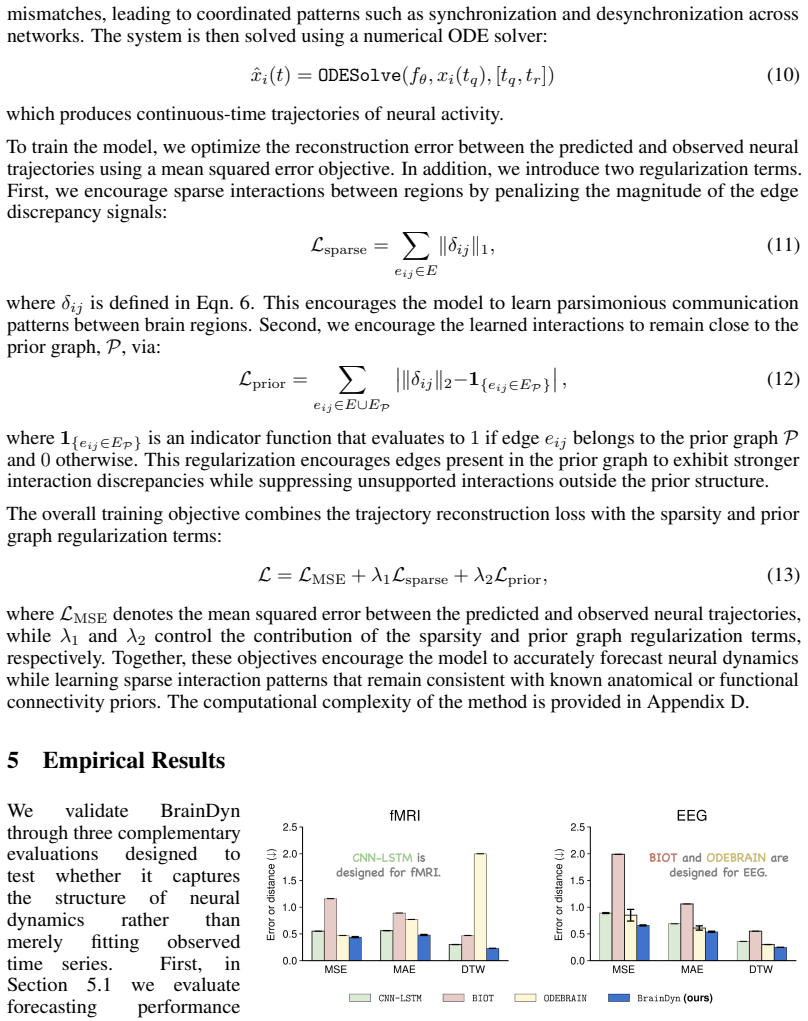
- Forecasting of future brain activity is improved across fMRI, EEG, and simulated spiking data.
- Learned representations enable prediction of effects from in silico perturbations on brain regions.
- Generated dynamics align with the anatomical organization of brain regions rather than ignoring it.
- The continuous-time formulation handles the irregular timing inherent in brain measurements.
Where Pith is reading between the lines
- Extending this model to include more detailed anatomical priors could further improve alignment with real brain connectivity.
- Applying similar sheaf structures to other time-series on graphs, such as traffic or climate networks, might yield better forecasts.
- The approach opens the possibility of using the model to generate large amounts of synthetic data for training other brain analysis tools.
Load-bearing premise
Discrepancies between neighboring brain regions as measured in the sheaf's shared spaces will drive message passing that results in activity evolution aligned with actual anatomical brain organization.
What would settle it
The model forecasts would be no better than those from a standard neural ODE without the sheaf component when tested on held-out time series from the PNC fMRI or TUSZ EEG datasets.
Figures

read the original abstract
Efficient neural network models that generate brain-like dynamic activity can be a valuable resource for generating synthetic data, analyzing differences in brain transients under conditions such as testing perturbation activity or inferring the underlying generative dynamics. However, large language models (LLMs) or standard recurrent neural networks (RNNs) ignore the anatomical organization and therefore do not produce components that align with brain regions. On the other hand, graph-based networks often have very simple message passing rules that are not sufficiently expressive for brain-like dynamics. To address this, we introduce BrainDyn, a sheaf neural ordinary differential equation (neural ODE) model for continuous-time dynamics on structured brain graphs. BrainDyn encodes the recent activity history of each brain region using a long short-term memory (LSTM) model over a sliding temporal window to produce hidden states, or stalks, that are projected through learnable restriction maps into edge-specific shared spaces. Discrepancies between neighboring nodes in these shared spaces are characterized by a sheaf Laplacian that can facilitate message passing between neuronal units. The output of these messages is then fed to a neural ODE that governs the continuous-time evolution of neuronal activity. We evaluated BrainDyn on resting-state fMRI (PNC dataset), scalp EEG with focal epilepsy (TUSZ dataset), and simulated activity from the NEST spiking network simulator. BrainDyn achieves strong forecasting ability across modalities, and the resulting representations support downstream tasks including in silico perturbation prediction.
Editorial analysis
A structured set of objections, weighed in public.
Referee Report
Summary. The manuscript introduces BrainDyn, a sheaf neural ODE architecture for modeling continuous-time brain dynamics on graphs. It encodes recent activity history of brain regions via LSTM over sliding windows to produce stalks, projects these through learnable restriction maps into edge-specific shared spaces, applies a sheaf Laplacian to characterize discrepancies for message passing, and integrates the result into a neural ODE governing the evolution of neuronal activity. The model is evaluated on resting-state fMRI from the PNC dataset, scalp EEG from the TUSZ dataset with focal epilepsy, and simulated spiking activity from NEST, with claims of strong forecasting performance across modalities and utility for downstream tasks such as in silico perturbation prediction.
Significance. If the forecasting and perturbation-prediction claims are substantiated by rigorous quantitative results with appropriate baselines and controls, the work could offer a principled way to incorporate anatomical structure into generative models of brain dynamics via sheaf Laplacians and continuous-time evolution. The combination of LSTM stalks, learnable restrictions, and neural ODEs on brain graphs is a plausible extension of existing graph and continuous-time methods, but its added value over simpler alternatives remains to be demonstrated.
major comments (3)
- [Abstract] Abstract: the claim of 'strong forecasting ability across modalities' is asserted without any quantitative metrics, error bars, baseline comparisons, data-split details, or evaluation protocols. This absence makes it impossible to assess whether the reported performance exceeds that of standard RNNs, GNNs, or continuous-time baselines on the PNC, TUSZ, or NEST datasets.
- [Model description] Model architecture (sheaf Laplacian message passing): the central modeling assumption that discrepancies characterized by the sheaf Laplacian will produce anatomically aligned brain-like dynamics is not isolated empirically. No ablation is described that removes the sheaf component (replacing it with an ordinary graph Laplacian or fully connected layer) while keeping the LSTM stalks and neural ODE fixed, leaving open whether the sheaf Laplacian is load-bearing for the claimed forecasting or perturbation results.
- [Experiments] Evaluation section: downstream utility for in silico perturbation prediction is stated but without concrete experimental protocols, quantitative metrics, or controls showing that the learned representations improve perturbation prediction over non-sheaf or non-ODE baselines.
minor comments (1)
- [Model] Notation for stalks and restriction maps should be defined more explicitly with respect to the underlying graph and sheaf structure to aid reproducibility.
Simulated Author's Rebuttal
We thank the referee for their constructive and detailed comments, which help clarify how the manuscript can be improved. We respond to each major comment below and commit to revisions that directly address the concerns raised.
read point-by-point responses
-
Referee: [Abstract] Abstract: the claim of 'strong forecasting ability across modalities' is asserted without any quantitative metrics, error bars, baseline comparisons, data-split details, or evaluation protocols. This absence makes it impossible to assess whether the reported performance exceeds that of standard RNNs, GNNs, or continuous-time baselines on the PNC, TUSZ, or NEST datasets.
Authors: We agree that the abstract currently asserts strong forecasting performance without accompanying quantitative details. This is a limitation of the submitted version. In the revised manuscript we will update the abstract to report key quantitative results (e.g., forecasting MSE or correlation with standard deviations) from the PNC, TUSZ, and NEST experiments, along with brief mention of the baselines and data-split protocols used. This will allow readers to evaluate the claims directly. revision: yes
-
Referee: [Model description] Model architecture (sheaf Laplacian message passing): the central modeling assumption that discrepancies characterized by the sheaf Laplacian will produce anatomically aligned brain-like dynamics is not isolated empirically. No ablation is described that removes the sheaf component (replacing it with an ordinary graph Laplacian or fully connected layer) while keeping the LSTM stalks and neural ODE fixed, leaving open whether the sheaf Laplacian is load-bearing for the claimed forecasting or perturbation results.
Authors: The referee correctly identifies the absence of an ablation isolating the sheaf Laplacian. The original manuscript does not contain such an experiment. We will add a dedicated ablation study in the revised version: we will replace the sheaf Laplacian with a standard graph Laplacian and with a fully connected layer while holding the LSTM stalk encoder and neural ODE fixed, then report the resulting changes in forecasting and perturbation-prediction performance. This will empirically test whether the sheaf component is load-bearing. revision: yes
-
Referee: [Experiments] Evaluation section: downstream utility for in silico perturbation prediction is stated but without concrete experimental protocols, quantitative metrics, or controls showing that the learned representations improve perturbation prediction over non-sheaf or non-ODE baselines.
Authors: We acknowledge that the current description of the in silico perturbation prediction task is insufficiently detailed. The revised manuscript will expand the Experiments section with a precise protocol (how perturbations are introduced, time horizons, etc.), the quantitative metrics employed, and explicit comparisons against non-sheaf graph models and non-ODE recurrent baselines. These additions will demonstrate whether the learned representations confer measurable improvement. revision: yes
Circularity Check
No significant circularity; model architecture and empirical evaluation are independent
full rationale
The paper defines BrainDyn via an explicit architecture (LSTM stalks projected by learnable restriction maps, sheaf Laplacian message passing into a neural ODE) and then reports forecasting performance on held-out data from PNC, TUSZ, and NEST. No equation or claim reduces by construction to a fitted parameter renamed as prediction, nor does any load-bearing step rest solely on a self-citation whose content is itself unverified. The derivation chain is self-contained against external benchmarks.
Axiom & Free-Parameter Ledger
free parameters (1)
- learnable restriction maps
axioms (1)
- domain assumption Discrepancies between neighboring nodes in shared spaces can be characterized by a sheaf Laplacian that facilitates appropriate message passing for brain-like dynamics.
invented entities (1)
-
Sheaf neural ODE for brain graphs
no independent evidence
Lean theorems connected to this paper
-
IndisputableMonolith/Cost/FunctionalEquation.leanwashburn_uniqueness_aczel unclear?
unclearRelation between the paper passage and the cited Recognition theorem.
Discrepancies between neighboring nodes in these shared spaces are characterized by a sheaf Laplacian that can facilitate message passing between neuronal units... (LF X)i = Σ ρ⊤i→eij δ(X)(eij)
-
IndisputableMonolith/Foundation/RealityFromDistinction.leanreality_from_one_distinction unclear?
unclearRelation between the paper passage and the cited Recognition theorem.
The output of these messages is then fed to a neural ODE that governs the continuous-time evolution of neuronal activity.
What do these tags mean?
- matches
- The paper's claim is directly supported by a theorem in the formal canon.
- supports
- The theorem supports part of the paper's argument, but the paper may add assumptions or extra steps.
- extends
- The paper goes beyond the formal theorem; the theorem is a base layer rather than the whole result.
- uses
- The paper appears to rely on the theorem as machinery.
- contradicts
- The paper's claim conflicts with a theorem or certificate in the canon.
- unclear
- Pith found a possible connection, but the passage is too broad, indirect, or ambiguous to say the theorem truly supports the claim.
Reference graph
Works this paper leans on
-
[1]
Charlotte Bunne, Yusuf Roohani, Yanay Rosen, Ankit Gupta, Xikun Zhang, Marcel Roed, Theo Alexandrov, Mohammed AlQuraishi, Patricia Brennan, Daniel B Burkhardt, et al. How to build the virtual cell with artificial intelligence: Priorities and opportunities.Cell, 187(25): 7045–7063, 2024
work page 2024
-
[2]
Virtual tissue staining in pathology using machine learning
Nir Pillar and Aydogan Ozcan. Virtual tissue staining in pathology using machine learning. Expert Review of Molecular Diagnostics, 22(11):987–989, 2022
work page 2022
-
[3]
Marvin Mergen, Anna Junga, Benjamin Risse, Dimitar Valkov, Norbert Graf, Bernhard Marschall, et al. Immersive training of clinical decision making with ai driven virtual patients–a new vr platform called medical tr. AI. ning.GMS Journal for Medical Education, 40(2):Doc18, 2023
work page 2023
-
[4]
Paula Sanz Leon, Stuart A Knock, M Marmaduke Woodman, Lia Domide, Jochen Mersmann, Anthony R McIntosh, and Viktor Jirsa. The virtual brain: a simulator of primate brain network dynamics.Frontiers in neuroinformatics, 7, 2013
work page 2013
-
[5]
Personalised virtual brain models in epilepsy.The Lancet Neurology, 22(5):443–454, 2023
Viktor Jirsa, Huifang Wang, Paul Triebkorn, Meysam Hashemi, Jayant Jha, Jorge Gonzalez- Martinez, Maxime Guye, Julia Makhalova, and Fabrice Bartolomei. Personalised virtual brain models in epilepsy.The Lancet Neurology, 22(5):443–454, 2023
work page 2023
-
[6]
Dynamical constraints on neural population activity
Emily R Oby, Alan D Degenhart, Erinn M Grigsby, Asma Motiwala, Nicole T McClain, Patrick J Marino, Byron M Yu, and Aaron P Batista. Dynamical constraints on neural population activity. Nature Neuroscience, 28(2):383–393, 2025
work page 2025
-
[7]
Fatemeh Hasanzadeh, Christian Habeck, and Yaakov Stern. Dynamic brain states during reasoning tasks: a co-activation pattern analysis.NeuroImage, page 121431, 2025
work page 2025
-
[8]
Diego Vidaurre, Stephen M Smith, and Mark W Woolrich. Brain network dynamics are hierarchically organized in time.Proceedings of the National Academy of Sciences, 114(48): 12827–12832, 2017
work page 2017
-
[9]
Sreevalsan S Menon and K Krishnamurthy. A comparison of static and dynamic functional connectivities for identifying subjects and biological sex using intrinsic individual brain connectivity.Scientific reports, 9(1):5729, 2019
work page 2019
-
[10]
Timothy O Laumann, Abraham Z Snyder, and Caterina Gratton. Challenges in the measurement and interpretation of dynamic functional connectivity.Imaging Neuroscience, 2:imag–2, 2024
work page 2024
-
[11]
Stefania Coelli, Martina Corda, and Anna Maria Bianchi. The time-varying brain: a comprehensive review of dynamic functional connectivity analysis in eeg and meg.Journal of Neural Engineering, 22(5):051005, 2025
work page 2025
-
[12]
Huifang E Wang, Paul Triebkorn, Martin Breyton, Borana Dollomaja, Jean-Didier Lemarechal, Spase Petkoski, Pierpaolo Sorrentino, Damien Depannemaecker, Meysam Hashemi, and Viktor K Jirsa. Virtual brain twins: from basic neuroscience to clinical use.National Science Review, 11(5):nwae079, 2024. 10
work page 2024
-
[13]
Generative models of brain dynamics.Frontiers in artificial intelligence, 5:807406, 2022
Mahta Ramezanian-Panahi, Germán Abrevaya, Jean-Christophe Gagnon-Audet, Vikram V oleti, Irina Rish, and Guillaume Dumas. Generative models of brain dynamics.Frontiers in artificial intelligence, 5:807406, 2022
work page 2022
-
[14]
The blue brain project.Nature Reviews Neuroscience, 7(2):153–160, Feb
Henry Markram. The blue brain project.Nature Reviews Neuroscience, 7(2):153–160, Feb
-
[15]
ISSN 1471-0048. doi: 10.1038/nrn1848. URL https://doi.org/10.1038/nrn1848
-
[16]
Graph neural networks for brain graph learning: A survey.arXiv preprint arXiv:2406.02594, 2024
Xuexiong Luo, Jia Wu, Jian Yang, Shan Xue, Amin Beheshti, Quan Z Sheng, David McAlpine, Paul Sowman, Alexis Giral, and Philip S Yu. Graph neural networks for brain graph learning: A survey.arXiv preprint arXiv:2406.02594, 2024
-
[17]
Peng He, Zhan Shi, Yaping Cui, Ruyan Wang, Dapeng Wu, Alzheimer’s Disease Neuroimaging Initiative, et al. A spatiotemporal graph transformer approach for alzheimer’s disease diagnosis with rs-fmri.Computers in Biology and Medicine, 178:108762, 2024
work page 2024
-
[18]
Xiaoxiao Li, Yuan Zhou, Nicha Dvornek, Muhan Zhang, Siyuan Gao, Juntang Zhuang, Dustin Scheinost, Lawrence H Staib, Pamela Ventola, and James S Duncan. Braingnn: Interpretable brain graph neural network for fmri analysis.Medical image analysis, 74:102233, 2021
work page 2021
-
[19]
Hamed Mohammadi and Waldemar Karwowski. Graph neural networks in brain connectivity studies: Methods, challenges, and future directions.Brain Sciences, 15(1):17, 2024
work page 2024
-
[20]
The topology and geometry of neural representations
Baihan Lin and Nikolaus Kriegeskorte. The topology and geometry of neural representations. Proceedings of the National Academy of Sciences, 121(42):e2317881121, 2024
work page 2024
-
[21]
Alexis Dubreuil, Adrian Valente, Manuel Beiran, Francesca Mastrogiuseppe, and Srdjan Ostojic. The role of population structure in computations through neural dynamics.Nature neuroscience, 25(6):783–794, 2022
work page 2022
-
[22]
T Konstantin Rusch, Michael M Bronstein, and Siddhartha Mishra. A survey on oversmoothing in graph neural networks.arXiv preprint arXiv:2303.10993, 2023
-
[23]
Xinyi Wu, Amir Ajorlou, Zihui Wu, and Ali Jadbabaie. Demystifying oversmoothing in attention-based graph neural networks.Advances in Neural Information Processing Systems, 36:35084–35106, 2023
work page 2023
-
[24]
David C Schwartz, Xiaojun Li, Luis I Hernandez, Satyadarshan P Ramnarain, Edward J Huff, and Yu-Ker Wang. Ordered restriction maps of saccharomyces cerevisiae chromosomes constructed by optical mapping.Science, 262(5130):110–114, 1993
work page 1993
-
[25]
Anton Valouev, David C Schwartz, Shiguo Zhou, and Michael S Waterman. An algorithm for assembly of ordered restriction maps from single dna molecules.Proceedings of the national academy of sciences, 103(43):15770–15775, 2006
work page 2006
-
[26]
Jakob Hansen and Robert Ghrist. Toward a spectral theory of cellular sheaves.Journal of Applied and Computational Topology, 3(4):315–358, 2019
work page 2019
-
[27]
Jakob Hansen and Thomas Gebhart. Sheaf neural networks.arXiv preprint arXiv:2012.06333, 2020
-
[28]
Federico Barbero, Cristian Bodnar, Haitz Sáez de Ocáriz Borde, and Pietro Lio. Sheaf attention networks. InNeurIPS 2022 Workshop on Symmetry and Geometry in Neural Representations, 2022
work page 2022
-
[29]
Neural sheaf diffusion: A topological perspective on heterophily and oversmoothing in gnns
Cristian Bodnar, Francesco Di Giovanni, Benjamin Chamberlain, Pietro Lió, and Michael Bronstein. Neural sheaf diffusion: A topological perspective on heterophily and oversmoothing in gnns. In S. Koyejo, S. Mohamed, A. Agarwal, D. Belgrave, K. Cho, and A. Oh, editors, Advances in Neural Information Processing Systems, volume 35, pages 18527–18541. Curran A...
work page 2022
-
[30]
Attention is all you need.Advances in neural information processing systems, 30, 2017
Ashish Vaswani, Noam Shazeer, Niki Parmar, Jakob Uszkoreit, Llion Jones, Aidan N Gomez, Łukasz Kaiser, and Illia Polosukhin. Attention is all you need.Advances in neural information processing systems, 30, 2017. 11
work page 2017
-
[31]
Neural ordinary differential equations.Advances in neural information processing systems, 31, 2018
Ricky TQ Chen, Yulia Rubanova, Jesse Bettencourt, and David K Duvenaud. Neural ordinary differential equations.Advances in neural information processing systems, 31, 2018
work page 2018
-
[32]
Yulia Rubanova, Ricky TQ Chen, and David K Duvenaud. Latent ordinary differential equations for irregularly-sampled time series.Advances in neural information processing systems, 32, 2019
work page 2019
-
[33]
Graph neural ordinary differential equations.arXiv preprint arXiv:1911.07532, 2019
Michael Poli, Stefano Massaroli, Junyoung Park, Atsushi Yamashita, Hajime Asama, and Jinkyoo Park. Graph neural ordinary differential equations.arXiv preprint arXiv:1911.07532, 2019
-
[34]
Neuroimaging of the philadelphia neurodevelopmental cohort.Neuroimage, 86:544–553, 2014
Theodore D Satterthwaite, Mark A Elliott, Kosha Ruparel, James Loughead, Karthik Prabhakaran, Monica E Calkins, Ryan Hopson, Chad Jackson, Jack Keefe, Marisa Riley, et al. Neuroimaging of the philadelphia neurodevelopmental cohort.Neuroimage, 86:544–553, 2014
work page 2014
-
[35]
The temple university hospital seizure detection corpus.Frontiers in neuroinformatics, 12:83, 2018
Vinit Shah, Eva V on Weltin, Silvia Lopez, James Riley McHugh, Lillian Veloso, Meysam Golmohammadi, Iyad Obeid, and Joseph Picone. The temple university hospital seizure detection corpus.Frontiers in neuroinformatics, 12:83, 2018
work page 2018
-
[36]
Nest (neural simulation tool).Scholarpedia, 2 (4):1430, 2007
Marc-Oliver Gewaltig and Markus Diesmann. Nest (neural simulation tool).Scholarpedia, 2 (4):1430, 2007
work page 2007
-
[37]
Neural population dynamics during reaching.Nature, 487(7405):51–56, 2012
Mark M Churchland, John P Cunningham, Matthew T Kaufman, Justin D Foster, Paul Nuyujukian, Stephen I Ryu, and Krishna V Shenoy. Neural population dynamics during reaching.Nature, 487(7405):51–56, 2012
work page 2012
-
[38]
Valerio Mante, David Sussillo, Krishna V Shenoy, and William T Newsome. Context-dependent computation by recurrent dynamics in prefrontal cortex.Nature, 503(7474):78–84, 2013
work page 2013
-
[39]
Computation through neural population dynamics.Annual review of neuroscience, 43(1):249–275, 2020
Saurabh Vyas, Matthew D Golub, David Sussillo, and Krishna V Shenoy. Computation through neural population dynamics.Annual review of neuroscience, 43(1):249–275, 2020
work page 2020
-
[40]
Self-supervised graph neural networks for improved electroencephalographic seizure analysis
Siyi Tang, Jared Dunnmon, Khaled Kamal Saab, Xuan Zhang, Qianying Huang, Florian Dubost, Daniel Rubin, and Christopher Lee-Messer. Self-supervised graph neural networks for improved electroencephalographic seizure analysis. InInternational Conference on Learning Representations, 2022
work page 2022
-
[41]
Julius Vetter, Jakob H Macke, and Richard Gao. Generating realistic neurophysiological time series with denoising diffusion probabilistic models.Patterns, 5(9), 2024
work page 2024
-
[42]
Ali Agga, Ahmed Abbou, Moussa Labbadi, Yassine El Houm, and Imane Hammou Ou Ali. Cnn-lstm: An efficient hybrid deep learning architecture for predicting short-term photovoltaic power production.Electric Power Systems Research, 208:107908, 2022
work page 2022
-
[43]
Autoregressive ConvLSTM Framework for fMRI Time Series Forecasting in Alzheimer’s Disease
Ahmed Alshembari, Anima Kujur, and Zahra Monfared. Autoregressive ConvLSTM Framework for fMRI Time Series Forecasting in Alzheimer’s Disease. InNeurIPS 2025 Workshop on Learning from Time Series for Health, 2025
work page 2025
-
[44]
Chaoqi Yang, M Westover, and Jimeng Sun. Biot: Biosignal transformer for cross-data learning in the wild.Advances in Neural Information Processing Systems, 36:78240–78260, 2023
work page 2023
-
[45]
Evolvegcn: Evolving graph convolutional networks for dynamic graphs
Aldo Pareja, Giacomo Domeniconi, Jie Chen, Tengfei Ma, Toyotaro Suzumura, Hiroki Kanezashi, Tim Kaler, Tao Schardl, and Charles Leiserson. Evolvegcn: Evolving graph convolutional networks for dynamic graphs. InProceedings of the AAAI conference on artificial intelligence, volume 34, pages 5363–5370, 2020
work page 2020
-
[46]
Odebrain: Continuous-time eeg graph for modeling dynamic brain networks
Haohui Jia, Zheng Chen, Lingwei Zhu, Rikuto Kotoge, Jathurshan Pradeepkumar, Yasuko Matsubara, Jimeng Sun, Yasushi Sakurai, and Takashi Matsubara. Odebrain: Continuous-time eeg graph for modeling dynamic brain networks. InThe Fourteenth International Conference on Learning Representations, 2026. 12
work page 2026
-
[47]
Inferring dynamic regulatory interaction graphs from time series data with perturbations
Dhananjay Bhaskar, Daniel Sumner Magruder, Matheo Morales, Edward De Brouwer, Aarthi Venkat, Frederik Wenkel, James Noonan, Guy Wolf, Natalia Ivanova, and Smita Krishnaswamy. Inferring dynamic regulatory interaction graphs from time series data with perturbations. In Learning on Graphs Conference, pages 22–1. PMLR, 2024
work page 2024
-
[48]
Learning sheaf Laplacians from smooth signals
Jakob Hansen and Robert Ghrist. Learning sheaf Laplacians from smooth signals. In ICASSP 2019-2019 IEEE International Conference on Acoustics, Speech and Signal Processing (ICASSP), pages 5446–5450. IEEE, 2019
work page 2019
-
[49]
Alexander Schaefer, Ru Kong, Evan M Gordon, Timothy O Laumann, Xi-Nian Zuo, Avram J Holmes, Simon B Eickhoff, and BT Thomas Yeo. Local-global parcellation of the human cerebral cortex from intrinsic functional connectivity mri.Cerebral cortex, 28(9):3095–3114, 2018
work page 2018
-
[50]
Decoupled Weight Decay Regularization
Ilya Loshchilov and Frank Hutter. Decoupled weight decay regularization, 2019. URL https: //arxiv.org/abs/1711.05101
work page internal anchor Pith review Pith/arXiv arXiv 2019
-
[51]
Ricky T. Q. Chen. torchdiffeq, 2018. URL https://github.com/rtqichen/torchdiffeq. 13 Technical Appendices A Extended Related Works 14 B Datasets and Preprocessing 16 C Experimental Setup 16 D Computational Complexity 17 E Baseline methods 17 F Trajectory metrics 17 A Extended Related Works Neural dynamics modeling.A foundational insight from systems neuro...
work page 2018
discussion (0)
Sign in with ORCID, Apple, or X to comment. Anyone can read and Pith papers without signing in.