Spin-Adapted TDDFT
Pith reviewed 2026-05-20 02:55 UTC · model grok-4.3
The pith
Spin-adapted TDDFT removes spin contamination by tensor decoupling in RPA and hybrid functionals.
A machine-rendered reading of the paper's core claim, the machinery that carries it, and where it could break.
Core claim
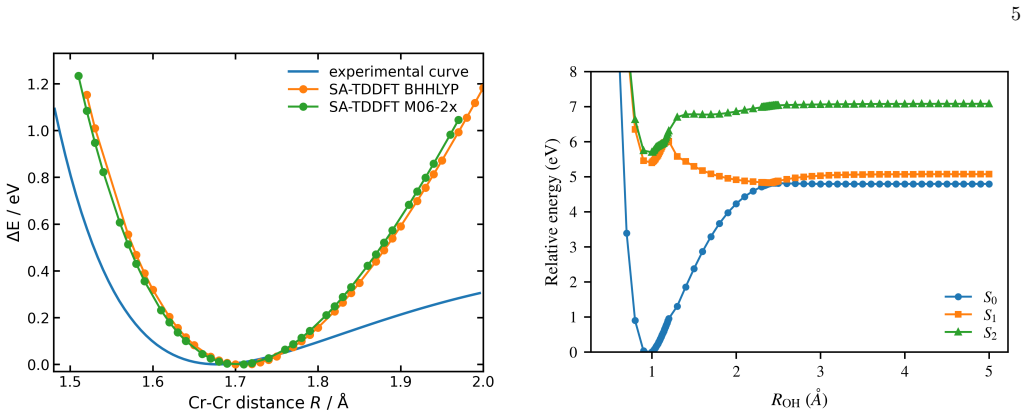
We develop a spin-adapted RPA by using tensor equation-of-motion and applying the Wigner-Eckart theorem with tensor decoupling. Casting the RPA Fock matrix and kernels as energy derivatives gives a TDDFT extension. To restore spin-component degeneracy, we use hybrids combining HF exchange with spin-unpolarized pure XC parts. Benchmarks, Cr2 dissociation, and phenol O-H conical intersections demonstrate the method.
What carries the argument
Spin-adapted RPA formed by tensor equation-of-motion combined with the Wigner-Eckart theorem and tensor decoupling, extended to TDDFT by energy derivatives.
If this is right
- Spin-conserving and spin-flip excitation energies become free of contamination.
- Degeneracy among spin components is enforced by the hybrid functional construction.
- Bond dissociation energies and curves for open-shell dimers such as Cr2 are described reliably.
- Locations of conical intersections in photochemical systems such as phenol are obtained without spin artifacts.
Where Pith is reading between the lines
- The tensor decoupling technique could extend to other linear-response properties beyond excitation energies.
- The method offers a route to consistent spin handling in larger transition-metal complexes where contamination often appears.
- Further tests on systems with strong spin-orbit effects would show whether the current hybrid choice remains sufficient.
Load-bearing premise
That hybrids of Hartree-Fock exchange with spin-unpolarized pure XC functionals will restore spin-component degeneracy while preserving accuracy of the tensor-decoupled framework.
What would settle it
A computed excited state in which energies for different spin components of the same multiplet differ by more than numerical tolerance, or a Cr2 dissociation curve that deviates from established reference values.
Figures

read the original abstract
Linear-response TDDFT is widely used for excited states but suffers from spin contamination in spin-conserving and spin-flip channels. Spin-adapted RPA was developed using tensor equation-of-motion and applying the Wigner-Eckart theorem with tensor decoupling. Casting the RPA Fock matrix and kernels as energy derivatives gives a TDDFT extension. To restore spin-component degeneracy, we use hybrids combining HF exchange with spin-unpolarized pure XC parts. Benchmarks, Cr$_2$ dissociation, and phenol O-H conical intersections demonstrate the method.
Editorial analysis
A structured set of objections, weighed in public.
Referee Report
Summary. The manuscript develops a spin-adapted TDDFT to address spin contamination in linear-response TDDFT. It constructs a spin-adapted RPA via tensor equation-of-motion and Wigner-Eckart theorem with tensor decoupling, then extends this to TDDFT by expressing the RPA Fock matrix and kernels as energy derivatives. Hybrids combining HF exchange with spin-unpolarized pure XC functionals are introduced to restore spin-component degeneracy. The approach is illustrated with benchmarks on Cr2 dissociation and phenol O-H conical intersections.
Significance. If the central construction holds, the method could provide a practical route to spin-pure excitation energies within a TDDFT framework, particularly useful for open-shell systems and photochemical processes. The tensor-decoupling strategy and energy-derivative formulation represent a coherent way to maintain consistency with ground-state theory, and the benchmarks on Cr2 and conical intersections offer concrete tests of performance on challenging cases.
major comments (2)
- [TDDFT extension and hybrid construction] The hybrid construction that replaces the XC part with a spin-unpolarized pure functional (described after the tensor-decoupled RPA derivation) must be shown to preserve derivative consistency with the already-decoupled tensor equations. Any mismatch would undermine the TDDFT extension and could reintroduce spin contamination or alter excitation energies; explicit verification, such as showing invariance of the kernel under the hybrid replacement, is required.
- [Numerical benchmarks] The Cr2 dissociation and phenol O-H conical-intersection benchmarks test overall performance but do not isolate whether the spin-unpolarized XC derivative remains compatible with the tensor EOM after decoupling. Additional analysis or a controlled test case demonstrating that degeneracy restoration does not shift energies relative to the pure tensor-decoupled RPA would strengthen the central claim.
minor comments (2)
- [Abstract] The abstract states that benchmarks are performed but provides no quantitative error metrics, tables, or specific results; adding a brief summary of key numerical improvements would improve clarity.
- [Method section] Notation for the tensor-decoupled quantities and the Wigner-Eckart projection should be defined explicitly at first use to aid readers unfamiliar with the tensor EOM formalism.
Simulated Author's Rebuttal
We thank the referee for the careful reading of our manuscript and the constructive comments. We address each major comment point by point below.
read point-by-point responses
-
Referee: [TDDFT extension and hybrid construction] The hybrid construction that replaces the XC part with a spin-unpolarized pure functional (described after the tensor-decoupled RPA derivation) must be shown to preserve derivative consistency with the already-decoupled tensor equations. Any mismatch would undermine the TDDFT extension and could reintroduce spin contamination or alter excitation energies; explicit verification, such as showing invariance of the kernel under the hybrid replacement, is required.
Authors: We agree that explicit verification strengthens the presentation. Our TDDFT extension is constructed by casting the RPA Fock matrix and kernels as energy derivatives of the hybrid functional, where the tensor decoupling via the Wigner-Eckart theorem is performed on the RPA level before the derivative step. The hybrid replacement (HF exchange plus spin-unpolarized pure XC) is introduced at the energy functional level, so the second derivatives that define the kernels inherit the spin adaptation by construction and do not reintroduce contamination terms. In the revised manuscript we will add a concise derivation in the main text or an appendix that explicitly demonstrates the invariance of the decoupled kernel under this replacement. revision: yes
-
Referee: [Numerical benchmarks] The Cr2 dissociation and phenol O-H conical-intersection benchmarks test overall performance but do not isolate whether the spin-unpolarized XC derivative remains compatible with the tensor EOM after decoupling. Additional analysis or a controlled test case demonstrating that degeneracy restoration does not shift energies relative to the pure tensor-decoupled RPA would strengthen the central claim.
Authors: The Cr2 and phenol benchmarks were selected because they are established challenging cases where spin contamination in standard TDDFT is well documented; the results show that our approach restores degeneracy and improves agreement with reference data. We nevertheless recognize the value of an isolated test of compatibility. In the revision we will include a controlled comparison on a small open-shell system, reporting excitation energies obtained from the pure tensor-decoupled RPA versus the hybrid TDDFT variant to confirm that degeneracy restoration occurs without extraneous shifts beyond the expected effect of the hybrid mixing parameter. revision: yes
Circularity Check
Derivation is self-contained with no circular reductions to inputs or self-citations.
full rationale
The paper constructs spin-adapted RPA via tensor EOM + Wigner-Eckart tensor decoupling, extends to TDDFT by recasting Fock matrix/kernels as energy derivatives, and restores degeneracy via HF + spin-unpolarized XC hybrids. No quoted equations or steps reduce a claimed prediction or result to a fitted parameter, self-defined quantity, or load-bearing self-citation chain. The Wigner-Eckart application and derivative casting are presented as independent steps resting on external theorems, with benchmarks serving as external tests rather than definitional inputs. This is the common honest case of a methodological derivation that does not collapse by construction.
Axiom & Free-Parameter Ledger
axioms (1)
- domain assumption Wigner-Eckart theorem can be applied to decouple the tensor components in the RPA equation-of-motion for spin adaptation
Lean theorems connected to this paper
-
IndisputableMonolith/Cost/FunctionalEquation.leanwashburn_uniqueness_aczel unclear?
unclearRelation between the paper passage and the cited Recognition theorem.
We develop a spin-adapted RPA by using tensor equation-of-motion and applying the Wigner-Eckart theorem with tensor decoupling. Casting the RPA Fock matrix and kernels as energy derivatives gives a TDDFT extension.
-
IndisputableMonolith/Foundation/AlexanderDuality.leanalexander_duality_circle_linking unclear?
unclearRelation between the paper passage and the cited Recognition theorem.
To restore spin-component degeneracy, we use hybrids combining HF exchange with spin-unpolarized pure XC parts.
What do these tags mean?
- matches
- The paper's claim is directly supported by a theorem in the formal canon.
- supports
- The theorem supports part of the paper's argument, but the paper may add assumptions or extra steps.
- extends
- The paper goes beyond the formal theorem; the theorem is a base layer rather than the whole result.
- uses
- The paper appears to rely on the theorem as machinery.
- contradicts
- The paper's claim conflicts with a theorem or certificate in the canon.
- unclear
- Pith found a possible connection, but the passage is too broad, indirect, or ambiguous to say the theorem truly supports the claim.
discussion (0)
Sign in with ORCID, Apple, or X to comment. Anyone can read and Pith papers without signing in.