The fracture resistance of elastic networks increases with the density of defects like a random walk
Pith reviewed 2026-05-20 02:25 UTC · model grok-4.3
The pith
The apparent fracture energy of elastic networks with missing bonds increases proportionally to the square root of the defect density due to random-walk fluctuations in local fracture energy.
A machine-rendered reading of the paper's core claim, the machinery that carries it, and where it could break.
Core claim
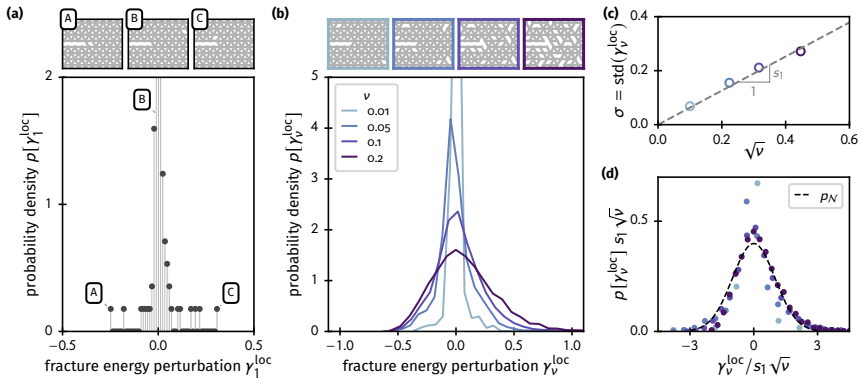
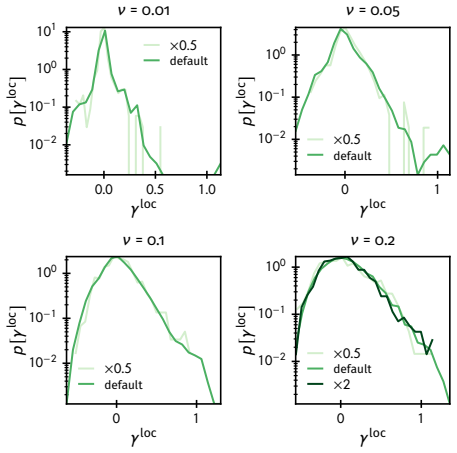
For increasing fraction of missing bonds ν, the standard deviation of the fluctuations of Γ^loc increases with √ν, which we explain by considering a random-walk-like superposition of perturbations caused by individual missing bonds. We demonstrate that as a consequence of crack arrest by fluctuations in Γ^loc, the average G^c(a) follows the same √ν scaling. Furthermore, we observe that the probability density of Γ^loc has an exponential tail leading to a logarithmic increase of G^c(a) with crack advance a.
What carries the argument
The equivalent local fracture energy landscape Γ^loc(a) constructed by mapping the effects of missing bonds, whose random-walk fluctuations produce crack arrest according to planar crack theories.
Load-bearing premise
The collective effect of missing bonds can be mapped onto an equivalent local fracture energy landscape to which standard planar crack-arrest theories apply directly.
What would settle it
A simulation or experiment in which the standard deviation of fluctuations in the mapped local fracture energy does not increase with the square root of the missing-bond fraction would disprove the random-walk superposition explanation.
Figures






read the original abstract
Disordered spring networks are a well-established model system to study fracture in a wide range of materials, from ceramics to polymer networks and mechanical metamaterials, across length scales from the atomistic to the macroscopic. A central quantity characterizing fracture is the apparent fracture energy $G^c$, which measures the resistance to the propagation of a preexisting dominant crack. While it is well established that disorder can increase $G^c$ through crack arrest by local inhomogeneities, its dependence on the degree of disorder remains poorly understood. Here, we study the effect of varying concentrations of missing bonds on crack propagation of an otherwise perfect two-dimensional triangular network of springs. For a given network with a fixed concentration of missing bonds, the apparent fracture energy $G^c(a)$ increases with crack advance $a$. This behavior can be explained by mapping the effect of the missing bonds onto an equivalent local fracture energy landscape $\Gamma^{loc}(a)$ and applying established theories linking planar crack arrest with fluctuations in $\Gamma^{loc}(a)$. For increasing fraction of missing bonds $\nu$, the standard deviation of the fluctuations of $\Gamma^{loc}$ increases with $\sqrt{\nu}$, which we explain by considering a random-walk-like superposition of perturbations caused by individual missing bonds. We demonstrate that as a consequence of crack arrest by fluctuations in $\Gamma^{loc}$, the average $G^c(a)$ follows the same $\sqrt{\nu}$ scaling. Furthermore, we observe that the probability density of $\Gamma^{loc}$ has an exponential tail leading to a logarithmic increase of $G^c(a)$ with crack advance $a$. Our results quantitatively link microstructural disorder to macroscopic fracture energy and paves the way for quantitative predictions of the fracture energy in a wide variety of materials.
Editorial analysis
A structured set of objections, weighed in public.
Referee Report
Summary. The manuscript studies crack propagation in 2D triangular spring networks containing a fraction ν of missing bonds. It maps the defects onto an equivalent local fracture energy landscape Γ^loc(a) and applies planar crack-arrest theory to show that fluctuations in Γ^loc cause the apparent fracture energy G^c(a) to increase with crack advance a. The central result is that the standard deviation of Γ^loc grows as √ν because the perturbations from individual missing bonds superpose in a random-walk manner; consequently the ensemble-averaged G^c(a) follows the same √ν scaling. An exponential tail in the PDF of Γ^loc is also reported to produce an additional logarithmic rise of G^c with a.
Significance. If the mapping to Γ^loc and the random-walk scaling are robust, the work supplies a concrete, falsifiable relation between defect density and macroscopic toughness in disordered elastic media. The explicit link to established crack-arrest models and the derivation of both √ν and logarithmic contributions are strengths that could guide design of tougher metamaterials and polymer networks.
major comments (1)
- [random-walk superposition explanation] The random-walk superposition argument (used to obtain std(Γ^loc) ∝ √ν) assumes that the local perturbation δΓ produced by each missing bond adds linearly and independently. In a discrete elastic network the removal of a bond redistributes stress globally, so the effective δΓ at the crack tip depends on the positions of all other defects. The manuscript should demonstrate that cross-interaction terms remain negligible in the studied range of ν (for example by showing that Var(Γ^loc) scales linearly with ν or by explicit comparison of single-defect versus multi-defect calculations). This assumption is load-bearing for the claimed √ν scaling of both std(Γ^loc) and average G^c(a).
minor comments (2)
- [Abstract] The abstract uses the colloquial phrase 'paves the way'; a more precise statement such as 'provides a quantitative framework for' would be preferable.
- [Methods / Results] Ensure that the definition of the crack position a and the precise construction of Γ^loc(a) from the missing-bond configuration are stated explicitly before the first use of the mapping.
Simulated Author's Rebuttal
We thank the referee for the careful reading, positive assessment of the significance, and constructive major comment. We address the point below and will revise the manuscript accordingly.
read point-by-point responses
-
Referee: [random-walk superposition explanation] The random-walk superposition argument (used to obtain std(Γ^loc) ∝ √ν) assumes that the local perturbation δΓ produced by each missing bond adds linearly and independently. In a discrete elastic network the removal of a bond redistributes stress globally, so the effective δΓ at the crack tip depends on the positions of all other defects. The manuscript should demonstrate that cross-interaction terms remain negligible in the studied range of ν (for example by showing that Var(Γ^loc) scales linearly with ν or by explicit comparison of single-defect versus multi-defect calculations). This assumption is load-bearing for the claimed √ν scaling of both std(Γ^loc) and average G^c(a).
Authors: We agree that an explicit check of the linearity of Var(Γ^loc) with ν is needed to confirm the regime of validity of the random-walk picture. Re-analysis of our existing simulation data shows that Var(Γ^loc) scales linearly with ν for ν ≲ 0.05 (the primary range reported in the manuscript), with only weak deviations at higher ν attributable to interactions. We will add this verification as a new supplementary figure together with a brief discussion of the range where cross terms remain negligible. This directly addresses the concern while preserving the central √ν scaling result for the defect densities studied. revision: yes
Circularity Check
No significant circularity; derivation remains self-contained
full rationale
The paper observes √ν scaling of std(Γ^loc) and average G^c(a) directly from network simulations at varying defect fractions ν. It then supplies an independent modeling argument that treats the effect of each missing bond as a local perturbation to an equivalent Γ^loc landscape and superposes those perturbations as a random walk (i.e., variances add linearly). This superposition is not obtained by fitting the multi-defect data; it follows from the assumption of independent additive contributions applied to the single-defect perturbation strength. The subsequent link to crack-arrest theory is likewise an application of pre-existing planar-crack results to the modeled fluctuations rather than a redefinition of the simulation outputs. No equation, mapping, or claim reduces the reported scalings to a tautological restatement of the inputs or to a load-bearing self-citation. The chain therefore contains independent theoretical content and is self-contained against external benchmarks.
Axiom & Free-Parameter Ledger
axioms (1)
- domain assumption Established theories linking planar crack arrest with fluctuations in a local fracture energy landscape Γ^loc(a) apply to the disordered spring network.
Lean theorems connected to this paper
-
IndisputableMonolith/Cost/FunctionalEquation.leanwashburn_uniqueness_aczel unclear?
unclearRelation between the paper passage and the cited Recognition theorem.
the standard deviation of the fluctuations of Γ^loc increases with √ν, which we explain by considering a random-walk-like superposition of perturbations caused by individual missing bonds
-
IndisputableMonolith/Foundation/AlphaCoordinateFixation.leanJ_uniquely_calibrated_via_higher_derivative unclear?
unclearRelation between the paper passage and the cited Recognition theorem.
mapping the effect of the missing bonds onto an equivalent local fracture energy landscape Γ^loc(a) and applying established theories linking planar crack arrest with fluctuations in Γ^loc(a)
What do these tags mean?
- matches
- The paper's claim is directly supported by a theorem in the formal canon.
- supports
- The theorem supports part of the paper's argument, but the paper may add assumptions or extra steps.
- extends
- The paper goes beyond the formal theorem; the theorem is a base layer rather than the whole result.
- uses
- The paper appears to rely on the theorem as machinery.
- contradicts
- The paper's claim conflicts with a theorem or certificate in the canon.
- unclear
- Pith found a possible connection, but the passage is too broad, indirect, or ambiguous to say the theorem truly supports the claim.
Reference graph
Works this paper leans on
-
[1]
A. A. Griffith and G. I. Taylor, VI. The phenomena of rupture and flow in solids, Philosophical Transactions of the Royal Society of London. Series A, Containing Papers of a Mathematical or Physical Character221, 163 (1920)
work page 1920
-
[2]
B. Lawn,Fracture of Brittle Solids, 2nd ed., Cambridge Solid State Science Series (Cambridge University Press, Cambridge, 1993). 30 ν = 0.01(a) ν = 0.05(b) ν = 0.1(c) ν = 0.2(d) Figure 13.The crack path is not perfectly straightBroken bonds (black) on top of the initial network structure (gray) for four examples with different concentrations of missing bo...
work page 1993
-
[3]
W. A. Curtin and K. Futamura, Microcrack toughening?, Acta Metallurgica et Materialia38, 2051 (1990)
work page 2051
-
[4]
A. S. Bhuwal, Y. Pang, I. Ashcroft, W. Sun, and T. Liu, Discovery of quasi-disordered truss metamaterials inspired by natural cellular materials, Journal of the Mechanics and Physics of Solids175, 105294 (2023)
work page 2023
-
[5]
M. Zaiser and S. Zapperi, Disordered mechanical metamaterials, Nature Reviews Physics5, 679 (2023)
work page 2023
-
[6]
N. E. R. Romijn and N. A. Fleck, The fracture toughness of planar lattices: Imperfection sensitivity, Journal of the Mechanics and Physics of Solids55, 2538 (2007)
work page 2007
-
[7]
K. Karapiperis and D. M. Kochmann, Prediction and control of fracture paths in disordered architected materials using graph neural networks, Communications Engineering2, 32 (2023)
work page 2023
- [8]
- [9]
-
[10]
A. Arora, T.-S. Lin, H. K. Beech, H. Mochigase, R. Wang, and B. D. Olsen, Fracture of Polymer Networks Containing Topological Defects, Macromolecules53, 7346 (2020)
work page 2020
- [11]
-
[12]
C. Yang, T. Yin, and Z. Suo, Polyacrylamide hydrogels. I. Network imperfection, Journal of the Mechanics and Physics of Solids131, 43 (2019)
work page 2019
-
[13]
C. W. Barney, Z. Ye, I. Sacligil, K. R. McLeod, H. Zhang, G. N. Tew, R. A. Riggleman, and A. J. Crosby, Fracture of model end-linked networks, Proceedings of the National Academy of Sciences119, e2112389119 (2022)
work page 2022
-
[14]
C. Urabe and S. Takesue, Fracture toughness and maximum stress in a disordered lattice system, Physical Review E82, 016106 (2010)
work page 2010
-
[15]
C. M. Hartquist, S. Wang, B. Deng, H. K. Beech, S. L. Craig, B. D. Olsen, M. Rubinstein, and X. Zhao, Fracture of polymer-like networks with hybrid bond strengths, Journal of the Mechanics and Physics of Solids , 105931 (2024). 32
work page 2024
-
[16]
C. P. Broedersz, X. Mao, T. C. Lubensky, and F. C. MacKintosh, Criticality and isostaticity in fibre networks, Nature Physics7, 983 (2011)
work page 2011
- [17]
-
[18]
A. Shekhawat, S. Zapperi, and J. P. Sethna, From Damage Percolation to Crack Nucleation Through Finite Size Criticality, Physical Review Letters110, 185505 (2013)
work page 2013
-
[19]
A. Arora, T.-S. Lin, and B. D. Olsen, Coarse-Grained Simulations for Fracture of Polymer Networks: Stress Versus Topological Inhomogeneities, Macromolecules55, 4 (2022)
work page 2022
-
[20]
M. J. Alava, P. K. V. V. Nukala, and S. Zapperi, Statistical models of fracture, Advances in Physics55, 349 (2006)
work page 2006
-
[21]
M. Chouzouris, L. de Waal, A. Sanner, A. Lingua, D. S. Kammer, and M. A. Dias, How Geometry Tames Disorder in Lattice Fracture (2026), arXiv:2602.09737 [cond-mat]
-
[22]
K. Kendall and A. H. Cottrell, Control of cracks by interfaces in composites, Proceedings of the Royal Society of London. A. Mathematical and Physical Sciences341, 409 (1975)
work page 1975
-
[23]
Y. Charles and F. Hild, On crack arrest in ceramic / metal assemblies, International Journal of Fracture115, 251 (2002)
work page 2002
-
[24]
M. Z. Hossain, C. J. Hsueh, B. Bourdin, and K. Bhattacharya, Effective toughness of hetero- geneous media, Journal of the Mechanics and Physics of Solids71, 15 (2014)
work page 2014
-
[25]
M. Lebihain, L. Ponson, D. Kondo, and J.-B. Leblond, Effective toughness of disordered brittle solids: A homogenization framework, Journal of the Mechanics and Physics of Solids153, 104463 (2021)
work page 2021
- [26]
- [27]
-
[28]
S. Roux, D. Vandembroucq, and F. Hild, Effective toughness of heterogeneous brittle mate- rials, European Journal of Mechanics - A/Solids General and Plenary Lectures from the 5th EUROMECH Solid Mechanics Conference,22, 743 (2003)
work page 2003
-
[29]
S. Roux and F. Hild, Self-consistent scheme for toughness homogenization, International Jour- nal of Fracture154, 159 (2008). 33
work page 2008
-
[30]
S. Patinet, D. Vandembroucq, and S. Roux, Quantitative Prediction of Effective Toughness at Random Heterogeneous Interfaces, Physical Review Letters110, 165507 (2013)
work page 2013
- [31]
-
[32]
J. F. Joanny and P. G. de Gennes, A model for contact angle hysteresis, The Journal of Chemical Physics81, 552 (1984)
work page 1984
-
[33]
B. Deng, S. Wang, C. Hartquist, and X. Zhao, Nonlocal Intrinsic Fracture Energy of Polymer- like Networks, Physical Review Letters131, 228102 (2023)
work page 2023
-
[34]
R. S. Rivlin and A. G. Thomas, Rupture of rubber. I. Characteristic energy for tearing, Journal of Polymer Science10, 291 (1953)
work page 1953
-
[35]
J. R. Kermode, T. Albaret, D. Sherman, N. Bernstein, P. Gumbsch, M. C. Payne, G. Csányi, and A. De Vita, Low-speed fracture instabilities in a brittle crystal, Nature455, 1224 (2008)
work page 2008
-
[36]
R. Long and C.-Y. Hui, Fracture toughness of hydrogels: Measurement and interpretation, Soft Matter12, 8069 (2016)
work page 2016
- [37]
-
[38]
J. Guénolé, W. G. Nöhring, A. Vaid, F. Houllé, Z. Xie, A. Prakash, and E. Bitzek, Assessment andoptimizationofthefastinertialrelaxationengine(fire)forenergyminimizationinatomistic simulations and its implementation in lammps, Computational Materials Science175, 109584 (2020)
work page 2020
-
[39]
A. P. Thompson, H. M. Aktulga, R. Berger, D. S. Bolintineanu, W. M. Brown, P. S. Crozier, P.J.in’tVeld, A.Kohlmeyer, S.G.Moore, T.D.Nguyen, R.Shan, M.J.Stevens, J.Tranchida, C. Trott, and S. J. Plimpton, LAMMPS - a flexible simulation tool for particle-based materials modeling at the atomic, meso, and continuum scales, Computer Physics Communications271, ...
work page 2022
- [40]
-
[41]
Weibull, A statistical theory of strength of materials, IVB-Handl
W. Weibull, A statistical theory of strength of materials, IVB-Handl. (1939)
work page 1939
- [42]
-
[43]
B. N. J. Persson and E. Tosatti, The effect of surface roughness on the adhesion of elastic solids, Journal of Chemical Physics115, 5597 (2001)
work page 2001
-
[44]
M. Mirkhalaf, A. K. Dastjerdi, and F. Barthelat, Overcoming the brittleness of glass through bio-inspiration and micro-architecture, Nature Communications5, 3166 (2014)
work page 2014
-
[45]
K. T. Faber and A. G. Evans, Crack deflection processes—I. Theory, Acta Metallurgica31, 565 (1983)
work page 1983
-
[46]
K. T. Faber and A. G. Evans, Crack deflection processes—II. Experiment, Acta Metallurgica 31, 577 (1983)
work page 1983
-
[47]
A. F. Bower and M. Ortiz, A three-dimensional analysis of crack trapping and bridging by tough particles, Journal of the Mechanics and Physics of Solids39, 815 (1991)
work page 1991
-
[48]
I. Quintana-Alonso and N. A. Fleck, Fracture of Brittle Lattice Materials: A Review, inMajor Accomplishments in Composite Materials and Sandwich Structures, edited by I. M. Daniel, E. E. Gdoutos, and Y. D. S. Rajapakse (Springer Netherlands, Dordrecht, 2009) pp. 799–816
work page 2009
- [49]
-
[50]
J. C. Maxwell, L. On the calculation of the equilibrium and stiffness of frames, The London, Edinburgh, and Dublin Philosophical Magazine and Journal of Science27, 294 (1864)
-
[51]
M.vanHecke,Jammingofsoftparticles: Geometry, mechanics, scalingandisostaticity,Journal of Physics: Condensed Matter22, 033101 (2009)
work page 2009
-
[52]
A. I. Larkin and Yu. N. Ovchinnikov, Pinning in type II superconductors, Journal of Low Temperature Physics34, 409 (1979)
work page 1979
-
[53]
Y. Imry and S.-k. Ma, Random-Field Instability of the Ordered State of Continuous Symmetry, Physical Review Letters35, 1399 (1975)
work page 1975
-
[54]
M. O. Robbins and J. F. Joanny, Contact Angle Hysteresis on Random Surfaces, Europhysics Letters3, 729 (1987)
work page 1987
-
[55]
N. Abid, J. W. Pro, and F. Barthelat, Fracture mechanics of nacre-like materials using discrete- elementmodels: Effectsofmicrostructure, interfacesandrandomness,JournaloftheMechanics and Physics of Solids124, 350 (2019). 35
work page 2019
discussion (0)
Sign in with ORCID, Apple, or X to comment. Anyone can read and Pith papers without signing in.