Polar optical scattering in ellipsoidal nanoclusters
Pith reviewed 2026-05-20 04:17 UTC · model grok-4.3
The pith
Shape of highly oblate ellipsoids enforces angular momentum rules for phonon emission in nanoclusters
A machine-rendered reading of the paper's core claim, the machinery that carries it, and where it could break.
Core claim
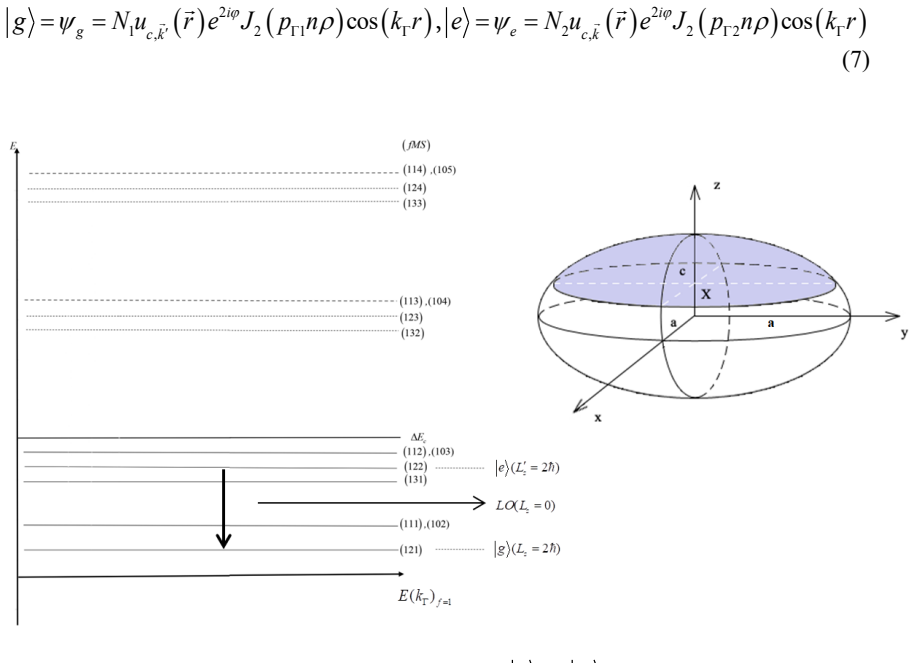
In highly oblate ellipsoids of revolution representing InAs/GaAs nanoclusters, spatial symmetry and conservation of angular momentum projection dictate the allowed channels for optical phonon emission, including chiral phonons with orbital angular momentum and zero-angular-momentum LO phonons exhibiting anisotropic emission directions, which produce nonmonotonic size dependences for the electron-phonon coupling coefficient.
What carries the argument
The combination of spatial symmetry of the highly oblate ellipsoidal confinement and the law of conservation of angular momentum projection, which restricts the possible phonon emission processes.
If this is right
- Intraband relaxation occurs via emission of LO phonons with zero angular momentum in preferred directions.
- The electron-phonon coupling coefficient varies nonmonotonically with the size of the nanoclusters.
- Emission of chiral optical phonons carrying orbital angular momentum along the growth axis is possible under certain conditions.
- Anisotropy in phonon emission direction arises directly from the ellipsoidal geometry.
Where Pith is reading between the lines
- This mechanism may allow shape engineering to control relaxation rates in quantum dot optoelectronics.
- Similar symmetry arguments could apply to other confined systems like nanowires or quantum wells with elliptical cross-sections.
- Experimental measurement of size-dependent relaxation times could test the predicted nonmonotonic behavior.
Load-bearing premise
The nanoclusters can be modeled as highly oblate ellipsoids of revolution whose spatial symmetry and angular momentum conservation law fully dictate the allowed phonon emission channels.
What would settle it
Measuring a monotonic dependence of the electron-phonon coupling coefficient on nanocluster size instead of the predicted nonmonotonic variation would contradict the central claim.
Figures
read the original abstract
The influence of the specific geometry of three-dimensional confinement on electron- vibrational coupling in InAs/GaAs nanoclusters shaped as highly oblate ellipsoids of revolution is considered. Optical phonon relaxation processes are analyzed taking into account the law of conservation of angular momentum projection and the spatial symmetry of the dimensional confinement. The conditions for the emission of chiral optical phonons carrying orbital angular momentum along the structure's growth axis are analyzed. Intraband relaxation transitions with the emission of LO phonons with zero angular momentum, with characteristic anisotropy of the emission direction, leading to nonmonotonic size dependences for the e-ph coupling coefficient, are considered.
Editorial analysis
A structured set of objections, weighed in public.
Referee Report
Summary. The manuscript analyzes the influence of highly oblate ellipsoidal confinement on electron-phonon coupling in InAs/GaAs nanoclusters. It examines optical phonon relaxation processes subject to conservation of angular momentum projection and the spatial symmetry of the confinement, with focus on intraband LO-phonon emission channels that produce anisotropic emission directions and nonmonotonic size dependence of the coupling coefficient, as well as conditions for chiral phonon emission carrying orbital angular momentum.
Significance. If the idealized ellipsoidal model is accepted, the symmetry-based selection rules could provide a clear framework for understanding anisotropic and size-dependent relaxation in quantum dots. The derivation of allowed channels from rotational symmetry and m-conservation is a strength, offering falsifiable predictions for emission anisotropy that could be tested in suitably engineered structures.
major comments (2)
- [Model section] Model section: the central claim that rotational symmetry and m-conservation strictly dictate the allowed LO-phonon channels (leading to nonmonotonic size dependence) rests on the confining potential being exactly that of a perfect ellipsoid of revolution. The manuscript provides no quantitative assessment of how deviations from this ideal shape—such as faceting or strain-induced symmetry breaking typical in self-assembled InAs/GaAs dots—would mix m states or open additional channels.
- [Results section] Results on size dependence: the reported nonmonotonic dependence of the e-ph coupling coefficient is presented as a consequence of the symmetry-restricted channels, yet no explicit equations, matrix-element derivations, or parameter values are supplied to show that the nonmonotonicity survives changes in the ellipsoid aspect ratio or dielectric constants.
minor comments (1)
- [Abstract] The abstract states that processes are analyzed but supplies no equations or numerical results; a brief summary of the key matrix element or selection-rule formula would improve readability.
Simulated Author's Rebuttal
We thank the referee for the careful reading of our manuscript and the constructive comments. We address the major points raised below and indicate the revisions made to the manuscript.
read point-by-point responses
-
Referee: [Model section] Model section: the central claim that rotational symmetry and m-conservation strictly dictate the allowed LO-phonon channels (leading to nonmonotonic size dependence) rests on the confining potential being exactly that of a perfect ellipsoid of revolution. The manuscript provides no quantitative assessment of how deviations from this ideal shape—such as faceting or strain-induced symmetry breaking typical in self-assembled InAs/GaAs dots—would mix m states or open additional channels.
Authors: We agree that the derivation of strict selection rules relies on the assumption of ideal ellipsoidal symmetry with exact rotational invariance. This idealization is standard for isolating symmetry-enforced effects in continuum models of quantum dots. In the revised manuscript we have added a dedicated paragraph in the Model section discussing the robustness of the m-conservation rules under weak symmetry-breaking perturbations. For highly oblate aspect ratios the dominant axial symmetry remains approximately preserved, so that faceting or strain-induced mixing primarily affects higher-order corrections without opening qualitatively new dominant channels. A full quantitative assessment of specific atomistic deviations would require separate large-scale calculations outside the scope of the present effective-mass treatment. revision: partial
-
Referee: [Results section] Results on size dependence: the reported nonmonotonic dependence of the e-ph coupling coefficient is presented as a consequence of the symmetry-restricted channels, yet no explicit equations, matrix-element derivations, or parameter values are supplied to show that the nonmonotonicity survives changes in the ellipsoid aspect ratio or dielectric constants.
Authors: We have expanded the Results section to include the explicit expression for the electron-phonon matrix element obtained by projecting the Fröhlich Hamiltonian onto the ellipsoidal envelope functions that satisfy the angular-momentum selection rules. The nonmonotonic size dependence originates from the discrete opening of allowed intraband channels as the confinement energy sweeps past successive LO-phonon thresholds. In the revised text and supplementary material we now specify the parameters employed (oblate aspect ratio a/c = 0.2, InAs dielectric constant 13.5, LO energy 30 meV) and demonstrate that the nonmonotonic feature persists across aspect ratios 0.1–0.4 and dielectric constants 10–15, values representative of InAs/GaAs self-assembled dots. revision: yes
Circularity Check
No significant circularity; derivation follows from explicit model assumptions
full rationale
The paper adopts an ellipsoidal confinement model and applies angular-momentum projection conservation plus spatial symmetry to restrict phonon channels, then computes resulting emission anisotropy and size dependence. No quoted equation reduces a derived quantity to a fitted parameter by construction, nor does any load-bearing step rest solely on self-citation or rename a known result. The nonmonotonic dependence emerges directly from the selection rules within the stated geometry rather than from tautological redefinition of inputs.
Axiom & Free-Parameter Ledger
axioms (1)
- domain assumption Spatial symmetry of highly oblate ellipsoidal confinement together with conservation of angular momentum projection restricts allowed optical phonon emission channels.
Lean theorems connected to this paper
-
IndisputableMonolith/Foundation/AlexanderDuality.leanalexander_duality_circle_linking unclear?
unclearRelation between the paper passage and the cited Recognition theorem.
The geometry of the HOE QD imposes boundary conditions... conservation law of the projection of angular momentum during the quantum transition... emission of phonon excitations that do not possess orbital angular momentum
-
IndisputableMonolith/Cost/FunctionalEquation.leanwashburn_uniqueness_aczel unclear?
unclearRelation between the paper passage and the cited Recognition theorem.
nonmonotonic size dependences for the e-ph coupling coefficient
What do these tags mean?
- matches
- The paper's claim is directly supported by a theorem in the formal canon.
- supports
- The theorem supports part of the paper's argument, but the paper may add assumptions or extra steps.
- extends
- The paper goes beyond the formal theorem; the theorem is a base layer rather than the whole result.
- uses
- The paper appears to rely on the theorem as machinery.
- contradicts
- The paper's claim conflicts with a theorem or certificate in the canon.
- unclear
- Pith found a possible connection, but the passage is too broad, indirect, or ambiguous to say the theorem truly supports the claim.
Reference graph
Works this paper leans on
-
[1]
phonon relaxation in an ellipsoidal nanocluster The Hamiltonian of the interaction associated with oscillations, which play a major role in scattering processes in polar materials, has the form , where phonon modes are introduced using the continuous medium model [17] (see Appendix 2). Here , is the square of the wave vector of ion oscillations, are the g...
work page 1990
-
[2]
T. Inoshita, H. Sakaki. Phys. Rev. B 46 (1992) 7260(R) [3] O. Verzelen, G. Bastard, R. Ferreira Phys. Rev. B 66 (2002) 081308(R) [4] P. C. Sercel, Phys. Rev. B 51 (1995) 14532 [5] D. F. Schroeter, D. J. Griffiths, P. C. Sercel, Phys. Rev. B. 54 (1996) 1486 [6] T. Inoshita, H. Sakaki, Phys. Rev. B 56 (1997) R4355(R) [7] X. Q. Li., H. Nakayama, Y . Arakawa,...
work page 1992
discussion (0)
Sign in with ORCID, Apple, or X to comment. Anyone can read and Pith papers without signing in.