Quantum master equation approach for the multiphonon up-pumping model
Pith reviewed 2026-05-20 05:52 UTC · model grok-4.3
The pith
A quantum master equation reveals that shocked phonon environments drive doorway modes differently depending on their frequencies in energetic materials.
A machine-rendered reading of the paper's core claim, the machinery that carries it, and where it could break.
Core claim
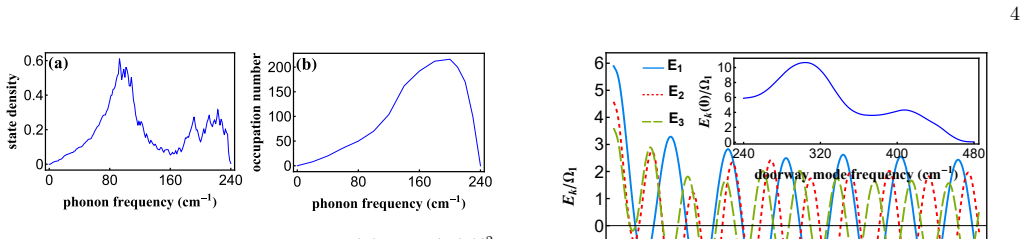
After eliminating the degrees of freedom of the phonon bath within a mean-field approximation, we derive a quantum master equation governing the energy transfer among vibrational modes. Our analysis reveals that doorway modes of different frequencies undergo distinct levels of effective coherent driving and dissipation, induced by the shocked phonon environment. This not only clarifies the microscopic origin of coherent phonon generation, but also reveals the possibility of modulating such coherent driving and dissipation. Based on numerical simulations of a simplified model using the master equation, we demonstrate how doorway modes extract energy from the phonon environment and subsequenly
What carries the argument
The quantum master equation for energy transfer among vibrational modes, derived after mean-field elimination of the shocked phonon bath.
If this is right
- Doorway modes extract energy from the shocked phonon environment.
- Higher-frequency molecular vibrational modes become excited as a result.
- The frequency dependence explains the microscopic origin of coherent phonon generation.
- Coherent driving and dissipation can be modulated to alter the energy transfer process.
- Simplified numerical simulations confirm the extraction and subsequent excitation pathway.
Where Pith is reading between the lines
- The same master-equation construction could be used to compare energy localization under different shock strengths or material compositions.
- Including additional modes in the equation might identify design rules for reducing shock sensitivity.
- Time-resolved measurements of phonon coherence at selected frequencies after shock could test the predicted frequency dependence.
- The approach suggests parallels to driven energy flow in other condensed-phase systems where a bath is suddenly perturbed.
Load-bearing premise
The phonon bath degrees of freedom can be removed through a mean-field approximation while preserving the key features of coherent energy transfer to the vibrational modes.
What would settle it
A direct numerical or experimental check that all doorway modes receive identical coherent driving and dissipation independent of frequency would falsify the central prediction of the master equation.
Figures



read the original abstract
A fully quantum multiphonon up-pumping model is proposed to characterize coherent energy transfer in energetic materials (EMs) subjected to external shock. After eliminating the degrees of freedom of the phonon bath within a mean-field approximation, we derive a quantum master equation governing the energy transfer among vibrational modes. Our analysis reveals that doorway modes of different frequencies undergo distinct levels of effective coherent driving and dissipation, induced by the shocked phonon environment. This not only clarifies the microscopic origin of coherent phonon generation, but also reveals the possibility of modulating such coherent driving and dissipation. Based on numerical simulations of a simplified model using the master equation, we demonstrate how doorway modes extract energy from the phonon environment and subsequently excite higher-frequency molecular vibrational modes. This work offers a renewed perspective for understanding the mechanisms of energy transfer in energetic materials.
Editorial analysis
A structured set of objections, weighed in public.
Referee Report
Summary. The paper proposes a quantum master equation for multiphonon up-pumping in energetic materials under external shock. After mean-field elimination of the phonon bath degrees of freedom, the derived master equation shows that doorway modes of different frequencies experience distinct effective coherent driving and dissipation from the shocked environment. Numerical simulations on a simplified model illustrate energy extraction from the phonon bath and subsequent excitation of higher-frequency vibrational modes.
Significance. If the mean-field treatment remains quantitatively reliable under far-from-equilibrium shock conditions, the work supplies a microscopic quantum origin for coherent phonon generation and suggests routes to modulate driving versus dissipation. This could complement classical up-pumping descriptions and inform detonation-initiation models in energetic materials.
major comments (2)
- [Derivation of the master equation] Derivation of the master equation (following mean-field bath elimination): the claim that doorway modes acquire frequency-dependent coherent driving and dissipation rests on the factorization implicit in the mean-field trace-out. Under strong, time-dependent shock the bath is prepared far from equilibrium; no error estimate or regime-of-validity analysis is supplied for this step, which directly controls the relative strengths of drive and dissipation across frequencies.
- [Numerical simulations] Numerical demonstration section: the simplified-model simulations show energy up-pumping but contain no comparison against known limiting cases (e.g., weak-shock thermal bath or classical multiphonon rate equations) or any convergence check with respect to bath truncation. This leaves the quantitative demonstration of the quantum coherent effects without an independent benchmark.
minor comments (2)
- [Abstract] Abstract: the phrase 'fully quantum' should be qualified, since the bath is eliminated via a mean-field approximation rather than retained in a fully quantum treatment.
- [Derivation] Notation: the definitions of the effective driving and dissipation operators after the mean-field step should be written explicitly with the frequency dependence shown, to make the central claim easier to verify.
Simulated Author's Rebuttal
We thank the referee for their careful reading of our manuscript and for providing constructive comments that will help improve the clarity and rigor of our work. We address each major comment below and outline the specific revisions we plan to make.
read point-by-point responses
-
Referee: [Derivation of the master equation] Derivation of the master equation (following mean-field bath elimination): the claim that doorway modes acquire frequency-dependent coherent driving and dissipation rests on the factorization implicit in the mean-field trace-out. Under strong, time-dependent shock the bath is prepared far from equilibrium; no error estimate or regime-of-validity analysis is supplied for this step, which directly controls the relative strengths of drive and dissipation across frequencies.
Authors: We agree that the mean-field elimination step is central to the derivation and that its applicability under far-from-equilibrium, time-dependent shock conditions merits explicit discussion. In the revised manuscript we will add a new subsection in the derivation section that outlines the regime of validity of the mean-field approximation. This will include (i) a qualitative error estimate based on the ratio of system-bath coupling strength to the shock-induced driving amplitude and (ii) reference to established results from non-equilibrium open-quantum-systems literature concerning mean-field treatments of driven phonon baths. We will also clarify that the frequency-dependent drive and dissipation emerge directly from the time-dependent bath correlation functions after the mean-field trace-out, and we will indicate the parameter regime in which this factorization is expected to remain accurate. revision: yes
-
Referee: [Numerical simulations] Numerical demonstration section: the simplified-model simulations show energy up-pumping but contain no comparison against known limiting cases (e.g., weak-shock thermal bath or classical multiphonon rate equations) or any convergence check with respect to bath truncation. This leaves the quantitative demonstration of the quantum coherent effects without an independent benchmark.
Authors: We acknowledge that the current numerical section lacks independent benchmarks. In the revised version we will augment the numerical demonstration with two additional sets of results: (1) a direct comparison of the quantum master-equation dynamics against the corresponding classical multiphonon rate equations in the high-temperature, weak-driving limit, and (2) a comparison to the equilibrium thermal-bath case (weak shock) to recover the expected thermalization behavior. We will also include a convergence study with respect to the number of retained bath modes, demonstrating that the observed up-pumping rates stabilize beyond a modest truncation threshold. These additions will provide quantitative benchmarks for the coherent effects reported in the original simulations. revision: yes
Circularity Check
Standard mean-field bath elimination yields independent master equation with no circular reduction
full rationale
The paper starts from a system-plus-bath Hamiltonian for vibrational modes coupled to a shocked phonon environment, then applies a mean-field approximation to trace out the bath and obtain a quantum master equation. The resulting frequency-dependent coherent driving and dissipation terms are direct consequences of that standard open-system derivation rather than a redefinition or fit of the target quantities. No self-citations, parameter fitting to data, or uniqueness theorems are invoked to load-bear the central claim; the distinct levels of driving/dissipation for different doorway modes follow from the frequency dependence already present in the bath spectral density under the stated approximation. The derivation chain is therefore self-contained and does not reduce any prediction to its own inputs by construction.
Axiom & Free-Parameter Ledger
axioms (1)
- domain assumption Mean-field approximation suffices to eliminate phonon-bath degrees of freedom
Lean theorems connected to this paper
-
IndisputableMonolith/Cost/FunctionalEquation.leanwashburn_uniqueness_aczel unclear?
unclearRelation between the paper passage and the cited Recognition theorem.
After eliminating the degrees of freedom of the phonon bath within a mean-field approximation, we derive a quantum master equation... doorway modes of different frequencies undergo distinct levels of effective coherent driving and dissipation
-
IndisputableMonolith/Foundation/AlphaCoordinateFixation.leanalpha_pin_under_high_calibration unclear?
unclearRelation between the paper passage and the cited Recognition theorem.
the phonon-vibration interaction term becomes... E_k = ∫ G_k(ω,ω′)S(ω)S(ω′)(α(ω)e^{-iωt}+...)
What do these tags mean?
- matches
- The paper's claim is directly supported by a theorem in the formal canon.
- supports
- The theorem supports part of the paper's argument, but the paper may add assumptions or extra steps.
- extends
- The paper goes beyond the formal theorem; the theorem is a base layer rather than the whole result.
- uses
- The paper appears to rely on the theorem as machinery.
- contradicts
- The paper's claim conflicts with a theorem or certificate in the canon.
- unclear
- Pith found a possible connection, but the passage is too broad, indirect, or ambiguous to say the theorem truly supports the claim.
Reference graph
Works this paper leans on
-
[1]
D. D. Dlott, Optical phonon dynamics in molecular crystals, Annual Review of Physical Chemistry37, 157 (1986)
work page 1986
-
[2]
J. R. Hill and D. D. Dlott, A model for ultrafast vi- brational cooling in molecular crystals, The Journal of chemical physics89, 830 (1988)
work page 1988
-
[3]
D. D. Dlott and M. D. Fayer, Shocked molecular solids: vibrational up pumping, defect hot spot formation, and the onset of chemistry, The Journal of chemical physics 92, 3798 (1990)
work page 1990
- [4]
-
[5]
K. McNesby and C. Coffey, Spectroscopic determination of impact sensitivities of explosives, The Journal of Phys- ical Chemistry B101, 3097 (1997)
work page 1997
-
[6]
J. Hooper, Vibrational energy transfer in shocked molec- ular crystals, The Journal of chemical physics132(2010)
work page 2010
-
[7]
A. A. Michalchuk, M. Trestman, S. Rudi´ c, P. Portius, P. T. Fincham, C. R. Pulham, and C. A. Morrison, Pre- dicting the reactivity of energetic materials: an ab initio multi-phonon approach, Journal of Materials Chemistry A7, 19539 (2019)
work page 2019
-
[8]
X. Bidault and S. Chaudhuri, Can a shock-induced phonon up-pumping model relate to impact sensitivity of molecular crystals, polymorphs and cocrystals?, RSC advances12, 31282 (2022)
work page 2022
-
[9]
W.-H. Liu, W. Zeng, F.-S. Liu, Z.-T. Liu, and Q.-J. Liu, Probing into the theory of impact sensitivity: pro- pelling the understanding of phonon–vibron coupling co- efficients, Physical Chemistry Chemical Physics26, 7695 (2024)
work page 2024
-
[10]
H.-P. Breuer and F. Petruccione,The theory of open quantum systems(OUP Oxford, 2002)
work page 2002
-
[11]
A. Jamio lkowski, An effective method of investigation of positive maps on the set of positive definite operators, Reports on Mathematical Physics5, 415 (1974)
work page 1974
- [12]
-
[13]
R. Alicki, On the entropy production for the davies model of heat conduction, Journal of Statistical Physics20, 671 (1979)
work page 1979
-
[14]
I. Rotter and J. Bird, A review of progress in the physics of open quantum systems: theory and experiment, Re- ports on Progress in Physics78, 114001 (2015)
work page 2015
-
[15]
G. S. Engel, T. R. Calhoun, E. L. Read, T.-K. Ahn, T. Manˇ cal, Y.-C. Cheng, R. E. Blankenship, and G. R. Fleming, Evidence for wavelike energy transfer through quantum coherence in photosynthetic systems, Nature 446, 782 (2007)
work page 2007
-
[16]
A. Ishizaki and G. R. Fleming, Quantum coherence in photosynthetic light harvesting, Annu. Rev. Condens. Matter Phys.3, 333 (2012)
work page 2012
-
[17]
D. D. Dlott, Multi-phonon up-pumping in energetic ma- terials, inOverviews of recent research on energetic ma- terials(World Scientific, 2005) pp. 303–333
work page 2005
-
[18]
G. Su-Hong, C. Xin-Lu, W. Li-Sha, and Y. Xiang-Dong, Correlation between normal mode vibrations and im- pact sensitivities of some secondary explosives, Journal of Molecular Structure: THEOCHEM809, 55 (2007)
work page 2007
-
[19]
J. Dalibard, Y. Castin, and K. Mølmer, Wave-function approach to dissipative processes in quantum optics, Physical review letters68, 580 (1992). 10
work page 1992
-
[20]
H. Carmichael,An open systems approach to quantum optics: lectures presented at the Universit´ e Libre de Brux- elles October 28 to November 4, 1991(Springer, 1993)
work page 1991
-
[21]
M. B. Plenio and P. L. Knight, The quantum-jump ap- proach to dissipative dynamics in quantum optics, Re- views of Modern Physics70, 101 (1998)
work page 1998
-
[22]
N. G. Van Kampen,Stochastic processes in physics and chemistry, Vol. 1 (Elsevier, 1992)
work page 1992
-
[23]
R. Kubo, M. Toda, and N. Hashitsume,Statistical physics II: nonequilibrium statistical mechanics, Vol. 31 (Springer Science & Business Media, 2012)
work page 2012
discussion (0)
Sign in with ORCID, Apple, or X to comment. Anyone can read and Pith papers without signing in.