Self-similar breakup of a liquid ligament with a solid particle
Pith reviewed 2026-05-20 02:16 UTC · model grok-4.3
The pith
A solid particle triggers universal self-similar pinch-off in a stretching liquid ligament once the surface approaches it.
A machine-rendered reading of the paper's core claim, the machinery that carries it, and where it could break.
Core claim
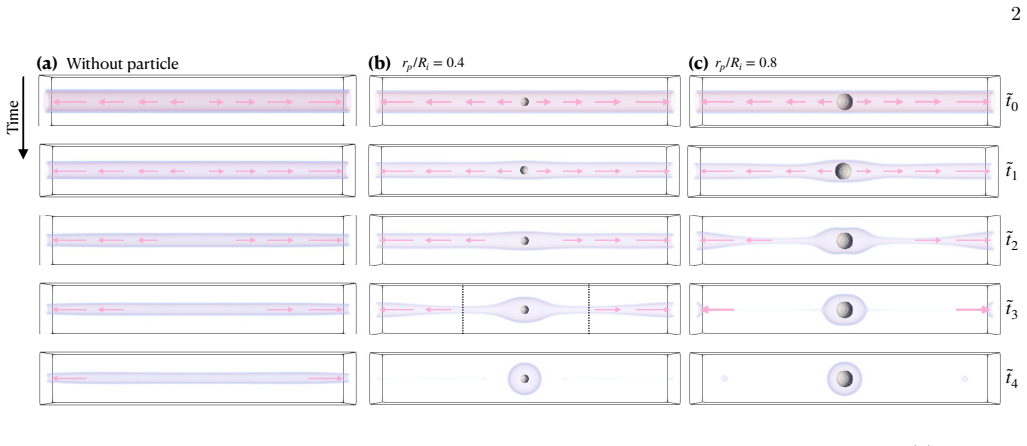
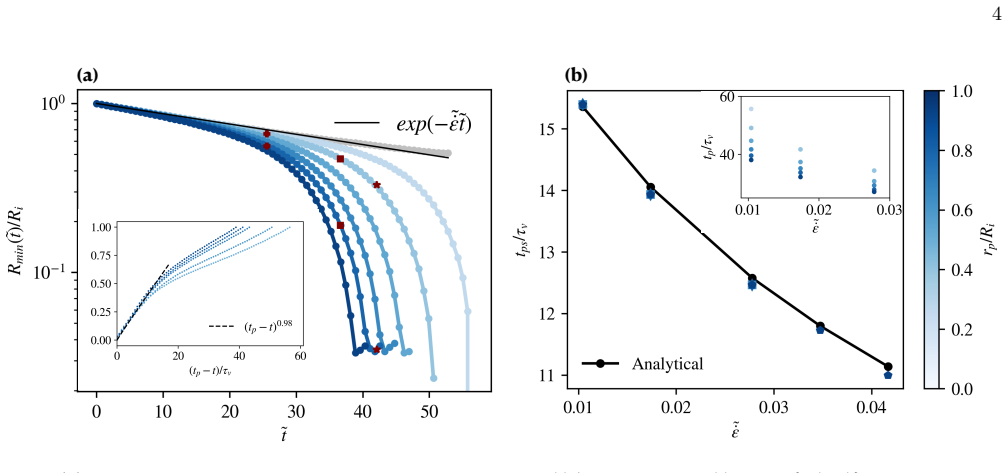
We show that particle-induced perturbations trigger a universal pinch-off dynamics in the viscous regime. Once the ligament surface approaches the particle, the subsequent breakup becomes self-similar and independent of the particle size. We derive an analytical expression for the pinch-off time based on the interplay between ligament stretching and Rayleigh-Plateau instability, which agrees quantitatively with simulations.
What carries the argument
The competition between uniform ligament stretching and Rayleigh-Plateau instability after the surface approaches the particle, producing size-independent self-similar pinch-off.
If this is right
- Pinch-off time follows a closed-form analytical prediction set by the stretching rate and instability growth.
- Breakup dynamics become independent of particle diameter once the ligament surface reaches the particle.
- The same self-similar sequence occurs for any localized perturbation that brings the surface into a similar configuration.
- Quantitative agreement between the derived expression and direct numerical simulations confirms the controlling balance.
Where Pith is reading between the lines
- The mechanism may set drop sizes in industrial sprays or coatings that contain suspended particles.
- Similar size-independent self-similar breakup could appear when ligaments interact with bubbles or other fluid inclusions.
- Extending the balance to include inertial or viscoelastic effects would test the limits of the viscous-regime assumption.
- The derived pinch-off time formula could be inserted into larger-scale models of atomization processes.
Load-bearing premise
After the ligament surface approaches the particle, breakup is controlled exclusively by uniform stretching competing with the Rayleigh-Plateau instability, without meaningful effects from particle surface properties or three-dimensional flow around the particle.
What would settle it
A simulation or experiment that changes particle surface wettability or introduces significant three-dimensional flow effects around the particle and observes a shift in pinch-off time or loss of self-similarity would falsify the claim.
Figures

read the original abstract
The breakup of thinning (stretching) liquid ligaments is strongly influenced by localized perturbations arising from impurities or suspended particles. Using numerical simulations and analytical modelling, we investigate the role of a solid particle on the breakup dynamics of a stretching liquid ligament. We show that particle-induced perturbations trigger a universal pinch-off dynamics in the viscous regime. Once the ligament surface approaches the particle, the subsequent breakup becomes self-similar and independent of the particle size. We derive an analytical expression for the pinch-off time based on the interplay between ligament stretching and Rayleigh-Plateau instability, which agrees quantitatively with simulations. Our results reveal a universal mechanism by which localized perturbations control the breakup of ligaments containing solid particles.
Editorial analysis
A structured set of objections, weighed in public.
Referee Report
Summary. The manuscript uses numerical simulations and analytical modeling to study how a solid particle affects the breakup of a stretching liquid ligament. It claims that in the viscous regime, particle-induced perturbations cause a universal self-similar pinch-off once the ligament surface reaches the particle; this dynamics is independent of particle size. An analytical expression for the pinch-off time is derived from the competition between uniform ligament stretching and Rayleigh-Plateau instability and is reported to agree quantitatively with the simulations.
Significance. If the central claim is substantiated, the work would identify a particle-triggered universal mechanism for ligament breakup in the viscous regime, with implications for atomization processes and multiphase flows. The parameter-free character of the derivation (no free parameters listed in the axiom ledger) and the direct comparison to simulations are positive features that would strengthen the contribution if the underlying 1D reduction is justified.
major comments (1)
- [Analytical modeling and derivation of pinch-off time] The derivation of the analytical pinch-off time (described in the abstract and the analytical-modeling section) rests on the assumption that, after the ligament surface approaches the particle, the evolution is controlled exclusively by uniform axial stretching competing with the Rayleigh-Plateau instability. The manuscript does not demonstrate that three-dimensional Stokes flow around the particle, no-slip boundary conditions, or moving-contact-line dynamics remain sub-dominant throughout the self-similar stage. Because this scale separation is required for both the claimed universality and the particle-size independence, the quantitative match with simulations cannot yet be regarded as confirmatory.
minor comments (1)
- [Abstract] The abstract states quantitative agreement between the analytical expression and simulations but supplies no error bars, regime-isolation criteria, or details on data selection; adding these would improve clarity without altering the central claim.
Simulated Author's Rebuttal
We thank the referee for their careful reading of our manuscript and for the constructive feedback. We address the major comment below and will incorporate revisions to strengthen the justification of our modeling assumptions.
read point-by-point responses
-
Referee: The derivation of the analytical pinch-off time (described in the abstract and the analytical-modeling section) rests on the assumption that, after the ligament surface approaches the particle, the evolution is controlled exclusively by uniform axial stretching competing with the Rayleigh-Plateau instability. The manuscript does not demonstrate that three-dimensional Stokes flow around the particle, no-slip boundary conditions, or moving-contact-line dynamics remain sub-dominant throughout the self-similar stage. Because this scale separation is required for both the claimed universality and the particle-size independence, the quantitative match with simulations cannot yet be regarded as confirmatory.
Authors: We thank the referee for identifying this important point regarding the justification of the 1D reduction. Our fully three-dimensional simulations show that, once the ligament surface reaches the particle, the subsequent dynamics collapses onto a self-similar form that is independent of particle size (as quantified in the results section). This numerical evidence indicates that three-dimensional effects localized near the particle become sub-dominant relative to the global stretching and capillary-driven instability during the late-stage evolution. To make this scale separation explicit, we will revise the analytical-modeling section to include a brief timescale analysis comparing the particle-induced flow relaxation time to the self-similar pinch-off time, together with representative velocity-field snapshots from the simulations that illustrate the transition to axially uniform stretching away from the particle. These additions will directly support the claimed universality and particle-size independence while preserving the parameter-free character of the pinch-off-time derivation. revision: yes
Circularity Check
Derivation of pinch-off time from stretching and Rayleigh-Plateau competition is independent of simulation data
full rationale
The paper states that it derives an analytical expression for pinch-off time from the interplay between ligament stretching and Rayleigh-Plateau instability once the surface approaches the particle. This is presented as a first-principles reduction under the stated assumptions of uniform 1D stretching in the viscous regime. The quantitative agreement with simulations is described as validation rather than the origin of the expression or any fitted constants. No load-bearing self-citation, self-definitional step, or fitted-input-renamed-as-prediction is identifiable from the abstract or context; the central claim rests on external knowledge of Rayleigh-Plateau instability and stretching dynamics, making the derivation self-contained.
Axiom & Free-Parameter Ledger
axioms (1)
- domain assumption Breakup after the ligament surface approaches the particle is governed by the interplay between ligament stretching and the Rayleigh-Plateau instability.
Reference graph
Works this paper leans on
-
[1]
S. P. Lin and R. D. Reitz, Drop and spray formation from a liquid jet, Annual Review of Fluid Mechanics30, 85 (1998)
work page 1998
-
[2]
A. M. ARDEKANI, V. SHARMA, and G. H. McKIN- LEY, Dynamics of bead formation, filament thinning and breakup in weakly viscoelastic jets, Journal of Fluid Me- chanics665, 46–56 (2010)
work page 2010
-
[3]
A. Fraters, R. Jeurissen, M. van den Berg, H. Reinten, H. Wijshoff, D. Lohse, M. Versluis, and T. Segers, Sec- ondary tail formation and breakup in piezoacoustic inkjet printing: Femtoliter droplets captured in flight, Phys. Rev. Appl.13, 024075 (2020)
work page 2020
-
[4]
U. Sen, C. Datt, T. Segers, H. Wijshoff, J. H. Snoei- jer, M. Versluis, and D. Lohse, The retraction of jetted slender viscoelastic liquid filaments, Journal of Fluid Me- chanics929, A25 (2021)
work page 2021
-
[5]
T. Thorsen, R. W. Roberts, F. H. Arnold, and S. R. Quake, Dynamic pattern formation in a vesicle- generating microfluidic device, Phys. Rev. Lett.86, 4163 (2001)
work page 2001
-
[6]
L. M´ en´ etrier-Deremble and P. Tabeling, Droplet breakup in microfluidic junctions of arbitrary angles, Phys. Rev. E74, 035303 (2006)
work page 2006
-
[7]
J. A. F. Plateau, Acad. Sci. Brux. Mem.23(1849)
-
[8]
L. Rayleigh, On the capillary phenomena of jets, Pro- ceedings of the Royal Society of London29, 71 (1879)
-
[9]
L. Rayleigh, Xvi. on the instability of a cylinder of viscous liquid under capillary force, The London, Edinburgh, and Dublin Philosophical Magazine and Journal of Science 34, 145 (1892)
-
[10]
J. Eggers and E. Villermaux, Physics of liquid jets, Re- ports on Progress in Physics71, 036601 (2008)
work page 2008
-
[11]
A. A. Castrej´ on-Pita, J. R. Castrej´ on-Pita, and I. M. Hutchings, Breakup of liquid filaments, Phys. Rev. Lett. 108, 074506 (2012)
work page 2012
-
[12]
R. M. S. M. Schulkes, The contraction of liquid filaments, Journal of Fluid Mechanics309, 277–300 (1996)
work page 1996
-
[13]
A. Clarke and S. Rieubland, Fluctuations in rayleigh breakup induced by particulates, Advances in Colloid and Interface Science161, 15 (2010), physico-chemical and flow behaviour of droplet based systems
work page 2010
-
[14]
X. Zhang, J. Zhang, H. Liu, and P. Jia, Rayleigh–plateau instability of a particle-laden liquid column: A lattice boltzmann study, Langmuir38, 3453 (2022), pMID: 35274953, https://doi.org/10.1021/acs.langmuir.1c03262
-
[15]
S. Gramlich and M. Piesche, Numerical and experimental investigations on the breakup of particle laden liquid jets in the centrifugal field, Chemical Engineering Science84, 408 (2012)
work page 2012
-
[16]
R. J. Furbank and J. F. Morris, An experimental study of particle effects on drop formation, Physics of Fluids 16, 1777 (2004)
work page 2004
-
[17]
V. Thi´ evenaz, S. Rajesh, and A. Sauret, Droplet detach- ment and pinch-off of bidisperse particulate suspensions, Soft Matter17, 6202 (2021)
work page 2021
-
[18]
V. Thi´ evenaz and A. Sauret, The onset of heterogeneity in the pinch-off of suspension drops, Proceedings of the National Academy of Sciences119, e2120893119 (2022), https://www.pnas.org/doi/pdf/10.1073/pnas.2120893119
-
[19]
A. De Rosis and C. Coreixas, Multiphysics flow simula- tions using d3q19 lattice boltzmann methods based on central moments, Physics of Fluids32(2020)
work page 2020
-
[20]
S. Leclaire, A. Parmigiani, O. Malaspinas, B. Chopard, and J. Latt, Generalized three-dimensional lattice boltz- mann color-gradient method for immiscible two-phase pore-scale imbibition and drainage in porous media, Physical Review E95, 033306 (2017)
work page 2017
-
[21]
Supplemental Material
- [22]
discussion (0)
Sign in with ORCID, Apple, or X to comment. Anyone can read and Pith papers without signing in.